Martyn V. Halm's Blog, page 7
June 25, 2014
Like to receive a free REVIEW copy of Reprobate?
To get the Amsterdam Assassin Serie noticed among the many books already out there, I offer free copies of Reprobate in exchange for reviews on Goodreads, Scribd, Amazon, Kobo and iTunes.
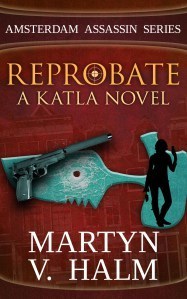
Assassin Katla breaks her own rules when confronted with an unusual witness…
Blessed with an almost non-existent conscience, Katla Sieltjes, expert in disguising homicide, views assassination as an intricate and rewarding occupation. Hidden behind her male alter ego Loki, Katla receives anonymous assignments, negotiates the terms with clients through electronic means, all to protect her identity. Her solitary existence satisfies her until she meets a blind musician whose failure to notice a ‘closed’ sign causes him to wander in on Katla’s crime scene. And Katla breaks one of her most important rules – never leave a living witness.
Reprobate is the first novel in the Amsterdam Assassin Series. With authentic details and fast-paced action, featuring an uncompromising heroine and a supporting cast of unusual characters, Reprobate gives a rare glimpse in the local Dutch culture, information on the famous Dutch capital, the narcotics trade, computer hacking, motorcycle gangs, mehndi bridal tattoos, martial arts, the psychology of social engineering, and the brutal effectiveness of disciplined violence.
This e-book now features a glossary.
So, if you want to support me and help me get noticed, send an email to katlasieltjes@yahoo.com with ‘Reprobate Review copy’ in the subject and tell me what e-reader you use and I’ll send you the Reprobate e-book file attached to the email. You can download the file and upload it to your e-reader. Available files are .mobi, for the Amazon Kindle, and .epub for the Nook, Kobo, Sony, iPad and most smartphones with e-reader compatibility.
Thanks to everyone for your support.



June 23, 2014
REVIEW: Falling Angel by William Hjortsberg
 Falling Angel by William Hjortsberg
My rating: 4 of 5 stars
If a mystery gets mixed with the occult or the supernatural, the result is often disastrous for the ‘willing suspension of disbelief’. Falling Angel is an exception to the rule.
Struggling private investigator Harry Angel is hired by a foreign client, Louis Cyphre, to find Johnny Favorite, a crooner from before the war. Favorite is supposed to stay at a private hospital in upstate New York, where he is treated for ‘shell shock’ sustained in the war, but when Cyphre tries to visit him he gets the runaround.
Angel visits the private hospital, only to learn that Favorite was transferred to the VA hospital in Albany in 1945. The transfer is bogus, but the person responsible turns up dead, so Angel has to dig in Favorite’s past in order to track him down.
Favorite used to hang out with an eclectic crowd—fortune tellers, musicians, voodoo priestesses and occultists—and Angel’s search takes him from the heights of the Upper West Side to the depths of Harlem.
The missing person case turns sour when it looks like Favorite is desperately trying not to be found; desperate enough to kill anyone who might know where to find him.
Angel follows, descending deeper and deeper into Favorite’s sordid past, only to end up knee-deep in corpses and to find his own past connected to Favorite’s in the most unusual fashion.
Not only are all the characters in this mystery finely drawn, the dialogue is quirky and surprising and the Faustian ending brings the mystery to a satisfying conclusion.
This novel was also filmed as Angel Heart, with Mickey Rourke as Harry Angel and Robert De Niro as Louis Cyphre.


June 19, 2014
Stopped Reading REVIEW: A Smudge of Gray – Jonathan Sturak
 A Smudge of Gray: A Novel by Jonathan Sturak
My rating: 2 of 5 stars
I’m conflicted about writing a negative review of this book. I stopped reading, which is usually a 1-star (I didn’t like it) review, but the merits of this book still pushed me towards a 2-star rating (It was OK).
The reason for my conflict is that I dislike the style of Sturak’s writing, but I acknowledge that he has a way with words and that there are almost no mistakes in his prose.
Let me first state what I liked about the book:
The cover is brilliant, I think. Ominous and eye-popping despite the lack of bright colours. Clearly a professional cover.
The blurb is also good. Good, clear prose, and a concise conflict that interested me.
Which is why I’m disappointed in the content of the book itself and stopped reading at the end of chapter 10.
Like I said, Sturak has a way with words, but instead of form following function, function was definitely subservient to form. Sounding a bit too pleased at his ability to write a simile or metaphor, Sturak’s convoluted prose strangles the story like kudzu vines killing a tree by taking away all sunlight.
I read part of the sample before I downloaded the book (for free) and was at first captivated by the prose, but after a while I started to long for the clear, concise prose Sturak used in his blurb.
Make no mistake, Sturak can write. I enjoyed the flowery descriptions: “A subway station bustled, infected with morning commuters.” The images were wonderful, however, the descriptions often tended to run several paragraph and dragged down the pace of the story.
Meanwhile the characters are unsympathetic without fail. Trevor Malloy is an arrogant and sadistic hitman, and his wife Laura is described in loving detail as a ‘housewife, a homemaker and babysitter when the kids weren’t in school’ with ‘a hourglass figure’ with the ‘naive look of an auburn-haired Hollywood star from the 1940s with her simple elegance’ who ‘spoiled her children’ and was in turn ‘spoiled by her husband with a large bankroll, which offered her a life filled with salon trips and a closet filled with designer clothes’. She behaves unsympathetic, complaining that she ‘doesn’t understand why her husband bought a trampoline’ when all the children do ‘is jump on that trampoline the minute they got home’. In all the interaction with the children and her husband she comes across as a whiny insecure hellion.
Brian Boise is an overworked detective who’d rather spend time crawling up the career ladder than with his haranguing wife and non-descript sullen kid constantly complaining about Boise’s lack of attention. His colleagues are rude, obnoxious turds who belittle and ridicule him.
Along with the drawn-out descriptions that reeked of verbal diarrhoea, Sturak has a tendency to talk down to his readers as if they are totally ignorant of the world around them:
Katie and Kevin jumped from the trampoline and ran toward their father at the back patio. Their dad was tall and wore a dark gray suit with black onyx cufflinks securing his French cuffs. He was wheeling a 20″ Travelpro Rollaboard carry-on featuring toughened nylon waterproof ball-bearing inline skate wheels and a Checkpoint-friendly laptop compartment–the ultimate addition to the frequent business traveler. The kids hugged him tenderly, just as two kids did who adored their father.
Like we need the retailer’s description of his luggage and the pointers that the kids adore their father.
Brian lowered his voice as lovers did when they expressed their feelings verbally.
This is a detective trying to convince his wife that it’s a good career move to solve a copycat murder case.
The verbosity extends to the use of alternative speech tags for the simple ‘said/whispered/yelled’, but often missed the ball:
“I want spaghetti!” Kevin shouted.
“I want hot dogs!” his sister contradicted.
To contradict is to deny the truth (of a statement) by asserting the opposite, and hot dogs are not the opposite of spaghetti.
“All you do is jump on (the trampoline) all day long.”
“Not all day, Mom. We have school,” Kevin clarified.
Kevin’s reply is a retort, not a clarification.
One of his gloved hands gripped his proverbial briefcase.
I wondered to what proverb or idiom the briefcase referred, but evidently Sturak means that the briefcase always accompanied the character.
The silhouette of an inert figure holding a briefcase stared at him.
Inert means lacking the ability or strength to move, it’s not a substitute for ‘motionless’.
…, the tingle of adrenaline flowing through his amplified veins.
Amplification is the increase in volume of sound, not an increase in physical volume of matter. Though sometimes used to describe the intensifying of feelings (amplified hearing) or concepts (amplified political unrest), or enlarging upon or adding detail to a story or statement, the widening of veins is not amplification.
The verbose prose also tends to dramatise everyday inanimate objects in a way that irritated me:
On the nightstand, a clock blared “11:57.”
The clock is not making any sound, so blaring is odd.
Without warning, the car propelled on the track, and just like that, chaos ensued.
This is a description of a leaving subway train during normal ‘rush hour’. The departure of a subway train is usually preceded by doors hissing shut and the soft tug when the train starts moving, so it’s not shooting forward ‘without warning’. No ‘chaos ensues’, but rather the normal bustle of a subway station continues.
This time he dropped the cake on the floor. It detonated.
The sponge cake ‘detonates’? Since ‘detonate’ means ‘causing to explode’, the description goes awry. Sponge cake, even if flung at a tile floor, rarely explodes and never causes anything to explode.
The third floor elevators sat in tranquility, but then an abrupt ding sliced through the silence. The shining doors opened as Trevor strolled off.
Quite a dramatic description for an elevator arriving and a passenger getting off.
Large maps of the city were sprawled across the walls.
Sprawling is a horizontal action (sitting, lying, falling), not a vertical one.
(Character opens a top drawer.) Inside, a 9mm pistol, silencer, and ammunition glared at him.
So a pistol stares at him angrily or fiercely? While I concur that a pistol might have a menacing or ominous vibe, glaring requires eyes, something a gun lacks.
I’m sure many readers will probably delight in Sturak’s wordiness, but I couldn’t be bothered to drag myself through garrulous blathering with literary pretensions where I expected a tense thriller.


June 17, 2014
REVIEW: A Bird Without Wings – Roberta Pearce
 A Bird Without Wings by Roberta Pearce
My rating: 4 of 5 stars
Since my noir novelist notoriety is already down the drain after reviewing For Those Who Wait, I might as well review Roberta Pearce’s A Bird Without Wings.
The author was concerned that I would be bored reading her books due to the lack of blood and violence. And disturbed people. However, knowing beforehand that Callie was unlikely to stab Lucius in the eyes or Lucius ending up a spree-killer actually made me focus on their interaction. And I found both Callie and Lucius a lot more engaging than the protagonists of FTWW, mainly because they seemed more ‘fleshed out’.
Callie is a frumpy genius with a crush on her boss, Lucius Ransome, who is called Luscious by the female staff for obvious reasons. Her best friend Rachel learns that Lucius is looking for a researcher into some family history to distract his family while he gets the family’s affairs in order.
Grumpy Lucius hires frumpy Callie, who surprises him by disagreeing with him about a painting, but he doesn’t start noticing her bodacious body after Rachel gives Callie a makeover.
Lucius is always called in to fix the problems of the Ransome family, as he seems to be the only one with some sense. The rest of the family seems obsessed by some ancestral treasure and Callie has to disprove the existence of the Hidden Ransome Treasure while Lucius can fix the problems without his family interfering.
I thought this was a pretty good plot for a romance novel. I admit I haven’t read many, but in comparison with FTWW, where the protagonists aim at preventing a wedding from happening, ABWW is definitely more engaging plot-wise.
Another interesting juxtaposition is that Callie is from a poor background, suffering from self-esteem issues, and focuses on money as important, as people who don’t have any are wont to do. Lucius, however, is born into a rich family and doesn’t think money is that important. Through studying the Ransome family for her research Callie learns the real value of money.
One thing that irked me about Pearce’s prose is her tendency to use alternative speech tags or combining action with speech tags, instead of using beats or standardised speech tags like ‘said/whispered/yelled’. The reason it irked me is that speech tags like ‘she averred’ have tendency to break the spell as I’m reading. The first time I came across ‘averred’ I actually had to look it up, now it’s ‘God, she used that verb again’.
Apart from Pearce’s use of speech tags, the prose flowed well and I stayed up too late reading the last few chapters. Pearce’s has a few instances where her protagonist, who apparently has total mnemonic recall, explains historical facts in a way that skirts exposition but thankfully stays on the interesting side and doesn’t become the dreaded info dump.
The ending was predictable, but well played out.
As to the ending–I disliked the epilogue intensely to the point where I felt it was a blemish on an otherwise well-written and clever novel. Let me explain:
The novel ends with all the issued tied in a neat bow and the protagonist are all set to live happily ever after. Turn the page and there’s an epilogue in the form of a letter Callie sends to a Constance Simms, who turned out to be the second-grade teacher from the beginning of the book. Since I didn’t read the book in one sitting, I had no idea who Simms was again (thank God the ebook has a search function) and I thought the information in the epilogue was wholly unnecessary for the story, except to re-iterate and confirm what the ending already concluded.
My advice to Pearce: Trust you readers and lose the epilogue.
I heard that Pearce’s next novel will include a sociopath in love, so I’m eagerly awaiting an ARC…


REVIEW: For Those Who Wait – Roberta Pearce
 For Those Who Wait by Roberta Pearce
My rating: 3 of 5 stars
At the risk of damaging my noir novelist notoriety, I’m going to say I liked FTWW, but not unequivocally. For one thing, the title was too long. And there was too much romance in it. All these people pining for each other, instead of the fjords, like any Norwegian Blue would…
However, I can’t complain about the romance, because the author herself pleaded with me not to read and review her work. She didn’t want me to risk my alpha male reputation (where do women come up with that tripe?) and she thought I’d be bored out of my skull without at least one dead body.
So there’s this girl Fiona, who pines after the bad boy big brother of her best friend. The BBBB spurns her and marries a girl he knocked up, so he’s doing the honourable thing.
When I complained about this incongruity, the author claimed that I was focused too much on verisimilitude. Apparently I’m not much of a bad boy (hey, I always carried condoms so I wouldn’t be forced into a shotgun wedding). Despite the lack of verisimilitude, I read on.
The book starts at the preparations for a wedding between Mara, Fiona’s middle sister (the protagonist is the eldest of three McKenna sisters) and Fiona’s best friend Will, the younger brother of Bad Boy Noah Wilding (sure, put Wild in his last name, why not?).
Meanwhile, Noah is divorced from the bitch he married, because he found out that he was not the child’s biological father, so the passion between Noah and Fiona is rekindled, although they’re both older and wiser (ha-hum).
Mara is an insecure bitch (or is she just bitchy from having saint-like Fiona for an elder sister?) and Noah and Fiona conspire to break up the wedding to prevent Will from Unhappiness Ever After.
Now, I readily admit my unfamiliarity with the romance genre, so I told the author I would just read the book to comment on the technical aspects. Still, despite my many reservations, I was sucked into the story (or was it because of the torrid sex scenes?). Usually I wouldn’t be interested in the happiness of entitled and affluent beautiful people like Fiona or Noah, but they were so relatable I had to read on and know whether the promised HEA would indeed happen or if the wedding ended up in a massive bloodfest with Fiona snapping and going on a spree killing.
I’m sad to say there was no blood spilled or people maimed. While that was disappointing to me, Roberta Pearce’s readers will probably enjoy the ending of FTWW.
I just segued straight into reading Pearce’s second novel, A Bird Without Wings (another bloody long title).


June 7, 2014
Author Interview: Martyn V. Halm

An interview with the lovely Elaine White…
 Originally posted on Vampires, Crime and Angels...Eclectic Me:
Interview:
~
♐ I find the idea of your MC being the assassin really original. Was Katla always going to be your main character, or did you have someone else in mind? And if she was, why?
.
Well, I have a lot of characters in my head, all clamouring for attention, but Katla was always going to be the protagonist of the Amsterdam Assassin Series. Although Bram, her blind lover, is also a crucial part of the series. I’ve read several books where the assassin was the antagonist, but not many where the assassin is the protagonist. And if the protagonist is an assassin, they are often filled with remorse, unable to get out of the life, fatalistic and nihilistic. Katla is none of that. She really enjoys the autonomy of her work as a corporate troubleshooter arranging ‘fortunate accidents’. And I enjoy helping her find original and creative…
View original 1,739 more words


June 6, 2014
Rogue mishap on Kobo?
To my loyal readers,
Thanks to an alert fan I found out that anyone who downloaded Rogue from Kobo got Reprobate instead. I’m not interested in laying blame. The matter is in the process of being rectified, but to anyone who had the misfortune to buy Rogue from Kobo and receiving the wrong book, please don’t hesitate to contact me for a new version of Rogue.
Cordially,
Martyn.



June 5, 2014
Rewritten: The introduction from my Work-In-Progress:
My work-in-progress is a stand alone noir crime fiction novel called In Pocket. The pitch/blurb:
If only Wolfgang hadn’t picked the pocket of the fat woman…
Nomadic pickpocket Wolfgang gets blackmailed into teaching his craft to the mysterious Lilith, a young woman with no aptitude whatsoever to become a pickpocket. Wolf figures the easiest way is to go with the flow and instruct Lilith in the art of emptying other people’s pockets, but even he could never foresee the dreadful things that follow…
IN POCKET is a standalone novel with ties to Martyn V. Halm’s Amsterdam Assassin Series. Follow Wolf as he gets entangled in a possible fatal web of violence and deceit, where nobody is who they seem to be and everyone has a hidden agenda.
Below is the rewritten beginning of the novel (old version is here), which is written in present tense. The rest of the novel is in past tense, except for the interludes…
The world is strangely tilted when I open my eyes to the deafening roar of the helicopter reverberating against the walls around me. The down draft of the blades stir the loose dirt on the grimy bricks and I shield my eyes again, feeling grit blown against my face. Around me everything remains dark. The helicopter’s search light must be trained on something else. Or someone else.
The wind dies down and the roar changes to a bass-line thumping as the police helicopter flies away. A bit further away, around the corner, I hear a siren starting up, but it sounds like an ambulance, not a police vehicle.
I closed my eyes again. I must’ve passed out. For an instant, I think. Just long enough to lose my bearings. I remember her face, looking up at me. And the hard punches in my belly, now a faint throbbing.
Without opening my eyes, I push myself in an upright position, the bricks damp and cold against my buttocks. My legs feel like they’re asleep, but without tingling—the usual pins-and-needles sensation is mysteriously absent. A bad sign. I think I can forget about running. Or even getting up.
I open my eyes and blink a few times to focus. The wall across from me is less than two meters away. An alley. To my left, a dead end. To my right, plastic garbage bags leaning against an overflowing dumpster. I’m in a cul-de-sac.
The siren grows louder and I lean forward carefully to peek around the dumpster. Sodium lights flood the sidewalk with sickly orange light that reaches into the dead end alley to touch my grubby sneakers. A neon-yellow ambulance races past the mouth of the alley, the sound of the siren fading quickly in the distance.
I go through my pockets to check my possessions, but I seem to have none. Money, gone. Keys, gone. Straight razor—
I look at my pants, dirty and smelling of urine. I look at my hands, dark with street grime. And it all comes back. Why I’m wearing these dirty clothes. My possessions aren’t gone. I left them. I only had my phone and the gun.
They’re both gone.
All I’ve left is the small carton in my inside pocket…
Around the corner I hear muted voices and the crackle of a two-way radio. A moment later I hear a car start up. My right hand grabs one of the plastic garbage bags and a spasm of pain pierces my gut as I heave the bag and toss it next to my legs.
The car halts at the mouth of the alley and the bright search light of a flashlight shines on the opposite wall, then swerves around towards the dumpster that hides me from view. The beam briefly illuminated my grimy pants and the garbage bag hiding my sneakers. The light clicks off and the car trundles away.
I realise I’m still holding my breath and let it out slowly.
I listen, but don’t hear anyone else, just my own raspy breathing. I’m alone.
My left hand touches my belly, comes away wet.
Sticky.
Raise my hand to my eyes, but it’s too dark too see.
I peer past the dumpster again, but all I see is a cobblestone quay and a canal. Not enough information to determine where I am. Just another dead-end alley in the centre of Amsterdam. The street sign is missing. Or was never there at all. Not all dead-end alleys here have names.
I remember the carton in my inside pocket and take the pack of cigarettes. I open the lid and brush my finger over the filter tips. And the metal wheel of the butane lighter. I breathe a sigh of relief. I don’t know what would be worse; no cigarettes, or cigarettes and nothing to light them with.
I shake one from the pack and light up. My hands automatically shield the bright flame to prevent giving away my position.
In the light I count the contents. Seven left, not counting the one I just lit. And a folded piece of tinfoil with the small white envelop beside it. I won’t use that unless the pain becomes too bad.
I glance at my left hand. The sticky stuff covering my palm is red. I lower the lighter to see my belly. The lower half of my shirt is dark with blood. In the weak light the blood looks black. I touch the mess gingerly.
Three holes. Bullet holes.
The lighter sputters and dies. As the flame goes, a ghost-flame shimmers on my retina. I shake the lighter by my ear. Sounds like there is still some fuel left.
I cup the glowing tip in my hand, return the pack and lighter to my inside pocket, and blink to restore my night vision.
A shadow glides over the walls as someone passes the mouth of the alley. I watch from behind the dumpster, unable to draw in my numb legs sprawled amid the refuse that litters the bricks.
The shadow flicks over my pants and disappears from view.
I listen to the receding steps.
I don’t want to be found. Not after what I did…
I drag on my cigarette. No idea what time it is. If I’m still in Amsterdam’s old quarter, I should be able to hear the bells from the myriad of churches. And pinpoint my location.
I take a last drag and extinguish my cigarette against the bricks.
The numbness in my legs worries me. Maybe the bullets hit my spine.
In the distance a church bell chimes.
Once. Twice. Silence.
That sounded like the Oude Kerk, but I’m not sure. If this was the Red Light District it would be busier…
Two strikes.
Two in the morning.
Five hours till dawn.
A whole night to die in.
And muse about the events that got me in this predicament.
If only I hadn’t picked the pocket of the fat woman…
I’d love to hear what you think, so please comment below. Also, before I will look for a publisher or publish In Pocket myself I will need beta-readers to make sure the story is as good as I can get it. So stay tuned!
If you want to read the next sample, wherein Wolfgang targets the Fat Woman and set in motion the chain of events that lead to his predicament, send me an email at katlasieltjes@yahoo.com with ‘password sample?’ in the subject line.



May 29, 2014
REVIEW: Miami Blues by Charles Willeford
 Miami Blues by Charles Willeford
My rating: 5 of 5 stars
I loved this book. The quirky characters, the weird situations, the interaction. Junior Frenger, a freeloading sociopath recently released from prison, arrives in Miami, where he uses his skills at deception and violence to twist situations into his advantage.
Weary police detective Hoke Moseley investigates the carnage in Frenger’s wake and falls victim himself, which leads to hilarious situations.
Strongly recommended to fans of Elmore Leonard and noir crime novels.


Review: Miami Blues by Charles Willeford
Miami Blues by Charles Willeford
My rating: 5 of 5 stars
I loved this book. The quirky characters, the weird situations, the interaction. Junior Frenger, a freeloading sociopath recently released from prison, arrives in Miami, where he uses his skills at deception and violence to twist situations into his advantage.
Weary police detective Hoke Moseley investigates the carnage in Frenger’s wake and falls victim himself, which leads to hilarious situations.
Strongly recommended to fans of Elmore Leonard and noir crime novels.