Peter Nealen's Blog, page 13
April 28, 2021
The Guns of “War to the Knife”
One of the fun aspects to writing the Brannigan’s Blackhearts series is the gun porn. It’s always been a staple of the Action/Adventure genre. I do try for a bit more authenticity than some of the older works in the genre (which will remain nameless), while at the same time avoiding the multi-page descriptions, so as not to bog down the story. Featuring a wide variety of weaponry is still cool, though, which is why I’ve been running this series of posts since the series started.
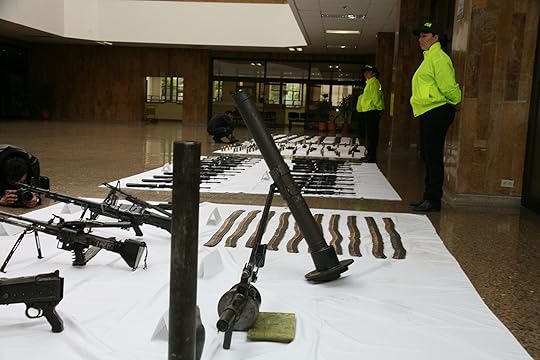
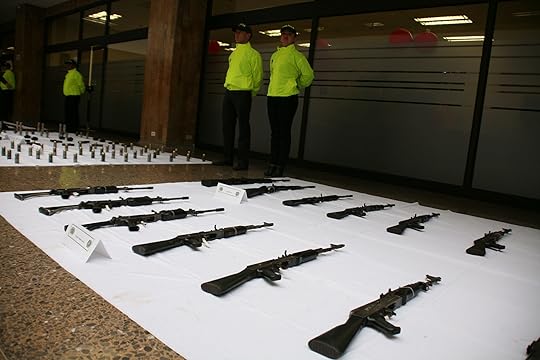
Most of the time, the Blackhearts use a common service weapon in the Area of Operations where they’re working. War to the Knife is no different. Their local contact gets them IWI Galil SARs, which have been an issue service rifle in the National Army of Colombia.
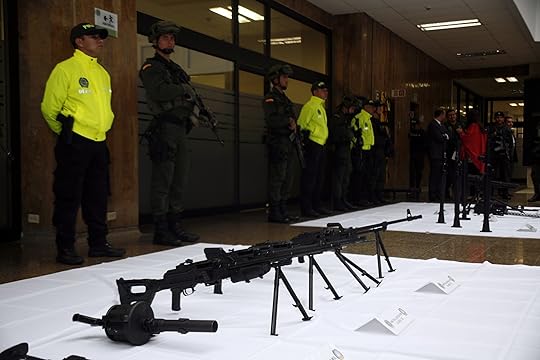
There are also a couple of the 5.56 version of the IWI Negev light machinegun.
And Flanagan gets a chance to use a Galatz sniper rifle.
The Green Shirts, the narco-communists who have taken over San Tabal, carry a mix of weapons based on many carried by the FARC. That means a mix of mostly M16s and AK-47s for rifles (mostly either captured from the Colombians or trafficked in by the Cubans and Venezuelans, or other cartels), M60 and PKM machineguns, and RPG-7s.
And finally, in a Brannigan’s Blackhearts tradition, we have at least one antagonist with a somewhat distinctive sidearm. Diego Galvez, Clemente’s right-hand man, carries an IWI Jericho 941 in 9mm.
Some might notice that there are a lot of Israeli guns in this particular volume. That’s simply because the Israelis sold a lot of weapons in Colombia. I found it slightly surprising, given the partnership that the US has had with Bogota since the days of Pablo Escobar, that the Colombians appear to use more IWI than Colt or FN.
War to the Knife is out on Kindle and Paperback May 18th.
The post The Guns of “War to the Knife” appeared first on American Praetorians.


April 23, 2021
Strategic Assets Hits Audio
The march to get the Maelstrom Rising series on audio continues. Cody knocked it out of the park with Strategic Assets. (Granted, my Polish isn’t great, so I hope his pronunciations are better than mine would be–I trust that they are, given what he did with the Mandarin on Kill Yuan.)
All 10 hours + of Strategic Assets is now available on Audible, Amazon, and iTunes.
They retook Gdansk…
…At a terrible cost for both sides.
Where and when will the next blow fall?
Winter is setting in, and Eastern Europe is hurting. Russians prowl on one side, while the European Defense Council’s forces sit on the German side of the border, strangely quiet. Matt and his team have recovered from the wounds they received in Gdansk, but as low-intensity warfare continues, the question remains:
What is the EDC waiting for?
The Triarii are sure that the same people who launched the war aren’t giving up. They’ve already killed thousands. Power is their only goal, and the EDC won’t simply leave the Americans and Poles in peace. They can’t. Too much blood has already been shed.
So, Matt and his team get a new mission.
Go deep into enemy territory and find out what is happening.
Before the next hammer blow ends the war for good…
If you do like audio, please consider picking these up and reviewing them. They’re not cheap to make, but I’d really like to keep pushing forward with them.
***
Meanwhile, I just finished the first draft of War to the Knife. Still got some editing to do before it goes live on the 18th. Research is in full swing for Area Denial. That one’s set a little farther out, because I have a couple other projects I need to work on before I tackle that one. (Neither one of which I can really talk about yet.)
Busy as always.
The post Strategic Assets Hits Audio appeared first on American Praetorians.
April 13, 2021
SOBs – No Sanctuary
So, since I’m currently hard at work getting War to the Knife finished, I’ve resumed the SOBs readthrough. I’m a bit behind–I got sidetracked last year. So, we’re picking back up at Soldiers of Barrabas #13 – No Sanctuary. (Yes, I realize that I haven’t reviewed the last three. I’ll have to go back and refresh on Vultures of the Horn, Agile Retrieval, and Jihad.)
(For those unfamiliar, the Brannigan’s Blackhearts series was conceived in late 2017 as a sort of spiritual successor to the Soldiers of Barrabas. While Able Team, Phoenix Force, and their joint operations in Stony Man are perhaps better-known, the SOBs caught my imagination a bit more immediately. They’re grittier and a bit more grounded. The first one, The Barrabas Run, is basically a poor man’s Dogs of War.)
The SOBs, like the Blackhearts, tend to take deniable missions from the US government, funneled to them by a walking mountain of a man named Walker Jessup. (Jessup has had to get involved a couple of times, always to his chagrin; he likes food a lot more than fighting.) But No Sanctuary is more of a personal story. Because Liam O’Toole’s past has come back to haunt him.
O’Toole was an IRA fighter in his youth, before he left, emigrated to the US, joined the Army, and became a Special Forces soldier in Vietnam. After Vietnam, he became a mercenary, and has been Nile Barrabas’ right hand for the previous twelve books.
Except that he recently got married, retired from the merc life, and has now taken his bride on vacation to Ireland. Ireland in the early ’80s, when the Troubles were still going strong.
And the IRA doesn’t forgive or forget.
This is not the strongest entry in the series, if we’re being honest. It does touch on the mutual savagery of the Troubles in Northern Ireland. And a common thread in O’Toole’s story from the beginning illustrates another element to the Troubles–not everyone rallied behind either flag. O’Toole’s mother disowned him as soon as she found out that he’d joined the IRA. And she’s refused to acknowledge a son named Liam ever since.
But while it does touch on the real-world stuff, it’s a more personal story than that, revolving around Liam, his history, and the rescue mission that the SOBs launch when he’s betrayed and goes missing in Belfast.
The story is…workmanlike. It’s not bad, but it didn’t quite grab me the way some of the others have. Beck and Nanos are even more over the top than usual, and it’s kind of an annoying distraction. Seamus Killerby, the main villain, chews the scenery more than I think most of the SOBs villains have in the past.
Overall, it’s decent, and it’s set in a war that’s largely forgotten outside of Ireland these days.
The post SOBs – No Sanctuary appeared first on American Praetorians.
February 26, 2021
Rolling the Dice – Thunder Run is Live Today!
Thunder Run has officially gone live on Kindle!
Everything in Europe will change after this. Whether for the better or worse? That remains to be seen…
Europe teeters on the brink…
…As all sides consider their next move
But can one more blow really end the war?
The European Defense Council’s doomsday strike has been averted. More American forces have reached Poland. And the Russians are starting to turn up the pressure in the Baltic.
Now, as the EDC’s irregular campaigns ramp up, a decision has to be made.
Matt’s team will be back on the tip of the spear, regardless of the plan. But as forces start to move, and the leadership starts to outline their plan, the less he likes it. It sounds like wishful thinking to him.
But he’s a Triarii team leader. He’ll always answer the call.
Still, the questions remain.
Does victory lie at the end?
Or a situation made much, much worse?
Get it here. And if you liked it, please consider leaving a rating or review.
The post Rolling the Dice – Thunder Run is Live Today! appeared first on American Praetorians.
February 23, 2021
Thunder Run Chapter 3
A week and a half later, I walked into our TOC in Fort Grodzisko.
The bunker hadn’t gotten much warmer since the winter, though it had gotten brighter, as more work lights were brought in. We still did some planning and intel collection on computers, but given how fast and how nasty the cyber war had gotten—not to mention how often power grids were being targeted, on both sides of the Atlantic—we used paper maps, whiteboards, and as much analog stuff as we could. And those needed light.
Brian Hartrick was waiting in the “Grex Luporum Corner,” along with Shane Tucker and Bobby Burkhart, the other two Grex Luporum team leaders in country. There weren’t a lot of us, and we were in high demand in the States—and there were whispers about new ops in the Western Pacific, though those were extremely hush-hush at the moment—so Shane, Bobby, and I were it for the moment.
We were also all understrength. We’d taken losses over the last few months since all this started. None of our ten-man teams were sitting at more than eight bodies.
“You made it.” Hartrick’s sardonic tone always sounded like he wasn’t sure if what he was saying was a good thing or a bad thing, especially when it was, on its face, a good thing.
“You make that sound like you weren’t sure it was going to happen.” I shook Tucker’s hand and nodded to Burkhart.
Hartrick sighed and shrugged. He always looked slightly angry—and he often was—but I’d known him for too many years to be put off by his permanent scowl. I’ve got something of a “resting mad dog face” myself. Hartrick had been on the cadre that had seen me make it into the Grex Luporum Teams despite lacking the SOF experience, and then had been my first team leader.
“Things are getting a little crazy. Between the Russians pushing the border, Poznań and Łódź practically at a standstill from ‘spontaneous demonstrations,’ and IEDs going off around Warsaw and Kraków, I’m not taking anything for granted.” Hartrick’s Polish was getting a little better, though mostly when he wasn’t paying attention—he’d angrily stated his indifference after stumbling over words a couple of times—but his pronunciation of the place names was noticeably better than it had been.
“More IEDs?” I’d been out of the bigger loop for the last few weeks—we’d gotten some news in Braniewo, but we had mostly been too busy to pay much attention.
Hartrick nodded. “Three in the last couple of days. Nobody’s claimed credit, which just means Malinowski’s list of usual suspects is longer than usual.” The Polish commander we’d worked with since the battles before Gdansk wasn’t exactly mellowing as the war went on. General Reeves, commanding the Army’s 7th BCT, was getting vocally concerned about some of Malinowski’s suspicions. His net was getting wider and wider as the months dragged on, and the unconventional, non-martial part of the war got nastier. Reeves was worried that he was going to start suspecting the Americans of playing some part in the unrest and growing chaos in his country soon.
Given some of the stupidity I’d heard coming from a few of the politicians in DC when they’d weighed in on the war, the few times we’d gotten news from home, I couldn’t say I’d necessarily blame him if he did.
“So, is that why you pulled us back?” I glanced at the map over Hartrick’s shoulder. “Got some ‘special’ HVTs for us?”
“Not quite.” He grimaced again. “It was at Reeves’ request; he wants all of the special units ready to prep for something big. He won’t say what—in fact, I doubt he knows yet. He’s about to play second fiddle, once The Big Red One finishes mustering.”
I sighed. “So, they did send a bigger fish to take over, then.”
He nodded, his scowl deepening. “Yeah.”
I looked at him sharply, then traded glances with Shane and Bobby. “That doesn’t sound good.”
“It ain’t.” He looked up at the door as it opened. “I’ll let Oscar fill you in.”
We all followed his gaze toward the front door. Oscar Gutierrez was the Triarii infantry commander in Europe. A former Marine Colonel, he still looked the part. Tall, silver-haired, and clean-shaven, he looked far more patrician than us scruffy Grex Luporum guys. His greens were rumpled, and he hadn’t put the patch on his shoulder—none of us were wearing them at the moment, either—but he didn’t look nearly as hangdog as I might have expected him to.
Gutierrez had to deal with both the Polish and American leadership. And we’d been having issues with the American officer corps since before Gdansk. I could only imagine how bad it was about to get, when Reeves was about to be outranked.
“I don’t suppose any of you have heard of General Amy Sellar?” Gutierrez had better hearing than any of us. His earpro must have worked better when he’d been in the military. Either that, or he’d started wearing hearing aids so he could overhear us when we were talking trash in the TOC.
“I vaguely remember something, but I don’t think it was particularly good.” Tucker was frowning as he thought. “Something along the lines of ‘Damn, I’m glad I got out.’”
“That sounds about right.” Gutierrez waved at Modine, who was working on something on the other side of the TOC as he joined us. “She’s the definition of ‘politician in uniform.’ And guess who’s now the ranking US Army officer in Poland.”
“Great.” I honestly didn’t see it as more than just one more annoyance. We’d butted heads with Reeves for weeks before Gdansk, and he’d still been something of a pain in the ass—if less so—afterward. “So, what? She wants to see everybody in formation before we do anything else?” I’d certainly heard weirder and dumber stuff from officers and Senior NCOs in warzones.
“I’m afraid it’s a bit worse than that.” Gutierrez put the folder he’d been carrying down on the table and leaned on it, looking around at all of us. “We’re standing down for the next week, while courses of action are determined.”
I frowned. Pulling the team back from Braniewo had made sense. There was a lot to do, and only so many of us to go around to do it. Regular Triarii infantry sections were doing a lot of the same stuff, breaking up into squads to embed with Polish Territorial Defense and acting as recon assets for some of the regular Wojska Lądowe units on the German and Czech borders. But to stand down altogether?
“Boss, that is not a good idea. We just came from the Kaliningrad border, and things are getting sporty there. And from what Brian tells me, things on the EDC side are just as dicey. There’s a lot of training, coordination, and network-building to do. Most of the early warning comms nets aren’t built yet. Never mind the react forces in a lot of these places.” I folded my arms. “I’m not saying the Poles can’t handle it on their own, but at this point, every pair of hands helps.”
“I know that, Matt.” Gutierrez looked tired. “I do. Hell, so does Reeves. But, well… The Army didn’t come alone.”
Something about the way he said that made the three of us frown. Hartrick just stared at the table, as if he’d already gone numb.
Gutierrez sighed. “The first ones off the boat weren’t Army or Marines. They were the negotiating team from the State Department.”
I stared at him. Tucker was pinching the bridge of his nose between his fingers. Burkhart was kind of staring with his mouth open, as if that was the dumbest thing he’d ever heard. Hartrick just looked thunderous. “What are they planning on negotiating?” I was a little proud of myself that I didn’t launch into an epic stream of profanity.
Gutierrez’s mouth tightened into a thin line. “’Plans for a cease-fire with the EDC over the next month, hopefully leading to a permanent peace.’” He was clearly quoting State’s boilerplate.
I snorted. “And what position do they really think we’re in to negotiate from? We’ve barely held onto Poland. Unless they’re really here to negotiate our surrender?”
“Fuck that.” Tucker looked and sounded like he wanted to spit on the floor.
“Oh, they’re insisting that’s not the case, of course.” Gutierrez sounded simultaneously tired and disgusted. “It’s all the usual bullshit. This was all thanks to a ‘misunderstanding,’ military stupidity, Polish runaway nationalism, blah, blah, blah, fucking blah.” I had to raise an eyebrow at that; Gutierrez was obviously getting strung out. He didn’t usually get so close to losing his cool. That was our bailiwick. “They’re insisting that they can smooth the waters, if the Polish and US military knuckle-draggers just get out of the way and let them talk to their ‘enlightened’ peers over in the EDC.”
“Do they not understand what’s actually been going on over here? Do they have no idea where the fuck they are?” Burkhart had lost the dumb, shocked expression, and was starting to get mad.
“Of course they don’t. They’re smarter than we are, remember?” Gutierrez shook his head. “They’re so smart, that they automatically know that the people on the ground, experiencing the war firsthand, are wrong. It never fails.” He looked up and around at us. “However, that’s just one plan. There are currently three.”
He started to tick off on his fingers. “State wants a total stand-down while they open communications with the EDC and begin peace talks. They still haven’t explained just how they think they’re going to have the leverage to do that. We’re hanging on by our fingernails, at the end of one hell of a long and spiderweb-thin supply line, with enemies to east and west. Meanwhile, between the coup attempt in Germany and the French nuclear arsenal going up in smoke, things aren’t exactly stable in the EDC sphere of influence at the moment, and negotiating with us just might signal weakness at a time that nobody on that side of the line can afford to.
“Option two is our plan, effectively ‘Polish Fortress Doctrine.’ We’ve already made some good progress, and Warsaw is mostly onboard with it. Hell, the Territorial Defense Brigades were already a building block toward something of that nature—we’ve just expanded it.” We had. It had started to some extent in the States, even before the cyber-attack. The growing disorder had necessitated some work on what had euphemistically been called “anti-fragility.” This had involved a combination of building community watches, training, and developing localized infrastructure that wasn’t as prone to grid or supply-chain failure. We’d simply been carrying a lot of that over to Poland, particularly in the border zones. It was shaping up to be a long war. “The obvious follow-up to that being guerrilla war in Germany and France, which will necessitate contact with some of the Bavarian groups and Nouveau Gallia.” He snorted. “Believe me, State is just thrilled with that idea.”
I could imagine. The Bavarian groups—the oldest of which had their roots in the actual region of Bavaria—were a bit of an oddity in Germany. They were the closest to what we Americans might call “conservative.” Focused more on independence and stability, they rejected most of the politics floating around Germany, of both the left and right variety. They seemed to be a little like the Triarii, but what little contact there had been hadn’t been particularly warm—they seemed like a prickly bunch.
That only made them worse in the eyes of the bureaucrats and diplomats at State. To them, anyone who ascribed to the ideology of “get lost and leave me alone” was the next thing to a full-blown, goose-stepping Nazi.
Try to parse that out.
And the less said about Nouveau Gallia, the better, as far as State was concerned. After all, they were an actual secessionist organization that had already seized control of Narbonne and several smaller cities around it, and furthermore, had held it against EDC and Armee de Terre assault. State really didn’t like them, almost as much as they disliked us.
“Then there’s the third option, which seems to be the most likely to be adopted, since General Sellar is pushing it, and she appears to have the most political capital to work with.” He didn’t look like he really wanted to say what it was; there was a pained expression on his face. “That plan is a fast offensive across Germany to Brussels, in order to oust the European Defense Council, and then set up a replacement council that Washington believes will be more ‘reasonable.’”
There was a moment of silence. “I mean, on its face, that doesn’t sound like that unreasonable a plan.” I was almost hesitant to say it. “On its face.” My eyes narrowed as Gutierrez took a deep breath without looking at me. “I mean, trying to do a full-blown ‘nation-building’ effort under these circumstances is simply impossible. But… Why do I suddenly get this awful feeling that there’s a lot of dumb underneath the prima facie reasonable strategy?”
“Probably because you’ve developed a sixth sense for this kind of fuckery, Matt.” Gutierrez lifted his head. “We all have. We probably wouldn’t be Triarii otherwise.” He sighed. “The catch is that they want to do it on a short timeline, with what we’ve got available. The old, ‘You go to war with the army you have, not the army you want’ quote has been getting thrown around a lot.”
“They want to invade Germany, then France, with three divisions and a brigade minus?” Tucker was thunderstruck. “We threw twice that onto two beaches at Normandy, and that was just to gain a foothold.”
“Ah, but that was before the high-technology future.” Gutierrez couldn’t keep the sarcasm out of his voice. “Between the force multiplying factors of modern weapons and the current disarray in EDC-controlled Europe, we should be able to penetrate through to capture the EDC with a single, fast-moving spearhead.” He rubbed his temple as if he was getting a headache. “At least, that’s their logic. The Expeditionary Force G3, Colonel Isaacs, is a scrappy bastard, and he’s pushing this plan hard. Trouble is, much like the majority of them, he’s got no combat experience. He was at TRADOC all through Kosovo.”
“I’m still not sure I’m following this. I might just be biased.” Burkhart held up a hand, his brow furrowed in thought. “They want to drive through to Brussels with three divisions and the bulk of 7th BCT? I presume that they’re planning on using us and the 10th Group guys to run around in the rear areas raising hell to keep the bad guys off them while they advance?”
I glanced at Hartrick. His expression, while never what I’d call cheerful, was not promising. “Not really. ‘We’ll be moving too fast,’ was what Isaacs said.” He leaned heavily on the table, looking down at the map without seeing it. “He even brought up the old Soviet ‘Seven Days to the River Rhine’ plan, and the run on Baghdad in ’03.”
“And we all know how well that worked out.” Hartrick had held back so far, but he couldn’t keep that snarl back.
“Wait. Wasn’t the Soviet invasion supposed to start in East Germany, not Poland?” Tucker was rubbing his eyes. I think we were all developing a headache at that point. “And I’m pretty sure the Red Army was going to be throwing a lot more than three divisions on a shoestring supply chain into the mix.”
“Correct on all points.” Gutierrez took another deep breath. “Look, gents, as bad as I’m making this sound, right now it’s not set in stone. Reeves and Malinowski are pushing back hard.” He chuckled bleakly. “I think Reeves came within about an inch of getting court-martialed the other day. He was getting heated.”
“Really? General Reeves thinks this is a stupid idea? To the point that he’d jeopardize his career?” I knew that Reeves had turned around a little since he’d stubbornly refused to accept the intel that we’d brought from Germany without drone corroboration. That refusal had almost cost us Gdansk and the whole war. He’d been emblematic of the high-tech, highly political nature of the current US Army.
“Reeves is almost a different man these days.” Gutierrez smiled a little, though the expression didn’t have much humor in it. “He’s still kind of an officious asshole, but he also grasps the situation better than the newcomers, and he doesn’t want to see his people cut off and slaughtered in central Germany. Trouble is, the big brains in the 3 shops are only looking at the Euro Defense Corps in a purely conventional light. They see how much strength has been drawn off to face Nouveau Gallia, not to mention all the other little outbreaks we keep hearing about in Slovakia, Czech Republic, Catalonia, and even Bavaria. Between the Corps being spread thin and already taking a hammering when we retook Gdansk, they think they’ve got a chance to just race through and get to Brussels before the EDC can muster a solid defense.”
“I mean, it’s possible.” I had to admit that much. “But it ain’t what I’d call probable. It’s a best-case scenario. And you never plan best-case scenarios when it comes to war plans.”
Hartrick snorted. “You haven’t been paying enough attention, Matt. We’ve been doing that for at least the last fifty years. Probably more.”
“More.” Gutierrez nodded. “The Civil War was supposed to be over by Christmas, 1860. There were picnickers out on the grass at First Bull Run, there to watch the war start and end.”
“So.” I crossed my arms. “How much does the Russians’ push in the east have to do with this rush job?”
“A lot. She doesn’t want to admit it, but I think that Sellar is more afraid of the Russians than the EDC. So are her masters. They want this over with as quickly as possible.” Gutierrez shrugged. “In a way, they’re not wrong. The US isn’t exactly in good shape to fight a world war right now.”
“What was that about, ‘You go to war with the army you have, not the army you want?’” I wanted to spit, myself. “Except you figure out how to fight the war to win it, not do stupid shit because you’re afraid of it going on longer than a month.”
“So, what are we doing?” Tucker tried to get the conversation back on track.
“Right at the moment, we’re standing by. Sellar wants the Triarii stood down completely, but that ain’t gonna happen.” Gutierrez put a folder down on the table. “But I do have a potential series of missions for Grex Luporum teams outside the country, so that’s why I’ve pulled you boys back.
“We don’t know which option we’re going to be stuck with, but the official US government’s people are pushing for either One or Three. And we’ve got to be prepared for any of the three of them.” His expression got bleak. “In the interests of being ready for Option Three, I’ve got three future European Defense Councilors for you boys to go retrieve and get to safety, pending an offensive to topple the existing EDC.”
Thunder Run is live on Kindle on Friday, and available in Paperback now.
The post Thunder Run Chapter 3 appeared first on American Praetorians.
February 16, 2021
Thunder Run Chapter 2
The Territorial Defense troops were piling out of the Star 266 trucks where they’d pulled over on the side of the road, and the first couple of squads had already started to spread out into the woods as Chris and I rejoined Scott and the rest of the team. Scott and Arkadiusz had already deconflicted and linked up with the Poles. The two of them were standing near the lead truck, talking to Jaskolski while Reuben guided the Light Infantry point elements into the woods. It would not be a good thing if they stumbled on us in the dark and the wrong people got shot.
I glanced over the men and women spreading out into the trees. They were better equipped than the raid force had been, but that wasn’t saying a lot. Load bearing vests worn over bulky, early 2000s era body armor turned even the fittest soldier into a lumbering pear shape, and not all these boys and girls were lean and mean studs to begin with. They at least had night vision, monoculars mounted on old MICH helmets. The Territorial Defense Brigades had gotten a lot of the Wojska Lądowe’s old FB Beryl 5.56 AKs, as the regular Land Forces had switched to the Grot Cs.
But while their equipment was a bit better than the bare-bones 1960s stuff the raiders had been using, their training wasn’t great. Even as I watched, I saw a lot of them bunching up near the trees, and their small unit leaders were being awfully loud getting them sorted out.
The two of us walked across the narrow field, raising our NVGs so as to avoid getting whited out by the glare of the headlights, and joined Scott, Arkadiusz, and Jaskolski at the lead truck.
Jaskolski was dressed and equipped just like the rest of the Territorial Defense troops, though he had a PM-84 submachinegun slung in front of him instead of an FB Beryl rifle. Arkadiusz was still in his Wojska Lądowe cammies with his MSBS Grot C rifle and monocular NVGs, but otherwise was dressed and equipped a lot like we were. We’d run as light as possible. No body armor, NVGs on skullcap mounts, and only carrying ammo, comms, minimal med gear, and water on load bearing vests under the ghillie hoodovers we’d brought through Slovakia all those months before.
It felt like a small lifetime ago.
“Lech.” I stuck out my hand and he shook it. “Glad you got here so fast.”
“Mateusz.” Jaskolski was tall and lanky, and about ten years older than one might expect for a man of his rank. His English was about as fluent as my Polish, so aside from greetings and some basic small talk, we usually conversed through Arkadiusz. We also used first names, because as Triarii, we didn’t really have ranks, and Jaskolski was old enough and flexible enough that he just rolled with it.
He rattled off a string of Polish, and Arkadiusz nodded and turned to me. For all his stocky build, oft-broken nose, and pugnacious attitude, in the light Arkadiusz looked like a kid. He wasn’t; he’d been in combat in Kosovo. But he had a baby face that he tried to offset with a short, neatly trimmed beard. “He was waiting for this. After what happened in Pęciszewo, we were all expecting it to happen again.”
Jaskolski pointed as he spoke again. I caught a little bit of it, but not enough. “We will spread out and sweep the woods from here to the border. One squad from Fourth Platoon will move out onto the eastern flank, to make sure they did not slip past.”
I nodded. “We’ll stick with you, unless you want us to push up ahead.”
But Jaskolski shook his head when Arkadiusz translated. “No. You come with me.” He might not have been particularly fluent at English, but he still tried from time to time.
“Fair enough.” I wasn’t going to say so, and I knew that Jaskolski wouldn’t either, but none of us quite trusted the Territorial Defense troops’ target discrimination. Unfamiliar shapes in ghillie hoodovers in the dark could very well draw fire.
I keyed my radio. “Golf Lima Ten, Deacon. Hold what you’ve got. Once the Tango Delta boys and girls are deployed, we’ll join the sweep.”
“Great.” That would be David. “I’ve got time for a nap, then.”
***
We had just started moving when the Russian helicopters showed up.
Jaskolski, Arkadiusz, and I were just under the eaves of the woods, so we heard them first. I stepped out from under a tree, scanning the sky above the treetops with my PS-31s. I picked up the dark dots against the sky pretty quickly, especially since they weren’t running blacked out. That made some sense, considering the game they were playing. They were only moving to counteract “instability” on the Polish side of the line, after all. They totally weren’t flexing for an invasion or otherwise intruding on sovereign territory.
Never mind that that had already happened. Those saps we’d killed under the trees were expendable, after all. Pawns in the game.
As they got closer, I could start to make out shapes. No attack helicopters this time, though they’d flown Hinds and even a couple of Ka-52 Alligators along the border recently. No, this was a four-ship flight of Mi-38s. The massive replacement for the aging Mi-17 could carry thirty troops. That meant if this went sideways, our eight Triarii and sixty-two Poles were going to be facing a hundred twenty Russian regulars. Not to mention any irregulars who’d survived our ambush.
Jaskolski was on the radio. Arkadiusz translated without prompting. “They are already being lit up by air defense radars, and they are being challenged over the radio not to enter Polish airspace.”
I just kept watching as the four helos banked aside from the border and started to circle above the strip of woods that stood along the demarcation line between Poland and Kaliningrad Oblast. So, they weren’t going to cross the line yet.
Arkadiusz listened, his head cocked, as we kept advancing along the woods toward where we’d made contact with the irregular intruders. I glanced at him, and even through the faint fuzziness of my NVGs at that distance, I could see him grimace. “And there is a motor rifle company right on the other side of the border checkpoint.”
“Of course there is.” I turned my eyes back up toward the helos. They had flared, slowed, and started to descend. “Have they answered the radio at all?”
“I don’t know.” Arkadiusz looked over at Jaskolski, who had finished on the radio, and stepped it out, his stride lengthening as he headed toward the border. We hurried to keep up, as Jaskolski switched channels and started barking orders over the radio.
“It sounds like they are saying that they have reports of firefights near the border, and so they are ‘securing’ the border while ‘offering assistance’ to us if we need it.” I didn’t need to see Arkadiusz’s face to tell what he thought about that. And I agreed. It wasn’t exactly a new gambit. Start trouble while your own forces are conveniently staged within close proximity, and then move in to “restore order.”
I kept watching the helicopters as we continued alongside the woodline. They were definitely coming in to land. “Looks like they’re touching down about a mile north of us, on the other side of that strip of woods on the Russian side of the border.”
Jaskolski looked over at me, and Arkadiusz translated. He nodded tightly. “They will deploy and move right up to the border,” Arkadiusz said as Jaskolski’s orders started to get passed, shouted through the woods. The pace picked up.
“Or over it.” While Jaskolski had picked up the pace again, none of us were having any trouble keeping up. We were in better shape and carrying lighter loads than the Territorial Defense boys and girls. “If that happens…”
“Then we are between the hammer and the anvil, my friend.” Arkadiusz wasn’t translating; I wasn’t even sure that Jaskolski had heard me, absorbed in the task of controlling his two platoons spread across half a mile of woods. I couldn’t disagree with him, though. Even with three new divisions landing in Gdansk, between the Americans, the Poles, and the Slovak and Hungarian volunteers, nobody on our side was in any position to fight a two-front war. The Russian Army might not be on par with the old Red Army, but it was still more than we could handle, especially when facing the European Defense Council and their cronies in the west at the same time.
The helos had vanished behind the trees, though I could still hear their rotors turning. They were technically in Russian territory, so they weren’t going to drop the troops and pop smoke. Which might be a good sign, or a bad one.
If the Russians were looking for an incident…
We pushed through the woods, hurrying to get into position ahead of the Russians. I hadn’t said anything to Jaskolski about getting to the bodies before the Russians could—there was a fence between Poland and Kaliningrad, but it wasn’t tall nor particularly hard to breach. And if the bad guys we’d shot had already breached it, it wouldn’t be hard for the Russians to claim that it had been cut before they’d gotten there. Hell, it wouldn’t surprise me if they’d had somebody shoot things up in Mamonovo, just to provide a little bit more justification. After all, if the Poles were letting disorder spill over into Russian territory, then the Russians would have to do something about it.
If that sounds far-fetched, just remember that the FSB, as it was called at the time, bombed an apartment complex in Dagestan to justify the Second Chechen War.
Jaskolski had started to lag behind the line. Not because he was winded, but just because he was trying to keep track of three or four radio channels at once. He noticed, and stretched his long legs out again to catch up.
We swept up the line of woods toward the border, the Territorial Defense troops managing to maintain a fairly straight skirmish line, though it wobbled a bit. I could still hear the Mi-38s on the other side of the line, but nothing had gone boom yet, and it didn’t sound like the Motor Rifles lurking near the border checkpoint had opted to open the ball, either.
We might still manage to keep this tamped down. Unless Ivan was dead set on creating a “security buffer zone” in eastern Poland tonight.
After another hundred yards, I started to push back into the woods. Jaskolski and Arkadiusz trailed me after Arkadiusz murmured something to Jaskolski, probably telling him that we were just about even with the ambush site.
Scott and Chris had joined me, most of the rest of the team having spread out among the Territorial Defense troops. Part of our reason for being out there was to do a bit of Foreign Internal Defense, helping bolster the locals’ training and stiffen up that flank in between missions.
It had been a couple of months since one of the hairiest missions I’d ever been on in my life. Flying deep into France to take out a chunk of the French nuclear arsenal—currently under EDC control, and therefore a clear and present danger, especially as the EDC had started rattling that saber following the failed coup in Germany—wasn’t something most men got to say they’d done. And Hartrick and Gutierrez had tried to get us some lighter work to keep us from burning out. The comedown from that mission had been a bear.
But we were one of currently three Grex Luporum teams in country, and there was a lot of work. The war wasn’t going away anytime soon. This was a few weeks of relative down time, but we’d be back into the really dangerous stuff soon.
So, of course, our “down time” meant trying to keep a second front from opening up. A front that we couldn’t win.
We were getting close, so I slowed down, scanning the forest floor as carefully as I was scanning the trees for signs of the enemy. I doubted that our erstwhile adversaries had had the guts to come back; the Poles were making plenty of noise that would warn them off. They’d already been hammered by someone they couldn’t see, and now reinforcements were on the ground. If they’d run from us, I doubted they were going to come back and tangle with a much larger force.
But what those regulars were going to do was another question.
There. I moved toward the dark lump at the base of a tree. One of the dead irregulars was sprawled on his face, one arm underneath his body, the other just kind of out to one side. It was impossible to see the blood on his dark cammies in the grayscale white phosphor image, but he wasn’t moving.
Jaskolski and Arkadiusz joined me. The Territorial Defense soldiers to either side of us slowed as we stopped, but Jaskolski waved them forward, barking an order at their squad leader, who chivvied his charges forward. Jaskolski wanted guns up on the border.
He turned the body over with a boot, and pulled a light off his belt. I flinched a little as he turned it on, but we weren’t exactly being covert at this point.
He played the light over the body as I flipped my NVGs up so they wouldn’t get whited out. The man had taken two rounds, one to the body and the other to the throat. His front was doused in blood, and his face was already gray.
He was wearing plain green, with an ancient Russian AK chest rig and an AK-74 lay next to him with no sling. The chest rig only carried three mags, which were now covered in pine needles and leaves, glued to the Bakelite with drying blood.
His sleeves were partially rolled up, revealing the extensive tattoos on his forearms. More crawled up his neck. Jaskolski bent to examine them, then snorted as he stood. “Chernyye Volki. Black Wolves.” Sarcasm dripped from his voice as he looked at me and rolled his eyes. “Original.”
That had been for my ears, I was sure, since he’d spoken English.
“Nobody ever said Russian thugs were all that inventive.” I spat. “Night Wolves, Black Wolves, whatever. Confirms what we suspected.” The Russians were being somewhat sneaky. Send the gangsters across, let them cause trouble, then move in in the aftermath.
I suddenly had an idea. “Have you got litters in the trucks?”
Arkadiusz was already nodding as he asked Jaskolski. The Porucznik frowned at first as he answered in the affirmative.
“Let’s grab a few of your people and move these bodies out. Take ‘em back to Braniewo. Take pictures of the identifying tattoos and make them public.” I shrugged. “Hell, put the bodies on display, if it works. Spread the photos around as much as possible. Make it obvious to everybody that the Russians were behind it.”
Jaskolski thought about it for a second, and started to nod, but then a radio call crackled. Arkadiusz tilted his head to listen, but Jaskolski was already hustling toward the border, snapping a quick bit of Polish over his shoulder.
That much I caught. The lead elements had reached the fence, and the Russians were already there.
We ran through the woods. I was moving a bit better than the Poles; I could see better. I got up to the fence a few yards ahead of Jaskolski and Arkadiusz.
It was a Mexican standoff. The raiders had cut the fence. There was a gap in the wire about two yards across. And a full squad of Russian Army infantry was deployed right on the other side, mostly down on a knee behind trees, weapons held ready. The Poles were similarly set up, though one of Jaskolski’s platoon leaders was standing in the open, facing the gap in the wire, barely ten yards from the nearest Russian soldier.
At a glance, the two forces didn’t look that different. In the dark, even the Russians AK-12s and the Poles’ FB Beryls looked almost the same. But there was a lot of history and a lot of hate packed into that little patch of woods, and a whole lot of deadly consequences if somebody opened fire.
I’d probably have been more comfortable playing with matches in a warehouse full of nitroglycerine.
I said a quick prayer to God and St. Michael that we all got through this in one piece.
***
Jaskolski and the Russian company commander started to talk, using terps, across the line. I sent Arkadiusz up to listen in, but pulled the rest of the team back into the shadows, to watch and wait.
“Shouldn’t we be up there?” Jordan had gotten surprisingly eager on this mission. Ordinarily, his cynicism and the tank-sized chip on his shoulder made him standoffish and suspicious—sometimes even within the team. And he’d run into enough stares from the Poles in the rural areas that his sensitivity to racism—which he’d come by honestly, thanks to an American chapter of the Fourth Reich—had been flaring up pretty badly in recent months. But between getting back to his Special Forces, Unconventional Warfare roots with the Territorial Defense Brigade, and the friendship he’d formed with a young man who’d been helping out on the fort in Gdansk, a half-Pole, half-Nigerian whose loyalty and culture were all Polish, seemed to be mellowing him out some.
It was about time.
“It’s a tossup.” Scott fielded the question before I could. A former Recon Marine, Scott was our team diplomat as well as my right hand. He was also better read than I was, and I read a lot. “It might settle things to let the Russkies know that Americans are watching, but on the other hand, they know who Triarii are, and it might only throw gas on the flames.”
That was a sticking point to our presence and operations in Europe. The Triarii was a paramilitary NGO started by Colonel Joaquin Santiago several years before, as unrest tore at the fabric of the United States and the nastiest irregular war in the world encroached across the border and crept north, while the politicians decided that their petty grievances were more important.
But we were just that—irregulars. As a Non-Governmental Organization, we weren’t going to be recognized on the ground as formal representatives of the US Government, because we weren’t. After the open attacks on US peacekeeping forces in Slovakia, we’d been granted a Letter of Marque and Reprisal to prosecute the war in the name of the United States, but we were still auxiliaries—even though that term hadn’t been openly used yet. We worked hand-in-glove with the Army and the Marine Corps most of the time, but if the Russians wanted to call us mercenaries, they’d technically have a leg to stand on.
Either way, having Americans, and American mercenaries at that, on the ground in Poland probably wasn’t going to calm things down. It could, if the Russians decided that having the Americans turn our baleful eye on Kaliningrad, especially with the USS Abraham Lincoln and her Carrier Strike Group sitting right off the coast in the Baltic, was a bad call. But American might wasn’t what it once had been. The evidence for that was all around us, and it had started in Slovakia. Especially since the cyber-attack had all but crippled the US at home, and coordination and logistics were still screwed, months later.
On the other hand, our presence might only exacerbate the situation. With the Russians pointing to American mercs on the ground, they could muddy the waters about who had shot who on which side of the line, not to mention simply accusing the Poles of bringing American killers-for-hire in to start trouble. That might give the Russian company commander the cassus belli he needed to push across the line. For “security’s” sake, of course. It might not fly in the long run, but he had a hundred twenty men to our seventy.
“Scott’s right. I think we’ve got a better chance of keeping things calm if we stay out of sight.” I watched the conversation unfold. I couldn’t hear much, and my Polish and Russian were both too rusty to follow what was being said even if I could have. “It’s out of our hands for the moment. Just got to watch, wait, and be ready to fight like mad dogs and get as many of these kids out as we can if things go pear-shaped.”
***
We waited as the night dragged on, and rapidly mobilized elements of the 9th Armored Cavalry Brigade scrambled from Braniewo and deployed along the border, while two elements of Polish Air Force F-16s and a pair of Polish Mi-24 Hinds started orbiting above us.
Things were getting tense. Even in the grayscale view I had of the world through my NVGs, I could see the growing agitation on both sides of the line. Even without seeing the Polish and Russian body language, I could feel things getting closer and closer to the tipping point.
And there wasn’t a thing I could do about it but wait.
But nobody had opened fire yet. And finally, as the sky started to lighten in the east, behind the woods, the Russian commander stepped back and turned to his men. A few moments later, they were fading back into the woods.
“Well, we’re not dead. Great start to the day.” Greg just grinned as I turned toward him, his mustache outlining his teeth beneath his NVGs.
“Shut up, Strawberry. It’s too early for your cheerful bullshit.” I stood up. “Let’s fall back with our friends, retrieve those bodies, and get back to Braniewo.”
Greg, though, wouldn’t be suppressed. Even as we started to pull back from the border alongside the Territorial Defense troops, he piped up again. “Technically, since we haven’t slept yet, it’s late.”
“Shut up, Greg.”
Thunder Run will be out on Kindle and Paperback on Feb 26
The post Thunder Run Chapter 2 appeared first on American Praetorians.
February 9, 2021
Thunder Run Chapter 1
Chris was on point, about five yards ahead of me, when he suddenly froze and put up a clenched fist.
I followed suit instantly. When you’re in hostile territory, you pay attention to what your point man does. While every man in a small team has to be alert at all times, the point man is the team’s eyes and ears.
And while we were still on the Polish side of the line, I definitely considered where we were “hostile territory.”
Staying in place, I scanned the woods around us carefully. We’d switched night vision in the last month, having gotten a new supply shipment in when the convoys carrying the Army in had arrived. I wasn’t entirely sure about losing the thermal capability, but the clarity and the depth perception the PS-31s provided were a lot better.
Unfortunately, even with the better NVGs, I couldn’t see what had prompted Chris to halt.
The woods were dark, despite the faint lights from Mamonovo about two and a half miles to the north. We’d picked a new moon on purpose. The PS-31s turned the darkness into pale grays, but they couldn’t show me what I didn’t have a line of sight on.
Then I heard it. A faint rustle through the trees, somewhere ahead of us. I’d been tracking the rest of my team by sound as well as sight since we’d crossed the border out of Poland, about two miles away from the border checkpoint, so I’d noticed when the signal to freeze had been passed back and we’d all stopped moving. Someone was ahead of us, moving through the trees.
And they were coming closer.
Chris looked back at me, turning his head slowly and pointing to his twin-tube NVGs before pointing roughly due north. Then he held up four fingers, clenched his fist, and held up four fingers again.
Eight men. Due north, coming toward us.
I acknowledged and signaled for him to get down. I started to lower myself to the ground, even as I turned back toward Greg and repeated the signal. If we were close enough to hear them, they were close enough to hear us, and it was therefore too late to try to move away. There were a lot of fallen needles and leaves on the forest floor, and moving through it without making a sound was difficult at best.
I eased myself down on my belly, carefully lowering myself so as not to make too much noise, keeping my LaRue OBR held ready, though I didn’t get on the scope, instead scanning just above it. My helmet was already weighing my head down, though the 31s were a lot lighter than the PSQ-20 thermal fusion goggles we’d been using.
I didn’t dare twist around to look back—it would make too much noise—but I had more than enough confidence in the rest of my team by then. The Grex Luporum Teams were the Triarii’s elite already, and we’d gathered enough combat experience since all hell had broken loose in Slovakia almost a year before that some things had simply become second nature.
Movement drew my eye. I turned my head a fraction of an inch to see better.
The man stepping carefully through the trees was lightly equipped, just like we were, though he wasn’t wearing NVGs. A soft patrol cap was on his head, and he had what looked like an AK-74 in his hands. The next man who appeared out of the woods behind him was dressed and equipped almost identically.
They were damned close, and we weren’t exactly in the best of ambush spots. But that was why we drilled hasty ambushes.
After a moment, I could see that they weren’t quite walking straight toward us. They were going to pass by about ten to twenty yards away. Which was good, but this was still going to be a knife fight in a telephone booth.
Even so, I wasn’t inclined to let them waltz past us. I could still smell the smoke from Pęciszewo. It was a bitter, metallic smell on the spring air, even attenuated by distance and the woods. There hadn’t been much wind since that village had been hit, so the stink of burned wood, plastic, tar, and flesh had lingered in the air.
Chris had dropped where he was, still facing north, though he’d rolled partway to his side to cover the oncoming shooters with his OBR. I had gotten down in close to the same attitude, since I hadn’t known for sure where the bad guys were, and I was kicking myself a little for it. Behind me, I knew that the rest of the team had turned to alternating sides before getting down. It gave us three hundred sixty degrees of security without having to clump up into a perimeter. We’d practiced it for a long time now, because it worked in the bush. And the men behind me—at least half of them—were in position to light the raid force up without needing to move.
I slowly and quietly pumped my fist toward the shadowy figures as they moved through the trees. Hasty Ambush Right. I lay there for a few moments, giving the team time to pass the signal—presuming Greg had seen it, which I was sure he probably had, having already noticed that we were in a tight spot—and for the “little green men” to walk all the way into our kill zone. Finally, as the sixth man came alongside me, I rolled to the side and brought my OBR to bear, tilting the rifle so that I could pick up the offset red dot in my NVGs.
The dot settled on a dark figure in fatigues and soft cap, carrying a PKP machinegun. I let my breath out, carefully eased the selector to fire, and squeezed the trigger.
After the quiet of the woods, the crack of the suppressed shot was still devastatingly loud. The rifle surged back in my shoulder, but my position was good enough that it barely threw the dot off, and I saw the man crumple as the bullet tore through his armpit, ripping apart his heart and lungs before exiting out the other side. He fell without making a sound, his knees giving way and dropping him on his face.
A heartbeat later, the rest of the team opened up. Ripping reports echoed through the woods—though the shots were a lot quieter than they would have been without the suppressors, there’s no way to make a supersonic bullet silent. The first seven men in the file were all smashed off their feet in a couple of seconds. At that range, we could hardly miss.
For a brief moment, nothing more happened as the echoes died away. A faint groan signaled that not everyone in that lead element was dead. I might have heard a muttered curse in Russian, somewhere ahead of us. But the shocking violence of what had just happened would take a few heartbeats to sink in.
We had to move while that happened. We were way too close to settle in for a slugging match, even if I’d been sure that we had the numbers for it. The advantage our NVGs gave us only went so far.
“Chris! Peel left!” I was still close enough to hiss the words instead of shouting, since the shooting hadn’t really started in earnest yet.
I was already getting up, though that consisted more of rolling to my stomach, doing a half a pushup, and getting my feet under me. I stayed low, quickly getting behind a tree just to my right. It was a low fir, so it provided more concealment than cover, but it was better than nothing.
Chris didn’t get up immediately, but shifted his position slightly, dug a frag out of his vest, pulled the pin, and lobbed it toward the Russians as hard as he could. At almost the same moment, gunfire erupted ahead of us, muzzle flashes flickering in the dark and the distinctive rattling reports of Kalashnikov fire split the night. Bullets tore through the air overhead, chopping branches off trees and smacking bark off the trunks to rain down on our heads.
A moment later, Chris’s frag went off with a tooth-rattling thud, and at least one of the AKs fell silent as screams erupted in the night. The fire got wilder and even less focused—they hadn’t known for sure where we were to begin with, thanks to the suppressors. The frag hadn’t told them much.
Chris got up, snapping a fast pair of shots at one of the muzzle flashes, then he was turning and burning, scrambling past me as fast as his legs could carry him, threading between the trees toward the rear of our formation. Bullets nipped at his heels, but the bad guys couldn’t see well enough to hope to hit him except by sheer luck and volume of fire.
I gave him a handful of heartbeats, then I rose up, shouldering my own rifle, finding a figure crouched halfway behind a tree but facing entirely the wrong directing, spraying gunfire out into the woods. I slammed two rounds at him, glanced to my right to make sure I wasn’t about to accidentally get shot in the back, then I was up, turning to the left and sprinting after Chris, careful to steer off to the side just enough that I wasn’t running into any of my teammates’ line of fire.
Greg cranked off four rounds, the harsh but muted cracks sounding right behind me as I ran past him. Two more shots later, and he was coming after me.
I ran down the length of our Ranger file, passing Chris where he’d taken up a position behind an ancient, hoary oak that we’d passed on the way up only a few minutes before. I hooked around behind him, finding a towering spruce about four yards beyond and to his right, and threw myself down behind it.
Someone was yelling in Russian, trying to get control of the situation, but these guys weren’t Spetsnaz. The discipline wasn’t there. The more we shot at them, the more they shot at shadows they couldn’t see. I tracked in on a flickering muzzle flash, got eyes on a man doing the “rice paddy squat”, spraying fully automatic fire at the trees in front of him, let out a breath as my dot settled on his silhouette, and fired. I didn’t have a chance for a follow up shot. His head jerked back as my bullet punched through his brain and he fell over backward, his Kalashnikov falling silent as the signals from his brain to his trigger finger were suddenly cut off.
I hadn’t been trying to shoot him in the head, but I’d take it.
Greg opened fire from off to my right. We were forming a sort of echelon right as we fell back, giving the entire team better fields of fire while spreading out and making ourselves harder targets. It was another maneuver that we’d practiced enough that it just sort of happened.
We’d had quite a bit of time to practice since we’d gotten to Europe. And a lot of it had been in real-life, live-fire combat situations like this one.
I reached for my radio as Jordan ran behind me, huffing a little. Aside from Tony and Reuben, who were packing our machineguns, Jordan was the most heavily laden. He had the med bag on his back.
With Jordan falling back, Tony was suddenly in the clear. He went to work.
The stuttering chatter of the suppressed Mk 48 was a lot quieter than even the lighter AKs, but the effects were devastating, especially at that range. I saw two men get shot to rag dolls in two bursts as Tony cut their legs out from under them, bullets tearing through their guts and lungs as they fell. Then he was up and moving, David taking up the fire for a moment before following suit.
“Shorty, Deacon.” I was glad that my voice was still level and calm, and I wasn’t breathing too hard. Firefights might have become common enough that they were simply another day at the office, but this had been a little too close for comfort already.
“Send it.” Arkadiusz Gniewek, callsign “Shorty,” was currently the unofficial ninth member of Grex Luporum Team X. We’d brought him in with his commander’s okay to act as our liaison with local Polish law enforcement, military, and militia. He was a short, scrappy bastard with a nose that looked like it had been mashed flat quite a few times, but he spoke fluent English and Russian as well as his native Polish.
“Fall back to the rear and get on the horn to Porucznik Jaskolski. Tell him we need backup in the woods just north of Podleśne. Incursion from Kaliningrad, foot mobiles, unknown numbers.” My Polish had gotten a lot smoother in the last few months, though I was still far from fluent. Which was part of why we had Arkadiusz with us.
“Roger.” A moment later, he was sprinting toward the back, having jumped the stack a little, turning and burning while Reuben was still laying down hate with his own Mk 48. Reuben was technically our secondary medic, but when Dwight had been killed in Slovakia, he’d taken up a machinegun, quoting the old aphorism that, “The best medicine is lead downrange.”
I had a shot at another figure running from tree to tree, but I held my fire when I realized he was running away. The incoming fire had slackened considerably already. We’d killed quite a few, and the rest were starting to waver, since they still weren’t sure where the deadly fire was coming from.
Bad idea, sending your boys with no night vision. But it fit what we’d seen so far.
Arkadiusz was on the radio, speaking rapidly in Polish, too fast for me to quite follow. The harsh cracks of suppressed 7.62 NATO fire was making it hard to hear, too.
I took stock for a second. Scott was just starting to move, firing five fast shots into the trees before getting up and sprinting toward Chris, panting, “Last man,” as he passed. He angled behind us, heading for the rear and the easternmost tip of our new echelon formation.
We were now down behind cover, in a staggered slash across the narrow strip of woods that led south from the border between Kaliningrad Oblast and Poland. The interlopers were no longer capable of laying down any coherent fire. We were still taking sporadic bursts, but they had no targets from what I could tell, and they were shooting at phantoms under the trees. We probably should have kept falling back, but I thought we could hold our position until backup got there. If they’d pushed, we would have continued to break contact, but instead I decided to hold what we had.
“Golf Lima Ten, this is Deacon. Hold your positions and cease fire unless you have a target.” I’d have needed to shout to make myself heard without the radio, and that could have unnecessarily complicated the situation, giving the enemy a clue as to our whereabouts. As long as we were ghosts in the darkness, they’d be uncertain and tentative, which would buy us time.
I got a chorus of low acknowledgments and double squelch breaks. We stayed where we were, down on our bellies in the leaves and needles and ferns, some of us peering through our sights over fallen trees. Arkadiusz was still on the radio, but it sounded like he was making progress.
Furtive footsteps crunched in the leaves and needles, and a moment later Scott whispered from a few feet away. “Deacon, you good? You hit?” Scott was my assistant team lead, and he was doing his job. We weren’t quite what I’d call consolidated yet, but there was a lull in the fight, so he was filling in where he could, lest one of us bleed out quietly without anyone knowing.
I had to check myself. I hadn’t felt myself get hit, but I’d seen men utterly ignore fatal wounds before. But I didn’t seem to be leaking anywhere. “I’m good. Check on Chris.” I didn’t look back, but kept my eyes on the woods, watching for a renewed advance. Scott slapped my boot softly and headed for Chris’s position.
I heard low murmurs from over there as Arkadiusz duck-walked over to me and got down behind a tree stump, in the prone behind his MSBS Grot C. “They are coming.”
“Good. How many?” I shifted my aim to cover what might have been movement, but I didn’t have a shot.
“Two platoons. Porucznik Jaskolski is not fucking around.” He wasn’t wrong; the 43rd Light Infantry Battalion of the 4th Warmian-Masurian Territorial Defense Brigade was already stretched thin, with detachments patrolling most of the coast, the border, and the cities of Braniewo and Pieniężno, while already understrength. Getting the Territorial Defense Brigades up to fighting snuff was proving more difficult than anyone had hoped, especially given the body blows that Poland had taken since the previous fall.
That was part of why we had two Triarii Grex Luporum Teams out in the northeast of Poland, when the most immediate threat was coming from Germany in the west. The Poles had other enemies, as well, and while the Russians had intervened to our benefit during the battle for Gdansk, that most decidedly did not make them friends.
Especially not to the Poles. To the Poles, no Russian was ever going to be a friend.
“How far out?” I had my own estimate in my head from what I knew about Jaskoski’s unit, but that was just that—an estimate.
“Fifteen minutes. He’s had them on standby every night for the last week.” Arkadiusz sounded a little sympathetic, and I could understand. Those boys had to be tired as hell.
But with raids hitting the small farming villages along the border with Kaliningrad about every other night for the last week, Jaskolski had reason to be a hardass.
The Russians were insisting that it was the work of criminal elements and “Polish terrorists trying to stir up trouble with Russia.” We all knew better, but it was providing them with justification for the growing military buildup in Kaliningrad. And it was making the Poles nervous.
I thought about the timing and the lay of the land for a moment. I couldn’t see any movement ahead of us anymore, though a few of the intruders were still firing random bursts of AK fire into the trees in our general direction. We were going to lose track of them soon, certainly within less than fifteen minutes. And if they had a leader who was remotely smart, we might just get flanked if that happened.
It was unlikely, given the skill level I’d seen so far that night, but far from impossible. And I’d learned not to underestimate glorified monkeys with guns a long time ago. The least-trained, least-disciplined thug can sprout some serious animal cunning when the chips are down.
I got up and moved up to join Scott and Chris. “Scott, stay here with the boys and keep an eye out for those Territorial Defense guys. I’m going to take Chris up along the edge of the trees and see if we can’t keep eyes on our little buddies up there before they give us the slip and pop up somewhere we don’t want them to be.”
“I’d say they already did, but I’m with you.” Scott scanned the forest, his voice still low. We were all still talking quietly, barely above a whisper—and that actually doesn’t carry as far in the woods at night as a whisper does—so that we didn’t give our position away any more than we already had.
I whispered the five-point contingency plan that we always did—we could all recite it in our sleep by then, but we still went through it anyway, just in case—gave his shoulder a squeeze to acknowledge his thumbs up, and tapped Chris. “Let’s go.”
He got to his feet and we faded into the dark, hunting the survivors we’d left behind.
***
They’d made tracks. We found the bodies, but their buddies were long gone. The two of us continued about another two hundred yards toward the border without catching up with them. Though when we paused, I could almost swear I still heard movement ahead of us.
When a column of headlights appeared on the road to the west, coming from the general direction of Braniewo, I signaled Chris to turn back. We hadn’t heard shooting, so they hadn’t flanked the rest of us. At least, not yet. Though from the noise they were making, I didn’t think they’d be flanking anyone anytime soon.
I could imagine the welcome they’d get back in Kaliningrad. They’d failed, rather miserably. And I doubted there was a lot of brotherhood between the Russian Army and whoever these clowns were. Otherwise, they would have been better equipped.
“Weeb, Deacon. Opposition appears to have called it a night from where we are. We’re moving back.” It was time to link up with Jaskolski and mop the rest of this up.
I just hoped the night was over with, and we could go back to our temporary berthing in Braneiwo and get a few hours’ sleep.
But somehow I doubted it was.
Thunder Run will be out on Kindle and Paperback on February 26.
The post Thunder Run Chapter 1 appeared first on American Praetorians.
February 4, 2021
Thunder Run Prologue
Calls for Terrorism Hearings Concerning Texas
Representative Amelia Anderson-Pugnoli has openly called for hearings in Congress regarding the recent clashes in West Texas which saw the Texas National Guard seize control of the West Texas oilfields. She and the nearly one hundred twenty Representatives who back her have said that the actions of Texas Governor Hollis, the Texas National Guard, and the right-wing organization that calls itself “The Triarii” amounted to insurrection and international terrorism. “This kind of violence amounts to nothing less than a betrayal of everything America stands for! Texas is not a sovereign country, and even if it were, the attacks on international companies and Mexican nationals are crimes against humanity, and must be punished.”
Governor Hollis has issued no statement at this time.
Violence Continues on West Coast
Seattle is in flames again tonight, this time in reaction to the alleged killing of a local community activist near Capitol Hill. While the Capitol Hill area has been an epicenter for unrest since 2020, the latest spate of violence appears to be between several local activist groups. As this article goes live, it is still unclear what prompted the latest dispute, but it may have been a personal clash between would-be leaders of the Seattle Chapter of People’s Revolutionary Action. However, rumors continue to swirl that Hamal Johnson-Rodriguez was assassinated by right-wing extremists or even by agents of the Federal government.
This is only the latest incident in waves of violence that have wracked the I-5 corridor since before the cyber-attack that crashed the power grid. The unrest has put considerable obstacles in the way of recovery, and months after the lights went out, they remain out for large portions of every major city on the West Coast.
Rumors Swirl about Chinese Involvement in Current Unrest
Conspiracy theories abound during times of crisis, and the current problems our country faces are no different. People look for someone to blame, for some explanation for the random and chaotic events that have upended their lives. So, it should be no surprise that such theories have erupted in popularity since the cyber-attack last year.
Many of these conspiracy theories are often used by unscrupulous actors to further their agendas. The current rumors that the People’s Republic of China may have been involved in the cyber-attack, and has been fomenting the chaos in its aftermath, however, are wildly irresponsible even for the right-wing organizations that have fed the fears of the American people in the aftermath of a disaster of unprecedented proportions. To attempt to antagonize the world’s foremost emerging superpower at a time like this is reprehensible, and those who spread these rumors should be silenced.
Stalemate in Europe
The European Defense Council has issued strongly worded condemnations of what it terms terrorist attacks on French territory by American forces early this year. They have refused to confirm or deny whether or not the strikes did, in fact, cripple the French nuclear arsenal, which has been under the Council’s effective control for the last five years.
From what this reporter was able to determine, however, hostilities appear to be at something of a standstill since the strikes, which came in the aftermath of an attempted coup in Germany. We were assured by European Defense Council spokespersons that the ultranationalists in Poland are nearly exhausted, and that they are confident that negotiations can be opened soon to resolve the dispute with the United States that was fomented by those same ultranationalists.
Indian-Chinese Ceasefire Holds Despite Skirmishes
The ceasefire on the Doklam Plateau remains in effect, though both India and China have moved large conventional forces into position on both sides of the border. While skirmishes have intensified along the Line of Actual Control, so far, there have been no major offensive moves made by either side.
Even so, analysts have pointed to an uptick in terrorist attacks in the Indian-controlled areas of Kashmir. Most deny that there is any solid link between the skirmishing and the terror attacks; the Lashkar e Taiba fighters have no known ties to China, especially given Chinese treatment of the Muslim Uighurs in Xinjiang. However, a few have pointed to past support for other Islamist terror groups, and the fact that jihadist groups have only very rarely targeted Chinese interests.
Despite the upheaval happening elsewhere in the world, many eyes remain fixed on Kashmir as a major potential flashpoint.
Britain Still Professes Neutrality
In the wake of the strikes that rocked the French naval base at Brest, the British Royal Navy has stepped up its patrols in the North Sea and English Channel, but have kept their distance from both the French and American navies. When questioned, Prime Minister Jameson has simply said that, “The United Kingdom has enough difficulties of its own without becoming embroiled in war on the continent. The UK left the European Union before the ill-advised European Defense Council came into being, and when the belligerents are all NATO members, we have no binding responsibility to become involved under the North Atlantic Treaty.”
While the Prime Minister did not say as much, some pundits have pointed out that Great Britain’s own domestic unrest and economic hard times—especially in the wake of the last crash of the British Pound, which saw the currency reach a new low on the international monetary exchange, furthering the damage done by the waves of recession that have wracked the country since Brexit.
Also brought into question is whether or not the British Army is even in any shape to take sides in the continental war. While the riots at the end of last year have quieted, they have not ceased altogether, and entire British Army units are said to still be disaffected, if not in outright mutiny.
Is the Russian Bear Stirring?
While Baltic Fleet units continue to patrol close to US Navy ships in the Baltic, the Russian Army continues to move. Russian Army forces have poured into Ukraine, but while Estonia remains occupied, no buildup has been detected there. This has hardly been comforting to the Latvians and Lithuanians, however, though they now find themselves alone, cut off from Poland by the Kaliningrad Oblast, and with Russian Navy ships between them and the USS Abraham Lincoln, which entered the Baltic last month, not to mention the USS Dwight D Eisenhower, currently deployed in the North Sea.
Russian forces are, however, massing on the Polish border, both in Kaliningrad Oblast and Ukraine, despite the commitment of forces in the latter to quell the growing Ukrainian unrest—in a sharp reversal of the situation only a few years ago, when the unrest was largely being fueled by pro-Russian separatists. Russian “partner forces” are also staged in Belarus, but have so far avoided deploying forward, it is believed due to requests from the Belorussian government.
Moscow has issued no formal statements about any of these troop movements, only offering to serve as a mediator between Washington, Warsaw, and Brussels. These offers have, so far, fallen on deaf ears.
Chinese Offer Peacekeepers in Europe
In an unprecedented move, Beijing issued a formal offer to the European Defense Council today to send People’s Liberation Army peacekeepers to Poland and Slovakia under UN mandate.
While it would not be the first time PLA peacekeepers have been deployed abroad—the People’s Liberation Army has deployed several thousand UN peacekeepers around the globe—most of the UN missions they have undertaken have been in Africa. To deploy peacekeepers in the Western world is truly a sign that the world is changing rapidly, and signals China’s readiness to step into a true leadership position on the international stage.
“We cannot continue to assume that events around the world do not affect us all,” said Jiāng Tiān Yué, a spokesperson for the Chinese Embassy in Paris. “We live in One World, and we must act like it. It is in everyone’s best interest to bring this unfortunate conflict to a close in a way that benefits all.”
It is currently unclear just what shape the peacekeeping force would take. A spokesperson for the European Defense Council, Janine Lévêque, declined to make a formal statement, but indicated that the Council may already be in talks with Beijing concerning the offer.
More US Forces Arrive in Poland
For the first time in over two decades, the entirety of the US 1st and 2nd Infantry Divisions, along with the 1st Armored Division, arrived in Europe as coherent units. Due to the logistical situation, the three divisions traveled by sea, for the first time since World War II, in ten separate convoys spread out over nearly a week. “Without direct support from the UK, or any of the other surrounding countries such as Denmark or Sweden, we had no choice but to convoy across the Atlantic,” Colonel Maria Tormond said. “There were several alarms that indicated we might have come under naval attack, but the passage was mostly uneventful.” She would neither confirm nor deny reports that two tankers and a support cargo ship were sunk by French submarines off the coast of Scotland.
The three American divisions are now unloading in the port of Gdansk, under air cover from the USS Abraham Lincoln and the 1st, 2nd, and 52nd Fighter Wings. The 52nd had already redeployed to Poland after declining relations with Germany led to the closing of most American bases in that country.
It will take some time for the three units to fully deploy. In the meantime, there are two major questions: What is the US Army’s next move in Europe? And how will the European Defense Council react to such a major deployment in a country currently hostile to the rest of Western Europe?
Thunder Run will be out on February 26.
The post Thunder Run Prologue appeared first on American Praetorians.
January 20, 2021
Signal Boost – The Monroe Doctrine
I’m still hammering away at Thunder Run, but another SPOTREPS author, James Rosone, has a new book out today: Monroe Doctrine Volume 1. If you’ve been a fan of the Maelstrom Rising Series, you might give it a look, as it follows some similar threads, just down south.
Cuba discovers a vast reserve of rare earth minerals…
Spies converge on the Caribbean…
…In the midst of the chaos, opportunity rises.
In the wake of the new Global Depression, the governments of the Caribbean and South America are in free fall—that is, until a benefactor makes them an offer they can’t refuse.
Since the 1800s, the US has held to the Monroe Doctrine, which maintains that no foreign nations will be allowed to interfere within the United States’ sphere of influence. However, with America divided and civil unrest spreading across the country, the Chinese see this as their chance.
Will China’s AI-Supercomputers outsmart the West?
Will they succeed in supplanting the United States? Is the West capable of pulling together one more time or will they go down in history as a group of failed states?
China moves in to “save the world.”
It’s currently available on Kindle.
The post Signal Boost – The Monroe Doctrine appeared first on American Praetorians.
January 11, 2021
Contingency Planning
Interesting times.
There’s a lot of backlash building against Amazon over the Parler fiasco. And while it’s entirely understandable (and I might even agree on a certain level), it presents some serious logistical problems for many of us.
Amazon isn’t just a monolithic, faceless, leftist corporation. It’s a set of infrastructure that a lot of indies and small businesses use. I’m one of them. Amazon has been the 800lb gorilla in the room for some time now, and, like it or not, there aren’t a lot of good alternatives out there. The granola-eaters have been pushing “Bookshop.org” for a while, but they take a much larger cut than Amazon.
It’s entirely possible that the backlash might amount to a drop in the bucket. Inertia is a real thing, and people tend to forget outrage for convenience over time. But it is only prudent to start looking at alternatives.
Unfortunately, there aren’t a huge number. The obvious one would be simply to start publishing here, through AmericanPraetorians.com. I already sell paperbacks through the shop (though currently not many). I’d have to move ebooks there, as well, and (and here’s the hard part), figure out marketing. Locals.com has been brought up as a possibility, as well. I’ve even started to think about trying to build some sort of author conglomerate that turns into a sort of digital Gold Eagle, setting up a subscription and a regular publishing schedule, operating almost exclusively via email. Don’t know yet.
Email is, either way, going to be a huge part of it. If you’re not already signed up for the newsletter, please do so. Social media is going to be dicey for a while. I’ll still be posting, but Facebook already doesn’t like the fact that I’ve refused to pay them to show my readers my posts for the last several years. My reach there has been getting smaller and smaller. And I don’t see that changing anytime soon.
There’s an old Chinese curse that says, “May you live in interesting times.” I’ve made a modest career so far writing about interesting times, and they increasingly seem to be upon us. I hope that you’ll stick with me through them, and spread the word.
The post Contingency Planning appeared first on American Praetorians.