Peter Nealen's Blog, page 11
November 16, 2021
The Guns of Blood Debt
Dan Tackett, the main character of Kill Yuan, returns in Blood Debt, the tenth Brannigan’s Blackhearts novel. It’s a tighter, more localized fight this time, but there are still some interesting guns that will be used by friend and foe alike.
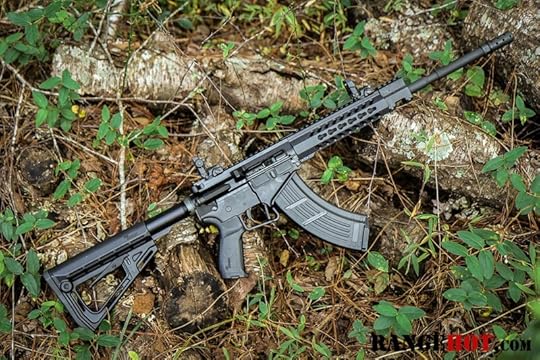
As the story opens, Mitchell Price’s Special Purpose team is closing in on their target, armed with Gilboa M43 carbines. Price decided on these rifles for the ergonomics of the AR/M4 platform, while still maintaining the capability to rearm with 7.62x39mm, which is common enough in Central Asia.
They are confronted by shooters in unfamiliar camouflage, carrying B+T APC 300 carbines. The Advanced Police Carbine is a Swiss design, ambidextrous, and can take B+T’s ROTEX suppressor. The APC does come in 5.56, but the APC 300 is optimized for .300 Blackout.
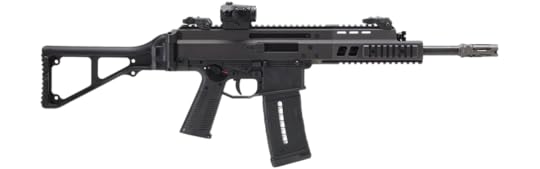 Image from B+T’s website.
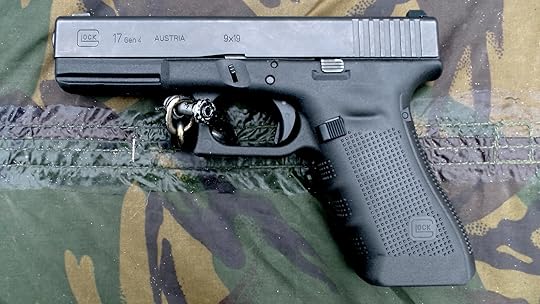
Boyd, the Humanity Front’s main hatchet man in Kyrgyzstan, is a professional, but he’s not as into exotic guns as Flint was. He picked the APC 300s for his team because the Front doesn’t want the appearance of a standardized military force. But his sidearm is pretty standard: a Glock 17 9mm.
When Brannigan’s Blackhearts get on the ground, they can’t be that choosy. Their contact has access to a cache of former Afghan National Army weapons. They end up with mostly old M4 carbines, formerly issued to Afghan Commandos.
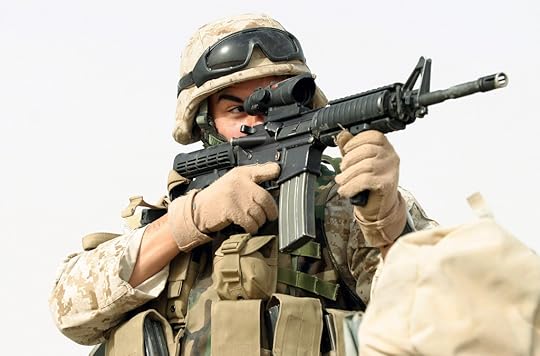
Curtis and Bianco, being the team machinegunners, hold out for some machine guns. All their contact has, though, is a couple of RPKs. Effectively the light machinegun variant of the AK, it has a slightly longer receiver, and a longer and heavier barrel, but is otherwise functionally identical to the AK-47.
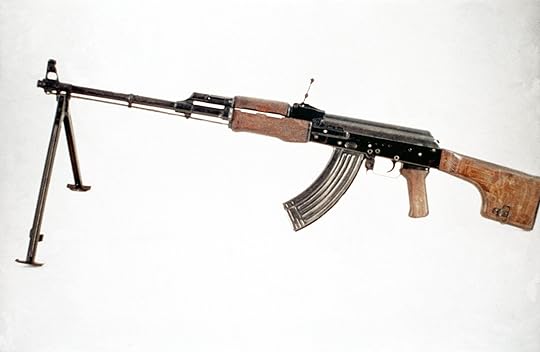 A Soviet 7.62 mm RPK squad light machine gun.
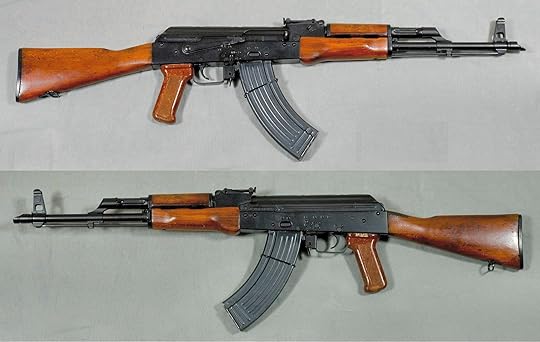
The Kyrgyz Army is still mostly equipped with Soviet-era weapons and gear, though they’ve started to get some American guns lately. While the Kyrgyz have some M4s, the soldiers we see are all armed with old AKMs. The Modernized version of the AK-47, the AKM has a stamped receiver and several other features making it easier to mass produce. It still fires the 7.62x39mm cartridge.
The Front has a few other nasty surprises, up in the Tian Shan mountains. But those will have to wait until the book comes out.
Blood Debt is currently available for pre-order, and will be out on Kindle and Paperback on December 14.
The post The Guns of Blood Debt appeared first on American Praetorians.


November 10, 2021
Triarii Patch Interest
I’ve gotten some more inquiries about Triarii patches lately. So far, I’ve held off because I still have quite a few Praetorian patches in stock. It’s a non-trivial up-front expense. However, I might have an avenue to get some made now. SO, I need some solid numbers. If you are interested in a Triarii patch (subdued green only for now), go ahead and follow the link and let me know.
Triarii Patch Interest Questionnaire
The post Triarii Patch Interest appeared first on American Praetorians.
October 12, 2021
October Update
There’s a lot going on this October. It’s been a busy year, and some of it I haven’t been able to talk about yet.
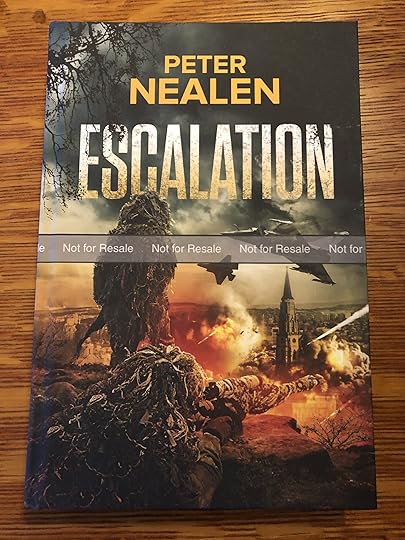
With Area Denial having come out as the seventh Maelstrom Rising book just last month, a new option has become available through KDP Print: Hardcovers. I got the proof for Escalation just a couple weeks ago, and that volume is now available in hardcover on Amazon. The system’s still in Beta, so I’m taking it carefully, one volume at a time. Holding Action should be up soon. So far, I’m impressed. The proof printed beautifully, and the binding is solid. The rest of the series will be out in hardcover over the next couple of months, and hopefully Power Vacuum will come out in Kindle, paperback, and hardcover on release.
I’m wrapping up the first draft of the third book in a series I’m writing for Nick Cole’s and Jason Anspach’s Wargate Books. Nick approached me about this project a few months ago. Three more books to get written than I’d had planned for this year, but when somebody like Nick asks, you say, “Yes.” It’s a little different. Recon Marines meet a world of myths and monsters. There’s some of my normal military fiction mixed with some Jed Horn and some hardcore sword and sorcery. There’s still work to be done, but the first book should be out in January.
Once this is wrapped up, I’ll be hitting Blood Debt hard, and still hopefully getting the fourth and final book of The Unity Wars done and turned in by the end of the year. It’s already outlined and ready to go.
In other news, my friend James Rosone has a new book out today, co-written with Matt Jackson, a Vietnam vet and helicopter pilot. Project 19 is the first volume of an alternate history of the 1991 Gulf War:

What if Saddam Hussein …
…hadn’t stopped with Kuwait?
Project 19 might have worked.
No one knows how close Iraq came to invading Saudi Arabia and the United Arab Emirates. They wanted their money, and Saddam wanted revenge. In a world where the USSR ran a lend-lease program with the Iraqis, Saddam felt emboldened.
He ’d convince the world that he was just bringing their 19th province back into the fold.
With an oil war going on, the Soviets threw their hats into the ring behind Iraq. If they’d had all the latest in equipment, the 100 hours war wouldn’t be so easily fought.
It could have changed history.
Would the Americans ultimately decide that this was a problem for the Arab nations to work out amongst themselves?
Would the stakes change?
How would Operation Desert Shield and Operation Desert Storm have turned out?
You’ll love this alternate history novel. It’s well-researched and will make you ask what might have been.
The ebook is only $0.99, so go pick it up.
Now, back to the word mines for me.
The post October Update appeared first on American Praetorians.
October 4, 2021
The Reason for This Website and Newsletter
Facebook was already getting to be an unreliable tool for this business. Too many long-time readers have told me that they had no idea a release was coming out until they checked Kindle, despite the fact that I’d been posting about it for a month. Facebook has set its algorithms to determine what you should see, regardless of what you want to see, unless you’re using something like Fluff Busting Purity. As a result, I’ve been urging subscriptions to my newsletter for some time. At least then, you’ll get notification in your email, provided you check it, when something comes out.
Now, it appears that Facebook is in quite a bit of trouble. Whether due to astounding degrees of incompetence or hostile action remains to be seen. There are a lot of rumors flying around, many of which I have yet to see corroborated. The end result is essentially the same, however. The biggest platform is down, hard, and it’s a good thing I didn’t have a release scheduled for tomorrow.
I’ve had a backup social media presence on MeWe for some time, complete with a backup to the Action Thriller Renaissance group I built on Facebook. A lot of my readers haven’t moved over there, for various reasons, but this is a large part of the reason why I staked out a spot there. In this case, it wasn’t that I got banned from FB (Never have ended up in NiceGulag, probably because I’ve shared fewer memes and used long words when I posted Wrongthink.), but that Facebook itself appears to have imploded.
Maybe this is going to be a good thing in the long run. Hopefully I won’t lose contact with some of those folks on FB, if the outage continues indefinitely, but some decentralization could be desirable, especially when the centralized platform has been turning into Plato’s Cave.
So, head over to MeWe, or just sign up for the Newsletter (you get a free novella when you do). The world got on fine without Facebook for a long time, it’ll get on fine without it. We just have to adjust some of our business strategies to disentangle, which is no bad thing.
The post The Reason for This Website and Newsletter appeared first on American Praetorians.
September 21, 2021
Into the Gray Zone – Area Denial is Live
There’s a Shadow War going on…
…And now the Triarii know it
Now it’s time for the next move
Hank and his section took a beating in West Texas, but they accomplished their mission and secured a strategic asset against a daring attempt to seize it. And in the process, they found out who’s really behind the war.
Now it’s time to strike back.
The government doesn’t want to admit Chinese involvement, despite what the Triarii and the Texas Rangers uncovered. So, once again, the Triarii must act on their own.
Destination: The South China Sea
Mission: Take the war to the People’s Republic of China
But will that be more easily said than done?
China has been pushing extra-legal territorial claims in the Spratly and Paracel island chains in the South China Sea for years. They have built artificial islands on reefs and shoals to beef up their claims, while simultaneously bullying their neighbors in the Philippines, Malaysia, Vietnam, and Taiwan, militarily and economically. They have even attempted to keep the US Navy out of international waters, claiming vast swathes of ocean as “security zones” around their ships. They have used irregular forces in the form of People’s Armed Forces Maritime Militia fishing vessels as “gray zone” combat multipliers, to help the PLAN dominate the area.
Area Denial takes us into that theater of maritime “gray zone” warfare, within the story arc of the Maelstrom Rising series. The term “area denial” itself comes from Chinese maritime strategy, a tactic to render sea passages untenable due to fast attack and ballistic missile threats.
The Triarii have their own version in mind. The Chinese are about to get a taste of their own medicine. Welcome to the world of near-future maritime guerrilla warfare.
Area Denial is out now on Kindle and Paperback.
The post Into the Gray Zone – Area Denial is Live appeared first on American Praetorians.
September 14, 2021
Area Denial Chapter 1
“Contact, starboard side, five miles and closing at fifteen knots!” The warning crackled over the intercom speaker in berthing.
Hank Foss rolled out of his rack, grabbing for his gear and his rifle. He’d been halfway expecting this alert for days now.
Shrugging into his chest rig, he slung the modified M5E1 in front of him as he climbed up out of the berthing, clattering up the metal-grated ladderwell along the starboard side before turning through a narrow hatchway and into the modified command center that they’d built out of about half the galley.
Space aboard the Jacqueline Q was at a premium, as large as she was. The Triarii command center consisted of three laptops on a table, with charts, maps, and printed imagery tacked up on the bulkheads. Right then, Cole Spencer, Hank’s second in command and his closest friend, was studying the laptop that showed their current drone overwatch feed.
“What have we got?” Hank was tall and spare of frame, with a lean, hatchet face and black hair starting to show some gray at the temples. Having retired from the Marine Corps as a Gunnery Sergeant before joining the Triarii, he was surprised there wasn’t a lot more gray. Especially after the last couple of years.
“Three boats.” Spencer didn’t look up as he watched the video feed. He’d started shaving his head to simplify hygiene since they’d boarded the Jacqueline Q in Port Arthur. The overhead lights gleamed off his ebony scalp and the furrows in his brow as he watched the screen. “They look like local fishing boats, but I think we both know better.”
Hank stepped around to look over his assistant section leader’s shoulder. The drone feed was a bit pixelated, but still a lot clearer than it might have been even five years before. The tech had gotten better and cheaper, fast. It was easy to pick out the three white boats, each probably forty feet long, bouncing across the waves, spread out into a loose wedge formation. They were tiny compared to the Jacqueline Q’s massive four-hundred-seventy-foot length, but each one carried at least ten to fifteen shooters. He could see the weapons clearly; they weren’t exactly hiding them. Several RPGs were mixed in with the rifles and machineguns. If the Jacqueline Q had been the simple fishing trawler that she appeared to be, they’d be in trouble.
“I don’t know what you mean. Little fishing boats like that always have that kind of firepower aboard. Makes the fishing easier.” His eyes narrowed. “They’re awfully far out for boats that size.” Hank was already thinking ahead. He was fairly sure of the resolution if the pirates tried to take the Jacqueline Q, but if the small attack boats were this far out in the Timor Sea, then they wouldn’t be out on their own. “Did you wake up Chan?”
Spencer nodded. “He’s already getting his boys into the hold, ready to play.”
Hank turned toward the ladderwell aft. “I’ll go talk to the captain.” He ducked to fit through the hatch. “I don’t think he was quite ready for things to get this froggy, this fast.”
“I don’t think so, either, but after the drone footage from the other day…” Spencer let the sentence trail off.
“Yeah.” Hank didn’t have to comment. They’d both watched as pirates had surrounded and boarded a Malaysian-flagged container ship barely fifty nautical miles off the Australian coast. It had been too far away for them to do anything but watch, and their mission wasn’t here, anyway. But the message had been clear enough.
It still bugged him a little as he mounted the ladderwell toward the bridge, as hard as he was trying to keep his emotions locked away. Can’t save everybody. He’d told himself that many times since they’d watched the attack.
He’d told himself that a lot over the months since Texas. The months since Arturo’s death. He still wasn’t sure he believed it.
He forced the thought—and the memories that went with it—away as he got to the bridge. Not the place, not the time.
Michael Chan, commanding the other Triarii infantry section aboard the Jacqueline Q, was coming up at the same time, geared up and armed, his helmet under his arm. “What’s up?”
Hank paused at the hatch. “Looks like pirates. I’m heading up to brief the Skipper.”
Chan nodded briefly. “Is Cole still on watch?”
“Yeah.”
“Okay, then. I’ll get everybody to action stations.” Chan turned and headed back down toward the hold. He wasn’t a man of many words, and his ego wasn’t so large that he had to be in the middle of planning. He accepted that Hank had a grasp on the situation, and so he was going to get things moving and get the rest of the brief when it came. Chan was the sort of man who’d rather be ready for action first, then find out the specifics later.
The bridge wasn’t crowded or especially busy. Captain Reggie Smythe didn’t like a lot of noise and fury on his bridge. He had originally been a fishing trawler captain, which was why he’d taken the Jacqueline Q out after her extensive refit in Port Arthur. And given that the Jacqueline Q only had an operational crew of about six, with the other sixty-eight men aboard being Triarii infantry, there was no reason to have a lot of people on the bridge.
Smythe was at the control station, while Vern Satoshi was bent over the chart table. They both looked up, Satoshi’s eyes widening as he saw that Hank was geared up and armed, wearing a plate carrier with four 7.62 mags in the placard on the front plate, two more on his belt, his modified M5E1 hanging from its sling in front of him, his helmet dangling from his off hand.
“What’s up, Hank?” Smythe wasn’t easily rattled, though there was a nervous look in his eyes as he took in the Triarii infantry section leader’s gear and weapon. “Another drill? You know we’ve got a good week before we hit Palawan.”
Hank shook his head as he moved to the radar station. “Not a drill. What are you picking up to the north?”
Smythe tilted his head as he flipped through the windows on his tablet. He had every readout and station on the ship linked to that one device. The originals were all still there, but Smythe could monitor them all from wherever he was aboard. His forehead furrowed. “Looks like three small craft coming our way. Awfully far out for fishing vessels that size.”
“It is. Which was the first clue.” Hank had a tablet of his own under his arm, which he had linked to Spencer’s station. He brought up the drone imagery. The little unmanned plane was banking to circle around, the camera still trained on the three boats. He zoomed in; the weapons were even more obvious now. “We’ve got pirates.”
Satoshi’s eyes got even wider, and he turned pale. Smythe seemed to take it in stride, though. “Been a lot of reports about pirates getting bolder out here. Even stories about an attack within sight of Darwin, though the Aussies took care of that pretty quick.” He frowned at the imagery on Hank’s tablet. “I wasn’t expecting them to come after a fishing trawler, though.”
“Hostages.” Hank’s voice was grim. “There’s been a lot of K&R involved with these attacks.” Kidnap and Ransom was a major industry in international piracy. It could be a lot more lucrative than actually stealing whatever was aboard the target vessels.
“Makes sense.” Smythe was still frowning, though. “This is a whole lot of ocean for them to be hitting ships this far from Indonesia and Timor, though. Why now?”
“You’ve got three guesses and the first two don’t count.” Hank raised an eyebrow as Smythe looked him in the eye.
“China?” Smythe asked quietly.
Hank nodded. “More than likely. The Aussies just tried to disentangle again, so they’ve got to be punished in every way possible. And we’ve seen the PRC use criminal elements as proxies for offensive warfare before; quite recently, in fact.”
Smythe nodded. He knew Hank’s history. He knew what had happened in Texas, and in California before that. What was still happening, in places the Triarii hadn’t secured yet.
The captain looked at the radar plot again. “They’ll be on us pretty soon. Within the next thirty minutes.” He pursed his lips. “What did you have in mind?”
“They ain’t boarding.” To Hank, that was blatantly obvious, and he’d gotten to know Smythe well enough during the long passage from the Gulf of Mexico to know that he didn’t really have to spell that out. But all the same, Smythe was a fisherman and a seaman first and foremost. Not a fighter.
That was why the Triarii were aboard.
“I’d be inclined to agree.” He pulled up the chart. “I’m not sure if we can outrun them, though.”
“Didn’t have running in mind.” Hank was already turning toward the hatch again. “That’s what we’ve got sixty-eight shooters and two disappearing Thirties for. Just make sure your boys don’t freak out when the shooting starts.”
***
The three pirate boats slowed as they came in closer to the Jacqueline Q. Their gunwales lined with armed men, mostly wearing sleeveless shirts and rolled-up fatigue trousers, they spread out around the trawler, matching course and speed. The Jacqueline Q hadn’t slowed or deviated from her course by much, though Smythe had tried to turn away from the oncoming boats, even if only for show.
Hank waited below the gunwale on the starboard side, just behind the disappearing armature of one of the 30mm cannons that had been mounted forward for defense—or offense, if the situation called for it.
After all, the Jacqueline Q wasn’t exactly a fishing boat anymore.
He cursed quietly under his breath as he watched the drone feed on his tablet. He’d have much preferred to be able to watch their attackers with his own Mark One Eyeballs, but that would have risked giving the game away if he got spotted peeking over the gunwale.
Two of the pirate boats hove in on the starboard side, while the third hung back to the stern. That was a problem. He looked down into the hold. “Jim, see if we can get a LAW to the stern without the pirates noticing.”
Jim Shevlin had joined the section after Texas. An older man, with time in both the Army and law enforcement, he’d taken to the role of the section’s gear NCO easily. He was no Tony Velasquez, but he was a good dude, and he’d actually been a Triarius longer than Hank had.
The lanky, balding man just nodded, grabbed up two of the green tubes, slung them over his shoulder, and hustled aft.
Hank turned his attention back to the tablet. The pirate in the black wife-beater, a yellow bandana tied around his head, with two bandoliers of 40mm grenades dangling around his neck and an M16 with an underbarrel M203 grenade launcher in his hands, had stood up in the bow of the closest boat. Two more pirates with ladders were right behind him, the hooked boarding ladders held in both hands, their weapons slung on their backs.
The pirate with the bandana on his head lifted his M16 and popped off a flare from his M203. It arced over the bow of the Jacqueline Q, hissing and sputtering with red flame. Then he lifted a megaphone. “You stop engines! Prepare to be boarded!” His English wasn’t great, but he’d clearly learned enough to board Australian ships, or any other English-speaking vessels passing within his sphere of influence.
“Can I smoke these assholes now, Hank?” Marco Rodriguez was the younger of the Rodriguez brothers, and the most openly aggressive of the two. With the section spread out doing a lot of Combined Action work with local militias in Texas, Hank hadn’t gotten to know either brother all that well before the training workup and the voyage from Port Arthur. But he knew him well enough now to know that he occasionally had to keep a tighter leash on him. Even if Lovell had already laid down the law.
“Give it a minute. Let Jim get those LAWs aft.” He wanted to get this done in one fell swoop.
Marco muttered to himself, but held his position. He was a good Triarius. He might complain, but he wouldn’t jump the gun.
Hank briefly thought of an old proverb from his distant career in the Marine Corps. “If Marines ain’t bitching, there’s something wrong.”
The pirate boat drifted closer, lots of weapons pointed up at the trawler, which so far had exhibited no reaction to their approach. Smythe was up on the bridge, he and Satoshi already down and away from the windows, just in case.
“Now.”
With a faint hiss, the modified hydraulic lift elevated as Marco Rodriguez pivoted the 30mm cannon outboard, cranking the barrel down to bring it to bear on the nearest pirate.
Hank had popped up to his own firing position along the rail just in time to see the pirate leader’s eyes go wide as he realized what had just happened.
A moment later, Rodriguez opened fire. The cannon, a home-built, reverse-engineered version of the Orbital ATK M230LF 30mm chain gun, could reach out to nearly 4 kilometers. The fifteen yards between the boat and the Jacqueline Q’s hull was like shooting fish in a barrel.
Flame spat from the massive muzzle brake as the cannon thundered, earsplitting booms rolling out across the water. The effects on target were devastating.
The first pirate to get hit, one of the ladder carriers behind the guy with the 203, just disappeared, blown in half by the massive round that passed through him like he wasn’t even there to smash a massive hole in the hull. The boat immediately began to take on water as Rodriguez played his fire back and forth across the boat, the boomboomboom echoing and making the reports of the other Triarii’s 7.62mm M5s sound like muted pops in comparison.
Hank barely saw the destruction Rodriguez was wreaking. He’d known that Marco would take care of the lead boat, so he’d sighted in on the second, along with most of the rest of Lovell’s First Squad. That vessel was still a little bit farther out, but thirty yards is still pretty easy, even with both platforms moving on the swell. His first shot had still been low, taking the pirate in the loose, light blue shirt in the stomach. The man doubled over the impact, red soaking his shirt, and fell into the bow, as the rest of the squad raked the boat with semi-auto fire.
Then Brule opened up with the squad’s Mk 48, and damned near sank the launch all by himself.
More gunfire rolled out over the ocean from astern, as LaForce’s Second Squad opened up on the rearmost boat. A rolling, hollow boom announced the launch of a LAW rocket.
Hank came off his sights for a moment to take stock. The lead boat was fully swamped, barely floating in a wrack of smashed boards, leaking oil and fuel, blood, and body parts. Rodriguez had ceased fire, mainly because he’d turned everything in front of him to wreckage and shredded meat. The second boat was foundering, though a couple of the pirates were still trying to return fire, AK rounds going overhead with little snaps.
Brule raked the boat with another burst, and the fire ceased.
The higher-pitched whine of an outboard rose somewhere aft, and Hank turned to see the third boat in full flight, putting up rooster tails of spray as the pirates ran for it.
“Fuck.” He gritted his teeth. “What did I give ‘em LAWs for if they were gonna miss?” He scrambled down from the gunwale. “Amos, make sure we snatch up anybody who survived.” He ran down the deck toward the superstructure aft.
He could almost have sworn he could hear LaForce cussing, even though he was too far away, with too much metal and too much spray between them. Etienne LaForce would not be happy with whoever had taken that LAW shot.
Ducking through the forward hatch, he clattered up the ladderwell to the bridge. Smythe and Satoshi were still up there, Satoshi looking more than a little like he was seriously wondering why he’d agreed to come on this float, while Smythe looked relieved that it was over.
Except that it wasn’t.
“We’ve got a squirter.” Hank moved to the starboard portholes and looked aft. He could just see the white shape skipping over the waves as the pirates tried to get away. “We need to come about and go after them.” He thought of something suddenly and keyed his radio. “Five, this is Six. Have we got our jammers up?”
“Up and going hard,” Spencer replied. “Ever since they got within a mile.”
“But we won,” Smythe protested. “They’re running. They’re not a threat anymore.”
“Not an immediate threat, no.” Hank straightened and looked the skipper in the eye. “But what happens when they get back to their buddies and word starts to get out about a fishing trawler with a lot of guns on it?”
He saw the realization dawn in Smythe’s eyes. “Oh. Oh, shit.”
“Yeah.” Hank nodded grimly. “As soon as they came after us, they were never getting back. One way or another.
“Bring us around and get us moving. I’m going to call in the Bell Challenger’s helos. Just in case.”
Area Denial comes out on Kindle and Paperback on Sept 21.
The post Area Denial Chapter 1 appeared first on American Praetorians.
September 7, 2021
Area Denial Prologue
Lines of Demarcation Stiffen Within the United States
Following the fighting in south Texas, internecine clashes between domestic groups and even states themselves within the United States have seemingly intensified. While rioting has broken out anew in multiple cities, protesting the activities of the right-wing militia known as “The Triarii,” as well as the Texas state government’s cooperation with them, federal authorities have begun intensive investigations into the actions of the Texas governor, as well as what appears to be full-scale war preparations on the part of the Triarii.
Support or opposition for the investigation has fallen out along largely state and partisan lines, though several of the Middle American states that have opposed it have large urban populations that have protested their state governments’ stance on the matter. The current—and continuing—disruption of power grids and supply chains has become yet another source of friction, contributing to the spreading chaos. Rumors abound of federal task forces preparing to move into the dissident states, while militias and even state National Guard units are being mobilized to respond.
The rumors about open armed clashes between Triarii and People’s Revolutionary Action in several “border states” have yet to be confirmed.
A hard split appears to be happening within the United States, and only time will tell what the future holds.
Our Government’s Schizophrenia Gets Worse
As my readers will know, I’ve been chronicling the cognitive dissonance which has characterized the US government and its policies for years. Conflicting narratives and special interests have been tearing our country apart while the fat cats line their pockets and laugh at us. But now we seem to have reached a new level of insanity.
A lot of people didn’t notice, due to the disaster that wiped out more than half of our power grid while terrorist attacks paralyzed our supply chains—probably the worst such disaster since 2020—but we entered a new war last year. How much it had to do with the power grid and the terror attacks I don’t know. There are secrets on top of secrets here, and reliable open-source information is hard to come by, especially since the Internet took a hit along with the power grid. But while to many of us, absorbed with our own problems, the fighting in Europe might be just one more footnote in a world gone to crap, the fact is that the US Army and US Navy have been fighting over there since this started.
But they’re not the only ones. The so-called “right-wing militia” called the Triarii—an organization that can arguably be said to be doing what the US government doesn’t want to—has also been engaged over there. In fact, reliable sources have told me that they were issued a Letter of Marque and Reprisal—the first such in over a hundred fifty years.
That’s right. The Triarii are fighting under contract for the United States government in Europe. At the same time, that same government is trying to destroy them for holding the line in Texas. Those of us who live outside of the Beltway—or Portland, or California, or New York—know all too well what’s been going on down on the border. And the Triarii stepped up and did what had to be done to stop it. But that can’t be borne by the pols, so now there’s an “investigation.”
Are they heroes or villains? There’s a debate to be had there, but the nutcases in DC seem to want to say “Both” at the same time.
Europe Descends Further Into Chaos
Following the attack that killed most of the New European Council at their inauguration ceremony in Strasbourg, the security situation has only worsened, as confusion rules. While the United States insists that the survivors of the New European Council are the only legitimate governmental body to decide the course of Europe’s future, the American State Department seems to be the only voice that thinks so. Paris and Berlin continue to waffle, Czechia has openly declared all connections to the former European Union null and void, and the breakaway republic of Nouvelle Gallia, which now controls nearly a quarter of southern France, has declared the European experiment officially dead.
Meanwhile, as the remaining units of the European Defense Corps tighten their control over the Chemnitz region, where they have held their ground since the lightning offensive that took down the European Defense Council, violence has continued to spread across Europe, as numerous groups have seized upon the chaos to attack their own enemies or attempt to seize power in numerous cities and regions. The extent of outside influence has yet to be determined, but sources insist that Russian provocateurs—who have already fueled chaos on the border with Poland—are already active in Germany and France.
More and more municipalities are turning to private security forces, as the US Army appears to be vastly overextended. So far, the largest such contractor also doubles as a humanitarian aid distributor, One-World Holistic Security Concepts, based out of Shanghai.
Open Fighting Between Iranian and Turkish Forces
As the Turkish Army continues to clash with Peshmerga fighters in the mountains above Soran, a new offensive has crossed into Iranian territory near Urmia, claiming that the Islamic Republic of Iran has been supporting the Kurdish Peshmerga against the Turks. So far, Tehran has issued no statement.
This marks a new high in Turkey’s drive for regional dominance, following their proxy actions in eastern Greece, Crete, and Syria over the last year, and open advances into northern Syria, resulting in the seizure of Manbij and a renewed siege of Aleppo. Furthermore, reports of activity by Turkish special forces have started to come out of places in Eastern Europe and Africa.
Turkey is on the march, as the power axes of the last century begin to shift.
Iranian-Saudi War Heats Up
The Iranian forces that have been sitting in the UAE for the last six months have begun to move again. Surprisingly, instead of driving directly west to attack Riyadh, they have turned north, paralleling the Qatari border and driving on the Al-Ahsa Oasis. Shelling and air attacks began at midnight yesterday, and Iranian forces appear to have cut the oasis off from reinforcement from both Qatar and the Saudi military.
At almost at the same time, a renewed offensive against Saudi-allied forces in South Yemen kicked off with a series of drone strikes and suicide bombings that nearly decapitated the Popular Force Committees that have sworn allegiance to the late President Hadi’s former chief of security, Ezdeen Samei. Samei himself escaped unscathed, but this latest setback to the Arab coalition that has been engaged in continuous warfare with the Houthis and their Iranian supporters could be enough to break the coalition unless the Saudis can rally renewed support.
Given the situation in Saudi Arabia itself, this seems unlikely.
Exhaustion? Or Merely the Eye of the Storm?
At first glance, it looks like the wars that have wracked our world for the last year might have come to a pause. Violence in the Middle East continues apace, but that has continued nearly nonstop for decades, now. The proxy war between Shi’a and Sunni Muslims has been going on for a very long time (decades to centuries, depending on who you ask), and is unlikely to end anytime soon. But the major clashes in Europe seem to be at an impasse, as the European Defense Council has been taken from power, and while rumors abound that the majority of their military forces have refused to surrender, Europe has been relatively quiet now for over a month.
Questions have been raised about the losses of extremely expensive, high-technology weapons systems over the last year of on-again, off-again combat. While none of the combatants have released numbers, analysts say that the United States and the former European Union states now have less than half of the high-technology assets—be it aircraft, armored vehicles, or missiles—remaining that they possessed at the beginning of the conflict. And in most cases, there are no resources or even facilities to replace those losses.
With the United States embroiled in internal strife, rampant crime, and still desperately trying to recover from the power grid disaster of last year, the likelihood that the battered American forces will be able to do much more than hold some of the ground they’ve taken seems slim. Nation building in a severely divided Europe will be a difficult mission, especially given the other players involved, who have not expended nearly the resources that the US, Germany, and France already have…
China’s Influence Grows
Despite backing off along the Line of Actual Control with India, China stands poised to take the place it has long desired—that of the world’s sole superpower and economic and cultural hegemon. With a growing domination of the ports and sea lanes—though primarily through economic rather than military means—China’s is the only economy that has so far not succumbed to the devastating blows of the last year. And Beijing is already maneuvering to cement that dominance. With most of the rest of the world distracted or wounded by war, terrorism, economic collapse, and ecological devastation, the Age of China may well be at hand.
Area Denial releases on Kindle and Paperback September 21st.
The post Area Denial Prologue appeared first on American Praetorians.
August 24, 2021
Release Day for “The Alliance Rises!”
Chaos spreads across the galaxy…
…The Galactic Unity seems unstoppable.
How can an unprepared galaxy oppose them?
With Valdek behind them, Centurion Scalas and the Caractacan Brotherhood face the Unity’s challenge head-on.
But this war has been planned for a long time.
And the Unity has more weapons than just their vast clone armies.
As brushfires erupt across the galaxy, the Brotherhood and their allies must move quickly to band together before they fall one at a time. But can they stand against this juggernaut?
This one turns the scale of things up; the action isn’t limited to just one world or star system this time. The war is spreading, and the action is accordingly widespread. I’ve grumped before that Star Wars lost the sense of scale as soon as they started going back to Tatooine again, and again, and again.
I hope you’ll enjoy this massive space war story. The next chapter is coming soon.
The Alliance Rises is out on Kindle today
The post Release Day for “The Alliance Rises!” appeared first on American Praetorians.
August 17, 2021
The Alliance Rises Chapter 1
If not for many years of discipline, Centurion Erekan Scalas would have been stifling a yawn behind his visor. The Regonese flock leaders, war chiefs, and politicians had been talking at Brother Legate Dravus Maruks for three hours, while Scalas and his other three brother Centurions had stood by and listened. If not for the climate controls in the Caractacan Brothers’ combat armor, they would have been freezing in the cold, whispering winds that sifted across Kego City’s Peace Plaza. Maruks had his helmet off, and his squarish, sun-blasted face was red with cold and wind-burn.
Maruks looked tired. As well he might. Regone was the fifth such system that the Avar Sector Legio of the Caractacan Brotherhood had needed to visit recently. It seemed that every brush fire in the galaxy was flaring up since Valdek had fallen to the so-called “Galactic Unity,” two thousand hours before.
The Brother Legate was in the midst of telling the gathered Regonese leaders that the Caractacan Brotherhood was not a mercenary company that they could hire to crush the Exiles on the third planet. The fifty, three-meter-tall avian nashai gathered around him at the base of the towering stone spire that formed the center of the Peace Plaza didn’t seem happy with the statement. They were clearly agitated, feathers rising and falling, hopping from clawed foot to clawed foot, beaks clacking.
“Should we be concerned about this?” Centurion Undon Rokoff asked. He was speaking over the private channel in Latin, his voice pitched low so that it couldn’t be heard beyond his helmet, especially since the Centurions were standing in a half-circle several meters from the meeting itself. “They are getting awfully excited.”
“No,” Scalas replied, just as quietly. Rokoff was the junior Centurion in the Avar Sector Legio, and was still getting used to his command. “That’s just the Regonese way. They get loud and expressive when they’re upset, and these Exiles have them very upset. But they aren’t likely to try to get violent with outsiders, much less Caractacan Brothers whom they’re trying to ask for help.”
“You’ve been here before?” Rokoff asked.
Scalas didn’t turn to look at him; they were in formation, standing statuesquely still, providing another image of Caractacan discipline and unshakability to the Regonese. “Yes, about three years ago.” Much of the galaxy had gone to using kilohours and megahours to measure longer spans of time, but the Caractacan Brotherhood was nothing if not traditional, and they still used old Earth years, even though Earth was long gone. “For much the same reason.”
“Erekan is one of the more widely traveled and well-read Centurions in the Legio,” Centurion Virgil Costigan put in. “He’s been on worlds I’ve never heard of. If he says it, you can trust that it’s true.”
Scalas said nothing. Costigan was an old friend; the two of them had served their novitiate together. But Costigan had been a rising star in the Brotherhood for some time, and Scalas couldn’t help but feel as if the other man had overshadowed him. Even when Costigan himself insisted that such feelings were nonsense.
“They certainly make enough noise to make one wonder.” Centurion Maximilian Soon towered over his fellows, standing a head taller than Scalas’s own not inconsiderable two-meter height. “Though much of it seems to be more concerned with fears of what might happen rather than anything that already has.”
He had barely finished speaking when a powergun bolt split the sky. Everyone, human and nashai, froze.
Every Regonese head turned to stare as the bright, green-white bolt shattered the peace and quiet over the ancient city. Their feathers rippled, and wide, golden eyes stared, blinking rapidly. Beaks clacked.
Then the shockwave washed over the Peace Plaza with a roaring clap of thunder, and they scattered toward the hardened structures that ringed the historic plaza. The threat from Exile-sympathetic terrorists had apparently been considered significant enough that the various flocks had taken steps to fortify the central monument of Regonese history.
None of the Caractacan Brothers on the Plaza bolted. They were Caractacans. Discipline was a by-word, part of the Code. “Never to flee before an enemy.” Maruks simply lifted his casque and lowered it into place, sealing it as another trio of bolts rained down out of the clear, blue sky. One struck a distant spire, similar to the stone chimney in the center of the Peace Plaza, but built of steel and glass. The lower half of the spire shattered, and the structure cracked, beginning to fall toward the ground, dropping slowly in the three-quarters of a G that was Regonese surface gravity.
Maruks reached out under Feygeil’s partly outstretched wing to grasp his arm, as the big Regonese started to rush past him. “Stay with us,” he said in Trade Cant, the de facto lingua franca of the spaceways, particularly out in the Carina Arm. “Centurions.”
Bright sparks were starting to flicker in the sky above, as those Regonese ships in orbit capable of combat began to take the hostile ship under fire. Scalas fell in with the other Centurions around the squat, thickset Brother Legate, and they started toward the bunker on the far side of the Plaza from the bombardment.
They had gotten about twenty meters toward the rim of the great circle when the main gate blew up. Dust and fragments billowed into the sky with a heavy, ground-shaking thud.
The Centurions turned almost as one, each man dropping to a knee and bringing his powergun to bear. There was no cover in the Plaza; the entire circle was open ground, sloping slightly down from the central spire.
“By twos, fall back to cover!” Maruks bellowed, even as hard shot fire started to hiss and snap through the cloud of dust and smoke. A bright flash in the sky above heralded the end of the orbital bombardment, as the attacking ship died in a spectacular explosion. Maruks had his own powergun in his hands; no Caractacan Brother went anywhere unarmed. They often limited themselves to sidearms while in their Sector Keeps, but they were not in a Sector Keep at the moment.
The Centurions answered the gunfire with the bright blue-white flashes and thunderclap reports of powergun fire. Tiny sections of copper wire turned to plasma and accelerated to a substantial fraction of the speed of light, blinking across the Plaza and seeking out targets that were only vague forms highlighted in Scalas’s visor.
Scalas held his position, dropping two charging nashai—presumably Exiles—with two shots, as Soon and Maruks pounded back toward the hardened overhang behind them, Feygeil in tow. As soon as another bolt scorched the air and hammered at him with the shockwave of its passage to his right, he rose, pivoted, and charged back to pass the Brother Legate and the other Centurion, where they were pouring fire into the gate.
He might have gotten another five paces before the entrance to the bunker ahead was filled with the armored forms of more Caractacans, a squad of Scalas’s own Century XXXII, boiling out into the Plaza behind their weapons, quickly identifying where the friendlies were and returning fire toward the gate. But there were a lot of attackers in that gateway.
Something heavier than the lighter small arms fire suddenly spoke in the gateway, and heavy slugs cracked overhead, shredding the cloud of dust ahead of the vehicle bulling its way through the wreckage of the shattered gate.
“Backblast!” an amplified voice roared in Latin, a moment before an HV missile streaked across the Plaza in an eyeblink and struck the vehicle like the hammer of some legendary god. The six-wheeled gun truck blew apart, flattening the nearby attackers and throwing fragments whickering high in the air.
The Plaza suddenly went quiet, which only made it easier to hear the rattle of gunfire and the thump of more explosions farther out in the city.
Scalas got to his feet. Before he could issue any orders, Maruks’s voice came over his comms.
“Soon, Rokoff, get to your Centuries and secure that gate,” he said. “Costigan, Scalas, we will get Feygeil inside and see if we can’t sort this mess out.”
Even before they could acknowledge, the Brother Legate was striding toward the bunker, ushering the war chief of the Dreje flock ahead of him. Feygeil went along meekly. Even though he overtopped Maruks by almost a meter and a half, the Brother Legate’s sheer force of personality had taken over in the face of the crisis.
Scalas jogged behind them, signaling his men to fall in as he went. He hardly needed to; they had heard the orders, and quickly closed into a diamond formation around the Brother Legate and his charge.
He glanced at Maruks as they went. It hadn’t been four months yet since the Draeyeenan had taken command of the Avar Sector Legio. He was no Michael Kranjick, but no one ever would be. Kranjick had fallen on Valdek. But if anyone had to take the reins from him, Scalas was glad that it had been Maruks.
He made a concerted effort not to think about the fact that it might have been him. That simple possibility brought up a storm of conflicting feelings of resentment, self-doubt, and relief that was better left alone.
The sounds of combat redoubled outside, and more powergun fire thundered from the gate. The attack wasn’t over. Maruks didn’t flinch, didn’t speed up, though even given the short length of his stride, he could move with remarkable swiftness without seeming to. In moments, the knot of Caractacan Brothers and a few more Regonese who had been swept up in their passage got through the hatch and into the bunker, beneath the steelcrete overhang.
“Herald of Justice, Maruks,” the Brother Legate called over the comms. “Status report.”
“The ships are secure, Brother Legate,” Captain Valdorius Titus replied. “Though it was touch and go there for a moment. A grounded freighter came apart and started pouring out troops and fighting vehicles. Most of them headed into the city, however.”
“A freighter?” Costigan asked.
“Yes sir, an older Sagmarion-class,” Titus replied. “The strange thing about it was that the attackers weren’t all nashai.”
“Who else, Captain?” Maruks asked sharply.
“Humans, velk, and a few yeheri,” Titus replied.
Scalas frowned behind his visor, watching Maruks. Even with his helmet on, the Brother Legate looked pensive. And Scalas had gotten to know the man well enough since he’d taken command to suspect that they were all thinking along the same lines. “Tell me about the orbital bombardment,” Maruks said.
“It appears to have been another freighter, sir,” Titus said, “with two 30cm powerguns mounted in her hold. She was destroyed by the Regonese orbital defense constellation only a few minutes after she opened fire.” He paused. “Wait a moment.” The line went dead for several seconds. Maruks appeared to be staring at the wall, though there was no telling how much data he was calling up in his visor’s display. Feygeil and two of the other Regonese, a Yeg flock leader named Uyibel and a lesser functionary of the Geg flock whose name Scalas hadn’t caught, were clattering into their own comms in Regonese. Unlike most worlds and races in the galaxy, Regone had a single language shared across flocks.
“Sir, the Exiles’ defensive constellation just opened fire on the blockading Regonese vessels, aided by three starships. They did serious damage; at least fifty of the Regonese ships were destroyed outright. And the starships are currently inertialess, inbound at about Point Five C.”
“Lift and render the Regonese what aid you can, Captain,” Maruks said grimly. “We will be secure here on the ground.”
“Acknowledged, sir,” Titus answered. The comm connection cut out.
Maruks looked at Scalas. “Thoughts, Centurion?”
“I think it’s clear that this is no longer simply about the Exiles, sir,” Scalas replied. “The Regonese may have thought they managed to keep them bottled up on the third planet and keep Bergenholm tech out of their hands, but clearly someone got through the blockade. And that someone has a vested interest in sowing chaos.”
“You have a theory.” It wasn’t a question.
“Valdek is only forty parsecs away,” Scalas said. “Given the timing, the Unity is the only culprit that makes sense. The more they keep the brushfires burning across the Avar Sector, the less organized resistance they’ll face as they continue to move on other systems.”
Maruks nodded. “You may well be right,” he said. “According to your reports, however, the Unity forces on Valdek were entirely made up of human clones.”
“So they were,” Costigan put in. “But if they are only out to cause chaos, then they might not commit that kind of massive force. The clones on Valdek seemed to be primarily trained for massed human-wave assaults, not special operations. If they only want to divert us, then they might use mercenaries.” Costigan was maintaining his bearing with admirable skill, but to Scalas, who had known the older Centurion for years, he could see that he was uneasy. His tanks and combat sleds were back at the spaceport with the starships; they had been a bit too much to bring to the Peace Plaza. The rest of his Brothers were trained as superb infantry fighters, of course, but they were cavalrymen, first and foremost. As much as the Brotherhood cross-trained, a certain level of specialization was almost inevitable.
And it had been some time since Costigan had been the Hero of Tide’s Point Station. He was as much a tanker now as his men.
The structure around them shook with a heavy impact, or possibly an explosion. “Brother Legate, Soon,” the Centurion called. “We are under heavy fire at the gate, but it appears that another force might have penetrated the fortifications on the north side. I think they are trying to kill or capture the Regonese flock leaders, sir.”
“Agreed,” Maruks called. “Hold your position; we will deal with the second incursion. And Centurion? If it appears that the opposition is using clone troops, make sure that you record it.”
It was a testament to how similarly the veterans of Valdek were thinking that there was no hesitation or surprise in Soon’s voice. “Yes, Brother Legate.”
Scalas was already moving, jogging down the curving corridor that ran through the heart of the fortified ring. Squad Sergeant Kahane, nearly as short and squat as Brother Legate Maruks, was beside him, with the rest of his squad following, their powerguns ready. That blast had come from part of Century XXXII’s sector on the ring.
Ahead, around the bend, blue-white flashes flickered, and thunderous reports reverberated down the passageway, along with the rattle and snap of less-energetic gunfire. Scalas leaned forward, pounding down the passageway while he called out over the comm, “Friendlies coming in!”
The Caractacan Brothers had set in around the fortified ring before the meeting had begun, joined by small units of Regonese flock warriors who had come as honor guards with their leaders. It sounded like both Caractacans and Regonese were fighting hard where the enemy had breached the ring.
He came around the bend to a scene that was nightmarishly familiar.
Whatever the enemy had used to breach the wall, it had blown a hole four meters high and three meters wide in the steelcrete. Fragments had been blasted across the passageway, and several were actually embedded in the opposite wall.
Three motionless forms in crushed chameleonic armor were slumped against that wall, half-buried in the rubble. They were not alone, however. The breach was littered with Regonese bodies, most of them mangled, charred, and smoking, as Caractacan Brothers poured powergun fire through the hole, joined by the lighter small arms carried by the lightly-armored Regonese warriors.
Half a dozen armored forms hulked in front of him as Scalas came around the bend. Three were covered down in a recessed doorway on the inside of the ring, two were in another on the outside, and the last was down in the prone on the floor, behind a small mound of rubble, firing up into the breach. Even as Scalas came up next to him, that Brother knocked a nashai form tumbling off the pile with a well-placed bolt. Feathers flew, burning, and the thunderclap of the discharge drowned out the brief squawk of pain.
Scalas brought his own powergun to his shoulder and blasted the next shape. That one was a velk, readily identifiable by its wide, flat head. The bolt transfixed the velk through the upper torso and it dropped, its fatigues on fire.
The powergun fire suddenly went silent. The breach was empty; the surviving attackers having fallen back or gone to ground. The Regonese kept shooting for a few moments, before their commander clacked and squawked at them to cease fire.
“Squad Sergeant Volscius,” Scalas called. This was Volscius’s sector; he’d been sure to remember where each squad was deployed.
There was no reply. Scalas gritted his teeth behind his visor. Of all the times for Volscius to play his little ego games…
“Squad Sergeant Volscius is dead, Centurion,” Brother Cordova said as he levered himself up off the floor to take a knee. He laid his powergun over his thigh and pointed toward the crumpled forms lying in the passageway. “He was too close to the breach when the charges went off.”
Scalas looked at the smashed bodies, forcing the conflicting thoughts to the back of his mind. Volscius had been a thorn in his side since the man had been promoted to lead his own squad. And yet, he had still been one of his.
It was not the time for ruminations or recriminations. There was nothing that could have been done, anyway. Volscius was dead. He could be mourned as appropriate later. The concern now was for the living.
“Bruhnan!” he barked. The big, hulking form of the Odroshan stepped out of the shadows on the far side of the breach.
“Yes, Centurion?” he called. Bruhnan was an enormous bear of a man, wearing armor that any other man in the Century would rattle around in.
“You are Squad Sergeant now,” Scalas told him. “We’ll get the Brother Legate to make it official later. Get your MT-41s up on the breach and get ready to hold it. This attack was too sophisticated; I doubt they’re finished. Kahane, get your support gunners up there as well. Where’s the Regonese commander?” He’d been speaking Latin, the Brotherhood’s internal tongue, but switched to Trade Cant for the last, raising his voice further.
“I am, Centurion,” a blue-and-gray-feathered Regonese said, stepping out of the doorway where he had been taking cover along with several of the Caractacans. The Regonese spoke Trade Cant with an odd intonation; they could form a startlingly wide range of sounds, but the rigid edges of their beaks still meant they sounded different than a being with lips. “I am Dreygef of Flock Yeg.”
“Dreygef, do you have any heavy weapons—machineguns, autocannons, that sort of thing?” Scalas asked.
If the Regonese nashai gestured in the negative, his body language was impossible for a human like Scalas to read. “No,” he said. “We are honor guard. Rifles only.”
Scalas nodded, even though he suspected that the Regonese couldn’t understand that gesture any more than he could theirs. “Keep your men back, then,” he said. “We will hold the breach.”
“This is our planet, our place,” Dreygef protested.
“And you have asked us for help,” Scalas replied, looking up at the towering avian. “Allow us to help. We have better armor and heavier weapons than you do. I suspect that these attackers are attempting to murder your flock leaders. You will do them no good by getting killed when we can prevent it.”
Dreygef blinked at him slowly a few times, then said, “Very well. But if they make the breach again, we will fight.”
“I wouldn’t have it any other way,” Scalas assured him, moving away and toward the breach. He wanted to see.
Several of the squad support gunners, armed with the heavier MT-41 support powerguns, were already set up on the edges of the hole in the wall. Beyond lay the park that surrounded the Peace Plaza, covered in the pale green, moss-like growth that was Regone’s analog for grass.
A vehicle squatted just a few meters away, its engine still humming. Scalas almost ducked back from the hole when he saw it, before he realized it had no turret. It was a utility truck, nothing more. But there was some movement visible behind it, so he stayed cautious.
Courage was a necessity for a Caractacan Brother. But there is a difference between courage and foolhardiness. And no one had ever accused Erekan Scalas of being foolhardy.
The sun was starting to go down, though there were still at least two hours of light left. High in the sky, he could still see faint flashes; there was a fight going on up there. It hadn’t been all that long since the attack had started; the enemy starships probably weren’t within the Caractacan ships’ engagement range yet.
He did move back from the breach, however, when he saw two more six-wheeled gun trucks, identical to the one that had tried to force the gate, trundle into view. They didn’t advance, but turned in and aimed their turrets at the ring.
As they did so, they started to disgorge more fighters from their back doors. The Exiles and their allies were determined to kill the flock leaders.
They didn’t know what they were getting into. “The next wave is coming, gentlemen,” Scalas said. “MT-41 gunners, prioritize the gun trucks.”
A clawed hand touched his shoulder pauldron. He looked back to see Dreygef looming above him.
“There are react forces on the way, Centurion,” the Regonese warrior said. “Many warriors, with heavy weapons. We have only to hold.”
Behind his visor, Scalas smiled tightly. “I daresay we will do more than hold, Dreygef,” he said. “Rest assured of that.”
He stepped up behind Geroges and lifted his BR-18. “Engage at will, gentlemen.”
The Alliance Rises comes out on Kindle and Paperback on August 24.
The post The Alliance Rises Chapter 1 appeared first on American Praetorians.
August 10, 2021
Setting the Stage – China’s Little Blue Men
While Russian “volunteers,” such as those who inexplicably showed up in Crimea in 2014, without insignia and with full Russian Army gear and weapons, are known as “Little Green Men,” the Chinese have their own equivalent at sea. Sometimes called “Little Blue Men,” the People’s Armed Forces Maritime Militia have come to provide a “Gray Zone” force multiplier for the People’s Liberation Army Navy (PLAN) in the contested areas of the Western Pacific.
The backbone of Communist Chinese maritime force has long been the maritime militias, largely out of necessity. The PLAN was hardly a force to be reckoned with in the late ’40s and onward. Much of the PRC’s coastal defense was militia, in keeping with Mao’s emphasis on guerrilla warfare. However, in recent years, with some pointing to Xi Jinping’s visit to the Tanmen Militia in 2013 as an impetus, the PAFMM has become more of a force projection instrument, particularly based around Hainan, Guangdong, and Guangxi.
Divided into “primary” and “reserve” units, the maritime militia isn’t as equipped as the PLAN, but it is expected to do a great deal, particularly in the South China Sea. Since the PRC claims a number of islands in the Spratly and Paracel chains, as part of Hainan province, many of the maritime militia units in those islands are from the Hainan maritime militia.
The form most often taken by these militiamen are fishermen. Communist China’s fishing fleets have become notorious all over the Pacific, and increasingly off the coast of Africa as well, for predatory, destructive over-fishing of the oceans, trawling entire fish stocks out of existence. Just recently, fishing fleets off the coast of Chile, Ecuador, Peru, and Colombia were intercepted by local authorities for illegally fishing in those countries’ exclusive economic zones. As with many PRC international efforts, the fishing fleet amounts to pillaging the rest of the world to the Chinese Communist Party’s benefit.
But, again, these fishing fleets double as paramilitary forces, trained and acting in the “gray zone” to enforce Chinese claims to waters and islands–claims that are disputed at best. Often the fishing boats are more aggressive than the PLAN’s warships, playing “chicken” with foreign naval vessels, to include American ones. A Chinese fishing trawler collided with a Japanese coast guard patrol ship of the Senkaku islands in 2010, apparently intentionally. Chinese fishermen attacked a South Korean coast guard ship in the Yellow Sea the same year.
More recently, Chinese fishing vessels have been pushing the Philippines in the South China Sea, pushing into Philippine territorial waters and aiding the Chinese attempts to lay claim to the entirety of the “Nine Dash Line,” a claim that has been denied in international court.
Chinese warfare tends to be fluid, hard to pin down, and the use of fishing fleets as weapons is in keeping with the philosophy outlined in “Unrestricted Warfare” (Qiao and Wang, 1999). Fully understanding what the West considers “war,” and fully willing to expand beyond that, the Chinese Communist Party, following the time-tested Communist philosophy of utilitarianism, will actively use their enemies’ laws against them. The People’s Armed Forces Maritime Militia, in most of its actions, is only one of many examples.
For some further reading:
Directing China’s “Little Blue Men”: Uncovering the Maritime Militia Command Structure
The Strategic Significance of the Chinese Fishing Fleet
The People’s Armed Forces Maritime Militia features prominently in the upcoming Area Denial.
The post Setting the Stage – China’s Little Blue Men appeared first on American Praetorians.