
C.P.D. Harris's Blog, page 42
November 26, 2015
The Shadow Wolf Sagas: Red Fangs 2.38
Shadow Wolf time! This is part of my weekly writing exercise, written raw and rough. The first story arc, Blade Breaker, can be found here. The first story of this arc, Red Fangs, can be found here. The previous week’s post can be found here.
<>
“Gonna fill ma bella!” chortled the thing emerging from the darkness, gnashing its teeth.
“Oh, thank Furis!” said Berkhilda, relief evident in her voice. “I was getting sick of all this prattle!”
Berkhilda pushed past me to meet the creature. The tunnels here were wide enough that she had space to swing her axe. Of course, had we been in a smaller passage, such a beast would not have been able to follow us.
“Gun cut yewww up!” chortled the thing.
Zavra whimpered, cowering behind me. Berkhilda snorted and charged. Her saw-toothed axe blurred as it sliced through the air. The beast made no attempt to dodge, nor did it flinch as the blade clove into its chest. Blood, thick and black, ooozed out of the cut.
“Wight… it is some sort of wight!” I shouted.
The massive wight slammed its bulk into Berkhilda as the vampire warrior struggled to pull her weapon from the wound. As strong as she was, the creature’s mass seemed to defy her, and she was pinned to the side of the passage by a veritable wall of pale flesh.
“Hurhurhur,” said the Beast, raising its cleaver.
I leapt at it, but something snared my foot, and I stumbled, catching myself before I fell. The wight swung its hook hand at me. I was just able to get my weapons up to shield myself from the blow. The impact lifted me off my feet. I flew. I hit the brick, bracing for impact as best I could, and slid down.
“Wathe yurrr turrrrn,” gurgled the corpulent wight. Berkhilda was pounding on it with her fists now, each punch driving deep into the folds of its flesh, but her powerful blows seemed to have little effect. Wights are notoriously resistant to pain, although I have never heard of any that were so rotund and gleefully hungry.
As I pushed myself up, the wight chortled and raised its cleaver. Berkhilda caught its arm and held the weapon in place with furious strength. The beast raised the hook-hand, scrapping it along her armour.
I pushed off the wall, charging, and leaping up onto the mass. The wight turned its head toward me beady eyes, widening. I landed on its mountainous back, digging the crowsbeak spikes on the back of my hammer and axe into its flesh, like pitons.
“Geddorffff,” rumbled the creature. Shaking and trying to reach me. I pulled myself up, and dug in again.
Berkhilda roared and I could see now that she was holding the creature by both arms, her face red with fury and effort.
“Hold on!” I shouted raising my axe as I crested a meaty shoulder.
“Do it!” Berkhilda shouted back.
The only way to kill a wight is to take the head. I swung my axe. The blade buried itself in neckflesh. The wight bellowed, trying to snap at me, shaking and rolling. I felt like I was in a boat, tossed by hurricane waves.
“FURIS GIVE ME STRENGTH!”Roared Berkhilda, pulling with all her might on the beast’s arms.
I hacked again. Black blood, thick and foul smelling, like tar, splattered on me. I hacked again. The beast gurgled and roiled. I hacked again and the head flew off, blood oozing out of the stump.
The wight, suddenly lifeless, sank to the ground. Berkhilda snarled and ripped her axe from the body.
“Well done,” I said.
“Its not over yet,” said Berkhilda, glaring at Zavra and hefting her weapon.
<>



November 24, 2015
Teaser Tuesday
Because it is still Tuesday somewhere amirite?
Today’s teaser comes from Bloodlust: Red Glory. I have just finished watching Jessica Jones on Netflix (loved it), which got me thinking about abusive relationships.
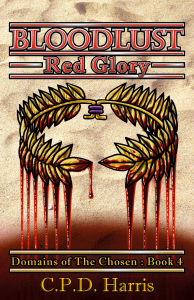
I like the idea that no matter how strong you are, there is always someone who has your number. This is one of the things that plays out nicely in Jessica Jones. In Red Glory, one of the main characters is Sapphire Kiss, a woman who will endure just about anything to get her shot at the grand championships. Unfortunately, she ends up in rough company, and despite her superhuman powers she ends up with a very human problem…
Silvius crossed the room, backhanding the Gladiatrix with enough force to knock her off her feet. Sapphire was shocked at his audacity but not his brutality. She rolled away, gathering breath to shout for help. Chosen Silvius was fast, however, and his magic was unbound. He closed before she could draw breath. The best she could do was roll with the blow as he kicked her under the chin. She spat blood and shattered teeth, but somehow got her arm in front of his next kick, which sent her sprawling into a corner nonetheless. Where were the Grey-Robes?
“Show some respect, you wretched whore,” said Chosen Silvius, looking down at her.
“You should kill me now you dog-fucking bastard,” spat Sapphire Kiss, glaring at Silvius. “If I win this tournament you and I will have a Reckoning of our own.”
Silvius’s laughter was cruel and mirthless.
“Good luck with that,” said Silvius. “I doubt you’ll have any fight left in you in a moment.”
And then he beat her. Kicking her, punching her, slamming her head against the ground. Sapphire Kiss surprised herself by actually catching a few of the Chosen’s attacks, despite her injuries. She felt her ribs crack and one of her arms fracture. She spat blood and lost vision in one eye. Then, when she was barely conscious, he stopped.
“You want to play at being a Champion?” said Silvius. “I can undo all of the damage that I have inflicted. All you have to do is beg my forgiveness, slut. Show me you know your place. Submit to your loving Patron.”
The other reason I was thinking of this passage today is that despite Sapphire Kiss overcoming her abusive patron, she is not even by a long-shot, which is a tale that would make an interesting addition to my next Domains novel.


November 22, 2015
Sunday Night Teaser: Blade Breaker
My next article on Diablo will air next week. It is getting close to release time for my new book, Blade Breaker (The Shadow Wolf Sagas #1) and I was busy getting copies out to beta readers.
Those of you who are frequent readers of the site with probably recognize the series, which is the fore-runner of my current serial.
Here is the first post of Blade Breaker.
As an aside, I really dislike that the version of WordPress that I am using now (why has it changed?) has taken away the ability for me to smart search my own posts for links… updates are supposed to be good… mmmkay?
Here is the new version of that introduction:
Chapter One: Omen of Wolves
Ragnar Twiceborn, Grimfang!
A wolf without a pack,
prowling shadow’d cobbles,
with ruin at his heel.
With the mournful howl of a wolf, ringing clear and close in my ears, I snapped awake. Heart drumming, my hand twitched toward where my weapons hung. Then I realized where I was, silk sheets and warm bodies, and I stopped. There was no rush of feet, no blade descending in the dark. I listened intently, senses taking in all of the sounds of the old stone house and the streets outside, but I could hear no wolfsong.
Had that clarion cry been just a figment of my dreams and not a warning?
The sounds that now came to my ears were as familiar as my own breath. I heard quiet, throaty laughter and the clink of glass from late nigh revels the Royal Red, a winehouse three houses down. Beyond that, the jingle of metal rings and the thud of booted feet announced a pair of city watch rounding the corner at the end of the street. Beside me, The Twins were deep in sleep’s rhythms, undisturbed.
I sniffed. The heady scents of perfume and my bedmates filled the room. The air coming through the armoured shutters was as clear and crisp as it ever was in Myrrhn, with only a hint of smoke and nightsoil, not yet congested with the morning fog. The most dangerous scent that I caught was that of a sewer viper stalking rats, but it was too faint to be nearby.
There was no noise, nor any scent out of place, and I relaxed; all was as it should be.
The wolf’s call must have been a dream then, yet such sounds usually heralded important events in my life. In Nordan Lands, the sound of wolves at night, calling to each other as they ran down their prey, was as commonplace as birdsong in the morning. Some men read fortunes in those calls, as the old Archaens claimed to read the entrails of birds. I dabbled in this, especially in the small hours when sane men sleep to shield themselves from dark thoughts.
I wondered then if I was being foolish. Perhaps the dream was just an echo or even lacking in meaning, given gravitas by late hour and sombre darkness. Would the Lord of the Black Wolves still have any commerce with a disgraced exile like myself?
As I plumbed my thoughts Eiskra shifted, burrowing under my arm. Her skin was warm and silken smooth, and her scent both familiar and divine.
“Sleep, old wolf,” she whispered before her breathing took on a steady rhythm once more. Her words and touch put me at ease, and sleep one again took hold.
<>
This second introduction is far more wordy, but it helps place Ragnar better, both in the city and in his groggy, half-awake state of mind. It shows just how eager he is for the call to action.


November 19, 2015
The Shadow Wolf Sagas: Red Fangs 2.37
Shadow Wolf time! This is part of my weekly writing exercise, written raw and rough. The first story arc, Blade Breaker, can be found here. The first story of this arc, Red Fangs, can be found here. The previous week’s post can be found here.
<>
Ironically, the Undercity of Myrrhn was more dangerous during the day; few people are compelled to venture there when the Undermarkets are closed and so some of the tunnels become havens for predatory creatures, especially those that left to hunt at night.
I led our little group through the dark and dank. I could scent anything that might be dangerous long before it would be upon us, even in a glorified sewer.
“How much further?” asked Zavra. “This place is worse than Cinder’s cellar.”
“Unless you wish to face the sun, I have to take us through these Sunken Isle passages to get between districts,” I answered. This was the part of the trek that worried me. The Sunken Isle tunnels were wild and dangerous, home to feral trolls and worse. “Unless of course, you’d like me to add an extra quarter day and go through The Portside Bowels.”
“Vradule save me!” muttered Zavra.
Berkhilda snorted, a little too loudly to be mistaken.
“Do you find my discomfort amusing, Vintul?” said Zavra. I hear her stop and turn.
“I do,” said Berkhilda, no mirth in her voice, now. “But I find your belief in the blood god moreso.”
“I assure you he is real, Vintul,” said Zavra.
“Ladies this is not the time for a theological debate,” I said, sniffing the air. “I think I can smell a troll’s lair nearby.”
“Do not call me Vintul, blood-slave,” snarled Berkhilda. “My name is Berkhilda Furisdottir.”
“Blood-slave… really?” laughed Zavra. “How you must hate what you are to use such a vile term.”
“It is what we are,” said Berkhilda quietly.
“I am no slave,” said Zavra. “Vradule sees to that. One day I you will see that embracing him is the only path to salvation Berkhilda.”
“I will take the gods of my true people over some forgotten Blood God,” said Berkhilda.
“You are fool!” said Zavra, her voice echoing down the passage.
“Quiet!” I said.
“Too wathe wiwwil man,” came a voice from the passage behind me.
I turned. An enormous humanoid filled the passage, waddling toward me. It was fat and pale with tiny, porcine eyes and a mouthful of needle-like teeth. One of its arms had a hook instead of a hand, while other held a cleaver. It was not a troll, but it wasn’t friendly. I drew my axe and hammer.
“Gonna fill ma bella!” chortled the creature.
“Oh, thank Furis!” said Berkhilda, relief evident in her voice. “I was getting sick of all this prattle!”


November 17, 2015
Teaser Tuesday
This week’s teaser is from Bloodlust: The Shield Maiden, third book in my Domains of the Chosen Series.
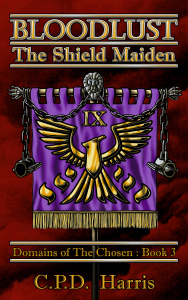
At its heart, The Shield Maiden is a tale of imperialism, strangers in a strange land, and people making the best decisions that they can when the shit really hits the fan.
Most of the book takes place on Ithal’Duin, a ‘lost’ continent that the people of the Domains have rediscovered. After an initial exploration, Chosen Brightloch, the newest of his kind besides Gavin and Sadira, forms an alliance with the people of Kirif and decides to make his Domain in Ithal’Duin. Vintia, fresh from retiring as a Gladiatrix becomes a Warbound with the Ninth Legion which joins his expedition.
The Domains are meant to be the reader identification culture in the series. The Cultures of the Domains are strange. The Kirifans frolic in the waves and live in strange towers of living coral. The Fologi are vicious man-eating Dolphins who live in Kirif. The Deoman are unknowable behind their masks, driven by strange impulses. The vast Empire of the Vvath is populated by slaves and ruled by Swords that bear the spirits of the Dwarves of Khazak Khrim.
But the strangest of all of the creations in the book is the sentient magical disease known as the Shugothoth. This creature is inspired in part by Lovecraft and in part by Everblight (from the Warmachine miniatures game, a Hordes faction). Once the Shugothoth infects a creature it can spy on the world through them and attempt to take over their body. It can then mutate the creature if it desires. The Vvath hate the Shugothoth and are engaged in the genocide of the Niyiki to stop it from spreading. We learn that Dwarves are immune to it, but only later find out why.
“ENOUGH!” snarled the First Shield. “Your demands do not matter. We have discovered this disease. We also know about your swords. We are the Ninth Legion of Krass. We have claimed this land and paid for it in blood. We will not surrender our arms to a foreign power. If you wish to make war on us, do so at your peril. Even if you kill the last of us others will come.”
“The Vvath do not fear your petty Empire,” said the Blade-Bearer. “As for your deaths, we could just leave you here. Shugothoth is no simple foe. It will starve you out until you are too weak to resist and then add your men to its ranks. You have no hope of survival but us. If you surrender, we will negotiate safe passage, under escort, for any uninfected men. Ithal’Duin belongs to us. Your skulls will decorate our walls before long.”
“Then come for us,” said the First Shield. “The Ninth Legion is ready for any foe. If any of our men wish to join you now, I will not stop them.”
None of the Legionnaires moved.
“Your leader is a fool,” said the Vvath loudly. “Your Kirifan allies have been ruined by our thralls, the Deomen. Surrender to us and you will live, if you are not infected. The alternative is to stay here and die. Our armies can fill the horizon.”
“Perhaps they can,” said Strategos Teven, stepping to the fore, “but unless I miss my mark, you won’t risk exposing most of them to this disease. Just how many Shugothoth-resistant soldiers can you afford to lose before you can no longer contain it?”
This happens to be true.
Alarmed, Shugothoth reacted to this new threat. The head of the great serpent and the beady eyes of all of the remaining Crocodilians snapped towards the Shield Maiden. A keening sound rose above the din of battle and, as one, they all charged toward Vintia.
While the Crocodilians were slowed by Vintia’s ice, the great serpent was far too massive, cleaving through the frozen water like an ironclad. Drovers and Legionnaires fired spiked guns into the beast, but these seemed as pinpricks to such a creature.
Vintia raised her shield as the serpent reared back. She could see something else, hateful and alien, staring out at her from behind the window of its eyes. She did not flinch, but returned that hateful glare with a look of defiance in her eyes. The head of the beast twitched and then dove toward her, maw gaping until it seemed about to swallow the sky.
I like the idea of looking into the eyes and seeing something else in there, something unexpected…


November 15, 2015
The Two Diablos: D&D, Game Mechanics, and Design Philosophy PART THREE.
After reading my last two articles you might be forgiven for thinking that I dislike Diablo 3. Nothing could be further from the truth. I love D3, both on PC and on console and have sunk a fair chunk of time into it. This series of articles was spurred by a recent bout of play with my Girlfriend and I playing D3 while hanging out at home with our 2 month old son, (occasionally joined by her teenage son). I love it.
Playing the the current iteration of D3 has been a great deal of fun, but I can clearly see that as good as the game is now, there are deep flaws within the basic design. These flaws are so deep that it has taken a powerhouse like Blizzard, arguably the greatest design house in computer gaming, to fix them. This week I will discuss those flaws, how they weaken the game, and then how Blizzard found a way to fix them, despite the flaws in the system.
For today, I will skip the idea that D3 is a fundamentally different game than D2, and focus on mechanical and the gameplay contract. Let’s start with talking about what a gameplay contract is and a few other definitions.
The Gameplay Contract: I could call this the ludic contract, from the Ludonarrative dissonance terms, but I prefer clarity in this case. The Gameplay Contract is entirely about the expectations that the player has when playing the game. Good game design will reinforce the Gameplay Contract, while bad game design will clash often clash with it.
Contract Dissonance: Contract Dissonance is when a mechanic, or narrative element clashes with a Gameplay Contract. A great example of this is when a player is playing a badass character and then a cut-scene occurs in which their character is rendered helpless and captured. It breaks the Gameplay Contract, the promise that their character is badass.
Mechanical Clash: Mechanical Clash is when two game systems work against each other. D3 suffers from this problem extensively, although I would argue that Blizzard has managed to polish the game to the extent that they the mechanical clash does not create contract dissonance. This is my own definition, and is not always part of the whole ludonarrative dissonance that others have defined and I am calling Contract Dissonance and The Gameplay Contract.
The Goals of Diablo III and The Gameplay Contract
When Blizzard set out to build Diablo III they had years of additional experience with systems, especially World of Warcraft, but also all of the lessons learned in game’s made outside of their company. Blizzard is a very R&D focused game studio, and so they put a lot of though into their games and tried to apply these lessons to D3’s design.
Blizzard felt that cool loot drops were a central part of The Gameplay Contract for the Diablo series. Given that Diablo is known for that, this was a safe bet. Originally they focused on rare items, since these were favoured by many players late in D2. From their World of Warcraft experience they decided that since finding cool loot was a large focus of The Gameplay Contract, then said loot should be the primary way that a player customized their character.
Blizzard was also conscious of the way that gameplay congeals around a small variety of effective builds and wanted to fight against that. Their skill system, reminiscent of Guild Wars One in some ways, allows a player to switch out abilities and try a wide variety of builds. While very, very flexible there is not a lot of depth in these builds.
For now I am leaving out the fact that The Gameplay Contract that D3 be like D2 may be broken. I’m saving that next week, so I can fixate on a pet theory of mine involving D&D 4th edition.
Systems Clash in Diablo III
If loot is the primary fashion in which a player customizes their character, then it follows that:
a) There needs to be a wide variety of useable equipment and bonuses on said equipment.
and
b) There needs to be some variety in the top tier, or most desireable bonuses on said loot.
Initially there was an enormous variety bonuses on D3`s equipment. Unfortunately the vast majority of those bonuses were useless to most classes.
Rares, the standard high level items, could have up two minor bonuses and up to four major bonuses. The minor bonuses were interesting but are ultimately trivial while the major bonuses ranged from useless to incredibly important. How did this happen? System clash.
D2’s item system is and was almost perfect. A few games have improved upon it in some ways over the years, but it still reigns supreme. D3 is build on that item system, but the game that supports it works in an entirely different fashion, which created a massive Mechanical Clash that Blizzard did not clean up until the release of D3’s expansion.
This Mechanical Clash occurs between several of the core mechanics of D3. It pits the purpose, the very Gameplay Contract of the itemization system, finding cool randomized loot that can be used to customize your character in a variety of ways, against the DPS mechanic and the primary stat mechanic.
In D3 maximizing DPS is of great importance since it is the basis of damage for ALL abilities and skills. In D2 builds that depended on damage from spells could often get away with a weapon with lower DPS. In D3 you almost always go with the highest DPS that you can get, with rare exceptions for a few important stats. This go big or go home DPS mechanic severely limits item builds.
The primary stat mechanic is nearly as crushing to item variety. In D3 each class has a primary stat. This stat gives them a massive damage increase in addition to the small bonuses that the stat already comes with. In D2 each stat had a set function more or less regardless of class, while D3 changed this up completely. In doing so they removed almost any reason for any class to focus on any stat other than their primary and vitality.
Caveat: In Diablo 2 items with Life-Drain were extremely desireable. In order to promote variety, Blizzard capped life-drain at a very small percentage of damage, especially at high levels. Unfortunately, in an oversight that seems very odd to me, they created Life on Hit/Life per second, which are even more necessary for most builds at high level play than life drain was in D2. This was just a mistake, really.
Shortly after release, as players started to get into the endgame, the limitations caused by this Mechanical Clash started to create an enormous Contract Dissonance. Players quickly realized that be best endgame gear consisted of a small number of highly desireable properties with everything else essentially being junk. The worst offenders were items with undesirable primary stats, which were just useless to most players.
Very quickly players whittled down the item system to a small number of desireable properties. Since there was no offset to be had by maximizing skill levels because of the DPS system, most builds had to maximize
Primary Attribute
Vitality
Resist All
Life per Second/Life per Hit
Primary properties related to damage (attack speed, critical, bonus damage). Given the way that DPS functions in D3 these ended up being more important than they might seem at first.
That really is a short list, especially since not all item types can have all of those properties. The DPS system and the primary attribute system prevented many of the abilities that were randomly assigned to items from having any use to most characters creating itemization that turned out mostly junk with a tiny number of desireable items and no variety at the top. This broke the Gameplay Contract and by making it hard to find cool loot and having very little variety in what was considered useful.
It is my opinion that the DPS and primary attribute systems were too deeply embedded into D3 to be changed once the game was live. This left Blizzard’s development team with the unenviable task of working around the mechanical clash to fix the gameplay contract.
Polishing a Turd into a Diamond
Let’s face, D3 was always going to do well. Much of the success in the design comes from Blizzard’s mastery of UI, look and feel, and the simple stuff that every other company seems to fuck up. Still, breaking the gameplay contract for cool loot did hurt the game. Blizzard fixed this rift with two interesting workarounds, iterated and polished over time.
Undesirable properties were removed from items, or shuffled off into minor property slots. Playing a character with a Dex primary stat? that’s cool we won’t drop loot with any other stat. other desirable properties became more and more frequent. This did away with the constant useless drops. (Along the way rares became the new blues in terms of frequency and lower level items simply became fodder for crafting)
So if every piece of equipment has a very small selection of stats that are necessary for high level play, how do you promote variety without going back and fixing that pesky mechanical clash? The answer is unique properties on artifact and set items! Basically Blizzard created a series of special items that have gameplay altering effects on them. These have all of the desirable base stats, plus some cool ability that customizes your build, even changing the way some skills function.
It wasn’t pretty, but these solutions repaired the Gameplay Contract, even though the mechanical clash remains and still limits the game. Next week I will tackle why D2 and D3 were so different in terms of basic mechanics and how that also breaks the gameplay contract for older players.


November 12, 2015
The Shadow Wolf Sagas: Red Fangs 2.36
Shadow Wolf time! This is part of my weekly writing exercise, written raw and rough. The first story arc, Blade Breaker, can be found here. The first story of this arc, Red Fangs, can be found here. The previous week’s post can be found here.
<>
“A blood construct,” said Berkhilda, her eyes widening as the enormous vampiric serpent melted into a pool of congealing blood and mounds of gore.
“That is… just… disgusting,” said Murith, eyeing the slop.
“Berkhilda, is this significant?” I asked.
“It means that Cinder is very powerful,” said the massive warrior, frowning. “All vampires can control blood to some degree. I use this control to stop bleeding and reinforce my armour when I am wounded.” She pointed to a shining patch on the side of her plate that looked as if someone had filled the hole with red glass. “Creating a long lasting independent construct of this size requires powerful blood and a great deal of skill.”
“Could your father do it?” asked Murith.
If the accusation bothered her, Berkhilda showed no sign. “His blood is potent enough, but he was never interested in blood constructs beyond a form of art. He has made a few long lasting sculptures that I know of, but I have never seen him animate anything.”
“So this is a rare ability, you would say?”
“Very,”
“That could help us identify Cinder,” I said. “Zavra, other than one being small and one being big can you think of anything else that might lead us to your assailants?”
“I know they accessed the Undercity from somewhere in here.”
“That’s useful,” said Murith. “I bet the entrance is trapped.”
“Yes,” I agreed. “On the other hand, it does mean that we won’t have to stay here. Maybe they left a trail that will help us figure out what Cinder is doing here. What else Zavra.”
“I suppose I could identify both of them by smell, though I don’t know how that will help,” Zavra answered reluctantly, as if she feared we might drag her around the city, sniffing for Cinder. The pain and fear of her captivity was wearing off, and she seemed more wary now, particularly of Berkhilda. Mind you, who wouldn’t be somewhat intimidated my a vampiric Nordan berserk?
“Well then, we should look around carefully then head out. Berkhilda and I can take the Undercity route and escort Zavra to safety after we search for a trail.”
“I have to report this,” said Murith, appearing from another room. “The watch will want to recover my squad.”
“I’m sorry, Murith,” I said.
“I don’t want your pity now,” said Murith, sounding tired. “What I want is a shot at this Cinder and his crew when you find him. This cannot stand.”
“I’ll be happy to have you at my side,” I said.
Berkhilda looked ready to speak, but though better of it.
“The tunnel entrance is not trapped as far as I can tell,” said Murith.
“That’s odd,” I said.
“I will go first,” said Berkhilda.
“It might be that they wanted to keep it clear in case they needed to make a quick exit,” said Murith.
“Or maybe they needed it clear for whatever they wanted to steal,” I said.
“Could be, I may be able to determine what was stolen just from going through today’s reports,” said Murith.
“Good, let’s meet up later,”
We parted ways. Berkhilda and myself, with Zavra following, climbed down a long ladder, descending into the Undercity.
<>


November 10, 2015
A Teaser for Tuesday
This week’s teaser comes from Bloodlust: Will to Power, the Second Domains of the Chosen Book
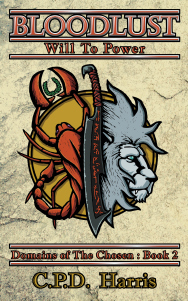
The Cover for Bloodlust: Will to Power
One of my guilty joys is writing nasty characters. I loved describing Karmal’s casual viciousness, Scarmaker’s skin-crawling predatory sadism, and even Zellin’s fractured, dissonant mind.
Ultimately that kind of villain is rare is real life. Even betrayal by a trusted friend is not common for most people. On the other hand, in modern life, our media is inundated with brutal punditry, misinformation, and nasty personal attacks. Gaius Gerald White and his wife Octavia Victoria White are representative of that kind of villainy in the Domains. They control the Arena Post, a journal that covers all of the salacious Gossip surrounding the Great Games and certain popular Chosen.
Gaius uses his perch to attack Sadira, saying she is more of a diva then a fighter. This follows the real world, where I find tabloids tend to target pretty young women and then pester them ceaselessly to get them to disintegrate; or at least they did until the Kardashians became professional trainwrecks (No insult intended, I actually think that this might be an astute business move, fulfilling a obvious demand). Gaius doesn’t bother with the truth about Sadira, instead selling constant tales of affairs, orgies, and romps.
GG White is a demagogue, almost a caricature of people like Rupert Murdoch. He works well in the Domains of the Chosen series because he represents the kind of ugly attention that fame and power can bring and also because he is an antagonist that Sadira cannot overcome through brute force, at least without succumbing to villainy herself.
In Red Glory his wife reveals that he has several servants, bodysculpted to look like Sadira. Nasty.
Later on, his focus moves to Gavin:
Will somebody please kill this man?
Whenever I am overwhelmed by the paltry politics and relentless regulation of The Great Games, and need to be reminded about what I truly love about the Arena, I make my way to a wonderful little place called Dregs and watch a Death Leagues match. I find that the raw, brutal purity of these games can cleanse even the worst of the contrived machinations of the Faction Games from my mind. It is a sacred pilgrimage for any true fan.
Rabble matches are a particular favourite. No other event strips away the veneer of civilization to show our true nature. The desperate men and women of Dregs pit themselves against a Gladiator of the arena, or a fearsome monster, in one last gamble to better themselves. It is all or nothing. Most of them will die, but a few of the strongest will survive, earning a better life over the broken bodies of their competitors. Many a great man has shown his will to kill as a rabbleman and gone on to greater things. It is a true lesson about the raw nature of life, and one of those events that everyone who loves Great Games should experience at least once.
Imagine my disgust when I ventured for my pilgrimage and encountered a Gladiator in the Death Leagues who was actively working against the traditions of our last connection to the games of old. Lionfang, some reject from the Faction Leagues is working his way through Supplicant’s Arena so he can challenge Valaran diVolcanus for killing his friend.
Here I was watching a rabble match where no one was dying. I felt violated, as if I was losing some vital part of myself. Thank Ezuis that Baron Bones was there to rescue the match. The rules that The Deliberative impose on the games, do allow a Gladiator to show mercy if he wishes, but these are the DEATH LEAGUES. If you don’t want to kill, by the ancestors, stay out!
I’m all for vendettas, but this Lionfang does not belong in the Death Leagues. Someone kill him before he turns our last great traditional league, a true treasure of the Empire, into yet another rules-bound faction fan-wank.
-G.G. White
Ah, the appeal to tradition to justify the horrors that we inflict on others. I think that I will leave it there.


November 8, 2015
The Two Diablos: D&D, Game Mechanics, and Design Philosophy PART TWO
This week I am continuing my breakdown of the main mechanical differences between Diablo 2 and Diablo 3 [Click here to read the first part]
Before I delve into the the major differences again, I think that it is important to point out that there is a huge disparity of time between the two releases. Diablo 2 was released in 2000 and Diablo 3 was released in 2012. Interestingly the editions of D&D in publication at the time if release were 3rd and 4th edition respectively: I find that significant for several reasons, and I will write about that after I break down the major feature differences, likely next week.
Skills
D2: Diablo 2 was an early pioneer of skill tree systems, and certainly the most dominant game of the time to use them. The skill trees offered both active, passive, and uniquely flavoured class skills like paladin auras or barbarian shouts. Each class had around 30 different skills once everything was unlocked. Each skill could take up to 20 skill points to maximize (excluding items, which could push the total up to 30 or more IIRC) in effectiveness.
A maximum level character could have up to 110 skill points at level 99, spread out over 30 skills with up to 20 levels this made for a large potential variety in builds.
Some skills were weaker than others or just did not fit into popular build strategies. Thus, despite the high potential variety, it was argued that actual variety was fairly small in top tier character builds. This was something they tried to address in D3.
Some skills had “sweet spots” other than maxing the skill out, while the main skills used by most builds generally desired a full 20 levels at level cap.
As a counterpoint, viable builds did have some variety within each build beyond just the core of that build.
Mana costs often increased as the skill went up in level. This could result in an odd situation or sweet spot where the player would not want to increase a skill just because the increased cost to effect ratio did not work out. Some skills would decrease in mana cost at higher skill levels as well, which was inconsistent.
Skill trees followed a set pattern to get to higher level branches on the tree. This led to characters having to take points in skills that they would not always use. It was fairly minor, but aggravating to some players.
D3: Diablo 3 moved away from the skill tree and followed an entirely different skill system. Skills are divided into active skills and passive skills. Each active skill has six runes that can alter the effects of the base skill, often radically. The idea behind this was that there would be a higher variety of builds in D3, since every skill is viable. In practice, however, the variety is limited in the same way as D2 since some skill/rune combos simply work better with the build you want. D3 makes it very easy to switch skills, runes, and passives which create a sense of fluidity in the character.
Instead of mana each class has its own unique power pool which helps create a unique flavour for the class.
Honestly, aside from different names and different colours the different resources do not really change playstyle too much. If you notice them at all, it is usually because you have run dry…
Runes often alter the damage type of the skill. This allows every class to build around certain damage types without limiting their endgame. On the other hand, given the way DPS scaling works in practice you want your skill damage types to match up with any weapon bonuses as much as possible, which can be limiting.
Skills in D3 do not have levels. This follows in the same vein as attributes. The way to make your skill more powerful is not to put skill points into it but rather to level your prime attribute, mostly through items, and increase the DPS of your weapon.
Items can radically alter some skills, often in very powerful ways.
Damage
D2: In Diablo 2 damage can come from multiple places. Spells had their own base damage determined by skill level. Strength added to melee weapon damage, while dexterity added ranged weapon damage. A mage character could viably use a weak weapon with desirable bonuses instead of having to max their DPS so long as they had a decent level of skill in their spells.
D3: In Diablo 3 all attacks use the same DPS, determined by the weapon the character wields and their primary attribute level. This same DPS level determines the characters base damage for all attacks. Thus your wizard had better well be really well armed.
I cannot emphasize how much this makes the two systems play differently, especially in conjunction with the primary attribute system. Weapons in D3 are ridiculously important and weapon damage, along with the bonuses accrued by equipment to your character`s primary stat take the place of skill levels as a provider of damage and even advancement. Shoehorning everything into one stat seems to reduce the variety of play in the game, which seems greatly at odds with the desire to promote variety.
The DPS system in D3 was the first indication to me that the game was overdesigned. I will discuss what I mean by that later, but basically it is a level of polish in a system that smooths the game out but makes it rather bland at the same time.
Oddly monsters in D3 mostly kill the player with ground effects.
Scaling
D2: In Diablo 2 monsters had a set power level based on what act on what difficulty level you encountered them on. Damage scaled based on weapon wielded, attributes, and to a huge extent the level of the skill being used. If an area was too tough the player could level up and keep trying until they overcame the enemy.
D3: In Diablo 3 difficulty scales with the player and player choices. If an area is too tough, which is unlikely given how smooth the game is, the player can change the difficulty (this is different than when it was first released, when it followed a similar system to d2). You cannot overcome content by outleveling it in the same way that you could in D2.
On the other hand you have the ability to start the game on a higher difficulty with new characters, which is nice.
The addition of paragon levels to D3 did add some customization to the game, although it is still limited by the game`s inflexible approach to stats.
Gear
D2: Gear is very important in Diablo 2. Items can make a huge difference in power level. Gear is randomized and is one of the major rewards of playing, beyond simply gaining levels. The Gear system in D2 influences a huge number of modern games.
Gear in D2 did scale, but that scaling was not nearly as regimented and the most powerful gear could be found and equipped long before reaching level 99.
D3: Gear in Diablo 3 follows the same scaling patterns as World of Warcraft and other MMOs, increasing greatly in power from level to level.
Until you reach maximum level in D3 your gear, especially your weapon is disposable. Find an awesome artifact? well it will be good for a few levels at least. This is because the whole game was designed around gear advancement and then balanced to perfection and beyond.
Gear in D3 is the main method of mechanical customization. I would go so far as to say that what to equip is the only meaningful choice beyond class that a D3 player must consider.
Gear in D3 has a large variety of properties, however, many of these properties are less desirable as others. DPS, Primary attributes, Vitality, and regeneration are of supreme importance. Given that character advancement is so dependent on gear desirable stats become must haves and the variety in gear is actually reduced to better or worse and a few rare abilities that only occur on artifacts.
Ultimately The gear system in D3 is where all of the overdesign problems came home to roost and I think it is at the root of why so many people feel the game was not better than its predecessor, despite a much bigger budget. I will tackle that next week!


November 5, 2015
The Shadow Wolf Sagas: Red Fangs 2.35
Shadow Wolf time! This is part of my weekly writing exercise, written raw and rough. The first story arc, Blade Breaker, can be found here. The first story of this arc, Red Fangs, can be found here. The previous week’s post can be found here.
<>
It took Git several long minutes to clean the blinding serpent’s venom from my eyes with the cloth to his satisfaction. Berkhilda was kneeling above the stricken vampire woman that we had rescued. As I watched she pulled a heavy wrought flask from her side, unstoppered it and poured red liquid down the woman’s throat. The scent of blood, magnified by great potence, reached my nose. The woman stirred, and the brutal wounds on her shoulders where she had been pinned to the wall above the tub began to close. A moan escaped her lips and she looked around, more alert now, less terrified.
“Thank Vradule,” she said.
Berkhilda frowned “It would be better to thank the gods of the North, Furis and Skygge. They had more to do with your rescue I wager than the god of blood.”
The woman smiled up at the dour warrior. “Perhaps it was he that brought you here, kinswoman, after all you are one of his chosen people as well, are you not?”
“I do not count myself among them,” said Berkhilda, standing.
“Do not be offended,” said the woman. “You pray to your gods, I will follow mine. Please forgive me. I am Zavra.”
“I am Berkhilda Furisdottir of Clan Bloodaxe.”
“You are Lazar Vintul’s daughter are you not, Berkhilda?”
“I am,”
Git was finished. I saw Murith examining the various devices around the room. It would not do to trigger any of Cinder’s traps. The vampiric cobra had left us battered and bruised, and with daylight breaking outside Berkhilda and Zavra would have trouble moving around outside. I stood up and raised my voice.
“I am Ragnar Skyggeson, called Grimfang,” I said. “We have some questions for you Zavra. Firstly, do you know why Cinder brought you here?”
“Cinder?” said Savra, her face twisting. “Who would name their progeny after that old apostate? I was on my way home from a feeding party in Redsilks when we were ambushed. I lost my guards in the confusion. Some massive oaf dragged me here. I remember going through parts of the undercity. They… they speared me to the wall. It was a big one and a smaller one, both hooded. I passed out. I am not very good with pain. They gathered my blood and fed it to others down here. They planned to turn a bunch of them. When I last woke, everyone was gone, except the snake. It was… it was going to eat me… I know it! Thank Vradule you came.”
“Do you know why they wanted you?”
“I… I have strong blood.”
“Strong blood and a weak will,” said Berkhilda evenly.
“Not everyone is a fighter,” said Zavra, looking away.
“Strong blood?” I asked.
“Don’t you know anything Ragnar?” said Git, looking up from where he was examining the tub full of blood. “Some vampires have more potent blood than others. That trait is passed on by the vampire who creates them. Something about those who have it changes the blood they drink. It is fascinating stuff really.”
I looked at Berkhilda, she shrugged.
“So he wanted you for your blood?” I asked Zavra.
“The big one said that it would look bad on the watch if they killed me,” said Zavra, lips trembling. “I remember that distinctly. The two of them, just sitting there, talking about me like I was already dead. It was horrible.”
“What about–” my question was interrupted as the enormous serpent suddenly began to melt, flesh sloughing of bone, bone loosing shape, and both turning to blood before our very eyes.
“A blood construct,” said Berkhilda, her eyes wide.



