
C.P.D. Harris's Blog, page 41
December 22, 2015
Teaser Tuesday
This week we have a teaser from my new book Blade Breaker (the Shadow Wolf Sagas #1).
Questions flooded my mind. I wanted proof that he was telling the truth. Did he have someone who could prove that he was not the one who had killed her? Likely not if The Guild was looking into it. But first, I had to show the assassin where he stood.
There is a reason that they call my clan The Shadow Wolves.
A low growl, like that of a large wolf, rumbled from the shadows behind us. The sound was full of menacing intent. The assassin stiffened and then I made my move.
Poison has little effect on Twiceborn; I was not as helpless as he thought.
The assassin was fast. It is a vital trait in his chosen profession: even with the element of surprise on my side, he managed to cut my throat as I moved. Turning my head prevented the laceration from being truly bothersome, but only by a hair’s breadth.
My original plan had been to reach over my shoulder, grab him, and throw him to the ground. When my grasp closed on nothing, I rolled forward, grabbing my axe, coming up facing the room. A knife flew through the dark, grazing my ear. Snarling, I threw myself forward, holding up the axe to help ward off any further missiles. The assassin did not shy away from me, despite the disparity in our bulk. A swift kick to my knee, hard and painful, was followed by a stab to the shoulder as I staggered. Twisting deftly I hooked the blade with the crow’s beak backspike, aiming my fist at his head as I pulled him toward me. Rather than resist, the assassin cannily shifted his momentum, pushing in the direction that I was pulling him in and darting under my punch. He whirled, throwing another small blade at me. It took me in shoulder, close to my neck. I felt it prick me, but it was a small wound.
The idea behind the Shadow Wolves is that they are the clan that puts effectiveness over honour. They are stealthy, sneaky, and value cunning. Their Gods are Garms, the Fate-Thwarter, and Skygge, the lord of secrets and shadows. Ragnar stood out among them for being honourable, and thus earned a place in the Kingsguard.
The wolves in question themselves are something else entirely — a secret that is slowly revealed over time…



December 21, 2015
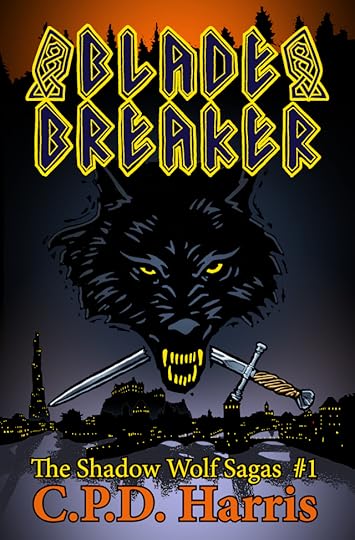
Blade Breaker Released!
I am pleased to announce the first book of my new series has been released. Check Blade Breaker out on Amazon!
Also I saw Star Wars last night, so no post…


December 15, 2015
Teaser Tuesday
Here is an excerpt from my newest book, Blade Breaker, which should be out next week, pending a little more editing, and a little cover work.
They call the place the Spearmarch because the tall pines loom like the pikes of an army alongside the old, well-travelled roads. It was peaceful, deep within the royal Domains and surrounded by the lands of the Great Clans on every side. No one expects an ambush in such a place.
We only had a handful of scouts and outriders. These were overwhelmed instantly. Thus, when the depths of the Spearmarch disgorged a horde of Skraelings fit to overrun an army ten times our size, it stunned me. How could such a thing happen, here in the bosom of our lands? Such was the sense of disbelief that men who would normally throw themselves into danger lost heart. When the enemy charged, shaking the ground under their innumerable boots all seemed lost.
Yet, Siggurd Stormbreaker, the High King of all the North, refused to run. He moved calmly to the front of the army, pushing his way through his protesting Kingsguard, myself the only member of the Shadow Wolf Clan honoured with a position among them in more than a hundred years. His gaze swept the enemy and then he spat dismissively and lifted his sword, Garmsbita, above his head. Invoking the Gods to witness the battle he rallied. His last line, the last words from my king are still clear in my mind.
“Stand with me now brothers and let us show Gods and Ancestors that we are brave and true; Come ruin! Come glory! Come courage and red joy!”
We met them head on, charging into the onrushing horde instead of taking up a defensive position. Thyra was beside me, bright and strong. At first we made great headway. We formed around Siggurd and clove into the screaming, frenzied Skraelings, seemingly unstoppable. Were we not the men and women of the North? Was Siggurd Stormbreaker not the very king who had routed The Devout in his youth?
Bright blades rose and fell, red with blood. The air was thick with the war-shouts of the North and muttered oaths to the Gods of my people. We killed and killed and killed, and although the enemy was all around us, we did not waver.
Then a Murder-Wight, fearsome and fell-handed came upon the High King at the forefront. Dread was the blade it wielded leaving a trail of shadow in the air. It cut down two of the best men among us in a heartbeat and then it was upon the King. They fought and it seemed to me that both armies paused and parted to watch the struggle. The Wight was swift and strong, but the king was hard as iron and battle-wise. A sudden stumble caused my heart to leap, but it was just a ruse. Cunning Old Siggurd caught that terrible sword on Garmsbita and then struck the Wight’s head from its shoulders in a single blow. It was glorious.
For that one moment we felt as if we could do anything. We howled and my voice mingled with that of Thyra screaming next to me. Our weapons were light as air, our armour was unbreakable. Each man that fell was a hero. We pushed on; full of life, all cares forgotten.
Then, just as the enemy seemed sure to break, I caught sight of a shadow behind the High King and then he was gone. There is something broken in my memory of that moment. My mind cannot make sense of the image, and it is as if the identity of the killer was ripped from me. This recollection was no different.
When Siggurd fell, the tip of our spear was blunted. Confusion reigned; and we faltered as word of the king’s death spread like wildfire in dry grass.


December 13, 2015
‘Man’ on the Street Interviews: Why do so many people support Sauron?
I have been working on my next book release, Blade Breaker (Shadow Wolf Sagas #1) and I am somewhat busy. So instead of a regular post today I am going to indulge in my interest in politics.
Some of you may not know this, but I am an ardent supporter of the Free Peoples of Middle Earth. I cannot understand why any reasonable person would ever supports Sauron. Yeah, I know Denethor and Boromir failed, and Frodo did not live up to expectations, but I could never bring myself to support a faction that is directly associated with Melkor. I mean seriously, that dude will destroy the planet to get what he wants.
Now I know that will rile some of you up. So, in an effort to understand the other side I have sent veteran reporter Stinkyknob Spleenripper the half-troll out to ask orcs, men, and others why they support Sauron. Here are some of the opinions we gathered.
Sharku, goblin warg rider
“I don’t really care about him, but I don’t care about Gandalf or Minas Tirith either. I don’t support either side, deep down. But I think it would be funny if someone like Sauron actually won. It might shake things up in Middle-Earth.”
Bolg, son of Azog (note that Bolg did this interview on the condition that we point out that he was also in the books, or as he put it, the not bad version of the Hobbit)
“Sauron says what he means and doesn’t mince words. He isn’t afraid of what anyone thinks of him. I’m tired of the political correctness of the Free Peoples. I mean if I want to call Dwarves and Hobbits stunties, isn’t that my right? If I want to chop them up and eat them, isn’t that part of my culture and heritage? We need a leader like Sauron to stop this tide of Free Peoples before they tear down the border walls of Mordor and let all these jerks in. Have you ever seen an elf work a day in your life? No.”
Gorbag, a Captain at the Black Gate
“Sauron is strong on security. He is the best leader. After the fall of Isengard that is exactly what we need. If you don’t like a fiery giant eye watching you, I have to ask what you have to hide? You’re probably soft on Rohorim. Where do you think all the grass in Mordor went? That’s right, the horses ate it. They ate or grass. Sauron is the only one who can save Middle-Earth.”
Olog-Hey, a Cave Troll
“Middle-earth is broken. I support Sauron because we need to hit rock bottom before we can fix anything. We need to break the system before we can get anywhere. I mean look at all these Free Peoples leaders. Gandalf, Elrond, Galadriel… they’re all basically the same. They aren’t fixing anything! They nearly gave the ring to that monster Boromir for fuck’s sake!”
Hoarmurath, Nazgul
“Sauron has executive experience. He’s a Necromancer. I think that a guy who can get the economy of Mordor running efficiently can do a better job with Middle-Earth than career leaders like Denethor and Theoden.
Sauron knows how to negotiate. He is the most convincing man you have ever met. Trust me on this. No one else would have been able to get this ring on on my hand. Once he told me about his tax plan, I just couldn’t resist.
Sauron will make Middle Earth great again. Then we will finally be able to show the Noldor that we are the greatest land of all!”
Zerleg, Easterling
“I saw a Hobbit yesterday, outside of the Shire! They love drugs and will eat all of our food. We need better border security. Only Sauron has a plan that will guard all of the approaches from the West. Only Sauron is willing to use Giant Spiders to protect us.”


December 10, 2015
The Shadow Wolf Sagas: Red Fangs 2.40
Shadow Wolf time! This is part of my weekly writing exercise, written raw and rough. The first story arc, Blade Breaker, can be found here. The first story of this arc, Red Fangs, can be found here. The previous week’s post can be found here.
<>
“So tell me Zavra, did Cinder really think that someone like you could fool us?
Zavra stopped moving, her eyes almost comically round with surprise. Berkhilda chuckled at the other vampire’s expression.
“Wh– What?” said Zavra. “You think I’m working for Cinder? I was left for dead back there, standing in a tub of my own blood. Ragnar, please…”
“It is no use Zavra,” intoned Berkhilda. “We can see the trail you left for the wight to follow. Cinder needed powerful blood to create the serpent that attacked us, but he did not use yours. You are in league with our enemy, there is little doubt.”
“You hate me because I embrace everything that you dislike, Vintul,” snarled Zavra. “You just want me dead because I remind you that most of us don’t see eternal life and youth as a curse. Vradule has blessed us both, the difference is that I can see that.”
“I embrace the honour of my true people.”
“You’re a fool then. We have given you so much more than they have. What would you be without Vradule’s gifts Berkhilda. Would you even be half the warrior that you are now?”
Berkhilda just stared. Zavra’s comment seemed to have struck a nerve.
“Be that as it may Zavra,” I interrupted. “We know that you are working with Cinder.”
“What proof do you have of that?” Zavra asked angrily.
“Firstly the trap that Cinder left you in was incomplete. There was no mechanism that would result in your death. That on its own is not truly incriminating, but coupled with Berkhilda’s observations it is pretty damning.”
“Cinder left in a hurry. How do you know her forgot to set the trap?” said Zavra.
“I don’t. But that did make me suspicious of you. Which got me to thinking that the sewer entrance was locked from the wrong side. You shut it after Cinder left, then strung yourself up.”
Zavra’s demeanor changed then. She went from looking like a scared aristocrat to a defiant rebel.
“Let me kill her,” said Berkhilda, lifting her axe.
“I would rather she take us to Cinder. Bring us to him and we will let you live, what do you say to that Zavra?”
“I hope he kills you,” she snarled.
Berkhilda growled, showing her fangs. Zavra deflated.
“You are out of options Zavra. My friend here is from Clan Furis of Great Clan Bloodaxe; they aren’t exactly forgiving of their enemies.”
“I will lead you to him,” said Zavra. “He has a warehouse in Splinterside.”
“How many men does he have there?”
“Only a few,” answered Zavra.
“She is lying,” said Berkhilda.
“If you lead us to his lair, what do you think Cinder will do to you if they manage to kill us Zavra?”
“He would torture me, then kill me in the most excruciating manner he could think of,” Zavra answered. “I would regret being born.”
“So are you going to be truthful about what we need to kill him?”
“Very well. He has dozens of newly made vampires in his warehouse and a handful of more experienced servants. They have lookouts and most of the entrances are trapped.”
“But you can get us in, can’t you?”
Zavra made a strangled sound. Finally she spat out a single sullen word.
“Yes.”


December 8, 2015
Teaser Tuesday: Leagues in The Domains of the Chosen
This week’s teaser is from Bloodlust: Will to Power. As usual, it will be up for free this Friday on Amazon.
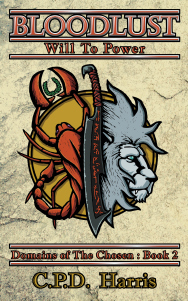
The Cover for Bloodlust: Will to Power
As a Canadian I have always been fascinated by the idea of sport’s leagues. I first became aware of this when my grandfather was discussing the differences between the rules of the CFL and the NFL. Now, I don’t follow sports directly, but the passionate discussion of minutiae and how a simple rules change can impact a game falls directly into my love of anything game related. It stuck with me, and when time came to write the Domains series, I remembered those discussions.
There are numerous Leagues in the Arenas of the Krassian Empire. The Faction Leagues, the games put on by popular political parties, are the most widespread and influential. But there are others…
“I see,” he said. “You’re both Gladiators, ranked six… Faction Champions, albeit from a small town in the south… Decent records… Still in good standing with the Reds. I see no problems here, honoured Gladiators. Do you wish to join the Free Leagues?”
“We do,” Gavin answered, cutting off any chance for Ravius to exercise his wit. They had, after all, stood outside in the rain and mud for several hours for this very reason, but the clerk still needed their official acquiescence.
“Agreed,” said Ravius.
They both touched their thumbs to the clerk’s link device to finalize their agreement.
“Very well,” said the clerk after a few more minutes of fiddling with his link. “The trials are tomorrow. It will count as a regular match for your career ranking purposes. We will be taking the best two fighters from each trial, win or lose. I have entered you both in the trials appropriate to your training class. Please feel free to browse through the trial rules on your way out.”
Ravius smiled brightly at the clerk, but his expression quickly darkened after they stepped outside.
“Champions of a small town?” he grumbled. “That’s more than he’ll ever be. I’ve been poisoned, cut, set on fire, stabbed, and stepped on by a giant. I’m damn proud of what we have accomplished!”
“You can get your revenge by winning, my friend,” said Gavin.
<>
Here is a rundown on the leagues:
The Faction Leagues: in the Faction Leagues, each Gladiator fights for a particular faction in various challenges. Gladiators earn points for their faction in each challenge, which are tallied at the end of the season to see which Faction ‘wins’ a particular arena. The Faction Challenge system is so complex and strategic that it requires an additional layer of management, but this only seems to endear it to modern fans. Factions are essentially political parties with massive sports franchises and are based on the old Chariot Racing and Gladiatorial factions (which also used colours, as in red faction, whote faction etc) from our own history. The Faction Leagues have their own feeder leagues and are the primary goal for any Gladiator who wants to make a name for themselves.
Independent Arenas: Independent Arena Masters are not required to host any League.
The Free Leagues: The Free Leagues were created as a no-nonsense League free of any of the restrictions and complications. Any Gladiator can join the Free Leagues, as long as they can pass a trial. Free Leagues Gladiators choose their own matches and can fight for a faction if they desire.
The Death Leagues: In the Death leagues every match is a Deathmatch. The Death Leagues hearken back to when the games were pure, or so they would have you believe. Gladiators who survive here gain influential backing which can get them into the Grand Championships.
The Skyclad League/The Skin Leagues: In the Skyclad Leagues the Gladiators are required to wear more revealing armour. Even the Heaviest armoured Gladiators must bared their face, chest, genitals, and buttocks in this Leagues. This new League is popular, for obvious reasons, but most fighters and ‘true fans’ look down upon as mere titillation. The monsters often have a sexual theme as well and more than a few detractors call this league by darker names.
The Master’s League: The Masters Leagues is reserved for Gladiators of Master Rank. In practice only former grand champions and popular masters really get to fight in it.
The Heretic’s League: This League is reserved for Heretics seeking to redeem themselves and gain citizenship.


December 6, 2015
Sunday Night Teaser and naming vibes.
This week I have a little teaser from my next book: Blade Breaker, which is a re-write of the first Shadow Wold Serial and should be familiar to anyone who reads this blog regularly.
The Inn of the Willing Wench always seems to me to be the perfect temperature. Perhaps it is simply my love of the place that makes me think so, or perhaps it is a little of Brunor’s magic. After my visit to the Pink Pearl and violent encounters with both a gang of thugs and a pair of assassins while investigating the origins of a peculiar poison, I was looking forward to lubricating my mind with the best bitters in the city. Brunor’s Brews are rightfully famous even among the Nordan, traditional recipes passed down through the centuries. Tis one of the many reasons that the Wench is my favourite tavern in Myrrhn.
As luck would have it, Brunor himself was working that night, along with his daughter, Limra. As was tradition when the old dwarf was working, the place was in a festive mood. There was a small spiced drake, one of Brunor’s specialties, roasting alongside the usual boar and beef.
The thought of meat, rare and red, soon had me salivating. A good meal did me wonders when hurt. Although, truth be told, my pride was wounded as well; the idea that someone had gotten the drop on me did not sit well. It had been sloppy not to be extra cautious when doing predictable things like visiting a friend. Whether an actual physical need or a spiritual one brought on the response, I cannot say.
After devouring a delectable chunk beef seasoned with cracked peppers, I settled in to a pair of mutton shanks, another house specialty, finished with a succulent apple glaze. Normally, I prefer my meat plain, but I made an exception for the Wench’s wondrous fare.
I often worry that the name Inn of the Willing Wench might offend some people. We live in an age where everything is politicized and people seem to look for reasons to get offended.
In this case, the name comes from a Fantachronica game I ran in university. Changing it would feel like I am doing that creation an injustice, or even engaging in dishonest whitewashing.
In the end, rough nuggets of world building like this probably lend the setting more authenticity. It is better to write honestly, as if no one is judging.


December 3, 2015
The Shadow Wolf Sagas: Red Fangs 2.39
Shadow Wolf time! This is part of my weekly writing exercise, written raw and rough. The first story arc, Blade Breaker, can be found here. The first story of this arc, Red Fangs, can be found here. The previous week’s post can be found here.
<>
“Its not over yet,” said Berkhilda, glaring at Zavra and hefting her axe.
There was a certain gleam in her eyes, the half-mad glare of a woman too far gone in battle-rage to act sensibly. I stepped between the two.
“What do you mean by this?”
“She hates me,” said Zavra, her voice thick. “She hates all of our kind.”
“You and I are not of the same kind,” snarled Berkhilda. “This one left a trail–“
“You are a vampire Vintul, just like me–” Zavra tried to shout over the larger woman, almost pushing past me. She was small, but strong.
“– FOR THE WIGHT TO FOLLOW,” roared Berkhilda, eyes bulging with barely contained rage. She loomed over me, quivering with rage.
I found myself chuckling. “I don’t know, Zavra, she certainly seems to follow the conflict resolution strategy of her Clan.”
“What?” Zavra seemed confused. Calm settled over Berkhilda, but she did not move back; she was intent on the other vampire.
“You said she left a trail for the wight to follow?”
“Markings on the walls,” snarled Berkhilda, pointing behind her. There was a clear mark on the corner.
“I was marking our way in case we got lost,” said Zavra. “Isn’t that what you do when adventuring in the Undercity. I’ve read so very many stories about it.”
It was obvious to me that she was lying then, but difficult to discern why.
“Of course, of course. That works best for armed groups that are expecting conflict Zavra.”
“Oh Vradule, I am sorry Ragnar,” said Zavra, deflating. “I led it right to us.”
“You owe Berkhilda an apology as well…”
My eyes met Berkhilda’s: an understanding passed between us. She knew that I was watchful know. Zavra’s behaviour was deeply suspicious.
“As you wish,” said Zavra. “I am sorry, Vintul.”
“You will call me Furisdottir,” said Berkhilda.
“Why do you deny your heritage?” said Zavra. “You were born to one of the great lineages. Your blood is potent. You are a veritable princess.”
“It is not pure,” answered Berkhilda. “My mother’s people are honourable. My father’s are parasites at best and monsters at worst.”
“You must be one of the monsters,” sneered Zavra. “You hate your own kind. Is it true that you have drunk the blood of our kind?”
“It is,” said Berkhilda. “But they were all bad. I was cleared in tribunal each time.”
“A convenient excuse,” said Zavra. “Did you know that drinking the blood of another of our kind can make us more powerful, Ragnar?”
“What are you getting at Zavra?”
But she ignored me, once again confronting Berkhilda. They were so mismatched that it seemed like a pup admonishing the father of wolves on the surface.
“You have everything Vintul, and yet you deny your true bloodline and play at being a Nordan,” said Zavra. “So many people would kill for the gifts that you have been given. It disgusts me that you waste them and dny our people.”
“You act as if we have been persecuted unjustly,” intoned Berkhilda. “We have not. Our people may live in relative peace in places like Myrrhn and Grundoone, but we have done great harm in the past. I consider the part of me that craves blood a curse.”
“If you are so cursed go stand in the sun!” said Zavra.
“I will not,” said Berkhilda proudly. “I will earn my place in the hall of heroes with great deeds and erase the taint on my soul with heroism.”
By now I was positioned behind Zavra. I looked at Berkhilda, who smiled, showing her sharp teeth.
“So tell me Zavra, did Cinder really think that someone like you could fool us?”
Zavra froze.
<>


December 1, 2015
Teaser Tuesday
This week’s teaser is from Bloodlust: A Gladiator’s Tale
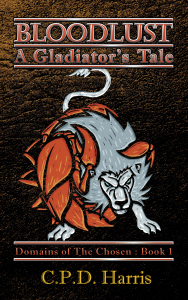
Cover for Bloodlust: A Gladiator’s Tale.
This week’s selection is from the start of the book. The writing is a little raw, being my first book and all.
While this scene seems like simple exposition, just a gladiator choosing his armour while a shop attendant flirts with him, it is meant to plant a few seeds in the reader’s mind. The first is the question of objectification. Gladiators are performers, after all, and crowd appeal is at least part sex appeal. The second is underlining that the rules of the arena are not meant to simulate those of battle. There are no spectators showing thumbs on the field of war, after all. The third is to remind readers that weapons and armour were subject to a fair amount of fetishism in warrior cultures.
“Um… Hello. I need armour for a match… this afternoon,” Gavin said a little nervously as Isabelle met his eye. He silently cursed his voice for not sounding as suave and heroic as he imagined it should.
“Well, unfortunately, that leaves out anything custom fitted; I can only do minor alterations in that span of time.” She allowed the barest hint of reproach to be heard in her voice, so that he would feel that she was doing him a favour. She smiled inwardly at Gavin’s shyness; the game was already won as far as she was concerned. “What armour class are you?”
“Middle,” he responded, unable to take his eyes off her as she closed in on him. “I’m looking for a breastplate, bracers, greaves, and also a shield.”
“Have you given any thought to style and colour, Honoured Gladiator?” she used the proper honorific to tickle his pride while she stopped at his side, just near enough to occupy his personal space.
“Um…” His thoughts were suddenly dashed upon the rocks as he became acutely aware of her scent and the nearness of her body. Her lips were a glossy crimson colour.
“Did they not teach you about the importance of style in your training?” She sighed, turning and moving away, rummaging for the tools she would need. She heard him let out his breath. Long ago she was surprised at how many novice male Gladiators did not pay attention to such an important facet of their career, but she had long since gotten used to it. She walked past him toward the fitting section, making sure to brush up against him, just so, as she did. “Follow me, please.”
She continued her lecture as she led him deeper into her shop, keeping her tone light with a hint of helpful amusement. “A Gladiator’s armour is not merely for protection; it is about how you present yourself to your audience. If you wish to be called to the Grand Championships, you will have to become famous as well as skilled. If you wish to become famous, you will have to win over the support of the people. And I must tell you that people respond very well to style and proper presentation Honoured Gladiator. It is part of building your legend.”
<>
“I think you should go for a more classical, heroic look, bright metal, silver and steel; pure and honest,” Isabelle said as they stopped at a well hidden fitting room. She handed him a mithril breastplate sculpted to look like the face of a ferocious roaring lion that she’d grabbed on the way. “Take off your tunic please. Let’s see how this looks on you.”
She watched as he stripped off his plain white tunic, enjoying the slight reddening of his cheeks. His arousal was obvious to her expert eye even through the conservative undergarment that he wore. For a moment she was tempted to act on her desires right there; she’d chosen the most remote fitting room just in case, but she kept her demeanour professional. With some men this would have been the perfect time to pounce, but she sensed this one was a romantic whose passions were best kindled a little more slowly. For the briefest moment she wished that she had met him when she was young and romantic herself, but she quickly slammed the door on that stray thought.
“Hold this to your chest while I put the straps on. You will be able to devise a glamour to help you put it on yourself fairly easily,” She said moving around behind him. “My name is Isabelle, by the way.”
I’m not certain how effective this is as a seduction scene, but it gets the point across. I’ve always wanted to revisit Isabelle, that carefree sampler of Gladiators, although I realize now that it is kind of a creepy relationship from our viewpoint since Gavin is around 16 at this point in the book… whoops.


November 29, 2015
The Two Diablos: D&D, Game Mechanics, and Design Philosophy PART FOUR
The first two articles in this series dealt with the differences between Diablo II and Diablo III, two of my favourite computer Action RPGs. The third post discussed how the systems clash between the Damage and Primary Attribute systems and the Itemization system and how Blizzard had to work hard to fix the gameplay contract, namely a game based exciting loot drops that provide the primary means of customization.
In this post I talk about another gameplay contract: namely that of the sequel. D3 is the sequel to D2 in the franchise, but many players point to other games as spiritual successors, and some even feel that the story line in D3 does not mesh at all with D2. But that is jumping ahead of myself. There is an even more basic question that must be answered here:
How much does a sequel owe to the original?
I will admit that I was pissed off that D2 did not have the same classes as the first iteration of the game. My initial complaints, however, were drowned in a Tsunami of awesome new features, combined with reverence for the original game that I knew and loved. D2 was more or less everything I loved about D1, but with better systems and a sweet skill tree to boot. Once I understood the new classes, I saw why they did away with the old. It was pure evolution.
Many people feel that a sequel to a beloved game should stick to improvements on existing systems and save the real innovation for new things (like the skill trees, set items, and sockets added in D2) and not rock the boat too much.
Others are obsessed with originality, and feel that every iteration of a game, even a sequel should strive to be new and different. These critics fear the stagnation that comes with sticking to a tried and true formula.
Both sides have a point, of course. If a sequel strays too far from the original it risks offending fans, on the other hand stagnation seems to be the order of the day with AAA games like Call of Duty and Assassins Creed turning out very, very similar games at a yearly rate.
In the end, a sequel should strive to stay true to the original but it must also try to make improvements in the series.
Is Diablo III a true sequel to Diablo II and why do I keep referencing D&D?
While I love D3, it is not a true sequel to D2, and I feel it breaks the gameplay contract by straying too far afield. D3 changed too many core systems and has an entirely different feel to character creation, leveling, story, and even the role that items play. While it doesn’t bother me, I can see why it upset a large number of people who loved the older games.
I am a huge fan of Dungeons and Dragons. I don’t play the game much anymore, I prefer homebrew systems, although I still own books from every edition. Nonetheless, D&D opened up the world of role-playing games for me, and kindled my interest in fantasy, so I love the game. (For the record, I think 5th ed D&D is a great edition for new players and nostalgia driven fans, but that is a different tale.)
Most of the editions of D&D follow a very similar evolutionary pattern, with relatively changes with each new version of the system. Obviously some players preferred the older editions, but as a whole each one felt like a natural progression from the last; even if you did not like where that progression went, you could still see where it came from.
Not so with 4th edition D&D. 4th was a major departure, leaving behind tried and true systems in favour of radical new ideas like encounter and daily powers, healing surges, and so on. Gone were the days when the fighter was defined by being the guy with the high attack value and multiple swings. Interestingly 4th ed also introduced the idea of each class having a primary attribute that mattered more than anything else on all their powers.
Sound familiar? There is no direct connection between D3 and D&D 4th but the design philosophy is very similar. Let me break it down:
Fear of sub-optimal character builds: Both D&D 4th and D3 are afraid that a player might gimp their character by building it wrong. This is where the primary attribute and damage mechanics prevalent in these games come from: they are meant to prevent a player from playing a barbarian who puts all his points in charisma and is not as effective as a strength based barbarian.
A desire for “smooth” gameplay experience and power curves: the statistical analysis that goes into both game is pretty impressive — it has to be because bucking the curve in either one results in a character that is either too weak or game-breakingly powerful. In D3 this is handled by allowing the player to shift difficulties, while in D&D 4th it is up to the DM to be aware of it. Because these systems are so tightly wound around having a certain character efficiency at a certain level they require special systems to cope with outliers. A good example is in D&D 4th where campaigns without magic items must compensate characters with special bonuses to hit and damage so that they can keep up with the expected curve. In D3 they replaced the old normal/nightmare/hell difficulty progression with player selected difficulty, which gives an entirely different feel to the game. When I say replaced, I mean it: D3 originally had a normal/nightmare/hell progression system (with a new level, inferno tacked on… badly) but it scrapped this in favour of a player controlled system, partly to compensate for outliers. In D2 players who bucked the power curve could simply progress at their own pace, but this is a less effective control in a game where DPS is so rigidly defined.
Rigidity of Design: This is the real kicker. Both D&D 4th and D3 are rigidly designed games. Their basic systems are not flexible at all. In creating a polished, balanced experience they have filed off some rough edges that actually had real design purpose in their predecessors. A good example of this is levels in D2 versus levels in D3. In D3 Levels mostly act as a control — unlocking new powers and determining what level of gear you can equip. In D2 Levels were a core framework, directly determining how powerful a character was by offering precious skill levels and attribute points. As a core system levels advanced beyond the difficult of most areas in the game, allowing even the most casual of players to eventually conquer a difficult area by leveling up. A corresponding example would be hit chances in D&D 4th. Prior to 4th the fighter classes enjoyed a much higher attack bonus than other classes, allowing them to reliably land melee attacks, even on higher level creatures. Mages and Rogues were compensated with other abilities such as massive damage spells or exceptional skills and positional attacks. In 4th everyone has very similar damage potentials, hit chances, skill levels, and the general utility of spells just disappears. Most of the flavour and a lot of the flexibility are ground off in order to satisfy design goals of smooth play, balance, and safe builds.
The Gameplay Contract of Sequels
Ultimately a player expects a sequel to be faithful to the original. IP aside, D3 is as guilty of being unfaithful to the original design as 4th edition is. Both games are good in their own right (yes, some people like 4th, get over it), but just play differently than their predecessors. The design philosophy is simply too different. Both D&D 4th edition and Diablo III were influenced by the reigning king of fantasy games at the time: World of Warcraft which needs the systems that they embrace (builds, smoothness, rigidity) to handle the needs of a very different player base.
D2 and D3 are both Isometric Action RPGs with cool randomized loot, but that basically describes the genre that Diablo built. Many games that have been created since are evolutions of D2 while if I took away the name and the visuals I doubt you would recognize D3’s pedigree. The game’s systems are radically different and thus it is easy to see why some people who truly love D2 just feel betrayed by the sequel, even though it is a really fun game. It just isn’t faithful to the original, is it?



