
Rosalind Hartmann's Blog: Rosalind Hartmann: author and brown girl, page 14
March 24, 2013
Request an authorgraph from me!
http://www.authorgraph.com/authors/ROzbeans
What is an Authorgraph?
It’s a personal, digital inscription for an e-book. It is sent directly from an author to a reader’s digital reading device.
Do readers need to own a Kindle device to receive an Authorgraph?
No, Authorgraphs are viewable on a wide variety of platforms. Readers can simply enter a regular email address at the time of their request and they will receive an email with links to download a PDF version (viewable in applications like iBooks) or an AZW version (viewable in all Kindle apps on iPad, iPhone, PC, Mac, etc.) of their Authorgraph.
Is there a cost to send or receive an Authorgraph?
Requesting, sending and receiving Authorgraphs are free! However, if a reader uses Amazon’s Personal Document Service to receive the Authorgraph on his/her Kindle then Amazon may charge a small delivery fee.
Kindle Personal Documents Service Fees
Kindle Personal Documents Service doesn’t charge fees for delivery of personal documents to Kindle devices over Wi-Fi or to supported Kindle reading applications. At this time, the only Kindle reading applications supported by Send to Kindle for PC are the Kindle for Android App (app version 3.5 or greater) and the Kindle App for iPad, iPhone, and iPod touch.
Fees for the Kindle Personal Documents Service via Whispernet are based on the size of the file submitted (before compression if you use a .zip file), your country, and where you’re accessing Whispernet. Personal documents service fees will only be charged for documents that are successfully delivered to your Kindle device via Whispernet. Personal documents service fees are rounded up to the next whole MB and apply to each personal document delivered via Whispernet to each Kindle device.
For Kindle Keyboard 3G users living in the United States, the Kindle Personal Documents Service fee via Whispernet is $ .15 per megabyte while inside the United States and $.99 per megabyte when traveling outside the United States.
For Kindle Keyboard 3G users living outside the United States, the Kindle Personal Documents Service fee via Whispernet is $ .99 (USD) per megabyte.
Kindle Personal Documents Service is not available via Whispernet in Canada. Please see Transferring Personal Documents via USB for information about e-mailing personal documents to your computer for USB transfer to your Kindle device.
I dunno, it looks neat. If you want one, hit me up at authorgraph!
 Tags:
Tags: Del.icio.us


TweetThis

Digg

StumbleUpon

Comments: 0 (Zero), Be the first to leave a reply!You might be interested in this:
 Free Chapters for Blood Memory #1 January 30th - Blood Memory available everywhere! Vignettes Thanks for the feature, Jasmine! Alesha and mah book + a feature!Copyright © Rosalind Hartmann [Request an authorgraph from me!], All Right Reserved. 2013.

March 23, 2013
How to support a new author – this means YOU
Writer’s Unboxed – Chuck Sambuchino
Chuck Sambuchino - twitter
(excerpt)
1. Buy their book. An obvious point, sure, but important nonetheless. Naturally, we must buy new copies of books, not used copies, for the sale to “count” and the author to get a royalty. So buy new. Heck, consider pre-ordering the book. Publishers pay attention to pre-orders to help get a sense of what titles are getting buzz and attention. Impressive pre-orders help the author.
2. Buy their book for others as a gift. Think of which friends and relatives would enjoy the book/novel. Buy it for them as either a birthday gift or holiday gift. You get to support your author friend and give cool gifts at the same time! Get copies signed if possible to make gifts special. Even people who don’t read many novels will still take note if a gifted book is personalized and autographed.
3. Face the book out at bookstores. Simply rearrange a bookstore shelf so that your friend’s book faces out to make it much more noticeable. (The theme begins: It’s all about getting noticed.)
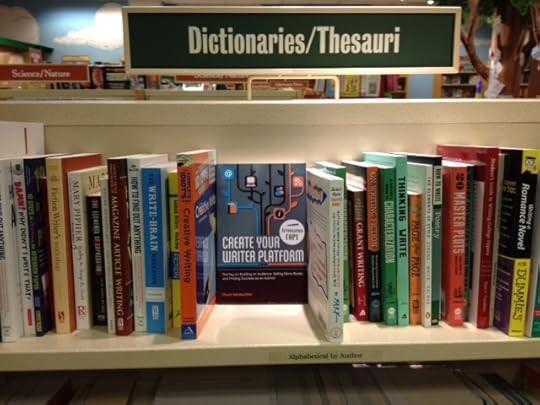
Now THIS is why you want your book to be face out.
4. When you actually read the book, read it where people can see it. Read it in public. Read it on the subway. Read it in the aisle seat of a plane. Read it on the deck of a cruise ship. After all, don’t you find yourself looking at what others are reading when you pass by? I do! And if I see 3 different people in 3 different places reading the same book, will I start to investigate it out of curiosity? Yes. It’s all about building public knowledge of something to the point where people are curious and discuss it.
5. Ask a bookstore employee where the book is located. When entering a bookstore, do not look for the book, even if you know exactly where it is. Go to the bookstore customer service clerk and ask them about the book. They will find it in their system and lead you to the book. My hope is that if several people do this at the same bookstore, then the employee(s) will begin to take notice of the title, wondering what all the buzz is about. If you’re lucky enough that an employee finally picks it up and reads it, then they might put it in the “Employee Picks” section or refer it to people who come in and ask “What’s something good I probably don’t know about?” or “What book makes a good gift?” Let bookstore employees help sell copies!
6. Leave a review on Amazon or BN.com or Goodreads or all. Reviews are still very important. Think about it. If you come by a new book and see it has 2.0 stars on Amazon, would you buy it? On some level, that silly rating does affect me and my decision — and my guess is that it affects you, too. So it’s crucial that, when you read a book and enjoy it, you leave a review on Amazon or BN.com or Goodreads or all. Those first 10-20 reviews really matter and can set a book on the right path. (Note: You can leave the same review on all sites to save time.)
7. “Like” the book on Amazon, or “Like” the author’s Facebook Fan page, or both. I heard from a literary agent once that the more “Likes” a book had on its Amazon page, the more frequent it turned up in Amazon’s comparable titles elsewhere. Getting your personal friends to “Like” another friend’s page is an easy favor to ask, as it requires no money. (Heck, go do some good right now: Open this separate page and “Like” Brian’s Facebook page if you have a second.)
(Here is as good a place as ever for me to update this older post with a quick plug: I am now taking on clients as a freelance editor. If your query or synopsis or manuscript needs a look from a professional, please consider my editing services. Thanks!)
8. Reserve a copy at the library. An employee here at Writer’s Digest Books once told me that if all copies of a book are reserved from our county library before the title came out, the system has a way of noticing this popularity and marking the book as one for “more orders.” (Also: Use the bookstore method above and ask librarians about the book — simply to draw attention to it and get the title on the mind of staff.)
9. Attend the book release party (if there is one) and bring a warm body or two. This task isn’t so much to help the author as it is to help the author’s self-esteem. It’s lonely to have a book release party or local signing with low attendance. If you already bought a copy, bring that book to be signed.
10. Spread news of the book through your social media channels. When the author mentions it on Facebook, share the news with your social circles and include a small note about what the book is and why they should buy it. In other words, spreading the word by saying “My friend got published!” is nice — but it’s better to say, “This new book by my hilarious friend is a great gift for dads who are raising daughters. Laugh-out-loud-funny stuff for all fathers to enjoy!” See how the second one targets people in a simple-yet-specific way? Do this kind of targeting when you spread the word via Twitter, Facebook, Pinterest, Google+, or blogs.
11. If you have media contacts or know people of influence, arrange a connection. This is one of the best things you can do and probably the biggest way you can truly influence the life of the book and the success of the author. If you’re married to the cousin of a local news personality, it’s exactly that kind of connection that serves as a great introduction between author and TV host. If you know a book reviewer at a newspaper in Boston, say so. If your old college buddy now runs the biggest reading club in all of Central California, try and help your author friend’s book be a future choice in that club. Utilize your network!
My own example of Point #11: When Brian’s parenting book was being edited, he was told to seek out blurbs for the cover. The top two people on his list were humorist Dave Barry and 8 SIMPLE RULES FOR DATING MY TEENAGE DAUGHTER author Bruce Cameron. Brian got the Dave Barry blurb, but not Cameron. Then I remembered: Hey. Didn’t I teach with Bruce Cameron at a writers’ conference in 2010? Yes I did. Maybe that will be enough to help. So I wrote Cameron personally and mentioned our past meeting and how he and we shared a hobby because we both authored dog books, etc., etc. And then at the end of the e-mail, I nicely asked if he would blurb Brian’s book. I was careful to explain that Brian’s work would be worth his time, and that the title was not some kind of small book that would only sell 17 copies in its lifetime. “This book has buzz,” I told him. Cameron replied back a few weeks later with a tremendous blurb. Success!
This last, large point touches on something very important. When you do approach someone of influence and ask them for a favor or suggest a book to them, have all your ducks in a row. Tout the book’s accolades or blurbs or interesting aspects to quickly convey that this connection/suggestion is worth their time. Don’t just say, “My friend has a new novel — check it out!” Say, “My friend has a new murder mystery novel and the Vanity Fair review comes out soon. She also just got a cover blurb from Michael Connelly.” Now you’ve got their attention…
Help writers sell books. It’s that simple. Just help them and support the publishing industry. Good karma will befall you, and the hope is that others will help you in return as your big release day comes.
 Tags:
Tags: Del.icio.us
TweetThis
Digg
StumbleUpon
Comments: 0 (Zero), Be the first to leave a reply!You might be interested in this:
Lissa Matthews Blog feature - Tuesday Jan 22, 2013! For the Love of Military Romance blog - Looking for more authors Book 2 dilemmas Blood Memory Want promotions? I'll give you promotions!Copyright © Rosalind Hartmann [How to support a new author - this means YOU], All Right Reserved. 2013.How to write a book and plan a series – Frances Brody
Writer’s Digest original article
Frances Brody – facebook and twitter
Blood Memory originally started out with 2 characters that had absolutely nothing to do with the premise. In fact, Blood Memory:Book 1 is about werewolves, not vampires, and the Pipers weren’t even a twinkle in my noodle yet. In 2005 I started writing about Ellis Duban and Simon Huntington. Twisted sociopath, but enigmatic leader of an unrecognized vampire clan and her right-hand, aka silent worshiping lover. No werewolves at all. None. The story evolved about a year later as we incorporated werewolves into the message board that Ellis and Simon started on – Sanguine Affliction. Then the legend was born, yadda yadda yadda. So I’m reading this article about planning a series and come across the following.
Recently I came across the advice that you should read around the genre you plan to write. Find out what’s on publishers’ lists; analyse the market.
The squeal of tires rips through my head (and you’d think literally if you saw my morning hair right now) and I stop at that sentence. I write paranormal fiction about werewolves and vampires. You don’t think I actually READ that genre, do you? I get the same group of questions…a lot.
“Oh did you like True Blood?”
“What did you think of Twilight?”
“Did you like the Anita Blake series?”
No. Movies sucked. Not really, I got 1/4 of the way through the first one.
I don’t read vampire books. They skeeve me out, sadly. Weird, huh? Why do I write about vampires and werewolves, but don’t read the genre? Because there is some serious crap out there for one, and two, you tend to see the smutty side of vampires because, let’s face it, that shit sells. Don’t get me wrong, I love me some smut, and have written a little (a lot) of it on SA and into my books. I guess my problem here is – mainstream paranormal is flooded with sex and that’s not just what my stories are about…for the most part.
Twilight was extremely well written, I will give Stephanie Meyers’ that. I enjoyed the entire series, although she could have ended it with WAY more bloodshed, but it didn’t transition near as well onto the silver screen. That’s not her fault, she didn’t write the screenplays. Actually, A LOT was lost in the translation, and I kept that in mind when I wrote my stories. There is way more military action than paranormal hotness in Blood Memory, which might be my downfall, but I just don’t think my writing fits the pop-culture phenomenon that the vampires are so popular in right now. Continuing on with the article…
Sometimes, practical tips are best. Here are mine. When starting work on a novel, I buy two A4 spiral-bound notebooks, for research, characters and story. I take a camera when I visit locations. Reading for background research is useful, but it doesn’t beat meeting the experts, and they are usually willing to help. I am never happy with my first drafts but save them. To avoid the confusion of a bleary-eyed start on the wrong draft, I highlight abandoned versions and give them a colour. At the end of each day I email work to myself, so if the house burns down while we’re out, or a burglar strikes, my manuscript lives on in cyberspace. Not very high tech, but this works for me.
Ok yeah I don’t do this, but it does sound very practical and helpful for this particular author. Maybe it’s a generational thing, as well. My bff, and ebook cover designer, asked me the other day, “Do you write down your ideas and outline?”
“God no, I just wing it.”
I do tend to keep everything in my head before writing it down. Book 1 was written almost exclusively on the fly during 2010′s Nanowrimo. It started with a couple pages from SA and just grew from there. It ended up being about 80k words, but I hit 60k during the first 30 days. Book 3 took a year and book 2 is proving to be difficult. Yes I wrote out of order, don’t judge! They say J.K. Rowling did the same thing with Harry Potter – having the entire story in her head before even finishing the first book. Ms. Brody’s tips are subjectively helpful, but I think everyone tends to have different writing styles. I daydream. A lot. But it works for me.
Tags: Del.icio.us
TweetThis
Digg
StumbleUpon
Comments: 0 (Zero), Be the first to leave a reply!You might be interested in this:
Free Chapters for Blood Memory #1 Testing a new Gravatar Finally...I'm a cool kid! Ringo, Marko, and Dom have a face! Want promotions? I'll give you promotions!Copyright © Rosalind Hartmann [How to write a book and plan a series - Frances Brody], All Right Reserved. 2013.March 22, 2013
Bestselling Ebooks of 2012 – Publisher’s Weekly
http://www.publishersweekly.com/pw/by...
15 Million+ for All Three
*Fifty Shades of Grey: Book One. E.L. James. Vintage
*Fifty Shades Darker: Book Two. E.L. James. Vintage
*Fifty Shades Freed: Book Three. E.L. James. Vintage
Ugh. The only thing I will say about this trilogy is that it inspired me to self-publish. If tripe like that can be successful, I should be able to take over the world.
50,000+
*Kiss the Dead. Laurell Hamilton. Berkley
*Dead Until Dark. Charlaine Harris. Ace
The Ugly Duchess. Eloisa James. Avon (59,333)
*The Signal and the Noise. Nate Silver. Penguin Press
Sizzling Seventeen. Janet Evanovich. St. Martin’s Press (59,156)
*The Lost Wife. Alyson Richman. Berkley
Jumping to the near end with 50k, I can say I’ve not read or really even heard of any of those authors. But props to them. Then of course we have the bottom of the bucket.
900+
Blood Memory: Book 1 by Rosalind Hartmann
It’s a process, ladies and gentlemen. A long, arduous process, but it’s been fun.
Tags: Del.icio.us
TweetThis
Digg
StumbleUpon
Comments: 2 comments on this itemYou might be interested in this:
January 30th - Blood Memory available everywhere! FeministFantasy plugs Blood Memory Book 1 Free Chapters for Blood Memory #1 10 Things I Wish I Knew About Being an Author That I Learned the Hard Way - Deborah Plummer The 'to do' list, by Johnny CashCopyright © Rosalind Hartmann [Bestselling Ebooks of 2012 - Publisher's Weekly], All Right Reserved. 2013.March 21, 2013
7 things I’ve learned so far by Douglas Brunt…ie cute guy

1. Don’t write more than 3 hours at a time. I write three hours in the morning, 9am – 12pm. Other people are best late at night. I try to go to the same place when I write, but that doesn’t matter much. I’ve done lots of writing on planes and in cars, hotels. The important thing is to write when your brain is at its best. Work edits or do outside reading with the rest of the day.
Don’t worry about a daily word quota. Stephen King has said he likes to get 2000 words each day. That’s a mistake for most people. Good for discipline but bad for a well written novel. Three hours of creating is taxing on any brain and you should stop there. Some days you may stop without any words at all. It’s much easier to write new stuff the next day than to go through painful deletions of a day’s worth of crap you already wrote.
2. Try it again — without the adverbs (and never used “padded” as a verb)
Adverbs lead to overwriting. Try taking them out and reading your prose again to see how it sounds. Simple and less words are more powerful.
Also, I can’t stand the word ‘padded’ used as a verb. It shows up in almost every spy novel now to tell us how someone walks undetected. It stops me from reading more.
3. Don’t imitate anyone else’s writing style (except for the “no adverb” thing).
Don’t copy another writer’s style because that is not authentic and that’s how it will sound. You develop your style over your whole life and through countless influences. Don’t impose something artificial. Style matters, but the real force of writing is ideas, not style. And a writing style isn’t something you can just change like clothes anyway. We’d all sound like Hemingway if that were the case. Only Hemingway sounds like Hemingway so don’t try it. Sound authentic instead.
I love reading Milan Kundera. I read in English. He writes in French and Czech. I can’t comment much about his writing style because I’m reading the translator. It’s his ideas I love to read. Don’t worry too much about style. Focus on your ideas and let your style be natural.
4. Find trusted readers and discuss.
Your spouse, a sibling, a friend need to read your drafts. They have to be people unafraid to tell you what sucks. For early feedback, that’s more important than professional editorial skill. Most people know what sucks.
(How to Deal With Writing Critiques.)
5. Research.
Spend more time working before you write page one. Then the story, at least parts of it, will feel as though it is writing itself. Offer to take people to lunch or dinner to interview them. People in power don’t say ‘No’ to two types: students and fiction writers. They want to help us. You can write off the meals as a business expense.
6. Keep the Story Moving.
I mean this in the physical sense, too. I sometimes fall into dialogue and observations that are inert, the characters never leave their chairs. Along with advancing the story, readers want to go places and see things. They want to feel varied pacing and some urgency now and then. Think of Tom Cruise sprinting (as my agent once advised), which he has done in every movie he’s ever made.
This isn’t high-literary advice. It’s something basic. Don’t bore the reader.
(Tips on getting your novel edited.)
7. Get thick skin.
You get criticism from agents, publishers, family, friends and reviewers on Amazon. Some is meant to help, some not. Use what you can for good and ignore the rest, which is easier said than done. I still read reviews on Amazon and get bothered by them. I like all the fours and fives. I’ve decided that after those, I prefer the ones. I’m certain my book is not worth one star out of five, so I must have connected with those people in some way and that’s better than indifference.
It really helped this guy was cute, FYI. Just putting that out there.
Tags: Del.icio.us
TweetThis
Digg
StumbleUpon
Comments: 0 (Zero), Be the first to leave a reply!You might be interested in this:
The Pipers Prologue I'm being featured on Heather Long's Blog - Thursday Jan 24, 2013!! More story art Blood Memory: Book 1 - available everywhere soon!Copyright © Rosalind Hartmann [7 things I've learned so far by Douglas Brunt...ie cute guy], All Right Reserved. 2013.Follow me on Facebook and Twitter, yo!
Facebook – Rosalind Hartmann author page
Blood Memory Series – Facebook page
I’m almost to 100 likes on my author page. Make a brown girl happy?
Tags: Del.icio.us
TweetThis
Digg
StumbleUpon
Comments: 0 (Zero), Be the first to leave a reply!You might be interested in this:
Formatting woes: Damn you indentions! Today's Author Feature/Giveaway - Heather Long! Amazon forum topic - squee! Blood Memory: Book 1 is available in print! Author Accomplice - Brandy WalkerCopyright © Rosalind Hartmann [Follow me on Facebook and Twitter, yo!], All Right Reserved. 2013.Finally…I’m a cool kid!
“So you published your book?”
“Yeah…sort of. It’s self-published.”
I have this conversation a lot with people. Maybe it’s my mindset, but when someone says, “Oh this is my friend Roz, she’s a published writer…”, I feel the need to correct them and add, “Well…self published.” Is self publishing a bad thing? Being all indie and shit? No, granted I haven’t found my niche in the industry or a decent fan base, but I’m competing with half a million other books – legitimately published or self – so calling myself a ‘author’ doesn’t feel legit yet.
Self Publishers: The New Generation of Cool Kids
Self-publishing is the chance to make your own future,” says Carmack. The endless possibility inherent in this entrepreneurial enterprise makes self-publishing a robust choice. It is, after all, far more exciting—and impressive—to create your own success than to put your career in the hands of a corporation and hope for the best.
I applaud authors who have managed to find a fan base. You can only share your facebook page or twitter so much until you get someone who posts ‘Get lost, spammer’. I got that the other day – but at least they took the time to actually say it. That’s me, silver lining kind of girl.
Tags: Del.icio.us
TweetThis
Digg
StumbleUpon
Comments: 0 (Zero), Be the first to leave a reply!You might be interested in this:
Al Roker retweeted my book! Author Accomplice - Brandy Walker Blood Memory: Book 1 - available everywhere soon! I am thankful! Amazon forum topic - squee!Copyright © Rosalind Hartmann [Finally...I'm a cool kid!], All Right Reserved. 2013.March 20, 2013
How to market your book. Wait, I should probably finish it first…
I came across an interesting article after being prompted by a friend to possibly look into ‘kickstarter’ to fund marketing my books. I originally self-published Book 1 on Amazon, so I decided to check it’s ranking.
Amazon Best Sellers Rank: #264,002 Paid in Kindle Store
Huh, ok. Well, that’s actually an improvement. Back in January it was #600,000+. A perfectly painful example to ‘it could be worse’. In any case, I go over to Kickstarter and register, starting my project. Then I came across this.
Funding goal
Hrmm. I start to google – how much does it cost to properly market your ‘indie-published’ book, which sounds considerably better than ‘self-published’, personally. I came across a blog by Lindsay Buroker, another self-published author with an interesting blog.
Book Marketing by Lindsay Buroker with guest post by Colin J. Earl
Colin writes:
Between these three INDEPENDENT authors millions of book were sold from around 2008 to 2011 and there is a lot of speculation on how they did it. John Locke even wrote a book on it – “How I Sold 1 Million eBooks in Five Months” (This book received less than stellar reviews). So much speculation and scams out there – allow me to offer my two cents and you might be surprised at what I have to say. The three things these authors had in common to make them successful were: timing, content and price. That is how they each sold so many books –there was not much beyond that.
I am really serious. If you took time to read Michael’s blog, Amanda’s Twitter feed, or even John’s “How I Sold 1 Million eBooks in Five Months” book. They really didn’t “do” much in the way of promotion. Michael used book bloggers to some extent, John really likes Twitter and Amanda used some combination of both. So what was so instrumental to their success? Well first was price. All of their books were less than five bucks. Still are for the most part. Second, and content, books, books, books, each author had books to spare when their sales blew up. Third and I think the MOST important, they were the front-runners in a space where consumption was EXPLODING, they used price and content push themselves to the forefront of that explosion and sold a whole lot of books because of it. Yep, it was a simple as that.
So what has changed? Why aren’t I selling 9000 books a day? Several things I think:
Ebooks aren’t new anymore – just a couple of years ago ebooks were new, exciting and while Amazon and Barnes & Noble are still selling thousands of ebook readers the consumption of ebooks has or will top out on its share of the market place at a bit above 30 something percent. Don’t see it going much above that. It’s established.
Competition – lots more authors and wannabe authors out there. Amazon ain’t a “pond” like it used to be for ebook writers – is a freaking ocean and its real easy to get lost in that ocean.
Pricing – “wars” have driven down the price enough so that .99 cents for an ebook is not out of the ordinary. People expect it now because there are so many people doing it.I could name more. What’s my point? My point is that putting up a book, making it free or low priced is not enough anymore. With changes in the market place, stiffer competition and the like going on, you need to have a better plan. (Notice I say plan)
Several suggestions – Global strategy – this is the first step now that you realize its not as easy as it used to be or you used to think. You need to come to a strategy to create exposure. Obscurity is the greatest enemy of the author. That’s where marketing comes in and planning comes close after that.
Have a Marketing plan, but only after you have several projects out. I wouldn’t even start thinking about spending any real time marketing until I had at least 3 books out. Remember! Content is key. You need to have content to gain traction in the market place.
Once you have content, come up with your plan. My plan involves a mix of paid and unpaid marketing platforms. I base my plan on the “Free Loss Leader” meaning I give a book away for free knowing that a certain percentage of those readers will “convert.” I like this platform because it allows people to “enter the fold” at little to no cost. So step one in my plan is to push people towards a free product. Step two, use five different platforms in conjunction. Here is what I am using right now.
1. Twitter
2. Google Adwords
3. Bloggers
4. Bookbub/Pixel of Ink/FreeEbooks.com etc
5. Facebook
These are a combination long term and short-term exposure sites. I don’t do use more than five platforms at any given time, because then you cannot manage everything. Remember doing something half way is like not doing it at all. Time is important with these endeavors, try to coordinate to use your endeavors in combination to create even more exposure. This is part of the reason I like the loss leader so much. Getting that free book moving on Amazon can put the Amazon marketing algorithms to work for you. If you can get those algorithms working for you. You are going to sell books.
I’ve done 4 out of the 5, but I’m still struggling. I do not have delusions of grandeur about making a profit off these books, or even manage getting an agent, much less publishing, but it’s one of those ‘bucket list’ things I promised myself. I enjoy writing and there are a few people who enjoy reading what I’ve wrote. For now, that’s enough. Hell, for a while, that’s plenty. I’ll probably set this kickstarter thing aside and finish book 2 and 3, then maybe look into agents. Or cheesecake. Probably the cheesecake first.
Tags: Del.icio.us
TweetThis
Digg
StumbleUpon
Comments: 0 (Zero), Be the first to leave a reply!You might be interested in this:
Book 2 - tentative release date!!!! Blood Memory: Book1 now available in paperback through Amazon.com Amazon forum topic - squee! The Moonlighting Effect - why Simon and Viv wouldn't work... Today's Author Feature/Giveaway - Heather Long!Copyright © Rosalind Hartmann [How to market your book. Wait, I should probably finish it first...], All Right Reserved. 2013.March 19, 2013
10 Things I Wish I Knew About Being an Author That I Learned the Hard Way – Deborah Plummer
@debbieplummer on Twitter
I have been blessed to be a published author both by the traditional process of an agent and a publishing company who managed the editing, marketing and every other aspect of the book process; and I have self-published where I managed every aspect of the process. From both processes, here is what I have learned:
1. Book publishing is about sales…not your great writing or your fabulous story or your credentials. Having a target audience that will buy your book and a great marketing strategy is the most important aspect of book publishing. There are many, many wonderfully written books with the most creative plots, inspiring stories, or great advice that do not sell. Publishers want to sell books and even self-published and indie authors are all about sales as well.
2. Professional editing is worth every dime…even if you aced your grammar course and love diagramming sentences, you still need an editor. I find it extremely difficult to edit my own work, despite the fact that I once taught grammar and creative writing classes.
3. The more eyes or your work the better…don’t hold on to your writing as if it were high-level, classified information. Sure, it is your intellectual property, but every writer, no matter how great, benefits from feedback, the more the better.
4. When writing fiction, show don’t tell…it is always better to describe a scene or create dialogue rather than straight narrative.
5. Read books on writing…they help. My favorite is Bird by Bird by Anne Lamott.
6. Join professional writing associations…even if you only attend one conference a year or page through one journal, you get to know the industry and feel a sense of belonging to a noble profession.
7. If you have self-published, don’t spend money on PR/marketing firms…unless you have a huge advertising budget and money to burn. Yes, PR/marketing firms can get you exposure, but they cannot sell books. Only you can do that. The ROI (return on investment), especially for new authors without a convenient audience, is very low. Once you become a best selling author, you may need a firm to take you to the next level. However, if you have self-published, starting out it is best not to spend your money with marketing agencies. If your work has been traditionally published, you should still expect to do a great deal of work promoting your book.
8. If you feel you must invest in some kind of marketing, spend money on advertising with book bloggers…they are all about books and folks who visit their sites love to read and are seeking the next best read.
9. Reviews sells books…positive reviews are great, but even negative ones help your writing and sell books. The best gift you can give an author is to write a brief review (you don’t have to be a great writer–a thumbs up or thumbs down suffices) and rate the book on sites like Amazon and Goodreads.
10. Be realistic about book sales…even though publishing is all about sales, writing is about communication. Even if you have twenty good fans, that means there are twenty people you have communicated with and twenty ambassadors for your work. Remember the majority of self-published authors sell less than 100 copies. New authors with traditional publishers sell about 2,000-5,000 over the lifetime of their book. Best sellers are in the range of 30,000 or more. If you are a published author, whether you’ve sold 20 or 20,000 copies, the joy of writing always remains.That is the lesson I have ultimately learned.
Tags: Del.icio.us
TweetThis
Digg
StumbleUpon
Comments: 0 (Zero), Be the first to leave a reply!You might be interested in this:
RosalindHartmann.com Alesha and mah book + a feature! Guest book gone Testing a new GravatarCopyright © Rosalind Hartmann [10 Things I Wish I Knew About Being an Author That I Learned the Hard Way - Deborah Plummer], All Right Reserved. 2013.March 18, 2013
For the Love of Military Romance blog – Looking for more authors
For the Love of Military Romance blog is looking for a few more new authors.
Looking For A Couple More Authors
Hello, everyone! Please excuse the mess of the blog. We are still getting settled and working on getting it all pretty for our opening in April.
We have been busy behind the scenes, but I wanted to put a call out for authors. We have a few slots still open, not many, so let us know as soon as possible. Here is what we will need from the author each month:
Mandatory
1 blog a month on anything military or military romance related. Interaction with readers on your day, ie coming back to answer any questions.
Optional
Swag-for monthly giveaways
New release info-to be posted once a month.
Easy, peasy, yes?
If you do not have the time to offer up a blog a month, we do have three days a month we will open to guests.
If you are interested, please email us at: loveofmilrom@gmail.com
Facebook: Author Accomplice
Tags: Del.icio.us
TweetThis
Digg
StumbleUpon
Comments: 0 (Zero), Be the first to leave a reply!You might be interested in this:
Another Guest Author Feature - The Published and Super Awesome Melissa Schroeder!!! Blood Memory: Book 1 is available in print! Rebelmouse/ROzbeans Lissa Matthews Blog feature - Tuesday Jan 22, 2013! 94k words and counting...Copyright © Rosalind Hartmann [For the Love of Military Romance blog - Looking for more authors], All Right Reserved. 2013.Rosalind Hartmann: author and brown girl

- Rosalind Hartmann's profile
- 57 followers

