
Susan Spann's Blog, page 75
January 6, 2014
January 2014: Monthly Observances
When you say “January Holidays,” most U.S. residents think of New Year’s Day and Martin Luther King, Jr. Day. However, January has even more to offer. It’s also official:
Hot Tea Month (because tea is sexy, yo)
Soup Month (it’s good food…)
Learn to Ski and Snowboard Month (making February official “Recover in Traction Month”)
Teen Driving Awareness Month (Who isn’t aware when the teen is driving? I’m usually clutching the door handle, screaming like a little girl…)
Stalking Awareness Month (Don’t look now, but there’s something behind you)
Be On Purpose Month (I discovered this one by accident)
and
National Skating Month (which, sadly, apparently doesn’t refer to slacking off at work.)
Have others? Please share them in the comments!


January 3, 2014
Sharing the Love – with a Contest!
I love to find new books through recommendations.
More than half of the books I read and loved in 2013 came to me via friends and acquaintances (many on Twitter and Facebook) praising books they, too, had read and loved.
In 2014, I’m paying that forward. Every month in 2014 I’m going to give away a book I enjoyed (disclaimer: usually written by an author I know personally) on my Facebook author page. I may vary the entry requirements slightly, but generally speaking all you’ll have to do to enter is leave a comment.
The January giveaway starts today! To be entered in a drawing to win a free trade paperback of Heather Webb’s delightful BECOMING JOSEPHINE, all you have to do is leave a comment at the Facebook status contest linked here telling me the best book you read in 2013 (really, any book you liked will do). That’s it! Contest closes next Thursday, January 9, at 11:59pm PST. On Friday January 10, I’ll hold a drawing and announce the winner.

Free books are ALWAYS a good thing – so please do stop by the Facebook page and leave a comment. This is a book you definitely want to win!
January 1, 2014
The Year of Overlooked Resolutions
New Year’s Day offers us all a new beginning.
Each person approaches the new year with a different set of hopes and dreams. For some, this year is “the year that I will finally finish my manuscript.” For some, 2014 is The Year of the Agent. Others will become publishers–for their own works or for the works of others. Still others will vow to read more books than they did in 2013.
It’s easy to focus on our goals, to the exclusion of some other, less obvious things.
While I’m here, and have a moment, I’m taking a look at some of the other things I plan to work on during 2014.
- I resolve to worry less about the things I cannot change.
- I resolve to listen more closely when the ones I love are speaking, even if the topic isn’t one I care about that much.
- When I start feeling alone, or sad, or as if no one understands, I resolve to remember that people love me not because of what I’ve done, but because of who I am inside.
- I resolve to remember that I am worthy of that love.
- I resolve to remember that every person on this planet (even and including the ones who cut me off on the freeway) is equally unique and special. I may not know them well enough to appreciate it, but I can remember that it’s true.
- I resolve to smile more often at strangers.
- When the world gnaws at my dreams, I resolve to wrest them back, wipe off the drool, and nurture them back to health. With extra ice cream and cupcakes if necessary.
Most importantly, I resolve to remember that the person I want to be is equal parts the person I wish to become and also the person I am right now.
Today is the only day we have. Tomorrow never comes. So whatever it is you want for your life…step out and seize this day. Today. Quit making excuses for what could be and start making it happen. Right now. In 2014.
HAPPY NEW YEAR, EVERYONE!

What are your resolutions? Jump into the comments and shout them, loud and proud!
December 31, 2013
Happy Release Day, JOSEPHINE!
Today marks the release of BECOMING JOSEPHINE, a fabulous debut novel by Heather Webb.
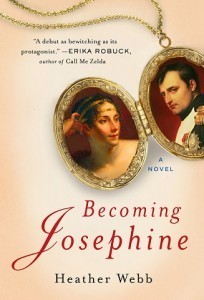
BECOMING JOSEPHINE tells the story of Rose Tascher – better known to history as Josephine Bonaparte (Napoleon’s first wife).
I loved this book for many reasons. I’ll address them in more depth in my review (look for that a week from Friday) but the book is beautifully paced, tightly plotted, and takes a close, personal look at the life of an extraordinary and complicated woman.
People know Josephine as “Napoleon’s wife,” and many books on Josephine focus on her years at Napoleon’s side.
Heather’s Josephine starts out as a simple plantation girl with dreams of finding love in Paris. When her first (arranged) marriage goes badly wrong–just as France falls into the throes of revolution–Josephine finds herself penniless, jailed, divorced, and without an eclair’s chance in Paris of recovering her stability or her status.
At least, you’d think so–but you’d be wrong. (You’ll have to read the book to find out more.)
I also love this book for a reason that has nothing to do with the words on the page. Its author is one of my closest friends, and she deserves this book–and its success–far more than I have words to say. I’ve watched as she edited, queried, signed with an agent, obtained her deal, and rejoiced with her each hard-won step of the way. And yet, despite everything she needed to do to obtain this goal, she also invested her time and love in editing and critiquing dozens of other authors’ novels, raising her wonderful children, and encouraging others (myself included) who needed a helping hand. Heather isn’t only a talented author, she’s a wonderful person, too.
Heather’s release – like every debut – is a cause for celebration. It means another author has emerged from the publishing trenches, weary and bedraggled from the effort, but victorious. Each success should encourage every one of us–both pre-published and on the shelf–because her victory is our victory too.
So congratulations, Heather … and congratulations, Josephine. And if you’re looking for somewhere to spend those holiday cards and spending dollars, and you enjoy a vivid, passionate story about an intriguing woman … pick up BECOMING JOSEPHINE. You won’t regret it.
December 24, 2013
A Merry Christmas … On the Reef
Twas the night before Christmas, and all through the reef
Every creature was swimming, with fervent belief
That an afternoon feeding would surely appear,
Every seahorse was on Santa’s “good list” this year.

Emo the clown nestled snug in his host,
An Anthelia coral grown larger than most.
The fish on the reef called a Christmas-Eve truce,
and made Wilson the urchin the “Christmas-tree” spruce.

From the back of the tank there arose such a clatter,
I sprang from the desk to see what was the matter.
I flew to the tank, started looking around,
To determine what made such a clattering sound.
The bluish-white lights gave a wintery glow
To the reef and the myriad corals below.
When, what to my wondering eyes should appear,
But a three-inch gold goby with no sense of fear.

A bold little watchman, this Emperor Max,
With a thousand-yard stare and a liking for snacks.
He hung in mid-water and glared at each fish -
Keeping this reef in line is his Christmas Eve wish!
“Now Cygnus! Now, Ghillie! Now, Ceti and Flappy!
Hey, Emo! Hey, Jett! Quit looking so happy!
From the top of the rocks to the top of the glass
This MY REEF, I tell you! It’s mine to harass!”

As dry leaves that before the wild hurricane fly,
When they meet with an obstacle, mount to the sky.
So all of the fish out of Max’s way flew,
giving him a wide berth, and his attitude too.

And then, in a twinkling, I heard little clatters
like plinko balls falling, or plastic that shatters.
I drew back and once again looked all around -
As Ripley fell off sea fan with a bound.

As a porcelain crab, Ripley just filter feeds,
She had climbed up the fan for her filtering needs.
But she fell from a height and went flat on her back,
and she looked pretty foolish (and that is a fact).

The fall made Max angry! His temper was up!
“I said no shenanigans, you foolish pup!”
The watchman’s long mouth was drawn down like a bow,
“Nobody messes with me, don’t you know?”
But then, from the opposite side of the box,
came a large cloud of sand and a clatter of rocks.
Scooter Jett taunted Emo just one time too many:
The Christmas Eve truce? Sorry, now there’s not any!

Emo’s chubby and plump, a right jolly old elf,
And I laugh when I see him, in spite of myself.
But a wink of an eye or a twist of a head,
and that poor maroon clown will start seeing some red.
Emo spoke not a word, but went straight to his work,
sneaking up behind Max (who was being a jerk)
but with his best thousand-watt Angryfish stare,
Max imposed Christmas peace on all fish, everywhere!

Max returns to his post, floating over the reef,
And gives me what might be a look of relief.
For the moment at least there’s no trouble in sight.
“Happy Christmas to all, and to all a good-night!”

Wishing you and your family a very Merry Christmas and a Happy New Year!
(I’ll be on “blogcation” through January 2, but I look forward to seeing you all in 2014!)
December 23, 2013
The Dreaded Second Draft
I’m working on a new Shinobi Mystery this morning. I wrote draft one in November (it’s not intentionally a “NaNo Novel” per se, but my normal writing schedule puts me into first draft mode in November, so I run with it) so now I’m working through what always proves the most difficult draft for me.
In my world, first drafts offer a time of excited discovery. I work from outlines, but the characters and plot threads always change themselves around on the page, so the first draft rarely turns out exactly the way I thought I’d write it.
The second draft, however, looms before me like a monstrous nightmare. When you let the plot take rabbit-trails and turn your characters loose upon on the pages, what remains when you hit “the end” is a Frankenstein’s monster with a stench that would knock a buzzard off a corpse.
The mental shift between writing first drafts (“WOOHOO!”) and editing second drafts (“How on Earth did I ever produce such a horrific creation…and DO I HAVE THE SUPERPOWERS REQUIRED TO FIX IT???”) amuses and surprises me every time. For those keeping track, I’ve written eight novel-length manuscripts. You’d think (or at least I would) that the transition would get easier over time.
No such luck.
Every time, the second draft surprises me with its reeking badness. And every time, I despair of wrestling it into submission.
Fortunately, I’m not alone in this.
One of my best friends (also an author) and I have regular conversations along this line. An average day on GoogleTalk goes more or less like this:
Me: How’s it going? I hope you’re making more progress than I am.
Author Friend: Hanging in there. Wrote two blog posts and made some progress on this draft before the kids came home.
Me: Good. I’m glad one of us is getting traction. This is the worst manuscript I’ve ever written. It sucks like a Dyson.
AF: You’ve started the second draft, haven’t you.
(Note that it’s not a question.)
Me: Yep. Only this one is worse than the others.
AF: That’s what you said the last time. It wasn’t true then, and it’s not true now. Remember what you told me last month, when I started on my second draft?
Me: I told you “this is normal for second drafts, it will come out fine in the end.” Why do I never remember this?
AF: LOL. That’s how it goes.
That transcript is a dramatization, but Author_Friend_001 will recognize it (and know herself in the words) as soon as she sees it. I reproduce it here because I wrote my first four manuscripts completely alone–without a critique group, and with only a couple of editing partners. I despaired each time I hit the second draft, and didn’t have anyone to tell me “this is normal…just push through.”
One of the greatest benefits of publication is the ability to share not only the joys but also the struggles of the writing path. To pull back the curtain and show the world (and all the others struggling toward publication) that the writer behind the scenes isn’t wearing pants. Not proper ones, anyway.
(Fun fact: most writers I know prefer pajamas or yoga pants. Writing is more of an LL Bean sport than a Michael Kors affair.)
The message here, and the early Christmas (or, if you prefer, late Hanukkah) gift I’m offering this morning, is this: Your second draft may give you much more trouble than the first one. Do not panic.
Push through with all the courage you can muster. Slap some paint and a few after-market pieces on that Frankenbook. You’ll bring it under control in the end … and although it may not be perfect, that’s what Drafts 3-6 are for.
Which draft gives you the most trouble? I’d love to hear!
December 19, 2013
The Long, Dark Potty-Break of My Soul
This week, the five lovely authors at the Debutante Ball blog are heading “into the dark” to talk about the times most writers would rather forget: the difficult times, when writing–and rejection–hurts the most.
In solidarity with my Deb sisters, and to encourage this year’s #PitchWars applicants, I thought I’d revisit my own darkest days — the long, dark potty break of my soul.
June 15, 2011 was my mother’s birthday. We spent it together in San Diego, right before the start of the Historical Novel Society conference. After our celebration, Mom hopped a train to her home in Malibu, and I headed off to pitch my fourth manuscript (a women’s historical novel) to the agents and editors at the HNS conference.
Like the three that came before it, my fourth manuscript earned praise, but no offers of representation. Once again, I felt my lifelong dream of publication slipping through my fingers.
I found myself caught in the worst of traps–locked into a dream that would not come true and would not let me wake. I couldn’t stop writing. That wasn’t a choice. I self-identified as a writer, and had since my early childhood. I’d worked at many other jobs, but writing owned my heart. No matter how many rejections I received (and I’d had a few…dozen…by then) surrender was not a viable option.
Instead, I prepared myself to live my life as an unpublished author and die surrounded by cats and oft-rejected manuscripts. In the darkest moments, I imagined my son erasing my hard drive, and with it the lion’s share of my existence…as if I had never truly lived at all.
Trust me, however dark and bleak your road may look … I’ve walked those very steps.
And yet, I chose to keep on walking. I kept putting words on the page. I made the decision that if it took a lifetime of trying and failing, then I’d write and fail and get up again as many times as it took until I died or saw my novels in a bookstore.
I went home from San Diego and started work on a new manuscript, in a new genre: a little book about a ninja detective and his “Watson,” a Jesuit priest, who have three days to solve a samurai’s murder and save a geisha’s life.
For those of you counting, that’s full manuscript #5 … and I wrote it during that summer of 2011, when the world seemed full of failure and rejection. Writing lifted me out of the darkness. My characters gave me joy. I clung to that novel–not as my only hope, but as the hope that would get me through those moments. Because, on the writing journey, there is no permanent failure, and any manuscript can bring redemption.
And redeem my dream it did.
In September of 2011 I pitched that novel to one agent, Sandra Bond. In October of 2011, Sandra signed me.
In February of 2012, SHINOBI, now Claws of the Cat: A Shinobi Mystery, sold to St.Martin’s Press for publication on the Minotaur imprint, as part of a three-book deal.
I’ve heard it said that the darkest hour comes just before the dawn. In writing, as in life, I’ve found this true.
Every author I know has a story of darkness, rejection, and the importance of having the courage to rise up one more time, writing one more novel, and finding the strength to persevere until the dream becomes a glorious sunrise.
Somehow I found the strength, and the words, when I could have sworn the well was empty. I’m telling the story because I believe, with all my heart, that you can find it too.

Do you have a story of courage lost, courage found, or a dream you won’t let go? I’d love to hear about it in the comments.
December 18, 2013
Copy Editors Are Cool (Copy) Cats
After the author and acquiring editor reach a consensus about the content-based edits on the author’s manuscript, the manuscript enters the copy editing phase.
In some cases, the acquiring editor also handles copy edits, but most publishers have separate copy editors. That’s the case we’re looking at today.
The copy editor reads an author’s manuscript for spelling, grammar, and house-specific formatting and stylistic issues. In addition to correcting errors, the copy editor ensures the manuscript complies with the publishing house’s style sheets. A style sheet is a standardized set of grammar and punctuating conventions, used to ensure that a house’s publications all follow similar rules.
Sometimes, the copy editor will also compile a set of deviations from the style sheet that apply to the author’s work (or series, if appropriate). For example, my books italicize foreign terms like kanzashi (a type of hair pin) to set them off from the rest of the text.
The copy editor’s style sheets determine which grammatical and punctuation conventions the publisher will use.
Once the copy editor finishes editing the work (usually in colored pencil on hard copy, but sometimes in electronic form), the editor sends a copy of the edited work to the author for review. The author has the ability to reject the copy editor’s changes but, generally speaking, it’s a good idea to go along with the publisher’s reasonable preferences.
On occasion, the copy editor will find a continuity error or ambiguity the author and other editors missed. When this happens, the copy editor will ask about the issue, usually in a margin note, which the author can address.
Most copy editors use standard marks and symbols, many of which seem odd to authors who haven’t had experience with professional editing (or journalism). You can find lists of these marks online. Here’s one example: http://www.merriam-webster.com/mw/table/proofrea.htm. Authors with books in the publishing process should learn about copy editing symbols, because the typesetter will interpret any marks on the manuscript in accordance with the house’s standard conventions.
After the author approves and returns the copy edited manuscript, the editor approves the pages and sends the manuscript to be typeset.
The typesetter reviews the copy editor’s notes and “sets” the manuscript pages in the form they will have when the book is printed – including the final font, kerning, & chapter or section headings.
When the typeset manuscript is finished, the author usually receives yet another copy – often referred to as “first pass pages” for final review. The purpose of “first pass” is a final look for grammar, punctuation, and spelling errors – it’s not a time for editing. Some authors love reading first pass pages, while others find it scary to see the “final” book and not be able to change it.
Although I didn’t plan this, tomorrow, I’ll receive the first pass pages for Blade of the Samurai, the second Shinobi Mystery. Fortunately, I fall in the “love to see them” category, which makes this an exciting time.
The publisher often gives the author ten days to two weeks to review and return both copy edits and first pass pages – which sounds like a lot of time but it goes by fast! Don’t delay when you get those pages in.
After the author returns the typeset pages, there’s a little “lag time” while the publishing house prepares for the next phase in the publishing process: ARCs!
#PubLaw will take a break for Christmas and New Year’s Day, but join me in two weeks, when #PubLaw’s Publishing 101 series takes a look at ARCs and how they factor into the author’s publishing journey.
December 12, 2013
On the Topic of Christmas Trees
First off, I’d like to wish a Happy Hanukkah, Kwanzaa, Holiday, or non-Holiday to everyone reading this, regardless of what you celebrate – whatever it is you do (or don’t do) over the next few weeks, I hope that you do it in a way that makes you happy.
All of which said … I love Christmas trees, and I have since I was a very little child.
I love the lights and the ornaments. I love drinking hot chocolate (or coffee) while I unwrap the various balls and baubles that carry so many memories, and hanging them on the tree while my family swaps stories of Christmases past.

I’m not as big on stringing the lights, mostly because it’s not that easy to electrically mummify an eight-foot tree when you’re just over five feet tall. Still, I manage, mostly because the lights must precede the ornaments, and, well … ORNAMENTS. WOO!
Almost a decade ago, when we moved to Sacramento, our family established a new tradition for picking a Christmas tree. I’m a fan of noble firs, and large noble firs at that. (I have continuing trouble recalling that nine foot trees won’t fit in a room with eight-foot ceilings.) In the years before we moved to Sacramento, our house had a vaulted ceiling, and selecting the tree (which usually measured 12 to 14 feet in height) wasn’t always easy.
The year we moved north, we all came down with the flu as Christmas approached, and quickly realized our former method of tree selection wouldn’t work that year. In fact, I barely had the strength to get to the tree lot at all. We walked as a family into the lot, took a look at the first noble fir of semi-appropriate size (a nine-footer, as I recall…see my note about the eight foot ceilings…) and said “let’s just take that one.”
Bear in mind … the tree was still bound up with shipping twine. We couldn’t see it. Couldn’t evaluate its beauty. Couldn’t determine whether or not this was the perfect tree to grace our family’s home.
We didn’t care.
The objective was “return with a tree” and between the cold weather and the flu, “a tree” was about as far as we could take it.
When we got the tree home and removed the twine, the branches fell into a perfect shape–as full and as lush as any tree we’d ever had before. It even fit in the living room … as soon as we took six inches off the base and removed the topmost branch that otherwise would have held the golden star. (Stars are overrated…right?)

With that, a tradition was born.
Every year since, we go to the lot and select a “mystery tree” still bound from shipping. We load it in the truck and bring it home. We see our tree for the very first time when we place it in the stand and remove the twine. Some years they’re thick. Some years, they’re thin. Some years, we have more spaces for big hanging ornaments than others. (You call them “holes,” I call them “hanging ornament windows.”)
Selecting the tree this way not only solves the issue of “finding the perfect tree” (and takes a lot less time than the other method, too) but helps me remember that Christmas isn’t about perfection. In fact, it’s quite the opposite. It’s about remembering that we’re loved because we aren’t perfect. That we are the way we’re made–and each of us is worthy of being loved exactly the way we are.

I love Christmas trees. They remind me of where I came from, help me celebrate where I am, and remind me that perfection isn’t a requisite–each of us can be lovely, and worthy, and much appreciated just for being who we are.
December 11, 2013
Publishing 101: Enter the Editor …
Today, the #PubLaw Publishing 101 series continues with a look at the editorial letter.
An “editorial letter,” sometimes also called “developmental edits” is a letter (now, often in email form) which the acquiring editor sends to the author after the contract is signed. Editors wait to send (and often, to prepare) the editorial letter until after the contract to ensure that the editor’s work isn’t wasted if the deal goes sideways at the contract stage. In very rare cases, and editor might send the editorial letter before the contract is signed, but this is definitely the exception to the rule.
The editorial letter contains the editor’s requests for changes to the novel. Often, the letter is accompanied by a line-edited version of the manuscript. However, where the requested changes are extensive, the editor may split the process into two separate rounds: the editorial letter first, and line edits following once the major edits are complete.
Sometimes, the editor and the author go through several rounds of edits. Other times, only one set of edits is necessary. In very rare cases, the editor may have no developmental edits at all, in which case the manuscript passes directly to the copy editor.
Many authors approach the developmental edit (the edit letter) with a mixture of fear and surprise – wasn’t the manuscript “finished” when they bought it? In reality, most manuscripts benefit from an editor’s comments – a good editor makes your work even better.
Some examples of things a good editorial letter will catch or correct:
- Continuity errors (eyes that change color, objects that vanish or suddenly appear from nowhere)
- Timeline errors (eleven-month pregnancies, sports teams playing out of season, too many bullets fired without reloading)
-Typographical and grammatical errors; misspellings (tricksy homonyms…)
- Inconsistencies in character, echo words, and other awkwardness the author missed.
Editors catch other things too, but those are among the most common.
The key, as an author, is not to view the editor as an adversary. (S)he isn’t your enemy – in many ways, (s)he’s your greatest ally. Editors don’t acquire books unless they love the story and the writing. They don’t acquire books in order to rewrite them. If an editor wanted a different story than the one you wrote, he or she would buy that story instead of yours.
Most editors see far more stories they’d like to buy than they can acquire; if yours made the cut, the editor knows it’s special – meaning the editor chose your book from thousands of submissions and hundreds the editor reviewed for possible acquisition.
The best way to handle your editorial letter is to read it once and put it away overnight before reacting. 24 hours’ worth of distance and contemplation will help you realize that in many cases, your editor is right.
You don’t have to make all the changes your editor suggests, but the publisher does have the right (it’s in every contract) to refuse to publish the work if you refuse requested edits.
Fortunately, most of the time, the editor’s comments are reasonable, & the editor & author can work together to find solutions. At the end of the day, the author and editor work together to make the author’s work the best it can possibly be.
And then, when the developmental edits are finished and the manuscript is accepted for publication … it’s the copy editor’s turn.
I hope you’ll join me for next week’s #PubLaw, when we look at copy editors–and copy edits–in the publishing process.
Have questions about this or other parts of the publishing industry? Please feel free to ask in the comments. I love to hear from you!


