
Heather Burnside's Blog, page 18
April 21, 2014
Refreshed, Reinvigorated and Ready to Go
I probably should have preceded this blog post with one headed ‘Fatigued, Frustrated and Fed up’ as that’s exactly how I felt just a couple of weeks ago. It’s a good thing that my holiday came when it did as I was well in need of it.

‘Why was I feeling so FFF’d up with everything?’ you may ask. Here’s why:
Fatigued because I’ve been working weekends for the last seven months as well as working Monday to Friday. Basically, me and my husband have been renovating my mother-in-law’s former home as she sadly passed away last September. Although the work was mainly cosmetic we underestimated just how long it would take to complete. We also didn’t realise how much the continuous weekend working would take it out of us, especially as we have both been fully stretched in our Monday to Friday occupations recently. Plus, we’re not as young as we used to be and at times like this it really shows.
Frustrated because I desperately want to publish the novel that I wrote several years ago. Unfortunately, I’ve been so busy lately that I can’t even find time to edit it let alone put all my promotional and marketing plans into effect.
Fed up due to a combination of the above two. I do tend to push myself too hard at times, to the point where I feel extremely tired but I still find myself dissatisfied if I don’t achieve all of my goals. I planned to launch my novel in May or June and it galls me to have to accept that I will probably need to postpone the launch date.


On a more positive note, two more weeks should see the end of the house renovations and then I’ll get my weekends back – at last! I’ve also spent two blissful weeks lazing about in the sun so I’m feeling much more refreshed and ready to tackle the mountain of client work that is waiting for me. Not that I’m complaining about my client workload – it’s always good to have plenty of paid writing, proofreading and editing work. Getting my weekends back, however, will be an absolute bonus. It means that I’ll be able to take some time to chill and recharge my batteries at the weekends. I might also manage to squeeze in a couple of hours on my novel if I’ve been too busy during the week. Bring it on!
I’d love to hear how other authors find the time to organise a heavy workload particularly those who have other commitments as well as being authors. Please feel free to share your thoughts in the comments box below.



April 2, 2014
My Favourite Rejection Letter
When I returned to my debut novel so that I could polish it up and prepare it for publication I realised that I hadn’t transferred my character list onto the computer. It was in fact still in a handwritten file. Whilst I was rummaging through the file trying to find the list I stumbled on something that I had almost forgotten about – my favourite rejection letter.
Is there such a thing?
Well for me, yes.
You see, I think it’s generally accepted amongst the Independent author community that for an unknown author the odds on being published through the traditional channels are extremely slim. Nevertheless, that is no reflection on the quality of the work. Just think of all the blockbuster movies that started out as manuscripts that were rejected numerous times by agents and publishers (a topic in itself which I will probably explore in a future blog post).
What a lot of authors find difficult to deal with though is that agents and publishers often don’t even bother to reply. This is usually down to the fact that they receive so many submissions. If they do reply the letter is usually a standard mass-produced one which doesn’t give any indication as to why the author’s work was considered unsuitable.
 When I went through the submission – rejection routine several years ago, it left me feeling downhearted. Although I fundamentally believe in my work, it helps to get some words of encouragement from someone in the industry who has probably sifted through thousands of manuscripts over the years. I did have a couple of near misses with my submissions but the best letter I received I have kept on file.
Thinking back now, that letter helped me to keep persevering. Although I eventually stopped sending submissions to agents and publishers and decided to concentrate on my writing business instead, I always knew that I would return to my novel one day. Thankfully, it’s now easy to publish as an Independent so my novel will get published this year, and when I do finally publish, I intend to celebrate, big time. I’ve copied a few of the sentences from that letter below:
“I have been right through the material you sent and had one of my trusted readers look at the manuscript extracts as well. We have come to the same conclusion, that you write well and have put a lot of thought, care and effort into your novel …There was a time when a manuscript of this quality would undoubtedly have been in with a very strong chance of getting into print. The market is much tougher now and to stand a chance you have to find an agent who will back you without reservation. Why a book can work for one reader and not for another I don’t know. Wish I did! … I am sorry I unable to help, particularly after you went to the trouble of supplying such an excellent submission (it could be a model for all aspiring authors). I do wish you the best of luck in finding representation.”
I pursued the matter with him to find out exactly why he felt he couldn’t represent me and basically it came down to personal taste. My book is aimed at a predominantly female readership so I think the fact that the agent was male probably put me at a distinct disadvantage in that instance. Nevertheless, it was very good of him to take the trouble to respond to me and give me some words of encouragement. He added that as my chances of getting published were favourable, I should keep on trying. But I’d already had my fill of rejection letters by then. If my novel (and the subsequent ones that I have planned) ever go on to be a great success I shall write to that agent and personally thank him for his kind words.

I’d love to hear about other authors’ motivations for self-publishing, and their experiences. Have you ever tried the traditional route and been knocked back? How did it feel? Please feel free to share your story in the comments box below.


March 20, 2014
Lose the Adjectives
I came across something else of interest in the book that I am reading, called “Writing a Novel” by Nigel Watts. In the chapter on style he cautions writers to beware of overusing adjectives and adverbs. One of the exercises at the end of the chapter is to write a descriptive passage without using them. In fact, he also encourages the reader to leave out abstract nouns, which is a point that I don’t necessarily agree with per my comments below.
I found this particular topic interesting in terms of the effects that you can achieve without having to use adjectives and adverbs. Nevertheless, I am not advocating that we leave them out altogether, but it’s amazing how descriptive verbs can be. Nigel Watts suggests looking at the work of authors you admire to see how they deal with certain situations. As I was reading a Val McDermid book at the time, and she is one of my favourite crime authors, I had a look. To my amazement she had managed to write an entire descriptive scene and hardly used any adjectives at all – remarkable!
 Unfortunately, due to copyright laws I am unable to quote the passage from Val McDermid’s book. However, it’s easy to compare contemporary writers to those of a bygone era who used a lot of adjectives and adverbs. In fact, my personal feeling is that adjectives and adverbs have their uses, but authors such as Dickens overused them, and I much prefer contemporary writing styles. Here is an excerpt from David Copperfield:
“My aunt was a tall, hard-featured lady, but by no means ill-looking. There was an inflexibility in her face, in her voice, in her gait and carriage, amply sufficient to account for the effect she had made upon a gentle creature like my mother; but her features were rather handsome than otherwise, though unbending and austere. I particularly noticed she had a very quick, bright eye. Her hair, which was grey, was arranged in two plain divisions, under what I believe would be called a mob-cap; I mean a cap, much more common then than now, with side-pieces fastening under the chin. Her dress was of a lavender colour, and perfectly neat; but scantily made, as if she desired to be as little encumbered as possible.”
Try comparing that passage to one from a book by one of today’s popular authors and you’ll probably see a vast difference in the number of adjectives and adverbs used.
Instead, verbs can be used to great effect. One example the author used is walking, which can be described as: shuffling, creeping, stepping, pacing, striding, dawdling etc. Each of these creates a different image in the reader’s mind. Another example relates to the various verbs used to describe eating: chew, gulp, devour, swallow, bite, consume, nibble, crunch etc. Again, each one paints a different picture in the reader’s imagination. ‘Devour’ for me brings to mind someone who is aggressive in their behaviour and attacks their food as though it is the enemy. ‘Nibble’ on the other hand, makes me think of someone who is nervous, reserved or picky.
I think that we can achieve similar effects with our choice of nouns or abstract nouns, for example, a stench is much more offensive than a smell whilst an aroma is more appealing. Having said that, the author of the aforementioned book also cautions against the use of abstract nouns because they are imprecise whereas if you describe a scene by painting a picture in the reader’s mind, it is more definite. The example, he gives is when describing the ‘devastation’ caused by a storm. The reason that the abstract noun ‘devastation’ is imprecise is because people interpret it in different ways. So, instead of using this abstract noun, you could describe the damage caused by the storm, which would paint a clearer picture in the mind of the reader. For example, you could describe the wind tearing the branches from trees.
This is just another idea that will stay in the back of my mind whilst I’m writing fiction. Hopefully it will help to improve the way I write. I would love to read your thoughts on the excessive use of adjectives and adverbs.


March 14, 2014
Writing Using the Five Senses
As I have returned to fiction writing after a long break I have decided to brush up on some of the skills I learnt on my writing course many years ago. I have therefore recently been reading a book called ‘Teach Yourself Writing a Novel’ by Nigel Watts. Whilst reading chapter 9, ‘Setting the Scene’, part of this chapter reminded me of something I covered on my writing course. This relates to utilising all of the senses when describing a scene from a character’s viewpoint because this helps the reader to picture the scene i.e. don’t just describe a scene or character visually but also describe how it sounds, smells etc. Perhaps you could be describing a mangy room where the odour is so bad you can almost taste it, for example.
 On this blog I have previously described how when I was writing my first novel I became really engrossed and felt almost as though I was the protagonist and was experiencing everything that she was going through. Perhaps part of the reason for that was because I was utilising the five senses. With my second novel I haven’t felt that same attachment up to now and I know that I need to recapture that feeling before I return to it. Hence I am revisiting some of the techniques that I learnt previously.
Another example of utilising the five senses would be if the protagonist was to enter the scene of a burning building. By using the five senses you would not only describe the visual impact but also the sound of the flames, the feel of the heat, the smell of burning flesh or the choking effects of the smoke. Obviously it isn’t always necessary to use all five of the senses but by using a few of them you can add dimensions to your scene. Because this helps readers to imagine the scene, it fits in with that old writing adage of ‘don’t tell, show’.
I was pleased to find an example in my debut novel where I’d taken on board some of the advice I’d picked up in trying to set the scene. In this particular scene the protagonist has just been subjected to a vicious verbal attack in the canteen where she works, as she is one of the suspects in a murder inquiry.

Julie’s first reaction was to flee from the room as quickly as possible, but Norma’s words kept echoing inside her head, and she told herself, “If I run, everyone will think I’m guilty.” She knew that she had to see it through. “I’m going to eat this bloody pie if it kills me,” she told herself. “I’ve got to try to act as normally as possible; I mustn’t let them get to me.”
Consuming the meal was a struggle. Julie had never before realised that eating could take such an infinite length of time. Her muscles were tense and she found it a tremendous effort to eat each mouthful. Her throat was so constricted that she felt as though she would choke each time she tried to consume the bland pie. Occasionally, she raised her head and glanced around the room just to let people see that she wasn’t about to bow her head in shame.
 She could sense eyes watching her, but each time she raised her head, they quickly diverted their gaze. This caused her to become even more self-conscious. She felt as though her every movement was being noted; the shaking of her hands, the way she struggled to swallow – her face becoming more flushed with each agonising gulp, the way she shuffled uncomfortably on her chair.
A piece of pie then became lodged in her throat and she lifted her drink so that she could attempt to swill it down. Unfortunately, the cup slipped from her shaking hand. She quickly grasped at it and managed to steady the cup on the table, but not before some of the contents had spilt onto her food.
As she replaced the cup, Julie heard somebody clear their throat and a couple of people coughed, as though indicating a break in the tension. She couldn’t face going to the canteen staff for a cloth to wipe up the mess, so  she searched her bag for a tissue. Julie only succeeded in clearing up part of the drink with her tissue, so she had to face eating the rest of her meal with her plate swamped by liquid.
She had managed to swallow the lump of Shepherd’s pie whilst her mind had been drawn to other things, and this had encouraged her to quickly devour a few more forkfuls. However, she was still only two thirds through the pie, and was beginning to struggle to swallow it once more. She knew that she mustn’t leave any on her plate, as this might suggest that she had rushed away, unable to face people any longer.
When Julie eventually reached the point where a marginally acceptable amount was left on her plate, she arranged her cutlery so that it concealed the biggest lumps of food. She then stood up and pulled back her chair as calmly as she could, in defiance of her rapidly beating heart and clammy hands. Julie then walked slowly and deliberately from the canteen with her head held high.

Please feel free to share your thoughts about using the five senses in your writing, by adding your comments below.
—————————-


March 7, 2014
My Return to Fiction Writing
Now that the main thrust of the promotion for my second book “Great Places for Kids’ Parties (UK)” is almost over, it’s time to turn my attention to my debut novel, which I hope to get back to soon. It needs a heavy edit, fact checking, a change to the ending and proofreading. The prospect is quite daunting as I haven’t touched the book for several years. In fact, I haven’t written any fiction for several years so I need to get myself into a totally different mind-set. In preparation I’ve been reading a useful textbook about novel writing in the hope of recapturing some of the skills and techniques that I learnt on my writing course.
The writing style for fiction is so different than for non-fiction but it’s also much more creative. With non-fiction I try to present the facts in an interesting, reader-friendly way, but with fiction I can do so much more. For example, I can:
Develop the plot
Build up suspense
Create conflict
Have fun with dialogue
Become absorbed in my characters etc. etc.
With regard to the last point in particular, I’m looking forward to recapturing the buzz that I felt when I was writing my first novel. I can remember becoming so absorbed that my writing became like a form of meditation and I would escape to another domain. I almost became the main character as I entered her world and shared all the emotions that she was going through. I would also get a tremendous feeling of excitement as the plot developed.
I use the term ‘my first novel’ because I have already started my second novel with about 8000 words penned, although about 50% of it is in outline form. However, up to now I haven’t experienced the same buzz that I experienced with the first novel. I’m sure that this is partly because I have been so focused on the non-fiction work, which is why I’m anxious to return to the land of fiction.
 I am looking forward to using a lot of the techniques that I learnt on my writing course and will be re-reading my course notes as well as text books on fiction writing in order to refresh. I’m hoping that by brushing up my skills it will put me in the right frame of mind so that my creativity starts to flow again. At the same time, however, I won’t let adherence to the suggested methods stifle my creativity. I believe that the text has to flow naturally but it’s good to have the ideas in my subconscious as they will then come into play whilst I am writing (hopefully). If I come across any interesting techniques I will share them via the blog.
Of course there are the small matters of ongoing promotion for my two parenting books and client work to deal with but, apart from that, I intend to work flat out to get my novel ready for publication. I’ll be posting excerpts as I go along.


February 21, 2014
Selling your Books to UK Libraries
As I successfully managed to sell my first book to a number of libraries throughout the UK, I thought I would try again with Great Places for Kids’ Parties (UK). If it’s something that you are interested in doing then I’ve republished my original blog post below (with some slight updates), which explains how to go about it. The process is actually more straightforward than it sounds. Once you’ve made sure that your book is listed at all the right places (ref below) it’s simply a matter of emailing one point of contact for each region.
 So, for the effort of sending one email you could sell as many as 20 or 30 books at a time depending on how many libraries there are in that region and how many books the region wishes to stock. You would then have to package and send the books off. Don’t forget to shop around for parcel carriers as companies such as Hermes or Yodel (in the UK) often work out cheaper than Royal Mail for larger packages. You can enter details of the package weight and size on their websites to find out the postage costs. An advantage with larger packages is that the p&p cost per book becomes cheaper.
Another advantage with libraries is that by stocking your book with them it can help to get the word out about your books. I have put details of each of my other books in the back of my books as well as my forthcoming novel. I’ve also included details of where to buy further copies. Therefore, sales to libraries could lead to other sales further down the line. You can also claim library royalties, which is an amount credited to you each time your book is borrowed.
To save you time looking up all the email addresses for libraries, I have a spreadsheet already prepared, so let me know if you would like a copy. As it was created over a year ago some of the email addresses could be out of date, but you could always find up to date details by referring to the websites as detailed below.
——————
ORIGINAL BLOG POST
If you want to place your book with libraries in the UK, the first point to note is that most public libraries have their own preferred suppliers. The majority of libraries will deal through one of three major wholesalers, which are: Gardners, Askews and Bertrams. You can find contact details for all of these by entering their names in Google. These are all main suppliers so their websites will come at the top of the search results.
It is not necessary to open an account with these wholesalers; this only applies if they are holding a stock of your books. If you hold your own stocks, libraries merely need to know that they will be able to order copies of your book. This is how the process works:
Registering your Book with Nielsen
When you register your book with Nielsen’s Book Data and are given your ISBN number they will place you on their tele-ordering system. This means that the wholesalers can order copies of your book from them. N.B. If you have published your book through CreateSpace and have used their ISBN number then you probably won’t have registered your book with Nielsen’s Book Data. However, if you want to act as your own publisher then it is best to purchase your own ISBN numbers from Nielsen.
Registering with BDS
For libraries it is also best to register your book with Bibliographic Data Service (BDS) at: http://www.bibliographicdata.co.uk/. Many of the library providers will need your book to be listed on this database so that they can order copies for libraries. Before you approach libraries, it is best to make a quick call to each of the wholesalers above and make sure that your book is on their systems. If you have registered with BDS it is best to give it a few days for the information to filter through to the wholesalers.
Finding Library Contact Details
The next stage is to approach the libraries. There is a list of all the libraries in the UK at: http://dspace.dial.pipex.com/town/square/ac940/weblibs.html. The good thing about libraries is that there is one point of contact for each region, usually called the Library Acquisitions Officer or something similar. So, for example, Lancashire has more than 30 individual libraries. If you click Lancashire on the above web page, then click ‘About ou r Libraries’ from the menu on the left, followed by ‘Find your nearest library’ from the menu on the right, you will see an A-Z listing on the next screen. The main library for a particular region is often listed as Central Library or otherwise it will be based at the most major city or town in that region. Alternatively, there will be a separate email address to contact libraries generally rather than an individual branch. In this case it is shown as a link ‘email the library service’ at the bottom of the screen, and the email address is: library@lancashire.gov.uk.
All of the regions’ library websites work in a similar way. Basically you are looking for the main library or the reference library for that region and the email address should be something similar to the Lancashire one. Always head your email for the attention of the Library Acquisitions Officer so that it is (hopefully) forwarded to the right person. In some cases there may be a contact form rather than an email address so it is worthwhile telephoning to ask for the email address since it is difficult to promote your book on a contact form.
Approaching Libraries
When you approach each library make sure that you give them any details of your book that might be of interest to that particular region e.g. if it has a local angle, and don’t forget to include the ISBN number, which is essential. Send them a PDF if you have one, cover image and a link to the press release so that they can find out more. You could also include details of how to order, emphasising that your book is listed with Nielsens, BDS and the various wholesalers.
Dealing with Wholesalers
Wholesalers ask for massive discounts for trade – some as high as 60%. I found this out when I approached one to open an account as I had been misinformed and led to believe that I needed to do so. However, because you are merely asking if you are on their system and then approaching libraries, this puts you in a better position. If the library places an order with their wholesaler, who in turn approaches you, you will then be able to agree the rate of discount, bearing in mind that you have already made a sale for the wholesaler. When doing so, don’t forget to factor in the postage and packing costs, which are very high nowadays. The rate that I managed to agree with the two wholesalers that I have dealt with was considerably lower than 60% subject to me meeting the costs for postage and packing.
——————
One point I want to add is that it is easier to submit details of your book to BDS prior to publication using their online form. Once the book is published you won’t be able to use the online form and will have to send a physical print copy of the book. You then have to wait a couple of weeks while they upload it onto their system and it becomes available to book wholesalers.
This time around I found that Askews and Bertrams already had my book listed on their databases because I had listed it with Nielsen’s PubWeb system, which enables publishers to list details of their published books. However, this doesn’t always mean that libraries can access a copy as some wholesalers have a separate division that deals with libraries. It can be confusing at times as you get told a different story each time you speak to someone. Therefore, I would recommend ensuring that full details of your book are listed with BDS and with each of the three main wholesalers before approaching libraries.
Good luck with your ventures and please feel free to leave comments below if you have any questions.
——————-


February 14, 2014
My Cringe Moment
It’s a fact that I don’t enjoy book promotion but I know it’s something I have to do. Although my first book was featured in regional magazines i.e. regions outside the one in which I reside, I took the bold decision to approach my local press this time round. The reason why it’s a bold decision is because I’m basically quite shy, hate drawing attention to myself and avoid having my photograph taken if at all possible. However, the Tameside Reporter has done me proud with a full page feature – so large that I’ve had to scan it into the computer in two halves. Unfortunately it’s so big that I haven’t found a way to get the text large enough to show on screen apart from the headings.
I must admit that I find the whole thing slightly embarrassing and will either stay indoors for the next few days or otherwise walk around with my head bowed down, hood over my head and scarf around the lower half of my face (it is winter after all). Anyway, without further adieu, here it is, complete with me wearing a false smile and daytime makeup subtly applied especially for the occasion:

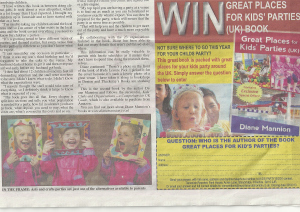
Have you got any cringe moments you’d like to share? Go on, indulge me. Don’t let me go through this alone.


February 6, 2014
My First Radio Interview
I have avoided radio interviews up to now as public speaking isn’t really my thing. However, deep down I realise that, as part of the publicity for my books, it is something that I will have to confront eventually – just not quite yet. Press interviews, on the other hand, I’m quite comfortable with, having done quite a few to publicise both books. I’ve also been on the other side of things, conducting many interviews in order to write case studies and magazine features on behalf of clients.
Although my books have been featured in a number of parenting magazines, websites and blogs, they haven’t been covered by local press until now. When I approached the Tameside Reporter they replied asking if I would also do an interview for the local radio – ‘Oh dear, the day of reckoning has arrived,’ I thought. I was then told that the interview would take place in my home and recorded with snippets of it being used for radio. This put my mind at ease knowing that I wouldn’t have to speak live on the radio.
When the day of the interview arrived I wasn’t particularly nervous, because I knew it wasn’t going out live. However, the minute the microphone was placed inches from my mouth I immediately  broke out in a sweat. The microphone was so near to me that I felt as though not only my voice would be picked up but also every sharp intake of breath, clearing of the throat, cough, mumble, fidget and maybe even the sound of my thudding heart – or so it seemed. It was a good experience though as it forced me to ‘get over myself’ and concentrate on the matter in hand. So I tried to focus on the interview and forget the presence of the microphone, although it wasn’t easy as the menacing little machine was positioned in the forefront of my field of vision, looming threateningly between me and the reporter.
On the day when the news item went out I cringed as I listened to myself talking about my book (I actually hate the sound of my own voice). As proud as I am of my Manchester roots, I don’t think the Mancunian accent is the most appealing in the world. Anyway, my piece went out at the end of the news every hour from 14:00 till 18:00. They used a couple of quotes from the interview and rotated them in two sets. I have to say that the second set sounded better than the first where I was a little repetitive. All in all though, it wasn’t too bad for a first time. You can catch the item on the Tameside Radio listen again feature by selecting 4/2/14 then listening to the news at any time between 14:00 and 18:00; my piece is at the end of the local news items.
The day after I’d listened to my piece on the radio I dashed out to buy this week’s Tameside Reporter so that I could read the accompanying feature. I quickly flicked through the newspaper twice before concluding that the item wasn’t being featured. ‘Oh no,’ I thought, ‘Was I really that bad?’ Curiously I scanned the front page to see what type of stories make the local press. And there it was, in small letters at the end of the feature headings, ‘Next week – local author’s kids’ party book release.’ So, next week will see me rushing out for my local newspaper once again.
Great Places for Kids’ Parties (UK) is available to purchase in both a digital and print version from Amazon.
——————-


January 30, 2014
Book Promotion Continued
It’s been a busy week with the ongoing promotion for “Great Places for Kids’ Parties (UK)”. Here are just a few of the exciting things that have been happening:
Book Reviews
“Great Places for Kids’ Parties (UK)” has already received some favourable reviews on Amazon. Here are some of the comments:
“Great ‘dip into’ resource for harassed parents with shallow pockets! Well researched, well written and easy to use. I would recommend this book to all parents/carers in need of inspiration in organising kids’ parties with a difference without breaking the bank!”
—————
“A real gem, I would recommend this to anyone, the possibilities for its use are endless. There are also exclusive offers and discounts available too, which is amazing. Me being a neat freak means that this book greatly appeals to me as it is so organised and informative, and parents who are more fly by the seat of your pants people will love this book for its simplicity and ease of use. A great idea.”
—————-
“Who knew there were so many choices for birthday parties in the UK! There are some great ideas I never would have thought of. This guide is full of useful tips too, the detail the author has gone into is fab. A great one stop shop, will save me plenty of time trawling the internet for ideas.”
—————-
The book will be featured on a couple of parenting review sites and parenting magazines over the next few weeks. The first of these is already online at the book reviews for mums website and you can see it here. Big thanks to Becky Goddard-Hill for kindly featuring a review of my book on her website.
Local Press Interview

I’ve got my first local press interview on Monday for a feature about me and my books, which will appear in next week’s edition of the Tameside Reporter together with a competition to win a copy of the book. The interview will be recorded for local radio as well, which will be a bit nerve-wracking, but it’s all part of the author experience. Additionally, I’m waiting to hear back from a local magazine about the possibility of a photocall at my local bookshop.
Stockists
“Great Places for Kids’ Parties (UK)” is available in digital and print versions at Amazon and can be ordered online from Waterstones. I have also arranged with a couple of book/gift shops to take initial stock of a few copies of the book. However, at this point it isn’t a long-term arrangement so fingers crossed that the books will sell well with them.
If you have any questions or tips on book promotion for independent authors, please feel free to share your comments in the box below.


January 21, 2014
Netmums Book Giveaway
My guest blog for Netmums has now been published and, as a bonus, readers have the chance to win one of five copies of my latest book “Great Places for Kids’ Parties (UK)”. You can find the blog post here. To be in with a chance of winning a signed print copy of my book all you have to do is post a comment in response to my guest blog on Netmums. The article is full of useful tips about taking the stress out of kid’s parties so it’s well worth a read if you have young children.
![Pageflex Persona [document: PRS0000026_00023]](http://dianewriting.files.wordpress.com/2014/01/ebook-offers-final.jpg)
There’ll also be a chance for readers of my local newspaper, the Tameside Reporter, to win a copy of my book through a competition which they will be running in conjunction with a feature about me and my books. I’m expecting a call from them any time now to arrange the interview.
If you don’t have any luck with the Netmums competition but would still like a copy of the book, you can purchase it in either Kindle or print format at Amazon. I’m also currently sourcing further stockists for my book so I’ll be adding details to the books page of my main website in the coming weeks.


