
Heather Burnside's Blog, page 13
June 23, 2015
Happy Birthday Cupid’s Way
Talented and prolific author Joanne Phillips is celebrating the first birthday of her romantic comedy “Cupid’s Way” today. This isn’t Joanne’s first book. She also writes contemporary romance and cosy mysteries, and I have personally read and enjoyed a couple of Joanne’s other books.
“Cupid’s Way” is based on an actual street and Joanne has included some interesting background details about the book in her blog post. You can find out more and take a look at the enticing book blurb by following the link below:



June 17, 2015
The Gunchester Era
I am due to release my second novel, “A Gangster’s Grip”, in the next few months, and it is currently with my beta readers. It will be the second part in “The Gunchester Trilogy”; Slur is the first part. All three books are set during the Gunchester era, an infamous period in Manchester’s recent history when gang-related gun crime escalated. This was, in fact, the reason why the press dubbed Manchester, “Gunchester” during the 1990s.
Slur features many of the same characters as the following two books and takes place at the beginning of the Gunchester era, in the 1980s. However, the 80s was the prelude to what was to become  one of the most dangerous periods in Manchester’s recent history. It was during the 90s when things really got out of control. My second book, “A Gangster’s Grip”, is set at the height of the Gunchester period and I will be giving more details about the novel in a future blog post. Firstly, though, I would like to tell you about the Gunchester era, which provides the backdrop for “A Gangster’s Grip”.
Manchester, like any major city, has always had its share of crime and organized violence. Even in the 19th century there were gangs such as the Scuttlers and the Bengal Tigers who would be involved in fatal knife battles.
Since the 1970s, Moss Side, an inner city area of Manchester, has been known as a place to purchase illegal drugs such as cannabis. The drug scene changed during the 80s though when heroin started to arrive on the streets of Manchester. At the beginning of the same decade, the police received reports of a gang war between rival gangs from Moss Side and Cheetham Hill. Up until that point the gangs had maintained good relations but something had caused a major rift.
At the start of the hostilities the weapon of choice had been the machete. Gang members also used knives to settle disputes. However, as time went on guns were increasingly being used in gang violence. The incidents of gun related crime soon escalated, reaching a peak in the 1990s. During a five year period when gun violence was at its worst there were 27 gang-related deaths and 250 injuries.
 Apart from the rivalry between Moss Side and Cheetham Hill, there was also rivalry between two Moss Side gangs whose members lived in close proximity to each other. Youths as young as 15 became victims of the violence and, as well as the nickname of “Gunchester”, Moss Side was also dubbed “The Bronx of Britain”.
In an attempt to rid the area of gangs, the authorities redeveloped the estate in Moss Side where the two local gangs were based. However, as a result, some of the gang members moved to other areas where they formed new gangs in places such as Longsight and Rusholme.
At the same time the city was experiencing problems with gangs from other parts of the city, mainly Salford, which controlled nightclub security in the city centre, and demanded a percentage of the income from nightclubs. At one point no nightclub was safe, and gangs loaded up with weapons would move in as soon as they heard about a new nightclub opening.
Eventually the police managed to bring the problems under control by carrying out ‘stop and search’ operations on cars entering the city centre on Friday and Saturday nights, and confiscating weapons. Manchester also set up a multi-agency task force to tackle gang-related problems. Nowadays, there is still gang related violence but the number of casualties has been vastly reduced since the figures reached their peak at the height of the Gunchester period.
“A Gangster’s Grip” features three rival gangs. Although I have set the book during the Gunchester era, and based the gangs in Moss Side, Cheetham Hill and Longsight, the gangs featured in the novel are fictitious, as are the pubs that are mentioned. The book is scheduled for launch around September/October and I will be including further details on this blog in the lead-up to the launch.
——————-


June 5, 2015
Anticipating my Arrest
I’ve just finished the first draft of my second novel and happily sent it off to my lovely beta readers, so I’m feeling a bit frivolous and in the mood for some light-heartedness.
A recent occurrence led me to think about my Internet browsing history during the course of writing the novel. It makes for some pretty disturbing reading:
Drug abuse
Machetes
Guns
Bullet wounds
Gang culture
Drug skimming
Law enforcement
Dog attacks
And that’s just in the last few weeks.
The occurrence that led me to think about my Internet browsing history was something as innocuous as searching online wool shops. (Yes, despite the graphic nature of my novels I’m actually quite  boring and mainstream in real life). Within a few hours of searching the wool shops, I was seeing advertisements for wool on Facebook and other social media sites. I was flabbergasted at how they had managed to get hold of this information. If advertisers can cash in on your browsing history so easily then the possibilities for the police are endless.
At this point I want to add that as well as carrying out online research I also have “brainstorming sessions”. Most of these occur while I’m at my computer and usually entail me sitting at my desk talking to myself. Then, to capture certain scenarios I sometimes mime my character’s actions just to check whether it would work in practice, and to make sure it would be realistic. Sometimes it’s necessary to use a mirror so that I can study the positioning of limbs, facial expressions etc. It’s all in the name of my art, you understand, and has nothing whatsoever to do with being slightly eccentric.
 So, I’m picturing the scene. The police have had a tip-off from their technical team about a dodgy browsing history so they start monitoring the house. One of the officers spots someone carrying out what appears to be a frenzied knife attack but when he zooms in the perpetrator is attacking a teddy bear with a biro pen. He calls for support. When the two officers arrive they approach the house with caution and creep up to the window. There they spot a middle aged woman sitting at her desk having an in-depth conversation. After a few seconds the conversation becomes heated and she seems to be taking on the roles of two different characters.
Ooh dear, how would I explain that one? Maybe this home working isn’t such a good idea. While writing the plot, I’m also losing the plot!
Is it just me or do other authors find themselves acting out scenes and talking to themselves while they work? I’d love to hear your views on this one. Talk to me please; my sanity depends on it! :) :) :)
——————-


May 13, 2015
SLUR on Special Offer
I am pleased to announce that SLUR will be available for the special promotional price of 99p (or 99 cents in the US) from 13th May until 20th May. If you want to grab a copy while it’s on special offer, here is the link: http://viewbook.at/Slur.
SLUR is the first part in a trilogy. The second part will be released late summer/early autumn of this year followed by the final part in summer 2016.

If you haven’t already read SLUR, here is the book blurb:
How would it feel to be accused of a murder you didn’t commit? To believe your friends, family and colleagues had turned against you. Would you reach breaking point or fight to prove your innocence?
Julie Quinley finds herself in this position following the events of one fateful night. She has to bear the slights and accusations of colleagues and acquaintances, and life becomes unbearable. Eventually, thinking that she has lost the respect of everyone around her, Julie plunges into a deep depression.
However, unknown to Julie, those closest to her are rallying support. She reaches a turning point when her friends reveal that they may have found the real killer. Realising she must act in order to clear her name, Julie joins them in trying to find evidence.
But proving a vicious murderer guilty is never going to be easy, especially when the police remain unconvinced. Will Julie and her friends succeed? And is their suspect really responsible for the crime?
I hope you enjoy SLUR. If you want to find out more about future books or receive other free gifts and special offers including a free copy of my short story collection “Crime, Conflict & Consequences”, please sign up to my mailing list here.
—————-


April 28, 2015
Reasons to Publish in Print
Opinions are divided on whether or not it’s a good idea to publish in print as well as digitally nowadays. Certainly it can save a lot of time and added expense to only publish digitally, and some authors are achieving success without releasing a print version. However, I like to see a book in print, as do many readers so I thought I’d put together some of my thoughts on the argument for publishing a print version of your book.
1) Book shops – They attract a local readership and local publicity. For example, if you hold a book shop signing, you stand a good chance of being featured by the press in the area where the book  shop is situated. Regional authors often start by building up a following in the area where their novels are based. This makes sense because these readers will identify with the places and customs explored through the author’s books.
It’s a mutual arrangement with local book shops – you are supporting the business by giving something of interest to draw in extra customers e.g. a book signing event, and the book shop in turn is helping to get your book noticed.
2) Libraries – With a print version of your book you can sell to libraries, which gets the word out to a wider audience. Every copy sold to a library could be read by numerous people who may recommend your books to others. Some people who borrow books from libraries also buy books so they may become firm fans who will buy future books by the same author.
3) Reader preference – Some people still prefer print and, in particular, many people like to get their hands on an author signed version.
4) Goodreads Giveaways – This is where you put up a few print copies of your book on the Goodreads site to be given away to participating readers. Goodreads chooses the winners from the participants. The advantage of giving away a few copies is that many people add your book to their “to be read” lists when they enter the Giveaway.
Having only published one novel, the jury’s still out on this one for me. I would surmise that the benefits from having a Goodreads Giveaway are ongoing rather than an immediate route to sales. This is because many readers on Goodreads have thousands of books on their “to be read” lists so it could be a couple of years (if ever) before some of them read my book.
I wouldn’t underestimate the power of Goodreads though and I think it could be especially advantageous if you have more than one novel available. If my book reaches the top of a lot of lists in a couple of years’ time, and those people like my book, they may decide to purchase other books as well as recommending my book to other readers on the site. I can therefore see how the snowball effect could kick in.
5) Other opportunities – I have been invited to take part in a literature festival in the summer as a result of having my book stocked by a Manchester book shop. Having your book in print can open up similar opportunities.
6) Presents – It’s easier for people to buy print books for birthday and Christmas, presents for their family and friends. Although the bulk of books sold are now digital, sales of print books will boost your overall sales figures.
7) Amazon – Having a print version of your book available looks good on Amazon because Amazon shows the savings that purchasers are making when they buy the Kindle version. The majority of people buying books on Amazon choose to buy Kindle rather than print versions, so this is a good thing especially as independent authors tend to price their Kindle versions low.
N.B. Having said all the above, I have published my short story book in digital format only, but I have based this decision on the fact that it isn’t cost effective to publish in print for a book of that size.
Please feel free to share your thoughts on this topic. Do you prefer to publish only a digital version or do you like to see your book in print too? Are there any other reasons for publishing a print version which I have not covered above, or are there any disadvantages?
—————


April 14, 2015
Work in Progress Blog Hop
I was nominated for the Work in Progress Blog Hop by the lovely Georgia Rose who blogs at Georgia Rose Books. Georgia is a prolific blogger who reviews books on behalf of Rosie’s Book Review Team. She is a very supportive member of the indie author community and also writes revealing and entertaining author interviews via her blog. Georgia is currently completing her third book in the excellent Grayson Trilogy and I know that I am amongst the many readers who are looking forward to reading it and finding out what happens next.

Thanks for the nomination Georgia. My second novel is currently at the first draft stage so before I revisit the first three chapters to see whether they pass muster, I want to introduce four other bloggers in line with the blog hop rules which are:
Link back to the person who nominated you.
Write a little about and give the first few lines of your first three chapters from your WIP.
Nominate some other writers to do the same.
So, here are my nominations:
Guy Portman’s Blog – Guy shares lots of insightful information about famous authors and notable novels via his blog. He also includes details about his travels and other interesting observations.
Marilyn Chapman blogs at Guernsey Girlie. I love the retro feel of Marilyn’s blog and she covers history topics (amongst others) in an entertaining way – I think my school history teachers could have learnt a thing or two from her about approach.
Sue Coletta blogs at Crime Writer Blog, which has a wealth of information for anyone who writes in the crime genre. As well as her murder blog Sue generously shares crime writer’s resources, writing tips and a whole lot more via her website.
Yasmin Selena Butt blogs at Hello You. Yasmin’s blog is full of personality and she’s a girl who isn’t afraid to tell it like it is. I’ve also included Yasmin because I can’t wait to find out more about her second book.
Here’s a little about my work in progress:
I’m currently writing the sequel to SLUR and am at the first draft stage so I might edit some of these excerpts at a later date. We’ve now moved on five years to 1991. During the 1990s Manchester was infamously nicknamed ‘Gunchester’ by the local and national press due to the upsurge in violent gun crime by drugs gangs in certain areas of the city.

In SLUR I hinted at the fact that Rita (one of my main characters) had a father who was a petty crook and a sister who hung around with some dodgy characters. I’ve therefore decided to explore her story further and make her the main character in the sequel.
Rita returns from Greece for reasons that I don’t fully disclose until later in the book. When she arrives at her parents’ home she finds out that her sister is going out with the local gangster. She senses danger straightaway but her parents refuse to take her seriously for their own dubious reasons. Despite the lack of support from her parents Rita sets out to lure her sister away from her boyfriend. This proves more difficult than she anticipates and many lives are put at risk due to the boyfriend’s shady dealings.
Here is the first paragraph of each of the first three chapters:
Chapter 1
Rita couldn’t wait to get to her parents’ house, unaware of what to expect when she arrived. It had been so long since she’d been home from Greece and she had missed everyone, despite their shortcomings. She rushed to the front door while Yansis struggled behind with their overstuffed suitcases.
Chapter 2
The scene at her best friend Julie’s house was in complete contrast to the one Rita and Yansis had left behind half an hour earlier. Before they even got inside Julie’s home, the differences were apparent. Rita’s parents lived in Longsight, a deprived area of the city that Rita had been glad to leave behind when she had gone to live in Greece five years ago. The estate where her parents’ home was situated was particularly run-down. During the years that Rita had lived there she had grown accustomed to the abundance of litter, overgrown gardens, graffiti ridden walls and areas of worn grass used as dumping grounds for old furniture. The latter doubled up as play areas for small children who used the bug infested mattresses and sofas as trampolines.
Chapter 3
Leroy was at the wheel of his black BMW driving along the busy Cheetham Hill Road on his way to a meeting with his suppliers. He cruised through this vibrant multi-cultural area where new architecture mixed with old, and industrial units, furniture stores and car showrooms stood alongside churches, mosques and synagogues. He’d left early with the intention of collecting some other goods before his meeting.
I’m looking forward to seeing everybody else’s blog posts and finding out more about their WIPs.
——————-


March 31, 2015
Why do you Love Being an Author?
During a recent email chat with an author friend we were discussing how frustrated we become when other work pulls us away from writing our novels. I commented that it was probably because other work didn’t give us the same sense of satisfaction as writing novels. This led me to thinking – just what is it about being an author that is so satisfying? So I thought it would be interesting to try to pin down some of the reasons:
Escapism – When writing a novel you can escape into your own world which can be anything you want it to be. That does beg the question – why is my writing world full of violence, bad language and warped characters, and why does that give me so much satisfaction? Hmmm!
Creativity – I gain a sense of fulfilment in having created something from nothing and I’ve no doubt it’s the same for other authors. Your book is like your baby that you feel proud of and it gives you t hat special feeling of having nurtured it from start to finish. A lot of us are familiar with the buzz of holding the print version of our own book in our hands or seeing it on the shelf in our local book store or library.
Reader Satisfaction – It’s lovely to receive feedback from readers and know that somebody has enjoyed one of your books.
Organisation and Planning – In the (non-writing) world of work, good organisation was always one of my strengths and I think that both non-fiction and fiction books require good organisation skills. You have to be able to plan the chapters, and carefully interweave the main plot and sub-plots. Organisation and planning are also important in achieving a good balance with the pacing of a novel. Because of my organised nature I actually enjoy these challenges.
Kudos – If I’m honest it’s always flattering when people take an interest in what I do although I also get a little embarrassed sometimes. Even though there are increasing numbers of people publishing books, it still attracts a lot of attention when you say that you have written and published a book.
Huge Potential for Financial Gain – Yes, there’s a golden carrot dangling on the end of that metaphorical piece of string. The trouble is, every time you try to grasp the carrot, somebody yanks the string and you find you’ve got a bit further to go until you reach your reward. But as long as we can see the carrot, we’ll keep trying to grab it.
I’m speaking for the majority of authors, of course. There are some who are already reaping large financial rewards, which provides further encouragement for the rest of us.
Now for the things I don’t love so much:
I don’t think I’m very good at the whole marketing and promotion thing. I’ve never been one for selling myself. I’d rather shy away and get on with my writing but I expect a lot of authors are like that, which is probably why we choose to do what we do.
 The other negative aspect for me is that there aren’t enough hours in the day. This is another one that I often hear other authors complain about, especially independent authors. It would be wonderful if we could devote all of our working hours to writing and have somebody else take care of all the promotion, editing, proofreading and formatting etc. but for most of us that isn’t feasible.
I’d love to hear your thoughts on this one. What is it about being an author that you love or are there any aspects of being an author that you’re not so keen on?
Anyone fancy a carrot?
——————–


March 20, 2015
Versatile Blogger Award
Thank you to Guy Portman of http://guyportman.com/ for nominating me for the Versatile Blogger Award. I have been following Guy’s blog for some time and it is full of entertaining author–related information as well as interesting anecdotes about his travels.

Here are the rules relating to the award:
Nominate 15 other bloggers relatively new to blogging (I’ve dispensed with the ‘new to blogging’ bit since I could only find a few of them)
Let the bloggers know that you’ve nominated them
Share 10 random facts about yourself
Thank the blogger who nominated you
Add the Versatile Blogger Award picture to your post
Ten random facts about me
Since my blog is about things related to my writing I’ll start with some bookish facts:
1. The oldest book I own is ‘As you Like It’ by William Shakespeare. It is a 1941 version by the Oxford University Press marked with a school stamp. Don’t worry, I didn’t acquire it by nefarious means. My school were having a clear out and were giving old books away to the pupils.
2. My favourite book is ‘Guests of the Emperor’ by Janice Young Brooks. This is the story of a group of women and their fight for survival in a Japanese prison of war camp during World War Two. I also love ‘Tess of the d’Urbervilles’ by Thomas Hardy.
3. My first foray into commercial writing was when my junior school teacher asked the pupils to submit poems for a book that was being published. It was a collection of poetry by children from  schools all over the area. I have a vivid memory of the last day of junior school. We were asked to rewrite the poems in our best handwriting. Everybody else had one or two poems for submission but the teacher had selected several of mine. While all the other children were celebrating the last day I was busy writing. Somehow it felt more like a punishment than a privilege and I never did find out whether any of my poems were published.
4. I’ve lived in Manchester all my life and I love it (despite the weather). I love everything about Manchester and consider myself lucky to have so much on my doorstep – great music, sport, culture, shopping, countryside etc. etc. etc. I can’t think of anywhere else I’d rather live. Despite all this we have our share of crime, like any other city, which is why I’ve chosen Manchester as a base for my novels. I hope this doesn’t mean that I am showing the city in a negative light because it doesn’t represent Manchester as a whole.
5. Prior to becoming a writer I used to work in credit control and I became a graduate Member of the Institute of Credit Management (MICM). Although I hated the job I finished studying for my professional qualification because I figured that all education is worthwhile. That has proved to be a wise decision because I’ve produced a lot of copy in the consumer finance niche over the years.
6. My favourite drink is cappuccino.
7. I enjoy the theatre but mostly go to local theatre rather than central Manchester. It’s a lot cheaper, easier to get to and we have a high standard of amateur theatre groups in our local area.
8. I used to enjoy knitting and crochet but haven’t done any for ages because of the need to wear varifocals for the last couple of years. I’m definitely not a fan of them and had a separate pair of glasses made up specifically for computer work.
9. As a child I loved reading so much that for a long time I refused to watch TV. I even told my school teacher that I didn’t like the television. While the rest of my family were watching TV I used to lie on the carpet with my head underneath my dad’s legs as he used to rest his feet on a stool. The gap underneath his legs used to obscure the TV screen and drown out part of the sound so that I could concentrate on my books.
10 The other place I love is Spain. I can talk the language a little although not as well as I used to. I spend holidays in a town that is occupied mainly by British ex-patriates so I don’t get sufficient opportunities to practice my Spanish.
That’s enough about me. I would like to nominate:
Crime Writer’s Blog (Sue Coletta)
The Lavender Field (Kim Smith)
Annethology (Anne Goodwin)
Writer Babble (David Delaney)
Best Dad I Can Be (Mark Richards)
——————-


March 12, 2015
Free Promotion – Crime, Conflict & Consequences
Here’s a chance to grab your free copy of my short story book, “Crime, Conflict & Consequences”, which is on free promotion from today on the Amazon Kindle: http://viewbook.at/Consequences. There are 10 stories in a variety of genres, writing styles and themes so there should be something to suit a wide range of reading tastes.
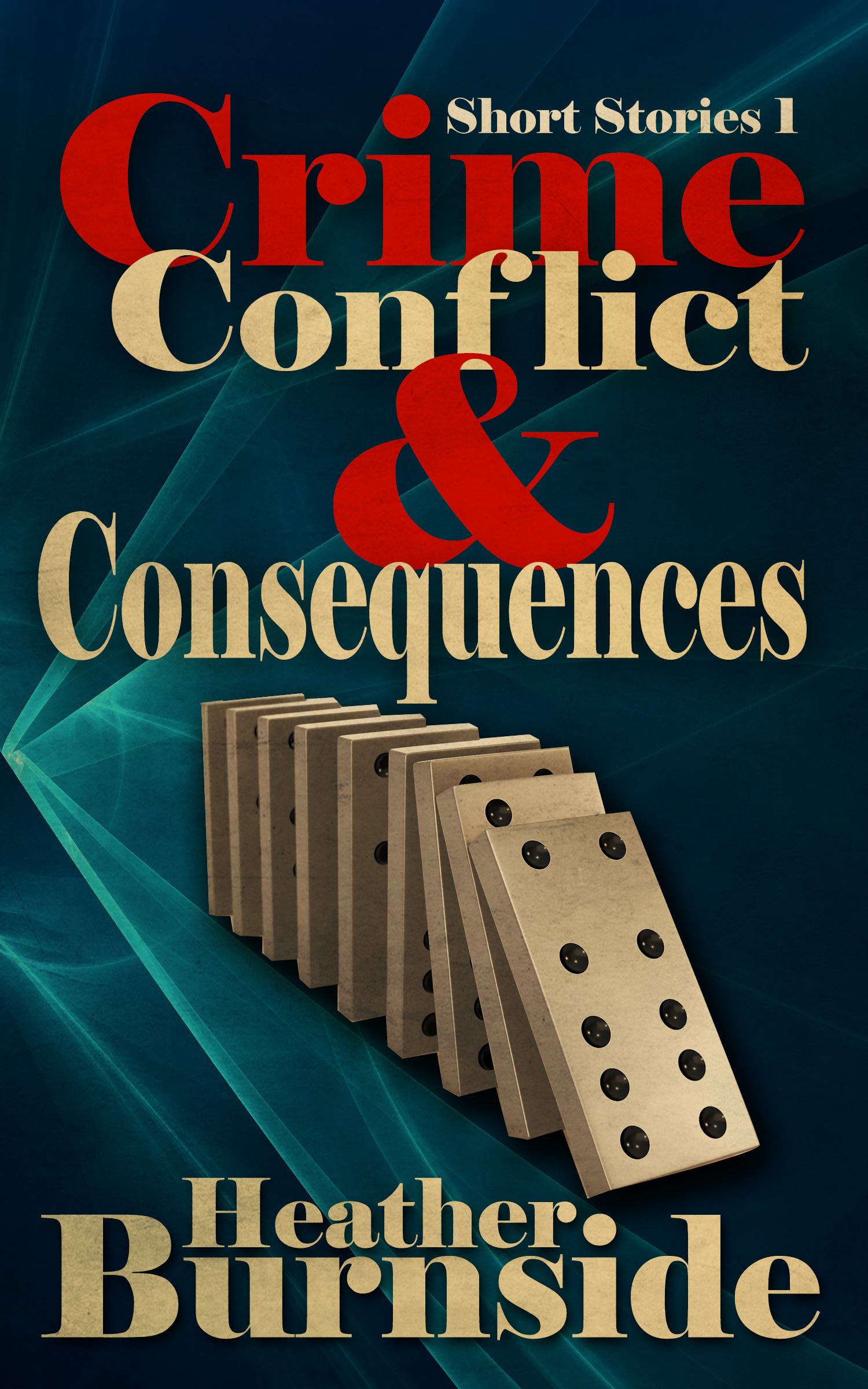
Here is the book blurb:
This entertaining collection of 10 assorted tales explores a variety of genres with stories of crime, love and family dilemmas. There are also a few twists and surprises along the way. The common thread running through each story is – consequences.
In HELD UP our heroine is caught in the wrong place at the wrong time and becomes a witness in an unusual bank robbery.
In ISLAND OF DREAMS Joe and Bev are looking forward to returning to the island they visited on honeymoon 34 years previously. Will it still be the same?
In WELCOME ABOARD find out how Helena copes with the job from hell.
These short stories are a great introduction to the work of Heather Burnside. Each one makes an enjoyable quick read with a satisfying conclusion.
I hope you enjoy the stories.


February 26, 2015
Are Big Publishers Compromising their Authors?
I read a book recently by one of my favourite thriller writers but was disappointed because it wasn’t up to his usual standard. The book extended to 500 pages in print but I felt that it should have been no longer than 250 – 300 pages. At 250 – 300 pages it would have been a good book but for me there were too many forced twists that were unconvincing.
To illustrate my point, here is a brief synopsis:
The protagonist worked for a protection agency in the US and he was assigned to protect a family from someone who wanted to obtain information by violent means. At first it was suspected that the father would have the requisite information as he was a law enforcement officer but it transpired that it wasn’t him. It may have been a convincing twist if played only once but that twist was carried out repeatedly. The author worked his way through each member of the family, four of them altogether, until eventually the person holding the information turned out to be the 16 year old daughter. Without all these unnecessary additional twists it could still have been a very good plot, which leads me to believe that the fault doesn’t lie with the author.
It isn’t the first time I have noticed this; the same thing has happened with other good authors. When I checked out the reviews of this particular book they reiterated what I was thinking and cited examples of other popular and talented authors where this sort of thing had happened. I’m not convinced that it’s because the author has run out of ideas. Take the above example; it would still have been a good book if it had been much shorter. No, I think the problem may lie with the publishers and here’s why:
When I studied for my writing course many years ago we learnt the way in which the major publishing houses operate. Once an author has signed up with them they will require the author to produce a set number of books over a certain time period and will also specify the required minimum word count per book. Therefore, on occasion authors may be forced to stretch a plot beyond the bounds of credibility.
At that time (about 15 years ago) I was informed by my tutor that publishers wouldn’t consider any novel of less than 80,000 words. In fact, the trend was for novels in excess of 100,000 words. I don’t know what the current requirements are but, in view of the above, I wonder whether these are still the same.
While I would be I liar if I said that I wouldn’t consider going with a traditional publisher if I was to be given the opportunity, the above is one of the factors that I would have to think long and hard about. Here are some other factors that are worth considering should you decide to follow the traditional publishing route:
How do the royalties compare to the rate you receive as an independent author?
Would any increase in sales compensate for the fact that this rate would be substantially less than the rate of 70% (in most cases and after VAT) currently enjoyed by authors independently published through Amazon?
How much promotion would your publishers undertake on your behalf?
Would your book be stocked by major book store chains?
Would you have any say in the choice of book cover design and the book’s title?
How much advance would you receive?
How long would you have to wait for your royalty payments?
What would the time lapse be between completion of the book and publication date?
Would you be expected to make public appearances etc.?
 For anybody who is offered a contract with a major publishing house it is easy to become so carried away with the excitement that you lose objectivity and don’t think about all the implications. As independent authors we have autonomy and are used to making all the decisions ourselves. I therefore think it is important not to lose sight of this and I wonder how it would feel to have all of these decisions taken out of our hands.
On the one hand it would perhaps free up more time to focus on writing because you might get more help with editing, proofreading, formatting and promotion. However, on the other hand, how would it feel to be told, for example, that you couldn’t use your own title for your own book?
I would love to hear your thoughts on this one.


