Richard Abbott's Blog, page 22
August 26, 2015
How did people in the past view their own ancient history?
I’ve had the happy experience of being on the Scilly Isles for the last couple of weeks, surrounded by ancient historical monuments as well as natural beauty, and it set me wondering about how people in the past thought about the older monuments they saw around them.
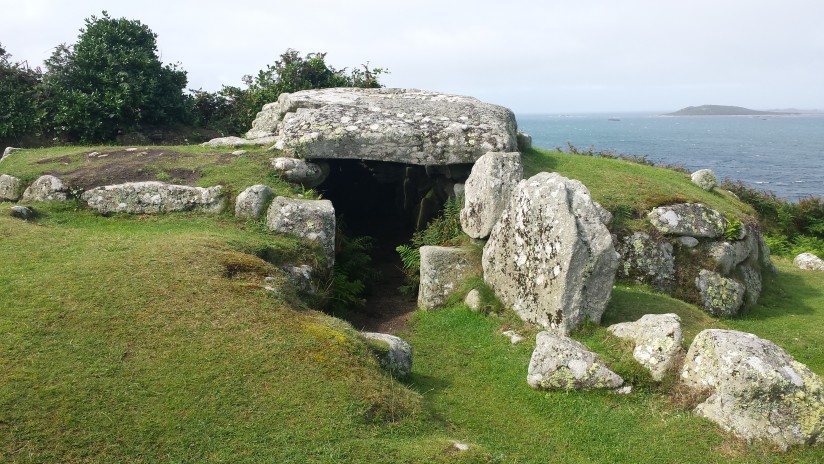 Bant’s Carn entrance grave above Halangy Village
A couple of examples. On St Mary’s there is an Iron Age village, Halangy (from the early AD period). It now overlooks the stretch of water across towards Tresco, but when the island was first settled, a person standing here would be looking across a wide expanse of cultivated land towards some low hills. But up the hill from the houses, with a space carefully left between, is a much older entrance grave, Bant’s Carn, from either the Neolithic or Early Bronze Age – possibly 2 or 3000 years older. The grave overlooks both the village and the drystone walls marking out ancient field divisions.
How did the Halangy villagers regard that tomb? Was it a place of solace or spiritual protection, either in the ordinary difficulties of life or more specifically from the slow but relentless impact of rising sea levels? Or perhaps a nuisance that called for regular observances but apparently contributed nothing and took up valuable land? Or was its function lost to history by the Iron Age, and it simply stood there as an enigmatic reminder of an older time? Many such old human relics are given names suggesting they were built by giants – apparently their monumental scale made it seem impossible that they could have been built by human ancestors. But at least there would be a sense that whoever built it was living in the same place, sharing something of the same experience of life.
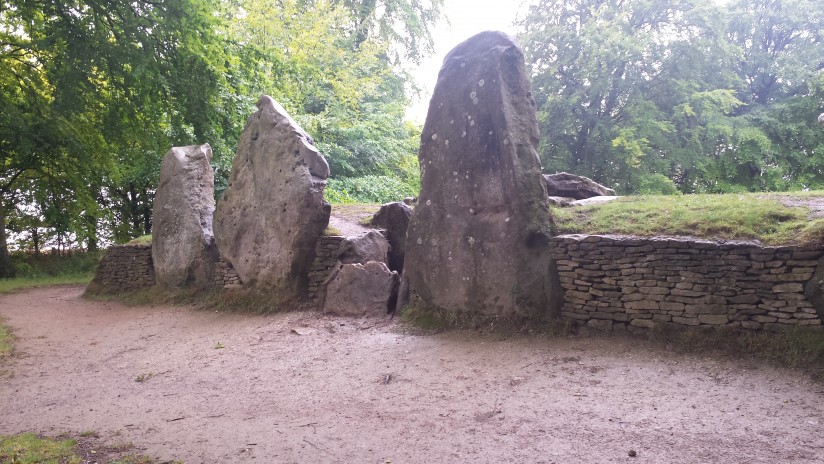 Wayland’s Smithy, beside The Ridgeway
Another example comes from The Ridgeway. The modern national trail follows the middle portion of a very ancient trackway linking the Wash in East Anglia with the Channel coast and River Severn. It was used actively for thousands of years, and scattered along it are all kinds of monuments of the human past. The particular one I want to focus on is Waylands Smithy, a very long Neolithic burial mound beside the track which itself incorporated an older, smaller tomb within it.
Now picture yourself as a person walking the Ridgeway in the Late Bronze Age (c. 1200BC say for definiteness) – perhaps you are carrying trade goods, or going to a festival to celebrate. You camp one night close to Waylands Smithy, and wander over to look at it in the moonlight. What do you make of it? Something like 2000 years separates you from its builders, and presumably the symbolism which was clear when first constructed is obscure to you. Do you even recognise it as a burial place? And if you do, does that recognition bring comfort or anxiety? Unlike the case of Halangy village, you have no possible personal connection with the culture who erected it, and no sense that those people could be your own ancestors.
All this made me think a lot about my own writing, set in the Late Bronze Age in the Levant. Uphill from the town of Kephrath are caves used as family tombs over a number of generations. There is a very direct link between the current occupants of the town and those tombs, and so there is no mystery about them, other than the basic mystery of death. But elsewhere in the land nearby, there are older constructions, to which Kephrath and its occupants have no connection. What would they make of them?
No answers here, but a lot of provocative questions about the past!


August 10, 2015
Interview – Labayu
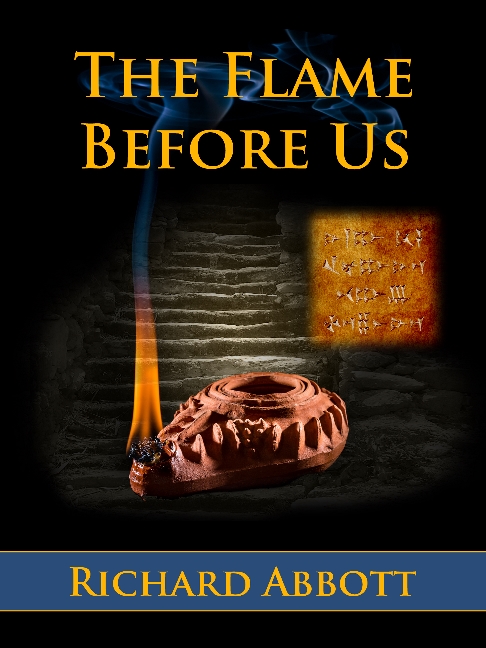 Cover – The Flame Before Us
Here is the next in the series of character studies from The Flame Before Us, presented in the form of interviews.
Today’s interview is with Labayu, a Kinahny man who grew up in Kephrath, but until recently was living among the northern tribes of the Ibriym, in the Galil region. He has recently moved back to Giybon, largest of the Four Towns.
I had been directed to one of the houses in Giybon, but Labayu was not at home. His wife, Ashtartiy, makes me welcome with mint tea and some raisins, and then settles me outside. The corner of the house shades me from the afternoon sun, and a spreading rose curls above the door lintel. Ashtartiy’s mother is inside, and two children, but it is clear that I am not to join them. Domestic conversation floats intermittently out of the door, and I drift on an autumnal reverie.
Finally I see Labayu approaching from the town gate. He strides up to me, welcomes me enthusiastically, and sits beside me. One of the children runs out to hug him, watching me covertly before dashing in again.
“Have you been here long, sir? I was setting snares along the ridge north from here and forgot the time.”
“Not long, and I have been made welcome.” I remember just in time that in his tradition, the house belongs to Ashtartiy rather than him. “Your lady wife has shown me the hospitality of her home. I was not sure if I would find you here. They told me in Shalem that you were often away from the town for weeks on end.”
“Not so much just now. Until early this year I was living north of here, in Ramath-Galil, west of Kinreth. I led a band of men who protected the northern borders of the Land. The Sons of Anath, they called us.”
“Your family were there as well?”
He nods.
“But Ashtartiy hated it. The Ibriym tribes up there have no respect for our customs, and refused to give her honour as mother of the house. As soon as we heard the first rumours of trouble she came back here to her mother’s house. I persevered and stayed longer, but now here I am, as you see.”
“The trouble you mention: that was when the Sherden and their fighting cousins first came into the land?”
“No, no, it was before then. The king of Hatsor heard news of their approach before we did, and set out to scour the land for men to force into his army. Little good it did him, though, for the newcomers swept his troops away with all the rest. But Ashtartiy left at that early stage, in case I needed to escape in haste out into the wilderness.”
He paused, thinking back. Keen to keep the conversation going, I rush on.
“But when these newcomers arrived you were away from that village, I hear.”
“Yes indeed. The headman, Pedayah was his name, he led his people south to avoid the fight. I stayed there to scout what was happening. And because Abiy’el, the warleader of the Ibriym at that time, he wanted me to see if a covenant treaty might be cut. We had no idea who they were, you see, and we had no idea that they were made up of different tribes themselves.”
“Were you able to make peace?”
“Not then. Not ever, with some of their tribes. But we came to an agreement with the Sherden, after a while.”
He pauses, apparently wondering if he should continue, and then rushes on.
“I was the one who was first able to come to peace with them. It was in Shalem. I had pursued a small group of them there with a handful of my men, thinking that they were the enemy. But the people I met wanted peace, and a place to settle quietly on the other side of the River. I spoke with them, and realised that we could find common ground with them. But as for their distant cousins, who fought the Mitsriy along the Sea Road and settled on the coastal plain: with them I fear there will always be hostility.”
“At the village cistern they told me that your men did not all agree with this treaty.”
“They did not. That covenant cost me the friendship of a man I had known all my life. Shimmigar, he was called. He could not forgive these newcomers for an act of cruelty, and he will not accept that they are not all alike. He has not spoken to me since the day we cut the covenant with the Sherden. He stayed in the north of the land, to carry on the fight. I hope he still lives.”
He falls silent for a while, and his face shows the grief of the broken companionship. I let him reminisce for a while before I speak again.
“Tell me of the Sons of Anath.”
“Oh yes. It was Abiy’el’s idea in the first place. He wanted a band of hunters who would protect his people on the fringes of their settled land. North, south and west towards the sea. Not so much east, as many of his kindred still live there. But so few of the Ibriym had any of the necessary talents to fulfil such a task, and so it fell mostly to Kinahny men who were their allies. He called this band the Sons of Anath, so that we would feel that it was our heritage as well as his. I was a hunter and trapper, and my father before me, and he chose me to lead the men in the north.”
“But here you are back in Giybon.”
He grins, and waves a hand at one of the passing village men.
“And very glad to be here. Ashtartiy grew to hate Ramath-Galil quicker than I, but I was not far behind her. It is no place for a man or woman raised in the Four Towns. But that aside, the Sons of Anath had been Abiy’el’s idea, as I said. Now that he has lost his place as warleader, the Ibriym do not know whether to keep the tradition alive or not. Some say one thing and some another, and until they are of one mind I have returned to my traps and snares. And the home of my wife, which I came to miss very greatly in that time out in the wilderness.”
“Would you do it again, if they asked you?”
He pauses for a long time. His two children bring us each another beaker of mint tea. The sun slips down towards the wooded ridges. I look around, knowing that Shalem is away in the distance ahead of me, but unable to see any part of it.
“I maintain my friendship with the Sherden, you know. It was Towanos who first spoke with me, that day in Shalem. I had gone to that room all ready to be their enemy, and to arouse the king of Shalem against them. My heart was changed there by all that I saw and heard. Towanos was the first of the Sherden to take the time to speak with me. We found that we shared a great deal in common.”
We fall silent again. Finally he returns to my question.
“I think not. I was willing to try it for Abiy’el, because I respected him. And he respected us. But the Ibriym cannot agree amongst themselves just now, and I do not know who will emerge as their warleader. We are their covenant allies, and at need we will fight beside them. But just now, I do not think that I would go out into the wilderness again as I did before. My place is here, I think.”
“So these last few months have changed you?”
“Beyond measure. Beyond anything that I imagined at the time. When I was roaming in the north of the land, looking for these strangers who seemed to be invading our land, then when I was rushing south to find Abiy’el and saw the tents and camps of the Ibriym who had fled their homes, something changed for me. There was one night when we saw the signs of a town on fire, my men and I. It was near to Shalem; we feared it might be our homes here in the Four Towns. In fact it was a small village of Shalem, set alight by desperate Ibriym men, and nothing to do with the newcomers. But after that night I decided that I would not leave my home town again except for the most severe need.”
He glances in to where Ashtartiy had come to the door to watch the two of us.
“I am content here, in a way that I never was before. But see, my wife has finished preparing our meal. You will join us, I hope?”
We get up and go inside the house, ducking under the limbs of the rose, heavy with the season’s hips.
This is the last of the current series of interviews – later in the year I hope to do some more with other characters.