Richard Abbott's Blog, page 15
January 24, 2017
Kindle preparation part 2 – the files
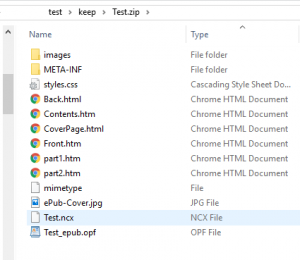 Contents of epub file
Last time I looked at the basic principles of a Kindle mobi or general epub file. This time I’ll be focusing a bit more on what the different ingredients do. We’ll also start to uncover a few more places where Kindle and epub handle things differently. For reference, here is a sample set of files you need for an epub book – Kindle is essentially the same but some “administrative” bits are inserted automatically by KindleGen so you don’t need to worry.
Somebody who uses Microsoft Word or some similar software to construct their book may find the following paragraphs confusing, since they will probably never have needed to address this directly. But under the bonnet this is what is happening with your book preparation, and many years of technical software and QA work has convinced me it’s better to know rather than not know. At very least this may help diagnose when something goes wrong!
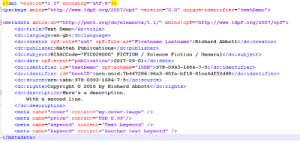 Preamble / metadata section of opf file
So, the key ingredient is the opf file which ties everything together. It has four main sections. The first is Metadata – a general information section containing things like author name, book title, publisher, ISBN (if any), price, brief description, and so on. The kind of detail you might expect to see on a library card or catalogue entry. I’ll be giving specific examples of the different files later in this series but for now want to concentrate on principles rather than details. There are also some important places where you have to ensure that a reference in one place matches one somewhere else – again, I’ll return to this.
 Manifest section of opf file
The second section is a list of resources – the Manifest. For epub this must be complete, and although KindleGen is clever enough to fill in some gaps, it is good practice to be thorough here as well. So this identifies all content files, any separate style sheets, all images including cover, the ncx navigation file, and anything else you intend to include. But it’s a simple list, like the ingredients for a recipe before you get to the directions, and this section doesn’t tell KindleGen or an epub reader how to assemble the items into a book.
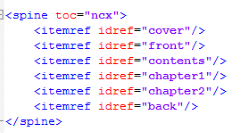 Spine section of opf file
The third section – the Spine – does this work of assembly. It lists the items that a reader will encounter in their correct order. This section turns your simple list of included items into a proper sequence, so that chapter two comes after chapter one. Here you also link in the ncx file so it can do its job.
 Guide section of opf file
The final section – the Guide – defines key global features of the finished book. For example, this is where you define the cover, the HTML contents page, and the start point – the place where the book opens for the very first time, and the target for the navigation command “Go to Beginning” (or equivalent). It’s worth remembering that the start point doesn’t have to be the first page – many books set this after the front matter, so that you skip over title pages and such like and begin at the beginning of the actual story. But be warned that following a scam to do with counts of pages read, Amazon does not take kindly to people putting the start point too far through the book.
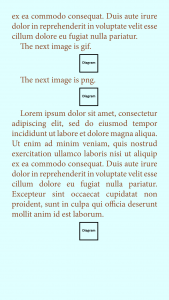 epub treatment of png and gif transparency
Images can cause unexpected problems. The opf file expects you to supply not just a file name, but also the file type, such as jpeg, png or gif. And here we encounter one of those annoying differences between devices. Kindle accepts png files along with jpeg and gif, and many people are used to the convenient feature of the png format that it allows transparency. A png with transparency will – usually – take on the background from whatever happens to be behind it, like the page background for example. An epub file will do exactly this if you use coloured background.
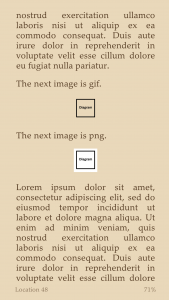 Kindle treatment of png and gif transparency
But KindleGen does not. You can supply a png file successfully, but internally it will be converted to jpeg format… and jpegs do not allow transparency. The background will be converted to white, and the final effect will not be what you hoped for. The way round this is to use gif images if you want transparency, but since this is an old format many people do not suspect that this is necessary.
Now, sometimes this won’t matter – for example if you want to insert a map, and have it look as though it is on white paper. But other times it looks decidedly odd, when it is intended to be just a logo or divider symbol. It’s a thing which particularly catches out those who are used to printed books, or older Kindles which only supported black-and-white. It’s not very long since I discovered this hidden conversion png -> jpeg that KindleGen does, and as a result expanded my pre-publication testing considerably.
A couple of closing comments about the files themselves. The contents files ought to be valid HTML – this sounds obvious, but most browsers, and KindleGen, are very forgiving about syntax errors, so people often forget to be careful. But although the output file may be generated, such errors can lead to surprising changes of appearance between paragraphs. It is good practice to use the w3.org online validator to check this – it’s completely free, and will either confirm that the file is valid or else tell you what’s wrong and how to fix it. Alternatively, once you have built an epub file, the free epubcheck utility will do a similar job as one of its several checks. (I’ll come back to epubcheck when I talk about building an epub file). Other than that, you are at liberty to split up content however you like – all in a single file, or one per chapter, or whatever. It’s up to whatever you find convenient (though a few epub apps load just one file at a time so you might notice a slight delay every now and again while reading).


January 17, 2017
Goodreads annual stats and other things
A quick blog today, focusing on a couple of things. First, like most of us, my annual Goodreads statistics appeared, telling me what I had read in 2016 (or at least, what GR knew about, which is a fair proportion of what really happened).
 Cover – The Recognition of Shakuntala (Goodreads)
So, I read 52 books in the year, up 10 from 2015 (and conveniently one a week). but the page count was down very slightly. I guess I’m reading shorter books on average! Slightly disappointingly, there were very few books more than about 50 years old, with Kalidasa’s Recognition of Shakuntala the outstanding early text. This year, I have a target of reading more old stuff alongside the new. In 2016 there was also more of a spread of genres, with roughly equal proportions of historical fiction, science fiction, fantasy, and non-fiction (aka “geeky”), contrasting with previous years where historical fiction has dominated.
I also recently read that Amazon passed the landmark of 5 million ebooks on their site in the summer, slightly ahead of the 10th birthday of the Kindle itself. The exact number varies per country – apparently Germany has more – but currently the number is growing at about 17% per annum. That’s a lot of books… about 70,000 new ones per month, in fact. Let nobody think that reading is dead! As regards fiction, Romance and Children’s books top the counts, which I suspect will come as a surprise to nobody.
Finally, we have just had a space-related anniversary, namely that of the successful landing of the ESA Huygens probe on Saturn’s moon Titan on January 14th 2005. An extraordinary video taken as it descended has been circulating recently and I am happy to reshare it. Meanwhile the Cassini “mothership” is in the last stages of its own research mission and, with fuel almost exhausted, will be directed to burn up in Saturn’s atmosphere later this year. I vividly remember the early mission reports as Cassini went into orbit around Saturn – it’s a bit sad to think of the finale, but this small spacecraft has returned a wealth of information since being launched in 1997, and in particular since arriving at Saturn in 2004.
(Video link is https://youtu.be/msiLWxDayuA?list=PLT...)
January 10, 2017
Kindle preparation part 1 – the background
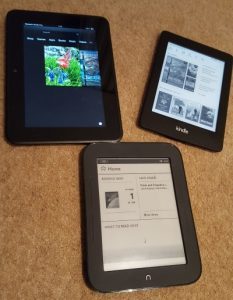 Kindle and Epub Devices
This is the first of an occasional series on the quirks of preparing ebooks. Almost everything applies equally to Kindle and general epub, but for the sake of quickness I shall normally just write “Kindle”.
The conversion of a manuscript written in some text editor through to a built ebook – a mobi or epub file – happens in several logical stages. A lot of authors aren’t really aware of this, and just use a package which does the conversion for them. Later in this series I’ll talk a bit about how Amazon’s software – KindleGen – does this, and what parts of your input end up doing what.
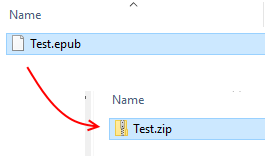 Changing the name of an epub file
First, what is a ebook? You can see this best with a generic epub file. Find such a file on your system, then make a copy so you don’t accidentally corrupt your original. Let’s say it’s Test.epub. Rename it to Test.zip and give approval if your computer warns you about changing file extension.
Contents of epub fileThen you can look inside the contents and see what’s there – a very specific folder structure together with a bunch of content files. This is what your epub reader device or app turns into something that looks like a book. This list not only lists the files, but (presupposing you’ve given sensible names to the source files) it tells you something about their purpose. The ones identified as HTML Documents are basically the text of the book, including the contents listing and any front and back matter the author chooses to put in. The document styles are there. There’s a cover image. The ncx file describes how the Kindle or epub reader will navigate through the book (of which more another time). The opf file is the fundamental piece of the jigsaw that defines the internal layout. The images folder contains, well, images used. The other files are necessary components to enable the whole lot to make sense to the reading app or device.
A Kindle mobi file is much the same except that there is usually some encryption and obfuscation to dissuade casual hacking. But actually, almost exactly the same set of files is assembled into a mobi file. What KindleGen does is rearrange your source files – whether you use Word, plain text, or some other format – into this particular arrangement. By the same token, if you are careful to get everything in exactly the right place, you can create your epub file with nothing more than a plain text editor and something that will make a zip archive out of the files.
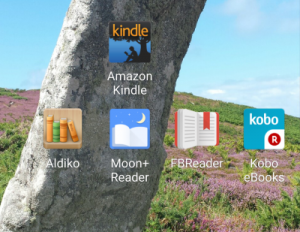 Some Phone Ebook Readers
So now we know that a Kindle “book” is actually a very long thin web site, divided up into convenient “pages” by the device or by an app. Kindle books never scroll like a regular web site, though a small number of epub apps do. They show the content in pages which replace each other, rather than an endless vertical scroll. There’s a good reason for that – readability studies have shown that presentation by means of pages is more easily read and comprehended than scrolling. The layout chosen by most word processors – a continuous scroll with some kind of visual cue about page divisions – is good for editing, since you can see the bottom of one page and the top of the next at the same time, but it’s not so good for readability. The scrolling choice made by some epub apps is due to developer laziness rather than any logical reason – and even here, some apps allow the reader to choose how they move through the book
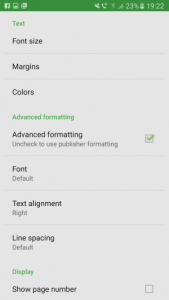 Aldiko Reader options
So the underlying structure is entirely different from the fixed layout called for by a printed book or its computer equivalent such as a pdf or Word document, even if the superficial appearance is similar. On a computer, you can resize the window containing your pdf as much as you like, and the words will stay in the same place on each line of each page. But with Kindle or epub, you can swap between portrait and landscape view, or alter font and margin size, or change line spacing, and in each case the words on the lines will reflow to fit. In the landscape aspect of some Kindles you can choose to view in two columns side by side. In most epub readers you can choose to override whatever text alignment the author or publisher has chosen, and read it however you like. After each such change the device or app recalculates how to lay out the text.
Now many of us choose to use some sort of word processor to write our story, in which none of this is very visible. You can certainly alter the page settings and experiment, but most people just set it to whatever their typical national page size is – A4, or Letter, for example – and leave it at that. That gives the illusion that the process of production is fundamentally the same as that of a printed book – but in fact it is not. If an author’s main intention is to write a paperback book, and they perceive the Kindle version is just a handy spinoff, then focusing on page layout seems to make sense. But most indie authors sell a lot more ebooks than printed ones, so it makes more sense to understand the particular needs of the electronic medium.
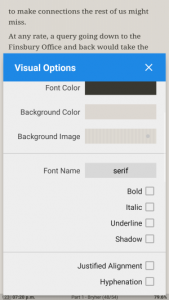 Moon+ Reader options
You actually don’t need any extravagant software to create an ebook. A plain text editor, together with some knowledge of simple HTML tags, is all you need along with some other free tools. But for those of us who don’t have that knowledge, a word processor plus some sort of format converter is handy. But – as we shall see later – there are pitfalls with such software, and the end product is not necessarily as you would hope.
One of the really exciting features of an ebook is that it bridges two worlds which in the past have been separate – the world of traditional printing, and the world of visual and web design. This fusion opens up huge opportunities for the reader, but has also led to misunderstandings and difficulties. Some of the opportunities are obvious, like the ability to search, synchronise across multiple devices, swap between text and audio versions, and so on.
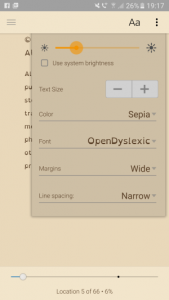 Kindle options (portrait mode)
But there is much more. If I don’t like the original font, or I have dyslexia and prefer a specialised font, I can change it. If I need to expand the font size so I can read the text, I can do this. If I like a coloured page instead of black and white – and I have a device with a colour screen – I need only change a setting.
In all of this, the reader is not constrained by the author’s, or publisher’s choices. A great deal of display choice is where it should be – in the hands of the reader, not the writer. It seems to me that this fact has not been fully grasped by many authors, or small publishers, who sometimes treat an ebook as though it was no different from a printed book. They then expect to define every aspect of the display. But people who read ebooks have a considerable amount of choice over how they read – it’s a new world, and needs new thinking.
That’s it for today. Next time, I will be looking at some of the additional information that ties the separate content files together.
January 3, 2017
Fun with the sun part 2 – the Analemma
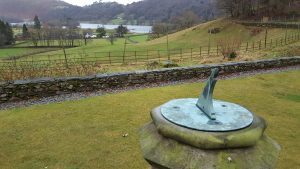 Sundial, Allan Bank, Grasmere, Cumbria
Part 2 of this little series looks at a different phenomenon to do with the sun’s movement through the sky. Imagine yourself picking a time of day – let’s say 10:30 in the morning – and taking note of where the sun is in the sky. Do this at the same time every day of the year to build up a curve tracing the sun’s apparent movement. One way to do this would be to take a photo pointing at exactly the same angle at exactly this time, then overlay the photos on top of each other. Another way would be to put a stick in the ground as a rudimentary sundial, then mark out the end of the stick’s shadow each day. It’s an easy experiment in principle, but takes a lot of patience and accuracy to get right.
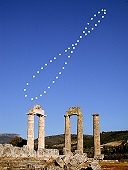 Analemma with the Temple of Zeus (340-330 BC) at Ancient Nemea, image credit Anthony Ayiomamitis, found at http://solar-center.stanford.edu/art/...
But suppose you’ve done that – what would you expect to see? We know that the sun goes up and down in the sky through the year – in winter it is lower and in summer higher. So i suspect that most people would expect to see a straight vertical line being plotted through the year as the sun cycles along its seasonal track. But actually what you get is not a straight line, but a figure eight shape. In the northern hemisphere the top loop of the 8 is smaller than the bottom, while in the southern hemisphere the loop nearer the horizon is the small one.
This curve is called the analemma, and has been known for a very long time – Greek and Latin authors wrote about it some two thousand years ago in the interest of designing a better sundial. My guess is that people observed this much longer ago, and that the creators of the great prehistoric stone observatory monuments tried to incorporate it in their designs.
We can describe this curve mathematically, and it is taught as a method of dead reckoning for those at sea. With a good watch to keep track of time, decent knowledge of the analemma shape, and some precise observations of the sun’s position in the sky, you can pinpoint your position down to around 100 nautical miles. Not bad if you’re lost at sea with no GPS!
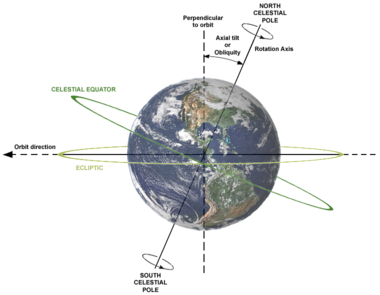 The Earth’s axial tilt (Wiki)
The root cause of this is a combination of two factors in the Earth’s movement. The first is that the polar axis, around which the Earth spins to give day and night, is not at right angles to the plane of the Earth’s orbit. This offset angle, a little over 23 degrees, is what gives us seasons. The second factor is that the Earth’s orbit around the sun is not perfectly circular, but a slightly squashed oval. Moreover the sun is not at the centre of the oval, but offset to one side at one of the two focal points – we are about 5 million km closer to the sun in early January than we are in early July. The Earth does not move at a constant speed around this oval. We speed up at closest approach to the sun, and then slow down as we move further away. Those who can remember school physics might have come across this as Kepler’s 1st and 2nd laws of planetary motion, originally formulated in the early 1600s.
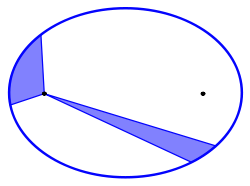 A planet moves quicker when closer to the sun (http://scienceblogs.com/)
Now, for convenience we split our year into equal length days, which means that for one part of the year, a day according to our clocks gets ahead of its allotted portion of the orbit, and for another part it falls behind. By the end of the year it all comes out even. Also, the offset of the polar axis changes the degree to which these shifts make a real difference against the sky. The combination of these two factors is what generates the figure 8 shape of the analemma.
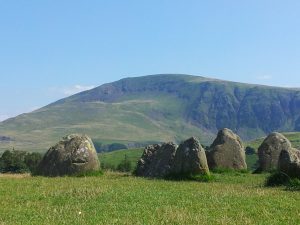 Castlerigg stone circle, Cumbria
Let’s think back to our ancient ancestors and the stone monuments they built. We know that the positions of the stones encode astronomical information. The monument builders were aware of not just the annual cycle of the sun, but also of more subtle patterns, such as the 28 year cycle that the moon makes in its own path against the sky. Since the analemma can be mapped out with nothing more complicated than a stick to make a shadow, it seems to me quite improbable that they did not know it. Having said that, I don’t know of any specific stone patterns that can be linked directly to the analemma. Once people started making sundials, they soon found that there was no single division of hour markers that works consistently. The figure 8 shape ensures that your sundial sometimes runs fast and sometimes slow.
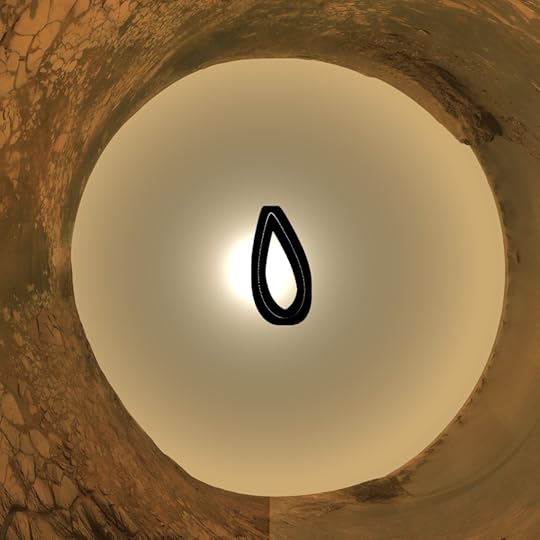 Martian analemma, photographed by NASA’s Opportunity rover, 2006-2008 (NASA/JPL)
Moving into the future, every planet has its own variation of the analemma. The exact shape depends on interplay between the angle of the polar axis and the extent to which the orbit deviates from a pure circle. Our Earth has these two factors in approximate balance. So does Pluto, which therefore has a figure 8 shape like Earth, though in this case the top and bottom loops are almost the same size. But for other planets one factor or the other dominates. As a result, Jupiter has a simple oval shape, while Mars has a tear-drop. However, actually making the observations (as opposed to calculating them) might be tricky as you move out through the solar system. On Earth, you only have to wait 365 days. But a Jupiter year is almost 12 of our years, and Pluto takes nearly 250 years to circle the sun once. You would need extreme patience to plot out a full analemma cycle in both these places!
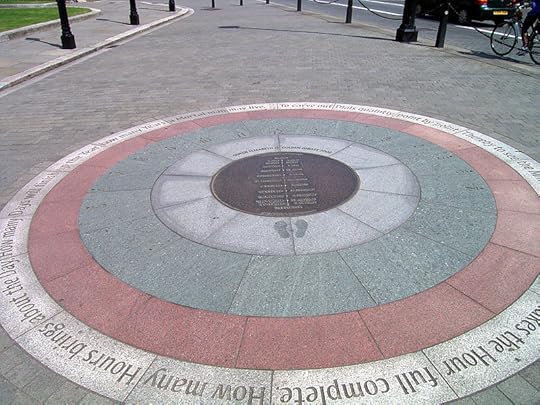 Golden Jubilee Sundial, Old Palace Yard, Westminster (Wiki)
December 30, 2016
Fun with the sun part one – the Equation of Time
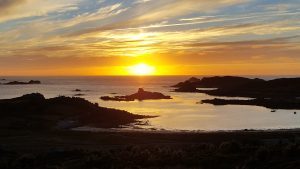 Sunset from Bryher
I guess pretty much all of us know that December 21st this year marked the winter solstice, and so – in the northern hemisphere – the shortest day and longest night of the year. But comparatively few people seem to know that this day is not the one when the sun rises latest and sets earliest. The exact dates of those events are, at the latitude of London, just over a week different from the solstice. Specifically, the latest sunrise this year is not until January 1st 2017, and the earliest sunset was on December 12th.
It turns out that the times when the sun rises and sets are governed by a moderately complicated algorithm called the Equation of Time. This obviously varies with your latitude and longitude, but also takes into account the small differences between the solar day and the sidereal day (the day length as measured against the distant and essentially fixed stars), seasonal variations in the earth’s distance from the sun, the apparent size of the solar disk, and a host of other relevant pieces of information. Strictly speaking, one’s height above sea level, and the details of the surrounding terrain also make a difference, but not in a way that’s easy to quantify here. Finally, there are several different definitions of what angle counts as the zenith line, and I have taken the civil definition as opposed to nautical or astronomical.
Once upon a time the calculations would have taken a very long time and lots of paper, but nowadays we can throw the calculation steps into Excel and find out the information for anywhere we want, and for a reasonably long span of time into the past or future. For the curious, a step by step description can be found at this link.
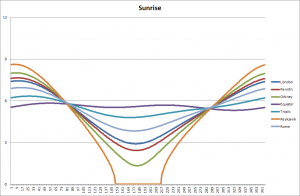 Sunrise through the year at different locations
Out of curiosity, I plotted the changes for a series of latitudes from that of Reykjavik in Iceland (just over 64 degrees north) via Orkney, Penrith and London in the UK, through Rome and the Tropic of Cancer to the Equator. For simplicity I just took everything on the zero longitude line (through Greenwich) since I was only interested in changes in latitude. If you wanted to do this for yourself then you would need to adjust for your actual longitude east or west from Greenwich, and your official time zone.
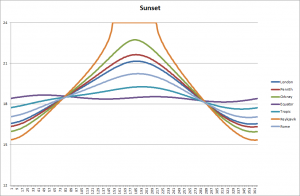 Sunset through the year at different locations
Here’s the corresponding chart for sunset.
A few things stand out at a quick glance. First, the time of sunrise varies considerably at some times of the year even between London and the north of Scotland. Secondly, you don’t have to go all that far north to get to the ‘land of the midnight sun‘. Thirdly, the total range of variation of sunrise is very small at the equator – about 1/2 an hour, as compared with London’s 4 1/2 hours, or Iceland’s 8 1/2 hours. The places where all these lines cross over is at the spring and autumn equinoxes, where night and day are each 12 hours long across the whole globe.
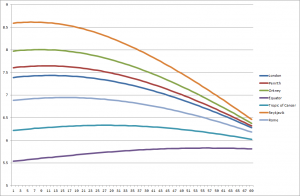 Sunrise – the early part of the year
Going back to where we started, and looking carefully at the early part of the year, you can see that the day of latest sunrise happens after the solstice. The further north you go, the closer the two days are together. So in Reykjavik the latest sunrise is on December 26th. Come down to Orkney and it’s the 28th. In London you have to wait until January 1st. In Rome, January 5th. If you lived on the Tropic of Cancer (say in parts of the Sahara, roughly on a level with Kolkata, India) you’d be waiting for the 8th.
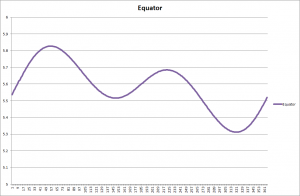 Changes through the year at the Equator
If you live right on the Equator something else comes into play. You get not just a simple days-get-longer then days-get-shorter cycle. Instead there is a more complex curve. Something similar happens in the whole belt of the tropics. This is because there are times when the sun at noon is to the south (as always happens in the northern hemisphere north of the Tropic of Cancer(, but then times when the noonday sun passes overhead and is, for a while, to the north. As it swings over and past you, the day length lengthens and then shortens again – as you can see in the graph.
OK, that’s enough of the Equation of Time for this week. Next time – another oddity about solar movements through the year, together with some thoughts about what this all means for us humans as we have observed the sun through the years. I am convinced that our remote ancestors knew about these patterns (though probably didn’t dress them up in the sines and cosines used by modern maths) and incorporated this knowledge into their monuments and observatories. But more of that next time…
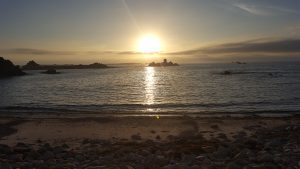 Sunset from St Agnes
December 20, 2016
Celebrations
 Christmas pudding and whisky
It’s a time of the year when we think about celebrations. Midwinter is an important time for several different religious reasons, but nowadays the main focus is on family and social events. To some extent, the spiritual roots of the festival as a time when new beginnings are stirring in the darkness of the year – at least, for those of us living in the northern hemisphere – have been overlaid with a focus on much more immediate pleasures. We meet as families, we eat and drink, we play games. In many workplaces the office party provides an arena in which normal hierarchies can be set aside for a while.
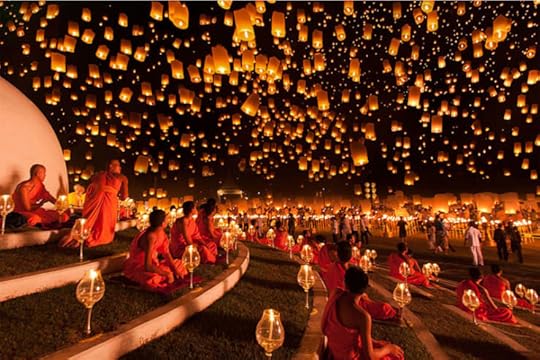 Yi Peng Lantern Festival, Thailand (Photo by Justin Ng)
My guess is that even at times when religious observance was more common than now, these more visceral elements were still an important part of the winter festival. Human beings may be rational animals (the saying goes back to Aristotle, some 350 years BC) but we are also playing animals, and fun-loving animals. Go back through the sacred calendars of the world’s religions, and you will find plenty of opportunities to celebrate as well as be solemn. Hardship and deprivation hardly ever erase the human desire to make meaning by way of groupish events.
Of course, the very same things which make an event good for one person might be difficult or painful for another. The celebrations that a group of people chooses can serve to reinforce difference, rather than undo such barriers. We may be good at finding causes to celebrate, but we’re also good at finding ways to include and exclude others from our celebrations. It would be nice to think that opportunities for inclusion might outweigh exclusion as we move forwards.
I see the act of celebration as one of the great unifying threads holding humanity together, whether you look back into the remote past or forward into the distant future. Whichever of these I am writing about, there will always be group events! However challenging the times, however alien the setting, it’s hard to imagine a society which has no provision for communal events.
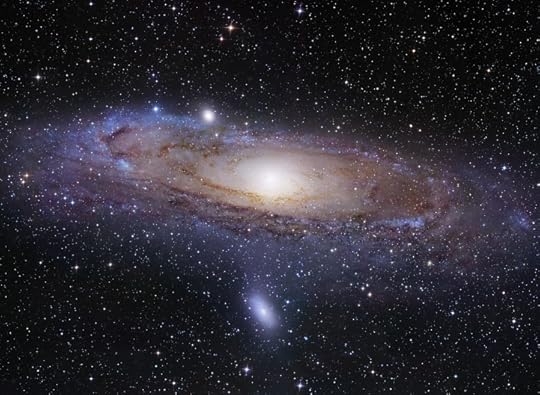 The M31 Andromeda Galaxy, the most distant object easily visible to the naked eye, NASA/JPL
December 13, 2016
Recent Mars pics and news of a Kindle Countdown offer
There have been some great pictures of Mars coming out recently from the Indian Mars Orbiter spacecraft so I thought I’d include a few here, together with an ESA video of a simulated flyby of one of the great valleys on Mars, the Mawrth Vallis.
[image error]Phobos in transit, from India’s Mars Orbiter, http://www.isro.gov.in/
So here is Phobos, tiny against the curve of Mars and very close in its orbit. Most of chapter 2 of Timing takes place on this moon, partly at Asaph, a (hypothetical) settlement facing away from the planet. and partly at a sort of industrial estate in the Stickney crater facing inwards.
[image error]Olympus Mons from India’s Mars Orbiter, http://www.isro.gov.in/
And here is a three-d representation of Olympus Mons, the second highest mountain in the solar system. In the book, there’s a financial training college on the lower slopes of the mountain, roughly in the foreground as you are looking at the picture.
To celebrate all this I am running a science fiction Kindle Countdown offer right now – prices start at £0.99 / $0.99 and slowly increase to the normal price by next Monday. So don’t delay… Links are:
Timing
Amazon.co.uk
Amazon.com
Far from the Spaceports
Amazon.co.uk
Amazon.com
Finally, here’s the ESA video flyby of Mawrth Vallis. It’s one of the various places where – long ago – liquid water most likely ran and shaped the terrain we see. Now it is of course dry, but it’s a place that will be the focus of science at some point in the international effort to explore the red planet.
December 6, 2016
Kindle Countdown offer – historical fiction
 Cover – In a Milk and Honeyed Land
I was nearly set up to start a series of blogs on Kindle formatting, having been reading a lot about that recently. But those aren’t quite ready yet, so instead I am just advertising that a Kindle Countdown offer is now running on my historical fiction series.
So all this week, up until Monday 12th, you will find the following books at reduced price on the Amazon UK and US stores;
In a Milk and Honeyed Land
https://www.amazon.co.uk/Milk-Honeyed-Land-Richard-Abbott-ebook/dp/B01B4ONXUY/
https://www.amazon.com/Milk-Honeyed-Land-Richard-Abbott-ebook/dp/B01B4ONXUY/
Scenes from a Life
 Cover – Scenes from a Life
https://www.amazon.co.uk/Scenes-Life-Richard-Abbott-ebook/dp/B00H8Y0F7E/
https://www.amazon.com/Scenes-Life-Richard-Abbott-ebook/dp/B00H8Y0F7E/
The Flame Before Us Cover – The Flame Before Us
https://www.amazon.co.uk/Flame-Before-Us-Richard-Abbott-ebook/dp/B00V2JVRGO/
https://www.amazon.com/Flame-Before-Us-Richard-Abbott-ebook/dp/B00V2JVRGO/
November 29, 2016
A history of water in fact and fiction
 Cover image, The Martian Way, Goodreads
Many years ago I read a short science fiction story by Isaac Asimov called The Martian Way, which he published in 1952. In this, planet Earth maintained control over ambitious colonies elsewhere in the solar system by means of controlling the water supply. At the start of the story everyone assumed that Earth’s vast oceans were the only source of water available. Whoever controlled the water was in charge. The plot is resolved by the retrieval of a piece of Saturn’s rings the size of a small mountain, made largely of ice. With some modest engineering work this was propelled back to Mars where it was needed. The possibility of autocratic rule based on control of the necessities of life was gone.
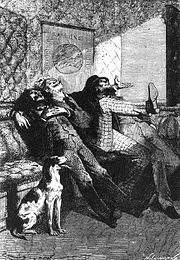 Cover, Jules Verne Around the Moon, Wiki
It was a good story, and highlights our changing comprehension of the place of water in the universe at large. Go back only a century or two, and there was a widespread assumption that whatever other worlds might exist would be pretty much like Earth. Features on the Moon were called seas, bays, lakes and marshes, presuming that they held open water. Early science fiction writers like Jules Verne (From the Earth to the Moon and Around the Moon) and HG Wells (The War of the Worlds and The First Men in the Moon) took for granted that interplanetary travel would be relatively easy, and that once you landed, you would need no special protection except against low temperatures comparable to the Arctic. When in 1877 Italian astronomer Giovanni Schiaparelli named features on Mars canali (the Italian word for ‘channels’), nobody hesitated to use the English word canal.
 Cover image, A Fall of Moondust, Goodreads
Then came the early days of space travel, along with a dramatic increase in the power and accuracy of telescopes. The lunar seas turned out to be open plains with no running water at all. The surface features on Mars ceased to be seen as artificial water channels, and were reinterpreted as the result of natural weathering on dry rock. The language we used for the planets changed. In 1961, Arthur C Clarke wrote A Fall of Moondust, where the plot hinged on the total absence of water. In 1969, Buzz Aldrin referred to the “Magnificent Desolation” that he saw on stepping out of the Apollo 11 lunar module. Imagery from the Apollo missions – and the personal accounts of astronauts – established the idea in the popular consciousness that the vivid blue of Earth’s oceans was something unique and precious in a starkly barren universe. The image was reinforced by the “Blue Dot” picture taken from the Voyager I probe.
 Cover image, Encounter with Tiber, Goodreads
But after that, there was another wave of observations and information. Perhaps water was not so rare after all. The first target was the Moon, and a careful study of places which are permanently shadowed regions. It turned out that ice will tend to aggregate anywhere which is in shadow most of the time. Buzz Aldrin, turning to fiction in Encounter with Tiber, positioned an early lunar settlement at the Moon’s south pole, specifically because of this new-found source of water. The search for ice spread wider, and now it seems that pretty much everywhere we look we find it.
The asteroids have significant amounts scattered here and there, with some impressive finds by NASA’s Dawn probe. Mars itself shows every sign that open stretches of water once shaped the terrain, though accessing it nowadays might be tricky. As I was writing this, NASA reported the discovery of an underground body of ice just under the Martian surface. It seems that Asimov’s water-seeking Martian settlers would not have needed to trek out to Saturn after all. If they did go there anyway, they would find no mile-high ice mountains since the rings are largely made of tiny granules. However, several moons of both Jupiter and Saturn apparently have ice as their surface crust, and liquid water below.
 Timing Kindle cover
So wherever we look in the solar system we find water, usually in the form of ice. Tomorrow’s space travellers and colonists will not have to worry about having access to water, though they will have to construct specialised equipment to access it. In Far from the Spaceports and Timing, my own fictional inhabitants of the Scilly Isles, somewhere out in the asteroid belt between Mars and Jupiter, will have to import many of life’s necessities, but not water – they will be able to find their own local supply.
Asimov wrote The Martian Way just as our scientific understanding was changing – indeed as with some other things he was ahead of his time. Although some of the details of his account would need updating, the basic theme remains sound. If and when we spread around the solar system, finding water is not going to be a problem.
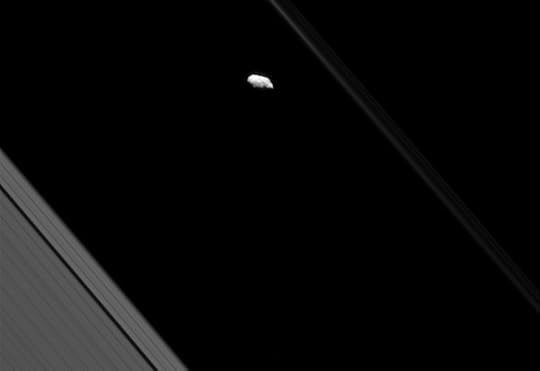 Saturn’s moon Prometheus and part of the ring system, NASA/JPL
November 22, 2016
A busy week for space
There’s been a whole rush of space news these last few days, and what better place to gather some of it together than here? Most of it has some relevance to the Far from the Spaceports series…
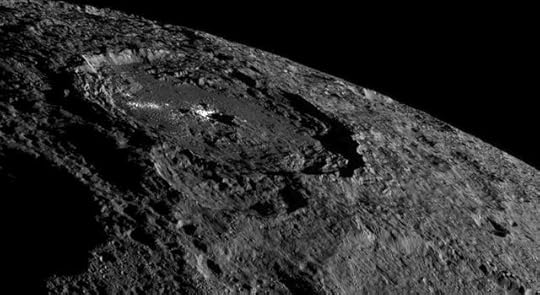 Occator Crate, Ceres, taken as Dawn moves further out from the asteroid, NASA/JPL
The first item I saw was an update from the Dawn spacecraft, going through a series of changes to its orbit around Ceres. For a long time it was orbiting closer to the asteroid than the International Space Station is to Earth, less than 400km from the surface, and now it is returning to a much higher orbit to complete some science measurements from about 1500km. And as a treat we got back this picture of the Occator crater, one of the main locations for the bright white spots scattered here and there on the surface. More details can be found at the NASA site.
In between I read how Elon Musk is pushing ahead his plans for a privately funded settlement on Mars – the announcement was made back at the end of September but I had not previously followed the details through. His idea is ambitious, involving a fleet of reusable rockets working towards a colony of a million individuals, sent in groups of 1-200 at a time. More details can be found at several places including space.com. According to his figures, the price per individual will drop to around $1-200,000 – a lot of money, to be sure, but not unreachable. His current aim is to get an unmanned version sent on its way in about 18 months, and manned flights within a decade. We shall see…
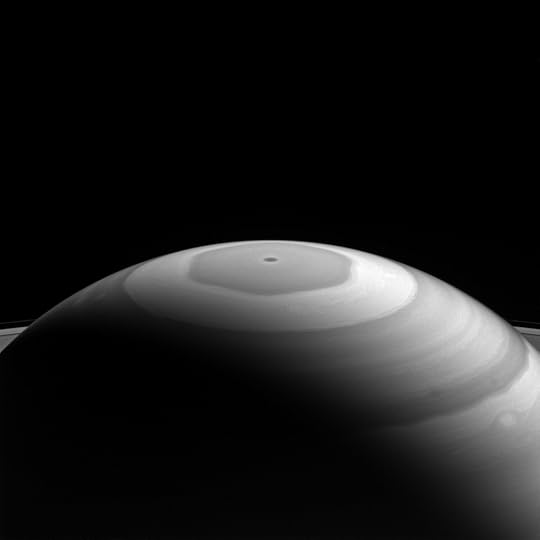 Saturn’s north pole, from Cassini, NASA/JPL
Then Cassini sent back this splendid picture of Saturn’s north pole. I was especially interested in that, since the planned book 3 following after Far from the Spaceports and Timing will include Saturn – or at least its moons – as a destination. Cassini has returned vast amounts of information about Saturn since 2004, but will run out of fuel late next summer and will be deliberately rerouted to burn up in Saturn’s atmosphere. This picture was taken at something like 1.4 mllion km from Saturn – 3 or 4 times the distance from the Earth to the Moon. More details can be found at the NASA site.
Finally a science article on a potential new form of spaceship engine has now been peer reviewed and published… Called the EmDrive, it was first worked on about 15 years ago by a British scientist, Roger Shawyer , and has now been taken up by NASA for serious study. The theoretical problem is that nobody has come up with a satisfactory explanation of how it could work: however several teams in the US and China have reported success, so maybe it’s going somewhere. Have a look at this link forthe latest news, or this link for some very sketchy details.
That’s all for today, but I’m sure there will be much more to come…
Timing cover Far from the Spaceports cover