Helen Callaghan's Blog, page 4
February 15, 2015
The Chronophage
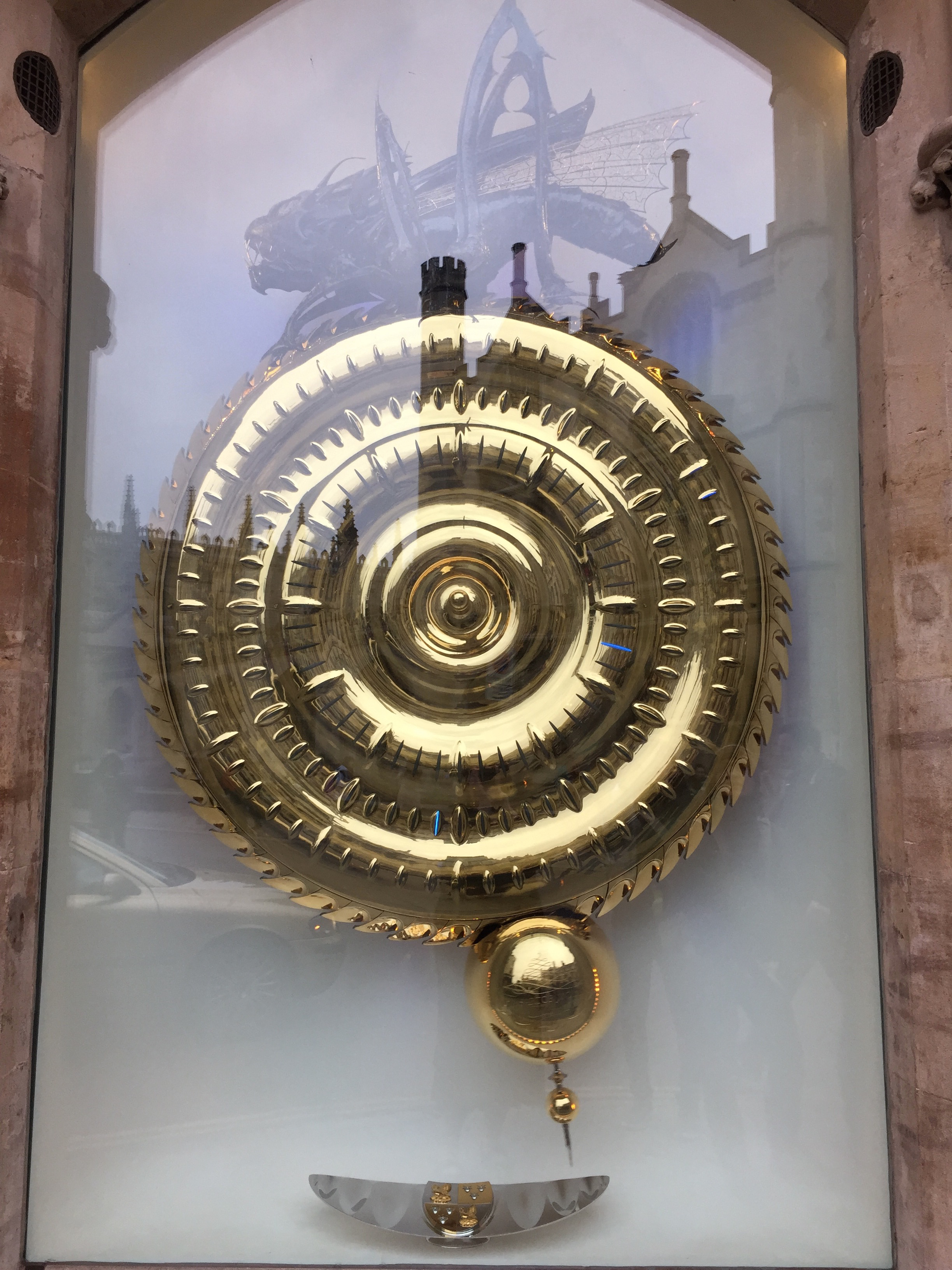
One of the Cambridge landmarks that features in the latest book is the Corpus Clock.
The clock is this large, imposing creation set into the corner of Corpus Christi College where Trumpington Street and Bene’t Street meet. It was conceived and funded by old member John C. Taylor and unveiled to the public on September 19th, 2008, by Professor Stephen Hawking.
It stands there now, tocking sonorously but slightly irregularly (the clock is only ever accurate once every five minutes, a design feature that reflects the subjectivity of time), and usually during the day it is surrounded by a small crowd of tourists contemplating its hypnotic sound and movement:
The Corpus Clock is a wholly mechanical mechanism (there is a tiny electronic motor, but this runs the lights and LEDs on the disk) housed behind a plate of 24 carat gold (the the plate was formed by creating an underwater explosion to mold it at a secret research facility in Holland, because of course it was).
The escapement of the mechanism takes the form of a beautifully sculpted and rather sinister creature in the shape of a grasshopper. This is the Chronophage, or the Time Eater. Its metal teeth ratchet rhythmically atop the disk as it turns – it devours the hours of the day.
Beneath all this, on the stone steps below the glass, is written a line from scripture: mundus transit et concupiscentia eius (“the world passeth away, and the lust thereof”).
So there stands Corpus Clock, an exquisite art object, mechanical wonder, and stern warning not to waste your precious time. And yet it exerts this captivating hold on the attention as you pause to linger at its feet, your errands forgotten as you stand there spellbound, watching the metal grasshopper devour the rest of forever, second by irregular second:


The Chronophage – the Eater of Time
One of the Cambridge landmarks that features in the latest book is the Corpus Clock. The clock is this large, imposing creation set into the corner of Corpus Christi College where Trumpington Street and Bene’t Street meet. Old member John C. Taylor conceived and funded it. Professor Stephen Hawking unveiled it to the public on September 19th, 2008. It stands […]
The post The Chronophage – the Eater of Time appeared first on The Book of Lost Nights.
February 6, 2015
Adventures in Cocktails: Harry’s Bar in Venice
Just a little entry this week, as I’ve been crazy busy, but I did want to share this nugget.
Harry’s Bar is famous for its dry martini, and speaking as an afficianado of dry martinis, this seemed the perfect destination for me that first night in the city. I had booked a weekend on the spur of the moment as a birthday treat for myself – one of my New Year’s resolutions had been to travel more, so I could write the whole thing off as virtuous self-expansion.
The bar itself is in a little alleyway, and it loomed suddenly out of the dark once I disembarked from the vaporetto, heading away from the Grand Canal.

It was growing dark as I approached, and though everything was beautiful and ornate and picturesquely decaying, it was also freezing, as an icy wind knifed in from the Adriatic. I was ready to go in and try a cocktail.
The bar is pleasant and comfortable, though quite small, and the waiter friendly as I approached and ordered a dry martini. I must confess I was a little surprised when instead of mixing me one, he took what looked like a tumbler out of a chiller on the bar and set it in front of me (I thought, at first, that it was a complimentary glass of water) and then this was joined by a little dish of olives: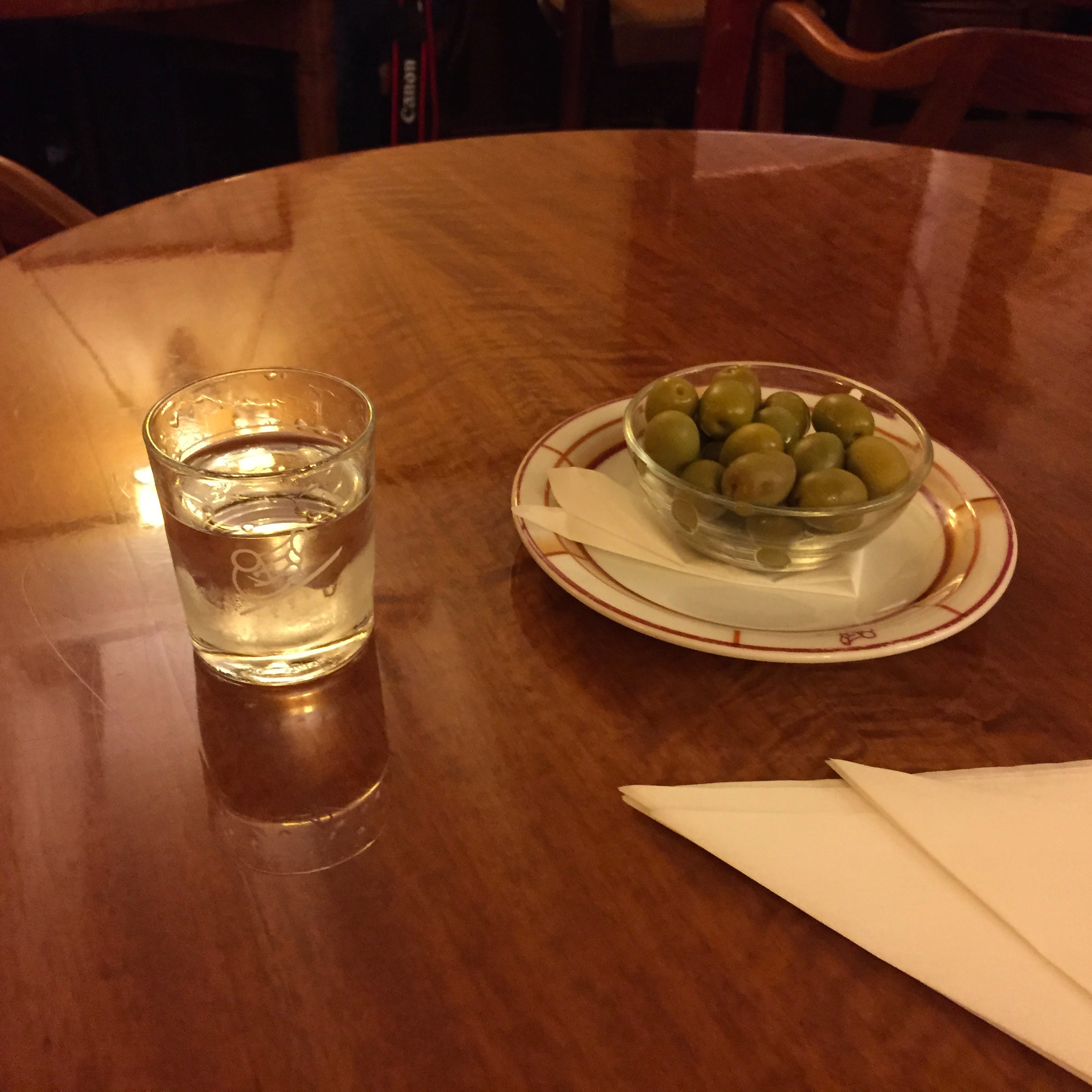
I was a little disappointed, as for €20 I kind of want to see some of that that hot shaker action, but must say, the martini itself was outstanding – deliciously dry, and the olives being on the side instead of in the glass gave it this pristine taste which I did really enjoy.
I meant to go back and try the house creation – the Bellini – another night, but never got round to it, so it will have to wait until my next visit, which will hopefully be not too far in the future.
Adventures in Cocktails: Harry’s Bar in Venice
Harry’s Bar is famous for its dry martini, and speaking as an afficianado of dry martinis, this seemed the perfect destination for me that first night in the city. I had booked a weekend on the spur of the moment as a birthday treat for myself – one of my New Year’s resolutions had been to […]
The post Adventures in Cocktails: Harry’s Bar in Venice appeared first on The Book of Lost Nights.
January 29, 2015
Felbrigg Hall
One of the things that I did this year, while writing Dear Amy, was get out to visit some country houses.
At the centre of the book is a rambling Jacobean manor with a hidden cellar, looked after by a secretive live-in caretaker. In the book, the house stands for various things – it is a prison, it is a lair, but most of all it is an island, a sign of a vanished way of life, representing an extinct social structure, crumbling into dust. It is full of secret history which will also vanish. The theme of secret and lost history, both personal and public, is what Dear Amy is all about.

I love visiting these kinds of places, not so much to get a sense of the gracious living that went on in them, but to appreciate this lost world, so very different to my own experience; in short, to engage with that secret history.
Of course, the problem with maintained properties is that they are effectively museums – they are replications of themselves, preserved in polished amber, frequently furnished with objects brought in from elsewhere and displayed “to give the sense of what it would have looked like”.
Felbrigg Hall is a notable exception. It’s a fabulous manor house in Norfolk that was handed to National Trust in the 1960s, with the express direction it be left exactly as it was.

The result is a sort of genteel messiness, with books and tea trays and endless Victorian picture frames with sketches and photographs covering up the silk wallpaper.
The history of the Hall is correspondingly wonderful and eccentric. After hundreds of years of being owned by knights, courtiers, and admirals, the house was sold after its last scion, William Fredrick (or “Mad Windham” as he was known at Eton – he liked to wear a train guard’s uniform and blow unauthorised whistle blasts at train stations), went bust after a scandalous marriage. Mad Windham ended up driving coaches, in dangerous and terrifying manner, between Cromer and Norwich until his early death in 1866.
The house was then sold to an industrialist, John Ketton, who had changed his name from Kitton. A bitchy contemporary remarked: ‘Windham is gone to the dogs. Felbrigg has gone to the Kittens’.
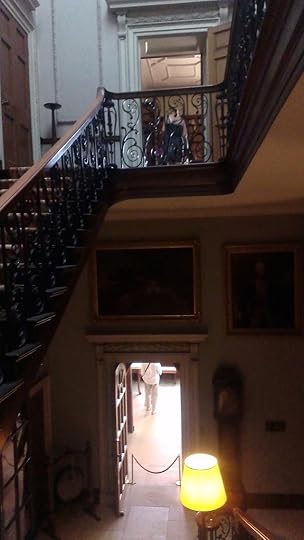
That said, I did particularly love its wrought iron staircase and skylight, and this, in altered form, made its way into the book:
Visiting Felbrigg Hall
One of the things that I did this year, while writing Dear Amy, was get out to visit some country houses. One of these was Felbrigg Hall. At the centre of the book is a rambling Jacobean manor with a hidden cellar, looked after by a secretive live-in caretaker. In the book, the house stands for […]
The post Visiting Felbrigg Hall appeared first on The Book of Lost Nights.
November 6, 2014
Medieval Cookery: Roo Broth
Roo broth – I know, right? Was is it, some kind of medieval kangaroo soup?
Well, no. Roo broth is more of a bruet – a kind of thickly sauced meat dish – a bit like a stew. The roo is not for kangaroos but roe deer, and this is the venison dish I cooked alongside the frumenty last week. Like last week’s recipe, it is from A Forme of Cury as translated in Pleyn Delit by Hieatt and Butler, and it goes like this:
Take the lire of the Deer oþer of the Roo parboile it on smale peces. seeþ it wel half in water and half in wyne. take brede and bray it wiþ the self broth and drawe blode þer to and lat it seeth to gedre with powdour fort of gynger oþer of canell. and macys. with a grete porcioun of vineger with Raysouns of Coraunte.
As far as I can make out, this means:
Take the liver and other meats of the roe deer. Cut it in small pieces and parboil it. Cook it well in a half water/half wine mixture. Take bread and soak it with broth and add a little blood to it. Let it all simmer together with ginger, cinnamon, and mace, and a large measure of vinegar with added currants.
Actually, if you’d like to see how the recipe looks in its true original format, the Rylands Medieval Collection has scanned the page here.
You’ll note here that the recipe mentions liver. I don’t have access to venison liver, so I just used stewing venison from Waitrose, which comes in at 300g for a fiver, so this proved to be an expensive experiment. Goodness, I hope it works!
Hieatt and Butler talk a little about the evolution of roo broth in their book, observing that later versions add onions and herbs but lose the currants and vinegar, which they retain. The sweetness of onions and currants is to counterbalance the vinegar used. Vinegar was frequently part of venison recipes in medieval times, and I don’t know but am guessing it is because it is an acid and game can be tough – it’s a way of pre-cooking meat. To this end, you might want to marinade the meat first, as Hieatt and Butler suggest.
Ingredients
You’ll need:
600g of stewing venison
300ml red wine
75ml red wine vinegar
60ml olive oil
2 chopped onions
3 or 4 branches of fresh thyme
1/2 tsp cinnamon
1 tsp salt (to taste)
1/2 tsp freshly ground black pepper
Scant 1/4 tsp of ground mace (more of a dash of mace, really)
2 tbsp olive oil
2 slices granary bread
200ml of water (more if looking a bit thin)
100g raisins
2-3 tbsp of chopped parsley.
(Optional) Get your full medieval on by serving it with frumenty, which is what venison was always traditionally accompanied with.
This looks like a lot of stuff, and the following looks like a lot of instructions, but really, it’s all very simple. Most of the chopping and adding happens in the marinade stage. Actually cooking it is a doddle.
The first step is to marinade the venison – this is a suggestion from Hieatt and Butler, and as I had never cooked venison before, this appealed to me as I had always heard the great danger in it would be that it would be tough. Then you’ll brown it. Then you’ll simmer it. And then, all going well, there will be something worth eating at the end.
Let’s kick off.
Marinading the venison
So, get your venison out:

YUM
Like I say, I’d never cooked venison before, and when it came out of the plastic packaging it looked revolting – dark red like it was rotten, and liberally sauced in maroon blood that smelled like… a lot of cold, sluggish blood. This picture makes it look much more attractive than it really was.
But never mind. I am committed now. Add your wine, vinegar, and olive oil:

Then add your onions, thyme, seasonings and spices (but not the parsley):

Give that a stir, pop a lid on it and leave it in your fridge for a day, or on your counter for a couple of hours if you’re really pushed.
Making the sauce base
Once time’s unstoppable flow has moved inescapably onwards by one day, take the meat out of the fridge, open the lid and inspect the contents.
This is where everything was very different from the Pies de Parys, which were something that smelled awful while being parboiled but ended up being delicious. In this instance, I took the marinading meat out of the fridge after 24 hours and gingerly popped the lid off.
And guess what?
It smelled AMAZING.
Very hard to describe that moment, but there was this fruity, warmly spiced but rich and savoury thing going on, and I can safely say I’ve never smelled anything like it, but I knew that whatever happened next was going to be A-OK.
So I made the sauce base, which involved tearing up two slices of granary bread and then pouring about 50 to 75mls of rich purple sauce over them (Pleyn Delit recommends using a blender, but to be honest, the bread will break up fine in the cooking process and why bother with the extra washing up?).
Bread is frequently used as a thickener in medieval cookery – see the blaunched porray I made. Here’s me pouring the juices on the sauce base:

Next, mash the bread up with the juices so it becomes this fabulous maroon paste:

Now it’s all on. Time to brown the meat.
Cooking roo broth
So, the next step is to brown the venison with the rest of the olive oil to seal it before you set it on to stew.
Put a big skillet or frying pan on, turn the heat up medium high, and add the olive oil.
Tease your venison chunks out of the marinade mixture with a slotted spoon and put it on kitchen paper to drain (DO NOT THROW THE REST OF THE MARINADE AWAY… don’t look at me like that. Somebody might do it. I remember years ago following a recipe for some chicken I marinaded in soy sauce and I chucked it down the sink before reaching the next line in the recipe book. Not my finest hour.)
Ahem, anyway – here’s the venison draining on kitchen paper:

Gently sear the venison in batches so it takes a plump, taut shape:

Put it in a big stewing pan with the rest of the marinade, the scrapings of your browning pan, the soaked bread paste, and add the water to get everything nice and moist:

Bring this to the boil, then turn down the heat and simmer for one hour, covered. Add more liquid if you think it’s looking a bit dry, but remember you’re after something quite thick, not runny.
Next, add the raisins and parsley, and then carry on cooking for another half an hour.

Taste it for seasoning, then “messe forth” with your frumenty:

YUM YUM
Was it nice?
I’m not sure anything could have been as nice as that smell when I first opened the tupperware box. But it had a go. The venison was something I’d never eaten as whole meat – I’d had venison meatballs and venison grillsteaks (and other things where the venison is frequently admixed with another meat, like beef), but the flesh itself was a revelation – a dark, rich taste, almost like liver in places, and very dense (but tender) in texture. The sauce was piquant and sweet, and married up perfectly with the frumenty I’d made to go with it. It didn’t taste at all vinegary, but had this deep, slightly sour fragrance of red wine, caramelised onion, and warm spice and fruit. Very unusual, but very good.
I now have tupperware servings of roo broth and frumenty made up in the freezer for when I fancy a very quick microwaved dinner that could be cheerfully served to ancient royalty.
Medieval Cookery: Roo Broth
Roo broth – I know, right? What is it, some kind of medieval kangaroo soup? Well, no. Roo broth is more of a bruet – a kind of thickly sauced meat dish – a bit like a stew. The roo is not for kangaroos but roe deer, and this is the venison dish I cooked […]
The post Medieval Cookery: Roo Broth appeared first on The Book of Lost Nights.
October 30, 2014
Medieval Cookery: Frumenty
So, for a while I’ve been promising myself I’d have a go at making frumenty. For a start, it’s easy, and also, it’s ubiquitous. It was a very common thing to serve in medieval times. Potages, or simple meals of grain or vegetables, were something all levels of society took part in. It’s a more rewarding research project to cook commoner food than the dishes that would have gone on to feed the elite, as you’re exploring a more universal experience of what it was like to live in those times.
Anyway, as for frumenty itself, it is a kind of cracked wheat or barley porridge, the savoury kind being made with stock and sometimes mixed with milk (cow or almond, depending on whether it was to be served on a fast day or not), coloured with a dab of saffron and bound with an egg. Frumenty is derived from frumentum, the Latin for wheat. It is served with most meats, but especially with venison – to medieval people, venison and frumenty are like fish and chips and sausage and mash.
This particular version included saffron, though Wikipedia claims that a sweet version of this, with currants, is still made in Devizes on Mothering Sunday. Another sweet version, called “furmity” and served with a slug of rum, is referred to in Hardy’s The Mayor of Casterbridge.
However, this time I’m going to be making a savoury frumenty with beef stock and milk, and serving it with its good buddy of old – venison (I’ll talk more about the venison next post).
The recipe is another one from the Forme of Cury, dated about 1390:
Nym clene wete & bray it in a morter wel, that the holys gon al of, & seyt yt till yt breste; & nym yt up & lat it keel. And nym fayre fresch broth & swete mylk of almandys or swete mylk of kyne and temper yt al. & nym the yolkys of eyryn & saffron & do therto. Boyle it a lily & set yt adorn, & messe yt forthe with fat venysoun & fresch motoun.
Take clean wheat and break it up in a mortar, so the hulls come off, and cook it till it plumps up and bursts and then drain it and let it cool. Make fresh broth and sweet milk (either cow or almond) and mix everything together, and then add egg yolks and saffron. Boil it a little and serve it with fat venison or fresh mutton.
Fat venison, I got you covered.
But to make the frumenty, I did this:
Ingredients
200g bulgur wheat
500ml stock
200ml milk
pinch saffron
1 egg, beaten
It’s dead easy, particularly since you don’t have to spend hours mortar and pestle-ing your wheat and then boiling it in our modern age – you just buy a bag of bulgar wheat.
First, mix your stock and milk together in a saucepan:

So. Not. Kosher.
I used the Heston Blumenthal stock from Waitrose, which was lovely and came in a jelly form. I went with dairy milk for this, but you could use almond milk, or even replace the milk with more stock. The final effect is this very rich, eggy, porridgey thing though, so the milk felt right ultimately, weird as it was to cook.
Anyway, bring it to the boil, and then chuck your bulgur wheat in:

Add a tiny pinch of saffron – about five strands. You’re after the colouring rather than the flavour.
Once it’s boiling again turn the heat way, way down and cover it, and let it not so much simmer as settle for about 30 – 50 minutes (well, Hiatt and Butler recommended this, but I found it was done in about twenty-five minutes). Make sure to top up the liquid with water or stock if it looks like it’s getting too dry. You are not looking for bite, like in pasta, but for it to be soft but not completely squishy. I was serving this with a meat dish that had its own sauce, so I didn’t want it to be too moist.
Next, add your beaten egg:

Pop it back on the low heat and mix the egg through it. You’re not looking to cook the egg, I don’t think (so this dish is neither pasteurised nor Kosher. Sorry.) so much as add a kind of yolky richness to the texture, so the egg can’t be solid or crumbly.
And you’re done:

You’ll have noticed during the tasting no doubt that there’s no seasoning. That’s okay, because all this is is a foil to the highly seasoned thing I will be serving with it. More on that anon…
Is it nice?
On its own? It’s tough to describe without spoilers, but yeah, it’s all right. More than pasta, bread, or rice, it’s something that exists to support other food – the extra things, like stock and milk and egg, all tend to come into their own when counter-balanced with the highly flavoured sour, sweet sauces and gamey meats that medieval cookery seems to love. It has a yolky, buttery, soft texture and when you put it on your tongue, you have this distinct sense it’s a matrix crying out for other flavourings (the meat juice was not particularly strong-tasting, but that could have been the absence of any salt being added).
That said, you wouldn’t need to cook expensive meat to go with it to make this a nice sturdy tea. It would take any flavour and be a tasty filling dish – you could add boiled eggs, or cut up sausage or bacon, or veg and herbs, especially if you added some crucial salt and a bit of pepper to it. It put me in mind of those couscous dishes I ate while digging in Tunisia, which came dry and had various added ingredients like chicken legs semi-submerged in it. Anything you had spare in the fridge would do, and you’d end up with a good, rib-sticking meal.
It would also work well in the sweet form, with currants and sweet spices and possibly cream, though in that case I would serve a much wetter version, more like a pudding.
So basically… yeah. Yeah. But it needs something to complete it. And that’s the story of the next post.
Medieval Cookery: Frumenty
So, for a while I’ve been promising myself I’d have a go at making frumenty. For a start, it’s easy, and also, it’s ubiquitous. It was a very common thing to serve in medieval times. Potages, or simple meals of grain or vegetables, were something all levels of society took part in. It’s a more […]
The post Medieval Cookery: Frumenty appeared first on The Book of Lost Nights.