Helen Callaghan's Blog, page 3
February 4, 2016
Video 3
The post Video 3 appeared first on The Book of Lost Nights.


Video 2
The post Video 2 appeared first on The Book of Lost Nights.
Video 1
The post Video 1 appeared first on The Book of Lost Nights.
February 3, 2016
Minimalist Patterns, Delicate and Subtle Motion
Lorem ipsum dolor sit amet, consectetuer adipiscing elit, sed diam nonummy nibh euismod tincidunt ut laoreet dolore magna aliquam erat volutpat. Ut wisi enim ad minim veniam, quis nostrud exerci tation ullamcorper suscipit lobortis nisl ut aliquip ex ea commodo consequat. Duis autem vel eum iriure dolor in hendrerit in vulputate velit esse molestie consequat, vel illum dolore eu feugiat nulla facilisis at vero eros et accumsan et iusto odio dignissim qui blandit praesent luptatum zzril delenit augue duis dolore te feugait nulla facilisi. Nam liber tempor cum soluta nobis eleifend option congue nihil imperdiet doming id quod mazim placerat facer possim assum.
Typi non habent claritatem insitam; est usus legentis in iis qui facit eorum claritatem. Investigationes demonstraverunt lectores legere me lius quod ii legunt saepius. Claritas est etiam processus dynamicus, qui sequitur mutationem consuetudium lectorum. Mirum est notare quam littera gothica, quam nunc putamus parum claram, anteposuerit litterarum formas humanitatis per seacula quarta decima et quinta decima. Eodem modo typi, qui nunc nobis videntur parum clari, fiant sollemnes in futurum.
The post Minimalist Patterns, Delicate and Subtle Motion appeared first on The Book of Lost Nights.
September 1, 2015
The Broomway: the Most Dangerous Road in Britain
I recently had the chance to walk the Broomway, a public byway six miles long that connects the foreshore at Maplin Sands to Foulness Island when the tide is out. When the tide is in, the way is drowned beneath the North Sea. If you are caught out there when the sea comes in, you are almost certainly going to die, as the current is strong and fast and the rivers Crouch and Roach form treacherous hidden whirlpools. Furthermore, access to the whole area is controlled by the military, who pop off artillery into the sands on a fairly regular basis. So, not very family friendly, if you get my drift.
It is easy to get lost out there, too, as the water runs out in strange, non-intuitive directions and the flat sands all around offer no bearing in misty weather or haze. Indeed, the only safe way to do it is by compass.
I love a spot of perilous geography, so how could I possibly say no? And I was very intrigued by the possibilities for my writing that such a landscape presented – it just screamed “murder pretending to be an accident”.
The walk begins in Essex, in Great Wakering, a few miles from Southend-on-Sea. So I was up at seven to get to Wakering Stairs, an elaborate journey that involved queuing up at an MOD roadblock for directions (the road is only open on certain days), in a portakabin behind farmers, while I admired the wonderful posters up on the office windows describing how to identify adders and treat their bites. I don’t particularly want to be bitten by an adder but I’m delighted that some are still out there in the world, presumably biting other people.
I was directed to a single lane road, flat and winding, that I was assured was the right way:

The Road to Foulness. No, seriously.
I reached Wakering Stairs, which of course weren’t actually stairs, and changed into the new wellies that soon proved themselves too short. It didn’t matter so much, as there we were, about to take the Perilous Road:

Wakering Stairs. Which are not actually stairs.
As we crested the little rise before the ramp, gathering around our guide, he talked a little bit about the surrounding landscape – the military base, the 17th century wooden trackway from old brickwork factories, the vague shapes of chimneys, towers and ships on the hazy horizon, looking like mirages:

The start of the Broomway, and the last dry land you’ll see for a while.
The walk is six miles, all told, and takes the best part of three and a half hours, particularly if you are not someone used to traveling in wellies.
But the road, the Broomway. Oh my God.
It was completely different to what I expected. Yes, it was undoubtedly dangerous, and parts of it more dangerous than others, full of unexploded bombs and forbidding command towers. The shifting sea and the land bore little correlation to one another:

Very pretty. Very disorienting.
The striking thing though was its unearthly beauty, particularly later in the day when the tide went fully out. The sky and sea mirrored one another, and the people walking were also mirrored. When we first looked over the rise, people were exercising their dogs on the shimmering surface, and it seemed as though they were walking on water.
I had expected the sea to go thoroughly out and leave sand, but that never happened – everywhere was shallow lagoons and little inlets, agitated by a constant flickering current, and most of the way was about two or three inches deep in water at any one time:

The Broomway, being underwater. The only thing that changes is how much water.
On the horizon, massive ships appeared in the mists between lost islands of towers and domes, and the guide told us that on a clear day you could perceive the earth’s curvature. On the land, in the distance, all was patchy dams and dykes dotted with fencing and vast, enigmatic military engineering, such as incinerators that looked like transistors and delicate crane like structures that were for testing ejection seats.
It was a beautiful place, and we came to a stop after two hours on a little outcropping of rock and crumbled concrete, spattered with barnacles and growing soft seaweed like green silky hair. I squeezed the water out of my socks and was told not to do this, but when I asked why, there was no answer. My friends offered me caramel shortbread which I accepted gratefully.
Anyway, the guide spoke some more about people who have been lost out there – fallen off barges, or their horse has been startled, or the weather overtook them. I took a few pictures and inspected the shellfish – mussels and oysters and the carcass of a single dead crab. Then we were off again, and the tide was at its lowest at noon, and the moving water grew still under the grey sky and the effect was utterly haunting, enchanted:

I got back to dry land tired but thrilled, flushed with the sea air and starving for some good old fashioned fish and chips. I would recommend the trip to any reasonably fit person with waterproof boots.
To find out more about walking the Broomway with a guide (which is very definitely the wisest way to do it!) then check out their website here.
May 15, 2015
This is Boring: Boring V at the Conway Hall
For the second year in a row, I went to the Boring conference:
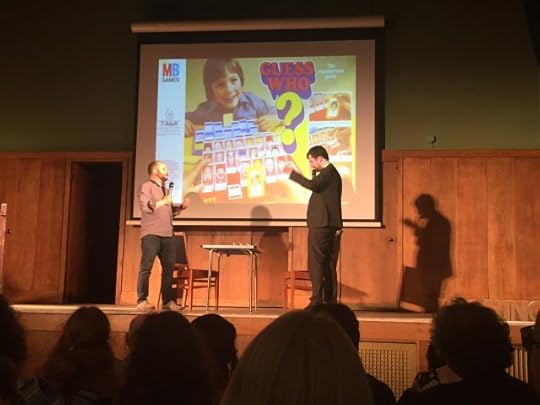
Somewhat less boring than I had been led to believe.
The Boring Conference is a celebration of the minutiae of the mundane – last year, speakers discussed things like why all national anthems sound the same, or the list of character names they collected for their potential novels when they were ten, or how paint actually dries on a molecular level.
I was supposed to meet my friends outside Conway Hall at ten for a 10:30 start, but after my astonishing incompetence negotiating my phone’s navigation ended up in the right place roughly half an hour late. Happily, they weren’t letting people into the building until half past, when we all filed in and watched soothingly anodyne video of a street scene in the suburbs, which urged us, with charming and apologetic reluctance, to tweet using the hashtag #boringV.
The introduction by James Ward was pretty typical of the event, describing his obsession with the Post Office Tower and collecting postcards about it, which he then restaged as photographs (London has far more trees now than in the 70s, a fact he bitterly regretted), and then it was Eley Williams talking about Mountweazels. Mountweazels are invented entries in dictionaries, encyclopaedias, etc which are inserted to detect plagiarism. We all loved this idea and kept talking about it all day. Sometimes I think the whole point of my life has been to be a Mountweazel in someone else’s reference work.
Alex Penman was a small child with a gigantic and infectious enthusiasm for lifts, which he shared with the room. Then Sarah O’Carroll discussed the strange and vanishing beauty of gasometers within the M25.
Rachel Souhami gave a fairly straight talk on the ins and outs of designing the information cards in museums, and as a heritage buff I did find it pretty interesting. There was some great How Not To Do It images.
Joanna Biggs was sick, and replaced by two people, so her planned talk must have been amazing – one, Eleanor Curry, a stand-up, shared her favourite 12th century medieval love poetry, which included nightingale slaughter and Marie de France’s unfortunate Lais of a woman who accidentally married a werewolf. To obtain a seperation, she stole his clothes so he had to stay in the woods, and bigamously married a non-lupine husband instead. Eventually, the werewolf inveigled his way into court as so often tends to happen, and ended up biting his wife’s nose off to teach her a lesson. It’s all about syphilis, apparently. Ah, l’amour.
Then Mark Highton talked about good bad movies, focussing particularly on Jaws 4: The Revenge (1987). Good choice, but personally, nothing will beat Battlefield: Earth (2000) for me. The bit with the gold bars is just genius. Also loved how you can leave a squadron of fighter planes just lying there for a thousand years and they will start first time. But I digress…
Irving Finkel was next. He works at the British Museum, I think, with cuneiform writing (which to me is just the epitome of cool) and is a striking figure with long white hair and glasses, like an Old Testament prophet on his way to a rock gig. He gave a fabulously opinionated speech about personal diaries.
His contention is that personal diaries are the only written form where people tell the absolute truth as they see it. Apparently diaries are usually never kept, which surprised me, but because of their potentially unpalatable contents are frequently sold or thrown away by family members after the author’s death. So he’s part of a scheme called The Great Diary Project to keep and house them. It sounded like the most fascinating thing. I could read people’s personal diaries all day. Maybe I should volunteer.
Then it was lunch and we ended up in a pub round the corner, eating fish finger sandwiches while shaking our heads and scowling over the election results. Fun fact: if you use deep-fried fish fingers for a fish finger sandwich the result is absolutely delicious.
Headed back to the building for Louise Ashcroft who talked about the tiny, low-key shopping centre joining Westfield to Shepherd’s Bush, called something like the Stretham Centre, and pictures of the fabulous products you can buy within, such as Dog Oil.
James Harkin, Andrew Murray, and Don Schrieber came on one after the other. They are all QI Elves, and each talked about their particular enthusiasm – there was a mathematical formula for how likely you are to find rude words in a dictionary – it’s this:
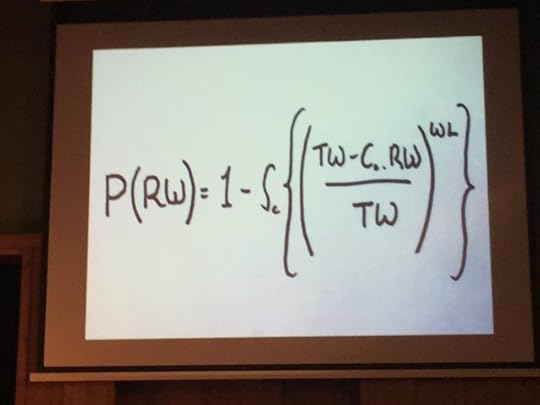
The proper use for maths
Then the the joy of wheelbarrows (did you know Chinese wheelbarrows have the central wheel come up, providing more stability, and the guy that made Ballbarrows went on to invent the Dyson?),
Andrew Hunter Murray talked about the Casio F-91 W wristwatch, and got very animated about it. Turns out both Barack Obama and Osama bin Laden owned one. Terrorists are huge fans, apparently, and owning one used to be a justification for detaining you: “they like them because they are waterproof”. The Casio F-91 W was the only branded product bin Laden was ever seen wearing:
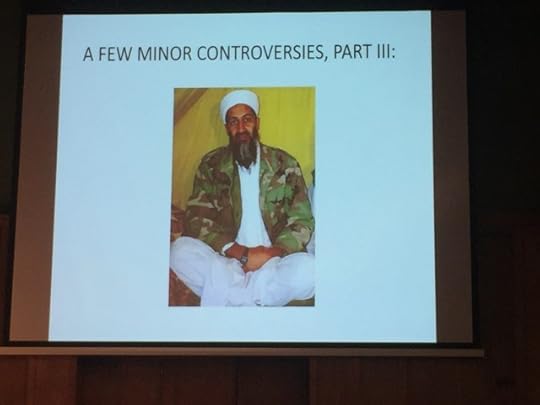
Osama bin Laden models his Casio F-91 W
Andy Riley talked about the joy of camping on traffic roundabouts, which was just fascinating. I’d never heard of wild camping before, and I loved the idea of it almost as much as I hate the idea of camping full stop. He told the story of a woman made homeless that set up a rather charming retreat in a roundabout in Derby one summer, including TV, and was only discovered when the leaves fell off the trees in Autumn.
Barbican (a film by Joe Gilbert) was a black and white film of the exterior of the Barbican, with voiceover commentary by residents. I didn’t really feel I knew much more about the Barbican by the end of it. It didn’t capture my personal experience of the whole whistling wind brutalism of the place. But then I have long suspected that the charm of the Barbican is lost on me.
Then we retired to the little pavilion teahouse in the park in Red Lion Square for tea and to dissect events so far. We agreed that the standard of speakers was far more consistent, but last year had had some very obvious fails but some hilarious successes, and this seemed a bit more even.
The last session started strong as we all played a game of Guess Who? with real people instead of the red board, and that was pretty amusing.
Then Rhodri Marsden did a talk on a new scale of measurement for British earthquakes similar to the Richter scale, which was clearly too exotic for local events, and included such classifications as “right on the cusp of being felt” up to “like someone moving furniture”:
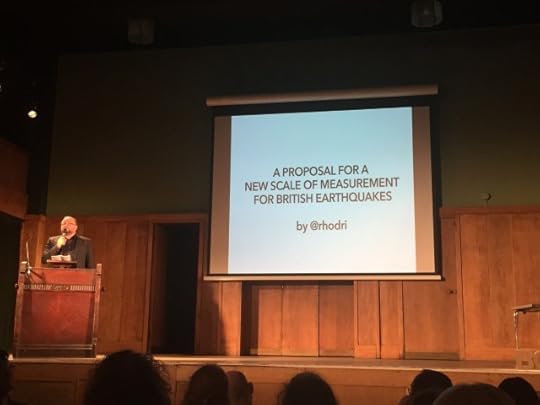
New British Earthquake classification based on how rubbish they are. Here’s one: “My fiancee was almost concerned.”
Kevin Kahn-Harris talked about the banality of evil, but also the level of organisation involved. He talked about Death Metal, and its manifesto of supporting the war against Christianity, killing all goodness, killing everyone else, and then yourself. There were some fab pictures and loved the names of the Death Metal guys.
He went on to contrast this self-defeating evil with that of that the Nazis or Josef Fritzl, who was required to go to enormous lengths of organisation to ensure his crimes remained undetected. Kahn-Harris’ contention was that evil pursued in the purest and most direct way was the the least efficient. but moderate evil levels required an enormous amount of effort for a return. In short, evil is most effective when it is boring, and most exciting when it is ineffective. It was in some places a much darker tone than most Boring talks, but a very interesting subject nonetheless.
Richard DeDomenici did some comedy with “Invoices I Need To Send”. And finally James Miller, a senior lecturer in creative writing at Kingston, read out his short story. Then we staggered out into the sunlight, in search of a pub.
So I would definitely recommend Boring if you are interested in that kind of thing, whatever that kind of thing is, but if you do want to go you’ll have to be quick next year as it always sells out fast!
March 25, 2015
Face to face with Jane Eyre
Had a lovely day – I had decided yesterday to pitch up at the Folio Prize Festival, so I left Zenobia at home who looked very stiff and unhappy (she’s been ill for weeks – the vet can’t find what’s wrong with her but the most likely culprit is advanced age – she’s over two years old, after all – a veritable rodent Methuselah), and set off for the British Library.
I was late and missed most of the first panel, so I had a vague lunch, and turned up for the first of the afternoon talks, On Conflict. It was Neel Mukherjee, Ali Smith, Erica Wagner and Charles Fiennes, and it was quite cool. There was an interesting observation in that conflict is not just good versus evil but also can be between contrasting versions of good.
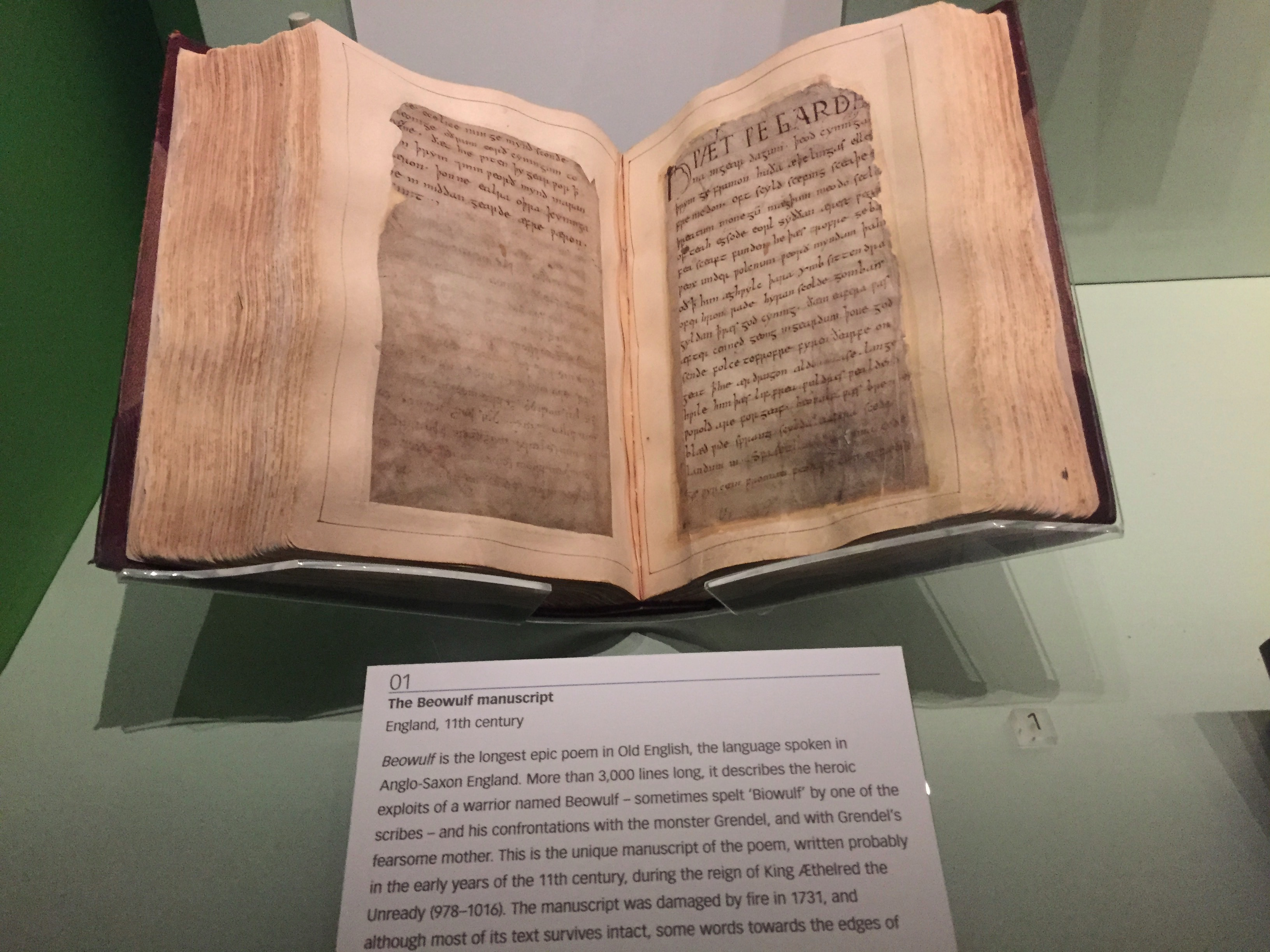
There was a break then, and a tour proposed of the Treasure of the British Library, and oh my God, what Treasures they were! I gasped aloud in places. Anyway, they had the following awesome stuff on display – the original copy of Beowulf. BEOWULF, with burnt corners.
They also had a fragment of Persuasion, my favourite Jane Austen novel, and most wonderfully, a handwritten copy of Jane Eyre.

And I had a kind of epiphany. See, I love Jane Eyre. It was one of the staples of my reading education. And to gaze at it where the hand had written “Mr Rochester” gave me this funny feeling. Because, before there was Jane Eyre, 19th century cultural phenomenon that has endured until the present; with its endless film and television adaptations and hordes of suspiciously good looking Janes, there was a woman alone in a room with a pen. And out of her was born this thing that millions know and love, this thing that shaped minds and hearts and ambitions.
So it seemed to me that when you looked at it in that light, what happened in that room during the 1840s was nothing short of miraculous, an abiding mystery of hope, creation, and inspiration that is on a par with the mystery of giving birth.
Anyway, there are so many other wonderful delights in there too. There were cute letters from Anne Boleyn that had been finished by Henry VIII, there was Shakespeare’s First Folio, there were letters and wills and sheet music by Bach and The Owl and the Nightingale, and well, it was just all kinds of fabulous. You should totally go. I gasped aloud, so many times.
And the vet phoned, though while I was in the Wit panel so couldn’t answer – hopefully they will phone back tomorrow. Poor Zenobia!
Face to face with Jane Eyre
Had a lovely day – I had decided yesterday to pitch up at the Folio Prize Festival at the British Library. I was late and missed most of the first panel, so I lunched vaguely and turned up for the first of the afternoon talks, On Conflict. The speakers were Neel Mukherjee, Ali Smith, Erica Wagner and Charles Fiennes, and it […]
The post Face to face with Jane Eyre appeared first on The Book of Lost Nights.
February 27, 2015
Tidings from London

So, rather wonderfully, Bethan Avery is going to be published in Spring 2016 by Michael Joseph, an imprint of Penguin Books I must say that I met a load of cool people during the auction, but I was blown away by the Michael Joseph team’s kindness and enthusiasm about the project.
It all seems a bit weird and dream-like, and I am still not entirely sure that I won’t wake up at some point and discover that nobody has any idea what on earth I was talking about, as though I’d escaped from a particularly low-key episode of The Twilight Zone. But as far as I know, Bethan Avery is happening.
I couldn’t be more thrilled, and to celebrate, am linking to this Buzzfeed article full of happy animals! Also, I’m drinking pink champagne later. Just because.
Additionally, they sent me a care package! Look who’s good for reading in the near future…
Tidings from London
So, rather wonderfully, Michael Joseph are publishing Dear Amy in Spring 2016. Michael Joseph are an imprint of Penguin Books I must say that I met a load of cool people during the auction, but I was blown away by the Michael Joseph team’s kindness and enthusiasm about the project. It all seems a bit weird and dream-like, […]
The post Tidings from London appeared first on The Book of Lost Nights.