
Travis Thrasher's Blog, page 38
June 24, 2011
Moving To Mars
 An ordinary man begins to play the piano, singing a soft & soulful serenade.
 This is how "Moving To Mars" begins.
A reminder of the Coldplay we fell in love with. Ah, Chris . . . the melancholy and the mood and the restraint.
A sweet song to sing to someone we love. All heart. Earnest. Oh so earnest--and that's not a bad thing-- and hey, what's that spiralling sound?
What's that beat?
Elton John circa 1973 has arrived.
Woah. The band has arrived as well. Crashing and cranking in.
Suddenly the old is morphed with the new. Suddenly there's a blast of guitar that sounds like vintage Pink Floyd. Ah the glory. The ecstacy.
We're flying now. We're floating and free. We're really truly flying.
This all was supposed to be an intro to the next blog I'm posting. But then again, sometimes the keys get away from my and I start flying as well . . .
What a glorious new song.


Old Souls & Blueprints . . .

 Finishing Friday with notes on future works. Drawing inspiration. Working on The Five.
June 23, 2011
Top 100: #69
 (I moved from North Carolina to the Chicago suburbs in the fall of 1987. A short time after that I discovered a brand of music called Industrial. This is still one of the all time classics that I used to dance to in Chicago clubs!)
"Headhunter" by Front 242 (excerpt)
One - You lock the target
Two - You bait the line
Three- You slowly spread the net
And four - You catch the man

June 22, 2011
Step #2 For Writing A Novel (Writing Tip #83)
 So do you have an idea you're dying to write? What do you do next? Just start writing?
 I used to do this sort of madness. Writing to see where it takes me. Usually it would take me nowhere, even if I managed to somehow write 400 pages.
Some authors write this way--seeing where the story will take them. But I think it's better and wiser to do a story map first. This is basically outlining the story that you're about write.
You can do a story map in any form that works for you. I use sheets of paper, then I will also narrow the story down and write the outline on my dry erase board that faces my desk. This way I can have the story map in front of me at all times to know where I'm going and what I'm supposed to do.
The story map doesn't have to be long and detailed. But you need to figure out how the story is going to start, and keep going, and get through that treacherous middle part, and eventually end. This framework helps as you write.
Part of the beauty and mystery in writing is when you deviate from the story map and when you surprise yourself. That's why I don't think you need to go overboard with outlining your story. You just need to know where you're going and how you're going to get there.
Okay--so you have your IDEA YOU'RE DYING TO WRITE and you have your STORY MAP. Do you start writing?
Not yet.

June 21, 2011
Writing A Novel In Ten Easy Steps
 So I'm going to share another Top Ten list. This one is ten easy steps to writing a novel.
 It's quite easy writing a novel. Writing a good novel . . . now that's a whole other thing that I'm still trying to learn.
But the more you practice, the more you learn. Hopefully that also means the better each story will become.
So ten easy steps to writing a novel. Where do you start?
NUMERO UNO
I've shared this before, but I'll share it again.
Pick the idea that you're dying to write.
If you're under contract to write a ten-book series involving vampires and nuns, then you're probably not even reading this blog. But you might be someone reading this who has quite a few ideas. How do you pick one?
Take the idea that you absolutely MUST write. Don't say that you're going to wait until next year or until you get better. No. I say take that idea and write it now.
But it's too ambitious. Doesn't matter.
It doesn't fit into a box. Doesn't matter.
It's already been done to death and no publisher would ever want to read it? So what?
If you're really wanting to know how to write a novel in ten easy steps, then it might mean that you've never completed one. And in order to complete it, you have to love the idea and love it more than ANY of those other ideas.
Take that idea and go with it. You have nothing to lose. If it doesn't work, so be it.
But who knows? Perhaps it will work.
So pick your best idea. Got it? Okay.
Step one down.

June 20, 2011
From My 23-Year-Old Self
 (I found this article I wrote in one of my many writing notebooks in our basement over the weekend and thought I'd share it)
"A Writer"10/20/94
A blank page. What a wonderful thing, seeing the white screen, the empty lines of the paper, the voidness of it all. Just waiting to fill up with words--adjectives, verbs, clauses, conjunctions, commas, periods. Many take for granted that page or that screen. I don't. I never will. To me, it is my life, my motivation, my love and one true passion.
I am a writer.
----
Twenty-three years old, too, but that doesn't stop my motivation, my desire, my burning lust for seeing my written words in print. I have been a writer for a while, too. Since third grade, when a newly married grade school teacher who had a flare for English inspired in me the flame to keep at that writing. I was interested in pirates then, and wrote a short, flamboyant story on Captain Kidd. Not the historical Captain Kidd, but my own Captain Kidd.
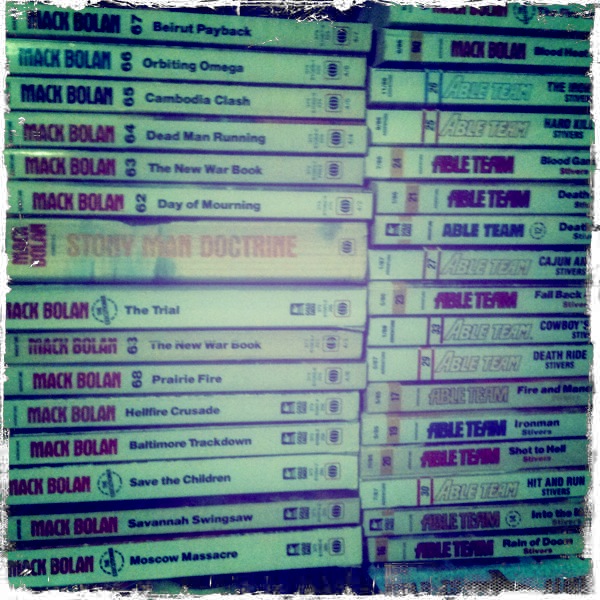
In eighth and ninth grades, it was a mixture of Rambo movies, Soldier of Fortune magazines, Mack Bolan books, and girls that captivated me. Which one I actually liked more, I cannot honestly say. Of course, it had to be females, but they were so frustrating all the same. The guns and action movies and adventure books never let me down. Everyone always got killed at the end. Someone's day was always made with the pull of the hairline trigger. Oh yes, I loved this, yet I didn't not forget my one true love: Writing.
In ninth grade, while living on top of a mountain known as Wolf Laurel, nestled between the North Carolina and Tennessee borders, I finished The Adventurer, my first 285-word novel. Written on college ruled paper in all pencil, held together by some company's three-ring-binder, The Adventurer detailed one man's revenge on his slain wife's murder. The mob, of course, was to blame for this killing. One by one, killing by killing, my main character, Peter Jonathen Best, avenged his wife's death. In the end, yes, even the Godfather was slain.
Looking back on the book, I do not laugh. I used to. Yet, I wrote the manuscript, spent time doing research about Manhattan and various guns, then rewrote the manuscript again. To this day, I am proud and even surprised at how well the storyline flows, however crazy and cliched the plot might have been. I was not even sixteen back then.
Over the years, in high school and through college, my interest in writing remained strong. I was always good in English, yet never excelled like others. I would hand in a hastily-written paper for English and only receive a B-plus, then would wonder why the other, more diligent students had been awarded A's.
I always told people "I'm going to be a writer." They always gave me the same look, too. That was okay. It is a look I've grown accustomed to, even humored by. It is like telling someone you are going to be a movie star or a rock musician. They seem to give you a look as if they are thinking You are a far way from Hollywood and Seattle.
----
After four years of being crazy at college, I came out with many ideas and notions and goals. I succeeded in many of these goals. Yet, I only saw my name in print a couple of times, and nothing having to do with fiction (which was my one true love). I wrote short story after short story. Inspired by Hemingway's short stories and Fitzgerald's This Side of Paradise, I saw myself as one of them. Youthful, full of life, experienced in the world, a good writer. Why couldn't I be the next Hemingway or Fitzgerald?
I finished a collection of short stories, and even managed to send a couple of them to various literary magazines. I have grown to enjoy getting the rejections. Fitzgerald was said to have decorated his room with dozens of rejection slips before his first story was published. I fancy myself doing the same thing. I have written close to sixty or seventy short stories since I've been out of college. Most are not publishable material unless I develop some sort of name and get a great editor to share my vision. Still, those rejection slips, how many I might see, will only make that one acceptance slip sweeter. And I do feel that the acceptance slip is not far away.
----
Between Good and Evil, the third title for my second completed novel, is in the process of being tuned and ready for submission. It is a short novel, only two-hundred pages on the computer, but I am proud of it. It deals with emotions, trials, and paths all of us take in life. It has a lot of potential, more than most of my other work. Yet, I still have a long way to go.
The amazing thing I am learning, and continue to learn, is how much the desire grows every time a new word is written. I become lost in my own world, creating stories. reinventing classics, telling my own experiences. They are timeless and wonderful. They become locked onto the page forever. The are concrete and magnificent. They are truly a part of me, right there, usually in readable prose.
----
Working as Author Relations Coordinator for a publishing house for six months now, I have had the privilege to see books being made first hand. Working in an editorial department, I see writers just starting out with their first book, ones with the fifth book, and ones with their twentieth book. I see the excitement of delivering one's first book, the greediness in selling over 100,000 copies, the eagerness of trying to get that one and first book out and selling. I have seen the marketing side of it, the editorial side, the production side, the consumer side. Fortunately, I have seen so much, especially so much for a mere twenty-three year old.
I have watched and listened and hopefully learned.
----
There will never be another Ernest Hemingway, no matter what anyone else may say or write or be. There are Stephen King's, John Grisham's, Robert Walter's. But it is different out there now. We compete with televisions, movies, compact discs, and radio stations. Magazines are a lot more captivating to the eye, not to mention talk a lot less time to read. Granted, the mega-authors of our days may be studied in years to follow, but like many things in our world today, the golden era for magnificent and famous authors is over.
Yet the desire fumes and grows and snorts. I long to write, and continue to do so. Two hours a day, if possible. After I get married and settle down, it might even increase. I hope it does.
Writers need to know one thing as far as this young, inexperienced writer is concerned. Above all the books they can read, above all the conferences they can go to, beyond all the advice they can take, they must do one simple thing. Hemingway even stated this. You must experience life, but then, after "going where you have to go, and doing what you have to do, and seeing what you have to see", you must write. You have to "get to the grindstone," fill those pages, mark up those sheets of papers. Even if the marketability of what you have written is nil, or if the idea is preposterous, or if the writing absolutely stinks. If you are a writer, you will write. You will fill those pages, make those mistakes, be subject to an editor's sharp uncaring sword. That's okay, however; all of us have needed an editor. Even the great ones did.
----
When I wonder if i will ever get a book published, sometimes I am excited, and sometimes I am depressed. Sometimes I think I have all the right ideas; other times, I think I have all the wrong motives and no ideas at all. Yes, I do wonder if I will ever see that glorious, magnificent, ego-building thing called a byline on the flap of a hardcover book. I think about it everyday.
Then, after thinking about it, regardless of whatever I do contemplate about, I start writing again. Not for the glory, or for the desire to see it in print, or for any reason in particular.
I write because I am a writer.

June 10, 2011
TT's Rules of Writing #10 (Writing Tip #81)
 They're just words.
 Let me repeat that: they're just words. That's all. They're not holy. They're not part of Scripture. They're just words.
Perhaps they mean something to you. So do those love letters you received in ninth grade. But you know--sometimes it's good to let things go.
Maybe they took you a long time to write. Sure, I get it.
Ever hear of a thing called practice? Think that all those people who are great at something—the artists, the athletes, the people achieving something special in life—just woke up one morning and made it happen? They were probably busting their butt day after day and night after night.
They're just words.
They are phrases constructed in such a way that makes it impossible to judge in a scientific manner. They can only be critically observed. They can only be read through subjective eyes.
Get rid of the typos and the grammatical errors and what are you left with?
That's the question.
Is the material really, truly that brilliant?
Really?
Have you put it on a pedestal and are too stubborn to take it down?
Did you have to work so hard for no reward that you're afraid of doing it again?
Can it be possible that a small part of you questions whether you're able to match the brilliance and beauty of those words of yours when you sit back down to start writing again?
Do you feel you deserve to be paid for those words?
Do you feel those words are better than other writers' words?
Look at them. Look at them on the screen or on the white sheet of paper.
THEY ARE JUST WORDS.
If there are 100,000 of them--well, then, God bless you. You've run the marathon and put in the work.
Now start again.
Perhaps one day those words of yours will be compared to other words like To Kill A Mockingbird and The Great Gatsby. But probably, the chances are you haven't killed your mockingbird and your Gatsby isn't really too great. Not yet.
So get back to work on more words.
It's impossible to type when your fists are tight and holding onto something. So just let those words go.
If they are meant to be published, so be it.
If they are meant to move another reader, so be it.
If they are meant to occupy the time and space of your soul and only your soul, so be it.
Write because you want to write. Because you love to write. Because you have to write.
And realize that regardless of what happens, at the end of the day, they are only words.
Like the face staring back at you in the mirror, those words have lines and blemishes and flaws. If that face happens to look like a young Paul Newman or a young Audrey Hepburn, then you're lucky (and you shouldn't be writing--you should be in film).
But chances are you're imperfect like the rest of us, and so are your words.
The magnificent thing is that those words can be made better. They can be polished and smoothed out and rearranged and perfected.
Always remember. They're words. They're just words.

June 8, 2011
TT's Rules of Writing #9 (Writing Tip #80)
 Don't just write it. Feel it.
 I know. That sounds a bit touchy feely. A bit emotive. But that's how I go about every writing project I get involved with.
Perhaps this is why I feel so worn out and beat up at the end of the day.
I've spent a decade writing semi-autobiographical stories. Some might see this as an exercise in vanity, but it's really not. I write about characters similar to me because I get them. I can put on their shoes and take a journey with them. I can feel what they're feeling.
Never once--never--have I written a story on auto-pilot. A story just for a contract, a job just for the cash. Granted--cash is nice these days. But every story I've written has meant something to me. Every story has forced me to feel exactly what those characters are feeling.
Teen love--sure. That's easy to imagine. But what about the loss a mother of an MIA soldier might feel? What about a teenager who has nothing? What about a man who is told he's going to die? What about someone who watched the love of his life tragically die in front of his eyes?
That was my 2010 in a nutshell. Heart-warming tales, huh? And with every character, I was walking and running and sitting beside them throughout the heartbreak and the drama. I forced myself to try and feel exactly what they felt. That's just my process.
Is it easy to snap out of it at the end of the day? Not exactly. Thank God I live with a patient wife. She doesn't get what I do, but then again she puts up with the sometimes weary and many times ornery person who comes home from work.
Emotions are strange things. I don't know where they come from or how to reallly truly manage them. All I know is that writing fiction is about the business of emotion. Feel what your characters are feeling. Feel for what your characters are dealing with, regardless of whether they're a hero or a villain.
Don't just write scene after scene, but feel each scene too.
It's exhausting. And yes, there are times when you won't be feeling it.
I think in the long run, the reader will feel the emotions too.

June 6, 2011
Only A Few Things
 I hear the same sounds
When I drift in the sanctuary of sleep
The same ripples come on shore
The same waves waving me goodbye
The same memories drift like messages in a bottle
The same scenes can been seen inside
I run but still see the sunset
I run but keep seeing the sun stalled in the distance
The wind whips and the sounds mock
And the dreams all stay the same
A boy adrift
And a man watching him
The orange haze of yesterday
The bright glow of tomorrow morning
The circles and the music and the laughter
I always awake wondering
Always awake tired
Always awake wondering if
Always asking What If

What I'm Working On
 The Ames family
 Lily
A pastor in love
The wedding to prevent the murder
Beyond what is visible
18
101
double tracks and double opportunities
Love is not enough
New Order
Electronic energy
Five to kill before they kill everyone
Dearly departed Chris
A boy and a rogue and a heroine
Dream on little dreamer
Dream in the dream with me


