Laurinda Wallace's Blog, page 9
July 19, 2013
Getting Into Character - Final Session of Summer School for Writers
 by Rose Ciccarelli, Editor
 Who is this person? Find out all you can by using questions to dig deep and jot down what you discover. You probably already have an image in mind, so physical details such as race and ethnicity, age, height, weight, and hair color should all be easy. Delve deeper. Does your character have any physical or mental defects? How about complexes? What about inherited attributes? You may have thought about occupation and education, but what‘s she like with family and friends? How about her place in the community? Does she do volunteer work? Is she affiliated with a religion or a political party?
How does she go through life? Optimist or pessimist? Frustrated or determined? Is she in a static place or evolving? If she’s the protagonist, she’ll need to grow or change (but even minor characters don’t have to remain static). What’s the arc of her particular story? A famous playwriting adage is: “In Act One, get the protagonist up a tree. In Act Two, throw rocks at him. In Act Three, get him down.” Plot out your character’s story arc on index cards, a flow chart, whatever works for you.These exercises will help you think your way into your character. However, successful storytelling means that you don’t tell readers all you know. You show them who she is so they make discoveries on their own. Readers come to know characters by interpreting what they do and say. Here’s an exercise that lets you show rather than tell something about a character. Describe your character’s favorite space. What does she do in that space?
How does your character act when she’s under stress? Is she tired, afraid, or angry? How does she move? What does she eat? (Does she binge on pomegranate seeds or ignore food altogether?) What does she do to get what she wants? Is she direct or manipulative? Does she use distraction or humor?As you write, you’ll discover new things about your character. She may act in ways that you never would have expected. And once you’ve written, evaluate. Is she acting consistently or in response to the demands of the plot?
Bringing a character to life is an ongoing process of learning all you can, discovering more on the way, and reassessing as you go … maybe it is like being in love after all. Thanks to Rose, my most excellent editor for contributing to SimplyLife this summer. If you'd like to contact Rose, you can find her on FaceBook.


July 17, 2013
Daily Rain
It's monsoon season in Arizona. This means it rains somewhere everyday for a couple of months. It comes along at the end of June and tapers off in September. Grass is now appearing in the front yard. The gardens, both flower and vegetable look happy. The leaves are a healthy green, and lush. Even the squash looks happy with big yellow blossoms promising a harvest to come. It's amazing how the mountains turn from brown to green in just days.
Once the rains stop sometime in September, things will gradually go back to brown. It usually doesn't take too long. Without the consistent watering from the sky, the landscape dries out quickly. Without the daily rains, the desert returns. Even if I collect the rainwater and use it later, it's not the same.
And so it is with feeding our souls. The daily time spent alone with the Savior can't be replaced with anything else. Hearing from God in His Word, and pouring out our hearts to Him in prayer has to be done daily. He has a fresh word for us each day. The word we read from the day before is easily forgotten. We save up our cares, feel frustrated and afraid, hoping for time to pray. Then the load is carried to bed with us, keeping us awake.
We make time for all sorts of things--taking a shower, feeding our faces, walking the dog, watching TV, and playing games on FaceBook. Why is spending time with God so low on our list of priorities? What are we afraid of?
 Just as the manna only lasted a day, so our devotional life needs daily attention. It's rain on our souls. Sun on our hearts. Time that's never wasted. I need to hear what God has to say to me everyday, not just when I might have the time. I also need to spill my guts to Him everyday. To unload my frustrations and worries, to ask forgiveness, and to voice praise for His constant showers of blessings. It's a conversation, a divine friendship nurtured, thriving in His new mercies every morning. In His presence there is fullness of joy and He is our peace.
Lord Jesus, stay with us, for evening is at hand and the day is past; be our companion in the way, kindle our hearts, and awaken hope, that we may know you as you are revealed in Scripture and the breaking of bread. Grant this for the sake of your love. Amen. ---Book of Common Prayer
Once the rains stop sometime in September, things will gradually go back to brown. It usually doesn't take too long. Without the consistent watering from the sky, the landscape dries out quickly. Without the daily rains, the desert returns. Even if I collect the rainwater and use it later, it's not the same.
And so it is with feeding our souls. The daily time spent alone with the Savior can't be replaced with anything else. Hearing from God in His Word, and pouring out our hearts to Him in prayer has to be done daily. He has a fresh word for us each day. The word we read from the day before is easily forgotten. We save up our cares, feel frustrated and afraid, hoping for time to pray. Then the load is carried to bed with us, keeping us awake.
We make time for all sorts of things--taking a shower, feeding our faces, walking the dog, watching TV, and playing games on FaceBook. Why is spending time with God so low on our list of priorities? What are we afraid of?
 Just as the manna only lasted a day, so our devotional life needs daily attention. It's rain on our souls. Sun on our hearts. Time that's never wasted. I need to hear what God has to say to me everyday, not just when I might have the time. I also need to spill my guts to Him everyday. To unload my frustrations and worries, to ask forgiveness, and to voice praise for His constant showers of blessings. It's a conversation, a divine friendship nurtured, thriving in His new mercies every morning. In His presence there is fullness of joy and He is our peace.
Lord Jesus, stay with us, for evening is at hand and the day is past; be our companion in the way, kindle our hearts, and awaken hope, that we may know you as you are revealed in Scripture and the breaking of bread. Grant this for the sake of your love. Amen. ---Book of Common Prayer
July 13, 2013
Top Dog
If you've had several dogs over the years, there's always one that's a little above the rest. It's like the Border Patrol agent I recently interviewed who told me that his first canine partner would always be his best one. The dog was just plain special. And so it is for us. The canine who merits top dog in our family was a yellow Lab named Buck.
He came into our home as a four-year-old. That in itself was out of the ordinary. We'd always had puppies. But after the demise of a dog who looked for every chance to escape the yard, our vet suggested we get in touch with a local breeder. Buck was a handsome boy who'd sired quite a few litters, but had been retired early from that job. Neutered, shots up-to-date, and AKC paperwork in hand, we took him home to see if he'd be a good fit. He'd been shown in the breed ring, his obedience skills were well established, and his laid back personality were all big pluses.
In no time, we were sure Buck would be a great addition to the family. Our youngest daughter, who was interested in obedience training got involved with 4-H and won ribbons at the county fair and state fair in short order. I even tried my hand at a couple of dog matches and came home with ribbons too. Buck was an absolute gentleman. He never jumped on anyone, and exhibited that wonderful Lab temperament, one of the hallmarks of the breed. The standard from the AKC states: "The ideal disposition is one of a kindly, outgoing, tractable nature; eager to please and non-aggressive towards man or animal. The Labrador has much that appeals to people; his gentle ways, intelligence, and adaptability make him an ideal dog." That was indeed Buck.
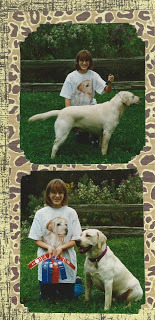 Champion Obedience DogHe came by it honestly with a pedigree of British champions a mile long. He wasn't perfect, however. Thunderstorms were his nemesis. The hint of thunder sent him into a tizzy. We had several incidents that were rather startling. He was put in his crate to try and soothe his nerves during a storm, but he bent the metal door apart, and escaped. Relegated to the pantry another time (BIG mistake) he took a bag of flour off the shelf and spread it everywhere. Cans were taken off the shelves and bore his jaw marks. The pantry looked like a Lucy episode. He would shred papers, plastic, furniture, anything in his path during a storm. Medication was very helpful and definitely took the edge off the destructive bent.
His accomplishments were quite varied and he had his 15 minutes of fame. He and I went to therapy dog training through the Delta Society and became certified. We made regular visits to an assisted living facility, made presentations in classrooms, and at children's events. Buck made instant friends wherever he went and loved to be in the middle of a crowd of kids or seniors. He brought a lot of happiness and fond memories to the seniors we visited. I heard lots of stories about their dogs and how much they missed having a four-footed friend. He showed off a few tricks, sat patiently, and wore his therapy dog vest with panache. Buck always seemed quite pleased with himself when we headed for the parking lot.
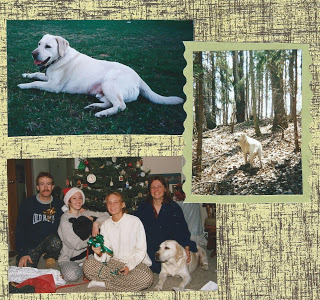 His biggest claim to fame was starring as Sandy in the musical "Annie" at our school. He was 10 at the time and was slowing down due to arthritis. He took to the stage in no time and although he wasn't exactly energetic, he won the hearts of the cast and audience. After four shows, I was sure he'd be glad to flop on the living room floor. He was not. Buck sat by the door ready to go at 6:00pm, waiting for me to load him in the mini-van. That goofy Lab face was actually disappointed when I told him the show was over and we didn't have any more performances. He kind of pouted for a couple of days after that.
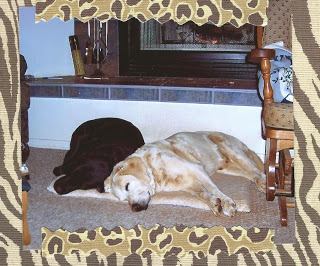 The Retirement Years with ClancyBuck rode across the country from New York to Arizona with my husband in an unair-conditioned pickup in October, 2003. It was pretty hot when they hit the New Mexico border, so bags of ice were placed under towels to keep him cool. They both arrived safely and Buck adjusted to retirement and desert life quickly. He did miss peeing in grass though. It took him awhile to get used to dirt. He and his buddy, Clancy kept each other company for three more years. Thunderstorms didn't bother him as much when he started losing his hearing, which is a good thing in Arizona. He plodded along after Clancy and my husband for walks until he just couldn't do it anymore. Old age and arthritis finally caught up with him at 13 1/2--a very advanced age for a Lab.
If there was ever going to be a dog who gets to heaven, it would be Buck. A darn good dog and companion, a real top dog.
He came into our home as a four-year-old. That in itself was out of the ordinary. We'd always had puppies. But after the demise of a dog who looked for every chance to escape the yard, our vet suggested we get in touch with a local breeder. Buck was a handsome boy who'd sired quite a few litters, but had been retired early from that job. Neutered, shots up-to-date, and AKC paperwork in hand, we took him home to see if he'd be a good fit. He'd been shown in the breed ring, his obedience skills were well established, and his laid back personality were all big pluses.
In no time, we were sure Buck would be a great addition to the family. Our youngest daughter, who was interested in obedience training got involved with 4-H and won ribbons at the county fair and state fair in short order. I even tried my hand at a couple of dog matches and came home with ribbons too. Buck was an absolute gentleman. He never jumped on anyone, and exhibited that wonderful Lab temperament, one of the hallmarks of the breed. The standard from the AKC states: "The ideal disposition is one of a kindly, outgoing, tractable nature; eager to please and non-aggressive towards man or animal. The Labrador has much that appeals to people; his gentle ways, intelligence, and adaptability make him an ideal dog." That was indeed Buck.
 Champion Obedience DogHe came by it honestly with a pedigree of British champions a mile long. He wasn't perfect, however. Thunderstorms were his nemesis. The hint of thunder sent him into a tizzy. We had several incidents that were rather startling. He was put in his crate to try and soothe his nerves during a storm, but he bent the metal door apart, and escaped. Relegated to the pantry another time (BIG mistake) he took a bag of flour off the shelf and spread it everywhere. Cans were taken off the shelves and bore his jaw marks. The pantry looked like a Lucy episode. He would shred papers, plastic, furniture, anything in his path during a storm. Medication was very helpful and definitely took the edge off the destructive bent.
His accomplishments were quite varied and he had his 15 minutes of fame. He and I went to therapy dog training through the Delta Society and became certified. We made regular visits to an assisted living facility, made presentations in classrooms, and at children's events. Buck made instant friends wherever he went and loved to be in the middle of a crowd of kids or seniors. He brought a lot of happiness and fond memories to the seniors we visited. I heard lots of stories about their dogs and how much they missed having a four-footed friend. He showed off a few tricks, sat patiently, and wore his therapy dog vest with panache. Buck always seemed quite pleased with himself when we headed for the parking lot.
 His biggest claim to fame was starring as Sandy in the musical "Annie" at our school. He was 10 at the time and was slowing down due to arthritis. He took to the stage in no time and although he wasn't exactly energetic, he won the hearts of the cast and audience. After four shows, I was sure he'd be glad to flop on the living room floor. He was not. Buck sat by the door ready to go at 6:00pm, waiting for me to load him in the mini-van. That goofy Lab face was actually disappointed when I told him the show was over and we didn't have any more performances. He kind of pouted for a couple of days after that.
 The Retirement Years with ClancyBuck rode across the country from New York to Arizona with my husband in an unair-conditioned pickup in October, 2003. It was pretty hot when they hit the New Mexico border, so bags of ice were placed under towels to keep him cool. They both arrived safely and Buck adjusted to retirement and desert life quickly. He did miss peeing in grass though. It took him awhile to get used to dirt. He and his buddy, Clancy kept each other company for three more years. Thunderstorms didn't bother him as much when he started losing his hearing, which is a good thing in Arizona. He plodded along after Clancy and my husband for walks until he just couldn't do it anymore. Old age and arthritis finally caught up with him at 13 1/2--a very advanced age for a Lab.
If there was ever going to be a dog who gets to heaven, it would be Buck. A darn good dog and companion, a real top dog.
July 12, 2013
Talking About Dialogue
Guest Post by Rose Ciccarelli, Editor
 Dialogue is more than words. It can show the reader how your characters interact. In every scene, characters talk (or avoid talking) because they WANT something. They may use different strategies to get it, communicated by words and actions. If one strategy doesn't work, then a character will try something else. That scene construction leads to conflict and forward movement in your story.The simplest way to make dialogue realistic is to invest time listening to how people really talk. Tune in at a baseball game or concert. Eavesdrop on the booth behind you in a restaurant. Listen to children chatting at the bus stop. What you’ll notice is that people don’t give a summary of events because the person they’re talking to already knows the situation and remembers what’s happened to this point. Also (although there are exceptions) people seldom say exactly what they mean. How often have you heard a real person say something like: “I’m being extra particular about ordering my meal from the waiter because I want you to think I’m in control when actually I’m really nervous about being out with you for the first time.” That may be an extreme example, but on TV last night, I heard this line of dialogue: “You are a bad woman because ...” I cringed for that writer.
Beyond listening to real people talk, WATCH how they interact. Listen for what isn’t being said. This observation can spark ideas about what characters do when they want to avoid communicating. Do they fidget? Dive into their smart phones to play Sudoku? Actions say more than words about how your character interacts with others; they show rather than tell readers about the scene’s undercurrents.
Sometimes, just listening to real people isn’t enough. Writing believable dialogue in historical fiction is a challenge. The writer teeters on a tight rope between evoking a sense of the period and being unintelligible to modern readers. If you’re writing period dialogue, look at books written around that time, or for the 1920s on, movies. Note words and sentence patterns that convey a sense of the time while still being understandable to modern readers. Arm yourself with a good etymology dictionary to avoid anachronisms, but use discretion too. Even if you’re right about a word, if a reader wonders about it, then you’ve pulled them out of the story. An example is the word “bouncer.” It’s been around since the mid-1800s, but if I read it in a story set during the Civil War, will I wonder?Dialogue is an indispensable building block for constructing scenes. Using these tips can result in characters that interact in engaging, believable ways, so that readers keep turning the pages to find out what your characters will say (and do) next.
Dialogue is more than words. It can show the reader how your characters interact. In every scene, characters talk (or avoid talking) because they WANT something. They may use different strategies to get it, communicated by words and actions. If one strategy doesn't work, then a character will try something else. That scene construction leads to conflict and forward movement in your story.The simplest way to make dialogue realistic is to invest time listening to how people really talk. Tune in at a baseball game or concert. Eavesdrop on the booth behind you in a restaurant. Listen to children chatting at the bus stop. What you’ll notice is that people don’t give a summary of events because the person they’re talking to already knows the situation and remembers what’s happened to this point. Also (although there are exceptions) people seldom say exactly what they mean. How often have you heard a real person say something like: “I’m being extra particular about ordering my meal from the waiter because I want you to think I’m in control when actually I’m really nervous about being out with you for the first time.” That may be an extreme example, but on TV last night, I heard this line of dialogue: “You are a bad woman because ...” I cringed for that writer.Beyond listening to real people talk, WATCH how they interact. Listen for what isn’t being said. This observation can spark ideas about what characters do when they want to avoid communicating. Do they fidget? Dive into their smart phones to play Sudoku? Actions say more than words about how your character interacts with others; they show rather than tell readers about the scene’s undercurrents.
Sometimes, just listening to real people isn’t enough. Writing believable dialogue in historical fiction is a challenge. The writer teeters on a tight rope between evoking a sense of the period and being unintelligible to modern readers. If you’re writing period dialogue, look at books written around that time, or for the 1920s on, movies. Note words and sentence patterns that convey a sense of the time while still being understandable to modern readers. Arm yourself with a good etymology dictionary to avoid anachronisms, but use discretion too. Even if you’re right about a word, if a reader wonders about it, then you’ve pulled them out of the story. An example is the word “bouncer.” It’s been around since the mid-1800s, but if I read it in a story set during the Civil War, will I wonder?Dialogue is an indispensable building block for constructing scenes. Using these tips can result in characters that interact in engaging, believable ways, so that readers keep turning the pages to find out what your characters will say (and do) next.
July 10, 2013
Where are the Sheep?
Last night a mega monsoon storm hit our area with high winds, and buckets of much needed rain. Our rain gauge which was a little tilted because of the wind measured three inches. We've been waiting since February for a significant rain, and we were blessed with a downpour. Within an hour into the storm, the bleating of goats or maybe sheep filled the air. But it wasn't either one. The sound came from small, but very loud, male spadefoot toads which remain buried in the sand until a major rain. The boys were trying to attract the girls--nothing new in nature.
The unique life cycle of the spadefoot is all about waiting--a very long time, sometimes more than a year to emerge from the earth and reproduce. But once they emerge, they must get the job done in quick order. Temporary ponds formed by runoff in the desert are tricky things. They can disappear in week or two. Often the pools of water evaporate within a few days. Toads and frogs lay eggs which then hatch into polliwogs. Because of their unique desert nature, the spadefoot toads waste no time, and their Creator gave their reproductive cycle a much quicker turnaround time than many other amphibians. Females can lay
up to 3,000 eggs in one night and the eggs can hatch within 15 hours. The tadpoles quickly metamorphose into young toads within 9-14 days. The desert is a harsh place, and a small number of toads actually make it. Those who do, eat as much as they can hold and using the hind "spadefoot" dig into the sand to wait until the next monsoon.
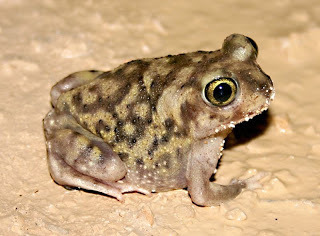 photo: wikimediaNot exactly an exciting life, but they eat a pile of insects before they disappear into the depths of the desert, which makes them quite useful. Last year the monsoon wasn't plentiful where we live, and the spadefoots didn't get much of a chance to enjoy the rain. I missed that weird chorus of bleating amphibians who joyously greet the monsoon with such wild abandon. They more than made up for it last night.
What an amazing God we have who made such intricate and incredible creatures! I'm convinced the sheep imitation shows His sense of humor in gifting a three-inch toad with such a peculiar and LOUD voice. They must make Him laugh.
Have you never heard? Have you never understood? The LORD is the everlasting God, the Creator of all the earth. He never grows weak or weary. No one can measure the depths of his understanding. Isaiah 40:28 NLT
The unique life cycle of the spadefoot is all about waiting--a very long time, sometimes more than a year to emerge from the earth and reproduce. But once they emerge, they must get the job done in quick order. Temporary ponds formed by runoff in the desert are tricky things. They can disappear in week or two. Often the pools of water evaporate within a few days. Toads and frogs lay eggs which then hatch into polliwogs. Because of their unique desert nature, the spadefoot toads waste no time, and their Creator gave their reproductive cycle a much quicker turnaround time than many other amphibians. Females can lay
up to 3,000 eggs in one night and the eggs can hatch within 15 hours. The tadpoles quickly metamorphose into young toads within 9-14 days. The desert is a harsh place, and a small number of toads actually make it. Those who do, eat as much as they can hold and using the hind "spadefoot" dig into the sand to wait until the next monsoon.
 photo: wikimediaNot exactly an exciting life, but they eat a pile of insects before they disappear into the depths of the desert, which makes them quite useful. Last year the monsoon wasn't plentiful where we live, and the spadefoots didn't get much of a chance to enjoy the rain. I missed that weird chorus of bleating amphibians who joyously greet the monsoon with such wild abandon. They more than made up for it last night.
What an amazing God we have who made such intricate and incredible creatures! I'm convinced the sheep imitation shows His sense of humor in gifting a three-inch toad with such a peculiar and LOUD voice. They must make Him laugh.
Have you never heard? Have you never understood? The LORD is the everlasting God, the Creator of all the earth. He never grows weak or weary. No one can measure the depths of his understanding. Isaiah 40:28 NLT
July 6, 2013
Which Breed? (Third Installment of Dog Days)
Big dog? Little dog? Long haired? Short haired? Temperament? There are lots of questions to ask yourself before deciding on the perfect breed for you and your family. If you're purchasing a dog from a reputable breeder, they'll most likely have a questionnaire for you to fill out before they'll even consider selling a puppy to you. Some shelters may do the same thing. For a successful match up between a dog and its new family there are lots of things to consider.
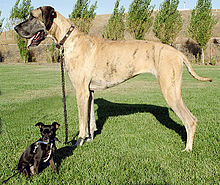 The American Kennel Club distinguishes differences between dogs by categorizing them in different groups. If you've watched the Westminster Kennel Club Show on TV in February, you've seen all the breeds paraded around the ring. The groups are: Working, Sporting, Non-Sporting, Hound, Terrier, Herding, and Toy. There's lots of variety within these groups, but dogs are bred for specific purposes, which determines personality, natural abilities, and how well they'll fit into your family dynamic. Dogs are social by nature, and all breeds need that constant human interaction. I'm thoroughly against "outside dogs" who are left on their own to bark, become aggressive, and in general be a nuisance. It's cruel and the dog doesn't stand a chance of being a companion animal. It's an unhappy life for the dog, you, and the neighbors.
1. Working dogs include St. Bernard's, Bernese Mountain Dogs, Boxers, Doberman Pinschers, Huskys, and lots more. All of these breeds are large and need room for exercise. These dogs also need lots of socialization and obedience training. They are extremely intelligent and eager to learn, but they need a job. They were bred to work. A bored dog is a problem.
2. Sporting dogs are a popular choice for many families. This group includes the Labrador Retriever (my favorite and America's favorite) The group includes spaniels, retrievers, setters, and pointers. All were bred to help two-legged hunters. They're usually easy going in personality, but they are active. Regular exercise and interaction with people will form a great family companion--if you have the room and are an active family. No couch potatoes for this group.
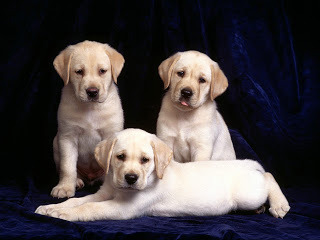
3. The Hound group includes Beagles, Afghan Hounds, Coon Hounds, Bassetts, and the list goes on. This group of dogs loves the chase. Once they're on the scent of the quarry...well they're focused. Beagle puppies are adorable. Who doesn't want a Snoopy--they're short-haired, and a nice size. Be aware that all of these dogs love to bark, howl, bay. It's what they're bred to do. It's a signal they've found the rabbit, the raccoon, or whatever they're after. Your neighbors will not love you if you leave them in the backyard at night.
4. Non-Sporting dogs are extremely diverse. The group includes the Bichon Frise, Boston Terrier, Chow, the Poodle, and Shar-Pei just to name a few. Make sure you find a reputable breeder and understand the specific breed before plunking down the cash.
5. Terriers have been popular for years and years. They're apartment sized and have engaging personalities. However, they were originally bred to kill. Farmers relied on these pint-sized dogs to keep the vermin down in the barns and farmyards. They love to dig, are absolutely focused on the kill, and aren't the most tolerant of other dogs. They need a firm and loving hand, lots of socialization, and obedience training. They're as smart as whip, so be prepared to be tested. Popular breeds in this group are the Jack Russell, Scotty, and West Highland.
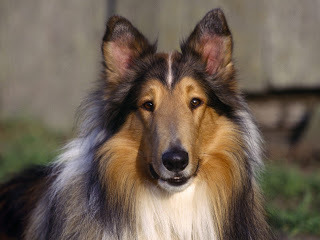 6. Collies are one of the breeds included in the Herding Group. All of these dogs were bred to herd livestock and protect their charges. German Shepherd Dogs and the Belgian Malinois are part of this group and are often used in law enforcement. The dogs in this group have high working drives and excel in obedience training. A real commitment is required to keep herding dogs active, trained, and socialized. They are loyal and reliable family companions, but that doesn't happen without a great deal of work on your part. The Pembroke and Cardigan Welsh Corgis are smaller breeds in this group and if the Queen of England has them, they must be OK. Be aware that as herding dogs, they have a natural inclination to nip at heels-- sheep, cows, or human. They want to herd after all.
7. The Toy Group is filled with the itsy-bitsy dogs that are pretty portable. Although small in size their price tag may be large. There are lots of undesirable breeders out there, so caution is advised. Some of the breeds are the Maltese, Pekingese, Chihuahua, and Yorkshire Terrier. Although, I'm more of a big dog person, the toy breeds make great companions. They aren't nearly as much care in the exercise category, aren't as expensive to feed, and you can even slide them under your airplane seat when you travel.
A dog is a long commitment--10 years or more in many cases. If you want a great family companion, find the best fit for your current lifestyle. Don't think you'll change. A nice idea, but it seldom happens. Studies show that dogs enrich our lives in many ways --even reducing stress and blood pressure. Set yourself and your dog up for success by selecting the right breed, get obedience training, and work toward getting the Canine Good Citizen (CGC) award through the AKC. Any breed or mixed breed is eligible to test. That's it for this week. Now it's time to wake up Clancy, and take him for a walk.
Resource Link: American Kennel Club
Next Week - July 13: A Memorable Dog - Buck
July 20 - Call of the Wild and Other Great Dog Stories
July 27 - Workin' Like a Dog - Interview with Border Patrol Agent and his Detection Dog
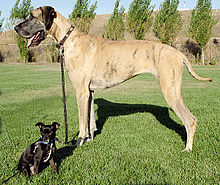 The American Kennel Club distinguishes differences between dogs by categorizing them in different groups. If you've watched the Westminster Kennel Club Show on TV in February, you've seen all the breeds paraded around the ring. The groups are: Working, Sporting, Non-Sporting, Hound, Terrier, Herding, and Toy. There's lots of variety within these groups, but dogs are bred for specific purposes, which determines personality, natural abilities, and how well they'll fit into your family dynamic. Dogs are social by nature, and all breeds need that constant human interaction. I'm thoroughly against "outside dogs" who are left on their own to bark, become aggressive, and in general be a nuisance. It's cruel and the dog doesn't stand a chance of being a companion animal. It's an unhappy life for the dog, you, and the neighbors.
1. Working dogs include St. Bernard's, Bernese Mountain Dogs, Boxers, Doberman Pinschers, Huskys, and lots more. All of these breeds are large and need room for exercise. These dogs also need lots of socialization and obedience training. They are extremely intelligent and eager to learn, but they need a job. They were bred to work. A bored dog is a problem.
2. Sporting dogs are a popular choice for many families. This group includes the Labrador Retriever (my favorite and America's favorite) The group includes spaniels, retrievers, setters, and pointers. All were bred to help two-legged hunters. They're usually easy going in personality, but they are active. Regular exercise and interaction with people will form a great family companion--if you have the room and are an active family. No couch potatoes for this group.

3. The Hound group includes Beagles, Afghan Hounds, Coon Hounds, Bassetts, and the list goes on. This group of dogs loves the chase. Once they're on the scent of the quarry...well they're focused. Beagle puppies are adorable. Who doesn't want a Snoopy--they're short-haired, and a nice size. Be aware that all of these dogs love to bark, howl, bay. It's what they're bred to do. It's a signal they've found the rabbit, the raccoon, or whatever they're after. Your neighbors will not love you if you leave them in the backyard at night.
4. Non-Sporting dogs are extremely diverse. The group includes the Bichon Frise, Boston Terrier, Chow, the Poodle, and Shar-Pei just to name a few. Make sure you find a reputable breeder and understand the specific breed before plunking down the cash.
5. Terriers have been popular for years and years. They're apartment sized and have engaging personalities. However, they were originally bred to kill. Farmers relied on these pint-sized dogs to keep the vermin down in the barns and farmyards. They love to dig, are absolutely focused on the kill, and aren't the most tolerant of other dogs. They need a firm and loving hand, lots of socialization, and obedience training. They're as smart as whip, so be prepared to be tested. Popular breeds in this group are the Jack Russell, Scotty, and West Highland.
 6. Collies are one of the breeds included in the Herding Group. All of these dogs were bred to herd livestock and protect their charges. German Shepherd Dogs and the Belgian Malinois are part of this group and are often used in law enforcement. The dogs in this group have high working drives and excel in obedience training. A real commitment is required to keep herding dogs active, trained, and socialized. They are loyal and reliable family companions, but that doesn't happen without a great deal of work on your part. The Pembroke and Cardigan Welsh Corgis are smaller breeds in this group and if the Queen of England has them, they must be OK. Be aware that as herding dogs, they have a natural inclination to nip at heels-- sheep, cows, or human. They want to herd after all.
7. The Toy Group is filled with the itsy-bitsy dogs that are pretty portable. Although small in size their price tag may be large. There are lots of undesirable breeders out there, so caution is advised. Some of the breeds are the Maltese, Pekingese, Chihuahua, and Yorkshire Terrier. Although, I'm more of a big dog person, the toy breeds make great companions. They aren't nearly as much care in the exercise category, aren't as expensive to feed, and you can even slide them under your airplane seat when you travel.
A dog is a long commitment--10 years or more in many cases. If you want a great family companion, find the best fit for your current lifestyle. Don't think you'll change. A nice idea, but it seldom happens. Studies show that dogs enrich our lives in many ways --even reducing stress and blood pressure. Set yourself and your dog up for success by selecting the right breed, get obedience training, and work toward getting the Canine Good Citizen (CGC) award through the AKC. Any breed or mixed breed is eligible to test. That's it for this week. Now it's time to wake up Clancy, and take him for a walk.
Resource Link: American Kennel Club
Next Week - July 13: A Memorable Dog - Buck
July 20 - Call of the Wild and Other Great Dog Stories
July 27 - Workin' Like a Dog - Interview with Border Patrol Agent and his Detection Dog
July 3, 2013
Against the Odds
If you've ever read the book of Judges in the Old Testament, you know about the exploits of a man named Gideon. He was one of Israel's judges before a king had been crowned. He was a leader when Israel was under horrible oppression by the Midianites. Life was miserable. The crops were destroyed and livestock stolen by these marauders from Midian. The Israelites went into hiding, living in caves and remote mountain areas, trying to survive. They were on the run and the Promised Land was in ruins.
Gideon was instructed by God to take out the enemy, so he sent messages out everywhere to gather an army. His call was answered with the arrival of 32,000 men. Not bad, but the Midianites had over 120,000 men. But God told Gideon that he had way too many men. God wanted His strength to be shown, not Israel's, so He commanded Gideon to cull the group by sending those who were afraid to fight back home. Twenty-two thousand immediately hit the road. But there were still too many. I can see Gideon trying to figure out why an army of 10,000 men was too large. He was obedient despite what he may have thought, and put the remaining men to one more test. He had them drink from a nearby spring. The majority got down on their hands and knees to drink. Three hundred cupped their hands to hold the water and drank. You guessed it--9,700 got sent home. With those 300 men, and the power of Yahweh, the Midianites were soundly thrashed. Over 120,000 Midianites died in that battle. An amazing story of God's power with such a small army.
The account of Gideon reminds me of the birth of this country. A downtrodden, abused British colony fed up with an oppressive government, dared to stand up and declare independence. A group of 56 men from all sorts of backgrounds--farmers, attorneys, businessmen, physicians, and professors faced incredible odds and signed that sacred American document. It begins like this:
As we celebrate the 237th birthday of this great country, overwhelming challenges face us. The odds aren't great that righteousness will prevail. Don't let that stop you from doing what is right and from praying. Our true freedoms aren't tied to a political system or a country anyway. God is in control.
Gideon was instructed by God to take out the enemy, so he sent messages out everywhere to gather an army. His call was answered with the arrival of 32,000 men. Not bad, but the Midianites had over 120,000 men. But God told Gideon that he had way too many men. God wanted His strength to be shown, not Israel's, so He commanded Gideon to cull the group by sending those who were afraid to fight back home. Twenty-two thousand immediately hit the road. But there were still too many. I can see Gideon trying to figure out why an army of 10,000 men was too large. He was obedient despite what he may have thought, and put the remaining men to one more test. He had them drink from a nearby spring. The majority got down on their hands and knees to drink. Three hundred cupped their hands to hold the water and drank. You guessed it--9,700 got sent home. With those 300 men, and the power of Yahweh, the Midianites were soundly thrashed. Over 120,000 Midianites died in that battle. An amazing story of God's power with such a small army.
The account of Gideon reminds me of the birth of this country. A downtrodden, abused British colony fed up with an oppressive government, dared to stand up and declare independence. A group of 56 men from all sorts of backgrounds--farmers, attorneys, businessmen, physicians, and professors faced incredible odds and signed that sacred American document. It begins like this:
When in the Course of human events it becomes necessary for one people to dissolve the political bands which have connected them with another and to assume among the powers of the earth, the separate and equal station to which the Laws of Nature and of Nature's God entitle them, a decent respect to the opinions of mankind requires that they should declare the causes which impel them to the separation.There's much more to the document, and I encourage you to read it. You may find it quite eye-opening. We have long enjoyed the freedoms gained by the courage and vision of these men. They paid for it with their reputations, livelihoods, and lives. Believing that God was with them, and that He would bless their efforts, they went to war against insurmountable odds. And He was with them. The British tyranny was defeated, and the United States of America was birthed. God loves terrible odds and He regularly uses small, insignificant things to bring about astounding events. He's still doing that today. If you begin looking for God to show up in your life, you'll be amazed. I am everyday.Photo Credit: blog.galveston.com
We hold these truths to be self-evident, that all men are created equal, that they are endowed by their Creator with certain unalienable Rights, that among these are Life, Liberty and the pursuit of Happiness. — That to secure these rights, Governments are instituted among Men, deriving their just powers from the consent of the governed, — That whenever any Form of Government becomes destructive of these ends, it is the Right of the People to alter or to abolish it, and to institute new Government, laying its foundation on such principles and organizing its powers in such form, as to them shall seem most likely to effect their Safety and Happiness.

As we celebrate the 237th birthday of this great country, overwhelming challenges face us. The odds aren't great that righteousness will prevail. Don't let that stop you from doing what is right and from praying. Our true freedoms aren't tied to a political system or a country anyway. God is in control.
I urge you, first of all, to pray for all people. Ask God to help them; intercede on their behalf, and give thanks for them. Pray this way for kings and all who are in authority so that we can live peaceful and quiet lives marked by godliness and dignity. I Timothy 2:1-2 NLT
So now there is no condemnation for those who belong to Christ Jesus. And because you belong to him, the power of the life-giving Spirit has freed you from the power of sin that leads to death. Romans 8:1-2 NLT
June 29, 2013
Pick of the Litter
"But, Mom the puppies are really cute. I'll take care of it. Honest. We need a dog. I'll walk him and feed him. Pleeeeeese, can't we get a puppy?"
The age old parent-child exchange about getting a puppy. The big decision to bring a baby canine into your family. How the passionate promises of feeding, walking, and cleaning up after the puppy pour so easily from your child's lips. You know, however, you'll be the one doing all of the above and more. Of course, puppies are adorable, soft, cuddly, entertaining, annoying, labor intensive, and sleep disrupting. But, most likely you'll cave and get one anyway.
Companion dogs are members of the family, and the puppy you add to the mix needs to be a good fit. Emotions run high over that furry, roly-poly critter whose antics can melt the heart of the stone. Take a deep breath and do your homework before making the commitment. Don't get a puppy at Christmastime. The excitement of the holiday will make it a very difficult time for the puppy and your family. Wait until the holidays are past and you can focus on introducing a new family member correctly.
Here's a puppy picking list for you that will help in selecting just the right one for your situation whether you go to a breeder or a shelter.
1. Beware of puppy mills, backyard breeders, and pet stores. A healthy puppy is paramount to a great experience in adding a dog to your family. A reputable breeder and shelters who make sure the dogs are given their shots, and have been vet-checked are your best choices.
2. Be realistic about the size of dog to choose. Too big and too little are the same problem. Look at your home, yard, and the age of your children. Young children aren't going to be able to walk a Great Dane when it reaches 8-9 months of age. A teacup-size dog may be cute for you to carry in your purse, but a young child can easily, albeit, unintentionally injure a small dog.
3. A purebred dog can be quite an investment, depending on the breed. If that's out of reach, many shelters offer excellent programs that include all shots, spaying, neutering, microchipping, and more. At either a breeder's kennel or a shelter, runs should be clean, the dogs well cared for, and records available.
4. Like a baby, a puppy needs a lot of equipment - a crate (yes, it's a necessity), a bed, collar, puppy food, toys, and a leash for starters. Regular vet visits during the first year are important too. They need shots, and health checks as they mature. Count the cost of responsible dog ownership before proceeding.
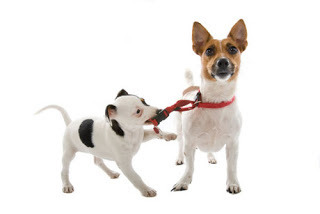
If you get the through the first list and decide to continue, let's check out the next step--selecting a puppy. I've gotten both puppies and adult dogs. We've gone to shelters and breeders with successful adoptions. The puppy personality test can be used successfully with adult dogs, as well as pups. Every dog has a distinct personality, just like people. Breeds are distinct in their pluses and minuses for your particular situation. Collies are beautiful dogs, but are you prepared for high maintenance hair? Males and females are different too. There are lots of things to consider.
The puppy personality test will show you how social, dominant, submissive, and how sensitive the dog is. These are extremely important in how quickly and easily your furry bundle of joy will adapt to his or her new home. Remember humans are the alpha dogs in the house, and you want a dog that easily accepts the proper position in the household.
1. Place the puppy a few feet from you. Then kneel down and call him/her, clapping your hands, and gently coaxing. The puppy may charge at you and lick or bite at your face and hands, or some may cautiously approach you, or not at all. You'll be able to quickly assess how confident, and how social the dog is. A puppy who comes to you readily with tail up, is an ideal response. If the puppy jumps or bites at you when he comes, shows aggressive behavior, while the dog who is hesitant or cowers with tail down is a fearful, shy dog.
2. Kneel down and gently roll the dog on his/her back, and hold for about 30 seconds. Does the dog struggle the entire time? Maybe he/she doesn't struggle at all or the puppy may struggle for a few seconds and then settle. This little exercise shows the dominance tendencies of the dog in a social situation. The more the dog struggles, the more dominant and aggressive he is. One who struggles and then settles is ideal. He's willing to accept restraint. The puppy who doesn't struggle or avoids eye contact is overly submissive and fearful.
3. Another dominance test is bending over the puppy and interlacing your fingers under the dog's belly. Lift it gently off the floor for 30 seconds. Does the puppy bite at you, struggle, lick your hands? The response will tell you how the dog accepts dominance while he/she has no control.
4. Sensitivity to touch is tested by pressing a finger and thumb on the webbing of a front foot. Exert increasing pressure on the webbing until you get a response while counting to 10. Stop immediately if the puppy shows any discomfort. If a dog responds before you can count to five or six, its sensitivity is high. Think about kids pulling on ears, or a tail, or tugging at loose skin. A highly sensitive dog may react by snapping or biting.
5. Homes with children are noisy places. Check out the puppy's sensitivity to sound by hitting a large metal spoon on a pot a couple of times. If the dog listens, walks toward you, or appears curious, he/she is't overly sensitive and isn't deaf. If a dog cringes or hides from the noise, he/she may not be right for your family. If there is no reaction at all, the dog may be deaf.
6. Retrieving a ball is a test to see if the dog is willing to work with a two-legged alpha dog. If the dog doesn't cooperate and willingly participate, don't expect that to change.
Now is not the time to rescue a sick or poorly socialized puppy. A home with children needs a well-adjusted and healthy dog who's a willing learner. You may like the "spunk" in a nippy puppy, but that's a behavior that will take time, consistent training, and patience to change. A shaking, shy one may tug at everyone's heartstrings, but the dog needs the same training as the dominant personality. Fear biters, and piddlers come from this group. Piddling and nippy dogs aren't fun as they get older.
A nice, balanced personality is the best choice. House training, and adjusting to home life is quite enough for a puppy to handle, and for you too. A special needs puppy is best left to owners with experience, and the right home environment.
A puppy can be a great addition to your family. Sophie, the Lab our daughters grew up with came from the county shelter and was a terrific companion for 10 years. She waited everyday for them to come home from school, napping in the shade of the maple in our driveway. She also deftly gobbled a pound of hamburger out of a grocery bag while I unloaded groceries. Life with dogs is always interesting.
Resource Link: American Kennel Club
NEXT WEEK: The Right Breed for You
The age old parent-child exchange about getting a puppy. The big decision to bring a baby canine into your family. How the passionate promises of feeding, walking, and cleaning up after the puppy pour so easily from your child's lips. You know, however, you'll be the one doing all of the above and more. Of course, puppies are adorable, soft, cuddly, entertaining, annoying, labor intensive, and sleep disrupting. But, most likely you'll cave and get one anyway.
Companion dogs are members of the family, and the puppy you add to the mix needs to be a good fit. Emotions run high over that furry, roly-poly critter whose antics can melt the heart of the stone. Take a deep breath and do your homework before making the commitment. Don't get a puppy at Christmastime. The excitement of the holiday will make it a very difficult time for the puppy and your family. Wait until the holidays are past and you can focus on introducing a new family member correctly.
Here's a puppy picking list for you that will help in selecting just the right one for your situation whether you go to a breeder or a shelter.
1. Beware of puppy mills, backyard breeders, and pet stores. A healthy puppy is paramount to a great experience in adding a dog to your family. A reputable breeder and shelters who make sure the dogs are given their shots, and have been vet-checked are your best choices.
2. Be realistic about the size of dog to choose. Too big and too little are the same problem. Look at your home, yard, and the age of your children. Young children aren't going to be able to walk a Great Dane when it reaches 8-9 months of age. A teacup-size dog may be cute for you to carry in your purse, but a young child can easily, albeit, unintentionally injure a small dog.
3. A purebred dog can be quite an investment, depending on the breed. If that's out of reach, many shelters offer excellent programs that include all shots, spaying, neutering, microchipping, and more. At either a breeder's kennel or a shelter, runs should be clean, the dogs well cared for, and records available.
4. Like a baby, a puppy needs a lot of equipment - a crate (yes, it's a necessity), a bed, collar, puppy food, toys, and a leash for starters. Regular vet visits during the first year are important too. They need shots, and health checks as they mature. Count the cost of responsible dog ownership before proceeding.
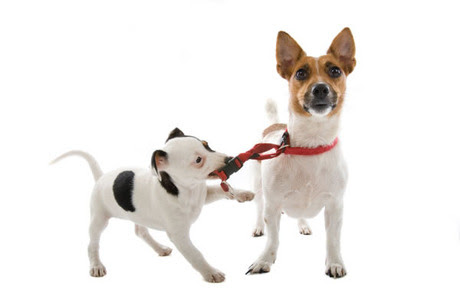
If you get the through the first list and decide to continue, let's check out the next step--selecting a puppy. I've gotten both puppies and adult dogs. We've gone to shelters and breeders with successful adoptions. The puppy personality test can be used successfully with adult dogs, as well as pups. Every dog has a distinct personality, just like people. Breeds are distinct in their pluses and minuses for your particular situation. Collies are beautiful dogs, but are you prepared for high maintenance hair? Males and females are different too. There are lots of things to consider.
The puppy personality test will show you how social, dominant, submissive, and how sensitive the dog is. These are extremely important in how quickly and easily your furry bundle of joy will adapt to his or her new home. Remember humans are the alpha dogs in the house, and you want a dog that easily accepts the proper position in the household.
1. Place the puppy a few feet from you. Then kneel down and call him/her, clapping your hands, and gently coaxing. The puppy may charge at you and lick or bite at your face and hands, or some may cautiously approach you, or not at all. You'll be able to quickly assess how confident, and how social the dog is. A puppy who comes to you readily with tail up, is an ideal response. If the puppy jumps or bites at you when he comes, shows aggressive behavior, while the dog who is hesitant or cowers with tail down is a fearful, shy dog.
2. Kneel down and gently roll the dog on his/her back, and hold for about 30 seconds. Does the dog struggle the entire time? Maybe he/she doesn't struggle at all or the puppy may struggle for a few seconds and then settle. This little exercise shows the dominance tendencies of the dog in a social situation. The more the dog struggles, the more dominant and aggressive he is. One who struggles and then settles is ideal. He's willing to accept restraint. The puppy who doesn't struggle or avoids eye contact is overly submissive and fearful.
3. Another dominance test is bending over the puppy and interlacing your fingers under the dog's belly. Lift it gently off the floor for 30 seconds. Does the puppy bite at you, struggle, lick your hands? The response will tell you how the dog accepts dominance while he/she has no control.
4. Sensitivity to touch is tested by pressing a finger and thumb on the webbing of a front foot. Exert increasing pressure on the webbing until you get a response while counting to 10. Stop immediately if the puppy shows any discomfort. If a dog responds before you can count to five or six, its sensitivity is high. Think about kids pulling on ears, or a tail, or tugging at loose skin. A highly sensitive dog may react by snapping or biting.
5. Homes with children are noisy places. Check out the puppy's sensitivity to sound by hitting a large metal spoon on a pot a couple of times. If the dog listens, walks toward you, or appears curious, he/she is't overly sensitive and isn't deaf. If a dog cringes or hides from the noise, he/she may not be right for your family. If there is no reaction at all, the dog may be deaf.
6. Retrieving a ball is a test to see if the dog is willing to work with a two-legged alpha dog. If the dog doesn't cooperate and willingly participate, don't expect that to change.
Now is not the time to rescue a sick or poorly socialized puppy. A home with children needs a well-adjusted and healthy dog who's a willing learner. You may like the "spunk" in a nippy puppy, but that's a behavior that will take time, consistent training, and patience to change. A shaking, shy one may tug at everyone's heartstrings, but the dog needs the same training as the dominant personality. Fear biters, and piddlers come from this group. Piddling and nippy dogs aren't fun as they get older.
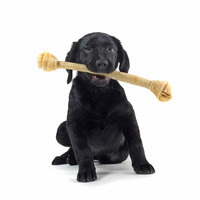
A nice, balanced personality is the best choice. House training, and adjusting to home life is quite enough for a puppy to handle, and for you too. A special needs puppy is best left to owners with experience, and the right home environment.
A puppy can be a great addition to your family. Sophie, the Lab our daughters grew up with came from the county shelter and was a terrific companion for 10 years. She waited everyday for them to come home from school, napping in the shade of the maple in our driveway. She also deftly gobbled a pound of hamburger out of a grocery bag while I unloaded groceries. Life with dogs is always interesting.
Resource Link: American Kennel Club
NEXT WEEK: The Right Breed for You
June 28, 2013
Confessions of the Indie Writer
 So, you want to get your novel published. Ten years ago, it was a daunting process. You needed an agent, and a publisher willing to take a chance on a new author. Both were hard to find. Today, with the rise of Create Space, Lulu, and Lightning Source et al, you can get your book in the hands of readers at the click of your mouse. The indie writer does it all—writer, publisher, and marketing pro. POD has forever changed the publishing model. While traditional publishers are struggling to make a profit, indie writers are on the move, and getting noticed.
I went indie a little over a year ago. The journey started about four years earlier when I finished my first mystery novel. My very first query letter to a publisher was accepted. Excited, I emailed the manuscript and sat back to wait. I was given regular progress reports by the acquisitions editor, and was on pins and needles when Family Matters made the third and final round. An august group of editors would decide my fate. Sadly, it didn't meet their “list.” But, they wanted my next book. And so I wrote two more mystery novels. Each one made it to the third and final round, but for one reason or another they didn't pick it up. However, they always wanted my next book. That’s when I went indie.

I’d already been writing magazine articles and actually receiving checks in the mail for them, so I was confident my writing was saleable. I turned to Create Space and haven’t looked back. By no means have I arrived, and the hard work to excel in the craft, and to market books continues. It’s a long, difficult process to get your name out there and sell books to people you don’t know. If you’re expecting quick returns, the New York bestseller list, or a traditional publisher knocking at your door begging you to write for them, please don’t attempt this at home. It’s hard to get noticed when indie authors are everywhere. Not that it was easy before, but there are crowds of new authors vying for the reader's attention. If you’re going indie, here are a few things I've picked up that may help you.
1. Decide whether writing is a hobby or career. This decision is huge. Will you be happy holding your book in your hands and passing them out as Christmas gifts or do you want to make money? It’s two entirely different paths. Neither is wrong—just very different.
2. Write every day. Writing is a craft and a discipline. Good intentions don’t get words on paper or on a computer screen. Practice. Practice. Practice. It's sort of like those scales your piano teacher assigned every week.
3. Get third party feedback about your writing. Take a writing class at a local college or join a writers group in your area. You need people who will tell you where your strengths and weaknesses are. Be brave.
4. Look for other writing gigs. Write for the local newspaper or your company’s newsletter. Submit articles to magazines. These types of writing jobs will sharpen your skills and build your confidence. Start a blog. Make it about something you’re passionate about. Be consistent. Give your readers new content on a regular basis, at least once a week.
5. If want to make money from your writing, you need to build an author platform. Get familiar with social media—Face Book, Google+, Twitter, LinkedIn, and all the rest. There are so many free publicity avenues, it’s overwhelming. Go one step at a time, and see what you can manage well. The Internet is a candy store full of social media tools and opportunities. Many are free, which is a wonderful deal. Another recommendation is to attend a writers conference. That's on my list for next year. Writing is a business on this track, so treat it as such.
6. Since the writer is his or her own marketing department, learn to write book descriptions that sell books. Practice writing press releases and put your bio together. Take a look at authors on Amazon and get some ideas about how to do right.
7. Develop a thick hide and persevere. Not everyone will love you. That’s okay. Take criticism in stride, find the truth in the critique, and use it to write better. You may avoid a publisher’s rejection going indie, but you won’t avoid readers’ rejections. Writing is not for the faint of heart.
8. Your book should go through the same process that a traditionally published book does. Deliver a quality product, from the cover to the last page. You want repeat readers. Pull together a team that includes savvy beta readers, a professional editor, and develop a marketing plan.
 Publishing a book on your own is a bit like giving birth. It’s a painful process and you’ll wonder why you ever thought being a published author was a good idea. I can tell you it
is
fun to hold your own book. It’s also gratifying to get a note from someone you don’t know, who enjoyed your book. You can see by the covers here, book production is growing. An inspirational novel, then a devotional, and now the mystery series has launched.
Publishing a book on your own is a bit like giving birth. It’s a painful process and you’ll wonder why you ever thought being a published author was a good idea. I can tell you it
is
fun to hold your own book. It’s also gratifying to get a note from someone you don’t know, who enjoyed your book. You can see by the covers here, book production is growing. An inspirational novel, then a devotional, and now the mystery series has launched. No, I’m not getting rich anytime soon. I need my day job…sigh. But, I’m currently living the dream. Seeing someone on an airplane with my book---that’s sweet!
June 26, 2013
Get Your Joy On!
If joy is a fruit of the Spirit, why are Christians looking so sour? Have you looked around church lately during a worship service? How many of them look joyful? How many look tired, bored, or maybe irritated? How about you?
A guest speaker came to our church in Castile, NY many years ago. He made a statement I'll never forget. He said, "Even if I hadn't met your pastor, I'd know who he is. He's the one with the glory face." He was right. Our pastor was a joyful man of God whose face reflected that fruit of the Spirit. No, he wasn't giddy or a laugh a minute. His joy was the real deal kind.
 It's more than happiness. It's more than a smile. It's all rather illusive and hard to define sometimes. Emotions can be tricky business, and we sometimes tend to discount them. True joy is much more than emotion, but emotion is part of it. There's nothing wrong with joy actually showing up on your face, in your step, or your actions.
The Greek word for joy in the New Testament is chairo which means "to rejoice, be glad, be well, to thrive." Sounds healthy, doesn't it? Fruit is good for you.
But the fruit of the Spirit is love, joy, peace, patience, kindness, goodness, faithfulness, gentleness and self-control. Galatians 5:22 NIV
Here are some things I'm learning about joy.
Joy is strong.
Joy shows up in unlikely places. It's not dependent on circumstances.
God is joyful about me.
I love that old gospel song that sings it out --"it is joy unspeakable and full of glory....oh the half has never yet been told." Don't waste another minute. Get your joy on and thrive!
"Rejoice in the Lord always. I will say it again: Rejoice!" Philippians 4:4 NIV
A guest speaker came to our church in Castile, NY many years ago. He made a statement I'll never forget. He said, "Even if I hadn't met your pastor, I'd know who he is. He's the one with the glory face." He was right. Our pastor was a joyful man of God whose face reflected that fruit of the Spirit. No, he wasn't giddy or a laugh a minute. His joy was the real deal kind.
 It's more than happiness. It's more than a smile. It's all rather illusive and hard to define sometimes. Emotions can be tricky business, and we sometimes tend to discount them. True joy is much more than emotion, but emotion is part of it. There's nothing wrong with joy actually showing up on your face, in your step, or your actions.
The Greek word for joy in the New Testament is chairo which means "to rejoice, be glad, be well, to thrive." Sounds healthy, doesn't it? Fruit is good for you.
But the fruit of the Spirit is love, joy, peace, patience, kindness, goodness, faithfulness, gentleness and self-control. Galatians 5:22 NIV
Here are some things I'm learning about joy.
Joy is strong.
"...for the joy of the LORD is your strength." Nehemiah 8:10 NIVJoy isn't transitory--it will last forever.
The poor will eat and be satisfied. All who seek the LORD will praise him. Their hearts will rejoice with everlasting joy. Psalm 22:26 NLTAngels experience joy.
...as the morning stars sang together and all the angels shouted for joy? Job 38:7 NLT
Joy shows up in unlikely places. It's not dependent on circumstances.
Consider it pure joy, my brothers and sisters, whenever you face trials of many kinds, because you know that the testing of your faith produces perseverance. James 1:2-3 NIVGod experiences joy.
But even as he spoke, a bright cloud overshadowed them, and a voice from the cloud said, "This is my dearly loved Son, who brings me great joy. Listen to him." Matthew 17:5 NLT
God is joyful about me.
Now all glory to God, who is able to keep you from falling away and will bring you with great joy into his glorious presence without a single fault. Jude 1:24 NLT
I love that old gospel song that sings it out --"it is joy unspeakable and full of glory....oh the half has never yet been told." Don't waste another minute. Get your joy on and thrive!
"Rejoice in the Lord always. I will say it again: Rejoice!" Philippians 4:4 NIV