Roberta Trahan's Blog, page 8
February 17, 2014
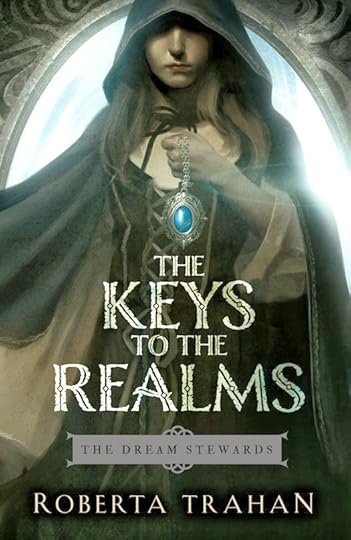
New Release Date Announced: THE KEYS TO THE REALMS (The Dream Stewards Book Two)
I am excited to announce that the release date for Book Two of The Dream Stewards: The Keys to the Realms has been move up to April 22, 2014 !!
Also new on the Amazon book detail page are some special preview features. Click the cover art and follow the link to see the front and back views of the gorgeous cover art by Mark Winters and read an excerpt from the book. You can also pre-order your copy (in both ebook and print format):
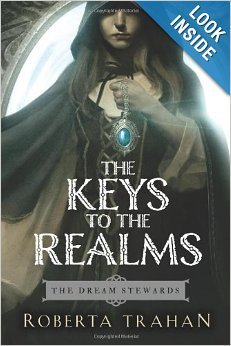
…this quasihistorical fantasy should appeal to fans of Celtic Mythology and Arthurian tales.” (Library Journal)


February 1, 2014
AFTERSHOCK is Shaking Things Up in the UK!
Great news! My recently released novella AFTERSHOCK is currently #1 in the UK (Science Fiction Short Stories)!!

If you follow my blog, you know that part of my earnings from the sale of each copy of AFTERSHOCK are donated to the Rutger Hauer Starfish Association. Every copy purchased contributes a little love to an important cause.
To learn more about the story, and the organization it benefits, read my release day post: Are You Ready for an Apocalypse?
AFTERSHOCK is available world wide. Just click the cover in the left hand sidebar to be taken to the Amazon buy page!


January 29, 2014
The History Behind the Fantasy ~ Hywel dda, the Ara Pacis, and a FB Party!
Hywel ap Cadell, the legendary king at the root of the mythology in The Dream Stewards series, was an intelligent, learned leader who modeled his leadership after the successful rulers of reference in his day. A pilgrimage to Rome in the early days of his reign is often credited as the point of inspiration behind Hywel’s greatest legacy – the codification of a written body of law that long survived him.
The reach of the Roman Empire was vast, and has naturally inspired and influenced the writing of many of my fellow history lovers. Author friend Stephanie Dray has invited me to help her celebrate the release of her new historical fantasy. DAUGHTERS OF THE NILE!
Join me and many other historical & fantasy authors for a full day of fun discussions, contests, and prizes!
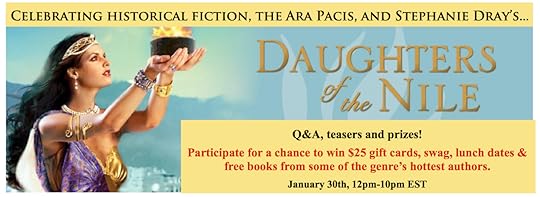
On January 30th, from 12pm EST to 10pm EST, an impressive roster of historical fiction authors and bloggers are hosting a Facebook party in honor of historical fiction, the 2,023rd anniversary of the Ara Pacis, and the release of Stephanie Dray’s newest book, Daughters of the Nile: A novel of Cleopatra’s Daughter.
Readers can win free books, lunch at the next Historical Novel Society meeting, swag, gift cards, and other prizes from some of the hottest authors of the genre. Please join us, and RSVP!


January 27, 2014
Guest Post ~ Urban Fantasy Author Melissa Olson
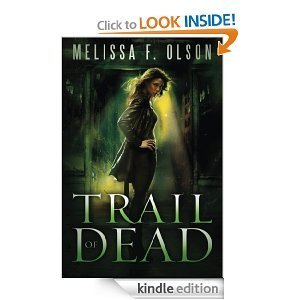
Greetings, readers of Roberta! A big thank-you to my host for letting me take over her blog today. I write urban fantasies about a young woman who has –and I’m quoting from the Amazon page here – “a rare ability to counteract the supernatural by instantly neutralizing spells and magical forces.” In other words, when a vampire or werewolf steps within range of her, they become human again until they move away. I call someone with this ability a null. Roberta asked me to share how I came up with this concept and built the system of magic in my novels.
I don’t know whether other fantasy writers come up with their worlds first and then 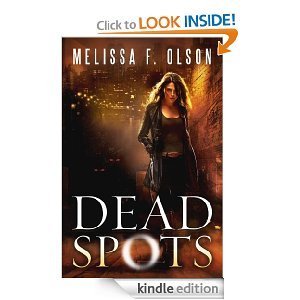 their protagonists, but for in my case, the null idea came first. It began with my interest in a few different things: crime scenes, how the supernatural could ever stay hidden in a modern world, and of course, the movie Hellboy 2. No, seriously. There’s a sequence in that film where the characters wear special goggles that let them see the supernatural, all the things that are usually hidden from human eyes. I was fascinated by the idea of someone who could see hidden things, and for a while I worked on a main character who was a crime scene photographer.
I played with the idea for ages, but whenever I got into all the real mythology questions, I kept running into problems. More importantly, the more I developed the character, the less I was able to connect with her. Runa was a little too squeaky-clean and cheerful for me to spend a whole book inside her head. I had hit a wall. Back to the drawing board.
 While I was researching crime scenes, however, there was another set of images that kept popping into my head: scenes from the short-lived 2007 television show Moonlight. Within that show’s mythology, whenever there was supernatural evidence, you could call a phone number and this group of uber-tough women would show up to clean it for you. As I remember them (granted, this was six years ago) those cleaners were classic screen badasses: black catsuits, leather, dangerously high ponytails, eyeliner to kill, the works. I thought they were a bit cartoonish, but I was very taken with the idea of the crime scene cleaner. Who were these women? I wondered. How did they get the gig cleaning up after other people’s messes? Why would they be invested in it? And why would they wear black leather catsuits?
I don’t remember the exact light bulb moment, but at some point it all came together for me. What if instead of seeing the supernatural, my protagonist undid it? And what if she used that odd skill set to clean up after the smarmy-ass vampires who ran around doing whatever they wanted?
And as soon as I put those ideas together, it was like a switch had flipped. Scarlett was born, fully-formed in my mind. She wasn’t a classic screen badass, or a cartoon, or cheerfully optimistic about life. She was moody and withdrawn and sarcastic. She was frozen in place, underappreciated, apathetic, and deeply, deeply noble. She had a lot of growing up to do, and more than anything, she needed someone to give her the chance to do it.
(Fun fact: I didn’t give up on Runa the crime scene photographer. I brought her back in book two as a romantic foil for Scarlett. She ended up having a much bigger part in the story than I’d first planned, and she’ll even make an appearance in book 3.)
But when I decided who Scarlett was, and what she could do, I was really just getting started. I still had to figure out the rules of the world around her, and guys, that is hard. Worldbuilding is hard. But I needed to work out how magic worked, and why nulls could undo it. I spent a long time considering where Scarlett’s powers might come from, and what would set my world apart from other urban fantasies. Then I had to make it all fit together in a way that made some kind of logical sense. (This process mostly involved explaining my ideas to my husband, who has a knack for immediately poking a hole in a plot problem. Then I’d try to fix that hole, take it back to him, and he’d poke another. Repeat.) Here are the rules that I eventually came up with for Scarlett’s universe:
1. There is no other place. No Never-never, no alternate dimensions, no Heaven or Hell. There is only here.
2. To that end, there are no angels or demons. They do not exist – or at least, they don’t exist any more than they do in reality.
3. Magic is everywhere; a component of nature, a force of life. It’s not exactly the same, but if I had to compare it to an existing mythology, the one that comes closest is probably The Force.
4. Because magic is a force (small letter f), it has interacted with and affected evolution for millions of years. Evolution in general is a huge part of my mythology. (There’s more about this in A Brief History of Magic, which you can find on my website.)
5. There is something wrong with magic. For the last few hundred years or so, it had begun to fade, to die. (I know why, but I’m not telling you. That’s a mystery for later.) Around the time that magic began to fade, nulls began to appear on the supernatural scene.
6. There is no ruling leader, group, or organization for the supernatural world, which I call the Old World in my books. Although we live in a digital age, the world of magic is still stuck in a mindset that’s similar to the one used for settling the American West: you stake out an area and try to hold it. You have your own rules for within that area, and your own way of doing things. The world is too big, and the supernatural is too secret, for global or even national leadership.
7. There is only one law that applies globally to all of the Old World: thou shall never tell humans about the Old World. Humans who find out have to be either killed or converted. Since there is now something wrong with magic, which makes it less likely for someone to be able to become a vampire or werewolf, this rule has occasionally been relaxed a tiny bit when a human is particularly useful – but only for whoever’s in charge of that region.
There are, of course, a hundred other details about how things work, but these were the laws that I started with when I began Dead Spots. And they’re working for me – after the third book, Hunter’s Trail (fall 2014), I’ll be writing another book set in Scarlett’s universe, but with a different protagonist. I hope she’ll be every bit as fun to write as Scarlett has been.
~~~
Melissa F. Olson was born and raised in Chippewa Falls, Wisconsin, and studied film and 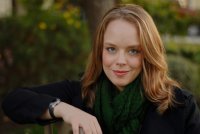 literature at the University of Southern California in Los Angeles. After graduation, and a brief stint bouncing around the Hollywood studio system, Melissa moved to Madison, Wisconsin, where she eventually acquired a master’s degree from the University of Wisconsin–Milwaukee, a husband, a mortgage, two kids, and two comically oversize dogs—not at all in that order. She is the author of Dead Spots, Trail of Dead, and the upcoming Hunter’s Trail.
To learn more about Melissa and her books, visit her website: http://www.MelissaFOlson.com


January 20, 2014
Exclusive Cover Reveal: THE KEYS TO THE REALMS (via The Qwillery)
Today our friends at The Qwillery are hosting the EXCLUSIVE Cover Reveal of my upcoming release – THE KEYS TO THE REALMS (Coming May 6, 2014)!!
Click the link to view the full cover design (front and back) by up and coming fantasy artist Mark Winters – and enter the giveaway for a Reader Comfort Kit including a signed copy of the first book in The Dream Stewards series, THE WELL OF TEARS .
EXCLUSIVE!! The Qwillery Cover Reveal: THE KEYS TO THE REALMS


January 13, 2014
3 Days Left – Enter to Win the AFTERSHOCK Survival Kit & Amazon Gift Card
 ONLY 3 DAYS LEFT to enter the AFTERSHOCKS Giveaway! Just visit my Facebook Fan Page and click on the Giveaway tab to learn how you can win the AFTERSHOCKS Survival Kit and Amazon Gift Card!
The kit includes a first aid kit, emergency blanket, clip on spot light, paracord compass key ring, an instant Latte and a $10 Amazon gift card!
Click the link to enter:
~~~
AFTERSHOCK
Imagine a seismic event of apocalyptic proportions – a natural disaster so devastating there is no point in planning for how to survive, only how to stay alive if you do survive. And then, imagine discovering that there is nothing at all natural about it…
“Roberta Trahan’s Aftershock is a little taste of post-apocalyptic perfection. Equal parts chilling, heartbreaking and suspenseful, it’s a total page-turner. A great read.” (Tara Bennett, best-selling author of Fringe: September’s Notebook and Lost Encyclopedia)
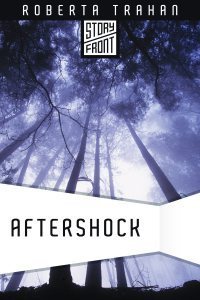
ONLY $.199

(for your Kindle, Tablet or eReader)


January 7, 2014
Are You Prepared for the Apocalypse? It’s An Aftershock After Party!
Welcome to the Official Release Day Celebration for my SF novella AFTERSHOCK!
For the next week we’ll be talking about earthquakes, global warming, apocalyptic events, and disaster preparedness. We’ll also be talking about the inspiration behind AFTERSHOCK, and another kind of natural disaster – HIV/Aids. Join the conversation, and don’t forget to enter the Aftershock Survival Kit Giveaway!
ABOUT THE STORY
Imagine a seismic event of apocalyptic proportions – a natural disaster so devastating there is no point in planning for how to survive, only how to stay alive if you do survive. And then, imagine discovering that there is nothing at all natural about it…
Stranded in an isolated mountain pass with a random band of travelers, climatologist Daria Black is a reluctant refugee in a harsh environment she no longer recognizes. The cataclysmic earthquake that shattered her family is also turning the lush Pacific Northwest into a desert.
With their surroundings growing more hostile by the minute and no way to call for help, the frantic survivors begin to clash over how to save themselves. Then Daria discovers the seismic event was not what it seems. Something else is reshaping their world.
Forced to confront her grief and guilt, Daria must find the will to fight. But first, she must decide who to follow, when to lead, and how to stay alive.

THE STORY BEHIND THE STORY
In 2001, the Nisqually Earthquake hit the Puget Sound region. My kids were in school, my husband was at work, and I was home alone. Writing. Though we escaped the experience with only minor damage, the emotional and psychological impact was major. Like most people, we had prepared for minor weather emergencies and power outages, but we had never considered what our needs might be if we were faced with a significant disaster.
In the days and weeks that followed, we learned a lot about earthquakes, fault lines, tectonic plates, and the impact of shallow tremors. The idea that an apocalyptic level seismic event could happen at any moment was new and hard to accept. My husband and I realized that how we thought about safety and security had to change – as did our entire community. The slogan “three days, three ways” became Seattle’s survival mantra. We prepared three ways to stay alive for three days – until help arrived.
We stocked a plastic garbage can with food, water, tarps, rope, and dozens of other supplies. We bought emergency backpacks for our vehicles and made a family plan for what to do if we were separated when disaster struck. Taking these steps helped ease the worries, but I needed to understand the threat looming over our heads.
Sometimes, however, ignorance really is bliss. I began to research the concept of liquefaction – the likely outcome of the 10.0 monster quake predicted to strike the Puget Sound region. What I discovered stunned and horrified me, and the only way I could process the fear the knowledge incited was to write it out. That anxiety-release exercise was essentially the first draft of AFTERSHOCK.
THE RUTGER HAUER STARFISH ASSOCIATION
Sometime later, I entered that early version of the story in a contest sponsored by SFF cult icon Rutger Hauer on his website. The ultimate intent of the contest was to gather a collection of stories for an anthology to benefit his beloved Starfish Association – a charitable organization he founded to raise global awareness of HIV/Aids, especially in pregnant women and children. While my story was not included in the anthology, I decided that if another opportunity arose to publish it, I would honor the original spirit behind it.
Currently, Mr. Hauer is actively working to encourage world governments and health organizations to classify HIV/Aids as a slow onset disaster. To support those efforts, 5% of the royalties I earn on every sale of AFTERSHOCK will be donated to Rutger Hauer’s Starfish Association.
To learn more about Starfish, and how your purchase will help, click on the tab at the top of the blog or click here .
THE GIVEAWAY
What’s a party without party favors? One lucky person will win an AFTERSHOCK Survival kit including everything you see in the photo below – plus a $10 Amazon gift card.
So tell me, are you prepared for an environmental apocalypse? If so, how?
Share your thoughts and ideas by commenting here, and then visit my Facebook Fan Page and enter the giveaway!


December 25, 2013


December 20, 2013
Hellequin for the Holidays
My 47North author friend Steve McHugh recently published a novella in his Hellequin Chronicles series. Just in time for the holiday gift giving. For the historical fantasy lover in your life (who already has MY book, of course), I give you Infamous Reign :

In late 15th century England, two young princes are given over by Merlin to the protection of their uncle, King Richard III. They soon vanish from sight, igniting tales of their demise at Richard’s hand and breeding unrest throughout the land.
Nathanial Garrett, also known as Hellequin, is sent to London to decipher fact from rumor and uncovers a plot to replace the king. But his investigation quickly becomes personal when he learns that an old nemesis is involved. He soon finds himself racing against time to rescue the boys before their fate, and the fate of all England, is sealed in blood.
Infamous Reign is a novella in the bestselling Hellequin Chronicles series, mixing gritty and action-packed historical fantasy with ancient mythology.
~~~
 Steve McHugh has been writing from an early age, his first completed story an English lesson. Unfortunately, he had to have a chat with the head of the year about the violent content and bad language. The follow up ‘One boy and his frog’ was less concerning to his teachers. A decade that he started work on his first publishable novel – the action-packed Urban Fantasy, Crimes Against Magic.
Steve lives in Southampton on the south coast of England with his wife and three young daughters. When not writing or spending time with his kids, he enjoys watching movies, reading books and comics, and playing video games.
Facebook: https://www.facebook.com/hellequinchronicles
Twitter: https://twitter.com/StevejMchugh
Website: http://stevejmchugh.wordpress.com/


December 7, 2013
My (Slightly) Schizophrenic Life – Guest Post by author Jason Sheehan
My name is Jason Sheehan and I am a science fiction writer. It hasn’t always been this way. I didn’t come to it by any normal path. And even to this day, actually saying out loud that I make up stories for a living is not an easy thing for me—mostly because of what I did before I became a professional nerd.
I’ve been an investigative journalist and a crime reporter. I covered the 2008 Democratic National Convention (mostly from the bars where the politicians and celebrities gathered after the day’s politicking was done) and almost lost a hand unwisely trying to feed a hippopotamus while reporting a story on the kitchen at the Denver zoo. I wanted to be a war correspondent like Michael Herr or Sebastian Junger, but ended up as a food writer, a restaurant critic and a food editor. I’m not complaining—getting paid to eat tacos for a living ain’t a bad way to make a buck—but the one thing that all of these things have in common is that they’re all journalism jobs. And journalists, first and foremost, are supposed to tell the truth.
And in my day job, I do. Always and without fail. But among journalists, admitting to writing fiction can be…weird. That you have it in you—the capability to tell a lie, to make up a quote, to write about a city being destroyed by giant robots which has not, in fact, been provably stomped flat by 100-foot-tall Kill-O-Bots (with cell phone video and on-the-record sources to back you up)—is, in some cases, taken as evidence of worse proclivities practiced in private. Admit it to the wrong old-school scribbler and they’ll look at you like you’ve just copped to being a serial masturbator or, worse, an untrustworthy voice. But the most common reaction is plain disbelief.
“How can you do it?” is the question I get asked most often when someone in the office puts two and two together and finally figures out that I really am the same Jason Sheehan putting out these widely unread books about robots and dinosaurs and spaceships. And what they really mean is, where do the stories come from? The people and their words? And how can you imagine things that aren’t really there?
Catch a journo in a talkative mood and, nearly to a man, they’ll tell you that the best thing about writing news stories is that it’s already all there—all the words, all the action, all the consequences. The job is not telling the story, but finding out the truth of what happened—the best and purest version of it. After that, it’s all just putting the words in the right order. The primary reason journalists don’t invent scenes or make up quotes is because it’s wrong, of course. Ethically and morally bankrupt in the worst kind of way. But the secret, secondary reason is that telling the truth is just easier. Get enough quotes from a source and the story is 80% written before you ever sit back down at your desk.
Anyway, writing about food, though a long walk from writing about crime or politics or other serious topics, is still journalism. And the reason I got into it (other than the obvious reason of having been a working chef for many years before I got my first writing job) is because writing about food really allows me to write about anything I want. With food as a frame or a lens, I can write about politics if the urge strikes me. I can easily write about crime. I can write about history and science and culture and hippopotamuses, all without going too far off the reservation. None of that is foreign to me. I can range wide, and often do.
But none of this really explains how
I ended up as the guy who can play by the rules in daylight, write honestly and forthrightly about foie gras and bourbon whiskey, and then, come nightfall, shed the guise of the mild-mannered food editor and get down to the dirty business of telling lies for money.
Is it that, as a boy, I fell hard for the pulp paperbacks that my dad used to keep on his bedside table? That I read some of the best and all of the worst science fiction of the 70′s and 80′s in a kind of fever because my dad was a big fan of ray guns and the local library and chose his reading material purely on the basis of the number of flaming spaceships, giant monsters and rock-jawed heroes displayed on the covers of the books he brought home? Absolutely. I caught the germ young and never shook it. That’s surely a part of it.
Is it that, as a young man, I started writing because I was lonely and then kept writing because I liked the worlds in my head better than the one I found myself in? Totally. I’m not sure there’s any writer out there who’d say different. My fiction predates my non-fiction by decades. I got a lot of practice on a lot of long nights and, later, used my black addiction to drown a couple other addictions I’d developed along the way, so that’s a piece of it, too.
But, strangely, I didn’t become serious about writing fiction until I became a journalist. My buddy Dave was a music writer in Denver. We were hired by the same paper around the same time and came up together. Neither of us had the credentials to be doing what we were doing professionally, so we both had a certain unease about our positions. He told me once that he kept himself sharp by reading everything but other music writers—lifting tricks and little bits of cleverness from sportswriters mostly, or national magazine pieces. Getting outside his own head and his own little world of rock shows and CD releases kept him sane and kept him fresh. Because I couldn’t stand reading most other food writers (we’re all a very precious and obsessive lot, and most days I can barely stand myself), I thought that was genius.
Around the same time, our boss—the paper’s editor-in-chief—admitted to me that she went home most nights and read “real literature” after a day of babysitting her flock of journos. She did it, she explained, to burn the gunk of journalism out of her head. To fill herself with beautiful words from the finest writers who ever lived to prove that not everything in the world was stories of city council elections and local weed busts.
This, too, seemed like wise counsel—a way to keep one’s self from getting bogged down in the mundane. And from those two pieces of disparate and sideways advice, I developed a habit of finishing my writing day with a bracing shot of the fantastic—of clearing out the pipes with something that was the dead opposite of what I did all day and getting as far outside my own head as I could by visiting other planets in my downtime.
Only instead of just reading science fiction, I wrote it. I considered it exercise. Staying strong against the daily grind of dinners and deadlines. When I scored my first book contract (for a memoir, of all things, about my life as a cook-turned-food-writer), I just added that to my plate. I’d work all day as a restaurant critic and editor, then turn to the book and then write about spaceships when everything else was said and done. Even if it was only a page or a paragraph, it was enough. It was a method for forcing myself to think orthogonally about words and voice and turns of phrase (which, to this day, makes me a better journalist and non-fiction writer), and a link back to the days when I would stay up all night reading Bradbury in my bed by the light of the streetlamp outside my bedroom window. When I read and wrote purely for the love of it, without any expectation of anyone but me ever inhabiting the worlds I was creating.
The first science fiction book I ever sold? It was the book I was writing, a paragraph at a time, while I was working on that memoir. It was the world I carried with me through Denver, to Seattle and, eventually, to Philadelphia—bouncing around the country, following the newspaper and magazine jobs wherever they took me and carving out an hour here and there for the breaking of rules and the telling of made-up stories. The second sci-fi book I sold came out of the same habit (and was mostly written while I was working on my second food book). And I’m sure the third will go the same way someday soon.
As it always has been, science fiction writing is my escape and my daily workout. It is my first love and my perfect retreat. I am a journalist by trade, but a liar by vocation. And as tough as it might be for some of my daylight colleagues to understand, I couldn’t do the one without the other.
∞
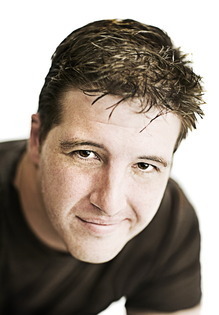 Jason Sheehan is a former dishwasher, fry cook, saucier, chef, restaurant critic, food editor, reporter, and porn store employee. As a young nerd, he fell hard for Star Wars, Doctor Who, William Gibson, Roger Zelazny and the spaceships-and-rayguns novels his father would leave on his bedside table. He dreamed of someday befriending a robot, stealing a spaceship and wandering off across the stars in search of alien ladies and high adventure. Since that hasn’t happened (yet…), he now writes about it instead–which is almost as good.