
Marc Weidenbaum's Blog, page 467
March 2, 2013
The Fate of a Drone in the Age of Drone Warfare (MP3)

With the slow but steady rise of public concern about the development and utilization of drones for military and police purposes, the rise of a form of music coincidentally called “drone” is, quite simply, small potatoes. I in no way would make a contrary case. All I would say on the matter is that the latter drone can help us comprehend the implications, especially at a psychic level, of the former.
Part of what makes the sonic drone, the music drone, trenchant is the manner in which it explores, inherently, the notion of pervasive technology, especially as pervasive technology becomes synonymous with invasive technology. Gordon Hempton, author of One Square Inch of Silence, has referred to such a buzz in the real world — the buzz of power lines, for example — as the “American mantra,” and it could be argued that for all his anxiety on the subject, he is underestimating its far broader geographic ubiquity.
Putting aside means by which the composition of drones might help us appreciate the cultural impact of the military drone, the parallel is especially disappointing for the simple reason that the music drone has been coming into its own, after decades of exploration, traced in western classical music at least as far back as Terry Riley’s 1965 work “In C,” but dating back far further at a cultural level, to the bagpipes of Scotland and the ragas of India and the throat singers of Tuva, among countless other practices.
A recent strong example of the aesthetic potential of the drone is “A Brief Reprieve from a Weary Heart,” a nine-minute piece composed by Darren Harper for the Sequence5 compilation. Very much in line with the understanding of ambient music as a genre, the piece can be heard both as background music and as foreground music. The drone, as a form, is arguably more succinct in that regard, in that it can be mistaken for, appreciated as, pure tone, or listened into for both vertical (overtone-laden) and horizontal (melodic) content. Harper’s is especially rich in the horizontal regard. It has the shape of a beautiful, reflective piece for orchestra, even if it sounds throughout like its raw materials are the sort of tonal wallpaper that makes hospitals and hotels feel insular and hermetic, even threatening in their own right. There is, as well, a touch of musical reference in the work, as the drone from which this music is formed sounds at times like two key drones in popular music: the held chord at the end of the Beatles’ “A Day in the Life” and the opening chord of Yes’ “Roundabout.”
Track originally posted for free download at soundcloud.com/darrenharper. Purchase the full Sequence5 album, all 42 tracks, at bandcamp.com. More from Harper at darrenjh.blogspot.com.
Drone image up top via wikimedia.org.


Past Week at Twitter.com/Disquiet
Yeah, I'll definitely be doing so. MT @Le_Berger: @disquiet Will you participate in this particular Junto? Would seem beffiting somehow. ->
So glad you made time. RT @ethanhein: New @djunto track: my audiobiography. http://t.co/LOatfBvobW ->
IRCAM should start a nightclub called IRCPM. ->
This made my morning, to be sure: RT @iIRCAM: @soundblog @disquiet :) ->
The single piece of computer equipment I have used the longest is the $99 CanoScan LiDE 600F scanner I bought in 2002. ->
Man, this past week's Person of Interest was something. I'm much more interested in parallel narratives than musical episodes. ->
Almost 40 musicians talk about themselves and their work: https://t.co/nmTVAhqFRo The 60th @djunto project. ->
Somehow it took 60 weeks, but I just posted my first track to the @djunto group: https://t.co/KCYrcHCJ6J ->
And you look up and an hour has gone by during which you have just been playing with nominally 5/4 beat patterns in DM1. ->
"the super-swively neck further enhances the power to sample the ambient soundscape" — Owl science at http://t.co/iFxgbnAjWj ->
Giving a guest talk this afternoon, on sound, to a class on writing for radio at the Academy of Art here in S.F. ->
Movie commentary tracks ripped to MP3 are my new jam. ->
Had foresight to set out my digital audio recorder four minutes in advance of the Tuesday noon siren in San Francisco. Uploading audio now. ->
lowercase numerals #ambientypography ->
em-elipsis #ambientypography ->
exhalation point #ambientypography ->
en-elipsis #ambientypography ->
air quote #ambientypography ->
demicolon #ambientypgraphy ->
Recording I made of the Tuesday noon siren in San Francisco: https://t.co/HUjYU68FHl ->
Nice. RT @taylordeupree: @disquiet implication-mark #ambientypography ->
After 3 weeks of deep-listening bootcamp, today in my course on sound in media landscape we begin with roots of music + commerce: the jingle ->
Definitely. When we get to product design. MT @matr77: @disquiet you doing a bit about Brian Eno's Windows 95 sound? http://t.co/QagxI5bRv4 ->
Dance remix of the San Francisco Tuesday siren I posted earlier: https://t.co/x26eOT231M. Thanks, @rawore! ->
This week's @djunto project will be based on @textinstagram. ->
textinstagr/am/bient ->
This week's @djunto is pretty straightforward but ended up with about 8 steps. It goes live shortly. Shortly means "after I eat lunch." ->
Okey doke, if you're on @AppDotNet, I'm now @disquiet over there, too. (Thanks, @qdot.) ->
In @djunto 61 we'll interpret random @textinstagram tweets as covers of singles: http://t.co/WFrQLliKhX + http://t.co/XjWrMj8rJr ->
Watching Zero Hour, but mostly looking forward to the @io9 post-mortem. ->
"For an auditory neuroscientist … reviewing this book was not unlike an arachnophobe reviewing a book about breeding spiders." ->
Previous tweet is @SethSHorowitz on @katherinebouton's new book on hearing loss: http://t.co/5Px0UrMbKi ->
The pointy hill was, for moments, visible through the thick mist that accompanied the transition from February to March, a sneak peak. #test ->
Obama's comment was a trial-balloon critique of JJ Abrams' unwieldy galactic power in advance of sci-fi franchise regulation. ->
Portable foghorn: http://t.co/qHQssBSLV8 ->
Instructions for portable foghorn: http://t.co/zyBjewRplo ->
There are 5.4+ million search returns on Google for "Hello would you mind letting me know which web host you're working with." ->
March 1, 2013
Stems: Buchla Doc, Mansell/Autechre Streams, Owl Predators
¶ Buchla Doc: Director Connie Field has launched a Kickstarter for a documentary on Don Buchla, a legendary figure in the development of the music synthesizer. Her colleague on the prospective documentary is editor Gregory Scharpen, who records as Thomas Carnacki.
More on the project at kickstarter.com and clarityfilms.org. They’re looking for an initial $25,000. Goal end date is Monday, April 15, at 1:15pm EDT.
¶ Designing Sound: Over at domusweb.it, Maria Cristina Didero talks with Domitilla Dardi, who along with Elisabetta Pisu curated “Disegnare Oggetti Sonori,” which translates “Designing Sound Objects,” an exhibit presented by Fondazione Musica per Roma and the IMF Foundation about the intersection of sound and design. Parallel to it was a Anna Cestelli Guidi–curated show by Zimoun.
Q: Can sound also be design? If so, how?
A: Sound is designed by sound designers but is also a phenomenon that guides many designers’ thinking. In the exhibition we have set up three approaches to sound design: that of Listening, through means conceived to transmit sound in absolute purity; Music, with instruments chosen for their experimentation with new ways of playing based on ergonomics, gestures and entertainment; and Sound Objects, everyday objects that associate a practical-utilitarian function, like an alert, background, or inspiration from the world of music.
This, part of the exhibit, is Leslie Borg* and **Anita Silva’s sensorial headphones, called “_scape” (2012):

¶ Birds of War: One of the tensions peculiar to reading about animal science is the underlying sense that the research, based in the field and enacted by individuals who generally appear to have a deep affection for their subject, is in fact at some level, perhaps discreet or perhaps quite obviously, funded by the military — that the study of life is, in fact, the study of death. This is, at a psychic level, something out of a story by Richard Powers (think of the corporate operations of Gain, or the computer science of Plowing the Dark). This sense permeates “The Owl Comes into Its Own”, a story by Natalie Angier in Monday’s edition of the New York Times. There’s much in the piece about the natural engineering of the owl’s wings, and what aeronautics can learn from them: “Researchers have traced that silent flight to several features. The bulk of the wing is broad and curved — the ideal shape for slow gliding — and is abundantly veined with velvety down plumage to help absorb sound.”
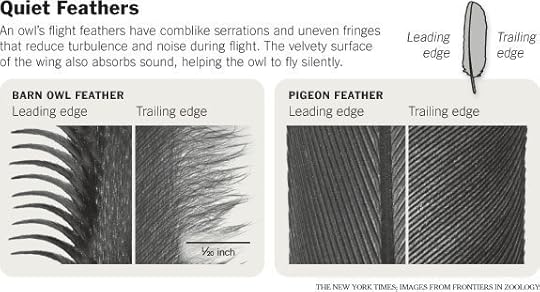
There’s also a fascinating moment when Angier plays an owl call from her phone and the owls respond: “I played the call again, the male grew bored, and I was about to put the phone away when suddenly the female — the larger of the two owls, as female birds of prey often are — pitched her body forward on her perch, lifted up her heavy, magnificent wings and belted out a full-throated retort to my recorded call.”
¶ In Brief: The entire score to Stoker, from director Park Chan-wook (Oldboy, Thirst), is streaming for free at blackbookmag.com. Get the full track listing at soundtracksonvinyl.com. The score is by the great Clint Mansell, best known for his work with Darren Aronofsky. The stream includes a new piano duet by Philip Glass, among a few other non-Mansell pieces. ¶ This weekend there are two streaming Autechre events in advance of the release, next week, of the duo’s Exai album. More info at mixlr.com. ¶ Just noticed that the productivity website 43folders.com has an Oblique Strategy in its footer. The current one reads “Honor thy error as a hidden intention” but they may rotate. Brian Eno as the new Stephen R. Covey. ¶ The 60th Disquiet Junto project closed this past Monday at 11:59pm, and we ended up just shy of 55 tracks; each features a different member of the Junto talking about his or her work. This Junto project was part of a larger SoundCloud audiobio project, more on which at blog.soundcloud.com. If you participate at SoundCloud, I strongly encourage you to join in the project. ¶ Impressively thorough overview of the score to Portal 2, the video game, at reddit.com. Also includes this solid response by the author to a snide commenter: “I understand, and am flattered when others choose to read this, I understand when others don’t. What I don’t understand is others taking time to tell me that they didn’t.” (Via twitter.com/dpnem.) ¶ Carl Stone links to Phnom Penh field recording he employs in his work: soundcloud.com/larbneur. File under “Cambodian Aerobics.” ¶ Via the increasingly excellent io9.com, “Yes, you can actually hear microwave pulses.”
February 28, 2013
Disquiet Junto Project 0061: Textinstagr/am/bient

Each Thursday at the Disquiet Junto group on Soundcloud.com a new compositional challenge is set before the group’s members, who then have just over four days to upload a track in response to the assignment. Membership in the Junto is open: just join and participate.
This assignment was made in the mid-afternoon, California time, on Thursday, February 28, with 11:59pm on the following Monday, March 4, 2013, as the deadline.
These are the instructions that went out to the group’s email list (at tinyletter.com/disquiet-junto):
Disquiet Junto Project 0061: Textinstagr/am/bient
This project requires a single die, or the digital equivalent.
Here are the steps in the project:
Step 1: Roll a die six times (or six dice once), add up the combined results, and then subtract five from it. Make note of the resulting number. If you don’t have access to a die, you can use various digital equivalents. This link, for example, will roll six dice simultaneously:
http://www.random.org/dice/?num=6
Step 2: Visit this Twitter account:
https://twitter.com/textinstagram
Step 3: Count the tweets of that account backwards from the most recent tweet at the time of your visit until you reach the tweet that coincides with the resulting number from step 1 above. Make note of this tweet, unless it begins with an @ sign. If the tweet begins with an @ sign, then use the next tweet (continuing down in reverse chronological order). If the next tweet also begins with an @ sign, then continue until coming to a tweet that doesn’t begin with an @ sign. This final tweet will serve as the title of the track you will soon begin composing and recording.
Step 4: Now, roll a die twice (or two dice once), add up the combined results, and then subtract one from it. Make note of the resulting number. This link will roll two dice simultaneously:
http://www.random.org/dice/?num=2
Step 5: Visit this web page and locate the list of Instagram filters:
Step 6: Count down the list of filters on that page until you come to the filter that coincides with the resulting number from step 4 above.
Step 7: Close your eyes and imagine a simple photograph that would be described with the tweet that is the title of your track, and that would have been treated with the filter that resulted from the step 6.
Step 8: Now imagine that the image from step 7 is the cover of your next single. Record a track of original ambient music that would be this single. It should be between one and two minutes in length, true to the postcard-like quality of Instagram — and, by extension, Textinstagram.
. . .
Background: This project is a low-key followup to the Instagr/am/bient compilation that I developed at the end of 2011, and that was in many ways the direct precursor of the Disquiet Junto. Various contributors to Insta/gr/ambient were among the initial participants in the Junto.
Deadline: Monday, March 4, 2013, at 11:59pm wherever you are.
Length: Your finished work should be between one and two minutes in length.
Information: Please when posting your track on SoundCloud, include a description of your process in planning, composing, and recording it. This description is an essential element of the communicative process inherent in the Disquiet Junto.
Title/Tag: When adding your track to the Disquiet Junto group on Soundcloud.com, please include the term “disquiet0061-textinstagrambient” in the title of your track, and as a tag for your track.
Download: Consider setting your track in a manner that allows for attributed, commerce-free remixing (i.e., a Creative Commons license permitting non-commercial sharing with attribution).
Linking: When posting the track, be sure to include this information:
More on this 61st Disquiet Junto project at:
http://disquiet.com/2013/02/28/disqui...
More details on the Disquiet Junto at:
http://soundcloud.com/groups/disquiet...
February 27, 2013
The Bounty of the Cricket (MP3)
The moon is gibbous. We know this because Phillip Wilkerson tells us so. He tells us in the process of titling an elegant, two-and-a-half-minute recording he made of droning crickets. The track is “Crickets Beneath a Waxing Gibbous Moon,” and it is one of Wilkerson’s ongoing and regular documents of his physical world, or more to the point the sonic components of that physical space. As with any sonic document, it is a part of a whole: the mechanical ear of the recording device focused on an aspect of a moment, that framing moment defined by the ear of the recording artist. Here the crickets are a chorus in the form of a cycle, these bright, microsonic chirps heard both as near-distance percussion and, in dense combination, a deep, far away, underlying drone. The illusion is to perceive this as either/or, when in fact there is, of course, a gradation in between, one that is difficult to locate, but well worth focusing on.
Track originally posted for free download at soundcloud.com/phillipwilkerson. More from Wilkerson, who is based in Florida, at phillipwilkerson.com and phillipwilkerson.tumblr.com. Image of moon phases courtesy of wikipedia.org.
February 26, 2013
Ecstatic Glaswegian Industrial Drone (MP3)
The sheer interminable white noise drone that is “A Soul with No Footprint” sounds like a massive factory at work, a factory in which the work is that of several hundred machines, each machine shaving some hard metal down to a fine point, sparks flying in controlled abandon, a grid of these spark clusters separated in rows and columns along the shop floor, all of it heard from above by a maintenance engineer caught up in the beauty of the chaos while navigating a catwalk to change out a rouge bulb. The track is one of two off a recent EP of the same name by Elizabeth Veldon, who’s based in Glasgow, Scotland. The full EP is available at “name your price” over at elizabethveldon.bandcamp.com, the second piece, “Folk Music as a Parasitic Infection,” exploring similarly ecstatic territory.
Track originally posted for free download at soundcloud.com/elizabethveldon. More from Veldon at twitter.com/elizabethveldon.
February 25, 2013
The Urban Stream (MP3)
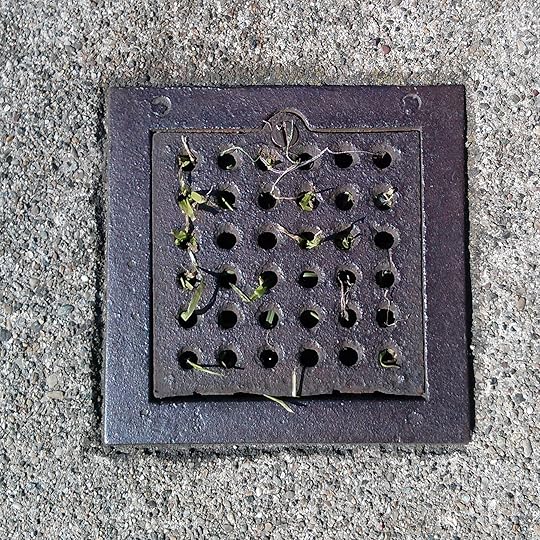
Sometimes quiet sounds are the most jarring, such as hearing what could be a stream while walking down a particularly cement-lined and almost entirely tree-less street in a large city. It’s a sunny winter Friday in San Francisco, not far from the ocean. There’s a strong wind, and passing planes and cars, and yet the sound is there, for certain, the sound of a small stream. Of course, it isn’t a stream, not in the general sense. It’s a drain, whose holes let the passing water echo above. A struggling bit of microfoliage, tiny weeds making their way to the sunlight, confirm the liquid below.
Track originally posted for free download at soundcloud.com/disquiet. Track recorded on my Nexus 4 cell phone using Easy Voice Recorder Pro on Friday, February 22.
February 24, 2013
Stems: Listening to Carruth, Mansell, and The New Republic
¶ Primer Directive: The complete score of Shane Carruth’s film Upstream Color is streaming for free, 15 tracks in total. Extended stretches of the film are devoid of dialog, and the natural sound and music, along with the visuals, are left to do the storytelling. As Jascha Hoffman tweeted shortly after seeing the film at its Sundance debut, “Shane Carruth’s Upstream Color : plot // William Basinski’s tape loops : song form.”
¶ Stoked About Stoker: “At the beginning of Stoker, India Stoker (Mia Wasikowska) tells us she can hear things more clearly than most people, a talent that is quickly apparent seeing as every noise and sound in India’s life is amplified.” That’s from the opening of Allison Loring’s appreciation of the sound design and score of the new Park Chan-Wook film, with music by Clint Mansell as well as a song from Emily Wells and a new piano piece by Philip Glass — at filmschoolrejects.com.
¶ URL Earmarks: This is pretty intriguing. The recent redesign of the website of The New Republic (newrepublic.com) includes a button that will read out loud the text on the page. Like buttons for Twitter and Facebook, for email and “save to PDF,” this is almost certainly going to be a UI/UX norm. So far, however, per this screenshot, it seems largely to be “coming soon”:

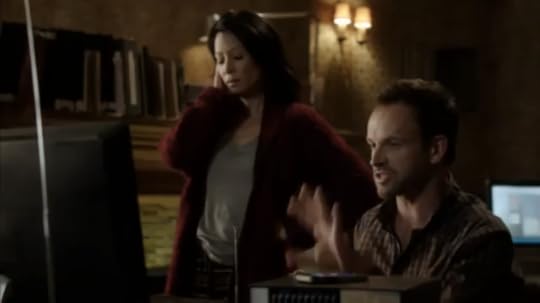
¶ In Brief: “Lost within the act of listening, I give attention to that which is often ignored: the high-pitched silence of a winter day; the whir of a movie projector displaying a silent film; the cavernous echo inside a museum. ” That’s from the latest post at the blog Phonomnesis, by John Kannenberg, sound artist and founder of the Stasisfield netlabel. ¶ Ethan Hein has posted a six-slide presentation about the extent to which rhythm is a cultural construct. That he is a new father is clearly an impetus for his exploration: slideshare.net. ¶ “Too loud? Sorry. I went downstairs to get some cereal. Didn’t want to miss anything. The city has excellent scanner apps but, um, there’s nothing like the tactility of the original devices, all those dials and buttons.” That’s Sherlock Holmes, as played by Jonny Lee Miller, in episode six (“Flight Risk”) of the first season of Elementary. The scene is on youtube.com:
¶ Many thanks to Peggy Nelson of hilobrow.com for having highlighted the Disquiet Junto’s end-of-2012 audio journal project. ¶ A tour of Matmos’ studio at xlr8r.com. ¶ List (at indiewire.com) of tips from top-rank sound designers has broad applications. Among the tips: “Decide if sound or music should do the heavy lifting in every scene” and “Too many sonic elements can be confusing.”
Synth/World Hybrid (MP3)
“Sweetened Air,” by Specta Ciera, is an appropriate title for a piece that appears to mix field recordings and synthesized sound in near equal amounts. One can hear the artificial tonal material as an additive to the raw, everyday sounds. Glistening, shimmering tones mix in with the rattle and whir of what seem to be passing cars and the light rustle of life. One can consider the “artificial” material just that, an artificial sweetener, as it were — or perhaps as something else entirely: the less natural-sounding material could be field recordings of a more fantastic sort, not immediately identifiable, and thus all the more evocative.
Track originally posted for free download at soundcloud.com/specta_ciera. More from Specta Ciera, aka Devin Underwood, at spectaciera.com.
February 23, 2013
Remains of the Data (MP3)
When in doubt, simply take stock of available resources. That, in essence, was the modus operandi that Mike 88 undertook when compiling “Leftovers,” a moody, downtempo set of plumbing clanks, ambiguous voices, and a drone-like melodic element. He describes the material as “all from random leftover samples from the recent tracks,” those being other pieces posted to his soundcloud.com/mike-88 account. This means the piece works both as its own standalone listening experience, and as an anecdotal complement to other Mike 88 tracks of late. The sharing of raw and willfully undercooked materials on SoundCloud remains one of its distinctions, evidence of the in-progress intimacy that sets the communal tone for communication between musicians and their listeners.
Track originally posted for free download at soundcloud.com/mike-88. More from Mike 88, of Minneapolis, Minnesota, at twitter.com/dayton_mike.


