
Marc Weidenbaum's Blog, page 466
March 8, 2013
Form Letter
On any given weekday, my inbox contains 100 or so new emails before I wake up, and I get up early, around 6am, California time. By the end of the day, when I go to sleep, usually around midnight, if I haven’t managed to delete any emails, my inbox will easily have 400 in it.
This is the current stage of the form letter template that I occasionally send out in reply to queries for coverage of a particular band, album, song, video, sound app, gallery exhibit, and so forth:
Hi. I don’t reply much to PR correspondence, even directly from musicians/coders/artists.
There’s simply too much of it, often as many as 400 emails per weekday.
The best way for me to state the situation is as follows: I receive an enormous number of inquiries for me to write about music/sound, and I listen to — I consume/absorb — as much as I can without doing what I’m paying attention to the disservice of being too casual about it. I then write about what I find interesting. And I write about something I find interesting every day, often more than once per day.
Important note: I pretty much focus my writing on “technologically mediated sound” — ambient music, sound art, sound design, sound in the media landscape, experimental classical, hip-hop production, that sorta thing. And I write very little about what would traditionally be considered a “song.”
Feel free to send me email (with any related materials, such as MP3 files, as links, not as attachments). Just please don’t take it personally, or even read into it any reflection of my (dis)interest, if and when I don’t respond.
And yes, this is a form letter, as is 99% of the PR I receive.
Best,
Marc


Cues: Glass House, Lucier’s Audiobiography, Prelinger’s Manifesto, …
¶ Glass House Music: Via NPR, video of Julianna Barwick performing a haunting layering of her vocals at the famed Glass House of Philip Johnson in New Canaan, Connecticut:
The conjunction of her music and this place brings to mind the influence of transparent residences on John Cage’s conception of sound. This is from his book Silence:
“The glass houses of Mies van der Rohe reflect their environment, presenting to the eye images of clouds, trees, or grass, according to the situation. And while looking at the constructions in the wire of the sculptor Richard Lippold, it is inevitable that one will see other things, and people too, if they happen to be there at the same time, through the network of wires. There is no such thing as an empty space or an empty time. There is always something to see, something to hear. In fact, try as we may to make a silence, we cannot.”"
¶ Talking Book: In a review of Alvin Lucier’ book Music 109 (Wesleyan) at lareviewofbooks.org, Dave Mandl gets to the heart of the document — that it is more history than musicology, and more personal history than history: “What exactly determined the set of people and compositions Lucier chose to discuss in his book — or, for that matter, in his lectures? … The most likely answer is also rather mundane: Lucier probably chose this particular group because it’s the circle of people he happens to have been involved with.” Not, to suggest, that there’s anything wrong with that.
¶ Borrower Be: Rick Prelinger’s essay “On the Virtues of Preexisting Material” is essential reading, especially for folks interested in the conceptual framework of the Creative Commons. This is the outline of his self-described “manifesto”:
Why add to the population of orphaned works?
Don’t presume that new work improves on old
Honor our ancestors by recycling their wisdom
The ideology of originality is arrogant and wasteful
Dregs are the sweetest drink
And leftovers were spared for a reason
Actors don’t get a fair shake the first time around, let’s give them another
The pleasure of recognition warms us on cold nights and cools us in hot summers
We approach the future by typically roundabout means
We hope the future is listening, and the past hopes we are too
What’s gone is irretrievable, but might also predict the future
Access to what’s already happened is cheaper than access to what’s happening now
Archives are justified by use
Make a quilt not an advertisement
It’s at contentsmagazine.com.
¶ Sine Table: This is the workbench of someone developing sine waves for musical use:
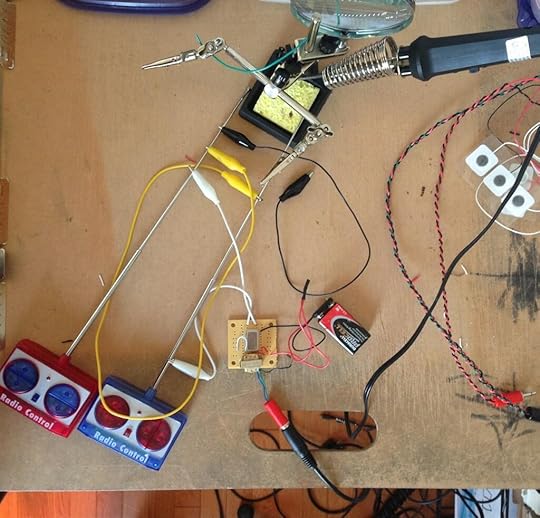
It was posted by Jeff Kolar as evidence of his work on the current, 62nd Disquiet Junto project. On a simpler note, if you’re participating in the project, making music from sine waves, this browser-based oscillator may be of use: onlinetonegenerator.com, as recommeded by Karl Fousek (karlfousek.com).
In Brief: ¶ The February compilation of Creative Commons music from the nx series includes a dozen tracks from the 59th Disquiet Junto project, “Vowel Choral Drone: musicnumbers.wordpress.com. It was compiled by Miquel Parera of Barcelona, Spain, who is at twitter.com/computerneix. (Hat tip to Larry Johnson (soundcloud.com/l-a-j-1).) ¶ Got word this morning that the Stephan Mathieu project at indiegogo.com was officially fully funded. ¶ The firm Arup, whose ambisonic activity has been a subject here, has further expanded its acoustics endeavors with the integration of the firm Artec (artecconsultants.com, arup.com). ¶ Both the Saturday and Sunday Autechre live sets from last weekend are still streaming as archival recordings at mixlr.com/autechre. ¶ Rob Walker, good friend and the organizer of the apexart exhibit that hosted Disquiet Junto music last year, has taken a new gig as a news columnist at Yahoo! (news: mediabistro.com). In his first column he lays out why the whys and hows of gadget-land are more deserving of focus than the whats — that is, than the gadgets themselves: “I won’t be doing is joining the race to post images of and quote press releases for the latest gizmo. To me, what’s really interesting about technology isn’t technology—it’s what people choose to do with technology, for better and for worse.” ¶ This section had been called “Stems,” for the partitions in the contemporary electronically mediated recording process. Before that it was called “Tangents.” Now it is called “Cues.”
John Parish Cue
The title of John Parish’s forthcoming compilation album, Screenplay, has various meanings. A collection of music he has written for the screen, it toys with industry terminology. By borrowing the language of the narrative and applying it to the score, he is staking a claim for the role music plays in film, the extent to which it has its own story to tell. By bringing together cues from several films, rather than releasing the full scores of any of them, the album is exploring the extent to which music for films has any life beyond the films themselves, beyond matters of narrative. The films included on Screenplay are Nowhere Man, Plein Sud, Sister (aka L’enfant d’en Haut), and Little Black Spiders. The last of these has had its end credits made available for free download, courtesy of the Screenplay record label, Thrill Jockey. It’s a stylish mini-suite, opening with looped vocals whose evident seams make the results sound more like notes played on a keyboard than sung by a choir. In time, strings and other instruments kick in, all with the studio ingenuity and slow-burn drama that Parish has brought to his work with PJ Harvey, Sparklehorse, and others in the past.
Track originally posted for free download at soundcloud.com/thrilljockey. More details on the album at thrilljockey.com and johnparish.com.
Here is a trailer for Little Black Spiders, featuring different music:
March 7, 2013
Disquiet Junto Project 0062: Life of Sine

Each Thursday at the Disquiet Junto group on Soundcloud.com a new compositional challenge is set before the group’s members, who then have just over four days to upload a track in response to the assignment. Membership in the Junto is open: just join and participate.
This assignment was made in the mid-afternoon, California time, on Thursday, February 28, with 11:59pm on the following Monday, March 11, 2013, as the deadline.
These are the instructions that went out to the group’s email list (at tinyletter.com/disquiet-junto):
Disquiet Junto Project 0062: Life of Sine
This week’s project involves making music from the basic building block of sound: the sine wave.
You will compose and record a piece of music using just three different sine waves, and nothing else — well, nothing else in terms of source material, but the waves can, after the piece has gotten underway, be transformed by any means you choose.
These are the steps:
Step 1: Devise which three sine waves you will employ. They should be different from each other in some evident way.
Step 2: The track should open with just one of the sine waves.
Step 3: Add the second sine wave at 5 seconds.
Step 4: Add the third sine wave at 10 seconds.
Step 4: Only at 15 seconds should you begin to in any way manipulate any of the source waves.
Deadline: Monday, March 11, 2013, at 11:59pm wherever you are.
Length: Your finished work should be between 1 and 4 minutes in length.
Information: Please when posting your track on SoundCloud, include a description of your process in planning, composing, and recording it. This description is an essential element of the communicative process inherent in the Disquiet Junto.
Title/Tag: When adding your track to the Disquiet Junto group on Soundcloud.com, please include the term “disquiet0062-lifeofsine” in the title of your track, and as a tag for your track.
Download: Consider setting your track in a manner that allows for attributed, commerce-free remixing (i.e., a Creative Commons license permitting non-commercial sharing with attribution).
Linking: When posting the track, be sure to include this information:
More on this 60th Disquiet Junto project at:
http://disquiet.com/2013/03/07/disqui...
More details on the Disquiet Junto at:
http://soundcloud.com/groups/disquiet...
Image via wikimedia.org.
March 6, 2013
Urban Reverberation (MP3)

There are various sorts of answer songs. There is, for example, the classic mode, in which someone picks up the mic to respond to a previous taunt or otherwise opposing view. Then there is the remix, which stakes a claim for psychological ownership of the source material. And then there is the correlative track, when someone posts a pre-existing bit of audio as a means of commenting on something. The latter category is where to file Guy Birkin’s “Urban Reverberation,” which he posted as a welcome reply to my recording of the Tuesday noon siren in San Francisco. It is a stellar example of repetition being a form of change, as the sound of the alarm alters ever so slightly with each pulse.
He writes, in part, of the track:
After initially being annoyed by this very loud noise, I noticed small fluctuations in its timbre and especially in the reverberations off the rows of terraced houses on the street. I recorded it to capture these effects, because I am interested in the ways in which sound is altered by travelling through the air and by reverberation from the surroundings. … Notice the way in which different aspects of the sound stand out at different times – sometimes following the beat of one tone, then the other, or focusing on the attack of the notes or the initial echo, both of which keep changing. What at first might appear to be very repetitive and dull turns out to reveal interesting variation through its repetition.
Track originally posted for free download at soundcloud.com/notl. More from Birkin, who lives in Nottingham, England, at twitter.com/guybirkin.
Stems: Android Eggs, Tape Loops, Martinez/Skrillex/Korine

¶ Android Music: There is a heap of Easter Eggs hidden in the holding page for the upcoming Google I/O developers’ conference, at which various Android subjects will be unveiled. These Easter Eggs are accessed by clicking the I and O on the page to yield various results. For example, clicking 10001000 yields a wave generator, as pictured above, and 11011011 yields a touch-based music toy. This being Google, there are Easter Eggs within the Easter Eggs — that is, the binary code isn’t entirely random. For example 10000001 yields a game of pong, the sense being that the 1 on either end symbolizes a paddle. It’s not immediately clear what the meaning of the two music-related codes is. (Found via the helpful comments on the post at theverge.com.)

¶ Tape Ops: The Dutch musician Wouter van Veldhoven has posted remarkable footage of old-school tape machines deployed to make minimal techno music:
More on van Veldhoven at woutervanveldhoven.nl. Found via laughingsquid.com. Hat tip to Max La Rivière-Hedrick of engine43.org.
¶ Spring Drop: The score to Spring Breakers, the new film by Harmony Korine (Kids, Gummo), was largely composed by Skrillex and Cliff Martinez, often working together. The pairing is certainly interesting, since it is fair to say that Skrillex, the showboating EDM figure, and Martinez, the composer of subtle scores to such films as Solaris and Traffic, represent polar extremes along the continuum that is contemporary electronic music. Almost the entire Spring Breakers soundtrack album is streaming is currently at pitchfork.com. Of the album’s 19 tracks, all but 5 feature either Skrillex or Martinez. Three are collaborations, 7 are Skrillex solo pieces (one a remix), and 4 are Martinez solo pieces. The album comes out March 18 on Big Beat/Atlantic Records, and the movie on March 22. The Pitchfork stream includes all but two of the tracks (numbers 8 and 19 in the list below). The movie stars James Franco, Selena Gomez, Vanessa Hudgens, Ashley Benson, and Rachel Korine. More on the film at springbreakersfilm.com. Here’s the track listing:
“Scary Monsters and Nice Sprites” – Skrillex
“Rise And Shine Little B***h” – Music by Cliff Martinez & Skrillex
“Pretend It’s A Video Game” – Cliff Martinez
“With You, Friends (Long Drive)” – Skrillex
“Hangin’ With Da Dopeboys” – Dangeruss with James Franco
“Bikinis & Big Booties Y’all” – Music by Cliff Martinez & Skrillex
“Never Gonna Get This P***y” – Cliff Martinez
“Goin’ In (Skrillex Goin’ Down Remix)” – Birdy Nam Nam
“F**k This Industry” – Waka Flocka Flame
“Smell This Money (Original Mix)” – Skrillex
“Park Smoke” – Skrillex
“Young N****s” – Gucci Mane (feat. Waka Flocka Flame)
“Your Friends Ain’t Gonna Leave With You” – Cliff Martinez
“Ride Home” – Skrillex
“Big Bank” – Meek Mill, Pill, Torch & Rick Ross (feat. French Montana)
“Son Of Scary Monsters” – Music by Cliff Martinez & Skrillex
Big ‘Ol Scardy Pants – Cliff Martinez
Scary Monsters on Strings – Music by Skrillex
Lights – Ellie Goulding
March 5, 2013
Outdoor Public Warning System (San Francisco, CA)

Every Tuesday at noon the Outdoor Public Warning System (OPWS) rings out around San Francisco. It has two stages. First there is a siren. Second there is a spoken announcement: “This is a test. This is a test of the outdoor warning system. This is only a test.”
As of October 2012, there are 111 speakers set up throughout San Francisco to broadcast the message. The majority have the message in English, but there are 2 in Cantonese and English and 17 in Spanish and English. See the above image for a map of the OPWS speakers.
Because of the city’s famously hilly terrain, as well as the speed at which sound travels, and the apparently inexact timing of the system’s triggers, the sirens and announcement can often be heard to overlap, creating an artificial echo effect in addition to the actual echo. Also, because it rings at noon, the sound of the warning often overlays with another form of announcement: the bells of churches and other institutions.
I made this recording on Tuesday, February 26, 2013, in the backyard of my home in the Richmond District of San Francisco. This was an especially clear day. It was made on an H4n, recorded directly to a WAV file. At five of the hour I placed the H4n in the backyard and set it to record. Only after the announcement had fully trailed off and been replaced by the bird song and church bells did I approach the H4n and turn it off. Then I trimmed the length of the recording to focus on the runtime of the OPWS.
And has happens occasionally in the wonderful world that is SoundCloud.com, someone shortly after the posting of the recording made their own remix of it. This is by rawore, aka Bob Phillips of Portland, Oregon:
More on the OPWS system at the website of the City and County of San Francisco Department of Emergency Management: sfdem.org.
Track originally posted for free download at soundcloud.com/disquiet.
Stems: Autechre Crowd, Reich/Radiohead, Sonic UI/UX
¶ Exai Excel: Just beautiful, this shared Google doc in which the trainspotting crowd collectively identifies the tracks that appeared in Autechre’s two free live streaming events on mixlr.com/autechre earlier this weekend, via twitter.com/pauladaunt. Autechre’s latest album, Exai, was released in digital form at the start of February and will appear in physical form this coming week. Here’s a detail of the tracklist document, which at this stage is unsurprisingly unwieldy to navigate, but still worth parsing for its line items and interesting segues, such as moving from the radio rock of Steve Miller Band to electronica of Seefeel:

¶ Reich Head: At classicfm.com, Max Richter, who expertly reworked Vivaldi’s “Four Seasons” this past year, interviews Steve Reich about reworking Radiohead. The audio is less than eight minutes long, and well worth a listen. They cover how Reich came to Radiohead’s music, what he did with/to it (“A lot of people will say, ‘Well, where’s Radiohead?’”), and the broader means by which other music has made its way into his work. It’s only the third time that Reich has consciously reworked another composer’s music, the two previous being Pérotin and Stephen Sondheim, though as Richter says, “A lot of music as well as what it purports to be about is also about other music.” One thing they do not touch on that would have been good to hear about is Reich’s take on remixes of his own work, of which there have been many. Reich’s re-use of Radiohead is titled “Radio Rewrite” and it will be premiered March 5 in London by the London Sinfonietta. The work was co-commissioned by the London Sinfonietta and Alarm Will Sound. The U.S. premiere will occur at Stanford on March 16.
¶ Fit to Hear: Just to follow up on the New Republic’s inclusion of an audio version of articles in its website redesign, there’s increasing evidence of Slate.com having audio editions of its stories that originate as text pieces. The project has not taken root in the site’s formal navigation sidebar, which includes things like a single-page version, a print version, and so forth, but take a look at the page for a recent write-up Hugh Howey’s novel Wool and you’ll see a prominent SoundCloud embeddable player in which someone reads the article.
¶ In Brief: The announcement by Yahoo CEO Marissa Mayer that ended work-from-home has been getting a lot of attention, but I’m more interested in her criticism of Yahoo’s on-hold music, which she reportedly called “garbage”: sfist.com. ¶ More than slightly off topic, but I reviewed the new Wayne Hancock album, Ride (Bloodshot), for the Colorado Springs Independent: csindy.com. It’s easily his strongest record since his 1995 debut, Thunderstorms and Neon Signs. This isn’t as off topic as it may seem, because Hancock, a yodel-friendly country blues singer, is a prime example of how matters of genre and modernity get all mixed up, and how hard it is to innovate, or develop one’s own voice, in a form not just predicated on but posited in the past. As I say in the review, “Ride is so old-school it feels downright groundbreaking.” ¶ If you’re in New York and have the cash, the venerable institution the Kitchen is holding its spring gala in honor of Brian Eno. It takes place May 7: thekitchen.org. ¶ The 61st Disquiet Junto project ended last night at 11:59pm, and ended up with 45 contributors, for over an hour and a half of music. The theme was a riff on — a follow-up to — the Instagr/am/bient compilation of sonic postcards from late 2011. This time around, rather than using Instagram images as source material for ambient tracks, the participants used tweets from the great @textinstagram Twitter account, such as “branches against a colorful background,” “a rusty old door,” and “warped picture through a glass.”
March 4, 2013
The Waiting Room (MP3)

The waiting room at the doctor’s office is self-enclosed. It contains a handful of chairs and is lit by two large windows, their blinds tucked just below a high, generically tiled ceiling. No one else is in the room. A tiny speaker sits on the windowsill, nearly a dozen stories up from the busy city street. The speaker emits barely perceptible music, a tinny whimper of sodden melodicism, as if the Whoville Pops is being overheard. What the speaker itself fails to do service to is further muffled by the incessant drone of the building’s ancient HVAC system, and the whole resulting thick ether of white noise is punctuated by the thuddish tic of an unseen clock.
In the audio recording made on a cellphone, the noise-like elements are greatly emphasized. They are far more prevalent and evident than they had been in person. It is as if the texture of the open road, so uniform when seen through the windshield of a fast-moving car, has been cast in high relief.
Track recorded on my Nexus 4 cell phone using Easy Voice Recorder Pro on Friday, March 1.
Image via pixabay.com.
March 3, 2013
An Italian Drone (MP3)
Following up on yesterday’s beautiful drone by Darren Harper, here is another that builds a slow and singularly beautiful melodic exploration from what is, for stretches, easily mistakable for pure background tone. It’s “Elektra” by Dr. Guilty, and that so-to-speak mistake is, in fact, a willful intent, as “Elektra” ekes its sonic transitions precisely from, and within, the sort of acoustic ephemera that is so pervasive as to become virtually inaudible. It moves from prayer-bowl ripples to knife-blade glistens to near-choral density, occasionally making steep crescendos both up and down, yet never losing the sense of something hovering slightly above and beyond conscious perception.
Track posted for free download at soundcloud.com/dr-guilty. Dr. Guilty is Gabriele Quartero of Biella, Italy, more from whom at bandcamp.com.


