
Marc Weidenbaum's Blog, page 455
June 7, 2013
Extraordinary Feedback Kalimba Drone Raga (MP3)

Highly recommended, easily one of my favorite things I have posted in months. This “Feedback Raga” is an intense, Fourth World rhythmic drone created on a makeshift thumb piano, or kalimba. The device was made by RP Collier of Portland, Oregon. By his own explanation, the thumb piano is “made from a metal clamshell box with hairpin tines attached to a flat metal dish resonator,” the dish acting “like a feedback antenna.” A piezo microphone transforms the notes into dense, overtone rich columns of noise, and the feedback bends notes into one another and develops this overwhelming undercurrent of electric activity — an undercurrent of current. The picture above is from Collier’s flickr.com set.
Track originally posted for free download at soundcloud.com/rpcollier. More of Collier’s music at rpcollier.bandcamp.com. Collier sent me the links via email earlier this week, right after I had posted the Alarm Will Sound rendition of composer Asha Srinivasan’s chamber orchestra ragas.


June 6, 2013
Disquiet Junto Project 0075: 18-Second Vine Suite

Each Thursday at the Disquiet Junto group on Soundcloud.com a new compositional challenge is set before the group’s members, who then have just over four days to upload a track in response to the assignment. Membership in the Junto is open: just join and participate.
This assignment was made in the evening, California time, on Thursday, June 6, 2013, with 11:59pm on the following Monday, June 10, as the deadline.
Below are the instructions that went out to the group’s email list (at tinyletter.com/disquiet-junto).
Disquiet Junto Project 0075: 18-Second Vine Suite
This project is about the experimental use of a casual mobile app to compose, perform, and record music. This marks the 75th weekly Disquiet Junto project, and it is the second Junto project to focus on a mobile app. Last time the app was NodeBeat, for the 20th weekly project. This time it is Vine (available for free via the URL vine.co), which is available for many if not all Android and iOS devices. The hope is that if you do not have such a device you might borrow one from someone.
Vine allows users to create and share six-second loops of audio-video. The extent to which that audio and video can be manipulated is largely determined by the stop-motion-like start-and-stop system Vine employs; it allows you to pause the recording, adjust the camera, and then continue the recording process.
For this project, you will create three six-second Vine videos, for a total of 18 seconds, resulting in a Vine suite. Each movement will be based on a specified sound source and a specified approach to the stop-and-start edits.
Step 1: The audio-video source for the first movement is water running steadily from a faucet. Record the sound and image of the water and tap your device’s screen at a relatively slow, even pace, roughly 70 BPM. Feel free to have other sounds playing off camera, or to have items in the sink that might make noise as a result of the flow of water. Do this for the full six seconds. When you are done, you will have completed the first of your three Vine videos. Tag it as #vinejunto and #disquietjunto, along with any other tags you’d like, before posting.
Step 2: The second movement will be much more quickly paced. There are two audio-video sources, which you will alternate between, at roughly twice the pace of the video from Step 1. Start with an image of something that rotates and makes sound — a bicycle wheel may be your best bet — and alternate with an image of something static, like a picture of a face in a comic strip, while you make a low droning noise with your voice. Feel free to “prepare” the rotating object, as you see fit, in a manner that might influence the sound it makes. Do this back and forth until you have completed the six seconds. Tag it as #vinejunto and #disquietjunto, along with any other tags you’d like, before posting.
Step 3: The audio-video source for the third movement is whatever is going on outside a window. Divide the track up into six even sections. The first section should be a wide view out your window. The five subsequent sections should try to focus the center of the camera on one object. The sound is whatever happens to be going on outside your window, though you should avoid recording conversation. There should be no additional sounds beyond what is happening out the window. Tag it as #vinejunto and #disquietjunto, along with any other tags you’d like, before posting.
Step 4: Record the audio from the three videos and create one single 18-second track. Upload this to your SoundCloud.com account.
Deadline: Monday, June 10, 2013, at 11:59pm wherever you are.
Length: Your track should have a duration of 18 seconds.
Information: Please when posting your track on SoundCloud, include a description of your process in planning, composing, and recording it. This description is an essential element of the communicative process inherent in the Disquiet Junto.
Title/Tag: Include the term “disquiet0075-vinesuite” in the title of your track, and as a tag for your track.
Download: Please consider employing a license that allows for attributed, commerce-free remixing (i.e., a Creative Commons license permitting non-commercial sharing with attribution).
Linking: When posting the track, be sure to include this information:
More on this 75th Disquiet Junto project, in which a three-part audio-video suite is created in the app Vine, at:
http://disquiet.com/2013/06/06/disqui...
More on the Vine app at:
More details on the Disquiet Junto at:
http://soundcloud.com/groups/disquiet...
More on Disquiet.com at HeroesCon
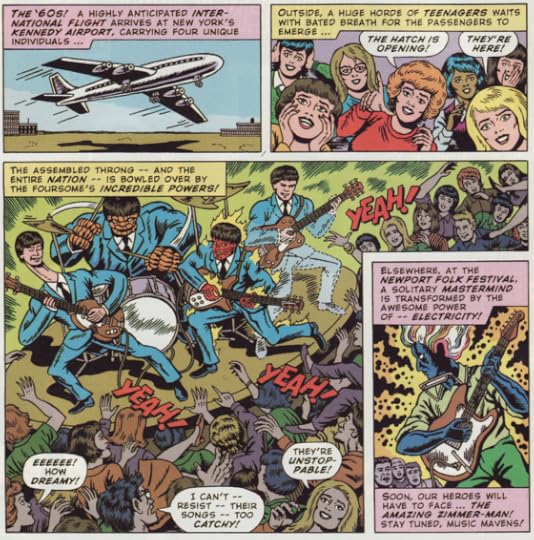
Major thanks to Craig Fischer and Ben Towle for spending some time this coming weekend during their Saturday, June 8, HeroesCon panel discussion on music and comics to talk about some of my work. I’m honored by the attention, especially because Fischer is drawing connections between my Pulse! comics editing and the current weekly Disquiet Junto projects. They were interviewed today by Tom Spurgeon of comicsreporter.com.
SPURGEON: Tell me a little about choosing Marc Weidenbaum as a subject, and what you feel is important people know about Marc. He was such a big figure for a while because of the high-profile PULSE! gig, but I’m not sure we’re not exactly at that point in history where that’s forgotten a bit but hasn’t been pulled out and re-examined yet.
FISCHER: Yeah, Marc’s legacy as a PULSE! editor is formidable: he got people like Jessica Abel, Carol Swain, Jon Lewis, Jason Lutes, Peter Kuper, John Porcellino, Keith Knight, Dave Cooper, Tony Millionaire and so many others to do those great back-page “Flipside” comics on musical topics. Justin Green’s Musical Legends book (2004) is terrific, maybe my favorite Green work after Binky Brown.
Marc also gave a lot of younger alt-cartoonists their first opportunity in a national venue; Marc commissioned PULSE! work from Adrian Tomine after seeing the earliest self-published issues of Optic Nerve.
As much as I respect Marc’s PULSE! tenure, though, I’m going to spend as much if not more time in my presentation talking about Marc’s Disquiet website, and the ways his activities and commentaries on ambient, electronic and experimental music intersect with comics. One of Marc’s “Disquiet Junto” projects, for example, encouraged musicians to “do a sonic version” of the first strip (the template strip) in Matt Madden’s 99 Ways to Tell a Story. As part of our panel, we’ll stage a “performan
More on Fischer and Towle’s panel here: “Disquiet.com at HeroesCon.” The above comic, by R. Sikoryak, appeared in Pulse! magazine, where I edited the comics from 1992 through 2002, in the October 2001 issue.
June 5, 2013
Orchestrated Ragas (MP3)
Alarm Will Sound follows, as do So Percussion and Eighth Blackbird, among other economically proportioned ensembles, along the admirable path that Kronos Quartet helped pave, in that it actively engages with composers to produce new works. Alarm Will Sound frequently posts the resulting audio, such as a series of pieces that had their live debuts at the Mizzou New Music Summer Festival, part of the new music initiative at the University School of Music. Most recent among these is a 2012 performance of a piece by Asha Srinivasan. Composed for chamber orchestra, the work, titled “Svara-lila,” builds drama and portent out of Indian ragas.
The performance was recorded on July 28 of last year. Srinivasan is an Assistant Professor of Music at Lawrence University in Appleton, Wisconsin. She writes of “Svara-Lila”:
The title, composed of two Sanskrit words, “svara” meaning musical note and “lila” loosely meaning play, refers to methods of manipulation of an 8-note pitch collection, which is derived from a conflation of two closely related Indian modes (ragas). More than just notes in a scale, a raga traditionally evokes strong emotions and moods. The exceedingly lovely and expressive ragas used to form my pitch collection are generally associated with sadness and longing. Thus, the piece begins with an expansive, slow progression of dissonant harmonic sonorities that explore various intervallic relationships within the pitch collection. Simultaneously, the top notes of the progression form the basis of a recurring modal theme that guides the entire structure of the piece. As the slow and dramatic growth unfolds, the modal nature of the pitch collection is gradually revealed through increasingly active melodic and rhythmic gestures. The piece remains harmonically driven to the very end when the previously unresolved main theme returns in full force only to have its final resolution undermined by achingly conflicting sonorities whose colliding dissonances linger in the air to the last moment, denying the much anticipated release.
That description comes from the website she shares with her composer husband, Andrew Seager Cole, twocomposers.org. Among the subjects Srinivasan teaches is electronic music, and if you look through the “works” section of the site you’ll be treated to samples of numerous works that employ a mix of standard orchestral instrumentation in addition to electronics, as well as an experiment with SuperCollider, among them a kickstarter.com tuba project that surpassed its $5,500 goal thanks to an impressive 113 backers.
Track originally posted for free download at soundcloud.com/alarm-will-sound. More from Alarm Will Sound at alarmwillsound.com.
June 4, 2013
Ambient, Beats, or Both?
The invocation of categories immediately brings those very same categories into question. To build a wall is to question, to test, its solidity. Just this morning I turned on three categorized sets — “carousels,” I called them; fluid, iterative podcasts is how I think of them. The general concept of these carousels is that as I come across material of interest on SoundCloud, I can easily add a given track to one of the three distinct sets, each with its own theme: ambient, beats, and “other,” the latter a space for more concentration-demanding listening.
And then, just hours later, I stumbled upon a track, “The Digged Up Loop,” by a musician I’ve never heard work from before, Duns Scott. By Scott’s own self-definition, “The Digged Up Loop” goes into the ambient bucket; “ambient” is one of the tags he’s associated with the file. But as lush and hazy as the track is, it is rife with rhythmic material, rounds of pulsing tones that come and go in a series of gentle swells. On first listen, this was going into the ambient carousel, but then, on repeat listens, the beats came more and more into the foreground. In the end, of course, it doesn’t matter where the track goes. The filter for the carousels is less a matter of rigorous genre taxonomy than of context-through-collation: where does the droning Duns Scott track make natural, aesthetic sense? The beats may, with their light counterpoint, bring to mind the rhythmic experiments of Steve Reich, but in the end their collective effect simply adds texture and momentum to the overall droning sensibility. And so, I added it to the ambient carousel — thought quite likely down the road I will come upon tracks that make sense in two if not all three of these carousels.
Track originally posted for free download at soundcloud.com/kanada-3. More from Duns Scott, who’s based in France, at dunsscott.tumblr.com.
Toward the 200th Anniversary of the Metronome
[image error]
More on this as the date nears, but on July 6, 2013, in and near Regensburg, Germany, a series of works will be debuted by artist, and frequent Disquiet.com collaborator, Paolo Salvagione. (Boon Design is handling the graphics aspect of the effort.) Three Salvagione projects will take place, and I’ve written an essay for each of them — the essays will appear here on Disquiet.com in the near future:
(1) There will be the start of a campaign to have Johann Nepomuk Mäzel, who perfected the metronome in 1815, inducted into the Walhalla, the Parthenon-like memorial to Germanic accomplishment.
(2) There will be a performance of György Ligeti’s 1965 “Poème Symphonique” for 100 metronomes.
(3) There will be an installation in the Walhalla that acknowledges the wives, husbands, and other significant others of the tinkerers, warriors, artists, and royalty who posthumously populate the building. (List of Walhalla residents at wikipedia.org).
There will also be a metronome-themed Disquiet Junto project the Thursday following the Regensburg event. More on Salvagione and Boon Design at salvagione.com and boondesign.com.
Introducing Disquiet Carousels
I have set up three sets of tracks on my SoundCloud.com account. These are places for me to bookmark for public consumption, for shared listening, tracks of other people’s music that I come upon in my regular SoundCloud listening. The experiment is sort of a cross between the “social bookmarking” of delicio.us and the “music discovery” of last.fm.
Each of these three sets is focused on a different listening experience. There is one that is broadly defined as “ambient,” there is one that features music comprised of “beats” (think instrumental hip-hop and minimal techno), and there is an “other” category, which is a mix of outward-bound contemporary classical, sound installations, and various experiments that don’t fit into the other two categories. The first two are intended to serve as background listening, while the third is anything but. I’ve labeled them all as “carousels.” There is the Ambient Carousel, the Beats Carousel, and the Other Carousel. They’ve each launched with about an hour of music, and I will, as time passes, remove some tracks from them and add other tracks.
I tried for some time to think of a playful term for these collections: stream, channel, zone, station, feed. Eventually I did what many sane people might, which is I posed the question to Twitter, Facebook, and app.net: “What’s a good term for a collection of rotating related tracks?” Among various responses, a Twitter interlocutor suggested “pinwheel,” which made me think of “carousel” — more the carousel that old-school slide projectors employed, not so much the carousels with the painted ponies going up and down. “Carousel,” more than any other term, seemed to get at what I was trying to get at: a format in which there was no strict, formal list of constituent parts, but in which things change as time progresses. I thought of art history professors in those pre-PowerPoint/Keynote days, their carousels of examples of paintings slowly changing from one semester to the next, one exemplary Bruegel exchanged for another, a Longo replacing a Basquiat, only for Basquiat to later on make a quiet return.
This iterative listening format became attractive to me when, over the past few months, I was working to focus on releasing a regular podcast associated with Disquiet.com. (Major thanks, by the way, to Boon Design for having developed the three carousel logos, which are based on a logo Boon put together for the yet-to-be-launched podcast.) A funny thing happened on the way to the podcast. The podcast is still in the works, but in the process of considering what would constitute a solid podcast — a mix of music and sound, some commentary, a framing context, theme music, graphic identity, infrastructure for delivery and archiving — I spent a lot of time thinking about listening to music amid music. Because that is, ultimately, what distinguishes a Disquiet podcast from writing about music at Disquiet.com: how on a podcast places a track in the context of other tracks. This “carousel” approach exists somewhere between the radio broadcast (ephemeral, with an ever-shifting mix of core and temporary track rotations) and the podcast (fixed, variable in length), with a fair bit of my dissatisfaction with the inherent one-track limit of ThisIsMyJam.com thrown in. The idea of a “set” has long been part of the SoundCloud offering, but only recently has it been the case that someone can create sets that include music other than one’s own. These sets also give me a format to focus attention on streaming-only audio, since the daily Downstream entries on Disquiet.com (which increasingly feature SoundCloud-hosted music) by definition only focus on freely (freely and legally, that is) downloadable music.
I remain interested in the podcast, and plan to launch it in the next month or so, but a podcast still strikes me as being a straightforward digital version of a pre-recorded radio broadcast — much like how a “netlabel” is, ultimately, a record label without the physical product. These “carousels” seem, in contrast, like a useful step forward, much as the collaborative efforts of the Disquiet Junto have been, in part, an attempt to nudge forward the idea of a record label.
Anyhow, the three carousels are live for anyone interested in listening: Ambient Carousel, Beats Carousel, Other Carousel.
June 3, 2013
Disquiet.com at HeroesCon
I’m excited to announce that this coming Saturday, June 7, at the HeroesCon comics convention in Charlotte, North Carolina, a panel discussion about the intersection of comics and music will include a presentation about various projects of mine. (I will not be present. I’ll be at home in San Francisco.)
The “Mega Music Panel” is titled “And Brainiac on Xylophone: On the Intersection(s) of Comics and Music.” Panelist Craig Fischer will be discussing my decade of comics editing (1992 – 2002) at Pulse! magazine (where I commissioned original work by Jessica Abel, Justin Green, Megan Kelso, Barry McGee, Carol Swain, Adrian Tomine, and many others), the “Sketches of Sound” series I published on Disquiet.com from April 2010 through December 2011 (featuring Brian Biggs, Leela Corman, Dylan Horrocks, Minty Lewis, and Darko Macan, among others), and most recently the April 2012 Disquiet Junto project that was drawn, so to speak, from Matt Madden’s experimental comics book 99 Ways to Tell a Story: Exercises in Style. Also due for a mention, apparently, is an essay (“Home Recording in the Age of Mechanical Reproduction” that I wrote for Frank Santoro’s magazine Destroy All Comics back in 1996. There’s an index on this site of all the Pulse! comics I edited. (Not likely to be dived into during the HeroesCon panel is my half decade at the manga magazine Shonen Jump, where I was editor-in-chief, as well as at its sibling magazine Shojo Beat; I was a vice president at Viz Media, their publisher.)
Fischer, a professor in the English department at Appalachian State University, writes the “Monster Eats Critics” column at The Comics Journal (tcj.com). This is the official description of the HeroesCon panel:
Comics and music share a lot of affinities—both depend heavily on rhythm and intervals, and many cartoonists are also musicians—and cartoonist Ben Towle and blogger Craig Fischer have organized a diverse smorgasbord of a panel to explore these affinities. Ben will discuss the many ways cartoonists represent music visually, and will chair a wide-ranging panel on comics and music with Peter Bagge (Hate, Yeah!), Ed Piskor (Hip-Hop Family Tree), Andrew Robinson and Vivek J. Tiwary (The Fifth Beatle). Craig will talk about the work of Marc Weidenbaum, an editor, teacher and musician who’s been combining comics and music in his creative projects for over two decades. And Charlotte avant-duo Ghost Trees (Brent Bagwell on saxophone, Seth Nanaa on drums) will participate in two live comics/music performances, including a soundtrack for Joe Lambert’s “Turtle, Keep It Steady,” a rock-n-roll retelling of the Tortoise-Hare fable!
More on the panel at heroesonline.com.
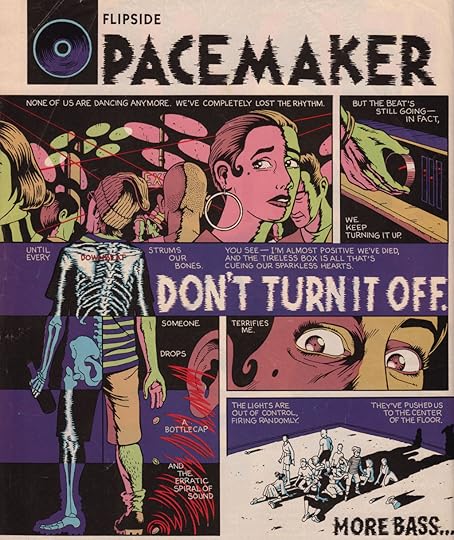
The image up top is one of my favorites from the Pulse! run, It’s a 1993 collaboration between Jon Lewis (True Swamp) and Jason Lutes (Berlin). More on the piece at Lewis’ website.
Four Summer Moods (MP3s)
Natalia Kamia goes by Kamikuma on her SoundCloud account. She has been posting a series there that she has called “summer moods” collectively. There have been four of these “moods” so far, numbered in succession: “Summer mood 1″ through “Summer mood 3,” plus the fourth with an additional provocation: “Very dark summer mood 4.” Each has at its core a specific source material, and each plays in a percussive space that is neither drone nor rhythm nor melody, but something entirely other. “Summer mood 1″ is made from “toy flute, industrial synth,” the gestural melodic material intermingling with ringing tones and shuddery noises. “Summer mood 2″ has another toy in its toolbox, a toy piano, in addition to field recordings of a garbage truck and “trash percussion processed”; the result is deeply sublimated, the sound of nocturnal activity. “Summer mood 3″ again has the gestural sensibility of recorded motion, an abused toy piano and more “trash percussion” at work. And as for the “very dark” “summer mood 4″, it is dark in intent, not tone, so quiet and remote that it sounds almost desperately frigid: summery, perhaps not, but most certainly a mood.
Tracks originally posted for free download at soundcloud.com/kamikuma. More from Kamia, who was born in Russia and is based in Gothenburg, Sweden, at nataliakamia.blogspot.com.
June 2, 2013
Karl Fousek v Karl Fousek (MP3)
The only thing better than an unexpected remix is one that occurs in such quick order that it happens while the mental echo of the source material is still in the process of receding, still remnant in the mind’s ear. Just two days ago here, focus was aimed at a bit of generative sound experimentation by Karl Fousek. The track, “cicada.pch,” was a short bit of light percussion, self-produced as the result of a project of Fousek’s. It turned out to be generative in more ways than that, because in turn it inspired “Small Sounds [Remix of Karl Fousek (analogue01)]” by Larry Johnson, who took material from “cicada.pch” and added in complementary sounds also produced by Fousek, namely the more slow-paced, ethereal “Musicbox Tape Drone”. This is the result:
Johnson’s reworking originally posted at soundcloud.com/l-a-j-1.


