
Marc Weidenbaum's Blog, page 448
August 8, 2013
The Hauntology of Daily Life (at Medium.com)

I am taking a bit of a midsummer rest here at Disquiet.com. There will be occasional posts throughout August, especially on Thursdays, when new Disquiet Junto projects go live.
Which is not to say I’m not busy. I just posted my first piece at the Medium.com service. It is titled “The Hauntology of Daily Life.” It is about China Miéville being stuck on a loop in my backyard, and how sounds can be rooted in place, and how memories are made.
This is the full text:
“The Hauntology of Daily Life”
Or, why China Miéville has, for years, been stuck in my backyard retelling the same story
A certain new, wifi-less café is situated across the street from a certain longtime dry cleaner in my neighborhood. I know this because I went to the dry cleaner to deal belatedly with some food-stained sweaters, and noticed the relative proximity as I made my approach by foot. I knew the café was somewhere around there, but had not yet connected that the two businesses were so close to one another. Needing to next head to a café to accomplish some work, I decided on this nearby one, despite having never entered it before, rather than my regular café, which is several blocks further down the road.
I made this decision while the dry cleaner’s proprietor, wearing his standard short white gloves of the thinnest imaginable cotton fabric, registered my drop-off by ticking away at his countertop touchscreen computer with the eraser of a long yellow pencil that has never been, and will never be, anywhere near a pencil sharpener. The tick of his touchscreen has a specific sound, a tight punch of a signal, that I associate solely with this dry cleaner. I do not visit the dry cleaner often, but when I do, I look forward to the touchscreen tick just as much as I do to the idea that my sweaters might soon have fewer spots on them.
Having deposited the sweaters and retrieved a yellow receipt so bright in color that it is impossible to lose in even the most overburdened wallet, I headed to the new café for two reasons: I had been meaning to check it out, and walking the additional handful or so of blocks to my regular café felt more like procrastination than exercise. As it turned out, the new café’s strident lack of Internet connectivity helped nudge me along during the current stage of a particular project, and I will almost certainly return there in the near future, even if all my sweaters are clean.
Next time I need to go to the café, I will know exactly where it is, just as I know that another café that I frequent is across the street — one block closer to the Pacific ocean — from a dim sum place I eat lunch at frequently, and just as I know that a favorite Vietnamese restaurant is on the same block as the movie theater that is closest to my home. I could not tell you the cross streets of any of these businesses, but I know where they all are in relation to each other. That is how memories are cemented. At least that is how my brain makes memories, through context, correlation, proximity.
And through incidence. There are different types of proximity, and though the word suggests physical nearness, there is also simply chance incident. On the way to the dim sum restaurant, there is a spot where I think about feathers, because a dead bird was left there for several weeks, and for weeks after its carcass had disappeared, individual feathers fluttered in the bushes and grass.
Key for my memory is sound, certain parallels between physical places and the sounds that I associate with them.
I do not think of alarms when I walk past the neighborhood fire station, but I do think about the crying in a nursery ward. This is because of a sign on the firehouse door that announces the place as a safe haven for unwanted newborns. The sign shows a child sleeping in a pair of hands, yet I cannot walk by that firehouse without the helpless calls of infants ringing in my mind’s ears.
There is a stretch of road between Pasadena and Glendale where I will always hear the rhythmic threadbare minimal techno of Monolake’s album Cinemascope, even if Led Zeppelin is blasting on the radio,even if I am deep in conversation on the phone or with a fellow passenger, even if the windows are open and letting in the sirens of passing police cars, all of which has happened. More than a decade ago, on a visit to the Los Angeles area, I blasted a CD of that album in a rental car after a long day of meetings, on my way to visit a friend across town, and though I have never again sat in that particular car, and I have long since parted ways with that employer, and my physical copy of the Monolake album is buried in a box in my closet, the music still hovers on the highway, waiting for me to trigger it simply by driving through it.
And I cannot step into a particular corner of my home’s small backyard without having the novelist China Miéville tell me a story — more specifically, tell me a particular part of a story. For at some point, many years ago, I struggled in that spot with a heavy ration of weeds, and while I pulled at the weeds, tried to separate them from the ground without leaving their crepuscular roots intact, a recording of Miéville reading from one of his stories played through the headphones attached to my MP3 player. I was fixed in that spot long enough for the story to take root. It is as if the story lingers there, set on a loop on an invisible jukebox, and I can access it if I get just inside a specific zone of the yard.
The piece also resides at medium.com.


August 4, 2013
American Soil (MP3)
One of the best reasons to read foreign news sources is to get a sense of the world beyond one’s own borders — by which is meant both the official lines of geographic demarcation, and the manner in which cultural norms lead to a self-selected understanding of reality, of life. To read about, say, the Grand Canyon in a Swedish newspaper’s travel section is to have a very different view of it than from, say, Sunset magazine, which considers the national monument to be part of its backyard. This sense of perspective is as true of everyday objects and events as it is of national treasures. And it is true of the news, as when the field recording catalog that is the great Touch Radio podcast series, which is based out of Britain, adds a recording of protests in Hollywood, all chanting and helicopter whirs and drumming and honking and, still, some birdsong (MP3).
Download audio file (Radio97.mp3)
Track originally posted for free download at touchradio.org.uk.
August 2, 2013
Sound of Sound of Art (MP3)
Rampant drumming. Cavernous echo. Murmuring crowd. Determined footsteps. Rising voices. Security pings. Hushed commentary. These are the things a museum is made of — or at least its sound environment. The audio comes courtesy of John Kannenberg, a musician and sound artist who often takes the space in which art is displayed as his starting point.
He describes the recording as follows:
This 3-minute teaser contains sounds recorded in June and July of 2013 as source material for my in-progress composition “A Sound Map of the Art Institute of Chicago.”
The best — or at least most remarkably well-timed — moment is when what appears to be a docent can be overheard describing synesthesia, how one can hear colors and smell sensation, and so on. Little did she know her spoken words would take on a new, unintended artistic purpose, themselves transformed from commentary on art to an artful commentary on commentary on art.
Track originally posted at soundcloud.com/johnkannenberg. More from Kannenberg at johnkannenberg.com.
August 1, 2013
Disquiet Junto Project 0083: R#d#ct#d

Each Thursday at the Disquiet Junto group on Soundcloud.com a new compositional challenge is set before the group’s members, who then have just over four days to upload a track in response to the assignment. Membership in the Junto is open: just join and participate.
This assignment was made in the evening, California time, on Thursday, August 1, with 11:59pm on the following Monday, August 5, 2013, as the deadline.
These are the instructions that went out to the group’s email list (at tinyletter.com/disquiet-junto):
Disquiet Junto Project 0083: R#d#ct#d
This week’s project is an open-ended exploration of surveillance and graphic notation.
The page at the following URL is the score that you will perform:
You can use any instrumentation you choose, just no source audio for which you cannot yourself claim ownership or fair use.
Background: The image is page 8 of recently declassified documents related to NSA collection of telephone metadata records.
Deadline: Monday, August 5, 2013, at 11:59pm wherever you are.
Length: Your track should have a duration of between two and five minutes.
Information: Please when posting your track on SoundCloud, include a description of your process in planning, composing, and recording it. This description is an essential element of the communicative process inherent in the Disquiet Junto.
Title/Tag: Include the term “disquiet0083-redacted” in the title of your track, and as a tag for your track.
Download: Please consider employing a license that allows for attributed, commerce-free remixing (i.e., a Creative Commons license permitting non-commercial sharing with attribution).
Linking: When posting the track, be sure to include this information:
More on this 83rd Disquiet Junto project, in which a page from recently declassified documents related to NSA collection of telephone metadata records is treated as a graphically notated score, at:
http://disquiet.com/2013/08/01/disqui...
Image found via twitter.com/shearm and twitter.com/glennf.
Full document at:
More details on the Disquiet Junto at:
http://soundcloud.com/groups/disquiet...
July 31, 2013
Listening Versus Paying Attention (MP3)
The second in the monthly Ora podcast/broadcast by Daniela Cascella and Salomé Voegelin has been posted online. Cascella (author of En Abime: Listening, Reading, Writing) and Voegelin (author of Listening to Noise and Silence: towards a Philosophy of Sound Art) discuss topics ranging from Pauline Oliveros’ Deep Listening to the sound-sensitive films of director Andrei Tarkovsky, but what distinguishes it isn’t so much the variety of subjects as the heavily nuanced conversation. Cascella and Voegelin prod each other from each question and observation to the next, digging into minute distinctions, and drawing from literature and personal experience even more than from recorded sound. One particularly interesting aspect of this entry is how they upend the commonly held distinction between hearing and listening. Traditionally it is understood that to hear is simply to be aware of sound, while to listen is to pay attention. What Cascella and Voegelin work to in their discussion is how since the act of listening involves a personal engagement with the material, that in turn means that it involves invoked associations, ruminations, considerations, invocations — and, thus, listening is far more than a matter of paying attention. If anything, to listen is to not pay attention, but to disappear into one’s own internal codex of meaning and memory (MP3).
Download audio file (ora2_17-07-13.mp3)
Track originally posted for free download at ora2013. The show was originally broadcast on July 25 on Resonance FM. More on Cascella at danielacascella.com and at salomevoegelin.net.
July 30, 2013
Sublimated Shoegazing
Another thick mass of deeply sublimated tape noise has emanated from the
excellent soundcloud.com/turmericmagnitudes account, based in San Francisco. The 10-plus–minute “Black Thread – Crude Shrine” (Black Thread being the act, “Crude Shrine” the song) sounds like someone is playing a My Bloody Valentine album that’s been recorded at half speed over and over on the same cassette until it makes Alvin Lucier’s “I Am Sitting in a Room” seem like an audiophile’s stereo-system dynamic-range test track by comparison. The whorl of deeply punished pop melodicism increases as it proceeds, until what could very well be a rough wave carries it out to sea.
Track originally posted for free download at soundcloud.com/turmericmagnitudes. More from Black Thread at soundcloud.com/blackthread.
July 29, 2013
Everything Medleys with the Night (MP3)
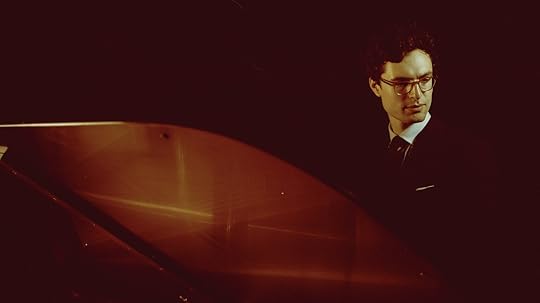
Timo Andres’ album Home Stretch, due out tomorrow, July 30, includes variations on work by Wolfgang Amadeus Mozart and Brian Peter George St. John le Baptiste de la Salle Eno, as well as the fully original composition from which the release takes its name. A live recording from 2010 of the Eno piece, titled “Paraphrase on Themes of Brian Eno,” is available for free download at Andres’ site (MP3), performed by the Metropolis Ensemble, conducted by Andrew Cyr. The composer describes it as “a 19th-century style ‘orchestral paraphrase’ on the subject of Eno’s music, focusing on the albums Before and After Science and Another Green World, with some Apollo by means of an introduction.”
Download audio file (eno_paraphrase.mp3)
The full album is streaming for free this week at npr.org, from whom the above photos is borrowed. The performance was recorded at Angel Orensanz Center in May 2010. More on Andres at andres.com. More on the album at nonesuch.com. More on the Metropolis Ensemble at metropolisensemble.org.
July 26, 2013
Filtered in a Modular Way (MP3)
Imitation isn’t the sincerest form of flattery. The sincerest form of flattery is taking several tracks by someone and putting them through enough modular-synth filtration that they come out sounding like mere sonic sediment, whisps of flittery noise, sine waves heard as shadows of themselves, digital vapor hanging in the still air. At least that’s what Shadowselves (aka Medford, Massachusetts–based Michael T. Bullock) has done with/to work by Pataphor (aka Shannon Smith).
Track originally posted for free download at soundcloud.com/mikebullock.
July 25, 2013
Disquiet Junto Project 0082: Minimal Haydn

Each Thursday at the Disquiet Junto group on Soundcloud.com a new compositional challenge is set before the group’s members, who then have just over four days to upload a track in response to the assignment. Membership in the Junto is open: just join and participate.
This assignment was made in the evening, California time, on Thursday, July 25, with 11:59pm on the following Monday, July 29, 2013, as the deadline.
These are the instructions that went out to the group’s email list (at tinyletter.com/disquiet-junto):
Disquiet Junto Project 0082: Minimal Haydn
This week’s project is another in a series of explorations of the concept of genre as a constraint. (The “downtempo” exercise went well several weeks ago, project 79, and this is another in that mode.) The genre this time is “minimal techno.” The source material is from another genre entirely: “classical,” specifically chamber music in the form of a string quartet. The goal of this project is to derive elements from the source material in the service of a track that would fit in the prescribed genre.
These are the steps:
Step 1: Download the MP3 track at the following URL. The track is the third movement of Franz Haydn’s String Quartet in F Major:
Step 2: Listen through the full 1:55 of the track, noting the time codes of source elements that could lend themselves to a minimal techno track. Aim for roughly between three and six.
Step 3: Extract the handful of elements that you located in Step 2.
Step 4: Compose and record an original track that you feel conforms to the genre of minimal techno, using only the elements from Step 3. You can manipulate them in any way you choose, though at some point in the track they should each be somewhat recognizable from the source material. You cannot add any other sounds.
Deadline: Monday, July 25, 2013, at 11:59pm wherever you are.
Length: Your track should have a duration of between two and five minutes.
Information: Please when posting your track on SoundCloud, include a description of your process in planning, composing, and recording it. This description is an essential element of the communicative process inherent in the Disquiet Junto.
Title/Tag: Include the term “disquiet0082-minimalhaydn” in the title of your track, and as a tag for your track.
Download: Please consider employing a license that allows for attributed, commerce-free remixing (i.e., a Creative Commons license permitting non-commercial sharing with attribution).
Linking: When posting the track, be sure to include this information:
More on this 82nd Disquiet Junto project, in which a minimal techno track was created using elements of a Haydn string quartet, at:
http://disquiet.com/2013/07/25/disqui...
The source Haydn audio is from:
More details on the Disquiet Junto at:
http://soundcloud.com/groups/disquiet...
Cliff Martinez on Reddit.com

Film composer Cliff Martinez (Solaris, Contagion) did a reddit.com IAmA (“ask me anything”) crowd interview yesterday. As of this count, there were 649 comments, many of them unanswered questions, and he weighed in on a lot of topics, from his favorite music, to playing drums with Captain Beefheart, to his ongoing collaboration with director Nicolas Winding Refn (Drive, Only God Forgives). Below are some highlights.
On the Cristal Baschet, pictured below:
[–]vincentmusic: You use a lot of Cristal Baschet on your scores. Where did you come across this instrument and how did you come to own one?
permalink
[–]cliffmartinez: I first saw the Cristal at the Museum of Modern Art in 1965 when I was a little kid. It was one of those mind altering early experiences that reupholstered my brain and turned me, not only into a musician….but into a weird musician.

On musical tributes:
[–]Roton7: Hi Cliff, I love your work! I really enjoyed the Only God Forgives soundtrack, especially “Wanna Fight”, which is just phenomenal. Were there any particular artists or songs that inspired that track?
[–]cliffmartinez: Yes. WANNA FIGHT is my impersonation of Philip Glass, Goblin and Ennio Morricone.
“Wanna Fight” starts 53 seconds into this YouTube clip:
Another on influence melding:
[–]sweextin: How do you handle the (sometimes blatant) plagiarism that goes on in the composing world? Does it bother you or flatter you?
[–]cliffmartinez: I think that’s part of the biz. My recipe for avoiding plagiarism is to rip off two artists at once. i.e. Gyorgy Ligeti + Tangerine Dream = SOLARIS
How his score to Solaris helps cheer him up:
[–]splooshy: The SOLARIS score is one of the most hauntingly brilliant things I’ve ever heard, and paired perfectly with Soderbergh’s vastly underrated version of the story.
Just want to say thank you. SOLARIS was part of what drove me to enter film school.
[–]cliffmartinez: Thank you, it’s my favorite. Whenever I feel depressed, I go to Amazon and read some of the testimonials on SOLARIS….”I held my blind dog up to the speakers and SOLARIS gave him back his sight….SOLARIS cured my arthritis, my razor blades stay sharp when I play them SOLARIS etc.”
Full interview at reddit.com. Read on for getting inducted into the Rock and Roll Hall of Fame and not having slept with Lydia Lunch, among other topics. (Image of Cristal Bachet via wikipedia.org.)


