
Marc Weidenbaum's Blog, page 20
May 18, 2025
On Repeat: Jeff Parker & Miles Davis
On Sundays I try to at least quickly note some of my favorite listening from the week prior — things I would later regret having not written about in more depth, so better to share here briefly than not at all.
Today, that means two live sets.
▰ If this live set by the Jeff Parker ETA IVtet was an EP, it’d be one of my favorite releases thus far this year. And if you’d told me any of the other players (in addition to guitarist Parker: Josh Johnson, alto saxophone; Anna Butterss, bass; Jay Bellerose, drums) was actually the leader, I’d have believed it.
▰ I very much enjoyed Nicolas Collins’ recent book, Semi-Conducting — Rambles Through the Post-Cagean Thicket, and think with some regularity about the anecdote in it when a young Collins walks bt Miles Davis‘ home in Manhattan and hears the trumpeter experimenting with a wah wah pedal. It’s a common element in Davis’ electric-era work, and especially central to this live concert, which was recorded at Chateau Neuf in Oslo, Norway, on November 9, 1971. That’s in between the two albums he released that year: Jack Johnson and Live-Evil. Davis’ band is: Keith Jarrett, keyboards; Gary Bartz saxophone; Michael Henderson, bass guitar; Leon “Ndugu” Chancler, drums; and on percussion, both Don Alias and James Mtume.


May 17, 2025
Scratch Pad: MRI, Popcorn, Scores
At the end of each week, I usually collate a lightly edited collection of recent comments I’ve made on social media, which I think of as my public scratch pad. I find knowing I’ll revisit my posts to be a positive and mellowing influence on my social media activity. I mostly hang out on Mastodon (at post.lurk.org/@disquiet), and I’m also trying out a few others. And I generally take weekends off social media.
▰ Had an MRI for an old wrist injury, and yes, throughout the noisy process I thought, “I think I have this album.” Just wasn’t sure if it was by Mark Fell or Zimoun, or someone whose name I’d forgotten. And despite the racket, I did fall asleep, much to my surprise.
▰ It occurs to me that popcorn is the rare food item for which the sizable majority of the times I’ve eaten it has been in the dark.
▰ I feel another burst of blog evangelism coming on, but for the moment I’ll just say that if you’ve been thinking of starting a blog, then take this message as a sign that, yes, you should start a blog. In short: help make the web more human.
▰ Just under two weeks until the 700th consecutive weekly Disquiet Junto music community project. It’ll begin on May 29.
▰ That thing where you update a favorite piece of software and immediately notice a new issue that you know is gonna cause their support line a heap of pain for the next few days
▰ We’re living in a golden age of movie/TV scores, not just the quality of the music, but the availability of the recordings, especially as it regards TV, for which album releases didn’t exist back in the age of vinyl/cassettes/CDs at the scale they do now.
▰ A beautiful sunny day means plenty of emergency vehicles flying by on their way toward the ocean
▰ Finished reading the first Bosch novel, The Black Echo (my ninth novel of this year), while in the back seat of a car headed south from very Northern California, the sort of zone where handmade roadside signs announce the future site of an imagined state of Jefferson. When the book ended, I immediately and seamlessly used my phone as a modem so I could — despite a weak signal and thanks to a library system at that moment still a five-hour drive away — put the second book in the series, The Black Ice, on my Kindle, and settled right in. Almost halfway done already. Also making progress on Anna Lowenhaupt Tsing’s The Mushroom at the End of the World and Sandro Veronesi’s The Hummingbird.
May 16, 2025
Recording Trios Around the Globe
In the Disquiet Junto music community, which has been going on weekly with shared composition prompts since January 2012, there are a few projects we do each year, notably the first of the year and the last of the year, and then somewhere in between there’s a three-part (sometimes four-part) sequence in which musicians around the world collaborate to record trios (the fourth part is if we tag on a remix stage).
In the trios sequence, the first week people record solos. We had over 40 solos by the end of the first week this year. The second week, people select a solo, pan it to the left, and turns it into a (temporary) duet by recording a track panned to the right. And the third week, these “duets” become trios, as musicians add a final piece to the resulting constructions.
Great works and fantastic forms of collaboration result as the weeks progress. It’s an incredible way for musicians to hear their own works in unexpected contexts, and an informative compositional experience to record while leaving space for others.
It’s always appealing to my ear, in particular, when multiple re-users turn a given solo into a variety of duets, and the duets into varied trios. Hearing the same foundational tracks put to different ends by different people can be revealing.
The second of these three projects is currently underway. You can read the instructions at disquiet.com/0678. Usually with Junto projects I just hit send on the instructions and sit back and listen as the tracks appear, adding them to a playlist being about all I have to manage.
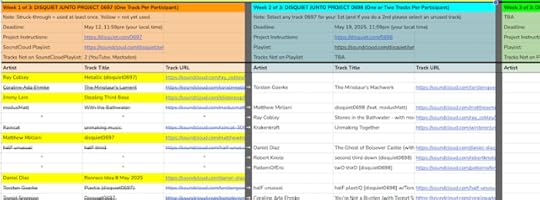
However, with the trios sequence, I get more directly involved, maintaining a necessarily complex online-viewable spreadsheet so Junto participants can sort out what has been done with their music, and what music they might, in turn, try a hand at. I love when I pull up the webpage and something like this pops up, showing me that a bunch of people are checking out the documentation.

I usually update the Junto’s weekly playlists once or twice a day as the given project unfolds, but for these trio projects I attend to the spreadsheet almost hourly, trying to keep on top of things. It’s exciting to watch and listen as the family tree of these tracks comes into full bloom.
Here’s a glimpse of what it looks like currently. Again, details are at the link above. The duets — really one-third-empty trios — are due by 11:59pm (your local time) on Monday, May 19, and then the final trios phase of the projects begins next Thursday, May 22. Join in if you have the time and interest.
May 15, 2025
Disquiet Junto Project 0698: Second Third
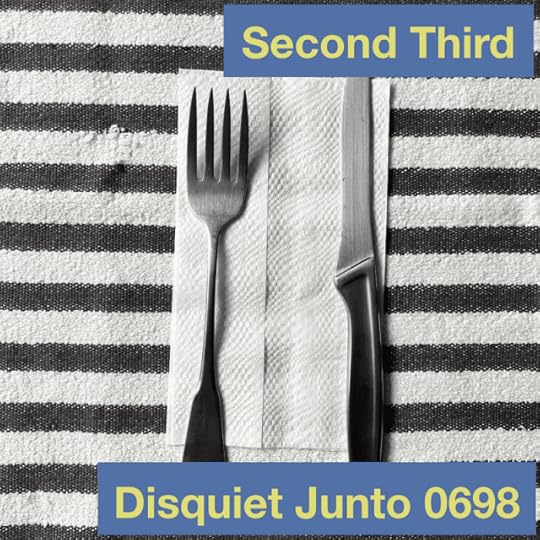
Each Thursday in the Disquiet Junto music community, a new compositional challenge is set before the group’s members, who then have five days to record and upload a track in response to the project instructions.
Membership in the Junto is open: just join and participate. (A SoundCloud account is helpful but not required.) There’s no pressure to do every project. The Junto is weekly so that you know it’s there, every Thursday through Monday, when your time and interest align.
Tracks are added to the SoundCloud playlist for the duration of the project. Additional (non-SoundCloud) tracks also generally appear in the lllllll.co discussion thread.
Disquiet Junto Project 0698: Second Third
The Assignment: Record the second third of a trio.
There are two versions of the instructions for this week’s project — one very short, the other very long.
Very short version (about 25 words): Select a track from last week’s project (disquiet.com/0697), pan it to the left, and add your own line to the right, leaving room in the center for someone to eventually turn it into a trio.
. . .
Very long version of the instructions (about 600 words):
While this is the second part of a three-part project, you can participate in one, two, or all three of the parts, which will occur over the course of three consecutive weeks, starting last week. You needn’t have done last week’s to do this week’s.
Step 1: This week’s Disquiet Junto project is the second in a sequence intended to encourage and reward asynchronous collaboration. This week you’ll be adding music to a pre-existing track, which you will source from the previous week’s Junto project (disquiet.com/0697). Note that you aren’t creating a duet, precisely — you’re creating the second third of what will eventually be a trio. What that means is: Leave space for what is yet to come.
Step 2: The plan is for you to record a short and original piece of music, on any instrumentation of your choice, as a complement to a pre-existing track. First, however, you must select the piece of music to which you will be adding your own music. There are tracks by numerous musicians to choose from (over 40 as of last count). All but a few are in this playlist:
https://soundcloud.com/disquiet/sets/disquiet-junto-project-0697
One additional track is on the Lines discussion board:
https://llllllll.co/t/disquiet-junto-project-0697-first-third/71838/19
And very short one is on Mastodon:
https://ioc.exchange/@philsawa/114504063097101750
(Note that it’s possible another track or two will pop up in — and some may disappear from — that playlist and discussion. Things are fluid on the internet.)
To select a track, you can listen through all those and choose one, or simply look around and select, or you can come up with a random approach to sifting through them.
Note: It’s fine if more than one person uses the same original track as the basis for their piece (more on this in Step 5 below).
It is strongly encouraged that you look through the discussion thread for the previous project on the Lines forum because many tracks include additional contextual information there:
https://llllllll.co/t/disquiet-junto-project-0697-first-third/
Step 3: Record a short piece of music, roughly the length of the piece of music you selected in Step 2. Your track should complement the piece from Step 2, and leave room for an eventual third piece of music. When composing and recording your part, don’t alter the original piece of music at all, except to pan the original fully to the left if it hasn’t been panned left already. In your finished audio track, your new part should be panned fully to the right.
To be clear: the track you upload won’t be your piece of music alone; it will be a combination of the track you selected in Step 2 and yours.
Step 4: Also be sure, when done, to make the finished track downloadable, because it will be used by someone else in a subsequent Junto project.
Step 5: You can contribute more than one track this week. In normal circumstances, Junto projects have a one-track-per-participant limit. You can do two this time. For the second, it’s appreciated if you try to work with a solo that no one else has used yet. I will keep an updated list in this Google Drive document of what has been utilized:
https://docs.google.com/spreadsheets/d/1dSDNhH5KnB2YlSlmBQiuhKTpAQ0Ijl391OnSUE8r4SI/edit?gid=0#gid=0
The goal is for many as people as possible to benefit from the experience of being part of an asynchronous collaboration. That, foremost, is the spirit of this project.
Tasks Upon Completion:
Label: Include “disquiet0698” (no spaces/quotes) in the name of your track.
Upload: Post your track to a public account (SoundCloud preferred but by no means required).
Share: Post your track and a description/explanation at https://llllllll.co/t/disquiet-junto-project-0698-second-third/
Discuss: Listen to and comment on the other tracks.
Additional Details:
Length: The length is up to you. Stick close to the length of the track yours adds to.
Deadline: Monday, May 19, 2025, 11:59pm (that is: just before midnight) wherever you are.
About: https://disquiet.com/junto/
Newsletter: https://juntoletter.disquiet.com/
License: It’s preferred (but not required) to set your track as downloadable and allowing for attributed remixing (i.e., an attribution Creative Commons license).
Please Include When Posting Your Track:
More on the 698th weekly Disquiet Junto project, Second Third — The Assignment: Record the second third of a trio — at https://disquiet.com/0698/
May 14, 2025

May 13, 2025
Empty the Magazine
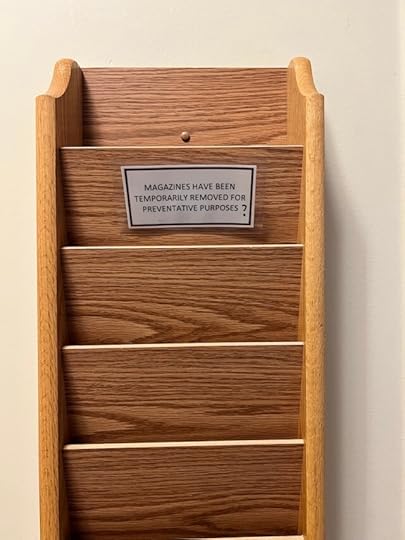
This was at the doctor’s office today. I have no idea what it means. I do like that someone added that question mark. It wasn’t me.
May 12, 2025
Work in Progress
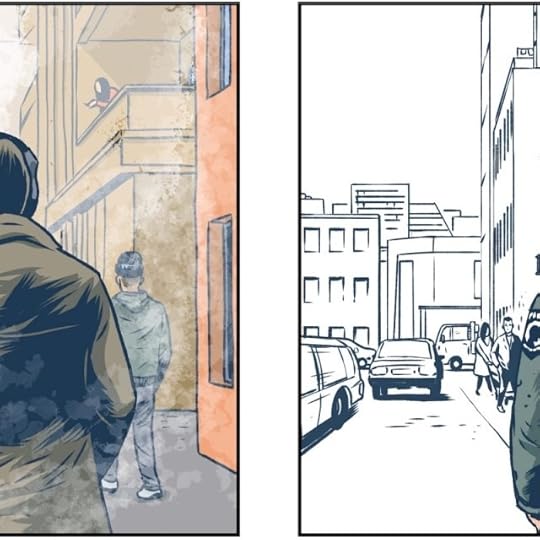
Work in progress for the next Frame by Frame comic I’m doing with Hannes Pasqualini (hannes.papernoise.net). Meanwhile, full back catalog of the series at disquiet.com/fxf.
May 11, 2025
Listening to Bosch Listening
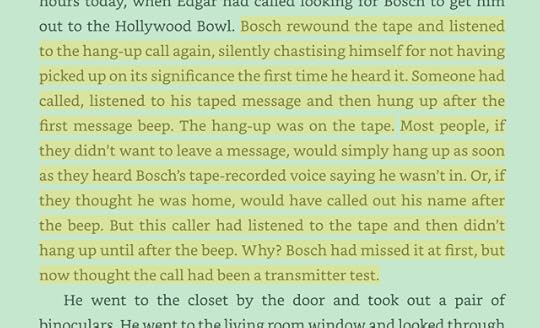
I mentioned last month, when I started reading the first Bosch book, The Black Echo, a scene in which Michael Connelly, author of the series, highlights the details of such a mundane thing as dialing a pay phone. It’s a moment, as I said at the time (having not yet finished the book), when something someone might not have imagined at the time of the book’s writing, the early 1990s, would ever become outdated was given the attention normally associated with historical fiction: getting all the precise aspects right.
Phones play a crucial role in the novel, as Bosch, a Los Angeles Police Department detective, and his FBI agent partner try to sort out the nature of a complex crime they are investigating. There are office phones and pay phones and home phones, and pagers, and, no surprise to the reader, surveillance taps on such phones, as delineated in this passage above.
The key thing in that passage is Bosch’s ear. This isn’t merely Connelly writing about phones; this is Bosch’s own thinking, the thinking of a detective. He had, earlier in the book, noticed a hang-up on his home phone’s answering machine. Much later in the book he reconsiders what he had heard, and finds meaning in it. The above, per my Kindle, is 58% of the way through the book. The original scene, when he first notices the recorded hang-up, occurs at 41%:
[image error]What’s especially funny to me, as the book’s reader, is that like Bosch, I also didn’t take much note of the hang-up at the time. In fact, I highlighted a totally different sentence when I read that paragraph, the bit about how Bosch listens to CDs. I did so because in the TV show, the Bosch character also listens to jazz, but only on vinyl. (I noted this on social media at the time, but somehow left it off my weekly collation of my social media posts, so I just added it.) Above I’ve now also highlighted the moment when this bit of crucial information — in the form of silence — is witnessed by Bosch, and he doesn’t comprehend it until another 17% of the story passes.
May 10, 2025
Scratch Pad: iOS, STT, Savory
At the end of each week, I usually collate a lightly edited collection of recent comments I’ve made on social media, which I think of as my public scratch pad. I find knowing I’ll revisit my posts to be a positive and mellowing influence on my social media activity. I mostly hang out on Mastodon (at post.lurk.org/@disquiet), and I’m also trying out a few others. And I generally take weekends off social media.
▰ After-dark trio for dishwasher, skateboarder, and whirring electric vehicle
▰ A friend who saw me mention using an Anbernic retro game handheld: I thought you didn’t play video games.
Me, after thinking about it: I don’t much, but I try. Mostly I’m interested in alternative firmware, sound design of virtual worlds, and chiptune music. (All of which video games are rich with.)
▰ I’m not sure if this was the intention with the iOS app “library,” but I find myself, on my iPhone and iPad, removing the vast majority of my apps from the home screen and accessing those just from the library
▰ A friend who uses speech-to-text a lot for writing sent me an email in which what was intended was “mazel tov” but it was transcribed as “muzzle tough”
▰ Hyper-local* food post: there are two Cherry Blossom cafes, one in the Inner Richmond and one on Ocean, and they both have many treats to offer. The essential one — for me, that is — is the savory scallions and ham, which is light and fluffy.
*San Francisco
▰ Reading-wise, I’m very close to the end of the first Bosch novel, The Black Echo. A lot of the book involves Bosch and his partner figuring out what might be going on, laying out their various hypotheses step by step. I’ve come to wonder how much of that is the author describing the detectives figuring things out, and how much of it is a lightly altered version of the author thinking as he himself was devising the plot in the first place. Thus what appears to be the unraveling of the given crime may actually have been the opposite: the raveling, as it were. There’s also an excellent little bit later in the book involving telephones that follows up nicely on the item I posted about earlier. I’ll share that excerpt later. This weekend is largely given over to family activities, of the sort centered around a cemetery, so time is understandably limited. I imagine I’ll finish it tomorrow before bed. The book club in which I’m reading The Mushroom at the End of the World delayed its meeting until next Sunday, so I’ve slowed my pace so it’ll be fresh when discussion occurs.
May 9, 2025
RIP, Skype (2003–2025)
Skype, the telecommunications app, launched in 2003, the same year as MySpace and the ill-fated Space Shuttle Columbia.
Skype was a progenitor of our late-pandemic, Zoom-mediated lives. And now, after 22 years, and almost a decade and a half following its acquisition by Microsoft, Skype has been shut down, as of May 5.
Between cellphones and Facetime and Slack huddles and all manner of conference-call apps, we take instant realtime video communication these days as a given, but Skype originated (voice-only initially) at a time when such things were expensive, all the more so when connecting people internationally.
For just under a decade, I taught a course about sound to art school students, the majority of whom were from other countries (e.g., Sweden, Korea, China, Spain, and Saudi Arabia). I started doing so in 2012, a year after Microsoft bought Skype. A core part of the assigned homework was maintaining a “sound journal,” in which students wrote several times a week, detailing an observation they made about one sound or another.
Certain topics revealed themselves as common to these journals as the years of my teaching went by: the issues of noise in a city, the comforting purr of a house cat, the way the chatter in cafes somehow provided the perfect backdrop for doing homework. The everyday utility of Apple’s AirPods became a nearly universal subject in these sound journal shortly after their debut in 2016.
And at least one student a semester would inevitably write a short essay affectionately describing the sounds that Skype made, in particular when it opened and when its bubbly melody announced an incoming call. These Skype-specific sounds meant that the student would soon be talking to family or friends back home. Often these sound journal entries would describe how the student didn’t even recognize a persistent low-level homesickness until Skype announced itself — and then the sense of longing and the awareness of loneliness kicked in.
There was a lot packed into those little Skype noises, and the app became a useful tool for discussing the broader topic of the course, that being the role of sound in the media landscape, and the more focused matter of what’s come to be termed “sonic branding.” Some of the best ways to introduce subjects in class, I learned, was to let them happen naturally. So for the most part, I didn’t introduce Skype each semester. I just waited for it to come up — for it to, in effect, ring — and then we would collectively dive into its emotional and cultural meaning.


