
Marc Weidenbaum's Blog, page 18
June 4, 2025
Chaos and Precision
Half of an upcoming glitch/beats album by MTCH, hkyrbnnpkmdtvovgjr (if something is encoded in that letter slurry, please lemme know), is up now for streaming, and it’s a fantastic set of frazzled IDM, full of heady echoes of Autechre and Monolake, with a vibrant arrhythmia that suggests live coding at work. Here and there are ominous drones, from which snatches of whirling effects, bounding percussion, and cybernetic beats emerge. It’s sound-design techno, breaking noises into fragments and moving them around with the subgenre’s trademark mix of chaos and precision — artisanal pick-up sticks tossed into a cyclone. Tracks like “kjbg” and “5_bstrckt” resemble a sonification of a subroutine attempting to take matters into its own hands (or lack thereof). The full album comes out Friday, June 6, on the label EVEL, which — at least based on its social media and Bandcamp pages — maintains a geographic ambiguity.


June 3, 2025
Junto Profile: Ángel Luis Martínez
This Junto Profile is part of an ongoing series of short Q&As that provide some background on various individuals who participate regularly in the online Disquiet Junto music community.
What’s your name? My name is Ángel Luis Martínez.
Spirit Turnpike is my project that I’d like to see perform as a full band someday. I use Professor MTZ (first word is derived from my “day” job) on recordings where my main contribution is mixing other artists’ work.
My first band, and which exists to this day, is The Arawax. It’s where I gained deep confidence and understanding of the bass guitar through folk, punk, and many other influences. We have done concerts together that were fun and well-received.
Currently, I also collaborate with New Haven Improvisers Collective.
Where are you located? I grew up in Brooklyn — specifically in Williamsburg and the adjoining areas in Bed-Stuy. While I played a little guitar, tape recorders and a Casio SK-1 sampling keyboard were at the center of my sonic adventures. The sampler also has a synthesizer function to make more sounds. This was the 1980s, so I made mixtapes from radio and TV programs, my own voice, and occasional noodlings on instruments, enjoying especially sampled weirdness from loops. I still have many of those cassettes, so now I sometimes think what, if anything, I can make from them.

What is your musical activity? I have played bass guitar and bass ukulele and sang with The Arawax since 2016, mashing up folk, rock, punk, funk, etc. We have performed in Queens and Philadelphia. I learned a lot about bass playing, especially the high notes so I could hear myself when we practiced.
In 2022, I began to attend the monthly free improvisation workshop series of the New Haven Improvisers Collective (NHIC) at the legendary Never Ending Books in that city. Its openness and dedication to making new music was welcoming and intriguing. In 2023, we began doing monthly showcases as well, many of which have been turned into live recordings. Each month there’s a new one on Bandcamp, except in June & July.
In 2023, I came to Bandcamp and released my music-poem “Non Fungible Tchotchkes,” my answer to the religion of crypto, just as the NFT craze was losing steam. It was part of a 4-track EP with different mixes, including one of me just reciting the poem. Occasionally, though, I find a report that tells me some relevance remains in the piece.
Soon on Substack, I encountered the Labelabel project by Miter (Ryan Stubbs), who produced Salon du Monde, Fremont, a three-part video variety show. I created a video for “Non Fungible Tchotchkes.” It was edited to appear on Episode 2 and as a coda on Episode 3. I was amazed how well that turned out, and it featured a lot of great artists who came together because we were all on Substack.
So how did I find Disquiet Junto? Not long after joining NHIC, I did a search for experimental jazz on the Internet Archive, and learned about Orchestra Eclettica Sincretista. It was through OES maestro Marco Lucchi’s postings that I heard some of his Disquiet contributions, and joined last June.
What is one good musical habit? I make sure I am ready to record ideas that arise. Sometimes I get an idea for a rhythm, a melody, or even song lyrics. I would record these short pieces — even and often for me only seconds long — to make sure I don’t forget how the music sounded to me. Even a phone voice recorder can be useful to make sure ideas are not forgotten.
What are your online locations? Besides Substack and Bandcamp, I pay more attention now to SoundCloud largely because of the Disquiet Junto. National and International Beat Poetry Society’s social media have been great for sharing writings and music. But I have found that email is a great place to share online.
What was a particularly meaningful Junto project? I had long wanted to do a lullaby — and in Spanish — so disquiet0655, Soothing Sounds II, was definitely a meaningful treasure!
“Al Mar, Mi Piratita” (To the Sea, My Little Pirate) was a deep and amazing pleasure for me. I’ve received a lot of acclaim for the piece. And the bonus was when we continued the following week with all our remixes — lullabies for adults, dig? I wasn’t expecting the attention I got for remixing my piece, and that just added to all the memories made possible with the prompt to make soothing sounds!
Are there connections you can draw between writing poetry and making music? Poetry is musical in the sense that the sounds a poet makes is key to understanding the meaning of a poem or even a verse. Musicians and poets choose sounds (represented by words or tones (or atonal sounds) to convey a message, an idea, a feeling, or an attitude.
Both poetry and music can be and are improvised. It’s another set of exercises for poets to consider how to put one word after another, and for musicians to consider how to put one sound after another.
Can you talk a bit more about that music habit of catching ideas as they arise? For example, do the raw recordings generally get replaced with more formal recordings, or do they sometimes become part of the final piece? For the OES collaboration a soliloquy — and some conversations, I was searching for recordings for what I can rework. Instead, I found a forgotten recording of me doing harmonium sounds on a Casio SA-47 (with preset South Asian instrumental sounds) and figured that would work with his track run in reverse. I was pleased with the result.
On Disquiet, “The Tree as the Eye in the Forest” began this way and I largely kept that way, including me moving about at the end. Also, tracks like “Aquidneck” and “Loud Work in Progress” were my own field recordings done by the phone recorder and mixed into the final track.
That said, there are a lot more recordings that I believe may be inspiring for the “formal recordings” later. And I am grateful that I can have them in rough form as a beginning.
June 2, 2025
Listen to the Code
In a manner of speaking, much electronic music is made entirely in code, whether within standalone physical devices that provide tactile means to control sound digitally, or in software that runs on, say, laptops or phones. And then there are coding systems that allow one to, from the ground up, create what might be thought of as raw software, such as the work GrundTon does in Pure Data (a visual programming language), here making what he calls ambient breakcore. And for a bonus, he posts some of his code on his GitHub. Below you can see (and listen to) a slightly spruced up version of the visual system he is developing. GrundTon is an art and technology student based in Vienna, Austria.
June 1, 2025
On Repeat: Score, Drone, Shadow
On Sundays I try to at least quickly note some of my favorite listening from the week prior — things I would later regret having not written about in more depth, so better to share here briefly than not at all.
▰ I end up listening to a lot of scores to films I never end up seeing. From the strength of the fragile ambient and minimalist music that Chris Gestrin recorded for his collaboration with filmmaker Jeff Carter, I’ll definitely be tracking down So Below, which is described as “A contemporary reflection on the utopian vision of Charles Fourier (1772-1837), framed in a multi-format cinema landscape variously local, regional, global, and cosmic.” Gestrin is based in British Columbia.
▰ Dreunen, by Magnetic Loops, is a series of quite varied drones recorded for International Drone Day, May 24, 2025. Magnetic Loops is based in Bristol, UK.
▰ Christopher Hanlon’s gentle “Thought Shadows” hides little glitches and beat-like plosives in its embrace. Hanlon is based in Belfast, Northern Ireland.
May 31, 2025
Scratch Pad: Fog Horns, Ponzi Schemes
At the end of each week, I usually collate a lightly edited collection of recent comments I’ve made on social media, which I think of as my public scratch pad. I find knowing I’ll revisit my posts to be a positive and mellowing influence on my social media activity. I mostly hang out on Mastodon (at post.lurk.org/@disquiet), and I’m also trying out a few others. And I generally take weekends off social media.
▰ It doesn’t seem that windy, but the Golden Gate Bridge is singing like nobody’s business
▰ Nothing like waking up to fog horns
▰ Books are a Ponzi scheme. Every time I finish reading one, I wanna read several more.
▰ One good thing about selling music gear is you don’t just get rid of the gear, you get rid of another box. And if you carry the package by foot to the post office, you feel even lighter after mailing it.
▰ Been in three group book clubs and one two-person book club this year, and there’s nothing like reading a book with other people — more dutiful, perhaps, but so much more insight, and I pay a different sort of attention.
▰ This week in #dronescrolling: Dunno if I’ll do this regularly or not, but it occurs to me I might, as part of the social media summary (slash digital life self-assessment) that I compile at the end of each week, post some mentions of solid things other people posted. Here are a few: Jeremy Wentworth regularly uploads short clips of his VCV Rack (i.e., modular synthesizer in software form) patches on his Mastodon account. The musician Dave Seidel, aka mysterybear, posted a janky yet photogenic jury-rigged stereo-mono adapter on Threads. Femi Shonuga-Fleming (aka Sadnoise) posted, on Instagram, a massive steel horn art object he made with Enid Corcoran. And these next are actually from a little earlier in the month, but Jeremy Bushnell published on Bluesky a bunch of photos of musicians performing at the recent Cleveland Re:Sound event, including Keith Fullerton Whitman and Maria Chávez.
May 30, 2025
“without … desire of victory”
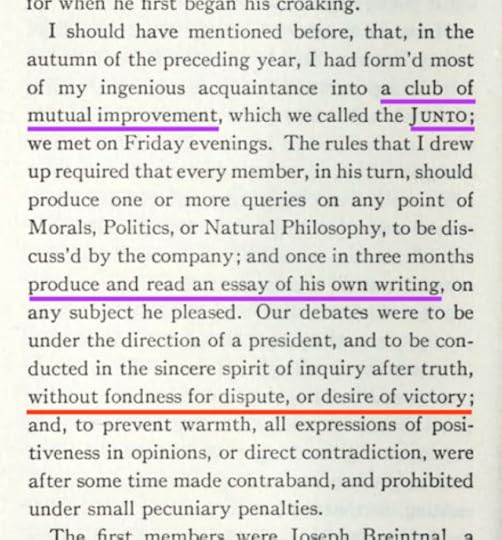
I’ve given* dozens of talks, presentations, interviews, and lectures about the Disquiet Junto music community over the past 13 years, and Benjamin Franklin, who first coined the word “junto,” remains a deep well I keep going back to. I’ve shared this mention of Franklin’s original 1727 Junto (from his autobiography) many times, and each time I’ve always been sure to underline what’s seen here in purple.
And yet only now have I noticed the additional part, which I’ve underlined in red, about “without … desire of victory.” One thing I was certain about the Disquiet Junto from the start, back in January 2012, was that it wasn’t going to be a competition. And now I realize that was part of Franklin’s own plan from the start.
*most recently for Donnell Alexander and Lev Anderson’s West Coast Sojourn podcast and at the Lines meet-up at Mission Synths earlier this this month
May 29, 2025
Disquiet Junto Project 0700: View Frame
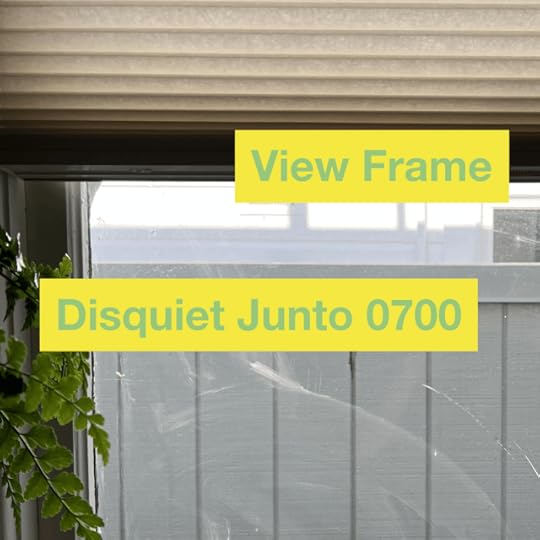
Each Thursday in the Disquiet Junto music community, a new compositional challenge is set before the group’s members, who then have five days to record and upload a track in response to the project instructions.
Membership in the Junto is open: just join and participate. (A SoundCloud account is helpful but not required.) There’s no pressure to do every project. The Junto is weekly so that you know it’s there, every Thursday through Monday, when your time and interest align.
Tracks are added to the SoundCloud playlist for the duration of the project. Additional (non-SoundCloud) tracks also generally appear in the lllllll.co discussion thread.
Disquiet Junto Project 0700: View Frame
The Assignment: Share a peek out your window and some sounds inspired by the view.
Step 1: Take a photo out your window, with a little bit of the frame in view. Show people a glimpse of your world.
Step 2: Record a short, simple piece of music inspired (or otherwise informed) by what you see.
Tasks Upon Completion:
Label: Include “disquiet0700” (no spaces/quotes) in the name of your track.
Upload: Post your track to a public account (SoundCloud preferred but by no means required). It’s best to focus on one track, but if you post more than one, clarify which is the “main” rendition.
Share: Post your track and a description/explanation at https://llllllll.co/t/disquiet-junto-project-0700-view-frame/
Discuss: Listen to and comment on the other tracks.
Additional Details:
Length: The length is up to you. Brief can be neighborly.
Deadline: Monday, June 2, 2025, 11:59pm (that is: just before midnight) wherever you are.
About: https://disquiet.com/junto/
Newsletter: https://juntoletter.disquiet.com/
License: It’s preferred (but not required) to set your track as downloadable and allowing for attributed remixing (i.e., an attribution Creative Commons license).
Please Include When Posting Your Track:
More on the 700th weekly Disquiet Junto project, View Frame — The Assignment: Share a peek out your window and some sounds inspired by the view — at https://disquiet.com/0700/
May 28, 2025
May 27, 2025
Pekler’s Background Music
“Fabulation for K”, from a forthcoming album, New Environments & Rhythm Studies, by Andrew Pekler, delays the delivery, to the point where the delay turns out to be the point. Almost a full two minutes of teasing chords and glitchy wisps (or wispy glitches) into “Fabulation,” after what on any other such track would have been the mere five to ten seconds prior to a steady beat kicking in, there’s a hint of a white noise pause — and then all over again it holds back, until quite suddenly it’s over. The track is a study in avoiding the obvious. “Cumbia Para Los Grillos,” the other currently available pre-release track, has a somewhat similar vibe, that of being stems of a whole other song, more parts than whole, and as a result more rewarding than what it might have become. “Cumbia” feels somewhat more fleshed-out than “Fabulation” is, mixing water-drop xylophones and moody organ-like haze, but it leaves plenty of room for the imagination. “Los Grillos” is Spanish for crickets, so perhaps the piece’s title is an acknowledgement of the backgroundedness of what Pekler is up to.
The album is due out June 27, 2025, on the label Faitiche, founded by Jan Jelinek. I saw the two of them play in San Francisco earlier this month.
May 26, 2025
Bosch’s Pre-Echoes
This following bit is from The Black Ice, the second novel in the series by Michael Connelly about Los Angeles police detective Hieronymus Bosch:
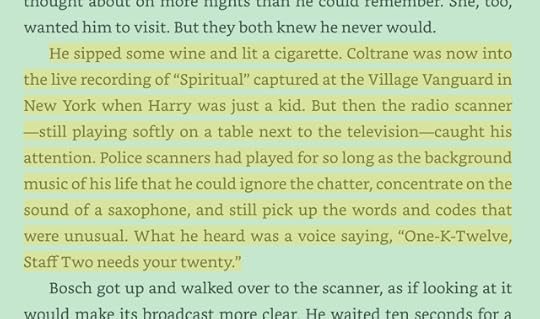
I love that Connelly, back in 1993, foresaw Eric Eberhardt’s long-running youarelistening.to project, You Are Listening to Los Angeles, which pairs meditative music and police scanners. The original site suffers today from the inevitable situation in which embeds stop functioning dependably (something my own site’s older posts are rife with), but you can check out recordings in Eberhardt’s NTS.live show.
The author Warren Ellis, in his 2013 novel Gun Machine, quotes his own fictional detective, John Tallow of the NYPD, referencing Eberhardt’s work:
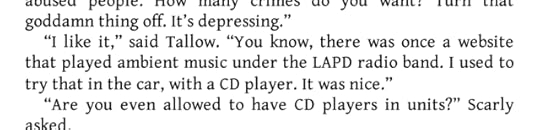
Eberhardt started You Are Listening to Los Angeles in 2011 and later expanded it to other cities. As he said to Roman Mars on the 99% Invisible podcast, “Some people think it’s peaceful. Some people think it’s creepy.”


