Sarahbeth Caplin's Blog, page 62
January 26, 2014
Things to quit thinking in 2014
Few links that are posted on Facebook end up being worth the time to read, but this one actually made me think: The top 37 regrets of dying people.
It’s funny how a short, non-specific list of generalities can change your thinking sometimes. But I needed to read this, and right now, as I’m still finishing off my mid-morning coffee, I’m devising my own list of “do nots” in hopes of being a better person.
Much of this list can be summarized by the following:
Quit caring what other people think.
I do this way too much, often without realizing it. Sometimes I feel the need to keep “trying on” different personas, and thoughts of, “Will this personality be liked? How about this one?” happen way too much. And it needs to stop. Trying too hard to get any group of people to like me has never worked for me in the end.
On that note…
Quit caring what other people think about your relationship. Maybe all our friends got engaged after only six months of dating, and we’re wacky because it’s been over two years and we’re still in the “talking” phase of planning a marriage. Different people have different experiences and different amounts of baggage to sort through before making a life-long commitment. Their timing has nothing to do with mine.
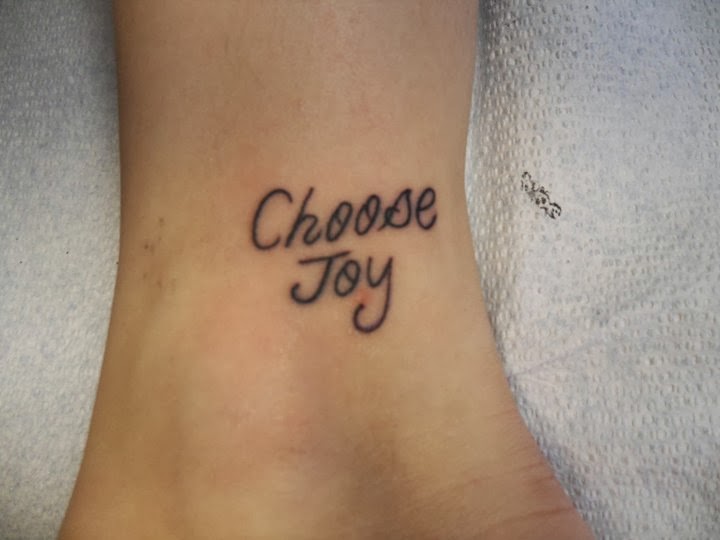
Quit caring what other people think about your ink. I never in a million years expected to become “that person” with several visible (depending on the season) tattoos. Well, I did. And they all tell a story, so the judgmental staring of a stranger means nothing to me if they don’t care to ask and get to know me.
Quit trying to maintain friendships that are better left to burn out.I have this notion that sharing moments with someone in the past means I have to hang on to them forever. Sometimes life just doesn’t allow that to happen, for a variety of reasons. It doesn’t always mean that person did something wrong; but sometimes people have to be let go of. I firmly believe that some people are meant to meet you only at certain points in your life.
I’m trying to learn how to appreciate good moments for what they are, even if they are isolated in one afternoon or series of dinners. They were good, and I’m grateful, but sometimes moving on is just necessary.
And sometimes it’s better to hide the Facebook updates of certain people rather than feel an obligation to ‘like’ it. If people want to post up to five times a day about how much they love their significant other, how many times he brought flowers to their work place, how excited they are for their wedding, that’s fantastic. Really. But if I keep feeling a temptation to compare my life, my significant other, my whatever to yours, you’re getting blocked. I’ll still talk to you in real life and share in your happiness. But I need to protect myself from the dreaded Comparison Game that no one really wins in the end.
I have this theory that truly happy people don't need to let Facebook hear about it all the time. But that's just me. If that causes some people to think I'm bitter, well, see List Item #1 :)
This is just a short compilation, and I’m sure more ideas will come later. But for now, I need to reread these things as often as it will take for me to accept and believe them…and train myself to be joyful.


January 24, 2014
Celebrities aren't role models. Get over it.
As the world starts freaking out over Justin Bieber’s arrest, I’m gearing up for the inevitable laments of “But he calls himself a Christian!” “Young girls look up to him!” “He was such a good kid!”
Maybe all that is true; maybe not. But honestly, I never understood the idea that celebrity = role model. Just think about the definition of “celebrity” in the first place: a really, ridiculously famous person. Someone whose face appears on magazine covers a lot. Someone whose sole income rivals that of entire countries.
Celebrities are just famous. More often than not, they exist only for our entertainment. That’s why it’s not too difficult for me to separate the art from the artist (unless you’re a shameless rape-culture-promoter like Robin Thicke: then you’re both a shitty person as well as a shitty musician), because looking up to the person behind the art almost always results in disappointment.
Most celebrities I’ve heard of don’t ask to be looked up to, but somehow that expectation is heaped on them anyway. The only time it’s appropriate to view a celebrity as both famous AND a role model is if they ask for the role…but even then, I’m skeptical. People aren’t perfect, and it’s completely ridiculous to demand that anyone live their lives under a microscope for young people to emulate, when the work they do isn’t even that life-changing. A song or a movie can inspire people and change lives, but in the grand scheme of things, artists don’t really exist to be heroes. They don’t exist to be leaders.
People like Nelson Mandela are role models because they lead. They teach. They can use song lyrics and theatrics to do that, but they are role models because their lives tell us “I am dedicated to a cause that is greater than myself,” rather than “Hey, look at me!!!”
“Celebrity” may be the result of a best-selling album, a leaked sex tape, or a starring film role. But leadership and respect must be earned. Whoever bestowed the label “role model” on a teenage superstar whose lyrics are primarily about picking up women in clubs needs to re-evaluate their priorities. There are plenty of real people who are much easier to relate to, and far more realistic in what they can teach us: people like teachers, doctors, fire fighters. Displays of leadership can be as grand as Nelson Mandela's speeches, or as small as a single mom working double shifts so her kids can have presents on Christmas morning (which isn't a small thing at all).
Parents, in addition, can stop funding the concert tickets and try be role models to their own kids, rather than put that burden on someone else.
Let the entertainers do their job – entertain – and leave the responsibility of leadership to those with inspiration that doesn’t demand a spotlight.
January 23, 2014
Bad grammar? Bad luck in the job search
A human interest piece submitted for my internship with Key Media. I love it because of the way it captures my nerdiest tendencies :)
 Recently, a joke about grammar was shared by a friend on Facebook: “‘I love cooking, my kids, and my pets’ is different than ‘I love cooking my kids and my pets.’ Use commas; don’t be a psycho.” That post elicited a laugh from me, but then I realized many of my friends with limited grammatical knowledge would fail to understand the difference between those two sentences. As a result, they are not only missing out on humor, but how to communicate effectively.
It’s no secret that the art of communication is lost on a generation that has replaced cursive with typing. It’s also no secret that the most in-demand job markets are looking for candidates with more knowledge of math and science than sentence construction. As a result, graduates are being sent out into the workplace knowing how to work effectively with numbers and clients, but they can barely construct sentences to adequately express themselves.
In a world that relies heavily on email-based communication, the applicants who can compose intelligently-worded emails to potential employers, free of basic spelling and grammatical errors, may stand a higher chance of being selected for an interview than those who carry 4.0s but don’t understand the difference between “To, two, and too.”
Unless your chosen profession does not involve written communication, all serious job applicants would benefit from a basic crash-course on grammar. It may seem elementary, but it beats the alternative of having people thinking you’re a cannibal.
Recently, a joke about grammar was shared by a friend on Facebook: “‘I love cooking, my kids, and my pets’ is different than ‘I love cooking my kids and my pets.’ Use commas; don’t be a psycho.” That post elicited a laugh from me, but then I realized many of my friends with limited grammatical knowledge would fail to understand the difference between those two sentences. As a result, they are not only missing out on humor, but how to communicate effectively.It’s no secret that the art of communication is lost on a generation that has replaced cursive with typing. It’s also no secret that the most in-demand job markets are looking for candidates with more knowledge of math and science than sentence construction. As a result, graduates are being sent out into the workplace knowing how to work effectively with numbers and clients, but they can barely construct sentences to adequately express themselves.
In a world that relies heavily on email-based communication, the applicants who can compose intelligently-worded emails to potential employers, free of basic spelling and grammatical errors, may stand a higher chance of being selected for an interview than those who carry 4.0s but don’t understand the difference between “To, two, and too.”
Unless your chosen profession does not involve written communication, all serious job applicants would benefit from a basic crash-course on grammar. It may seem elementary, but it beats the alternative of having people thinking you’re a cannibal.
January 17, 2014
I guess I don't have to be famous after all
It’s that time again. The time when I’m just about ready to click that “publish” button for a fourth time, and I’ll tell you: the rush never changes. It’s exciting. It’s empowering.
But it’s also a moment that calls for some self-evaluation. After all, it’s my fourth book. My fourth book at the age of 25, and I have yet to be named, let alone considered, as a best-selling author in any notable book review journal. So am I doing okay? Am I doing anything right at all?
What’s the point of asking these questions, anyway?
I created something I love, and am proud to have my name on. That’s what matters. The small circle of “fans” (that feels slightly pretentious) I’ve acquired are not part and parcel of this whole author experience: they are earned. And their reviews tell me that they appreciate my work not because I’m a hot new name in fiction, but because they connect with my stories. They recognize themselves in them.
That’s what matters.
But I’m someone who has wanted to be famous her entire life. There’s still a part of me that looks at my sales, my number of Twitter followers, compares them to those of other indie authors, and thinks I’m not doing enough. However, there’s a huge difference between putting work out there to be noticed, and putting work out there to say something real. If my only desire is to be noticed, to become some sort of household name, then I will always be disappointed, because there will always be someone else topping new charts that didn’t exist yesterday, selling more copies, and gaining more Twitter followers.
It’s funny how you can find a high school-style hierarchy in just about any occupation or hobby: no matter what you do, you will always, at some point, feel like a geek while someone else is being crowned prom queen. Well, the latest New York Times best-seller is the prom queen. I guess that makes me a mathlete or something?
I’m in the process of re-evaluating the real reasons I want to be famous. Not can’t-buy-toilet-paper-without-paparazzi-snapping-my-picture famous, but…famous. Significant. No, more like an important historic figure. Someone to be read about in history books, not People magazine.
And the more I think about it, the more I understand that my reasons for desiring fame are kind of stupid. I’m not “that special” of a person. I’m just a woman with something to say. So I write it down, publish it, and am blessed by the handful of reviews from people who tell me that they see their own stories in my work. I’ve made a few new friends out of this journey into publishing; friends I wouldn’t have met any other way, because they are as close as Philadelphia and as far away as England. They aren’t established critics, but they are people whose voices matter just as much as my own. And when they tell me that something I wrote resonated with them, it means the world.
And that is why I continue to write. Fame or no fame, I think I’m doing okay for myself.
January 9, 2014
Why I choose to be a "dark writer"
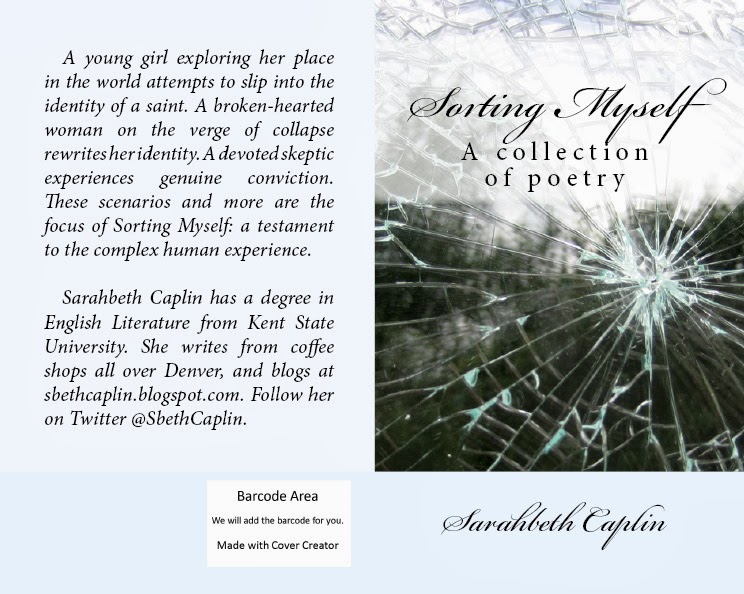
For my first post of 2014, I am introducing my newest book baby, due sometime next month. Sorting Myself, my first attempt at publishing poetry, may be my "darkest" book next to Someone You Already Know. You really can't get much darker than rape culture, and that subject does spill over into this new book (among other topics, such as religion, relationships, self-discovery, etc).
I learned early on that I write best when I get angry, and over the last few months of 2013, I saw plenty of things to get angry about. You could say that hell hath no fury on the creative drive of an angry woman. Happiness, in my case, doesn't do much for my productivity level at all.
I'm obviously far from the only writer with dark muses. Gillian Flynn is quickly becoming my new favorite "dark author," and some of the downright gritty imagery she uses makes me wonder about the kind of person she is in real life. People I've never met could be wondering the same thing if they happen to pick up this book, and come to some very false conclusions about my character. So really, how much can readers judge a person based on what they write about?
I suppose part of that answer lies in the reason someone writes in the first place. Some do it for money (crazy, I know). Some because they have something important to say (I'd like to think I'm one of those people). I think that my "writer's mojo" is making art out of crappy situations; the issues that make readers shudder are the ones that truly show what it means to be human.
Of course, others write purely for the fun of it. Their books are a means to escape, and meant to be read some place idyllic like the beach. That's okay too. But that's not the kind of writing that shows what I'm made of.
Sorting Myself is going be a very short book compared to my previous ones. You can enter my giveaway on Goodreads from now until March 1st.
I learned early on that I write best when I get angry, and over the last few months of 2013, I saw plenty of things to get angry about. You could say that hell hath no fury on the creative drive of an angry woman. Happiness, in my case, doesn't do much for my productivity level at all.
I'm obviously far from the only writer with dark muses. Gillian Flynn is quickly becoming my new favorite "dark author," and some of the downright gritty imagery she uses makes me wonder about the kind of person she is in real life. People I've never met could be wondering the same thing if they happen to pick up this book, and come to some very false conclusions about my character. So really, how much can readers judge a person based on what they write about?
I suppose part of that answer lies in the reason someone writes in the first place. Some do it for money (crazy, I know). Some because they have something important to say (I'd like to think I'm one of those people). I think that my "writer's mojo" is making art out of crappy situations; the issues that make readers shudder are the ones that truly show what it means to be human.
Of course, others write purely for the fun of it. Their books are a means to escape, and meant to be read some place idyllic like the beach. That's okay too. But that's not the kind of writing that shows what I'm made of.
Sorting Myself is going be a very short book compared to my previous ones. You can enter my giveaway on Goodreads from now until March 1st.
December 31, 2013
Tragedy is the core of literature
The post title is borrowed from a quote by Cormac McCarthy: "The core of literature is the idea of tragedy...you don't really learn much from the good things that happen to you."
It's a common sentiment at this time of year, but I'll say it anyway: 2013 was nothing like I thought it would be. And not in a good way.
In just 12 months, I nearly lost my father to cancer, took some brave steps in confronting old demons, and became physically ill from depression and anxiety, resulting in withdrawing completely from grad school and facing a quarter-life crisis. Or, more to the point, a quarter-life faith crisis.
At least the good news is that I went through all of this with my boyfriend only an hour away, as opposed to 3,000 miles. He may have a clearer picture of the "real me" than I do.
And, like every year before this one, 2013 has been a year of acquiring new and awesome books. I have no doubts that 2014 will bring more of the same.
However, new books also bring sadness, as I realize more and more that few people treat the act of reading as I do. Reading, for many, is a hobby; something they do at the end of the day to relax, to escape on a vacation, to pass time in the waiting room at the doctor's office. It should come at no surprise at this point, but reading for me is, well, my life. I live in books. I breathe books. Every experience of my life that shaped me, positively or negatively, is chronicled somewhere in a book I wish I wrote, by an author I view as a kindred spirit. It's safe to assume that without books, I wouldn't be a person of any significant substance. I'd be more lost, confused, and directionless than a typical twenty-something is expected to be. So a piece of my heart always shatters when I hear a person say "I don't read." Good for them, I guess; they're just missing out on a deeper realm of human experience, is all. No big.
I think this is the reason I do alone time so well: because books are where my friends are found. From the literary heroes who shaped my childhood, and rocky descent to adolescence -- Matilda Wormwood, Harriet M. Welsch, Anne Shirley, Sara Crewe, Jane Eyre, Katniss Everdeen, the March sisters (especially Jo) -- to the brave women who mentor me with their memoirs -- Lauren Winner, Rachel Held Evans, Sarah Bessey, Addie Zierman, Jonalyn Fincher -- I am never really alone. Then again, I am aware that people in books are frozen in time, while the authors behind them are living, breathing entities who are in a constant state of character evolution, as I am. There's comfort in knowing that people in books can never disappoint. But it's the real-life disappointments, inflicted by people who often mean well, but don't always show it, that challenge me to grow. So while there's safety in books, there's no real growth if I am reading in a vacuum.
I don't intend to create a laundry list of improvements for 2014. That almost never works. To be blunt, a lot of shit happened in 2013. And as much as that sucks, my love of reading has shown me that stories don't really progress without varying degrees of tragedy. Adversity is just a fancy name for plot twists. And that is what will, I hope, one day make me a kindred spirit on someone else's book shelf.
It's a common sentiment at this time of year, but I'll say it anyway: 2013 was nothing like I thought it would be. And not in a good way.
In just 12 months, I nearly lost my father to cancer, took some brave steps in confronting old demons, and became physically ill from depression and anxiety, resulting in withdrawing completely from grad school and facing a quarter-life crisis. Or, more to the point, a quarter-life faith crisis.
At least the good news is that I went through all of this with my boyfriend only an hour away, as opposed to 3,000 miles. He may have a clearer picture of the "real me" than I do.
And, like every year before this one, 2013 has been a year of acquiring new and awesome books. I have no doubts that 2014 will bring more of the same.
However, new books also bring sadness, as I realize more and more that few people treat the act of reading as I do. Reading, for many, is a hobby; something they do at the end of the day to relax, to escape on a vacation, to pass time in the waiting room at the doctor's office. It should come at no surprise at this point, but reading for me is, well, my life. I live in books. I breathe books. Every experience of my life that shaped me, positively or negatively, is chronicled somewhere in a book I wish I wrote, by an author I view as a kindred spirit. It's safe to assume that without books, I wouldn't be a person of any significant substance. I'd be more lost, confused, and directionless than a typical twenty-something is expected to be. So a piece of my heart always shatters when I hear a person say "I don't read." Good for them, I guess; they're just missing out on a deeper realm of human experience, is all. No big.
I think this is the reason I do alone time so well: because books are where my friends are found. From the literary heroes who shaped my childhood, and rocky descent to adolescence -- Matilda Wormwood, Harriet M. Welsch, Anne Shirley, Sara Crewe, Jane Eyre, Katniss Everdeen, the March sisters (especially Jo) -- to the brave women who mentor me with their memoirs -- Lauren Winner, Rachel Held Evans, Sarah Bessey, Addie Zierman, Jonalyn Fincher -- I am never really alone. Then again, I am aware that people in books are frozen in time, while the authors behind them are living, breathing entities who are in a constant state of character evolution, as I am. There's comfort in knowing that people in books can never disappoint. But it's the real-life disappointments, inflicted by people who often mean well, but don't always show it, that challenge me to grow. So while there's safety in books, there's no real growth if I am reading in a vacuum.
I don't intend to create a laundry list of improvements for 2014. That almost never works. To be blunt, a lot of shit happened in 2013. And as much as that sucks, my love of reading has shown me that stories don't really progress without varying degrees of tragedy. Adversity is just a fancy name for plot twists. And that is what will, I hope, one day make me a kindred spirit on someone else's book shelf.
December 21, 2013
If a man opened Pandora's box
What if the gender roles were reversed, and suddenly,
the world was no longer a safe placefor men?What if a male stranger should fear meon the streets at night,the New Female Predator,and his gut instinct
was to gird his ballslike women do with their attractiveness,so as not to make himself
a target?What if men were taughtthat Fear is the new Sexy,that involuntary arousalis code for "Yes Please,"and his gender aloneis his own personal Armageddon?
What if it had been
a manwho opened Pandora's box?
December 15, 2013
After being hit on at Barnes & Noble
I received a compliment(or something resembling one)between the aisles of Poetry and Fictionat Barnes & Noble,from a wannabe representative
of Smooth Talkers Anonymous:
Far too prettyto be reading books.
I wonder how many tragic young women,digging through Plath and Dickinsonin search of validation,would allow themselves to be flatteredby this drivel?How many would allow this blatant chauvinismto infiltrate their hard-won rooms of their own?I think of my teenage self,curve-less and wiry-haired,unpopular, yet proud to admit
that the love of my life is named Gilbert,
and you may not have heard of him
because he lives in a book. Therein was the real reason I was single
for so long, but nonetheless satisfied with who I was. I saw the world through fiction,allowing me to avoid the real-life villains with the hope that,if characters are created by humans,surely they can be embodied by
real humans, too."Too pretty" to be reading books,
you say?Too bad.You're too decently attractive
to be so pathetically ignorant.
December 14, 2013
Creating "bad" characters, and relating to them
Lately I've been fascinated by the idea of writing a story with a very unlikeable main character. Author Gillian Flynn is a pro at this, in her books Gone Girl, Dark Places, and Sharp Objects (creepy, horrifically disturbing books, but nonetheless interesting because they are different from what I normally read).
But "unlikeable" doesn't necessarily mean unable to relate to. I don't like villains that are evil just for evil's sake. The best "bad characters" are multidimensional. They have history. They also have a handful of good qualities.
While working on my book of poems, I can't shake this idea that keeps coming back to me, usually when I'm trying to sleep. It was originally going to be a redemption story about a pastor who is a saint to his community, but has a terrible secret. Now I may be shifting my focus toward a teenage girl, who may or may not be related to him in some way, but is known at school for being a not-so-nice person. She may be the type to use bullying as a way to build up her own confidence. She'll do this because she herself is weak, even if her victims don't see that.
I believe in this idea because I don't believe in truly "good" people. I don't even think of myself as a "good person" (though in retrospect, I'm hesitant to call myself a "bad person." Most people wouldn't say that about themselves, would they?).
I think about my personal prejudices...feeling disdain for large families with loud children coming in to coffee shops while I'm studying, letting their kids run all over the place and try to talk to me while I'm taking a timed online quiz (yeah, that happened once).
Mass-generalizing people who can't put sentences together and use the proper forms of "your/you're" as stupid, even if it's a proven fact that our education system doesn't adequately prepare students for the business world, and "business skills" may include proficiency in written communication.
Having a those people mindset regarding those who grew up in one place, in one culture, for most of their lives, and have had little interaction with people who are different from them. Never mind that I too can be one of those people. I am embarrassed by this fact.
So what makes a character truly unlikeable? What distinguishes an average person from the Hitlers and Mother Theresas of this world? In one last gesture of good faith, I'd argue that many people are simply not aware of how "bad" they can be. My goal then, if I choose to write this next story, is to develop a character who is aware of her personal badness, and has no desire to change.
At least, not yet.
But "unlikeable" doesn't necessarily mean unable to relate to. I don't like villains that are evil just for evil's sake. The best "bad characters" are multidimensional. They have history. They also have a handful of good qualities.
While working on my book of poems, I can't shake this idea that keeps coming back to me, usually when I'm trying to sleep. It was originally going to be a redemption story about a pastor who is a saint to his community, but has a terrible secret. Now I may be shifting my focus toward a teenage girl, who may or may not be related to him in some way, but is known at school for being a not-so-nice person. She may be the type to use bullying as a way to build up her own confidence. She'll do this because she herself is weak, even if her victims don't see that.
I believe in this idea because I don't believe in truly "good" people. I don't even think of myself as a "good person" (though in retrospect, I'm hesitant to call myself a "bad person." Most people wouldn't say that about themselves, would they?).
I think about my personal prejudices...feeling disdain for large families with loud children coming in to coffee shops while I'm studying, letting their kids run all over the place and try to talk to me while I'm taking a timed online quiz (yeah, that happened once).
Mass-generalizing people who can't put sentences together and use the proper forms of "your/you're" as stupid, even if it's a proven fact that our education system doesn't adequately prepare students for the business world, and "business skills" may include proficiency in written communication.
Having a those people mindset regarding those who grew up in one place, in one culture, for most of their lives, and have had little interaction with people who are different from them. Never mind that I too can be one of those people. I am embarrassed by this fact.
So what makes a character truly unlikeable? What distinguishes an average person from the Hitlers and Mother Theresas of this world? In one last gesture of good faith, I'd argue that many people are simply not aware of how "bad" they can be. My goal then, if I choose to write this next story, is to develop a character who is aware of her personal badness, and has no desire to change.
At least, not yet.
December 12, 2013
The male privilege poem
Another excerpt from the upcoming book. One of my favorites so far!
"Why don't you smile?"
the man at Starbucks said.
"I bet you have such a pretty smile."
This, from a complete stranger,
who knows not my circumstances,
my private battles,
my very life.
I gape at him and his broad shoulders,
and his condescending "Because I can" veneer.
Please, I think, Contain your male privilege,
its crumby texture already snowflaking
on my table. Let me enjoy my coffee.
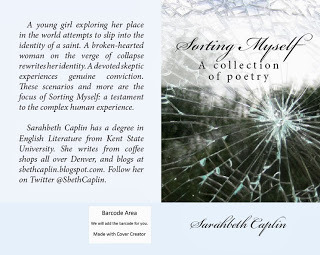
Also! Here's a preview of my snazzy new cover (the back cover text may change 50 more times before I declare it finished. Hard to accurately summarize a collection of poems when the subject matter is all over the place).
"Why don't you smile?"
the man at Starbucks said.
"I bet you have such a pretty smile."
This, from a complete stranger,
who knows not my circumstances,
my private battles,
my very life.
I gape at him and his broad shoulders,
and his condescending "Because I can" veneer.
Please, I think, Contain your male privilege,
its crumby texture already snowflaking
on my table. Let me enjoy my coffee.
Also! Here's a preview of my snazzy new cover (the back cover text may change 50 more times before I declare it finished. Hard to accurately summarize a collection of poems when the subject matter is all over the place).