James Bow's Blog, page 12
May 7, 2022
The Smart Disaster Movie

Recently, we rewatched the 2005 Discovery/BBC mini-series mock-docudrama Supervolcano, about how a group of geologists and people at FEMA handle the events leading up to and after a supervolcanic eruption in Yellowstone. It doesn't appear to be available on any streaming service, which is a shame, but you are able to view the two hours of film on Youtube.
It is a shame that the mini-series isn't easily available, because it's a very good film. I gave it a full review here, soon after it came out, and honestly, it holds up. Yes, the idea that the Yellowstone volcano is overdue for a super-eruption has been pretty thoroughly debunked, but taking the movie itself as your average disaster flick, it comes out as quite an above average flick, and one which doesn't require you to check your brain at the door at that. In addition to some tremendously good lines, there are decent moments of drama throughout, as the trope of the hero scientist being somebody nobody listens to until it's too late is thrown on its ear. Indeed, the head scientist, played by Michael Riley, is cautious to a fault, wants to prevent panic, and stave off the alarmist rhetoric of his brother-in-law who, incidentally, is just selling a new book about the Yellowstone volcano called (cough) Super Bang!.
There are no villains in this story. Everybody acts in line with what the evidence is telling them (would that certain officials do that in this day and age). They refuse to panic in the face of what should be an extremely unlikely worst-case scenario, except that the worst-case scenario is what eventually materializes. And unlike gonzo-apocalyptic disaster movies like 2012 or The Day After Tomorrow, Supervolcano doesn't go overboard with how bad the chaos gets (it doesn't need to). By and large, it sticks to the facts. Though Yellowstone is unlikely to erupt as a supervolcano, if it did, this is what would happen. And that's drama enough.
I'm having trouble thinking of any other disaster movie, that isn't basing itself on a historical event, that is trying to set itself in the real world and stay out of the ream of science fiction, playing smartly by these rules. The only thing that readily comes to mind is Deep Impact, which wins Bad Astronomer's general seal of approval, though he points out many scientific fallacies within.
Anybody out there have nominations for their own best non-speculative, non-historic disaster movie?


May 1, 2022
Return to Innocence
It's been obvious to a lot of people, for a long time, that there is way too much toxicity in social media. The platforms that were supposed to offer a free exchange of ideas have unfortunately tilted towards hatred and extremism, drowning out sane and moderate voices, and attempts to counter malicious misinformation and harassment get attacked as 'denying free speech'. I won't get too far into a discussion about how free speech does not equate to freedom from consequences, that responsibilities come with freedom (you cannot shout 'Fire' in a crowded theatre where there is no fire, you can be sued for libel and slander, and there should be consequences to those who willfully harm innocent people through their words), but it's fair to say that I feel that too.
I'm also concerned about how addictive social media is. I do too much doomscrolling on Twitter and Facebook. I feel that their attempts to handle harassment and hate speech have been ineffective at best, and often counterproductive. Seeing how some of my friends have been treated on Twitter and Facebook while some truly hateful voices have been given free rein has made me more than once think about leaving these platforms.
Unfortunately, that may not be possible for me. For one thing, my work requires my presence in social media. For another, for all its faults, social media remains the mainstay of my contact with far-flung friends and family. Until we find some other platform where we could all migrate, and do so, that isn't happening (though, my kids are finding their own spaces and now consider Twitter and Facebook to be an old folks' home. Tellingly, I've had no interest to head in their direction).
If I can't quit social media, maybe I can try to use it less, and maybe a way to do that is to try and get even older in my engagement with the World Wide Web. This blog is a legacy of the rise and fall of blogging as the major social media platform. I remember the great increase in the number and variety of blogs, the rise of audiences and comment forums, and the communities we built. I remember how the Canadian political scene both embraced and eschewed the partisan political nature of the American blogosphere. We had Blogging Tories, Libloggers, Blogging NDPers, Progressive Bloggers, and the Blogging Alliance of Non-Partisan Canadians (which I founded). Sure, there were teams, but we played together. Sure, there were fights and flame wars, but for many of us, we were all Canadians first. I count a number of former Conservative Party supporters as my friends (note, though, the term "former"), and guess where they came from. I could do with a return to that level of innocence.
Having our own blogs amounted to some gatekeeping. We needed some skills to put set up our blogs and make them interesting. Some of us found some decent rewards in setting up our own domain names and blogging software. While there was still plenty of noise blaring around the signal, once you found the signal, you could lock into it, and it would keep playing. Social media platforms like Twitter and Facebook drained that. Yes, it made it easier for anyone to post, and that is a benefit, but I've lost track of friends on Facebook thanks to this. They're still posting, but the algorithm and the sheer number of other posts to trawl through have kept them away. In more than one case, I've come upon friends I haven't spoken to online in a couple of years only to discover they have been turned into anti-vaxxer conspiracy theory-spouting parodies of themselves, blaming Trudeau for everything and cheering on the actions of the anti-democratic "truckers" convoy harassing the people of Ottawa. I can't engage with them now, they're too far gone. Maybe if I'd been in better touch with them in the intervening years, I could have talked them out of some of their delusions. Maybe.
But I digress (which, in blogging, you can do). I wonder what would happen if, instead of saying any old thing on Facebook and Twitter, I just posted here instead, like I used to. I wonder if my RSS Feed still works. I wonder if there are still RSS Feed Readers out there to capture and display the latest blog posts of my favourite blogs (answer: yes. A good free reader for Mac users is NetNewsWire). I wonder if my favourite old blogs are still posting new posts (answer: yes, some of them. Hello Blogography. Mind if I come in?).
It remains to be seen whether I can start posting anything as close to as often as I used to on this blog, or if the quick hit of Twitter and Facebook will prove to be too big of a habit to break, but I want to try. I did good things here before and, possibly, if I work at it, I can do some good things again. That may be innocent, or naive, but I feel that's a good intention, and good intentions are important, especially if they can produce good actions.
Hey, anybody out there in old Canadian Blogosphere land? Still posting? Care to send me your RSS feed address?
March 5, 2022
This Was Always Going to Happen (On $2/Litre Gas Prices)
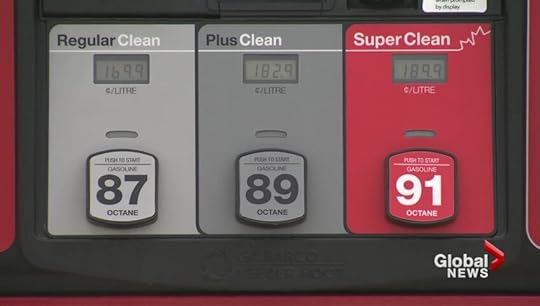
(Image courtesy Global News)
I hear tell that gasoline in Canada is heading up and passing $2/litre. I haven’t noticed too much because my car is electric.
But I won’t be too smug. I do remember to foofaraw when gas hit $1/litre. And the $2 pricetag to fill a tank is some serious hardship for people who need their cars to get to work, and who have bills to pay, groceries to pick up, and all the rest. You can blame it on Russia, but that’s little consolation to those here where the price hikes hit hardest.
But I have two points here — or, rather, two parts to one point. First, if we have to draw oil, we should be doing so from Canadian sources — the fields of Alberta, in the Maritimes, and what’s left of the fields of Ontario (yes, we’re still pumping, believe it or not). It gives dictators less of a hold over us and, when prices are high, our gas money at least go into Canadian pockets.
The thing is, though, that this event was always going to happen — if not because of a shooting war at Russia’s borders, or conflict in the Middle East, just by the simple fact that oil is finite, and I’m pretty sure we’re past Hubbert’s Peak. The price was always going to go this high and higher; it was only a matter of time.
The only way we can ensure that such an event doesn’t hurt Canadians on the street is to reduce our reliance on oil full stop — not foreign oil, all oil. Because we simply can’t count on the supply. We can count on the supply of renewables like solar, wind and hydro, and we can do nuclear. We can conserve. We can take public transit, bike, walk, and drive electrics. It has to happen.
And the sooner we make it happen, the less such events will shock and hurt us.
February 13, 2022
Twenty Years Later
Twenty years ago today, I signed up for a new blog from Blogger. And the rest is history.
Rather literally, in fact. Let’s be honest here, this blog hasn’t been functioning as a blog for the past few years. Few, if anybody comment. Posts come exceedingly irregularly. It’s a far cry from the time when Blogging was the hip new thing, and there was a collegial attitude amongst all the Canadian political blogs out there, NDPers, Libloggers, and Blogging Tories. We’ve lost the sense of community that encouraged me to set up the Blogging Alliance of Non-Partisan Canadians. It’s all Social Media, now.
And truth to tell, social media itself is evolving, and the old voices are fading away. My kids are not on Facebook nor Twitter, nor do they have any desire to be. They run Discord servers, now, and talk to their friends, safe in the knowledge that the generation gap means that parents are unlikely to stumble on their activities.
(As an aside, yes, we do still keep an eye on the online activities of our kids, but we’ve been able to trust each other a lot. The kids have been quite sensible about their presence online, and they know they can come to us with any problems, and we’re able to trust that they will come to us. I know that’s a blessing)
It’s amazing to look back on something that started out as something radical and new, then grew into the Next Big Thing, and then shifted inexorably into a historical curiosity.
Why do I keep this? Well, I don’t think you’d see me throwing any handwritten diaries away, if I had them. These are my words, and these are a record of how my opinions evolved and changed over the past twenty years of my life — even if the record of the last five years or so is somewhat sparse. More than that, it’s a record of an interesting time in my life, where I made a lot of online friendships — some of which are still going in Facebook and Twitter.
So, here’s to history. And I wave to anybody who stumbles upon this curio ten, twenty, or maybe fifty years in the future.
February 10, 2022
We, the Silent Majority
 I wrote this post in Facebook in response to a question put forward in a thread about the anti-vaxxers and the angry words rising up as a result of the pandemic. An individual asked me seriously, "Right or left...and so comes the division. I have a serious question. I am curious about what you think it would take to bring our country together again? Or do you think that will never happen?" Perhaps unsurprisingly, my reply revealed that there's actually a limit to the number of characters you can write in a Facebook comment, so I had to write the post separately. And now that I've written that post in Facebook, I think I need to say it here:
I am grateful for the serious question, and I will honour it with a serious answer. When people say things like, "what are your ideas about ending the separation and division that is happening in our country right now?", I think that implies that there are only two sides, here, and that the division is close to equal. It isn't.
Some of the organizers of the convoy in Ottawa, ostensibly against the cross-border vaccine mandate that the United States has imposed along with Canada, have included demands that the government be dissolved and replaced by the Governor-General, the Senate, and a "citizens committee" (presumably, them), all this just five months after we had an election where 95% of voters voted for parties that approved of the widespread use of vaccines, including vaccine mandates to try and end the pandemic (that was the official Conservative Party policy at the time, although they were wishy-washy over it. They were quite happy to criticize Justin Trudeau for not getting vaccines out fast enough). Only the People's Party of Canada, which in other elections campaigned against diversity, multiculturalism, and immigration) actively opposed vaccinations or vaccine mandates. They got less than 5% of the vote.
Even if you swap the Conservative numbers over to the anti-vaccine side now that many have spoken out in favour of this convoy (before backtracking once they saw the unsavoury consequences of what they were backing), 61.32% of voters still picked parties that strenuously do not support the ideals of this convoy and the people who back them.
Note also that, on the day when a couple thousand protesters showed up north of Queen's Park in Toronto in shiny new tractors (I wonder where they got them; the level of organizing here suggests a lot of fundraising that isn't exactly grassroots), over 15,000 people in Toronto showed up to get their vaccinations or vaccine boosters. Over 90% of the people in Toronto over the age of 12 have received at least one dose of vaccine (87.5% have two, and 51.7% have three).
If we are to accommodate the remaining 10%, it should only be for medical reasons. If some of the remaining 10% are simply uncertain or afraid or lied-to, then tough. If you choose not to get the vaccine, you choose to accept the consequences, up to and including getting fired from a job where your lack of vaccination threatens the health of your co-workers and the general public.
The remaining 90% have the right to protect themselves. Civil society has the right to maintain itself against individuals who would willfully make it sicker. Indeed, for the benefit of those within the 10% for whom vaccines are not an option because of serious medical issues, those whose only concern is "I just don't want to" really do have an obligation, in my opinion, to brave the needle, since this helps ensure that those who can't get vaccinated can still stay healthy even while unvaccinated. That's how herd immunity works.
It's inaccurate, even, to call this event in Ottawa and other centres across the country, a trucker's convoy, since the overwhelming majority of truckers are vaccinated (around 90%) and do not support this protest. The trucker's national association has come out against this protest. In the end, on one side you have a handful of people throwing a tantrum with extremely heavy and loud equipment and on the other side, you have everybody else.
How do we, the large and largely silent majority, bridge that divide? Well, how could we, without fundamentally compromising our values of democracy, diversity and justice? And, more importantly, how can we build any sort of common ground when many on the loud side refuse to provide any common ground themselves, denying even simple facts?
It used to be said, "you have a right to your own opinions, but you do not have the right to your own facts". Unfortunately, too many now feel that reality has a liberal bias. Too many people have tuned out of factual sources of information, turned away from civil society, and tuned into sources of misinformation, much of which is being deliberately fed to them in order to remove their trust in our democratic institutions and civil society. As nice as it would be to sit down with some of these individuals, talk to them, listen to each other, and come to some sort of compromise, no compromise is possible if one side says "The sky is blue", and the other says "No, it's not, you sheep, it's green! You're part of a Satanic conspiracy to take away these colour-correction glasses of mine, currently on sale for $49.95 at infoweirs.com."
The only way to resolve this is to confront these people with the truth, get them to put down those glasses, understand what's real and what isn't, and rejoin civil society. I can't help but wonder if it's not unlike trying to deprogram somebody who's fallen in with a cult.
There is no easy way to resolve this. I know many people across the political spectrum, including a significant number who voted Conservative in previous elections. Those I'm still friends with are all concerned with a growing tide of influence at the far right side of the spectrum who have increasingly painted everybody else who aren't them as an existential threat on their way of life (incidentally, most of those Conservative supporters who share these concerns are now former-Conservative supporters). Fundamentalist evangelical Christian groups are a part of this and they think of many of the people on the centre and the left as being of the Devil, and why the hell would they compromise with the Devil?
How do you compromise with that?������ How do you make common ground with that? And let's not forget that the anti-vaxx movement has been co-opted in many circles by white supremacist groups and neo-Nazis who saw this pandemic as an opportunity to gather up frightened people and destroy their faith in democratic institutions and civil society. The convoy itself has major organizers who are on record as being white supremacists. Convoy-goers might accuse me of painting with a broad brush "a few bad apples" who bring swastikas, racist Confederate flags, signs calling for our democratically-elected prime minister to be hanged, who throw stones at and shit on the porches of local residents who have pride flags in their windows, who intimidate homeless shelter workers and steal their food, but unless I see large sections of this so-called peaceful convoy confronting these "bad apples" and telling them that they're not welcome, these people are welcome, and the whole convoy is tainted. If the organizers have neo-Nazis cheering them on and if they honestly feel it's a bad look, maybe they should wonder why white supremacists and neo-Nazis feel safe cheering them on. And if they can't get these Nazis to leave, then they've lost control of their convoy and it has become something other than what they claimed it to be, and they should admit that and distance themselves from it. But they haven't. "There are good people on both sides", they say, even though one of those sides (mine) would never tolerate neo-Nazis and white supremacists riding shotgun.
So, "how do we end the separation and division"? Not by compromising with it. The silent majority hasn't done anything that merits compromise with the organizers of this convoy and the people who back them. The organizers of this convoy and the people who back them (apparently that includes the Attorney General of Texas who's upset that GoFundMe suspended the convoy's fundraiser because of alerts by Ottawa Police of criminal activities being funded by it; interestingly, he says this is an affront to "many patriotic Texans" who supported this fundraiser, and the convoy-goers who wanted to overthrow a democratically elected government) have shown that they don't want to compromise with us. They don't want to have anything to do with us but to trample on what we believe in. We are not being the unreasonable ones, here. We are not the ones who are operating on false information, either being misled by it or willfully spreading it.
So, how do we end this separation and division? By confronting it. By calling it out when we see it. By saying, what these people are doing is wrong. That these people are either lying or have been lied to. We end this separation and division by holding fast to our ideals and by telling and reaffirming the truth. And hoping that this is enough to bring some of these people back, and welcoming them back when these people see sense. We do it by suing and prosecuting those who wilfully spread misinformation to try and destabilize governments, to make people sicker, and cause deaths.
One reason why this convoy is so loud isn't just the horns they're using. The fact is, this 10% of society has an advantage because they don't have to follow the rules of civil society that, when applied properly, can save lives and end the pandemic sooner. The rest of us who understand and/or trust the science, who truly care about the health of everybody around them, who are trying to end the pandemic, rather than perpetuate it into something they can use to recruit people with, are masking up, practising social distancing, staying home and avoiding unnecessary travel.
We don't want to do this (masks are an annoyance, and staying home is no fun), but we're doing it so we can protect those we love and everybody else that might suffer if they caught COVID-19. We're doing this for the benefit of people we know, and people we don't know, even the anti-vaxxers. We're not the selfish ones, here. We want the pandemic to end without crashing our healthcare system and this is the way to do it, and it's tricky engaging in our own protests under these conditions. ������This is why the Silent Majority has been so silent for so long. But silence does not mean acquiescence. We see these people who flout health regulations, who were asked to help but spat in our face. And, by God, we'll remember them for a long time.
At this point, many of them shouldn't be seeking compromise with us. They should be asking us for our forgiveness.
October 9, 2021
North and West

I'm writing this in the White River Motel in White River, a couple hundred kilometres northwest of Sudbury. This is the first long distance transit trip I've taken since my Boston run back in February 2020. It's been a long time in coming.
To accomplish this, I caught an early GO Train from Kitchener to Toronto, then caught a GO Train from Toronto to Barrie, then hopped aboard the Ontario Northland bus from Barrie to Sudbury. After staying overnight in Sudbury, I walked over to the VIA Rail station and boarded the train to White River. Before the pandemic, this train operated thrice-weekly, but today only operates weekly, with a train from Sudbury to White River heading out on a Saturday, and a train returning from White River to Sudbury on Sunday.
There's a lot to recommend this trip. The scenery, especially during fall, is among the best in Canada this side of the Rockies -- better even than what the current Canadian travels when it goes through Northern Ontario. For railfans, it's also among the last places where the classic self-propelled RDC "Budd" cars now travel. It's also a working train, serving communities between Sudbury and White River where no other connection is possible.
These days, it's amazing to think that one could travel from Kitchener to Sudbury using only public transit in a day, or reach White River in two. But the truth is that this trip is remnant of what was possible just thirty years ago. White River is on the Canadian Pacific mainline where trains passed through daily from Toronto, Montreal, and Ottawa, on their way to Thunder Bay, Winnipeg, Calgary, and Vancouver. Whatever gain Metrolinx has been able to make in recent years, adding service to southwestern Ontario and the north of the GTA has been lost throughout most of the rest of the country thanks to malicious negligence from Conservative and Liberal governments.
Indeed, one other reason to take this trip is because it's very possible that it won't be here in ten years. The new equipment that the federal government has invested in VIA is welcome, but applies only to the Quebec-Windsor corridor. The proposed High Frequency Rail plan would be good, if it were more than just something on paper, but again it focuses on the "core" network, while ignoring the rest of the country that the railroads helped build. The Canadian transcontinental train is operating only once a week, and is only set to go back to twice-weekly operation once the pandemic ends. Deteriorating equipment and absolutely deplorable treatment by Canadian National has turned the service into a slog of a ride.
Riding from. Sudbury to White River, I can see how much this country needs its trains. Even in their reduced capacity, the service brings Canadians to portions of their country they wouldn't otherwise see. They brings people to medical appointments they couldn't otherwise reach. They bring families together.
Canada needs to reinvest in its passenger rail system across the country. The White River line should operate daily, not weekly. It should operate from Toronto, to Sudbury, to White River, to Thunder Bay, and then to Winnipeg. The transcontinental Canadian should be daily. There should be trains serving Winnipeg and Vancouver via Calgary as well as Edmonton. And we should restore service to the Northlander now.
This will cost money to invest in equipment and to negotiate a deal with the freight railroads to give these trains space to operate efficiently and at the fastest speeds possible, but it's worth it. It would boost the tourism industry in several areas of this country that could use it. It would improve the quality of life of many Canadians. All of Canada needs this, not just southern Ontario. And we need to make our politicians do it.
August 16, 2021
They Walked Like Capitalists Clifford Simak's They Walked Like Men Reviewed
 Please note that this review contains serious spoilers about the novel, They Walked Like Men.
Like many lifelong readers today, my love of reading began when my mother read to me as a child. My mother was different, however. As a librarian who loved science fiction, she moved quickly past younger reads onto her own collection of books, introducing me to writers like John Wyndham, Isaac Asimov, Ursula K. LeGuin, and Douglas Adams.
Years later, going through university studying for an urban planning job that the government cut as I graduated, trying to make a go of it in the soul-crushing IT industry, and finding solace in writing Doctor Who fan fiction, I had a couple of lucky breaks. One, I met my wife Erin through our writing. And two, as we started our life together, she set up a new tradition: every night, before going to sleep, I would read to her. I still do. I started with some of the books my mother read to me.
Returning to a book after two decades away can be startling. Cultural mores change. Some books reveal misogyny and racism you didn't realize was there because it was so prevalent around you when you first read it. Others surprise you by how well they speak to the conditions of the world in the author's future, but your present.
One such book is Clifford D. Simak's They Walked Like Men. Published in 1962 when the writer was 58, it's been largely out-of-print since 1979 and lies forgotten amongst his more notable works, such as All Flesh is Grass (1965), or the Hugo Award-winning Way Station (1963).
They Walked Like Men is set in what was then contemporary urban America - a place of downtown department stores and lunch counters that may be hauntingly familiar to older Gen-X readers remembering their childhood. Our protagonist is a journalist named Parker Graves, who literally stumbles into the story when something sets a trap for him outside his apartment door.
In the meantime, strange things are happening in urban America. The owner of a locally-renown department store sells his building, and to everyone's consternation, the new owners announce their intension to close the store and not replace it. Other businesses start getting offers for their establishments - way more money than their businesses are worth, and in cash - and many decide to close up shop to move out to... they're not clear on where, yet. And as the buyouts continue and more buildings shutter, Graves and many across America realize that there is nowhere to go. Even the wealthy are homeless. People may have as much money as they've ever had in their lives, but nobody is selling. Only some mysterious force is buying.
Simak's They Walked Like Men has a pulp noir feel. It is of its period and has a nuclear family outlook on relationships and gender politics. There are other flaws as well: the mysterious force (aliens, of course, who can shape-shift into anything) eventually single out Graves as a possible go-between between them and humanity, but why did they lay the trap for him at the beginning of the story, save as a means to suck the reader in?
But Simak's novel is remarkable because the shape-shifting aliens plan to take over the Earth in a unique way. They're not all-consuming locusts, or ruthless colonizers, but something just as devastating: real estate developers.
From the novel: "I see you do not realize," said the Dog, "exactly what you have. There are, I must inform you, few planets such as this one you call Earth. It is, you see, a regular dirt-type planet, and planets such as it are few and far between. It is a place where the weary may rest their aching bones and solace their aching eyes with a gentle beauty such as one seldom comes across. There have been built, in certain solar systems, orbiting constructions which seek to simulate such conditions as occur here naturally. But the artificial can never quite approach the actual, and that is why this planet is so valuable as a playground and resort."
And that, right there, is an indictment of corporate America.
The aliens don't want violence. However, they have discovered humanity's (really, America's and its allies) true weakness: the desire to accumulate brightly coloured pieces of paper, a.k.a. money. And being extremely capable shape-shifting aliens, they can provide that paper, in perfect replicas. It seems a strange thing to them as something humans could want but, hey, they like the smell of skunk oil, so who are they to quibble? Besides, they provided it, humans took it, and so the Earth is theirs, now.
Simak's book came out as America was taking its leap into suburban development and urban sprawl. It captures the feel of the start of white flight and the decline of urban downtowns across the country. Millennials may not appreciate the book from the Gen-X viewpoint that remembers Woolworth's now gone and lunch counters given way to fast food chains and trendy coffee shops, but Simak ably invokes the shift of wealth away from what little financial equality was achieved in the 1950s to the huge amounts of wealth now held by the richest one-tenth of one percent today. And Simak goes further, questioning the nature of money itself.
When I hear that it would cost just $30 Billion to end world hunger, and Jeff Besos could pay for that from what he finds in the folds of his couch, I ask myself: is that money in the one-percents' hands even real? When did we hand it over?
We did hand a lot of it over, as tax rates for the richest among us fell, while everybody else's wages remained stagnant compared to inflation. In the early 1980s, my family was able to support themselves in a downtown Toronto home on a single civil servant's income. That's unthinkable today (like father, not like son. No government planning job for me). But does all that we've handed over really amount to the tens of trillions of dollars now in unnamed bank accounts, or have those numbers been inflated in other ways?
I think Simak said it best, when Graves confronts the aliens and reveals what he sees as a key flaw in their plan: "You broke one rule. The most important rule of all. Money is a measure of what one has done - of the road he had built or the picture he had painted or the hours he has worked."
But the aliens don't get it. "It's money. That is all that's needed."
Really, money isn't work. Work is work. Money is faith - faith that by receiving this token, or this sheet of paper, or this electronic payment, your bills will be paid tomorrow. It's a promise. And humans over the centuries have tried hard to twist, finagle, and renege on that promise.
Even the fringe who pine to go back to the gold standard where all economic activity is weighed against the metals in our vaults ignore the fact that all the gold that we've ever mined in our history could be melted down into a cube that can fit inside an Olympic-sized swimming pool. If a golden meteor that same size crashed into the Earth, it would not cause worldwide disruption, until we mined it.
Some have suggested placing a hold on the bank accounts of every billionaire, removing every cent above each billionaire's first billion. Mikel Jollett on Twitter suggested we replace that money with a trophy that says, "you won capitalism". But if we confiscated the tens of trillions that we believe to be there, do we really solve every problem? Or do we enter a period of tremendous inflation that helps debtors, but hurts everyone else?
The aliens' plan still delivers a devastating, and unique, blow to humanity. It's like the plan the Nazis had to undermine the British economy with high-quality counterfeit pound notes writ large. Brilliantly, the aliens don't fully appreciate what they've done.
Simak's They Walked Like Men ends on an ambiguous note. The protagonist's victory, as a journalist, is that the information about the aliens gets out to the public. The people are left to decide what to do with that information. We aren't shown what happens next.
Maybe Clifford Simak didn't know or felt that it was a question that deserved its own novel that he wasn't willing to write, yet. Either way, it's a question that resonates today given the gobs of money that exist solely as electrons within the one percenters' digital accounts: what do we do when we realize money is an illusion? How do we measure our worth if money - and increasingly work - doesn't matter anymore?
Clifford D. Simak's They Walked Like Men is still out of print, but eBook copies are available through Amazon Kindle and Apple iBooks.
July 17, 2021
The Curator of Forgotten Things Wins a Region of Waterloo Arts Fund Grant
I'm very pleased to announce that I was among 30 other recipients of the Spring 2021 Region of Waterloo Arts Fund grants. The official announcement has just been released (also here). The funds will cover my expenses as I start work on writing a full first draft of my post-work novel The Curator of Forgotten Things (see samples here, here, and here). I am delighted and honoured to be included among the likes of Carrie Snyder, Andrew Smith, and the Grand Philharmonic Choir, not to mention all the other worthy winners.
From the press release:
The Region of Waterloo Arts Fund is awarding 31 grants, totaling $191,255, in response to dynamic proposals submitted by a wide range of artists and arts organizations. The Spring 2021 round received 86 applications seeking a total of $588,745 in grants funding.
The Arts Fund, a not-for-profit corporation served by a volunteer Board of Directors, is one of the few granting bodies in Canada that awards grants directly to artist-led projects. The mandate of the Arts Fund is to contribute to the creative vitality in our community by providing meaningful grants and other advocacy support to local individual artists and to arts and culture organizations.
Regional Council generously allocates the equivalent of 67 cents per capita to the Arts Fund for granting purposes, so that residents and visitors alike may benefit from the vibrancy of the local arts and culture sectors. Often, these supported projects are also able to attract additional funds through earned revenue, grants from provincial, federal or private sources, sponsorships, and in-kind donations. Since its establishment in 2002, the Region of Waterloo Arts Fund has supported 854 projects, for a total community investment of $4,682,792.
Of course, now I have to write the thing, but I'm optimistic. I've finished a decent draft of The Sun Runners, and I'm ready for another project. This will be a very different story from the space operas I've been writing in the past couple of years: Earthbound and bittersweet, maybe with just a touch of The Night Girl, considering the nature of our identity as the jobs go away due to automation (or, "what if the robots take over, but they're nice?").
Thanks again to the Region of Waterloo Arts Fund for their support. I won't let you down!
July 15, 2021
Storm Building

Some volatile weather this week in southwest and south-central Ontario. Barrie was hit by a small tornado earlier this afternoon. Well, we say small, but it was certainly large enough to do some significant damage to a number of homes. Fortunately, I haven't heard of any serious injuries.
We had one person post an impressive video of the tornado on the ground. And while it was impressive, and it might be helpful to Environment Canada in cataloging it, I have to say as a man with in-laws in Nebraska that, should you ever find yourself within two blocks of a tornado, _take cover immediately_. Get to the lowest level of your building, find yourself an interior room with no windows, and sit against the wall. Seriously, the man in the video was filming in front of a sliding glass door. Someone from the American Midwest is already imagining a branch being picked up and sent straight through that window, and where would that man be then?
I've found that the people of the American Midwest take tornadoes far more seriously than we do. Their public buildings have signs showing you where to go when a tornado comes near. They respect the power of these things. We don't. And as climate change expands Tornado Alley to the northeast, we're going to run into more encounters like this, and people are going to get hurt.
Take care, people. These things may be impressive to watch, but the full experience goes way beyond that, and we can't handle that.
July 14, 2021
I Love a Clever Sign

Taken earlier today, on Highland Road West.