James Bow's Blog, page 8
July 30, 2023
The Future History of the Earth's Silence

The above image is entitled Earth Over Moon - Apollo 17, and is by Kevin Gill. It's used in accordance with its Creative Commons licence.
If and when The Sun Runners and The Cloud Riders get published, I'm hopeful that they'll be part of a series I'd entitle "The Silent Earth Sequence". Some short stories are coming together within the universe these two books are helping to create, so for your interest, I'm posting what I've drafted of the future history of Earth, to explain how we get to the events described in my two novels-in-waiting. Enjoy!
It goes without saying that there are some spoilers, so if you're spoiler-phobic, look away.
2050
The Earth, unfortunately, is unable to meet its carbon reduction goals. Average global temperatures increase and the icecaps start melting. Sea levels increase, reaching a full meter by this time.
The United States succumbs to internal pressures (especially after the loss of Florida to the ocean) and Balkanizes. The phrase "As big a blunder as Florida seceding from the Union at the start of hurricane season" enters the lexicon.
However, the break-up of the United States enables and encourages the remaining governments of the world (including Canada and the saner parts of the United States) to pull together a peace treaty and form the United Nations of Earth world government.�� Technologies improve and the Earth is able to stave off societal collapse from environmental pressures through city domes, sea walls, genetic manipulation, and cloud seeding (explore other options).
Antarctica's icecap recedes to the point where serious mineral exploration can begin. The McMurdo Republic is born (and then enters into the United Nations of Earth along with everybody else). Earth's population stabilizes at 10 billion and a new prosperity dawns.
2060-2150
The technological advancements of Earth produce ion ships and other developments that allow for the start of space colonization. Colonies are founded on Mars, Mercury and the Asteroid Belt for mineral extraction. Cloud Zeppelins are placed on Venus.
Mars is like the Wild West 2.0, run by Tech Bros. As this progresses, some of the richest of Mars form "the Families", a series of competing organizations which overshadows the colony's nominal government (referred to as "Central Oversight"). While the nearly religious use of and adherence to contracts offers some protection to both parties, what is essentially indentured servitude grows here.
The miners of the Asteroid Belt skip around their systems in their asteroid skows. Their organizations are much more free-flowing; each individual skow or family are left to themselves to fill their own holds with plenty of metal resources, and several small fortunes are made.
Mercury, whose initial set-up was more science-based, builds latitude towns riding on Robinson Rails to stay ahead of the daylight (Each latitude town was set up by a particular space agency of particular old nations before their merger into the United Nations). They mine minerals and provide microwave power to the Earth from their solar reserves.
Venus establishes a cooperative society; their farm and forest platforms providing foodstuffs and medicine. Venus makes paper. They are proud of it.
The Earth's average global temperatures continue to heat up. The Earth becomes hungry for the inner solar system's mineral resources to build the technology it needs to keep the hostile environmental changes at bay (delaying the inevitable; some hefty denial here).
August 4, 2151
The Fall of Earth (events described in The Sun Runners). A terrorist action collapses the Manhattan Sea Wall and drowns the United Nations of Earth headquarters, sparking a chain reaction of events that leads to the collapse of the world government and order. The old nations declare their independence, then start fighting each other. Nuclear weapons are used.
Earth shuttle activity stops and the Earth's population goes into a steep and protracted decline. The colonies of the inner solar system are left to fend for themselves.
January 2155
The Asteroid Miners evacuate the Asteroid Belt. They gather the skows at Ceres and Vesta and set up convoys to take them to the nearest refuges (Vesta's convoy heads to Venus, Ceres' convoy heads to Mars). Venus welcomes the miners and tends to these refugees as best they can. Mars initially refuses the miners access to its landing sites. It's only through the actions of a small number of Families, led by the Nicholas Anastas, that these refugees are allowed onto the surface (a move which prevents these miners from attacking the Martian biospheres through an en-masse kamikaze run). The asteroid miners are integrated into their respective societies with varying levels of success.
(This event is described in passing in The Cloud Riders)
2157-2158
Terrorist campaign against the Martian Families (many of whom run things like a Mafia) is thwarted (see The Cloud Riders).
A more peaceful but still forceful servant strikes hit the Families on Mars. The Underunion is formed to speak for the working classes, bringing hope that a more equitable arrangement can be made between the colonists there. However, many of the Families remain capitalistic A-holes.
2162-2172
Thanks to the discovery of edible extremophiles, Mercury stabilizes following the incidents of The Sun Runners (population around 1 million), and its 17 latitude towns and 2 polar statics lead a careful, if sometimes tense existence as a closed system. Materials and technology are thoroughly recycled, with only iron and solar available in abundance. There are some questions about whether this can be kept up indefinitely, but people don't really talk about that.
Venus manages to be a decent place to live, if a somewhat carefully managed cooperative society. Their trade with Mars allows them to expand their colony, adding the Jacqueline Susann HAVOC city and other farming and forest platforms. (Population starts pushing past 1 million)
Mars (population 10 million) pollutes its environment with abandon and maintains its tremendous skills with robotics and resource extraction. The Underunion manages to support the worker classes of the planet, to a degree, but it remains a heavily capitalistic society, with some of the rich Families vying to increase their dominance. In the absence of Earth, Mars is setting itself up to be the new leaders of the Solar System, although Venus might have something to say about that.
Meanwhile, on the Silent Earth, things have stabilized enough that new nations are beginning to form, many on watershed lines. Some are starting to expand, trying to take back areas they used to control, but which have been independent (and by this point self-sufficient) for twenty years. They show no interest in going out into space. Contacts with their former colonies is extremely limited.
The first whispers of the Federation of Earth Nations appear.
2182 - 2192
On Earth, the Federation of Earth Nations is taking shape. Rival agglomerations are forming in key parts of the world., but the Federation is able to slip in and take over many of these through back-handed and nastily cunning ways. In later days, it proves itself quite willing to use open force.
The Earth's population bottoms out at just under 2 billion.
May 8, 2201
The Official End of the Silence as the Earth contacts Mercury (as described in The Sun Runners). The Federation of Earth Nations, having conquered the McMurdo Republic of Antarctica (the last independent nation on Earth) is fully in charge of Earth, and alarmingly authoritarian. It starts reaching out to its former colonies. We don't know what happens next (yet).


July 8, 2023
My Left Retina
 If you learn nothing else from my experience this past week, please take this advice: if you encounter oddities in your vision that look like large floaters, but act more like dead pixels, that actually occlude part of your vision, drop everything and call a doctor. Better yet, call an optometrist. While I am confident that I will regain enough of my eyesight in my left eye to be able to correct my vision to 20-20 again, possibly, acting on these warning signs could have caught my detached retina earlier.
Last Saturday, and Sunday, one of those large floaters started to change colour, going from black to white, and started obscuring a greater part of my vision. Realizing this was no ordinary floater, I called Ontario's Telehealth system (811) and gave them my symptoms. They told me to check into the emergency room at Grand River Hospital. They saw me after about three hours waiting (not bad, considering), looked at my eye, listened to my symptoms, and booked me an appointment for Monday afternoon to see an ophthalmologist.
Because I knew that I was going to need my eyes dilated for this visit, I had my father drive me. We waited in the opthamologist's office for a while, took more tests, and he came down with his diagnosis: a detached retina. Fortunately, detached retinas can be fixed with minor surgery. Unfortunately, they can't be done in Kitchener, as the expertise is currently found only in London and Toronto. Could I be in London for an operation tomorrow morning (Tuesday)? Could I be in London for an operation that night? Of course, I said yes.
For various reasons, the operation had to be pushed back to Tuesday morning, but I did meet the surgeon and get prepped on Monday evening. My father drove me to London and back twice (and again on Wednesday for the post-op follow-up). The surgery is unpleasant to describe, but it is truly minor. If you've had cataract surgery, it's similar. They don't put you out. They give you some very good drugs to keep you calm. They numb and paralyze your affected eye, cover your other eye, and get to work on you. You don't see anything, and you hardly feel anything. And, about two hours later, I was able to get up from my own bed and walk over to a wheelchair that wheeled me over to my father's car.
Some people may find this paragraph a little gross, so if you do, turn away: part of the surgery injects a gas bubble into your eye. This bubble is there to gently press against the reattached retina to help ensure that the reattachment takes. For twelve hours after surgery, I was told to strictly keep my nose aimed towards the ground, after which, I just had to keep my head elevated. In Wednesday's follow-up, I was told to walk with my head cocked to the right, and to sleep on my right side. In next week's follow-up, I wonder if he'll tell me to do the hokey-pokey. The gas bubble goes away on its own over two weeks.
My eyesight in my left eye is currently shot. I am not allowed to drive for at least two weeks following the surgery, and honestly it would be clearly unsafe for me to attempt to. I have no peripheral vision on my left, and my depth perception is out of whack. However, I am able to see light, shapes and colour all around the left eye's field of vision, which gives me a lot of hope that the surgery was a success, and my eyesight will improve. I can also see the gas bubble swishing about, which is weird, but it gives me glimpses in my peripheral vision of objects that are sharp and clear, so maybe a full restoration of my eyesight will happen. Fingers crossed.
Though this past week has been an ordeal -- albeit one made easier by having my father able to drive me to London and back, and one made easier by understanding coworkers who keep telling me to take it easy -- I have been impressed by many things: the speed with which our healthcare system identified the problem and prescribed a fix. The fact that we have doctors who will drop everything to fix somebody's eye. The fact that we can perform this surgery in such a way that it can be done within a couple of hours on local anaesthetic. And the fact that, thus far, this ordeal has cost me (and my father) absolutely nothing out of pocket, other than about $30 in parking fees, and about $60 in gas.
While our healthcare system in Ontario may have its flaws, it still works. It's shown me just how valuable it still is to our society. It's good to know that, if you suddenly start to go blind, people can fix you, and you don't have to mortgage your house to save your eyesight.
We need to keep this up. We need to ensure that our healthcare system provides vital healthcare to all of us with no out-of-pocket expense. We need to spend more tax money to improve the quality and range of the service: like bringing in a surgeon who can handle retinal detachments in Kitchener rather than shipping people over to London (one is planned to come to Kitchener's hospitals, but doesn't report for duty for another month).
Any governmen that cuts these services in the name of "efficiency", that privatizes our medicine, and threatens to move the costs of our medical care off the tax base and onto individuals who can ill afford it, are advocating for pain and death. We deserve better, and we should demand better, even if it means raising taxes to make it happen.
July 2, 2023
On Canada
 I love my country. My country is flawed. Both these statements are true.
We've muted our Canada Day celebrations these past few years in acknowledgement of the fact that we're built on a legacy which sadly includes dispossession and cultural genocide, and we still haven't come close to making redress. There are still indigenous communities out there who are forced to boil their water (although this number is decreasing). We still have far too much inequality, with whole classes of people locked out of a meaningful role in our economy and society. We have people who are forced to view our police with suspicion. We have people who suffer racist attacks, denial of their identities or genders, and erasure. As good as my life has been in Canada, it's a privilege that's been built on the legacy of darker things. My country is flawed.
But one of the great things about my country. is that I can say that it is flawed. Nobody is going to throw me in jail for doing so. Nobody important is going to call me names or try to shout me down. A goodly number of people will agree with me. Most of us do not say "Canada, love it or leave it"; we acknowledge the rights of the people who live here to demand better from their government and from society. And because of this, the possibility always exists that these flaws will be identified and fixed, and that Canada will be made better for it.
We have a lot of work to do, and too many of us (myself included) seem too slow to make change happen, but as long as we are open to the idea that change is needed, as long as we are open to the idea that we can make that change happen, change will come.
I love many things about my country. I'm ashamed of certain things about my country. But I most love the fact that there are people here who point out that shame and demand better, and that many of us are willing to listen to them to bring that better world about.
So I celebrate Canada Day, with the understanding that once the holiday is done, we need to get back to work.
June 19, 2023
Video Creative
Apropos of nothing, here are some videos that I've produced or helped produce over the past year. It's not writing, but it's still creative output I'm proud of. Have a watch!
June 3, 2023
My Father Drew Libraries for a Living
 A story from fifty years ago:
My father told me about working for the Ontario Civil Service, specifically for the Ministry of Citizenship and Communications, which had the responsibility for funding and regulating the province's municipal library systems. It kept him busy. If I recall correctly, a lot of the text of the Public Libraries Act of Ontario is his text. He knew the ins and outs of what each library received, and he travelled across the province, visiting library systems big and small. For this reason, he's much more familiar with northern and northwestern Ontario than I am -- at least, with their libraries.
But there were also periods during his work year when there wasn't much to do. And after organizing his desk, rather than sit there and twiddle his thumbs, he made work for himself by going out into the field and sketching local libraries. I haven't seen these sketches, so I don't know how true this story is, but he used it to explain the feast-and-famine nature of government work at the time. He was pleased that he'd found himself something to do that was somewhat inline with the mandate of his job. It's a different world today.
Recently, we've learned that the Eglinton-Crosstown LRT, the biggest rapid transit investment Toronto has seen in since the creation of the Bloor-Danforth subway in 1966 and 1968, is 98% finished, but stalled. Metrolinx -- a crown corporation that answers to Ontario's Minister of Transportation -- is arguing with Crosslinx Transit Solutions, the private consortium managing the contract work laying rails, building stations, and testing equipment. There does not appear to be any timeline on when that final 2% of work is to be done. Worse, it looks like the job that has been done features a number of items that aren't up to spec. The system that was supposed to open in 2020, then 2022, and then late 2023 (maybe), now looks like it won't open until 2024, at least.
And this isn't the only time something similar has happened to the Ontario government. In 2021, the $616 million extension of Highway 427 north of Toronto sat almost complete but unused for months because the Ontario government and the private consortium hired to build it could not agree on the quality of the work provided and the final payments for the infrastructure.
Reading between the lines, here's what I think happened and is happening with the Eglinton-Crosstown LRT: Early in the 2010s, the provincial government (under Dalton McGuinty) committed to building the rapid transit LRT line and gave Metrolinx -- its crown corporation which operated GO Transit, encouraged interregional transit and managed regional transit projects -- the task of getting the line done. Once a budget was agreed to, Metrolinx sought out private interests to do the actual building. Companies including ACS-Dragados, Aecon, EllisDon and SNC-Lavalin formed Crosslinx, an overarching consortium to manage the project and the work of its members. This doesn't surprise me, as this was a several billion dollar project, and managing its component parts was always going to be a challenge.
The Eglinton-Crosstown LRT actually seemed to be going smoothly when they were tunnelling, and building the initial station sites. The yard and the outdoor tracks are now ready enough to operate test equipment. But as we approached our opening dates, progress seemed to slow. Metrolinx's frankly terrible communications strategy in offering silence to local merchants wondering when their long sacrifices will finally pay off hasn't helped. These days, much of the line looks ready, but there's little apparent progress in the areas which are clearly not. So what gives?
I strongly suspect that, as we near the finish line, Crosslinx has discovered that they cannot finish the project within the remaining budget. Worse, some of the work that has been done does not appear to be up to spec, and may have to be re-done at some expense. Possibly these delays and redos are due to unexpected complications in the project (finding pipes or underground wires where you don't expect them, discovering that the water table is higher than you planned for, or unexpectedly uncovering the original corduroy road that brought settlers into the area -- all of these things and more have delayed projects in the past), or it could be that your initial plans were just wrong, or mismanaged by incompetent and/or bad faith actors, anything. Either way, possibly Crosslinx can't finish the line without going over budget, and it doesn't want that overrun to come out of its pocket.
Metrolinx, for its part, doesn't want to be on the hook for these overruns themselves, but their choice is either to go to the province, cap in hand, or hold Crosslinx to its contract, which means that now this matter is being fought in the courts, adding more months of delay.
This is what happens when you rely too much on privatization to build major infrastructure. The lack of clear accountability regarding who pays for what opens the door for litigation and delay. Worse, there's a risk here that if Metrolinx's contract with Crosslinx is air-tight enough, Crosslinx could simply declare bankruptcy and walk away. Consider that it is its own corporation set up by construction giants like EllisDon and SNC-Lavalin to be separate from them. If they decide to fold up Crosslinx, you know that they've shielded themselves from the financial fallout of doing so, from the very beginning.
Over the past fifty years, governments of almost every stripe have fallen in love with the idea of privatizing the construction of government infrastructure. These days, almost every single piece of major highway, commuter railway or rapid transit line has been designed, built and maintained by paying a private company to do so. Part of it is the lure of getting somebody else to take on the financial risk of such a project. Part of it is the result of a conservative-capitalistic shibboleth that all government is inefficient and all government spending is waste. I mean, just look at what my father had to do fifty years ago: he was so short of work during certain months out of the year, he sketched libraries! With private companies taking on the risk, they can turn to the market to provide the best experts to build the best things, and they'll only be paid to work when we need them to.
 Except that a lot of those companies of expert consultants owe a lot to the government civil service for that expertise. Every Toronto subway station built in the 21st century was designed by an outside architectural firm, but most of the TTC's subway stations before then were designed by people within the TTC. Consider the work of Herta Freyberg (pictured right), whose thirty-year career at the TTC has resulted in the construction of subway stations like Wilson and St. Clair West, where thousands of people pass through every day. She has had a considerable impact on the daily experience of so many Torontonians, and yet I don't think her name is even on a plaque.
Her job does not exist at the TTC today.
Sure, my father was underworked for a chunk of his working year -- let's say half a year for ease of calculations -- but that ignores the fact that he was overworked for the other half. The Government was paying him and his colleagues, including architects like Ms. Freyberg, for the right to the use of their expertise whenever it was needed. Sure, you could lay them off and hire consultants to do the jobs when jobs needed to be done -- and that's what happened a lot in the 1980s -- but those consultants would more likely be people like my dad, who would likely charge three times their civil service rate to take on these tasks.
After all, it's the marketplace. If work piles up during a certain portion of the year, there won't be enough consultants around to do all the work that's needed. That drives up their price, especially when they're thinking of how to pay their bills for their fallow period. Now do the math: if my father is laid off to save the government the fact that he was paid a year's salary for half a year's hard work, and then my father charges three times his salaried rate for the six months he's re-hired as an expert consultant, what has the government saved, exactly?
This is one of the things that I think is wrong with our society: in our drive to lower taxes and reduce government "waste", we made our governments stupider by pushing out the expertise within, and raised the prices we have to pay for that expertise. Because Liberal and Conservative governments have shunned rolling up their sleeves and doing the work themselves, they've created an expertise industry that is rife with risk, low on accountability, and which presents no savings to taxpayers in the long term.
Just as it's a lie to say that our governments don't have a revenue problem when almost every government over the past fifty years has lowered taxes, not raised them, those who suggest that the governments that govern best are those who govern the least have been getting exactly what they wished for, and it clearly hasn't helped. Continuing to follow the same path while expecting a different result is the textbook definition of insanity.
It's past time we switch direction. Our governments used to know what they were doing. They used to be more accountable. They can be so again, if we have the political will to force them to act.
April 28, 2023
Signs You Are Getting Old, #2,743
Some time ago, I don't recall exactly when (edited to add: I looked it up: it was in 2000), my family went to the theatre at Stratford and saw Paul Gross starring in William Shakespeare's Hamlet. Yes, Benton Frasier himself. And he was the perfect Hamlet: youthful, frenetic. Paul Gross is simply a brilliant actor, as he showed in Slings & Arrows. A perfect player for the perfect role for his age.
This year, Paul Gross returns to the Stratford Festival to play King Lear.
The sad thing about this is, you know what? He's going to be perfect at it.

April 25, 2023
I don't like Mondays
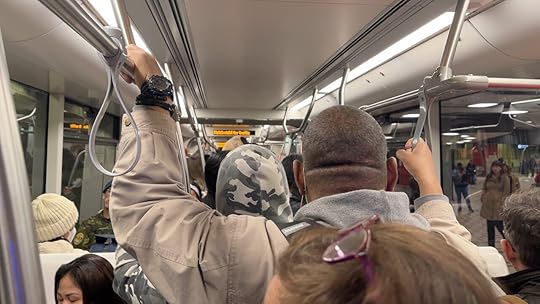
The federal government has just announced that it is spending over $300 million to buy the TTC electric buses and the infrastructure to power them. That's nice and all, and electric buses are cool, but with many TTC buses lying fallow, how about spending some more money on reversing the service cuts that are being forced on the TTC due to pandemic ridership losses and underfunding? We're falling into the trap that afflicted us in the early 90s: focusing spending on flashy capital projects while ignoring the day-to-day needs of service and maintenance. Shame. And it has consequences, which I illustrate below.
The title of this post is a West Wing reference, incidentally.
A week ago Monday, I delivered about 105 minutes of film to a professional film scanning company to finish phase two of my Richard Glaze 16mm Film Archive Digitization Project. The haul includes three 400-foot canisters from the late 1950s and twenty-six 100-foot reels from the mid-to-late 70s. The 1950s reels include footage of some of the last days of streetcar operations in Montreal and Ottawa. There's also some seventies footage of the Ontario Northland Railway; I hope it covers the time the government of Ontario purchased the Trans Europe Express equipment for their run from Toronto to Cochrane. I also had an excellent lunch with a friend and fellow railfan, so all in all an excellent and productive morning and early afternoon.
Getting back home was a bit of a haul. After exploring the city a little, I'm on the subway heading south towards Glencairn Station on my way to Union Station downtown when I hear an announcement that service is holding northbound at Glencairn "due to a medical incident". Not long after, the announcement was made that this incident had been resolved. My train wasn't even affected. However, not two stops later, it's announced that my train, and all after it, would be going out of service at St. Clair West Station and returning northbound. Apparently, subway service has been suspended from St. Clair West to St. Andrew (basically into the west side of downtown) due to "a trespasser on the track level at Spadina Station" further down the line.
We're in the early-middle part of rush hour at this point, so as the train goes out of service, and the others behind pull in and do the same, we're rapidly filling up the platform. They've promised shuttle buses, but I know from experience that these are hard to come by during rush hour. However, we can take the St. Clair Streetcar over to Yonge Street and board the parallel Yonge subway there. It might save time in the long run. While it works, I'm far from the only person to think this.
Getting onto the Yonge subway, we make good time southbound until we stop, again, this time at Dundas Station because of -- you guessed it! -- a medical incident (at the station, in fact, but not apparently on our train, as I didn't see or hear anything). Fortunately, the incident is cleared in about five minutes, so we head on our way. The total delay to my trip was about an hour.
Now, I was able to handle these incidents with good humour. Indeed, that was the state of mind of just about everybody who travelled alongside me. And none of these incidents could be said to be the TTC's fault. But to have three such disruptions happen within an hour... that's something.
And while I'm lucky enough to say that this is the first time this has happened to me while taking the TTC, I'm on enough boards and follow enough feeds to know that these incidents are not uncommon. Indeed some, like the "trespasser at track level" seem to be getting more common, and I'm worried that this may be indicative of societal stress and increasing mental health issues at work, here.
I mean, who goes onto the track level during rush hour and turns it into a security incident? Someone who is not coping well, I suspect, and is making a pretty loud call for help. And the medical issues that paused service? Could they have been fainting spells or, worse, heart attacks?
The therapists who talk to my kids, who talk to Erin, have told me they've seen a great increase in familial stress since the pandemic, and the pandemic has disrupted and continues to disrupt, the provision of medical services, including and especially mental health services. And we have governments, particularly one governing this province, who when people are calling for help, are focused on cutting costs, who have made our medical system worse, not better.��
I worry that we are under pressure and that these pressures are increasing. And just when we most need support and backup, our governments and particular political forces seem hell-bent on taking that away.
We can do better. I know we can because we used to. And we have to do better. If we have to raise taxes to do it, so be it.
April 16, 2023
Spiders of Toronto
 It's heartening in this day and age to discover that the Internet can still surprise you in pleasant ways.
I've been working on another educational book assignment during my off hours. This one is those high-interest publications for grade school students about Predators! With an exclamation point. These assignments come up from time to time, they're usually quick work for me, and they help keep my hand in when it comes to publishing. I do have a goal of having 100 books published with my name on them, and I think I've got less than twenty titles to go.
Because these books are designed to be slotted into school curriculums, they tend to follow similar patterns: a series of short, to-the-point, action-heavy chapters highlighting some key facts, and finishing off with links to further resources, such as websites, or other books to read.
Unfortunately, this latter part has become more challenging in recent years. The publishers want to offer up links to other educational and age-appropriate books. It goes without saying that they should be professionally published. It used to be an easy thing to do a search on your subject matter in Amazon's children's book category and select some of the most recent titles that are there. Unfortunately, with Amazon's embrace of independent publishing (not that I'm objecting to people having a venue to publish what they wish), the noise-to-signal ratio has gotten to the point where professionally-made alternate titles are hard to find -- especially if your publisher (reasonably) asks that the alternate material be up-to-date and not published before, say, 2017. The same is unfortunately true with finding additional web resources, though links to more general sites such as the San Diego Zoo usually serve.
It was during this search for alternative resources about spiders that I discovered this link deep, deep within my Google Search on educational resources about spiders. Spiders of Toronto appears to have been published some years ago (this site suggests 2013) as part of the City of Toronto Biodiversity Series. It goes on at length about the spiders we're likely to find in the city and the ecological benefits they provide. Along the way, it busts a few myths and tries to change a few minds.
Unfortunately, I can't point to this publication as an alternative resource, as it's too old for the audience. It's also something of an accident that I'd found it; I don't think it's even meant to be there.
I hadn't heard about this series, but there are other publications, including for birds, trees, shrubs and vines, fishes, butterflies, mammals, and reptiles and amphibians, all on the City of Toronto website. What I haven't found, at least with what searching I've done, is the landing page that links to all of these publications. This suggests to me that this page has been overwritten or vanished, leaving the PDF publications behind on the server, to be stumbled upon by accident as I did.
I always enjoy such discoveries of Internet treasures that would otherwise be lost and forgotten. Indeed, I'm thinking they might be worth downloading and saving, possibly until the Toronto Archives is ready to accept them for preservation...
April 6, 2023
Stand by Me and Classic Culture

So, one of the things that wrankles most about growing old is how much the pop culture of your childhood is turned into "classic" culture. It's like, for a GenXer, the music of Buddy Holly and the Beatles is ancient history, whereas Kate Bush is the anthem of your generation growing up. What do you mean Kate Bush's Running Up that Hill is now classic rock? WHAT DO YOU MEAN IT WAS RELEASED ALMOST 40 YEARS AGO?!
Anyway, we have a diner in Kitchener-Waterloo called Mel's that leans into classic 50s chic, with posters of classic movies like Attack Of the 50ft Woman adorning the walls. Photos of classic movie scenes and actors like Cary Grant adorn the sneeze shields between the booths.
Which brings me to the photo above taken of the divider between our booths at Mel's and why I'm tagging Wil Wheaton on this toot (originally composed in Mastodon). Wil, you may recall, is an actor, a tech personality and all-round decent guy known for portraying young Wesley Crusher in the series Star Trek: The Next Generation. Recently Mel's has been updating themselves. Not the look -- everything is reassuringly familiar and the food is good -- just the movies they've chosen. Like this scene, from the film Stand by Me, starring Wil Wheaton.
I can only imagine how it might feel to find your face suddenly on the walls of a themed diner that recalls a classic era.
Then again, he happens to be a few weeks younger than me.
April 4, 2023
Creativity and Working Around Ablest Language
Given that one of the novels I'm working on, The Sun Runners features a major character who becomes an amputee, I thought it wise to pay a sensitivity reader to look over my manuscript to ensure that I wasn't being offensive or condescending. For those who don't know, sensitivity readers are an increasing feature of the professional fiction writing industry, as they help catch and prevent incidents where we authors, writing in our ivory towers, make a hash out of other people's cultures and experiences. And as our society is changing and developing rapidly, this includes uses of terms that may have seemed perfectly acceptable back in our day, but are basically slurs now.
If you think we're too sensitive in this day and age, I ask you to recall my post entitled Yesterday wherein I note that while many of us (myself included) often yearn to go back to years before when times were simpler and we all knew what's what, the fact is that for many people, ethnic minorities, LGBTQ+ individuals, and more, yesterday was not better than today, because they were expected to just take the crap dished out by the establishment and shut up about it. The fact that they aren't willing to do so today and are calling people out about it is a good thing, because why should anybody take that sort of crap? Why should anybody be seen as less than who they are? And if being called to respect equality feels like oppression to you, that's your privilege talking.
My sensitivity reader generally liked my story and my portrayal of the amputee character. She did note some word usages that I had to change. What surprised me was the number of incidences of ablist language in my manuscript where I used terms that derogatively referred to mental illness. (Content warning for the sentence ahead) Phrases like "are you crazy/nuts/insane" recall put-downs of people with mental health issues, and it's increasingly being considered a slur. Note this article in Penn Medicine News for more details.
The issue is, there are people with mental health issues that are commonly referred to in these terms, and these same terms are often also applied to bad people - villains, antagonists, and so on, and these terms are too often used to make people with mental illness feel less human than what they are. Think for a moment the number of slurs out there that attack people with physical ailments and impairments. Are these at all acceptable? Good people, I think, largely say these aren't so, so why would the use of similar loaded and derogatory terms be used against people with mental ailments and impairments?
So I support the call to change our vocabularty so we don't use these words as often as we do, and let me say that, in writing, this is a challenge. Because when you are dealing with antagonists or accomplices acting outrageously in action scenes, there is a strong, strong desire to respond with a phrase that basically says "are you operating under a set of parameters that differs from objective reality?"
But that's no excuse. Indeed, it should be an opportunity to get creative. Especially in science fiction, a properly placed idiom not only adds colour to the scene, it builds the world you are trying to create. Which is why, when one of my characters asks the lead character if she is operating under a set of parameters that differs from objective reality, she says, "Are you oxygen-deprived?"
I will toss this out into the world. Hopefully, it does its job without demeaning classes of people. And it might give your science fiction story a bit more colour as well. We'll see.
You're also welcome to use the "are you operating under a set of parameters that differs from objective reality?" line as well. Possibly at Trump supporters.