
Paul Rodney Turner's Blog, page 9
December 5, 2013
Nelson Mandela -- The passing of a great friend and hero to the world
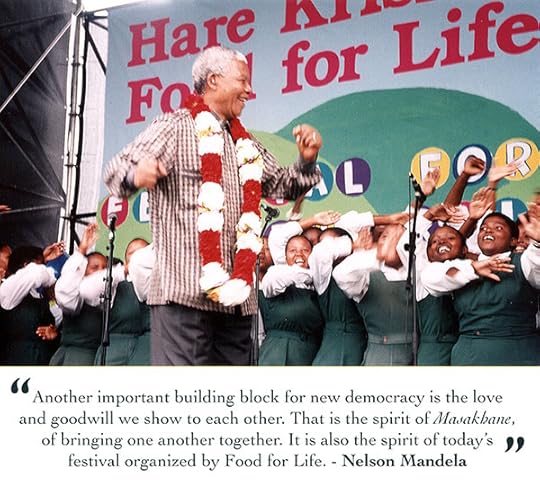
Nelson Mandela (1918 - 2013) was a great supporter and believer in what Food for Life stood for. He made the above statement at a gathering of 40,000 school children who were invited by Food for Life to a public picnic in Durban. Mr. Mandela was the honourable guest. He later told his colleagues that it was the most wonderful day of his life. To him, the gathering of so many children from diverse backgrounds for a picnic, symbolised what his whole political career had been aiming towards -- unity and equality for all. Mr. Mandela was so touched by the joy of the children that he could not contain himself and danced with them for many minutes before giving his touching speech to inaugurate the event. The children were served a vegetarian feast and the day was a grand success.
At the same picnic, Thabo Mbeki (Deputy President of South Africa), commented:
"FOOD FOR LIFE is the real Reconstruction and Development Programme. The understanding that if I have a plate of food, let me share it with my neighbour . . . let those who are feeling sad come together with us, and together we can share this burden. This understanding should be taken from FOOD FOR LIFE and transmitted to the entire country."On this sad day of the passing of a great human being, we bow down to Mr. Mandela and offer our heartfelt gratitude for his kindness, compassion and extraordinary vision. One way to measure the success of your life is to see how many people's lives you have improved just by you having lived. Well in Mr. Mandela's case, we can see he achieved that measure of success many millions of times over. God bless him!
Source: Food for Life Global


November 30, 2013
The Wisdom of Hindsight POEM

Jaggy, my darling, so sweet and kind,With piercing brown eyes and an inquiring mind, You enter my soul, deeply, and tickle my heart, and make me never want to leave you, or be far apart…
From your loving embrace, on a cold Winter's day, or your caresses on my neck, during the warmth of May,and your sweet words in my ear, as I look at the stars, and we debate, if the celestial object is Venus or Mars.
And you tell me, "No, it's not a planet, it's a star you fool,I'm a scientist, I've got a degree…go back to school!"I now surrender to your wisdom, as you kiss me on the neck, and I throw my hands to the sky and say, "What the heck…
"It doesn't really matter, because I'm with you tonight,"as we embrace each other tightly and appreciate the light, that rains down above from that celestial orb, as it soaks us in wisdom, and allows us to absorb…
The wisdom of hindsight, from past things gone wrong, We know what to do now, as we sing our song,of unity in diversity, as cultures clash,and intellects fuse, and hearts smash…
And become merged in a pool of love divine, As the heat of our passion creates a dessert so fine, and we relish the taste, and the joyous bond, as the Goddess waves her magic wand.
November 22, 2013
Food for Life Director featured in AUSTRALIAN YOGA LIFE

First printed Australian Yoga Life and put the www.ayl.com.auNourishing the soulSitting on a beach in Sri Lanka at the beginning of his world tour earlier this year, Food For Life (FFL) Global director Paul Rodney Turner was quietly reflecting on his life journey. “I pondered why I find myself travelling so much?” he wrote on his blog, Travel Diary of a Food Yogi. “Why I can’t seem to settle? The easy answer to that is, because I can. I am single, without any debts and a worldwide mission.”
But there is more to this story. “Yes, I travel for those reasons,” he says. “However, I also travel because I am searching for ‘home’.”
What does home mean for this yoga devotee who was born and raised in Sydney’s western suburbs and who now directs the largest plant-based food relief organisation in the world? “In its purest definition home is the spiritual domain, or where the soul is most happy,” he says. “Since I am not qualified to be in the spiritual domain at this time, I can only hope to find a sense of home by being in a place of soul happiness.”
Turner believes that in order to be qualified to enter into the spiritual domain we need to achieve a state of purity whereby our consciousness can tune into a higher spiritual frequency. “Being in a place of soul happiness means that, until our consciousness is fixed in the higher spiritual frequency, we can at least relish our connections in this world in the purest way possible – through unconditional love,” he says.
With its slogan Uniting the World Through Pure Food, Food For Life Global operates on the hope that the liberal distribution of plant-based meals prepared with loving intention can help bring peace and prosperity to the world. Founded in India in 1974 by the International Society for Krishna Consciousness, its volunteers, who are currently active in over 60 countries, serve more than 1.5 million free meals daily through initiatives such as free food restaurants, home delivery services and school feeding programs. Responding wherever there is a need, the charity has also provided aid in many of the world’s worst natural disasters and war zones, including the 1994 war in Chechnya, the 2010 Haiti earthquake and the 2011 Japanese earthquake and tsunami.
“Life is all about connection, and the more we realise how important food’s role is in creating this connection, the happier we will all become,” Turner says.
Tall and lean with clear blue eyes and a handsomely weathered face, Turner is also an accomplished vegan gourmet chef, numerologist, yantrologist (talisman) designer, poet, sought-after speaker at vegetarian conferences, and author. On his current world tour he is working to expand Food For Life projects, along with conducting raw food workshops and promoting his book Food Yoga: Nourishing Body, Mind and Soul. Keen to impart to others what he has learned through his decades-long immersion in holistic vegan cooking, Turner wants to emphasise that the “spiritual and nutritional value” of food is not just about what foods you consume but how you consume them “Life is all about connection, and the more we realise how important food’s role is in creating this connection, the happier we will all become.” Turner’s initiation into the Vaisnava Bhakti yoga tradition over 30 years ago as well. “Your food choices impact you physically, emotionally and spiritually,” he says. “When you eat with a sense of awareness of the blessings of food and its power to transform and unite, you will find that this same awareness will follow you throughout your other activities, helping you to be wiser in your decisions.”
“Life is all about connection, and the more we realise how important food’s role is in creating this connection, the happier we will all become.”Early days Turner’s evolution into the ‘food yogi’ began when he was initiated into the Vaisnava Bhakti yoga tradition over 30 years ago as a teenager. At the age of 19 he moved to an artist commune in Sydney’s Blue Mountains where he was introduced to the fundamentals of Indian cooking by a former Hare Krishna monk. Searching for a sense of identity, Turner became a monk himself. “I always had an inquiring mind and wanted to know answers on karma and reincarnation,” he told me. By studying the Bhagavad Gita he believes he found the answers he was seeking. “The Krishna in the Bhagavad Gita wonderfully explains how the soul is eternal and that it can never be cut, burned or destroyed in any way,” Turner says. “Only the body perishes, but the soul – the seat of consciousness, lives on past the demise of this body, receiving a new body, which is determined by one’s state of mind at the time of death. I loved the idea that God would give us another chance if we made a mistake in this life.”
Turner learned to cook gourmet vegetarian food in his early years as a monk, and it wasn’t long before he was in charge of preparing the Sydney Hare Krishna temple’s Sunday Feasts, which attracted up to 300 guests. He was drawn to India’s Vedic culture of hospitality, whose ethos is that no-one should go hungry, and it was the example of their selfless capacity to provide food for the needy that inspired him to start his own food outreach program.
“My first service was helping to make meals for the free café that we used to have in Parramatta,” Turner said. “A few years after that I started my own Food For Life projects at Sydney University and Macquarie University, where I would provide a free vegetarian lunch for students. The students used to know me by Priya.” Turner quickly learned that food had the power to influence people. “Pretty soon, I was getting free advertising for my charity work through the local media department, having my recipes posted in the student newspaper and doing paid catering gigs for the Student Union meetings.” Following this success, he graduated to the mainstream media, where he worked to raise awareness for Food For Life through radio and television interviews, including a guest appearance on The Ray Martin Show.Social issues in OzAs Australia entered an economic recession in the early 1990s, Turner became troubled by what he saw as worsening social issues, such as high unemployment and the on-going destruction of the environment. “One of the things I now teach our Food For Life leaders is the importance of being relevant in the minds of the public,” he says. “I stress that whatever they do in their community, they must also try to target the social ‘weak point’.”
Turner sought funding from the federal government so that his charity could employ long-termed unemployed people to grow organic vegetables on Food For Life farms. Funding was granted and the project was a success, with participants leaving the program with extra skills and a newfound sense of confidence. Seeing the way this was able to strengthen what Turner saw as an example of a social weak point – resulting from Australia’s high unemployment – he says, “What this did for me personally was convince me that with just a little bit of creative thinking you can find a solution to any problem using food as your medium,” he said.
Another social weak point Turner identified was poor nutrition in children after he heard about local school children missing out on a proper breakfast because their parents had to leave for work early. He approached a school in Millfield, NSW, and offered to start a ‘Breakfast Club’ where students could come to school a little earlier and get a healthy breakfast courtesy of Food For Life. “We usually made fresh wholemeal pancakes, farm fresh milk, granola and fruit. It was a big hit with the children,” he recalls.
Current Food For Life programs operating in Australia include the Crossways Restaurant in Melbourne, which serves discounted food to the elderly and concession card holders, andthe Perth-based PAWS organisation, which is involved in food distribution and community gardens. Crossways manager Jay Vaghela says he and the eight volunteers working in the restaurantsupply around 300 discounted meals per day, with patrons benefiting from the healthy and nourishing food that is vegetarian and freshly cooked. “We also provide free meals for those who cannot pay,” Vaghela said, “provided they are ready to help us for at least half an hour on our request.” Volunteers are always needed, and “we engage them as per their availability in this ecstatic service to humanity,” he said.
It was the example of their selfless capacity to provide food for the needy that inspired him to start his own food outreach program.Sustainable food productionSuccesses like these have encouraged Turner to position Food For Life Global not just as a food relief agency but as a social change organisation as well. Keen to encourage sustainable food production rather than just food provision, the charity has developed farming and training projects in areas stricken by starvation, such as the Ruzzizi Valley Project in Congo where over 200 different varieties of organic crops are grown, harvested and sold. In talking about the project in an interview on the USA television program ‘Good People, Good Works’, Turner said the project was going very well – with sustainable use of land and over 2000 people employed. However he acknowledges that, with the United Nations stating there are upwards of one billion undernourished people in the world today, much more work is required.
Turner believes that a plant-based diet, which, according to the Smithsonian Institute, is more cost effective and environmentally friendly than a meat based diet, would go a long way towards solving the world-wide inequitable distribution of food. “The most damaging expression of selfishness is the growth of factory farming,” he says. “Of all the agricultural land in the US, nearly 80 per cent is used in some way to raise animals. Furthermore, to service the growing demand of animal agriculture, over 35 per cent of all grain production in the world is fed to livestock and not humans.” Orphanage initiatives An additional initiative of Food For Life Global is the running of several orphanages in Southern Asia, including the Gokulam-Bhaktivedanta Children’s Home in Sri Lanka. By providing safe accommodation and three balanced, vegetarian meals a day, the 150 children who live there are able to focus on their education as well as having improved physical health. During his current world tour Turner visited the orphanage and was very impressed. “We had to keep reminding ourselves that this was no ordinary school,” he said. “Some of the children were actually ‘war orphans’, having suffered the traumatic experience of seeing their parents killed in front of them. And yet, here they were, studying to be good Sri Lankan citizens, obviously satisfied in the warm loving embrace of this exceptional children’s home.”
The efforts of Food For Life Global have not gone unnoticed. World leaders and politicians such as former South African President Nelson Mandela and US senator Arlen Specter have given the charity glowing testimonials. And former Prime Minister of Chechnya, Salambek Hadjiev, was once quoted as saying, “I pray that your Food For Life Program will expand to bring about a peaceful world.”Tireless workIt is towards this goal that Turner and the thousands of Food For Life volunteers are tirelessly working. “By connecting with people through food, you can connect with them in every other way,” Turner says. “Food For Life Global therefore serves food indiscriminately, and by doing so, no-one is denied. Let the world come, we can feed them. All we really want from this effort is to see peace and prosperity in the world.”
I first read Food Yoga when I was seven months pregnant with my first child. As my yoga instructor had pointed out to me, it was a time to embrace the changes my physical body was going through. Shebelieved that an expectant mother’s body was like Mother Earth’s soil, and I should provide a positive, fertile environment that would be sustainable and nurturing. And reading Turner’s book inspired me to do just that. It left me wanting to consume the best and purest foods to nourish not only my own body and soul, but, more importantly, the body and soul of my unborn daughter as well.
Turner who has his own daily yoga routine says, “Food choices are an integral part of the yoga path because according to these same traditions the body is our personal temple. Imagine practicing yoga while feeding yourself nothing but meat, white breads, sugar and caffeine. No doubt, your mind and body would be completely disturbed by such a diet. It’s easy to see that a balanced, calm mind is much easier to attain if you nourish your body temple properly.”
One of the most important rules of food yoga, he says, is that of ahimsa, or the principle of non-violence. “The foods you eat should not cause harm to you or anyone else,” he says. “The naturalquestions therefore are: Is the food I am eating causing damage to my body? Was anyone or anything harmed unnecessarily in the creation or processing of this food? If the answer to either of these questions is “yes”, you are not practicing ahimsa and therefore not practicing yoga in truth.”
Turner puts this principle into practice by shopping for fresh produce at local organic markets and is happiest subsisting on a diet largely made up of green smoothies, kale salads, homemade dhals, fruit, and seed or nut patés.
Unlike many health food books, Food Yoga does not actually outline specific meals or special dietary guidelines to follow. Rather, Turner acknowledges that everyone has different needs and no one diet will suit all. What he does advocate, however, is that we should make the effort to incorporate more raw foods into our diets. “My personal experience has shown that the more live fruits and vegetables people eat, the more sensitive, intuitive and respectful of nature they become.”
But as much as Food Yoga is about making better food choices for yourself, it is also about sincerity and respecting the source of the food. It is about conscientiousness and being grateful for the food wereceive. And it is about nurturing our fellow human beings and acting selflessly with the food we have. “This is how one thanks Mother Nature in a practical sense,” Turner writes, “by feeding some of her children in gratitude to her. It is also another way of … acknowledging that all food is intended not for mere self-gratification, but for the greater good of all beings.”
It all comes back to Turner’s worldwide mission to promote the work of Food For Life Global. “Food For Life literally is a revival of India’s ancient Vedic culture of hospitality, which is based on the principle of equality,” he says. “We’re trying to teach people that we’re all brothers and sisters, we’re all part of one family … and we should respect every human being on the planet. If you honour the land, if you eat pure food, if you share this food in a loving way, you can literally transform villages, transform towns, and transform consciousness, because food is a very powerful medium of love.”
===========================Author Suvi Mahonen is a freelance writer with articles appearing in Practical Parenting and Child magazines, and The Weekend Australian. Her latest fiction was included in Griffith Review’s ‘Women and Power’ issue. www.redbubble.com/people/suvimahonen
FOOD YOGA - Nourishing Body, Mind & Soul
Get your ebook now for only $19.95 or softcover for $29.95 (350 pages)
October 20, 2013
Saint Francis of Assisi and Compassion for Animals
 Saint Francis of AssisiExcerpt from: FOOD YOGA - Nourishing Body, Mind & SoulA new book by Paul Rodney Turner, the Food YogiThere are basically two distinct schools of Christian thought: The Aristotelian-Thomistic school and the Augustinian-Franciscan school.
The Aristotelian-Thomistic school teaches that animals are here for our pleasure—they have no independent purpose. We can eat them; torture them in laboratories – whatever we feel is necessary for our survival. Most modern Christians embrace this form of their religion.
The Augustinian-Franciscan school, however, teaches that all living beings are brothers and sisters under God’s fatherhood. Based largely on the teachings of St. Francis, this platonic worldview fits neatly within the vegetarian perspective.
St. Francis felt a deep kinship with all of creation, addressing it as a “brother” or “sister,” firmly believing that everything came from the same creative Source.
His great compassion and respect for the animal world also manifest in his expression of hospitality during Christmas (1223):
And on Christmas Eve, out of reverence for the Son of God, whom on that night the Virgin Mary placed in a manger between the ox and the ass, anyone having an ox or an ass is to feed it a generous portion of choice fodder. And, on Christmas Day, the rich are to give the poor the finest food in abundance.Indeed, St. Francis’ respect for creation appeared to have no boundaries. It is said that he once removed worms from a busy road and placed them to the side so they would not be crushed under human traffic.
When mice ran over his table as he took his meals or over his body while he slept, he regarded the disturbance as a “diabolical temptation” which he met with patience and restraint, indicating his compassion towards other living creatures.
The Catholic Encyclopedia comments on his compassion:
St. Francis’ gift of sympathy seems to have been wider even than St. Paul’s, for we find no evidence in the great Apostle of a love for nature or for animals ... Francis’ love of creatures was not simply the offspring of a soft sentimental disposition. It arose from that deep and abiding sense of the presence of God. To him all are from one Father and all are real kin ... hence, his deep sense of personal responsibility towards fellow creatures: the loving friend of all God’s creatures.According to St. Francis, a lack of compassion for animals leads to a lack of mercy towards humans. “If you have men who will exclude any of God’s creatures from the shelter of compassion and pity, you will have men who will deal likewise with their fellow men,” he said.
These wise words ring true in a modern world that kills tens of billions of animals annually. It appears that a nonchalant attitude towards animals could indeed be the root cause of an indifference to the fact that nearly one billion humans go hungry every day.
The Reverend Basil Wrighton, who served as Chairman of the Catholic Study Circle for Animal Welfare in London, during the 1960s, called St. Francis “the greatest gentleman that Christianity has produced, in the strictest sense of the word.” Reverend Wrighton himself was a remarkable figure, writing in favor of vegetarianism, against animal experimentation, decades before the contemporary movement for animal rights emerged.
According to the Reverend Alvin Hart, an Episcopal priest in New York:
Many Georgian saints were distinguished by their love for animals. St. John Zedazneli made friends with bears near his hermitage; St. Shio befriended a wolf; St. David of Garesja protected deer and birds from hunters, proclaiming, ‘He whom I believe in and worship looks after and feeds all these creatures, to whom He has given birth.’ Early Celtic saints, too, favored compassion for animals. Saints Wales, Cornwall and Brittany of Ireland in the 5th and 6th centuries AD went to great pains for their animal friends, healing them and praying for them as well.One of the many anomalies of so-called civilized society is the convenient justification of some people to eat certain socially-acceptable forms of meat while simultaneously working to protect animals. Otoman Zar-Adusht Ha’nish*, said it this way:
It is strange to hear people talk of humanitarianism, who are members of societies for the prevention of cruelty to children and animals, and who claim to be God-loving men and women, but who, nevertheless, encourage by their patronage the killing of animals merely to gratify the cravings of appetite.----------
Otoman Zar-Adusht Ha'nish (1844–1936) was the founder of the religious health movement known as Mazdaznan, which is based on Zoroastrian and Christian ideas with special focus on breathing exercises, vegetarian diet and body culture.
FOOD YOGA - Nourishing Body, Mind & Soul

Get your ebook now for only $19.95 or softcover for $29.95 (350 pages)
October 19, 2013
Mind - Body Oneness
 Thich Nhat HanhExcerpt from
The YOGA of POOL
- Secrets to Becoming a Champion in Billiards and in Life
Thich Nhat HanhExcerpt from
The YOGA of POOL
- Secrets to Becoming a Champion in Billiards and in Life(by Paul Turner)
It is true that through the power of mind management we can affect physical reality; however, because we are ultimately a combination of both gross and subtle energy (yin and yang), it is also true that the mind will follow what the body tells it.
Buddhist monk Thich Nhat Hanh explains that by nurturing the oneness of body and mind, and by listening to our body, “we are able to restore our wholeness …. and as body and mind become one, we need only to calm our body in order to calm our mind.”
Just like the body, we need to feed and exercise the mind. Success talk is an effective way to do that. However, for this method to be truly effective, you must first understand that the mind is not you, but rather just another tool at your disposal that can either help you or hurt you. It can be your friend or your enemy. It’s your choice. Just as a knife in the hands of a criminal can be dangerous, that same knife in the hands of a trained surgeon can save a life. The knife is neither good nor bad; it is how we use it that matters. The same goes for the mind. Make it your friend from now on; believe in yourself and start playing great pool!
The perfect yogi is of “steady mind” says the Bhagavad Gita:
One who is not disturbed in spite of the threefold miseries*, who is not elated when there is happiness, and who is free from attachment, fear and anger, is called a sage of steady mind. (Bhagavad Gita - verse 2.56)
In the same way, a great pool player will be a master of his mind and will never become disturbed if behind in game or overly elated if he is in front. Free from attachment, fear and anger, his mind will be as calm as a great lake.
Later in the book, I will provide some confidence building exercises using techniques borrowed from Neural-Linguistic programming and other mind/body disciplines.
In the next chapter, we are going to focus more on the practical side of improving your game, beginning with learning the world’s best aiming system.
-------------------
*Threefold miseries are the miseries pertaining to the body and mind, miseries caused by other living entities, and miseries resulting from natural disaster.

Excerpt from The YOGA of POOL - Secrets to Becoming a Champion in Billiards and in Life
(by Paul Turner)
ORDER NOW
Softcover $19.95 (+ shipping)
 World's Best Aiming System (eBook)The YOGA of POOL (eBook)BONUS: 20 Inspiration Cards (print or carry on your phone)BUY NOW AT www.billiardstraining.com
October 18, 2013
Challenges make your love stronger

What doesn't kill you -- will make you strongI console myself, as I write this song…A song of the heart -- hardened over time,That longs for loving -- through romantic rhyme…
And the sweetness of affection, on a Winter's morn, And the sunflower's blessing, as a new day dawns,And the caress of a hand, on a neck so sore,As my heavy heart burdens, and the tears do pour…
From a soul awakened, to a new love once more,as the heavens open -- for you I adore,I finally found you -- after a lifetime quest, Well they say you have to be patient for that which is best.
I feel renewed and loved, like never before,As the rainbows form, across the dance floor,And we sway in harmony, to the most beautiful sound,As John Lennon sings "Stand by Me" -- our hearts are bound.
As one synergistic explosion -- of all things divine, We look into each other's eyes and say: You are mine!
(c) Paul Rodney Turner


