
Paul Rodney Turner's Blog, page 6
October 2, 2014
Gandhi's birthday -- What will You Do Today in His Honour?
SOURCE: FFL.ORG
Today marks the anniversary of one of the most famous and influential men of the modern era, Mohandas Karamchand Gandhi, born October 2, 1869.
Gandhi was the preeminent leader of Indian independence movement in British-ruled India. Employing nonviolent civil disobedience, he led India to independence and inspired movements for civil rights and freedom across the world. Today he is still revered for these actions and is most often associated with all kinds of movement and causes for peace, animal right and vegetarianism.
Many people are unaware that the Russian philosopher Leo Tolstoy was a key influence in Gandhi’s life. He once wrote “A Letter to a Hindu,” in which he said that only by using love as a weapon through passive resistance could the Indian people overthrow colonial rule. In 1909, Gandhi wrote to Tolstoy seeking advice and permission to republish his “A Letter to a Hindu” in Gujarati. Tolstoy responded and the two continued a correspondence until Tolstoy’s death in 1910 (Tolstoy’s last letter was to Gandhi). The letters concern practical and theological applications of nonviolence. Gandhi saw himself a disciple of Tolstoy, for they agreed regarding opposition to state authority and colonialism; both hated violence and preached non-resistance.
 The Farm Animal Rights Movement (FARM) popularised an event in honour of Gandhi’s birthday called World Farmed Animals Day, a day dedicated to exposing and memorializing the needless suffering and slaughter of farmed animals.
 Most recently, there has been a campaign spreading through social media for people to fast today in memory of the tens of billions of animals killed ever year. Although this is certainly noble, the question must be asked: Is that the best we can do? Will this actually help? My feeling is it won’t have as much impact as people assume. Simply because the powerful corporations that run this world will continue pushing for more and more animal agriculture and one day of lower sales is not going to halt that momentum.
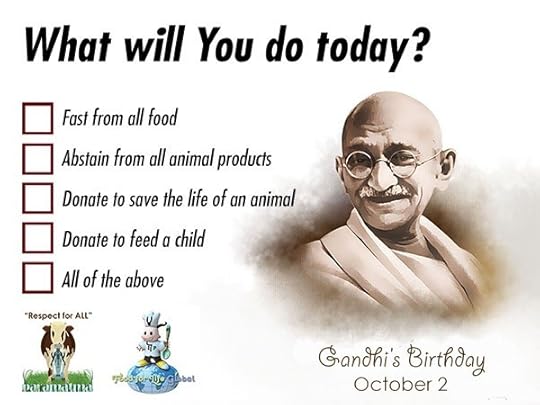
So I propose we do more than just fast, which is essentially inaction. Why not support causes like Food for Life and Paramatma Animal Sanctuary that are taking action to change the way people eat and think about food. Here is your check list today. The more ticks you add here, the greater your actions will be today in creating the peaceful world men like Gandhi and Tolstoy dreamed about.


September 20, 2014
The Teachings of Saint Francis are alive and well in Colombia!
Source: Food for Life Global
There are basically two distinct schools of Christian thought: The Aristotelian-Thomistic school and the Augustinian-Franciscan school.
The Aristotelian-Thomistic school teaches that animals are here for our pleasure—they have no independent purpose. We can eat them; torture them in laboratories – whatever we feel is necessary for our survival. Most modern Christians embrace this form of their religion. And sadly so do most people these days. We live in a very cruel and uncaring world, where animals are routinely slaughtered in the millions every day, with an estimated 150 BILLION being killed annually.
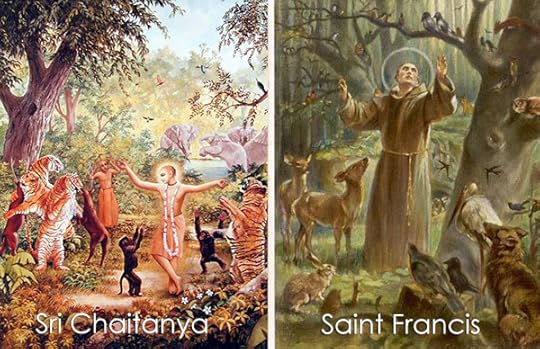
The Augustinian-Franciscan school, however, teaches that all living beings are brothers and sisters under God’s fatherhood. This is similar to the teaching of the great saint Sri Chaitanya, revered as an incarnation of Krishna by the Vaisnava tradition. Like Saint Francis before him, he also spoke to animals and even danced with tigers in the Jarikanda forest of India.
St. Francis felt a deep kinship with all of creation, addressing it as a “brother” or “sister,” firmly believing that everything came from the same creative Source. While Sri Chaitanya taught that all living beings are spiritually equal, but due to karma they appeared in one type of body or another for the time being. "All souls were evolving through different species," he said.
Saint Francis' great compassion and respect for the animal world also manifest in his expression of hospitality during Christmas (1223):
The Catholic Encyclopedia comments on his compassion:
These wise words ring true in a modern world that kills 150 billions animals annually. It appears that a nonchalant attitude towards animals could indeed be the root cause of an indifference to the fact that nearly one billion humans go hungry every day. There is something fundamentally wrong here and yet most of humanity just goes on as if everything is fine and dandy with how we sustain our bodies.
The Reverend Basil Wrighton, who served as Chairman of the Catholic Study Circle for Animal Welfare in London, during the 1960s, called St. Francis “the greatest gentleman that Christianity has produced, in the strictest sense of the word.” Reverend Wrighton himself was a remarkable figure, writing in favor of vegetarianism, against animal experimentation, decades before the contemporary movement for animal rights emerged. According to the Reverend Alvin Hart, an Episcopal priest in New York: "Many Georgian saints were distinguished by their love for animals. St. John Zedazneli made friends with bears near his hermitage; St. Shio befriended a wolf; St. David of Garesja protected deer and birds from hunters, proclaiming, ‘He whom I believe in and worship looks after and feeds all these creatures, to whom He has given birth.’
Early Celtic saints, too, favored compassion for animals. Saints Wales, Cornwall and Brittany of Ireland in the 5th and 6th centuries AD went to great pains for their animal friends, healing them and praying for them as well."
One of the many anomalies of so-called "civilized society" is the convenient justification of some people to eat certain socially-acceptable forms of meat while simultaneously working to protect animals. Otoman Zar-Adusht Ha’nish*, said it this way: "It is strange to hear people talk of humanitarianism, who are members of societies for the prevention of cruelty to children and animals, and who claim to be God-loving men and women, but who, nevertheless, encourage by their patronage the killing of animals merely to gratify the cravings of appetite."
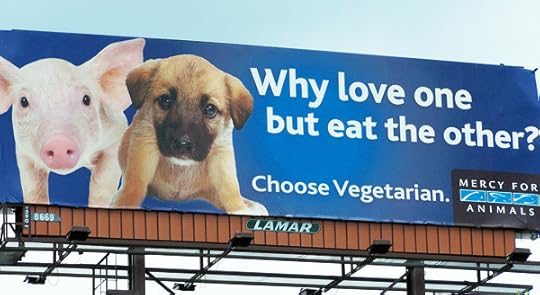
A recent ad campaign by Mercy for Animals sheds light on the hypocrisy of the modern diet.
My question is: why discriminate? How is it acceptable in one country to eat a cow and sleep with a dog and in another country to worship a cow and eat a chicken and in another to eat a dog. None of this makes sense. We cry out for peace and yet allow the wholesale slaughter of our animal "brothers and sisters" to go on unchallenged. If you really want peace in the world, start avoiding violent foods like meat, fish, eggs and commercial dairy.
Paramatma Animal Sanctuary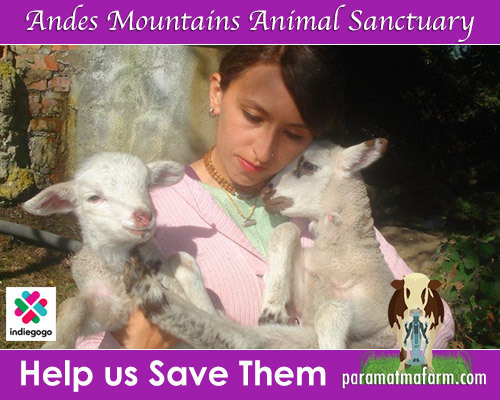
One project that has recently affiliated with Food for Life Global is trying to teach people by example that all animals deserve love and respect. Paramatma Animal Sanctuary located in the Andes Mountains just outside of Bogota, Colombia was founded by Juliana Castaneda and her friend Ekala das. The project founders were inspired by the teachings of Saint Francis from early childhood. The shelter is home to 34 abused and neglected animals, including one cow, one ox, one horse, 21 dogs, seven cats, 1 rooster, 1 lab rabbit, 1 quail and 1 lab rat. Juliana talks about some of the animals she has saved:
Seeing the good work of this project and the founder's sincere efforts to teach a culture that has become defined by animal slaughter, Food for Life decided to help this project when an an unlucky turn of events led to them losing the farm. Food for Life Global sponsored a crowdfunding campaign to raise funds to build a new shelter for the animals and allow Juliana and Ekala to continue educating the South American public.
Juliana tells her story
Paramatma is a Sanskrit word meaning “God in the heart.”Param: Supreme; Atma : Soul. So the main objective of our animal shelter is to teach the world that God is in the heart of all living beings.
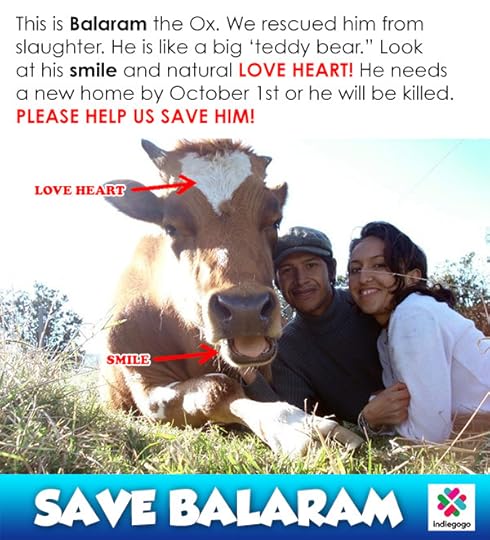
"While Ekala (above left) takes care of all the needs of the sanctuary, feeding the animals, cleaning, fixing broken fences, caring for their health and medicine, etc, I spend all my time earning money to support the shelter. On the weekends, however, I am also helping with the manual labour of caring for these animals. It is incredibly hard work," explains Juliana.
If you love animals; if you believe they are our brothers and sisters; if you believe they deserve love and respect, then please get behind this project and help Juliana and Ekala!
GO NOW to Help Juliana Build a New "No Kill" Animal Shelter
*Otoman Zar-Adusht Ha’nish (1844–1936) was the founder of the religious health movement known as Mazdaznan, which is based on Zoroastrian and Christian ideas with special focus on breathing exercises, vegetarian diet and body culture.
There are basically two distinct schools of Christian thought: The Aristotelian-Thomistic school and the Augustinian-Franciscan school.
The Aristotelian-Thomistic school teaches that animals are here for our pleasure—they have no independent purpose. We can eat them; torture them in laboratories – whatever we feel is necessary for our survival. Most modern Christians embrace this form of their religion. And sadly so do most people these days. We live in a very cruel and uncaring world, where animals are routinely slaughtered in the millions every day, with an estimated 150 BILLION being killed annually.
The Augustinian-Franciscan school, however, teaches that all living beings are brothers and sisters under God’s fatherhood. This is similar to the teaching of the great saint Sri Chaitanya, revered as an incarnation of Krishna by the Vaisnava tradition. Like Saint Francis before him, he also spoke to animals and even danced with tigers in the Jarikanda forest of India.
St. Francis felt a deep kinship with all of creation, addressing it as a “brother” or “sister,” firmly believing that everything came from the same creative Source. While Sri Chaitanya taught that all living beings are spiritually equal, but due to karma they appeared in one type of body or another for the time being. "All souls were evolving through different species," he said.
Saint Francis' great compassion and respect for the animal world also manifest in his expression of hospitality during Christmas (1223):
Indeed, St. Francis’ respect for creation appeared to have no boundaries. It is said that he once removed worms from a busy road and placed them to the side so they would not be crushed under human traffic. When mice ran over his table as he took his meals or over his body while he slept, he regarded the disturbance as a “diabolical temptation” which he met with patience and restraint, indicating his compassion towards other living creatures.And on Christmas Eve, out of reverence for the Son of God, whom on that night the Virgin Mary placed in a manger between the ox and the ass, anyone having an ox or an ass is to feed it a generous portion of choice fodder. And, on Christmas Day, the rich are to give the poor the finest food in abundance.
The Catholic Encyclopedia comments on his compassion:
According to St. Francis, a lack of compassion for animals leads to a lack of mercy towards humans. “If you have men who will exclude any of God’s creatures from the shelter of compassion and pity, you will have men who will deal likewise with their fellow men,” he said. Similarly, the Russian writer and philosopher, Leo Tolstoy believed that by killing animals, "a man suppresses in himself, unnecessarily, the highest spiritual capacity - that of sympathy and pity towards living creatures like himself - and by violating his own feelings becomes cruel."St. Francis’ gift of sympathy seems to have been wider even than St. Paul’s, for we find no evidence in the great Apostle of a love for nature or for animals … Francis’ love of creatures was not simply the offspring of a soft sentimental disposition. It arose from that deep and abiding sense of the presence of God. To him all are from one Father and all are real kin … hence, his deep sense of personal responsibility towards fellow creatures: the loving friend of all God’s creatures.
These wise words ring true in a modern world that kills 150 billions animals annually. It appears that a nonchalant attitude towards animals could indeed be the root cause of an indifference to the fact that nearly one billion humans go hungry every day. There is something fundamentally wrong here and yet most of humanity just goes on as if everything is fine and dandy with how we sustain our bodies.
The Reverend Basil Wrighton, who served as Chairman of the Catholic Study Circle for Animal Welfare in London, during the 1960s, called St. Francis “the greatest gentleman that Christianity has produced, in the strictest sense of the word.” Reverend Wrighton himself was a remarkable figure, writing in favor of vegetarianism, against animal experimentation, decades before the contemporary movement for animal rights emerged. According to the Reverend Alvin Hart, an Episcopal priest in New York: "Many Georgian saints were distinguished by their love for animals. St. John Zedazneli made friends with bears near his hermitage; St. Shio befriended a wolf; St. David of Garesja protected deer and birds from hunters, proclaiming, ‘He whom I believe in and worship looks after and feeds all these creatures, to whom He has given birth.’
Early Celtic saints, too, favored compassion for animals. Saints Wales, Cornwall and Brittany of Ireland in the 5th and 6th centuries AD went to great pains for their animal friends, healing them and praying for them as well."
One of the many anomalies of so-called "civilized society" is the convenient justification of some people to eat certain socially-acceptable forms of meat while simultaneously working to protect animals. Otoman Zar-Adusht Ha’nish*, said it this way: "It is strange to hear people talk of humanitarianism, who are members of societies for the prevention of cruelty to children and animals, and who claim to be God-loving men and women, but who, nevertheless, encourage by their patronage the killing of animals merely to gratify the cravings of appetite."
A recent ad campaign by Mercy for Animals sheds light on the hypocrisy of the modern diet.
My question is: why discriminate? How is it acceptable in one country to eat a cow and sleep with a dog and in another country to worship a cow and eat a chicken and in another to eat a dog. None of this makes sense. We cry out for peace and yet allow the wholesale slaughter of our animal "brothers and sisters" to go on unchallenged. If you really want peace in the world, start avoiding violent foods like meat, fish, eggs and commercial dairy.
Paramatma Animal Sanctuary
One project that has recently affiliated with Food for Life Global is trying to teach people by example that all animals deserve love and respect. Paramatma Animal Sanctuary located in the Andes Mountains just outside of Bogota, Colombia was founded by Juliana Castaneda and her friend Ekala das. The project founders were inspired by the teachings of Saint Francis from early childhood. The shelter is home to 34 abused and neglected animals, including one cow, one ox, one horse, 21 dogs, seven cats, 1 rooster, 1 lab rabbit, 1 quail and 1 lab rat. Juliana talks about some of the animals she has saved:
Seeing the good work of this project and the founder's sincere efforts to teach a culture that has become defined by animal slaughter, Food for Life decided to help this project when an an unlucky turn of events led to them losing the farm. Food for Life Global sponsored a crowdfunding campaign to raise funds to build a new shelter for the animals and allow Juliana and Ekala to continue educating the South American public.
Juliana tells her story
Paramatma is a Sanskrit word meaning “God in the heart.”Param: Supreme; Atma : Soul. So the main objective of our animal shelter is to teach the world that God is in the heart of all living beings.
"While Ekala (above left) takes care of all the needs of the sanctuary, feeding the animals, cleaning, fixing broken fences, caring for their health and medicine, etc, I spend all my time earning money to support the shelter. On the weekends, however, I am also helping with the manual labour of caring for these animals. It is incredibly hard work," explains Juliana.
If you love animals; if you believe they are our brothers and sisters; if you believe they deserve love and respect, then please get behind this project and help Juliana and Ekala!
Visit Juliana's campaign page and donate even $1 dollar to her new shelter. "Surely you have $1 in your pocket," says Juliana. "My animals don't have pockets."Animals depend on us to speak up for them; to show them our love and respect. They are innocent children and they are just as much a member of God’s family as we are.
GO NOW to Help Juliana Build a New "No Kill" Animal Shelter
*Otoman Zar-Adusht Ha’nish (1844–1936) was the founder of the religious health movement known as Mazdaznan, which is based on Zoroastrian and Christian ideas with special focus on breathing exercises, vegetarian diet and body culture.
September 5, 2014
The core value of the Pitt's personal family mission is charged with spiritual truth
 Brad and Angelina's wedding cake was made by their 10 year-old adopted son Pax.I love this family for a few reasons: 1) They have made a point of celebrating diversity and the equality of all human souls; 2) They take action to make the world a happier place; 3) They are not controlled by public opinion; 4) They live their life with truth and harmony at the core.
I feel strongly that the cure for all social ills is to embrace the truth of spiritual equality. Putting all religious dogma aside and deleting all "isms" from our life, we just need to honour this one truth to find true peace and happiness. You see, by embracing the concept of spiritual equality comes real unity and this leads us to the question: "What is the Source of that truth that unites us all?" In this way, the purpose of life and the identity of that Absolute Truth can be finally revealed.
In my book FOOD YOGA - Nourishing Body, Mind & Soul , I explore the idea of spiritual equality in detail. Essentially, it means to see the spiritual spark within all beings; the core essence of consciousness; the 'thing' that animates us and makes us a living being. Science may be able to tell us how the machine of the body works down to the cellular level, but one thing they have failed to fully explain is what is that 'thing' that drives the machine. In other words, who is the 'driver' of the body-machine?

Most spiritual literature speak of a soul, but usually it is framed as, "you have soul," rather than, "you are the soul." And these are two very distinct viewpoints. One is saying, you have some magical component that makes you alive and the other viewpoint clearly establishes you as something more than a body - a superior energy to the gross elements that make up the mortal machine. The ancient Vedas clearly side with the latter and rightly so, for whatever your belief is, one thing that cannot be denied is that the body is essentially dead without consciousness and consciousness, for all we understand about it, appears to be a symptom of that magical component, many of us call a "soul."
Vedic Scholar Srila Prabhupada comments:
The soul is full of knowledge, or full always with consciousness. Therefore, consciousness is the symptom of the soul. Even if one does not find the soul within the heart, where he is situated, one can still understand the presence of the soul simply by the presence of consciousness. Sometimes we do not find the sun in the sky owing to clouds, or for some other reason, but the light of the sun is always there, and we are convinced that it is therefore daytime. As soon as there is a little light in the sky early in the morning, we can understand that the sun is in the sky. Similarly, since there is some consciousness in all bodies — whether man or animal — we can understand the presence of the soul.The goal of self-realisation practices therefore must be to cleanse the mind and to become aware of yourself as a soul. Sadly, this is often not the case, and most people simply shoot for peace of mind and sense control and don't take it any further than that.
The Srimad Bhagavatam elaborates:
When one is completely cleansed of the impurities of lust and greed produced from the false identification of the body as "I" and bodily possessions as "mine," one's mind becomes purified. In that pure state he transcends the stage of so-called material happiness and distress. At that time the soul can see himself to be transcendental to material existence and always self-effulgent, never fragmented, although very minute in size.The key difference here is not the process one uses for self-realisation, but the goal. However, we first have to at least embrace the truth of spiritual equality. As long as one thinks that their soul is somehow superior to another soul, then progress cannot be made. Really, this idea is just a dressed up version of the same mundane trappings of bodily consciousness. In FOOD YOGA I make this point:
The important thing to realize is that ultimately we are not Christian, Hindu, Vaisnava, Muslim, Zoroastrian, Jewish, or Buddhist, all of which are just superficial designations; rather, we simply are. You and I are unique individuals. There is no need to put a label on who you are. Nor is there a need to define you by some church, temple, synagogue, community, gender, race or religion. You are who you are –a fragment of the splendor of God. We are actually little gods and goddesses having a human experience. Commentator of the Gita, Srila Prabhupada explains:
The entire cosmic manifestations, moving and nonmoving, are manifested by different activities of Krishna’s energy. In the material existence we create different relationships with different living entities who are nothing but Krishna’s marginal energy, but under the creation of prakrti (Sanskrit: Material Nature) some of them appear as our father, mother, grandfather, creator, etc., but actually they are parts and parcels of Krishna. As such, these living entities who appear to be our father, mother, etc., are nothing but Krishna. In this verse the word dhata means “creator.” Not only are our father and mother parts and parcels of Krishna, but their creator, grandmother, and grandfather, etc., are also Krishna. Actually any living entity, being part and parcel of Krishna, is Krishna. (Bhagavad-gita As It Is, Purport Verse 9.17)It is examples like the above that help us to re-evaluate our priorities and decisions in life. The Pitt family may not be the most religious people you'll ever find, but the core value of their personal family mission is charged with spiritual truth. We are all souls, equal in the eyes of God. No one is better than anyone else. The more we believe that the more peace and prosperity there will be in this world and this will surely set the stage for successful self-realisation.
To learn more about FOOD YOGA or my holistic life coaching visit: www.foodyogi.org
September 1, 2014
Food Yogi featured chef at Bogota Food and Wine Festival

I was chosen as one of the special guest chefs at the Food & Wine festival in Bogota, Colombia (August 27-31). The festival is held all over the world and has been held in Bogota the last 3 years. There were 40 International chefs to participate in this prestigious culinary festival, but I was the only Australian chef and one of only two chefs presenting a vegan dish over the 4 days. On Saturday, the main day of the festival, over 200 of Bogota’s luminaries came out to have breakfast made by Crepes and Waffles founder, Beatriz Fernandez, Dr-Cow Pablo Castro and then myself.The event kicked off with Beatriz Fernandez welcoming the attendees and sharing her philosophy on intentional cooking and the importance of preparing meals with love. She pointed to me and told the audience how happy she was to have him was looking forward to hearing about food yoga. Next Beatriz demonstrated one of her restaurant’s signature wraps. Pablo Castro “Dr Cow” followed her presentation with a demonstrator on how to make a raw vegan granola and sesame milk. Then my fiancé Juliana Castañeda and I took the stage and while Juliana translated, I wowed the crowd with a raw vegan chocolate mousse and toasted granola, while explaining the essence of what Food Yoga is: connecting with food in such a way as to nourish our body, mind and soul. The audience was immensely pleased with his talk and many said it was the highlight of the event.

Source with more PHOTOS: http://www.ffl.org/2014/director-of-food-for-life-a-featured-chef-at-bogota-food-and-wine-festival/
August 21, 2014
An Animal Sanctuary that touches the core of what Saint Francis of Assisi taught
I rarely endorse projects that are not my own, so this is one I fully believe in and think is well worthy of support.
Check out their web site: www.paramatamafarm.com
And their IndieGoGo Crowdfunding Campaign: http://igg.me/at/saveanimalsnow
Check out their web site: www.paramatamafarm.com
And their IndieGoGo Crowdfunding Campaign: http://igg.me/at/saveanimalsnow
August 4, 2014
New Food for Life Documentary Released: Uniting the World Through Pure Food
The world's largest plant-based food relief has a unique mission -- the solution for world peace . This new documentary features some of the primary feeding programs the charity has around the world, including the Food for Life Annamrita midday meal project that feeds school children across India. Currently Food for Life Global affiliates serve up to 3 million meals daily with projects in over 60 countries.The documentary follows Food for Life director Paul Rodney Turner around the world, including India, Fiji, Hungary, and New Zealand as he shares the unique mission of Food for Life through its outreach work. Uniting the World Through Pure Food Run time: 26:45
Created by: Paul Rodney TurnerTo learn more about Annamrita featured in this video visit:
http://www.annamrita.orgSee us on FACEBOOK: http://www.facebook.com/foodforlifeglobal[image error]
July 29, 2014
The Food Yogi INTERVIEWED on the YOGA TalkSHOW
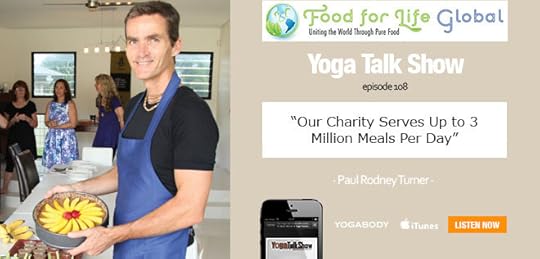
 EPISODE 108How to Serve 2 Million Meals on a Daily Basis and Change the World
 If you cannot see the audio controls, your browser does not support the audio element Prefer to download? Download
 Email ThisPaul Rodney Turner, the “Food Yogi” is the international director of Food for Life and the co-founder of Food for Life Global, the world headquarters for the charity.Food for Life is the largest plant-based food relief project in the world with helping people in over 50 countries and serving up to 2 million meals daily.In this Show, You’ll learn:Why Paul is called the “food yogi” and what it means to him.How Food for Life is serving millions of meals to people in need.The easy and hard things of having been a monk for 14 years.How food can be meditative and spiritual.Links & References from the ShowFood for LifeFood YogiPaul Turner[image error]
July 16, 2014
How to make a healthy snack bar for your children
As parents we cringe sometimes when our kids ask us for a particular snack bar that we know is not really as healthy as advertised. In fact, this is the case for the majority of health bars in the supermarket. Most are filled with artificial flavours, corn starch or fake fruits.
So how do you make a really healthy snack bar for your kids without breaking the budget?
It starts with purchasing some key ingredients, like fresh medjool dates and brazil nuts. We then build our bar from there.
Here is a simple recipe that you can make in your kitchen processor in minutes that will make enough snack bars to fuel your kids passion for at least a week.
I intend to bring out a Food Yogi recipe book soon featuring easy-to-make meals that will not break your budget but help you add the nutritional punch we all need in this unhealthy modern lifestyle.
To get my FOOD YOGA - Nourishing Body, Mind & Soul book just head on over to www.foodyogi.org
[image error]
So how do you make a really healthy snack bar for your kids without breaking the budget?
It starts with purchasing some key ingredients, like fresh medjool dates and brazil nuts. We then build our bar from there.
Here is a simple recipe that you can make in your kitchen processor in minutes that will make enough snack bars to fuel your kids passion for at least a week.
I intend to bring out a Food Yogi recipe book soon featuring easy-to-make meals that will not break your budget but help you add the nutritional punch we all need in this unhealthy modern lifestyle.
To get my FOOD YOGA - Nourishing Body, Mind & Soul book just head on over to www.foodyogi.org
[image error]
July 7, 2014
DOWNLOAD a FREE Sri Yantra Wallpaper for your Desktop
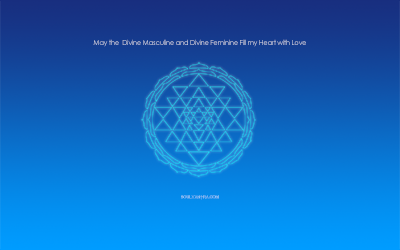
The Sri Yantra is the most powerful and most popular of all Yantras known to man. Essentially, it represents the divine masculine and the diving feminine in one beautiful and harmonous geomteric pattern. The upright triangles represent Siva (Masculine) and the downward triangles represent Shakti (Feminine). The marriage of these two symbols perfectly placed to create geometric harmony is what gives this yantra its power. Now you can have the power of this yantra on your desktop with 3 sizes to choose from.
 About the Sri Yantra?
 In the Shri Vidya school of Hindu tantra, the Sri Yantra ("sacred instrument", also Sri Chakra) [is a diagram formed by nine interlocking triangles that surround and radiate out from the central (bindu) point. It represents the goddess in her form of Shri Lalita Or Tripura Sundari, "the beauty of the three worlds (Heaven, Earth, Hell)".[
according to whom?
] The worship of the Sri Chakra is central to the Shri Vidya system of Hindu worship. Four isosceles triangles with the apices upwards, representing Shiva or the Masculine. Five isosceles triangles with the apices downward, symbolizing female embodiment Shakti. Thus the Sri Yantra also represents the union of Masculine and Feminine Divine. Because it is composed of nine triangles, it is known as the Navayoni Chakra.[1] "These nine triangles are of various sizes and intersect with one another. In the middle is the power point (bindu), visualizing the highest, the invisible, elusive centre from which the entire figure and the cosmos expand. The triangles are enclosed by two rows of (8 and 16) petals, representing the lotus of creation and reproductive vital force. The broken lines of the outer frame denote the figure to be a sanctuary with four openings to the regions of the universe".[2]In a recent issue of Brahmavidya, the journal of the Adyar Library, Subhash Kak argues that the description of Sri Yantra is identical to the yantra described in the Śvetāśvatara Upanisad.[3]Together the nine triangles are interlaced in such a way as to form 43 smaller triangles in a web symbolic of the entire cosmos or a womb symbolic of creation. Together they express Advaita or non-duality. This is surrounded by a lotus of eight petals, a lotus of sixteen petals, and an earth square resembling a temple with four doors.[1] The various deities residing in the nine layers of the Sri Yantra are described in the Devi Khadgamala Mantra.[4]The Shri Chakra is also known as the nav chakra because it can also be seen as having nine levels. "Nine" comes from "Nau or Nava" of Sanskrit. Each level corresponds to a mudra, a yogini, and a specific form of the deity Tripura Sundari along with her mantra. These levels starting from the outside or bottom layer are:[1]
In the Shri Vidya school of Hindu tantra, the Sri Yantra ("sacred instrument", also Sri Chakra) [is a diagram formed by nine interlocking triangles that surround and radiate out from the central (bindu) point. It represents the goddess in her form of Shri Lalita Or Tripura Sundari, "the beauty of the three worlds (Heaven, Earth, Hell)".[
according to whom?
] The worship of the Sri Chakra is central to the Shri Vidya system of Hindu worship. Four isosceles triangles with the apices upwards, representing Shiva or the Masculine. Five isosceles triangles with the apices downward, symbolizing female embodiment Shakti. Thus the Sri Yantra also represents the union of Masculine and Feminine Divine. Because it is composed of nine triangles, it is known as the Navayoni Chakra.[1] "These nine triangles are of various sizes and intersect with one another. In the middle is the power point (bindu), visualizing the highest, the invisible, elusive centre from which the entire figure and the cosmos expand. The triangles are enclosed by two rows of (8 and 16) petals, representing the lotus of creation and reproductive vital force. The broken lines of the outer frame denote the figure to be a sanctuary with four openings to the regions of the universe".[2]In a recent issue of Brahmavidya, the journal of the Adyar Library, Subhash Kak argues that the description of Sri Yantra is identical to the yantra described in the Śvetāśvatara Upanisad.[3]Together the nine triangles are interlaced in such a way as to form 43 smaller triangles in a web symbolic of the entire cosmos or a womb symbolic of creation. Together they express Advaita or non-duality. This is surrounded by a lotus of eight petals, a lotus of sixteen petals, and an earth square resembling a temple with four doors.[1] The various deities residing in the nine layers of the Sri Yantra are described in the Devi Khadgamala Mantra.[4]The Shri Chakra is also known as the nav chakra because it can also be seen as having nine levels. "Nine" comes from "Nau or Nava" of Sanskrit. Each level corresponds to a mudra, a yogini, and a specific form of the deity Tripura Sundari along with her mantra. These levels starting from the outside or bottom layer are:[1]
Go Now to Download: http://soulyantra.com/sri-yantra-wallpaper/
[image error]
 About the Sri Yantra?
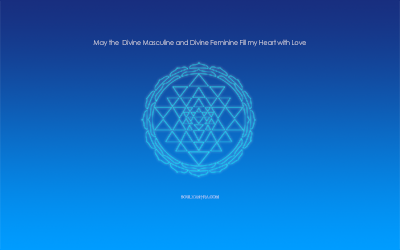
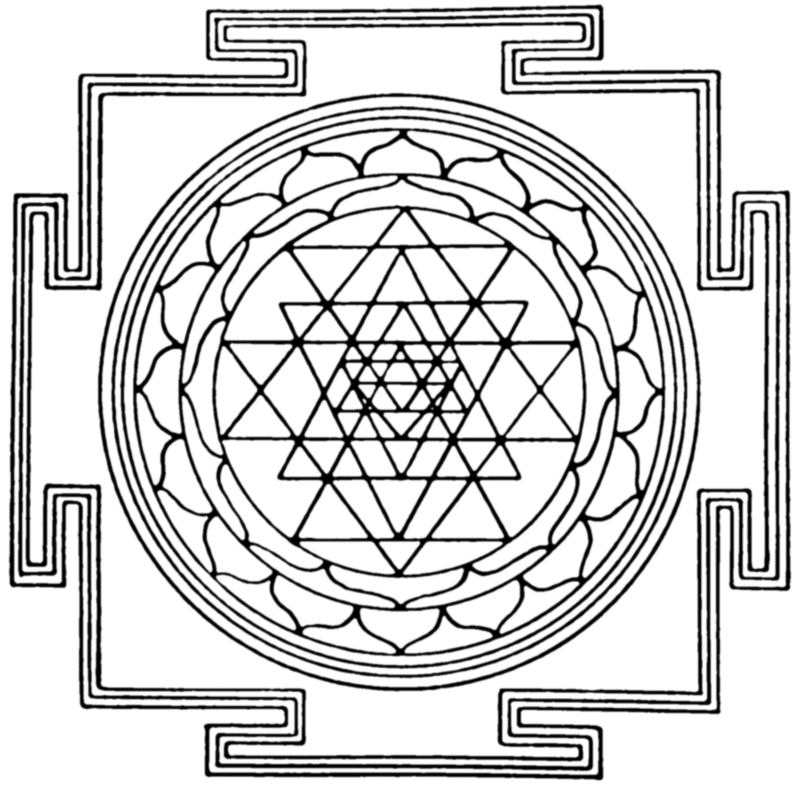 In the Shri Vidya school of Hindu tantra, the Sri Yantra ("sacred instrument", also Sri Chakra) [is a diagram formed by nine interlocking triangles that surround and radiate out from the central (bindu) point. It represents the goddess in her form of Shri Lalita Or Tripura Sundari, "the beauty of the three worlds (Heaven, Earth, Hell)".[
according to whom?
] The worship of the Sri Chakra is central to the Shri Vidya system of Hindu worship. Four isosceles triangles with the apices upwards, representing Shiva or the Masculine. Five isosceles triangles with the apices downward, symbolizing female embodiment Shakti. Thus the Sri Yantra also represents the union of Masculine and Feminine Divine. Because it is composed of nine triangles, it is known as the Navayoni Chakra.[1] "These nine triangles are of various sizes and intersect with one another. In the middle is the power point (bindu), visualizing the highest, the invisible, elusive centre from which the entire figure and the cosmos expand. The triangles are enclosed by two rows of (8 and 16) petals, representing the lotus of creation and reproductive vital force. The broken lines of the outer frame denote the figure to be a sanctuary with four openings to the regions of the universe".[2]In a recent issue of Brahmavidya, the journal of the Adyar Library, Subhash Kak argues that the description of Sri Yantra is identical to the yantra described in the Śvetāśvatara Upanisad.[3]Together the nine triangles are interlaced in such a way as to form 43 smaller triangles in a web symbolic of the entire cosmos or a womb symbolic of creation. Together they express Advaita or non-duality. This is surrounded by a lotus of eight petals, a lotus of sixteen petals, and an earth square resembling a temple with four doors.[1] The various deities residing in the nine layers of the Sri Yantra are described in the Devi Khadgamala Mantra.[4]The Shri Chakra is also known as the nav chakra because it can also be seen as having nine levels. "Nine" comes from "Nau or Nava" of Sanskrit. Each level corresponds to a mudra, a yogini, and a specific form of the deity Tripura Sundari along with her mantra. These levels starting from the outside or bottom layer are:[1]
In the Shri Vidya school of Hindu tantra, the Sri Yantra ("sacred instrument", also Sri Chakra) [is a diagram formed by nine interlocking triangles that surround and radiate out from the central (bindu) point. It represents the goddess in her form of Shri Lalita Or Tripura Sundari, "the beauty of the three worlds (Heaven, Earth, Hell)".[
according to whom?
] The worship of the Sri Chakra is central to the Shri Vidya system of Hindu worship. Four isosceles triangles with the apices upwards, representing Shiva or the Masculine. Five isosceles triangles with the apices downward, symbolizing female embodiment Shakti. Thus the Sri Yantra also represents the union of Masculine and Feminine Divine. Because it is composed of nine triangles, it is known as the Navayoni Chakra.[1] "These nine triangles are of various sizes and intersect with one another. In the middle is the power point (bindu), visualizing the highest, the invisible, elusive centre from which the entire figure and the cosmos expand. The triangles are enclosed by two rows of (8 and 16) petals, representing the lotus of creation and reproductive vital force. The broken lines of the outer frame denote the figure to be a sanctuary with four openings to the regions of the universe".[2]In a recent issue of Brahmavidya, the journal of the Adyar Library, Subhash Kak argues that the description of Sri Yantra is identical to the yantra described in the Śvetāśvatara Upanisad.[3]Together the nine triangles are interlaced in such a way as to form 43 smaller triangles in a web symbolic of the entire cosmos or a womb symbolic of creation. Together they express Advaita or non-duality. This is surrounded by a lotus of eight petals, a lotus of sixteen petals, and an earth square resembling a temple with four doors.[1] The various deities residing in the nine layers of the Sri Yantra are described in the Devi Khadgamala Mantra.[4]The Shri Chakra is also known as the nav chakra because it can also be seen as having nine levels. "Nine" comes from "Nau or Nava" of Sanskrit. Each level corresponds to a mudra, a yogini, and a specific form of the deity Tripura Sundari along with her mantra. These levels starting from the outside or bottom layer are:[1]Go Now to Download: http://soulyantra.com/sri-yantra-wallpaper/
[image error]
June 28, 2014
Graham Hancock Breaks the Set on TED Censorship, Lost Civilizations & War on Consciousness
A great interview by one of the world's leading philosophers and researchers on consciousness and the history of the human race. History or HIS STORY is really just an opinion promoted by self-serving elites that wish to keep the masses in ignorance and under their control. (13 min.) Worth watching.
For more: www.grahamhancock.com
[image error]


