Elspeth C. Young's Blog, page 8
November 17, 2012
2013 art calendar now for sale
 The Studios' 2013 engagement calendar/journal is now available for $27 (plus shipping).
Entitled At Home, this edition of the calendar features 53 inspiring quotations about the making and keeping of home, drawn from the writings of Al R. Young.
The 128 artworks in this full-color printing feature 51 original oil paintings by Al R. Young, Elspeth Young, and Ashton Young. Augmenting these images are 45 limited-edition lithographs by Al and Ashton, nine pen and ink drawings and block prints by Ashton, as well as seven of Al's exquisitely crafted pencil drawings.
Twelve watercolors from Elspeth's private portfolio are also featured as watermarks on the date pages throughout this edition.
 Printed on heavy paper, the book is bound with black plastic spiral and rests flat when open.
Each week in the calendar is accompanied by the kind of artwork and writing appearing in the sample pages, at right.
This is the 8th edition of the Studios' annual art calendar.


October 13, 2012
On the Easel: A Daughter of Ishmael

New painting in progress by Elspeth Young. All Rights Reserved.
Elspeth has several oil paintings in progress at the moment, but is nearing completion of another addition to the Studios' Book of Mormon Art Collection.
This painting celebrates the sacrifice and heroism of the daughters of Ishmael, who, in their devoted discipleship, left riches and comforts behind during a perilous eight-year desert journey to a Land of Promise. Nephi described their experiences simply and poignantly: "We had suffered many afflictions and much difficulty, yea, even so much that we cannot write them all" (1 Nephi 17:20); nevertheless, he concluded:
" . . . so great were the blessings of the Lord upon us, that while we did live upon raw meat
in the wilderness, our women . . . were strong, yea, even like unto the men; and they began
to bear their journeyings without murmurings. And
thus we see that . . . if it
so be that the children of men keep the commandments of God he doth
nourish them, and strengthen them, and provide means whereby they can accomplish the thing which he has commanded them; wherefore, he did provide means for us while we did sojourn in the wilderness (1 Nephi 17:2-3).
Accordingly, this painting symbolizes the hope that springs from doing the will of the Lord--a reminder that "sacrifice brings forth the blessings of Heaven" (Hymns, no. 27). Indeed, as the Lord promises all who journey through mortality: "I will go before your face. I will be on your right hand and on your left, and my Spirit shall be in your hearts, and mine angels round about you, to bear you up" (D&C 84:88). The young woman depicted has an expression of peace and hope, borne of the Spirit and her faith in Christ.


July 20, 2012
Highlights From Artistic Experience

I Will Uphold Thee (Mary Elizabeth and Caroline Rollins)
by Elspeth Young
Today commemorates the 160th anniversary of the event this painting depicts. The two courageous young women represented in this image saved stacks of precious pages of sacred text from a bloodthirsty mob hundreds strong. In honor of the day (and with Pioneer Day coming shortly), we thought readers might enjoy just a few highlighted entries from Elspeth's extensive painting log kept during the painting process in 2011:
9 August.
I had a very successful photo shoot with the models for the Book of Commandments painting. I have never had such fearless, good-natured models before. They reminded me of Helaman's stripling warriors who "performed every word of command with exactness" no matter the personal cost. In stifling heat they wore heavy costuming and bravely rolled about in the dirt with ants crawling all over them, while [still] maintaining character, dignity, and grace. The research and pre-production work on this painting has already taken six months.
20 August.
I finally put my brush to the panel and began painting . . . I began by blocking-in the sky. I want it to express the mob. While they are not physically present in the painting, I felt a stormy scene would communicate [the mob's] influence and presence. While I was painting it, I realized it also reminds the viewer of the Lord's words to Joseph Smith in Liberty Jail: "Though the Heavens gather blackness . . . all these things shall give thee experience." The sky block-in went well.
8 September.
I took my first assay into painting the corn field--I see that many hours will be expended in this way. I'ts quite a yellow, green, blue, ochre, white, and gray labyrinth."
9 September.
This painting represents a great many "firsts" for me--today was the first time I ever painted a set-in sleeve--at least where the shoulder sleeve is visible. Small tucks and gathers are new (but exciting) terrain. Spent a great deal of time doing what I call "watching" my painting: close observation, trying to absorb what is good and what needs work. I've decided to forgo any pattern on Mary's dress, as I believe any pattern would be visually visceral. . . I've never painted a fabric which reflects so many colors!
20 September.
[Continues to be] more hours of corn torture. What a fractal puzzle!
10 October.
[These weeks] have been many more hours of--you guessed it--CORN. But at last, I am beginning to be able to glaze and scumble to increase contrast and space and lighting.
28 October.
Today I began working on the corn in the foreground. It is amazing what it does to draw the viewer into the painting, even though (technically speaking) it actually divides the viewer from the figures. It is as though the viewer has to push his/her own way through a little corn to get to the action. I must confess I am besotted with this painting. I can't take my eyes off it!
19 November.
I have been working on refining the corn to Mary's right, and redoing the bonnet laces at Mary's throat. I wasn't happy with the former positioning and so I tacked the ribbon arrangement I wanted to my easel, attached a golden reflector next to it to simulate the correct sunset lighting, and have painted from life. Edging ever closer!
24 November.
I have taken pains to work on lightening Carloine's complexion with light greens, yellows, and blues. (Previously, in my painting she was favoring the coloring of a lobster.) I also pulled out the galley page facsimiles I made and worked from life to add texture to Mary's pages. I imitated the texture which naturally resulted from the models' activity [during] the photo shoot. It gives a wonderful feeling of authenticity not to have the pages white and pristine. They feel much more as though a mob handled them first.
30 November.
Well, the palette is clean, the last brush has been washed, and the painting is complete. I signed it in the lower right corner, using my usual mixture of cad yellow and scarlet.


June 15, 2012
New painting by Al features Nephi's faith and resourcefulness

Not Knowing Beforehand
The Things Which I Should Do
(Nephi the Patriarch)
by Al R. Young
Not Knowing Beforehand The Things Which I Should Do (Nephi the Patriarch) by Al R. Young is the newest
oil painting to be added to the Book of Mormon Collection of
original artworks from Al Young Studios. Forty five fine-art print
styles and sizes of this new image are now available at www.alyoung.com, ranging in price from $4.15 (4x5.75 poster print) to $780 (full-sized reproduction giclee canvas).
The original oil painting sells for $11,500, and is also available at alyoung.com.
Click here to see a larger copy of the new painting, read the artist's commentary, and look at the selection of available prints.
The image depicts the great pattern of faith and resourcefulness in
the life of Nephi, the son of Lehi. From his experience at the hands of
his brothers in a cave on the outskirts of Jerusalem (1 Nephi 3 - 4) to
the threat of starvation when his bow broke (1 Nephi 16), to time spent
in the mountains learning how to build a ship (1 Nephi 17 - 18), to the
threat of destruction upon the open sea, (1 Nephi 18), to his flight
into the wilderness when he fled from the land of his people's first
inheritance (2 Nephi 5), Nephi faced every wilderness of peril and
personal weakness by praying as though everything depended on the Lord,
and working as though it all depended on him.
Not Knowing Beforehand The Things Which I Should Do is the 12th original artwork in the Studios Book of Mormon Collection, and the 149th image in the
Studios commercially available fine-art portfolio.
The 45 open-edition prints of this new painting bring to 2,021 the number of prints and giclee canvases available at www.alyoung.com -- exclusive retail outlet for all of the artworks produced by the artists of Al Young Studios.


The window is the view
By Al R. Young
One of the pieces of advice I once received as a cub artist sounded quite savvy: "Paint to standard frame sizes. That way, you won't be out the expense of custom frames."
Savvy or not, the idea never worked for me. When I compose an image, I do so in terms of the way the visual elements and the image boundaries interact, the objective being that of creating a particular mood, which correlates with the way the eye moves over the image.
I suppose it is possible to start with a fixed size and proportion, but I choose not to be constrained in that manner because the constraint creates a preoccupation. Instead, I prefer to let the mood or the idea that wants expression in an image set its own bounds. After all, if I were a painting, that's the way I would want to be treated. At the very least, I would want the artist to know me better than I know myself, and, in setting bounds, ensure my happiness when I had come to know as much about myself as the artist knows.
The subject of composition, like the subject of eye movement, is wonderfully complex. I have never found, nor have I really wanted, a formula by which to compose my artworks. Composition is too creative, too much fun, to be formula-driven anyway.
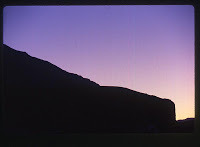
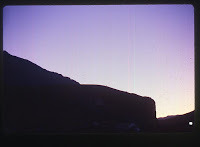
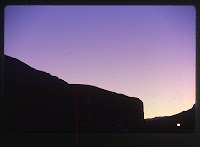
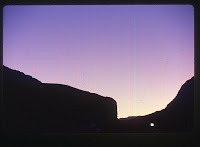
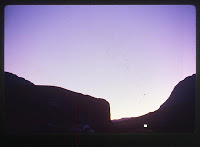
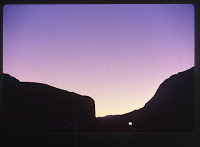
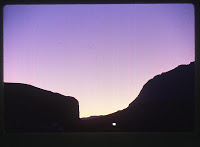
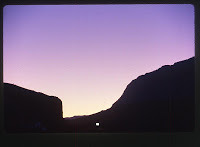
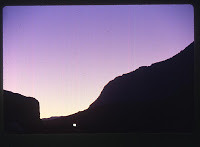
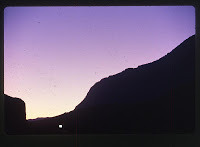
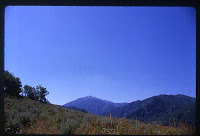
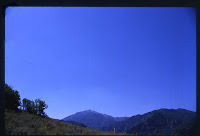
The following series of photographs that I took many years ago (when composition and eye movement were much on my mind and much on my reading list) is perhaps the simplest way I can think of to introduce the kind of activity involved in letting the idea for an artwork set its own boundaries.
While it may be difficult to look at these images without being preoccupied with "What am I looking at?" the point is not to identify the content, but to observe your own reaction to the relationship between the frame and the configurations of the elements in the frame. (The scene is a naturally occurring land form in the very early twilight of a sunrise. The white dot is a street light.)
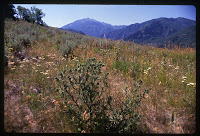
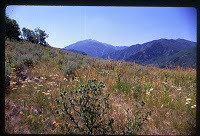
The following series of images presents the same kind of considerations, but with more readily recognizable content.
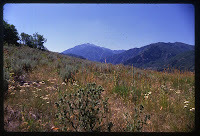
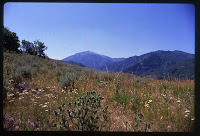
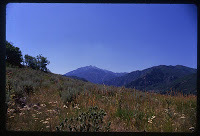
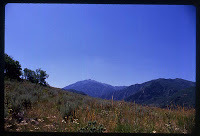
One of the most interesting discussions I ever encountered concerning the framing of visual art comes from the world of the comic strip. The author's comments opened my eyes to the fact that the size and proportion of the frames in a comic strip were manipulated according to the objectives of the artist who renders the images; that, like the manner in which a motion picture is edited, sequence, timing, and transition are paramount. (See, for example, The Art of the Comic Strip by Walter Herdeg and David Pascal, Zurich, The Graphis Press, 1972.)
The experience was like that of a friend of mine who, having spent several hours at the Louvre, said that after a while looking at innumerable paintings, he suddenly realized he had quit looking at the images and was, instead, looking at the frames. Of course, his point is not exactly the point, here, but it does accentuate the need to go back and forth in one's observations--while composing an image--in terms of the gestalt between the content of an image and its boundaries.
All of this bears directly upon the enormous task an artist faces in attempting to compress the experience of a motion picture, for example, into a single (gilded) frame.

One of the pieces of advice I once received as a cub artist sounded quite savvy: "Paint to standard frame sizes. That way, you won't be out the expense of custom frames."
Savvy or not, the idea never worked for me. When I compose an image, I do so in terms of the way the visual elements and the image boundaries interact, the objective being that of creating a particular mood, which correlates with the way the eye moves over the image.
I suppose it is possible to start with a fixed size and proportion, but I choose not to be constrained in that manner because the constraint creates a preoccupation. Instead, I prefer to let the mood or the idea that wants expression in an image set its own bounds. After all, if I were a painting, that's the way I would want to be treated. At the very least, I would want the artist to know me better than I know myself, and, in setting bounds, ensure my happiness when I had come to know as much about myself as the artist knows.
The subject of composition, like the subject of eye movement, is wonderfully complex. I have never found, nor have I really wanted, a formula by which to compose my artworks. Composition is too creative, too much fun, to be formula-driven anyway.
The following series of photographs that I took many years ago (when composition and eye movement were much on my mind and much on my reading list) is perhaps the simplest way I can think of to introduce the kind of activity involved in letting the idea for an artwork set its own boundaries.
While it may be difficult to look at these images without being preoccupied with "What am I looking at?" the point is not to identify the content, but to observe your own reaction to the relationship between the frame and the configurations of the elements in the frame. (The scene is a naturally occurring land form in the very early twilight of a sunrise. The white dot is a street light.)


The following series of images presents the same kind of considerations, but with more readily recognizable content.


One of the most interesting discussions I ever encountered concerning the framing of visual art comes from the world of the comic strip. The author's comments opened my eyes to the fact that the size and proportion of the frames in a comic strip were manipulated according to the objectives of the artist who renders the images; that, like the manner in which a motion picture is edited, sequence, timing, and transition are paramount. (See, for example, The Art of the Comic Strip by Walter Herdeg and David Pascal, Zurich, The Graphis Press, 1972.)
The experience was like that of a friend of mine who, having spent several hours at the Louvre, said that after a while looking at innumerable paintings, he suddenly realized he had quit looking at the images and was, instead, looking at the frames. Of course, his point is not exactly the point, here, but it does accentuate the need to go back and forth in one's observations--while composing an image--in terms of the gestalt between the content of an image and its boundaries.
All of this bears directly upon the enormous task an artist faces in attempting to compress the experience of a motion picture, for example, into a single (gilded) frame.
June 8, 2012
Clever like a crab

Nathanael Greene
by Charles Wilson Peale, 1783
By Al R. Young
General Nathanael Greene, the brilliant commander of colonial forces in the south during the closing years of America's War for Independence, used retreat as a road to victory.
His strategy actually made an ally of the earth itself, enlisting in his cause the topography, climate, vegetation, and other natural features of the countryside. Of his strategy for defeating the forces of Cornwallis, Greene wrote:
"I run as fast backwards as forwards, to convince our enemy that we are
like a crab. We can run in any direction, as long as it is away."
Pursuing Greene imposed a terrible toll upon his opponent, far more than would have been the case had Greene engaged his opponent in the traditional manner. And when Greene did engage, the British paid dearly for victory, so dearly that the victory was hollow.
Greene was not sidetracked by the desire to appear to be winning the war. Undoubtedly, many armchair generals would have volunteered advice, much of it ostensibly well meant, but all of it calculated primarily on alleviating armchair anxiety.
Instead of being diverted by such pressures, Greene remained focused not only on his objective, but the only way he could achieve it -- given the impossibility of his circumstances.
A battle-seasoned sergeant once explained the principle this way, when talking to a group of trainees: "The main thing is to keep the main thing the main thing. Otherwise, you die!"


June 5, 2012
Studios anniversary recalls summer of '97
Annually, we celebrate two anniversaries associated with the
founding of Al Young Studios. Today’s
anniversary, the groundbreaking, commemorates the summer of 1997, which was our initial foray into work as a full-time studio artist.
We spent
that summer working on a series of illustrations for Victoria Magazine. The three-part series, consisting of excerpts from The
Country of the Pointed Firs, by Sarah Orne Jewett, appeared in the July, August, and September issues.


The series featured one of Al’s
pencil drawings and 13 of his lithographs (many of which were created
specifically for the project), as well as one of Ashton’s pencil drawings.
Today, the artworks are part of the High Valley Collection, the book continues to be a favorite, and, because of the people we worked with at Victoria, the experience of the summer remains an enduring treasure.


June 1, 2012
Platform added to $10 easel
One of the first major additions to the $10 easel, several years ago, was a retractable platform that serves as a step when the easel is used for a tall painting, and as a bench when we need more seating in the studio.
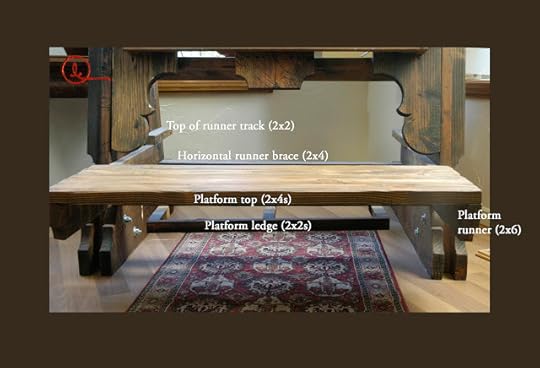
The platform rests on the top of the foot at the base of each side of the easel. The top of the track for the platform consists of a 2x2 (labeled "top of runner track" in the foregoing photograph). Note that the runner track shown, here, only allows the platform to be pulled out about 18 in., and that great care must be taken to ensure--before stepping onto the platform--that the back of each runner is inside the top of the track; otherwise, the platform gives way. Longer 2x2s would allow more of the platform to be exposed, but we chose not to install them.
In the foregoing photograph, the "platform ledge" is used only to hold the bottom of particularly tall paintings that are also narrow enough to fit inside the width of the platform runners. Most paintings can rest on a ledge clamped to the face of the easel.
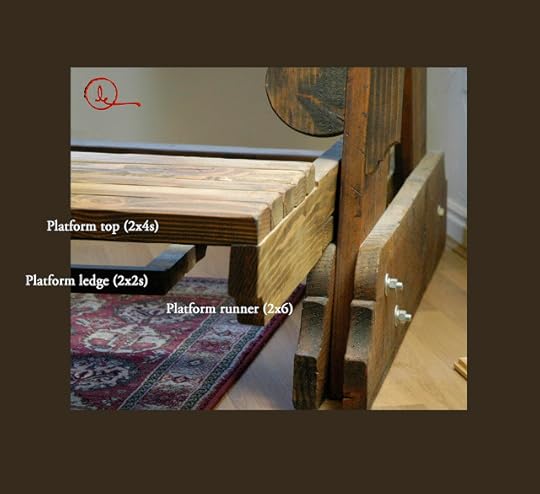
The following photograph shows a little more detail from a side view of the platform.
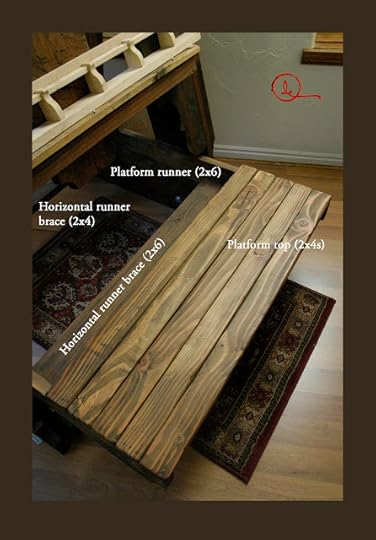
The next photograph shows the extended platform from the top. The "horizontal runner brace (2x4) is the back of the platform. The "horizontal runner brace (2x6) near the middle of the platform is the cross-member to which the "platform ledge" is attached.
The last photograph shows the back of the platform from inside the easel.
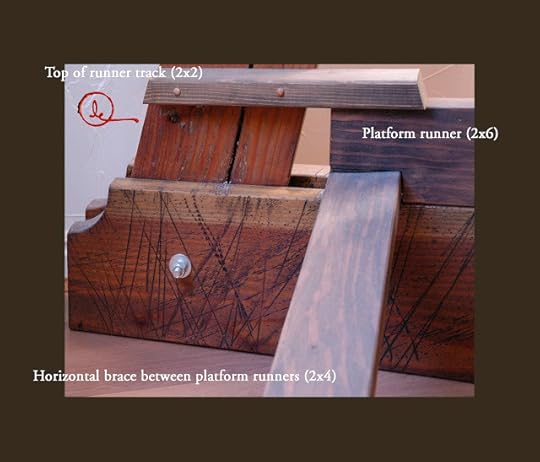
Grabbers were used as fasteners. Furniture wax greatly enhances the action of the platform.


The platform rests on the top of the foot at the base of each side of the easel. The top of the track for the platform consists of a 2x2 (labeled "top of runner track" in the foregoing photograph). Note that the runner track shown, here, only allows the platform to be pulled out about 18 in., and that great care must be taken to ensure--before stepping onto the platform--that the back of each runner is inside the top of the track; otherwise, the platform gives way. Longer 2x2s would allow more of the platform to be exposed, but we chose not to install them.
In the foregoing photograph, the "platform ledge" is used only to hold the bottom of particularly tall paintings that are also narrow enough to fit inside the width of the platform runners. Most paintings can rest on a ledge clamped to the face of the easel.
The following photograph shows a little more detail from a side view of the platform.

The next photograph shows the extended platform from the top. The "horizontal runner brace (2x4) is the back of the platform. The "horizontal runner brace (2x6) near the middle of the platform is the cross-member to which the "platform ledge" is attached.

The last photograph shows the back of the platform from inside the easel.

Grabbers were used as fasteners. Furniture wax greatly enhances the action of the platform.
May 11, 2012
Elspeth's new painting features Mary and the infant Messiah
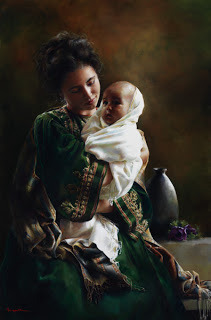
Bearing A Child In Her Arms by Elspeth Young
Bearing A Child In Her Arms (Mary and the Christ Child) by Elspeth Young is the newest
oil painting to be added to the Messiah Collection as well as to the Women of the Bible Collection of
original artworks from Al Young Studios. Forty three fine-art print
styles and sizes of this new image are now available at www.alyoung.com, ranging in price from $4.20 (4x6 poster print) to $569 (full-sized reproduction giclee canvas).
Click here to see a larger copy of the new painting, read the artist's commentary, and look at the selection of available prints.
The image is based on Nephi's vision of Mary and the infant Messiah, as recorded in 1 Nephi 11. Bearing A Child In Her Arms is the 20th original artwork in the Studios Messiah Collection, the 44th artwork in its Women of the Bible Collection, and the 11th in the Book of Mormon Collection It is also the 148th image in the
Studios commercially available fine-art portfolio.
The 43 open-edition prints of this new painting bring to 1,976 the number of prints and giclee canvases available at www.alyoung.com -- exclusive retail outlet for all of the artworks produced by the artists of Al Young Studios.


Fixed purpose

''Back Country'' by Al R. Young
By Al R. Young
Hiking in the mountains has been a favorite family pastime for many years. When the children were much younger, Mill Creek Canyon was a favorite haunt because instead of having to work hard just to get to the wooded shoulders of the hills, trails were relatively easy, safe for the children, and started in the woods surrounding the trailhead.
Like most trails that snake their way up into the mountains, much of the time along the way was spent with exposed roots and hillside rubble on one side of the path and a view into the attic of the forest on the other. But of all the many trails we hiked, I found my attention in Mill Creek drawn to trees that in their prime had suffered either a direct hit from a boulder, the falling of a nearby tree, or even a lightning strike.
Walking among them as a friend, I could almost hear their voices in the wind; and I could hear their silence, too, surrounded by the stories of their lives. It was sad to look upon the girth and straightness of so much dreaming and striving splintered on the forest floor, or broken like sectioned columns that in their fall had wrecked the limbs and spines of a companion's dreams of sky and wind and stars.
I also noticed, however, that from the mouldering debris of nearly every calamity, two or sometimes three spires of renewed hope, striving, and endurance rose as straight and strong as the first. And as I looked further, it struck me that this was as true for the tops of the trees as for their roots.
Few of the giants had made it to the roof of their world without the spent flame of their original intent being snapped off or withered. But just like the sinews of the roots, exposed along the trail (twining and growing ever onward until the obstacles in their path were clasped in the unyielding grasp of a fixed purpose), the tree's thwarted reaching at the fingertip of its first attempt had been turned instead into a hand extended heavenward.
I cannot think of those trees and their heavenward reaching throughout adversity, but what I also think of these lines from Alessandro Manzoni:
He who gave you so much happiness is everywhere, and never disturbs the joy of His children, except to prepare for them another greater and more certain. (From I Promessi Sposi, chapter VIII)