
Michael Brachman's Blog: Tales of the Vuduri, page 136
June 5, 2014
Science fiction as shorthand
I love science fiction. I like fantasy but I love science fiction. In the world of Rome's Revolution I don't even pretend that the genre does not exist. My hero, Rei, is a science fiction fan and constantly spouts off about it when needed.
Science fiction stories serve as a shorthand for me. For example, when Rei first thought of using the VIRUS units to defeat the Stareaters, the idea came (via OMCOM) from an H. G. Wells novel. Here is that scene:
“So find a way then. You can’t just let it go unchallenged.” Rei said.
“How?” Ursay croaked.
“Rei, perhaps you should tell them about H. G. Wells,” OMCOM offered.
“Which book?” Rei asked.
“War of the Worlds.”
Rei squinted, then opened his eyes wide. “You’re right, OMCOM!”
“What is it?” Rome asked.
“I know you guys don’t have fiction, but we did when I was growing up. One of the genres I loved reading was called science fiction which was speculation about possible futures.”
“How is this relevant?” Ursay asked. “The Overmind is familiar with the reference, but cannot see how it applies.”
“Well, there was a classic story, written in the 19th Century by a man called H. G. Wells. It was called ‘War of the Worlds.’ It was about an invasion of Earth by malevolent creatures from Mars.”
Rome just shook her head slowly. “Rei, there is no life on Mars,” she said to him in a didactic tone.
“Yes, I know, dear. That’s why it was called science fiction.”
“Go on,” said Ursay.
“Anyway, the creatures from Mars were all-powerful. No Earth weapons could touch them and it looked like they were going to conquer the planet and destroy all life.”
“So did they?” asked Rome.
“No. They were defeated,” Rei replied.
“How!?” Ursay insisted.
“By bacteria,” Rei answered. “They got sick and died.”
“So you are proposing that we send bacteria to make the Stareaters sick? How would such a thing be possible?” Ursay asked, exasperated.
“Not bacteria,” Rei said.
Of course, Rei was referring to the VIRUS units. By using this famous science fiction story as a reference, I did not have to explain the concept to you, the reader.
A similar situation is coming in my upcoming novel The Milk Run. Aason Bierak needs Junior to extend his "roadgrader" cannons and bore his way through the Jenga-block forest on Hades. He doesn't have time to explain the maneuver to Junior so he references the movie The Last Starfighter (a great movie if you've never seen it) and tells Junior to execute a 2D version of the "Death Blossom" which Junior proceeds to perform.

Pretty cool, huh?
Science fiction stories serve as a shorthand for me. For example, when Rei first thought of using the VIRUS units to defeat the Stareaters, the idea came (via OMCOM) from an H. G. Wells novel. Here is that scene:
“So find a way then. You can’t just let it go unchallenged.” Rei said.
“How?” Ursay croaked.
“Rei, perhaps you should tell them about H. G. Wells,” OMCOM offered.
“Which book?” Rei asked.
“War of the Worlds.”
Rei squinted, then opened his eyes wide. “You’re right, OMCOM!”
“What is it?” Rome asked.
“I know you guys don’t have fiction, but we did when I was growing up. One of the genres I loved reading was called science fiction which was speculation about possible futures.”
“How is this relevant?” Ursay asked. “The Overmind is familiar with the reference, but cannot see how it applies.”
“Well, there was a classic story, written in the 19th Century by a man called H. G. Wells. It was called ‘War of the Worlds.’ It was about an invasion of Earth by malevolent creatures from Mars.”
Rome just shook her head slowly. “Rei, there is no life on Mars,” she said to him in a didactic tone.
“Yes, I know, dear. That’s why it was called science fiction.”
“Go on,” said Ursay.
“Anyway, the creatures from Mars were all-powerful. No Earth weapons could touch them and it looked like they were going to conquer the planet and destroy all life.”
“So did they?” asked Rome.
“No. They were defeated,” Rei replied.
“How!?” Ursay insisted.
“By bacteria,” Rei answered. “They got sick and died.”
“So you are proposing that we send bacteria to make the Stareaters sick? How would such a thing be possible?” Ursay asked, exasperated.
“Not bacteria,” Rei said.
Of course, Rei was referring to the VIRUS units. By using this famous science fiction story as a reference, I did not have to explain the concept to you, the reader.
A similar situation is coming in my upcoming novel The Milk Run. Aason Bierak needs Junior to extend his "roadgrader" cannons and bore his way through the Jenga-block forest on Hades. He doesn't have time to explain the maneuver to Junior so he references the movie The Last Starfighter (a great movie if you've never seen it) and tells Junior to execute a 2D version of the "Death Blossom" which Junior proceeds to perform.
Pretty cool, huh?


June 4, 2014
Stareaters and spiral arms
In the original long form of Rome's Revolution, I had envisioned the Stareaters as this huge, malevolent force that represented the end of life. I wanted Rei's (OMCOM-aided) ingenuity to be responsible for constructing a defense, namely the VIRUS units.
I even wanted to make the Stareaters responsible for the spiral arms of the Milky Way and other galaxies, eating into them, causing the gaps:
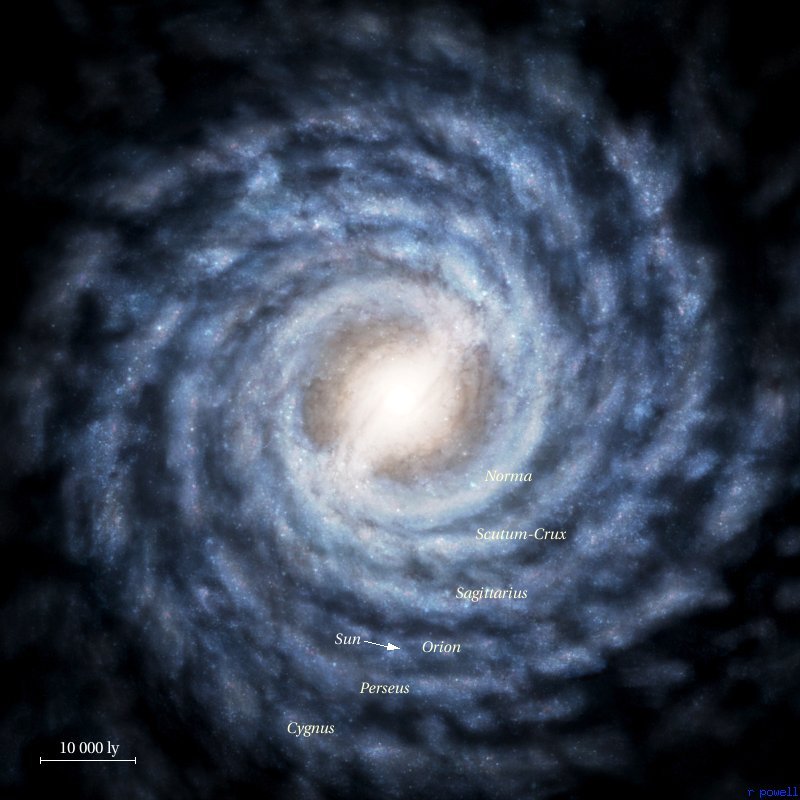
Here is the original take on that scene which presented this concept:
So I backed off, gave the Stareaters a purpose and let spiral arm galaxies just be a natural thing.
I even wanted to make the Stareaters responsible for the spiral arms of the Milky Way and other galaxies, eating into them, causing the gaps:
Here is the original take on that scene which presented this concept:
“Show us what you have,” said Ursay, hoarsely.When I crushed the three Rome's Revolution novels into an omnibus, it presented me with one of those rare opportunities to go back and rethink the preposterousness of the concept.
Rising above the plane of the ecliptic, a symbolic representation of the arms of the galaxy became noticeable. A bright yellow region appeared that followed the decreased density of stars between the spiral arms of the Milky Way. If the Stareaters were responsible for the gaps between arms, every galaxy had them, it would mean…
“How many of them are there?” Rome whispered.
“My probes are limited in number. This is just an estimate. It is possible that some of the stars disappeared for other reasons. But so far I have detected more than one thousand.”
So I backed off, gave the Stareaters a purpose and let spiral arm galaxies just be a natural thing.
June 3, 2014
Is the Algol part of a fleet?
In Rome's Revolution, the starship Algol plays an important role although it is usually in the background. I had always dreamed of it being this beautiful, graceful, awe-inspiring starship. Here is Rei's first view of the vehicle:
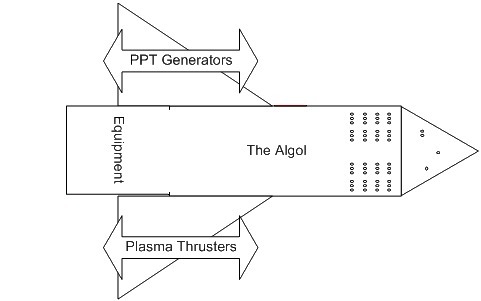
So, pretend it is graceful. Is the Algol one of a kind or is it part of the Vuduri deep space fleet? Answer: it is the flagship but part of a fleet. A similar ship, the Altair, had flown to the star Escobar to watch for Stareaters from above the galactic ecliptic.
After it returns to Earth, the Algol is used for many other missions. It will appear one last time in the upcoming novel The Milk Run. Its use and its passengers will surprise you.
Soon they were approaching the base. Rome circled around once and Rei saw the Algol for the first time. Unlike the silver tugs, this starship was a graceful white presence, smooth, shaped like a tapered hourglass with large wings and thruster pods mounted on the wingtips.And later, when Rei thought he was all alone in the universe, releasing the VIRUS units, he got to see it taking flight:
“Wow,” he said. “That is some kind of starship.”
When Rei got to 900 paces, he stopped because he could feel the ground shaking beneath him. At first, he thought it was another moonquake. He turned and looked back at the station. Off to his right, rising majestically above the rounded pyramid of the star-base was the Algol, pounding the dirt, whipping up the dust with its powerful EG lifters. The starship flew forward then executed a slow bank right until it came around and headed in his direction. He never realized how gigantic it was. The Algol was nearly half the length of the Ark II, but was much more graceful with huge thruster pods poised at the end of each airfoil. As it flew over his head, it waggled its wings. Rei raised his hand to acknowledge the gesture then stood by helplessly as it rose up into the air. After a short time, he saw it ignite the plasma thrusters and take off straight up. He watched it with tears once again welling up in his eyes as it became a tiny speck in the sky and then disappeared.Unfortunately, my skills as an artist are limited to Visio, meaning everything comes out blocky:
So, pretend it is graceful. Is the Algol one of a kind or is it part of the Vuduri deep space fleet? Answer: it is the flagship but part of a fleet. A similar ship, the Altair, had flown to the star Escobar to watch for Stareaters from above the galactic ecliptic.
After it returns to Earth, the Algol is used for many other missions. It will appear one last time in the upcoming novel The Milk Run. Its use and its passengers will surprise you.
June 2, 2014
Qubits
What is a qubit?
No, it isn't the unit of dimension for measuring Noah's Ark. That a cubit:

And no, it's not the video game with a little creature who uses a language all his own. That's Q*bert:

To understand a qubit, first you have to understand the computer term bit, which is a contraction of BInary digiT. A bit has two states: a one and a zero. It's at this level that all digital computers operate.
A qubit is a quantum bit which is actually an oxymoron. Qubits can simultaneously describe many values. They hold out both the possibility of a new generation of faster computing systems and the ability to create completely secure communication networks.
To see qubits in action, you should check out this article in which scientists have reported using entanglement to securely transmit data, possibly faster than the speed of light. In essence, they built a primitive version of a quantum computer. They produced qubits using electrons trapped in diamonds at extremely low temperatures.
You will recall in an earlier post, I discussed the death of Moore's Law and claimed the next leap forward in computing will be quantum computers. This is the type of computer that Rei Bierak took with him in Rome's Revolution and was featured in Rome's Evolution.
Also, don't forget, MASAL was built using the designs found after The Ark Lords were defeated. MASAL caused The Robot War among other unpleasantries. So be careful what you wish for!
No, it isn't the unit of dimension for measuring Noah's Ark. That a cubit:
And no, it's not the video game with a little creature who uses a language all his own. That's Q*bert:
To understand a qubit, first you have to understand the computer term bit, which is a contraction of BInary digiT. A bit has two states: a one and a zero. It's at this level that all digital computers operate.
A qubit is a quantum bit which is actually an oxymoron. Qubits can simultaneously describe many values. They hold out both the possibility of a new generation of faster computing systems and the ability to create completely secure communication networks.
To see qubits in action, you should check out this article in which scientists have reported using entanglement to securely transmit data, possibly faster than the speed of light. In essence, they built a primitive version of a quantum computer. They produced qubits using electrons trapped in diamonds at extremely low temperatures.
You will recall in an earlier post, I discussed the death of Moore's Law and claimed the next leap forward in computing will be quantum computers. This is the type of computer that Rei Bierak took with him in Rome's Revolution and was featured in Rome's Evolution.
Also, don't forget, MASAL was built using the designs found after The Ark Lords were defeated. MASAL caused The Robot War among other unpleasantries. So be careful what you wish for!
June 1, 2014
The mission to Tabit was a success
When Rei first met Rome in Rome's Revolution and he asked her why they were there, she told him that their mission to Tabit had failed.
“What do you do around here?” Rei asked. “What is this place, anyway? OMCOM said something about stellar cartography.”However, because of Rei's influence and invention of the star-probes, the crew at Tabit really did discover the cause of certain stars, Winfall in particular, disappearing. Once they had resolved that it was the Stareaters consuming stars, this was Ursay's reaction:
Rome sighed. “Yes. But no more. We have failed. We are leaving,” she said. Rome lowered her eyes to the floor.
“I don’t get it. Failed what?” Rei asked.
Rome took a deep breath and looked up at Rei. She started speaking again as if from a script. “We have been placed here to, eh, ipsarfa…”
“Observe.”
“…observe a certain venimani…phenomenon. We have not been able to do that.”
“What kind of phenomenon?” Rei asked.
“Many stars have disappeared.” Rome replied, clipping her fingers together then opening her hand flatly as if releasing pixie dust.
“What do you mean disappeared? I don’t understand,” Rei said for the hundredth time.
“Perhaps we will explain this to you later. For now, understand that this base was built to make certain observations. Those observations did not olumoner, no, that is not the word,” Rome shook her head. “Did not shed luz…”
“Light,” OMCOM corrected.
“…light on how it is happening. There was one star in particular called Winfall that we expected to go away. But it is long past the time when it should have disappeared. Winfall is still visible. So we are closing down this base. We are going back to… our home very soon.”
“We are abandoning this base. Now!” Commander Ursay said to Rome and moved to walk out of the room.So regardless of the outcome (and we know everybody lived happily ever after), in the purest sense, the mission to Tabit was a complete success. They did discover why the stars were disappearing. I wonder if the other base, at Escobar, figured out the same thing.
“Hold on a sec,” Rei shouted after him. “Why?”
Ursay turned back to him. “Because we must get this information to Earth,” Ursay said.
“Why?” Rei asked insistently.
“Because?” said Ursay shaking his head. “Did you not just see? Because there is a creature or creatures headed toward Earth that will destroy it.”
May 31, 2014
Are the Stareaters alive?
In a previous post, I examined the nature of life and posed the question, "Are the Stareaters alive?"
Here is the exact quote from that article:
We know that the Stareaters can be destroyed. We saw that at the end of Part 1 of Rome's Revolution but it still isn't clear if it was death or just a machine ceasing to function.
The Stareaters refer to themselves as Species 3. That very fact should tell you that they are alive rather than super-sophisticated machines but regardless, we will find out more about their nature and life-cycle in the upcoming novel The Milk Run.

Here is the exact quote from that article:
What about the Stareaters. Are they alive? Again, they meet the test of the above. They consume stars, they grow, they reproduce (we don't know whether it is sexual or asexual) and provide functional activity. But if they were merely sophisticated machines, like the VIRUS units, would they be alive? I can't even tell you if they die. They have not shared that with me.The first time that Rome, Rei and Ursay visualized a Stareater, the scene went like this:
OMCOM did not reply, but the virtual point of view panned across until a protrusion centered in the screen.Rei referred to the smaller sphere as a baby, although if their method of reproduction was mitosis, then a more accurate description might be clone as opposed to a child.
“Can you zoom in?” Ursay said.
“Of course,” OMCOM replied.
The bump became larger. The protuberance was spherical in nature and looked like it was grafted on, almost like a boil. Its surface resembled that of the much larger sphere.
“Bring us forward in time, slowly,” Ursay commanded.
“Advancing,” OMCOM said. The image stayed rock steady, but just like a balloon being inflated with a pump, the small protrusion became larger and larger until it was almost one quarter of the size of the Stareater. The object shuddered and then it disconnected from the larger sphere and moved off. In a wink, it was gone.
We know that the Stareaters can be destroyed. We saw that at the end of Part 1 of Rome's Revolution but it still isn't clear if it was death or just a machine ceasing to function.
The Stareaters refer to themselves as Species 3. That very fact should tell you that they are alive rather than super-sophisticated machines but regardless, we will find out more about their nature and life-cycle in the upcoming novel The Milk Run.
May 30, 2014
Balsa wood
Balsa trees grow naturally in the humid rain forests of Central and South America. You don't typically find a forest of balsa trees. They are kind of loners. They grow singly or in very small, widely scattered groups in the jungle.

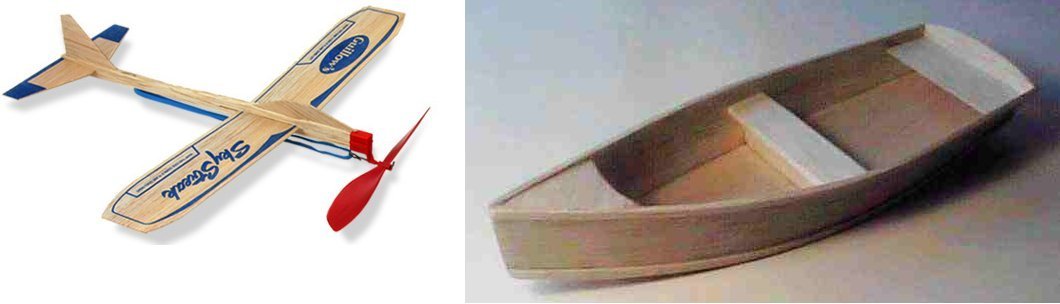
We are all familiar with balsa wood from our days of building model airplanes and other things.
You can even build a house out of it, or at least a toy house:
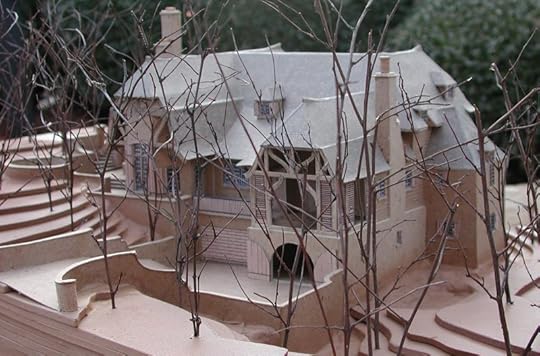
But could you build a real house out of it or would it take just one stiff wind and the thing would blow over? The "trees" or whatever you want to call them on the planet of Hades have about the same weight and tensile strength as balsa wood. We'll have to see how the colonists cope with having to use such a light material to build their homes.
We are all familiar with balsa wood from our days of building model airplanes and other things.
You can even build a house out of it, or at least a toy house:
But could you build a real house out of it or would it take just one stiff wind and the thing would blow over? The "trees" or whatever you want to call them on the planet of Hades have about the same weight and tensile strength as balsa wood. We'll have to see how the colonists cope with having to use such a light material to build their homes.
May 29, 2014
Chlorophyll
It could be argued that after DNA, chlorophyll is the most important complex biomolecule on the Earth. It is found in cyanobacteria, algae and plants and is responsible for absorbing energy and feeding these living entities. Of course we, as humans, are equally interested in its waste product, which happens to be oxygen. Without that, it'd be kind of hard to breathe.

On Earth, chlorophyll looks green because it absorbs the blue and red components of sunlight and reflects the leftover wavelengths which are mostly green. Interestingly, the molecular design of chlorophyll is very similar to that of hemoglobin.

I have no idea what that means. All I know is that leaves are green and it is very pretty in the summer.
What about on a world where the sun is a different color? For example, on Deucado, the star Tau Ceti is more orange that Sol. I postulated that the chlorophyll equivalent there would absorb slightly lower frequencies so the leaves or whatever they are would be more yellow, almost orange. In the planetary system of Nu2 Lupi, where much of the action of The Milk Run takes place, the primary star is also more yellow/orange so I imagine the light-absorbing material of the plants there is similarly yellow. The trees there are more like Jenga blocks than maples, however.
On Earth, chlorophyll looks green because it absorbs the blue and red components of sunlight and reflects the leftover wavelengths which are mostly green. Interestingly, the molecular design of chlorophyll is very similar to that of hemoglobin.
I have no idea what that means. All I know is that leaves are green and it is very pretty in the summer.
What about on a world where the sun is a different color? For example, on Deucado, the star Tau Ceti is more orange that Sol. I postulated that the chlorophyll equivalent there would absorb slightly lower frequencies so the leaves or whatever they are would be more yellow, almost orange. In the planetary system of Nu2 Lupi, where much of the action of The Milk Run takes place, the primary star is also more yellow/orange so I imagine the light-absorbing material of the plants there is similarly yellow. The trees there are more like Jenga blocks than maples, however.
May 28, 2014
Mini-nukes revisited
In a previous post, I told you about the chemical and explosive power of Thorium-235. This is a made-up substance with a long half-life yet radioactively powerful enough to set off a small atomic explosion. The book trailer for The Ark Lords shows you their destructive power.
[image error]
While they are very powerful, they are really just big-time explosives rather than full-blown atomic weapons. Their yield is only three tenths of a kiloton of explosive power. In fact, when the Darwin contingent on Deucado blew up Rome's Library, it was not even completely destroyed. This was Rome's observation of the destruction:
Interestingly, the larger sections of a regular Ark are several hundred feet across. So if you dropped a mini-nuke right in the middle, chances are the outer portions would be somewhat recognizable.
Who would do such a thing? You will have to wait until The Milk Run is finished to find out.
[image error]
While they are very powerful, they are really just big-time explosives rather than full-blown atomic weapons. Their yield is only three tenths of a kiloton of explosive power. In fact, when the Darwin contingent on Deucado blew up Rome's Library, it was not even completely destroyed. This was Rome's observation of the destruction:
“Oh no!” Rome cried out, pointing past the windshield. In the place where her library had stood, there was now a tremendous crater, several hundred feet across. Pieces of aerogel, bricks and other debris were scattered around the rim of the crater. Oddly, a small portion of the front wall remained. The rest of the building was simply gone. The trees circling beyond the edge of the crater had been knocked over, splayed outward in a radial pattern.You can see from the portion highlighted in bold that there were still recognizable fragments of the original building. Not everything was vaporized.
Interestingly, the larger sections of a regular Ark are several hundred feet across. So if you dropped a mini-nuke right in the middle, chances are the outer portions would be somewhat recognizable.
Who would do such a thing? You will have to wait until The Milk Run is finished to find out.
May 27, 2014
How does clay become ceramic?
Clay is not the same as soil. Clay is a naturally occurring substance that appears in pockets on or under the ground. The technical term for the main chemical components of clay are hydrous aluminum phyllosilicates. The operative word within the structure is silicates. There is silica in clay.
What happens when you fire silica in a high heat? It turns into glass. So what happens when you fire clay in a high heat, it turns into a type of glass often called a ceramic, a process known as vitrification. My brother Bruce takes a pottery class and we have a whole passel of mugs because of it:

Why do I bring this up? It is because in the upcoming novel The Milk Run, Aason Bierak and OMCOM come across large sections of soil, made of clay, that have been converted into a ceramic or vitreous-like substance.
The only thing that could have caused this was the repeated application of high heat. But where would you get such high heat on a cold world like Hades? That is a mystery which they must solve.
What happens when you fire silica in a high heat? It turns into glass. So what happens when you fire clay in a high heat, it turns into a type of glass often called a ceramic, a process known as vitrification. My brother Bruce takes a pottery class and we have a whole passel of mugs because of it:
Why do I bring this up? It is because in the upcoming novel The Milk Run, Aason Bierak and OMCOM come across large sections of soil, made of clay, that have been converted into a ceramic or vitreous-like substance.
The only thing that could have caused this was the repeated application of high heat. But where would you get such high heat on a cold world like Hades? That is a mystery which they must solve.
Tales of the Vuduri

Tidbits and insights into the 35th century world of the Vuduri.
- Michael Brachman's profile
- 21 followers

