
Luisa Weiss's Blog, page 19
May 17, 2013
Friday Link Love

We've had a run of gorgeous days here - the lilac bushes are heavy with blossoms, the night air is gentle and warm. My father is in town all week and Hugo's been having the time of his life with Grandpa - every day they head to the zoo, the park or the playground. When they come home, Hugo has dirt caked under his fingernails and the happiest, sweetest smile on his little face. Last weekend, while my father babysat, Max and I were even able to get dressed up, fancy shoes (for me) and everything, and go out to dinner by ourselves. Heaven! Heaven was also getting to celebrate my first Mother's Day at an Arab brunch with my boys, Hugo digging everything from fried zucchini to roast chicken to lamb meatballs to smoky eggplant salad.
I'm in the final days of the Whole30 now and am sort of amazed at how I barely even notice what I'm "missing out" on anymore. It's all become sort of second-nature, though I definitely couldn't live like this long-term. I'll have more to say on the whole thing next week when it's over, but it's been a really great challenge. I dare say I've even enjoyed it (mostly). Also: sweet potato fries! So, so, so delicious, especially when made with this.
Elsewhere,
A delicious idea for using up leftover roast potatoes (third recipe down).
Zachary Maxwell is fighting for better public school lunch in New York City.
Plain and simple Madeira cake (check out the loveliness of the rest of the blog too, which celebrates English food).
A "foreign man" bought 60 jars of Christine Ferber jam in Alsace the other day, hee.
Baja fish tacos, plus photos of the beautiful region.
A brilliant solution to a grocery store's surplus food.
Jennifer discovered that cornbread made with Maseca instead of cornmeal is cake-like and tender.
Loved reading this thoughtful interview with Suzanne Goin.
And finally, squid stuffed with beans! Go, Nigel, go.
Have a lovely, lilac-scented weekend, everyone.


May 15, 2013
Balancing Work and Motherhood
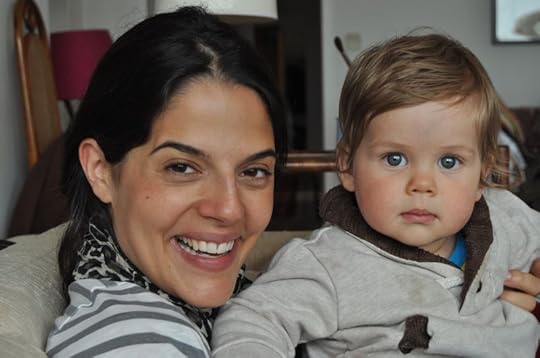
It was brought to my attention that mentioning the hard week Hugo and I had was a little alarming to some of you. I should have given more detail, perhaps, or not made it sound just so terribly awful. I'm sorry if what I wrote was upsetting to some - it never occurred to me that there might be people out there who were worried by what I wrote. To relieve the pressure I sometimes feel from parenting Hugo alone so much of the time, it helps to write about it here and there, mention it, get it off my chest, then move on.
But after I heard from many of you privately, I felt like I needed to explain a few things.
First of all, I realized that I rarely write about Hugo when things are good. And they are so often so very good. We have been blessed with an impossibly lovely child who has made the majority of his first year quite easy on his mother. When you consider that I am his sole caretaker five days a week, all day long, that's quite a feat. Not a day goes by when I don't feel lucky to have so much of Hugo to myself, to get to really see every tiny stage of development he goes through. Particularly because I know how acutely Max misses being around us every day, I feel a responsibility to witness everything Hugo does for both of us, to be present as much as I possibly can. It's a privilege that I've had as much time home with him as I have.
But of course things get tough sometimes. Of course they do! A few months ago, Hugo - in a very short window of time - simply stopped taking naps in his crib. He'll sleep in the stroller or car seat for 30 minutes, 40 if I'm lucky, but if I put him in his crib at naptime, he screams and screams (and pulls himself to standing and screams and screams). In addition, the poor thing has been cutting four teeth in at the same time. FOUR! He's been in pain for months.
Teething, over-tiredness, what we think is sadness at seeing Max so infrequently manifesting itself as massive clinginess with me - and all of this on my shoulders without a break, 12 hours every day. It's hard, no matter what kind of angel I birthed. But still, you need to know that most days Hugo is a peach. A beaming, chattering, toothy peach who strokes your face lovingly if you get close to him, who full-body-bops to music like an old pro, whether it's Haydn or blues, who charms the pants off every single woman (and many men!) who we pass on our daily outings, who purses up his lips and blows each time he sees a mobile or a hanging lamp or a tree branch silhouetted against the sky, who pages through books in silent concentration, who goes to bed without protest and sleeps so well that I'm too superstitious to say any more than that, and who always lowers his head on my shoulder just before bedtime so I can hear him breathing in my ear just as he did as a newborn and a four-month old and an eight-month old, giving me the opportunity to once again tell myself: don't ever forget this sound, this feeling; don't ever, ever forget it.
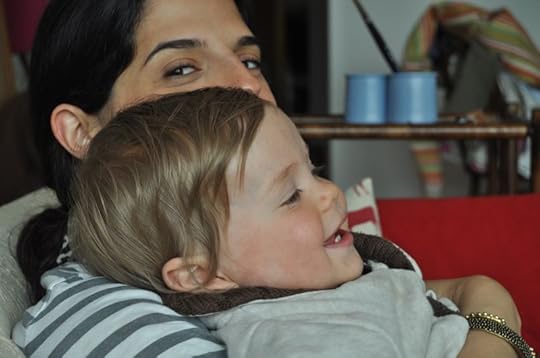
For many months, I didn't want to do anything but be Hugo's mother. I relished staying home and caring for him all day. I didn't care about work or cooking or anything but being there for him. It was a delicious immersion into another world - I felt deeply fulfilled and totally happy. But over the past few months, I've started feeling the urge to work again. Not just because we are most definitely a two-income household, but because I have that old creative itch again. It's wonderful! I'm so happy it's back! It's also...impossible without outside help.
How can I get any meaningful work done when 12 hours a day I can't do anything but take care of Hugo? We have organized a daycare spot for him, but it's not until next January. (In Germany, it's hard to find daycare for children under the age of 12 to 18 months.) And because Hugo only naps on the go, I can only work after he's gone to bed in the evening, at which point I'm tired myself, exhausted, really, and hungry and want nothing more than to crawl into bed and fall asleep while reading. (Related: If you sent me an email sometime between June 12, 2012 and now and are wondering why I haven't responded yet? This would be why. I am very sorry and also a little embarrassed.)
So, help.
Three things that helped me see the light on what a (or this) self-employed writer and mother needs to do in order to be able to work and continue to parent well were:
1. This gorgeous post, Help Is (Not) A Four-Letter Word by Rebecca Woolf.
2. A chapter called No Mystery About Sperm in Tiny Beautiful Things.
3. Talking to my village of girlfriends who are mothers and who all have slightly different situations in terms of childcare, but who all have childcare.
(4. And this post is good too.)
Lightbulb! All of a sudden, things seem possible again. Instead of trying to squeeze in a few emails and writing sessions before bed and feeling frustrated that I can't get work done while Hugo naps in his stroller and I'm stuck on the park bench, I have the prospect of real time for myself again. I can finally go ahead with that site redesign that is sucking up so much of my mental space. Take control of my blog advertising once and for all, so that this beloved blog of mine can start to be a source of meaningful income again. I can get started on that second book that my agent has so gently been prodding me about. And maybe even possibly ooh I don't know have a little time over for long-shot dreams like my novel. In the meantime, Hugo gets to be entertained and loved by a whole new energetic young person and I get to mother him feeling refreshed and ready for everything he wants to do. Maybe a little distance will even mean that naptime goes from being a big battlefield of anxiety for me to just a thing that my little peach does in his own quirky way, no big deal.
Uh, yes to all of that, please. As my mother likes to say sometimes, I can be a little slow, but I get there eventually.
So that's where we are these days, dear readers. Figuring out next steps, acknowledging that help is not a bad word, but a necessary part of this woman's daily life as a breadwinner and a loving mommy, and thinking that even though he does sometimes drive me to distraction (show me a kid who doesn't?), I feel like I won the lottery when it comes to Hugo, the bright shining light of my life.
May 13, 2013
Nigel Slater's Pork Meatballs in Broth

Meatballs! Oh, meatballs. Is there a more wonderful food? More pleasing to shriek out loud whilst walking your child, more lovely to mix and roll, more delicious to eat? I usually make meatballs in sauce, like the good Italian I am, and forget how many other ways there are to eat meatballs. But when Katie reminded me the other day, I practically tripped over myself getting to the store to buy ground pork.
I mean, ground pork flavored with mint and chiles and garlic and scallions, rolled into little balls and then suspended in broth? Hello? Was there ever any chance that I would hear about this recipe and not make it? No, I tell you. NO. (They're like skinless wontons in soup! In fact, next time I might actually wrap them in wonton skins.)
The recipe comes from Nigel Slater's Tender, his book on growing and cooking with vegetables, and it makes me giggle to no end that the original title for this recipe is Chicken Broth with Pork and Kale.
What?
Why, if you are given the opportunity to use the word meatball, would you ever shy away from using it? Doesn't Nigel know MEATBALL! is how you sell a recipe? Chicken Broth with Pork and Kale, I mean, I wouldn't even bother reading the recipe after seeing that title. I'd just flip on by. Tell me you wouldn't. GO AHEAD. (Yeesh! I'm worked up or something!)
Anyway, I am herewith rebranding the recipe as Nigel Slater's Pork Meatballs in Broth, because meatballs deserve all the love and attention they command, every last drop of it. Loud and proud, meatballs, loud and proud.
Now, onto the recipe. It is so easy a child could do it. You simply flavor with ground pork with chiles and herbs and garlic and scallions, then roll it into little balls. Emphasis on little! You want these to be one-bite meatballs, maximum two-bite. Then you lower them into simmering broth for a few minutes. The original recipe has you fry them first, but we all know how I feel about that. The meatballs taste just as delicious and you get to skip a whole, messy, pan-dirtying step. Boom!
Of course it'd be best if you made this with your own, lovingly prepared chicken broth. Of course! Of course. However, I am here to tell you that I made these with Better Than Bouillon vegetable stock (I should be getting stock options in the company at this point, shouldn't I?) (and yes, I know that it is most definitely not Whole30-approved, but life is full of tragic decisions and this was never going to be one of them) and it was sublime. Seriously! Totally delectable.
Finally, the original recipe tells you to blanch kale leaves and then float them in the broth (which is what Katie did, if you'd like photographic support). But kale has cleared out of stores here (and thank goodness is all I can say to that), so instead I used a very firm, very fresh zucchini sliced paper-thin and just threw the slices in at the very end of the cooking time. Why the zucchini? Because it's all I had in terms of green vegetables. Honest! No other reason. I imagine that a few spinach leaves would be nice here, too.
Meatballs! The best.
Nigel Slater's Pork Meatballs in Broth
Serves 3 or 4
500 grams (1 pound) ground pork
2 small hot chiles
4 scallions
2 cloves garlic
6 sprigs mint
6 springs cilantro or parsley
1.5 liters (6 cups) vegetable or chicken broth
1 fresh, firm zucchini, sliced paper-thin
1. Put the pork in a mixing bowl. Finely chop the chiles and add them with
their seeds to the pork. Slice the scallions, discarding the roots and
the very darkest tips of the leaves. Peel and mince the garlic, and add
with the scallions to the pork. Pull the parsley or cilantro and mint leaves from
their stems and chop coarsely, then add them to the pork with the salt.
Mix everything thoroughly with your hands and form into about sixteen
balls, about 1 1/4 inches in diameter.
2. Bring the stock to a boil
in and season with salt and pepper. Lower in the pork balls and then
decrease the heat and simmer for 5-7 minutes, until they are cooked
through. Add the zucchini slices to the soup and serve one or two minutes later.
May 10, 2013
Friday Link Love
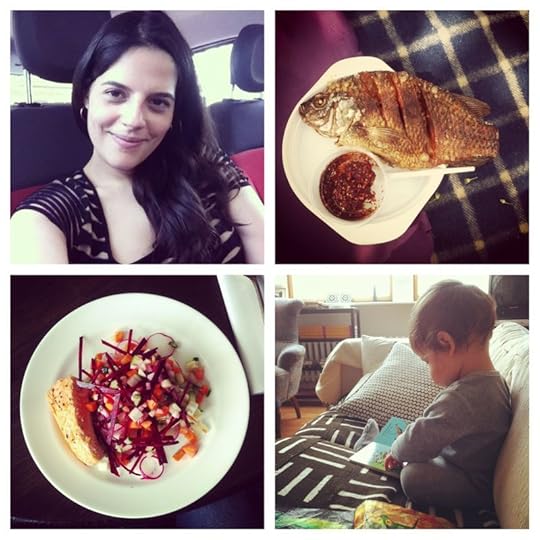
This week started out so well! I distinctly remember feeling all aglow on Monday evening. Hugo and I had had the loveliest day. Nothing special happened, but everything just flowed and felt good and right. But, sadly, as the week progressed, things went sharply downhill, ending today in what might have possibly been one of the lowest points of mothering Hugo since the very beginning. Sob. My only hope is that tomorrow will (must) be better. (A propos: For the German-speakers among you who have small children driving you crazy, I guarantee this video will make you cry.)
As for the Whole30, in case anyone is wondering how it's going, I'm on day 18 and I'm ready for it to be over. My headaches and fogginess ended abruptly around day 9 and I feel pretty good. But my insomnia shows absolutely no signs of abating and the monotony of all the meat and fish is getting to me. I miss my grains and beans and yogurt. Still, I'm going to stick with it, if only to prove to myself that I'm capable of being consistent with something for 30 days (my friends who cut out things for Lent every year have a harder job!). I'll keep you posted.
Elsewhere,
Small-batch pulled pork, finally!
I loved reading about this obsessive tinkering with a classic French chocolate loaf cake.
The funniest video on children's first tastes of "strange" food.
Zoe Nathan's walnut-jam scones look like they redefine the term.
Well, this is terrifying.
Craving all three of these hot-weather drinks.
These pork meatballs in broth are pure comfort.
Talk about a picky eater... Ha!
Have you ever grilled your PB & J?
And, finally, if I ever get around to making my own corn tortillas...there shall be Chicken Salad Tostadas.
Have a good weekend, folks!
May 8, 2013
Cooking for Hugo: A French Food Education

Hello! Don't think I've forgotten about this little series. It's just that for a while there, well, Hugo sort of went on a food strike. (In addition to the nap strike! I know.) And it was so strange and so frustrating that I sort of couldn't bring myself to write about it while I was in it. You know? He stopped wanting to eat my lovingly prepared vegetable purées, he stopped being interested in the food I made for myself and he threw everything I put in front of him to feed himself on the floor. A few times, he even reached inside his mouth after I put a spoonful of food in it and sort of clawed out the food, shrieking all the while in disgust. It was awful.
In retrospect, I think it was an unholy combination of teething and too
many bottles and textural issues and also just plain babyhood and I'm
very, very glad to say we seem to have worked things out. Now
Hugo gets a big bottle first thing in the morning and another big one
before bed, but the rest of the day, he eats three proper meals at the
table. It's so satisfying and wonderful to see him digging in to
whatever I put in front of him. Phew.
But some of my behavior while this was going on was giving me pause. When Hugo refused to eat something, I'd quickly prepare something else and offer to him instead. When that got thrown on the floor too, I'd look for yet another thing to give him, often resorting to buttered bread or pasta. After all, I couldn't very well let my almost 11-month old go hungry, could I? Those rules about not cooking things to order for your kids obviously were only meant for older kids, right?
Except then I was hanging out with my French girlfriend Marguerite and when I told her about what was going on and how I was dealing with it, she did one of those half double-takes backwards and shook her head gently. "Oh, no, Luisa. He refuses to eat? Then that's it. Don't make anything else for him." But, but, I protested. He's just a baby! Won't he be hungry? Won't he wake up in the middle of the night? Aren't I sort of then sending him to bed with no supper and won't I be judged cruelly for that and sent packing straight to Hades? "No! He has his evening bottle, right? He's almost 11 months old. He'll be fine." And, um, she was right.
So today, folks, I want to write about French rules for feeding children.
When I was pregnant, I read Pamela Druckerman's Bringing Up Bébé (French Children Don't Throw Food is the UK title). It had gotten a lot of mixed reviews - I got the impression that many Americans didn't like the idea that the French, yet again, were trying to tell them how to do things better. But I really liked the author's story, her self-deprecation and her admiration for what the French do actually get right with child-rearing. (And yes, at this point, you may substitute many other words for French: Europeans, Asians, common-sense folks, the older generation.) Particularly with regards to food. (NB: The book deals with many aspects of child-rearing in France; food is just a small part of the book.)
Then, I decided to read Karen Le Billon's French Children Eat Everything, which centers around the author's experience of moving to France with her two small, very picky children and learning the hard way about how to get them to eat better and behave better around food in general. Le Billon's husband is French and the pressure from his family and the community is very hard on the author; I often felt such sympathy for her predicament, caught between her own culture which had influenced her daughters' bad habits and her French in-laws's glowering disapproval. It can't have been easy for her to be the only foreigner in a small French village, surrounded by such rules and rigidity. By contrast, Pamela Druckerman's experience is far gentler. The French come across far nicer, too.
But both women observe many of the same phenomenon when it comes to children and food in France:
1. Babies are fed things like blue cheese, puréed beets and other strongly-flavored food right from the start.
2. There is a great reverence for the ritual of sitting down at a nicely set table for each meal, together.
3. The emphasis is on food being a purely sensual experience, not one in which punishment or reward ever plays a role in any way.
4. The importance of serving food in courses (vegetables to start, for example, then a main course of pasta, perhaps, or meat, and then fruit or yogurt for dessert), to give even a baby a sense of how a proper meal should unfold.
5. Never, ever, ever eating outside of set mealtimes (which are breakfast, lunch, afternoon snack and dinner).
6. Following the child's lead if he or she refuses to eat and simply ending the meal. No drama, no fuss.
There are others, too, but these are the ones that resonated the most with me. And they inspired me to make a few changes to mealtimes with Hugo. Not only do I no longer continue offering him different things until something "sticks", I also don't wheel and cajole him into eating one more bite of anything. If he's done, he's done and I respect that. I also don't give him any snacks (though this one is a little tougher to enforce with his softie grandmothers around) in between meals, which almost guarantees that he's happy to eat his meals with real gusto.
So, tell me, readers! Have you read either of those books and if so, what did you think? Did you find inspiration in the pages or were you already feeding your children à la française? Is your home culture similarly "strict" with rules for feeding children? Or do you think the whole thing is authoritarian and awful? Tell me what you think, about any and all of it.
May 6, 2013
Bon Appetit's Roasted Chicken Legs with Lemon and Oregano

Every so often a little recipe comes along that is just a sheer stroke of brilliance. I love recipes like that. I live for recipes like that. The most recent one to make me do a double-take of glee is this one, from Bon Appetit's December 2012 issue (and shot by my friend, Brian Ferry!)
Okay, so you know how most chicken recipes make you first brown the chicken and then remove it from the pan to do a bunch of other stuff, then you have to put the chicken back in and yadda yadda yadda, it's done? I don't know why they bug me so much, but these kinds of recipes do.
Actually, maybe I do know why:
1. I am lazy (but you already knew this).
2. Mess, mess, messy. I dislike spattering cooking fat.
And 3. Okay, fine, in addition to being lazy, I am also impatient and never brown the chicken long enough, so it's always a little flabby instead of perfectly crisp and wonderful.
This recipe, the darling thing, is all about making sure that the skin never veers anywhere even close to flabby. What you do is put the chicken, skin-side down, in a pan with a little bit of oil and then let it cook for a good long while without touching it, over medium heat, so that the fat renders out, slowly crispening and crispening the chicken skin (yes, I did just make that word up).
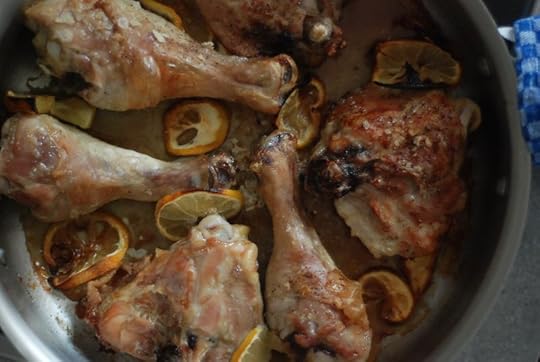
As it cooks, you can periodically get rid of the cooking fat, if too much of it renders out, but that actually never happened to my chicken. Once the chicken is halfway done, you throw in a whole bunch of lemon slices and stick the whole pan in a hot oven, where the lemons soften and the chicken roasts until the skin is perfectly crisp and of a deeply lacquered loveliness.
How lovely? SO LOVELY:

Then, all that's left to do is to remove that lovely chicken to a plate and scrape a bunch of different things (garlic, minced onion or shallot and oregano - the recipe calls for fresh, but I used dried and it was fine) into the pan that you cook on the stove top for a little while. In goes wine and broth, or just broth, if you'd prefer (which is what I did) and then you reduce this to a nice, saucy consistency and pour it over your lovely chicken and eat right away because oh my goodness it smells so good you simply cannot wait another second no sirree bob.
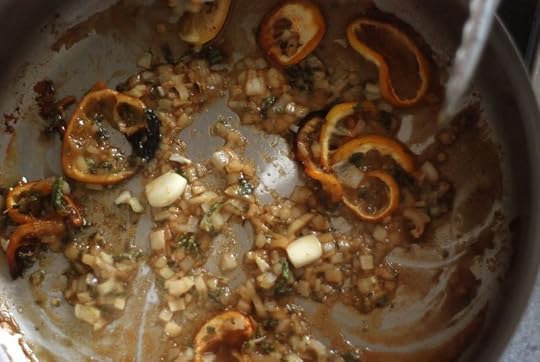
The lemons mellow and sweeten in the cooking process, and the soft lemons and velvety sauce contrast beautifully with the shatteringly crisp chicken skin. This was seriously delectable chicken, people. I'll never brown a piece of chicken any other way again.
(Note: The original recipe calls for deboned chicken thighs but I made it with bone-in chicken legs, cut through at the joint, and just added a few minutes onto all the cooking times.)
Roasted Chicken Legs with Lemon and Oregano
Adapted from Bon Appetit
Serves 3 to 4
1
lemon
4
large or 8 small skin-on, bone-in chicken legs, cut in two
Kosher salt and freshly ground black pepper
1 tablespoon olive oil
3
sprigs oregano
1 small onion, minced
1 small
garlic clove, minced
1/8
teaspoon
crushed red pepper flakes
1/4
cup
dry white wine (such as Sauvignon Blanc), optional
1/2 to 3/4
cup
low-sodium chicken broth (larger amount if not using wine)
1. Heat oven to 425°. Very
thinly slice half of lemon; discard any seeds. Cut remaining lemon half
into 2 wedges. Season chicken thighs with salt and pepper.
2. Coat a large room-temperature
skillet with the oil. Add chicken, skin side down. Place skillet
over medium heat and cook, letting skin render and brown, until chicken is
cooked halfway through, about 10 minutes. If there is a lot of fat in the pan, pour
off the excess fat to maintain a thin coating in pan.
3. Scatter half of lemon slices
over and between chicken. Transfer
skillet to oven, leaving chicken skin side down. Roast until chicken is
cooked through, skin is crisp, and lemon slices on bottom of skillet are
caramelized, about 15 minutes.
4. Transfer chicken pieces, skin
side up, and some of the lemon slices from bottom of skillet to a warm
platter. (Leave a few softened lemon slices in the skillet.) Return skillet to
medium heat. Add oregano sprigs, shallot, garlic, and red pepper
flakes; cook, stirring frequently, until fragrant, about 1 minute.
5. Remove skillet from heat. If using, add
wine; cook over medium heat until reduced by half, 1-2 minutes. Add
broth; cook until reduced and thickened, 5 to 6 minutes. Squeeze 1 lemon wedge over
and season sauce with salt, pepper, and juice from remaining lemon
wedge, if desired. Return chicken to
skillet, skin side up, to rewarm. Serve topped with caramelized lemon
slices.
May 3, 2013
Friday Link Love

The huge news in our little household this week is that Max, my hero, got a job near Berlin and is moving back home this summer! It's all terribly exciting. Tomorrow we're dressing up for the first time since our wedding and going to the wedding celebration of our dear friend who married us - I can't wait. After months of wearing a mommy uniform, I'm thrilled just to put on a dress and high heels.
Elsewhere,
Have you ever had Indian coleslaw? Sign me up.
A fascinating piece on being an apple detective.
Crunchy, creamy cucumber avocado salad.
of a family reuniting after the Vietnam War.
The very funny Nicholas Day on sweet potatoes.
I could watch Jean-Georges cooking all the live-long day.
Dreaming of attending this week of cooking classes on Kea in the Cyclades.
Love that April Bloomfield's pea soup calls for frozen peas.
Selling ground poultry is almost unheard of in Germany; after reading this report, I'm glad to hear it. Stay safe, people!
And finally, a little interview on date nights I did on Loop de Luxe (plus a discount code for 25% off if you're tempted by the gorgeous store: WEDCHEF).
Have a good weekend, folks!
May 1, 2013
Deborah Madison's Shaved Fennel Salad with Celery and Egg
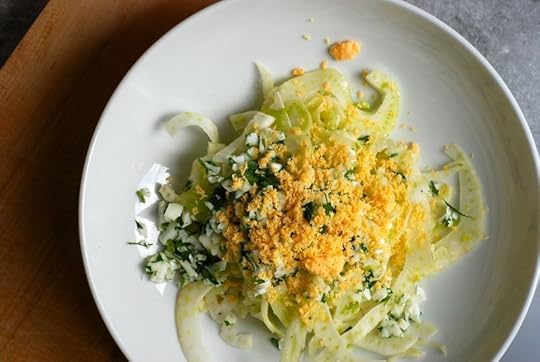
These are good times to be a vegetable-lover. Not because it's springtime, though that certainly doesn't hurt, but because everywhere you look these days, vegetables are getting all the attention. New cookbooks on vegetables are coming out of every corner, from the River Cottage, from Clotilde's Parisian kitchen, from vegetable goddess Deborah Madison, all the while giving "nose-to-tail" cookbooks the boot.
Deborah Madison's publisher sent me a copy of her latest book, Vegetable Literacy, a few months ago and the reason I'm just posting about it now, honest to goodness, is because I was too busy reading it to cook from it. It's just fascinating. Deborah has structured the book around 12 different groups of vegetable families (the sunflower family, for example, includes artichokes, endives, tarragon and chamomile, just to name a few) and has outdone herself with recipes that feel fresh and new and exciting (beet salad with star anise, sweet potato soup with asafoetida, chard with sesame and yogurt, broccoli paired with tomatoes - though I'm still wrapping my head around that one) And a word of warning: if you, like me, are not in possession of a garden of your own to plant things in, reading this book will give you a bad, bad case of vegetable envy.
(Also, it will make you want to leave olive oil behind beforever and become a full-time convert to ghee. How does she do it?!)
The funny thing is, I'm not even all that good with plants. My mother has the greenest thumb of anyone I know, but me, well, I can barely keep alive the hardy old palm that Max left here when he took the job in Kassel. But still, there's little that I enjoy more than reading the Seed Saver's Exchange catalogue (don't know it? Welcome to your new obsession). And Vegetable Literacy is sort of like that catalogue, but with delicious recipes and gorgeous photos and nice stories to boot.
When my friend Dervla
started raving about Vegetable Literacy's recipe for braised fennel
with saffron and tomatoes, I thought I'd make that from the book first. (I was feeling awfully torn - there are so many things I'd like to make from the book right now.) But when I
opened the book to that page, something else caught my eye: a little
salad of shaved fennel and celery with a sieved egg on top.
Doesn't the phrase "sieved egg" make your heart sing a little? It does mine. The papery crunch of the thinly sliced
vegetables paired with that creamy egg is just lovely. And Deborah has you add a bit of
lemon zest and a sprinkle of truffle salt, if you've got it, to the
salad for a little special zip, turning what is usually a winter standby in this house into something celebration-worthy.
Much like everything else in the book.
Deborah Madison's Shaved Fennel Salad with Celery and Egg
Serves 4
Adapted from Vegetable Literacy
1 large egg
1 fennel bulb
4 inner celery stalks
Grated zest of 1 lemon
Salt and pepper
2 to 3 tablespoons olive oil
1 tablespoon fresh lemon juice
Small handful of finely chopped herbs (fennel fronds, celery leaves and/or parsley)
Fennel pollen or toasted fennel seeds, optional
Truffle salt, optional
1. Boil the egg. Trim the top of the fennel bulb and slice off the thick bottom. If the outer leaf of fennel is bruised, remove it and use it for something else. Using a very sharp knife or mandoline, slice the fennel paper-thin. Do the same with the celery stalks. Toss the vegetables together with the lemon zest, salt, pepper, lemon juice and olive oil. Arrange on a serving plate.
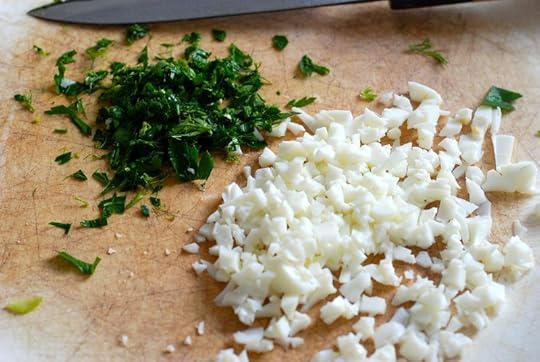
2. Peel the egg and finely dice the white. Toss the chopped herbs and white together and scatter over the fennel salad. Rub the egg yolk through a sieve over the top of the salad. If using, sprinkle the fennel pollen or seeds and truffle salt over the top and serve immediately.
April 29, 2013
Cooking for the Whole30
It's been a week since I started the Whole30. Seven whole days! And so far, what irritates me the most is figuring out breakfast. I'm usually a toast and cereal breakfaster, sometimes dabbling in oatmeal or pancakes. But now, all I eat are eggs. Eggs, eggs and more eggs. It's okay - I buy these totally luscious eggs from a little lady at the market and they have incredible orange yolks and taste sweet and fresh, like they were laid this morning. But still. 23 days from now, I know I am going to be deeply thrilled to eat anything other than an egg for breakfast again.
Other things I have discovered:
1. Whole30 is getting me to eat way more fruit. I hadn't realized how little fruit I'd been eating lately until now.
2. I'm eating far more "mindfully". There are no more random snacks or treats just because I'm feeling bored or tired. I have to think a little more about the preparation of my meals and when I sit down to eat, that's all there is. No dessert or pre-dinner snacking. It's sort of liberating.
3. I don't really miss the things I thought I'd miss (bread, pasta, bread and bread). In fact, it's way easier to do the Whole30 than I thought it would be. My cooking isn't really any different than before, it's just that I don't rely on my usual starches in addition to everything else to fill me up.
What I really do miss: my milky morning (and sometimes afternoon) Earl Grey. Oof, I miss it so much.
As for how I feel? I have a weird low-grade headache and feel sort of blurry in the afternoons, if you know what I mean. I've heard this passes eventually. Otherwise, I feel the same as always.
Now, here are a few things I made over the past week that were delicious and very easy and that you should eat whether or not you're on some ridiculous "nutritional reset". (Just add rice!)
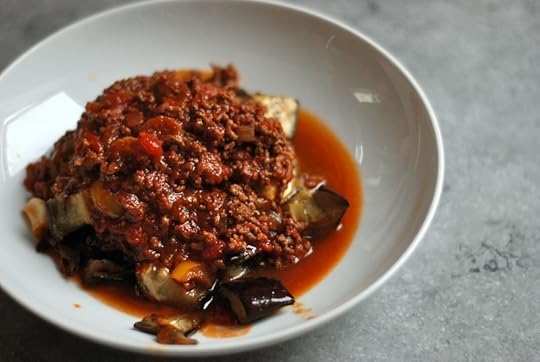
First, a sort of deconstructed Turkish eggplant-ground beef soupy stewy business (I'm a recipe-naming wizard, aren't I?):
Okay, you know how cooking eggplant is always a tricky business? More often than not, you end up with super-oily eggplant, which is no fun in my book. Here's the best way I know to cook eggplant: in the oven. Take four small eggplants, wash and trim them. Then cut them into bite-sized pieces. Put the eggplant pieces on a baking sheet and drizzle with a few tablespoons of olive oil. Sprinkle with flaky salt. Make sure the eggplant pieces are all in one layer. Put in 200 C (392 F) degree oven for about 20 minutes, then shake a bit and cook for 5 or 10 more minutes, until the eggplant is browned and fragrant. Now you can stir that delicious, soft and silky eggplant into tomato sauce (for a lighter pasta alla Norma, for example) or you can put it aside, while you make my Turkish-inspired ground beef soupy stew sauce.
Heat a bit of olive oil in a pan, then add a small minced onion and one small sliced yellow bell pepper. Cook, stirring, for 10 minutes, then add a pound of ground meat (beef or lamb). Cook, stirring, until the meat is no longer pink. Add two cloves of peeled garlic, a good pinch of salt, 3/4 teaspoon allspice, 1/2 teaspoon cinnamon, 1/4 teaspoon cayenne pepper and 1/8 teaspoon cumin. Stir well to incorporate and cook for a few minutes. Then add a 14-ounce can of chopped tomatoes. Pour water into the can to fill it a quarter of the way up and then add that water to the pan as well. Stir to combine. Bring the sauce to a boil and let simmer over medium-low heat, covered, for 30 minutes. Taste for seasoning, adjust with a bit of water for a looser sauce, then serve over the roasted eggplant.
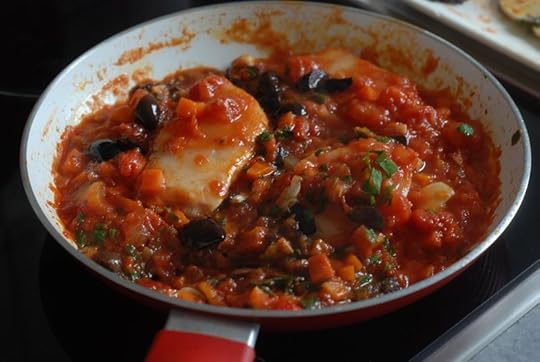
Next, Stewed Cod in Spicy Tomato Sauce (that's better, isn't it?).
Pour a little olive oil in a sauté pan. Add two cloves of peeled garlic and one small minced onion. Cook, stirring, until the onion is translucent and fragrant. Add 1 peeled, diced carrot and cook for a few more minutes. Add one crumbled dried chile and stir. Add one 14-ounce can of chopped tomatoes and a pinch of salt and stir well. Cook over medium heat for 20 minutes, until thick and stewy. In the meantime, pit and chop about 6 or 7 Kalamata olives. Stir the olives into the sauce. Slip two or three pieces of cod fillet or any other firm, white fish into the pan and cover with some spoonfuls of sauce. Let simmer until the fish is just cooked through and flaky, but still moist and tender, about 8 minutes, depending on the size of the fillet. Top with chopped flat-leaf parsley and serve immediately.
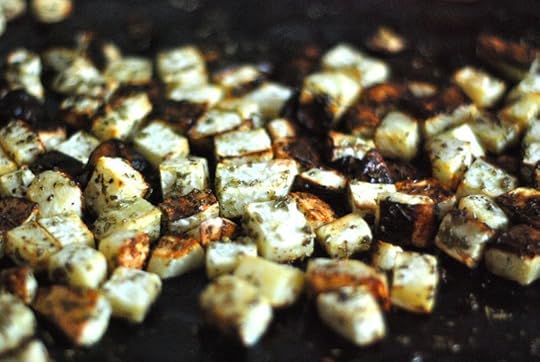
This is barely even a recipe, but it's delicious, so here you go. Let's call it Herb-Roasted Celery Root:
Take one celery root, peel and cube it. Put the cubes on a baking sheet. Sprinkle with a two or three tablespoons of this herb rub. Drizzle with a few tablespoons of olive oil and toss well until the herbs and oil are well-distributed. Put the baking sheet in a 200 C (390 F) degree oven for 20 minutes, toss briefly and cook for another 10 minutes, until the celery root is browned and fragrant.

And finally, Roasted Cauliflower Salad (I'm getting the hang of it, aren't I!):
Separate a head of cauliflower into bite-sized florets. Arrange on a baking sheet. Drizzle with a few tablespoons of olive oil and some flaky salt. Roast in a 200 C (390 F) degree oven for 15 minutes, then add a handful of halved cherry tomatoes to the sheet and roast for another 15 minutes, until browned and tender. Scrape the roasted cauliflower and tomatoes into a serving bowl. Add some lemon zest and chopped flat-leaf parsley to the bowl. Make a vinaigrette out of olive oil, sherry vinegar and a touch of mustard. Drizzle over the vegetables and toss well. Serve hot or room temperature.
April 26, 2013
Friday Link Love

Three days ago, I started the Whole30 nutritional reset (which - to my eyes, at least - just seems to be the fancy term for a diet, except in this case there's no calorie-counting or finding weird substitutes for things). For 30 days, there's no dairy, sugar, legumes and grains of any kind, alcohol, processed foods or, wait for it, white potatoes allowed on my plate. I can eat fish and meat, all the vegetables I want, plus fruit, nuts and seeds.
Now, I am generally not the audience for things like this, or for diets of any kind. But I've been struggling with terrible insomnia, some pesky joint pain and a few unwanted pounds for months now and when I read about the Whole30, I was instantly intrigued. People claim that it helped them sleep better, gave them more energy and cleared up joint pain. And, I don't know, I suddenly wanted in on the challenge. I could have never done this in the winter or while nursing or at any point before in my life - willpower is not my middle name - but right now I'm feeling pretty pumped about the whole thing. I'll write more about it next week.
Eating organic on food stamps.
Fennel seeds on egg salad sounds so good.
The story behind Sriracha hot sauce (it's a family company!).
I want to master this most basic Japanese recipe.
Brilliant ideas for food to pack when traveling.
And finally, this müsli/granola hybrid is right up my alley (via House to Haus).
Have a lovely weekend, folks!


