Glenn Dean's Blog, page 13
April 28, 2012
The real iTruck?
I joked earlier this week about iTrucks, but apparently there's actual Army interest in them according to an article at Wired's Danger Room.
The term iTruck was reportedly coined by National Defense as a way of describing a smart, technology-integrated truck that might even be able to operate independently, like this Lockheed Martin / TARDEC Convoy Active Safety Technology demonstration:
Is it time to hire Apple?


April 27, 2012
British War Dog to receive Dickin Medal
A British war dog will receive the Dickin Medal for heroic action performed in Afghanistan. It's the canine equivalent of the UK's highest medal for valor, the Victoria Cross, or the US Medal of Honor.
Treo, an eight-year-old lab, is a bomb dog. He's twice had significant finds. From the linked Daily Mail article:
Treo’s heroics include finding a ‘daisy chain’ improvised explosive device (IED) while working as a forward detection dog in Sangin, Helmand Province, in March 2008.
A daisy chain is two or more bombs wired together and concealed by the Taliban on the side of a path to maximise casualties among soldiers on patrol.
I wish we would recognize US military working dogs with a similar US award. It may not mean as much to the dog as a bunch of dog treats might, but it would tell their fellow two-legged soldiers how much we value their service.
A hand salute to Treo!
April 26, 2012
Army interested in new Designated Marksman Rifle -- poor investment?
According to a Military.com article "Army the Army's Next Infantry Squad", the Army is interested in replacing the M14 Enhanced Battle Rifle it has procured in small numbers for overseas Squad Designated Marksmen with a shortened version of its M110 Semi-Auto Sniper Rifle. In my view, it's fixing the right problem with the wrong solution.
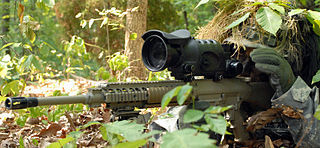 M110 SASS. US Army photo/PEO Soldier.The Designated Marksman concept is a good one in theory -- have a rifleman in each squad capable of taking long range or low-percentage shots to take out high value targets. Practice has never quite matched up to theory, though.
In typical Army fashion, we blame our equipment. "Our rifle isn't good enough", we complain, "We need a purpose-designed DM weapon." So we do some experimentation and discover a few things that help, like two-stage triggers and magnified optics. But we're still not good enough, so "we need a new rifle, but with longer range!"
That begot the M14 EBR, which was just a rack-grade M14 battle rifle upgraded with a rail-equipped stock so it could take accessories and a scope. The troops felt good because they had a 7.62mm rifle with longer range -- in theory. In practice, the EBR's accuracy really wasn't any better than the base M14, which isn't any better than any other battle rifle -- good to 300m, occasionally good to 600m, rarely beyond. (Before some Camp Perry shooter flips out, let me say that yes, you can build a fantastically accurate rifle out of an M14 if you work at it, which is what was done to build the M21 sniper rifle. But we didn't do that with the EBR.) But since the EBR looks like a sniper rifle, soldiers expect it to act like a sniper rifle -- and that's not what they get (I've seen the range data and I travelled around Afghanistan specifically collecting feedback on the EBR, so if you're a one-shot one-kill wonder with an EBR, good on you, but you're not the average DM).
The next step down that line of insanity is to give the DM an actual sniper rifle (or, to reduce visibility, a shortened sniper rifle like the article linked above supposes). That's a bad idea for two reasons.
First: cost. An M110 cost about 10x a standard rifle. That's OK when you're equipping snipers, who are relatively low density; not so good when equipping individual infantry squads. I'll even set aside the logistics argument of mixed ammo in the squad for the moment, or the question of whether at squad level you even need to engage at 600-800 meters range, where the enemy generally can't touch you except with heavy weapons and nothing else in the squad can support.
Second: effectiveness. Putting a 1 MOA (minute-of-angle, for those non-shooter types, a measure of accuracy equal to 1" spread at 100 yards) gun in the hands of a 10 MOA soldier does not a Designated Marksman make. The cost of buying short-M110s would be far better placed against more range time and more effective training for the DM soldiers themselves.
Here's the case study.
When I worked at Ft Benning I was involved with a Designated Marksman experiment evaluating options for new DM rifles. We went to a brigade getting ready to deploy who would get the rifles, and asked for their 25 best shooters who were going to be Designated Marksmen. The plan was to get a baseline by having them shoot a standard qualification course with their issue weapon, then run them through the Designated Marksman program of instruction and get a performance baseline, and then begin to switch out weapons and compare their performance, using design-of-experiments to randomize the design and try and control variables as much as possible.
Except that 7 of the 25 shooters failed to qualify on the baseline qualification course. 7 of the BCT's best shooters -- bolos. Retrain, requalify. We then ran the DM course, and no one qualified -- including a B4 sniper. We ran the entire DM course again (burning a lot of extra range time, and ammo), and finally on the second go-round got eight guys qualified, which was enough to run the experiment and get the data we needed (the other 17 went back to their unit as better shooters but still not DM material).
My lesson: invest in training. It's generally cheaper, easier, and more effective than giving a soldier a piece of equipment without the training to fully employ it. You want sniper-like performance and 800 meters range? Give a troop a sniper rifle without sniper training and that's exactly what you won't get.
But instead all we want to do is buy equipment like it's a magic bullet. Someone probably wants to know what rifle won the DM shootout. I'll tell you, but you won't believe me: the standard rack-grade M4 with an ACOG. We did have a modified M16 with match ammo that performed exceptionally, until it ran out of match ammo and we fired it with standard issue ball, at which point it shot worse than the issue rifles. The M14? Dead last out of four, by a long shot. Yep, the standard M4 with a well-trained soldier, a decent sight and regular ol' green time could consistently print a man-sized target at 600m. Sure, a sniper rifle it wasn't -- but it was good enough to answer the DM mission.
We sent the results up the chain with a recommendation to buy more ACOGs and invest in more training. The Army bought more M14 EBRs instead.
Car Geek: Scion FR-S First Drive Review at Jalopnik
From the car geek corner ... Jalopnik has posted an extensive first drive review of the Scion FR-S, sibling of the Subaru BRZ and the newest affordable sports car on the market. It's a thorough read -- check out the link -- but here's a teaser:
What you realize on the road is that you could absolutely use this as a daily driver. With all the traction and stability control robots active, it's well-behaved and quick. It made 120 on the open desert highway with several thousand RPMs to spare. It's not the absolute fastest thing off the line, but acceleration feels good and the car's low stance and agility makes boring traffic much more fun.
On the track, the car really shines. With the stability and traction control off, the chassis comes alive. It's essentially neutral, handling wise, but you can lift off a bit in a turn and get it to oversteer enough to make things fun. The flat engine and low center of gravity really make the difference here. It's light enough (2758 lbs), but manages to feel like it's held to the road with magnets. Very little body roll, and surprisingly recoverable when you try and force a bit too much oversteer.
I'm sticking with my S2000, but the Miata clearly has some great competition now.
Sec Army recognizes innovators
From Army.mil ... the Secretary of the Army reconized a number of soldier and civilian innovators working for the Department. I find the best story to be the one of four soldier-innovators:
Among those whose contributions save lives are the four Soldiers who teamed to build the "HMMWV Egress Assistance Trainer," or "HEAT." The training device helps Soldiers and other service members learn to escape from an overturned Humvee.
"We built the prototype and got it inducted into Army training, and now it's part of the curriculum for every unit going down range," said Sgt. Mickey L. Hill, 82nd Sustainment Brigade, XVIII Airborne Corps, U.S. Army Forces Command, Fort Bragg, N.C.
Hill was part of a team that included Chief Warrant Officer 4 Rick Cox, Sgt. 1st Class James A. Jett Jr., and Staff Sgt. Christopher R. Whiting that devised the training device, which involves a Humvee that can be mechanically flipped using hydraulics. Their construction of the device was in response to combat losses in theater from Soldiers unable to escape from overturned Humvees.
"After so many losses in Operation Iraqi Freedom to begin with, from vehicle fatalities specifically from vehicle rollovers, FORSCOM directed their safety office to come up with an idea," said Jett. "At the time, the only training tool was a graphic training aid, a card. [Chief Cox] had the idea and came up with the materials. We assisted him in actually fabricating from what his idea was, to making it work."
The Army has now adopted that training tool worldwide, and a similar tool is now going to be used that trains Soldiers to exit an overturned mine-resistant, ambush-protected vehicle, known as an MRAP.
Way to go, guys! It just goes to show that given the tools and opportunity, soldiers can be some of the best sources of new and effective ideas.
April 25, 2012
Awesome F-15 Aerial Footage
From Air Force training in Japan ...
F-15s are still pretty amazing after all these years.
Apple Earns $39B in a quarter
Apple Inc released financials showing it earned $39 billion (with a "B") in the first quarter of 2012. Wow. The entire Army investment budget for research, development, and procurement is about $40B in a year. Maybe we should outsource to Apple? They could work on important projects like the iTank, iTruck, iChopper, and iRifle.
April 24, 2012
C-27J Performing Well in Afghanistan
I've posted previously about the difficulties of delivering cargo to remote regions of Afghanistan, which directly supported the need for the program that became the Joint Cargo Aircraft, filled by the C-27J Spartan, which the Air Force has now canceled, causing the Army to once again rely on contract air.
As it turns out, some of the first C-27Js the Air Force bought are in Afghanistan in direct support of Army troops, and are getting rave reviews. According to a spokesman for the 25th Combat Aviation Brigade, as quoted in an article at DoD Buzz:
Maj. Craig Jayson, executive officer for 3rd Battalion, 25th Aviation Regiment, 25th CAB, says with the C-27J relieving his unit’s Chinooks, the unit has the opportunity to fly more missions to forward operating bases which the C-27J does not have access to.
“We can focus on picking up personnel and equipment that are lower priority and fulfill requests that are normally canceled due to lack of resources,” said Jayson. “Overall, the C-27J increases our flexibility and ability to support more customers in a single day.”
An increase in C-27J missions also decrease the costs associated with CH-47 missions as well.
“The hourly operational cost of a resupply mission using the Chinook is more than $7,500 an hour for the CH-47D and $9,000 an hour for the CH-47F,” said Jayson.
Based off Landrum’s calculations, the U.S. Army has saved $30 million by conducting missions with the C-27J instead of the CH-47 Chinook. When it comes to relieving the CH-47 Chinook with fixed wing assets, the C-27J seems to be the best choice over other fixed-wing options.
“The C-27J has all of the benefits of a fixed wing aircraft such as speed, altitude, payload capacity and range, yet also possesses the ability to conduct many mission sets similar to rotary winged cargo aircraft,” said Sgt. Maj. Ronald Graves, 25th CAB operations sergeant major.
Adding to the list of the C-27J’s benefits, Graves said the aircraft can operate in adverse weather and with limited visibility. Also the C-27J can land on a 2,400-foot dirt strip as opposed to the 3,000 feet a C-130 Hercules requires. Perhaps the biggest advantage the C-27J currently offers the Army is the fact it is tactically controlled by 25th CAB commander Col. Frank Tate. The tactical control gives him the flexibility to provide immediate support to soldiers on the battlefield.
“This relationship allows for quick and dynamic tasking, when required, which greatly increases our ability to deliver nearly anything, anywhere, in support of the soldier in the fight,” said Graves.
The best benefits appear to come from direct tactical control of Air Force aircraft by the Army aviation unit (shades of the WWII Army Air Corps??). Whether those same benefits could be realized if the aircraft in question were C-130s rather than C-27s seems open to debate, but clearly the unit finds the aircraft valuable, and it allows the Army to focus scarce (and expensive) Chinook blade hours to areas that can only be serviced by rotary wing.
Since I spent a lot of time flying Chinook ring routes to places that could have been serviced by STOL or other small cargo aircraft -- had they been available -- I can certainly see the benefit.
It looks like it's too late to save the JCA concept for the Army though, despite the report card from Afghanistan, unless there's a business case based on the demonstrated cost savings that says the Army should buy back the C-27s the Air Force wants to divest ...
April 22, 2012
Army Awards M4A1 Production Contract to Remington; Part One of Two-Pronged Carbine Strategy
As reported by Defense Review and Military.com's KitUp! Blog, the Army has awarded a production contract for M4A1 carbines to Remington Arms, shifting away from the original producer, Colt. The $83M contract is for production of 24,000 M4A1 carbines. This is historic as the incumbent and primary producer of rifles for the US Army for the last forty-plus years will not no longer be delivering a rifle to Uncle Sam.
This award is part of an Army two-prong strategy to evaluate a new carbine direction. The first prong is the product improvement of the current M4. The Army assumed rights to the technical data for the M4 from Colt in 2009 (an event long delayed due to a successful Colt lawsuit in the '90s). By competing, the Army succeeds in driving down the price for the M4 -- the Remington contract price appears to be about 2/3rds of the price that the Army was paying Colt -- and begins product improvement by first adopting the SOF M4A1 version, which besides having some hardened components drops the three-round burst capability in favor of full automatic. The M4 had started adopting M4A1 components a number of years ago, with one example being the stiffer M4A1 "golden" extractor spring which reduced extraction jams.
Lest anyone decry the loss of three-round burst, training is the best burst limiter and means of conserving ammo. A lot of experimentation with burst fire showed that with three-round burst soldiers tended to overcompensate for muzzle climb and the burst was more likely to miss the target. Operationally nothing is lost by the return to full auto and the soldier gets a lot more choices for employment. But I digress.
The savings from the competition is about on par with the savings realized when the Army competed production of the M16A4 and the contract went from Colt to FN USA.
The second prong, of course, is the Individual Carbine Competition, which is going on now to assess commercial alternatives to the M4/M4A1. The winner of that effort is supposed to be compared against the current cost of M4 carbine production to determine if the Army continues to buy M4-series carbines or changes to a new weapon.
Frankly, as I've predicted before, I expect the business case analysis will favor keeping the M4, particularly when this new award to Remington puts the cost of an M4A1, with its improvements, into the $675/carbine range. Between the similarity in performance from most commercial offerings, the existing robust logistics tail for M4/M16-series weapons, and the fact that the Army owns the technical data and can continue to compete the M4 in the future, it will be very difficult for a new contender to overcome the incumbent's price and logistical advantage. A new producer will either have to "buy in" to the contract by selling a significant number of carbines at a net loss, or offer such a significant performance increase that offsets the higher price in a "best value" competition. Since I don't believe any of the ICC offerors has performance so exceptional that there will be a win on a best value basis, it comes down to cost. At the end of the day, it's almost always cheaper to improve what you've got rather than buy new unless there's a significant shift in requirements.
It'll be interesting to see how this plays out.
April 21, 2012
Book Update -- Previews through Google Books
Previews of my book Soldier / Geek: An Army Science Advisor's Journal of the War in Afghanistan are now available through the Google Books partner program. The previews allow a look inside the book for a number of pages to include the full color photos for the electronic edition.
The Google Book program is still in beta, so a number of the links to actually get the book don't work -- for example, if you follow the Amazon.com link, it doesn't find the book, though my Amazon link here works and you can search Amazon or Barnes & Noble by title and find the book. Reviews are not linked yet, either. With luck Google Books will sort that out over time. Google Books also doesn't show an eBook available, even though the preview is the eBook itself, and the book is available through Google Play eBooks. Lesson: Beta tests are fun!
The other eBook previews are available from Google Books too: In Search of Lethality (though this one shows title page only for some reason) and Weapons of the Zombie Apocalypse.