Glenn Dean's Blog, page 11
May 23, 2012
Hand grenades: no more "Pull pin and throw"?
An engineer at Picatiny Arsenal is making improvements to the fuze design of the venerable M67 fragmentation grenade designed to make the grenade both safer and easier to use for left-handed throwers, who currently have to hold the grenade upside-down to pull the pin and throw it properly.
According to the Army.mil story:
The first motion ensures that users have a firm grip and control of the lever before they can arm it.
The second motion "arms" the grenade by rotating the explosive train in-line. If the tactical situation were to change, the Soldier just reverses the second step and the grenade is re-safed. Currently, re-safing a grenade requires trying to reinsert the sometimes-deformed safety pin, which is not easily done.
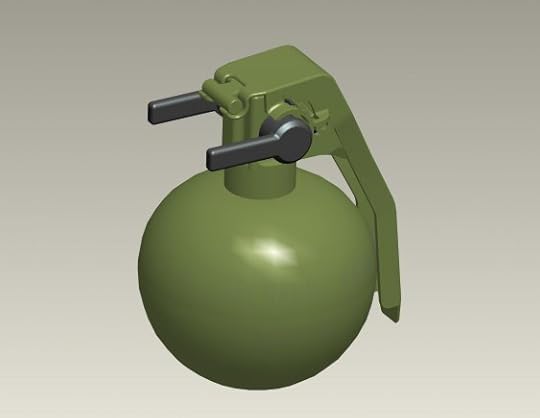 Grenade Design concept -- via Army.mil.
Improving the grenade is actually pretty tough, as it's the one munition that most soldier's enter service more-or-less prepared to employ -- minus those who think they can pull pins with their teeth.
In a previous life I was the user representative for soldier munitions (among other items), which included things like hand grenades, flares, smokes, Claymore mines, and other items. We worked through a number of safety issues with the grenade, and a different fuze mechanism was discussed many times, but most of the ideas that came up were more difficult to understand and employ than this latest concept.
I haven't seen it in person, but based on the photos and description, it certainly looks like the engineer, Richard Lauch, may be on to something. It appears the design is ambidextrous and resistant to tamper, but potentially capable of single-handed operation, all of which are improvements.
The challenge, as the article identifies, is requirements -- mostly because many munition requirements, the grenade among them, are so old that they pre-date current and prior requirements systems, and as a result the requirements system has a hard time figuring out how to handle them. This is the perfect type of modification to be handled by a simple engineering change proposal, though, assuming some user and program buy-in, since the modification is noth a safety improvement and does not change the essential capability of the grenade -- both of which fall within existing exemptions in the current requirements process that do not need new requirements documents.
Good luck, Mr. Lauch.


May 22, 2012
RDECOM Command Sergeant Major OEF Interview
The Army Technology Live blog has an interview up with the Research, Development, and Engineering Command Command Sergeant Major, Command Sgt. Maj. Lebert Beharie, discussing his recent trip to Afghanistan. An interesting excerpt:
How does the RDECOM Field Assistance in Science and Technology-Center accomplish its mission of providing engineering solutions to Soldiers directly in theater?
“What a tremendous capability to our Soldiers. This is a big win for the Army. This is a battlefield enabler having the RFAST-C that forward in theater. In six months, they have done over 177 projects for theater. That is throughout the [Combined Joint Operation Area], throughout the battlespace. While I was there, they were working on projects for the [Afghanistan Working Group] for the Afghan Army. They are working on engineering projects for the Air Force’s AC-130.
You name it, they are working on it. You have a Soldier who walks up to the RFAST-C and says, ‘Hey, I have a problem.’ I met that Soldier, a specialist. He showed me how he came up with the design, his drawings, what he envisioned, and the problem he had. He walked up to one of our engineers and said, ‘Hey, here is a problem that I have. Here is what I think a solution could be. Can you do something about this?’ Our scientist said, ‘Absolutely we can do something about it.’ They put the engineering mental muscle behind it and came up with a great product to fill that Soldier’s problem. This proliferates on the battlefield. It was a game-changer. This was an adjustment that had to be made because of new technology that we sent to theater to protect our Soldiers. We had to adjust how we placed certain items on vehicles.
I cannot speak enough about how great of a resource [the RFAST-C] it is for theater. I spoke to RC-South, RC-East, RC-Capital. I’ve talked to every command, all the way through [International Security Assistance Force] Command, and they all are singing the praises of what we are doing in theater.”
This is pretty interesting to me as my Afghan Journal and book are all about my own deployment to Afghanistan as an RDECOM science advisor, and one of my co-workers recently returned from a deployment with RFAST-C.
The theater has certainly matured significantly from a technology perspective since I was there. The RFAST-C is a tremendous capability -- a full service engineering lab and prototype shop, staffed with RDECOM engineers, able to research, analyze, design and build solutions for soldiers on the battlefield in real time. It was just an idea being kicked around when I left RDECOM; it's great to hear that not only did it get deployed, it is getting great feedback from the soldiers who need its services. Trying to get this sort of mission accomplished as an RDECOM quick reaction team leader in the states was tough, as we had to beg, borrow, or steal (well, borrow) resources -- RFAST-C appears to be well resourced and much closer to where the action is.
I expect with the reduction of forces in OEF the RDECOM and acquisition footprint will probably also decline; if RFAST-C is still an effective capability let's hope it stays as long as the troops need it.
May 21, 2012
Commercial or military spec?
I'm often asked why the military doesn't develop and deploy things faster. "Wouldn't it be cheaper/easier/quicker," I'm asked, "to just buy something commercially available? Why does the military try to make its own equipment instead of just buying an existing product? Why Nett Warrior and not just an off-the-shelf Android phone?"
Well, lots of reasons -- military unique capability, for starters. That's obvious. But I had an experience the other day that demonstrates why military specifications are often required that drive up time of procurement, cost, and complexity:
I left my smartphone (brand to remain nameless) in my car for the day, by accident. It was in the glove compartment, not in direct sunlight or plain view. The car was parked in a shady area that would be in sunlight by noon. Peak air temperature for the day was about 80 F at around 1600. When I got to my car after work, it was hot inside, but not so hot that it ws uncomfortable to sit on the black seats or touch the black steering wheel.
The phone, however, did not function -- "Temperature error" was all it said when I turned it on. It had overheated and took a good 15 minutes to cool down before it functioned again. Not a big deal for a commercial device, but imagine that you needed that phone to call for artillery fire or medical evacuation, on a 110 degree day in southern Afghanistan, when the radio had been sitting inside an armored truck baking in direct sunlight so that it reached 140 F inside. You want the phone to work when you turn in on regardless of temperature. And of course you want it to work when cold, if it gets wet, if you drop it, if you accidently smack it with your rifle ...
It doesn't take long to see why it is hard to use commercial technology standards in a lot of military applications.
May 19, 2012
For want of a nail
According to the command investigation, obtained by Navy Times through a Freedom of Information Act request and signed by Vice Adm. John Richardson, head of Submarine Forces, the bolt was accidentally left in Georgia’s gear housing during a routine inspection in December as a result of inadequate preps and oversight for the annual reduction gear inspection.
“This was an avoidable mishap,” Richardson wrote in his July 19 letter closing the investigation into the first known instance of main reduction gear damage on a submarine in three years. “Had watch-standing principles of integrity, formality, procedural compliance, level of knowledge, questioning attitude and forceful backup been responsibly adhered to and executed, this incident would not have occurred and the ship would have deployed on time.”
Reminds me of an old saw on attention to detail:
For want of a nail the shoe was lost.
For want of a shoe the horse was lost.
For want of a horse the rider was lost.
For want of a rider the message was lost.
For want of a message the battle was lost.
For want of a battle the kingdom was lost.
And all for the want of a horseshoe nail.
May 18, 2012
A look through a thermal rifle sight
In case your only exposure to thermal weapons sights has been playing Call of Duty, here's a video of some guys demonstrating shooting with a thermal rifle sight:
While it looks like they're having fun, and their accuracy is certainly up to the task shooting targets at 25 meters, I have to wonder: why is the presenter wearing a pistol? In case the water bottles and soda cans counterattack at close range?
May 17, 2012
Oops! AP: Apache drops training missile over neighborhood
An AH-64 Apache helicopter accidentally dropped a training missile into a neighborhood in Killeen, Texas, according to an AP article published in the Washington Post:
About 100 homes in a neighborhood near Fort Hood were evacuated Tuesday night after a witness reported seeing something fall from the sky around 8 p.m., Killeen police spokeswoman Carroll Smith said. Residents were allowed back into their homes within an hour of the incident.
Ordnance technicians from the Army post examined the missile and determined it didn’t have a warhead or propulsion system, Fort Hood officials said. The training missile, which had implanted itself into the ground, was removed before midnight and left a hole in the ground several feet deep
Now, I once had an NCO who worked for me who was a Chinook crew chief, and he told a story about cutting sling load on a cow from about a thousand feet when they got a fire light during a flood evacuation. (Mooooo! Splat!). And we know the Air Force over time has accidentally lost everything from aircraft to include nuclear weapons -- but this is the first I've heard of a helicopter losing a weapon in a populated area -- even though it was just a training aid.
Dog: The original weapons system
The Atlantic has a great article up about humanity's original supporting weapons system: the dog.
The article references a study published at American Scientist which credit's humanity's domestication of the dog with our species' survival, helping in hunting and defense at a time when humans began to crowd out our cousins, the Neaderthals, eventually leading to our relatives' extinction. From The Atlantic:
Shipman speculates that the affinity between humans and dogs manifested itself mainly in the way that it would go on to do for many more thousands of years: in the hunt. Dogs would help humans to identify their prey; but they would also work, the theory goes, as beasts of burden -- playing the same role for early humans as they played for the Blackfeet and Hidatsa of the American West, who bred large, strong dogs specifically for hauling strapped-on packs. (Paleolithic dogs were big to begin with: They had, their skeletons suggest, a body mass of at least 70 pounds and a shoulder height of at least 2 feet -- which would make them, at minimum, the size of a modern-day German Shepherd.) Since transporting animal carcasses is an energy-intensive task, getting dogs to do that work would mean that humans could concentrate their energy on more productive endeavors: hunting, gathering, reproducing.
The original study says:
Dogs may also have contributed more directly to human hunting success. To discover how big a difference dogs could make, Vesa Ruusila and Mauri Pesonen of the Finnish Game and Fisheries Institute investigated what may be the closest easily studied analog to a mammoth hunt: the Finnish moose hunt. Finns use large dogs such as Norwegian elkhounds or Finnish spitzes to find moose and keep them in place by barking until humans can approach and shoot them. In hunting groups of fewer than 10 people, the average carcass weight per hunter without dogs was 8.4 kilograms per day. With dogs, the yield went up to 13.1 kilograms per hunter per day—an increase of 56 percent.
Both the original and The Atlantic's summary make good reading -- check them out! And remember when you look at your favorite pooch sleeping on your couch: he might just be the reason you're around.
May 16, 2012
GD-ATP Reveals new .338 Medium Machine Gun
... and also reveals that they still know nothing about making a light weight machine gun.
According to a press release and report at The Firearm Blog, General Dynamics Armaments and Tactical Products (Burlington, VT) has revealed a new "lightweight" medium machine gun designed around the .338 Norma Magnum cartridge (similar in size to the more widely known .338 Lapua Magnum used in Canadian and British sniper rifles as well as some hunting weapons). The weapon is reported to weigh 24 lbs, achieve range approaching a .50 caliber, and is based on the light recoil system used in the XM806 .50 machine gun. According to the GD-ATP press release:
“The LWMMG is an affordable weapon that closes a current operational gap, providing .50 caliber-like firepower in range and effect at the same weight and size of currently fielded 7.62mm machine guns,” said Steve Elgin, vice president and general manager of armament systems for General Dynamics Armament and Technical Products. “Weighing in at 24 pounds and featuring a fully collapsible stock, the LWMMG offers superior mobility and portability in both mounted and dismounted operations.”
General Dynamics’ LWMMG also offers a distinct advantage in both extended and close-in fighting by using the highly efficient .338 Norma Magnum cartridge for increased accuracy and lethality out to 1,700 meters, a distance currently gapped in the operational capabilities of warfighters.
“By employing the larger .338 NM round, the LWMMG delivers twice the range and dramatically increases lethality above the 7.62 round,” said Elgin. “In addition, the LWMMG goes beyond providing suppressive fire and gives warfighters the ability to attack point targets at significantly extended ranges.”
The LWMMG has a firing rate of 500 rounds per minute, a maximum range of 5,642 meters, and is equipped with quick-change barrel technology. In addition to use by dismounted infantry and on ground vehicles, the weapon can be used as the armament system aboard helicopters and littoral craft, providing greater range and effectiveness for those platforms.
Sounds good, right? So, why don't they get it?
First, for a dismounted weapon, the weapon is still heavier by about 2 lbs than the light weight dismounted version of the 7.62mm M240L. Two pounds probably seems like a small price to pay for an increase in range and effectiveness, but it neglects the additional increase in weight that comes from the larger ammunition. Ammunition makes up a significant portion of a machine gunner's load -- 100 rounds of 7.62mm weighs about 7 lbs, so the load is typically shared at least with an assistant gunner and ammo bearer if not spread among the entire small unit. I don't have data on .338 NM handy, but given that 100 rounds of .50 cal is 35 lbs, I'd guess the .338 NM is 50-100% heavier than 7.62, so in the 10-14 lbs per 100 rounds range. So the net effect is that the ammo load is so great it significantly reduces the ability to conduct dismounted maneuver with the weapon, or you can maneuver but not carry enough ammo to last the duration of the fight. It's better than the XM806 in .50, but not by enough to matter.
Well, what about for a mounted weapon? For a vehicle mount, the relative weapon of weapon and ammo is insignificant -- you might as well just mount a Ma Deuce and get the full value. Sure, the GD gun will have lower recoil, which would be useful in a lightweight remote weapons station. But in that case, your requirement is really for a lightweight remote weapons station, and you'd be better off designing a weapon around that requirement to be machine fired in the first place, rather than trying to adapt the weapon mount to work with a gun designed to be man-fired (charging, arming, and firing mechanisms designed for humans tend to be a royal pain for remote weapon station design).
Then there's reliability. The "impulse averaging" system that GD-ATP uses has been around for a while, first in the XM312 lightweight .50, which was redesigned into the XM806 (so that it could use M2-common ammo, rather than the incompatible ammo designed for the obsolete M85 .50 machine gun). Both of those weapons achieved significantly worse reliabiliy than the M2 they were advertised to replace. Matching the M240 in reliability is no small challenge -- remember, the M240 is the weapon the Army adopted even though it was 4 lbs heavier than the M60 it replaced, and beat out an improved M60, because of its phenomenal reliability -- and the 240L is just as reliable as its heavy-weight version. I strongly doubt that a GD-ATP weapon based on their impulse-averaging recoil system will be able to match any currently fielded machine gun in reliability.
Then there's the bizarre ammunition choice. Why not .300 WINMAG, which is at least in US service use for the M2010 and Mk13 sniper rifles, or .338 Lapua, in service with some NATO allies? Armies are notoriously resistant to adopting new ammunition configurations, particularly if they are one-trick ponies used by only one weapon (sniper rifles excluded).
So, looks to me like another swing-and-a-miss. Sorry, guys.
May 15, 2012
Air-conditioned body armor?
Given how heavy and hot most military body armor is, let's hope they turn their inventive skills to military armor some time soon. While vehicle-mounted cooling vests have been around for quite some time, in the form of everything from a NASCAR racer's cool suit to the military's Mounted Soldier System, a light application for use by dismounted soldiers has thus far eluded developers.
I'm sure lots of soldiers will cheer when someone finally figures out how to cool military body armor without adding a lot of extra weight.
May 14, 2012
Car Geek: Congress to mandate automotive Event Data Recorders?
According to Edmunds.com's Straightline Blog, the US Senate has passed a bill that, if similar language is passed by the House, would require all automobiles sold in the US starting in 2015 to be equipped with automotive Event Data Recorders that would record information in the event of a crash. According to Straightline:
As it stands now -- and this may be changed when the bill gets to the House -- the owner or lessee of the vehicle owns all of the data collected by the black box and said information can only be retrieved by the owner unless there is a court order or the information is "pursuant to an investigation or inspection authorized under section 1131(a) or 30166 of title 49, United States Code, and the personally identifiable information of the owner, lessee, or driver of the vehicle and the vehicle identification number is not disclosed in connection with the retrieved information."
Finally, the information can be accessed "for the purpose of determining the need for, or facilitating, emergency medical response in response to a motor vehicle crash." This, of course, would mean your black box is connected to the grid wirelessly and a physical connection isn't necessary.
I'm of two minds about this. On the one hand, there is still too much needless loss of life on US roads every year, and the data geek in me wants to believe that gathering more data about the events immediately surrounding an accident might be helpful in designing safety systems that would help prevent future accidents.
On the other hand, this adds some cost to the price of each vehicle (probably several hundred dollars today, though that cost probably drops significantly once these EDRs are built in large quantities), gives "big brother" yet another look over your shoulder, and -- given that to enable the emergency response feature the vehicle has to have a wireless connection, which means its location can be tracked at all times -- means that every vehicle can be tracked and located at any time, not just by the government, but also potentially by criminals, advertisers, or anyone else you'd want to avoid.
Given how very few vehicles relative to the millions sold each year will be in accidents from which useful EDR data might be recovered, I'm not sure the mandate and investment is worth it.
I'll go out on a limb and suggest that the best investment in increased road safety would be increased training and licensing standards for drivers. If we were to raise the bar similar to European driving standards, we might achieve the same intent at much lower cost.
As with military hardware, an investment in training is almost always cheaper, faster, and more effective than a technology solution.