John A. Heldt's Blog, page 4
April 2, 2024
Unraveling a Revolution
The book will be a big one. With a projected length of 142,000 words, it will be bigger even than
River Rising
and
The Memory Tree
, the weighty twin tomes that anchor the Carson Chronicles series.
I admit that gives me pause. Authors are strongly advised to limit their books, even historical fiction works, to 100,000 words.
 I won't with this one though. Like many writers, I believe that if you have a story to tell, you should tell it. You should develop every major character and narrative thread until you can develop no more.
In The Patriots, my twenty-fourth novel, I will do just that. I will dive deep into the lives of Noah and Jake Maclean, two orphaned brothers who travel from the Philadelphia of 2024 to the one of 1776.
Like most boys, Noah, 22, and Jake, 15, will not be able to resist a dangerous temptation that calls to them from their own property. They will enter a mysterious stone shed and venture to the American Revolution, where they will meet Ben Franklin, John Adams, Peggy Shippen, and the lovely daughters of a furniture maker.
Unlike September Sky , River Rising , The Lane Betrayal , and The Fountain , the first books of my last four series, The Patriots will focus more on people than events. It will focus on the brothers; sisters Abigail (20) and Rachel (14) Ward; and Douglas Maclean, the boys' great-uncle and the patriarch of a Scottish clan that goes back centuries.
It will also lay the foundation for a trilogy that spans the length of the revolution, a conflict I am covering for the first time. It will set the stage for more action-oriented stories in books two and three.
Because of the book's length, I don't expect to finish the first draft before July. I do expect to have the finished product out by October 1.
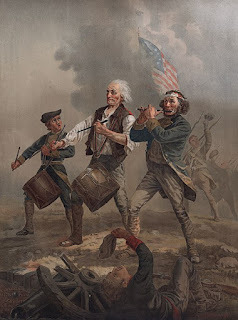
Credit: Spirit of '76 , an 1875 oil painting by American illustrator Archibald MacNeal Willard, is courtesy of Wikimedia Commons.
I admit that gives me pause. Authors are strongly advised to limit their books, even historical fiction works, to 100,000 words.
 I won't with this one though. Like many writers, I believe that if you have a story to tell, you should tell it. You should develop every major character and narrative thread until you can develop no more.
In The Patriots, my twenty-fourth novel, I will do just that. I will dive deep into the lives of Noah and Jake Maclean, two orphaned brothers who travel from the Philadelphia of 2024 to the one of 1776.
Like most boys, Noah, 22, and Jake, 15, will not be able to resist a dangerous temptation that calls to them from their own property. They will enter a mysterious stone shed and venture to the American Revolution, where they will meet Ben Franklin, John Adams, Peggy Shippen, and the lovely daughters of a furniture maker.
Unlike September Sky , River Rising , The Lane Betrayal , and The Fountain , the first books of my last four series, The Patriots will focus more on people than events. It will focus on the brothers; sisters Abigail (20) and Rachel (14) Ward; and Douglas Maclean, the boys' great-uncle and the patriarch of a Scottish clan that goes back centuries.
It will also lay the foundation for a trilogy that spans the length of the revolution, a conflict I am covering for the first time. It will set the stage for more action-oriented stories in books two and three.
Because of the book's length, I don't expect to finish the first draft before July. I do expect to have the finished product out by October 1.
Credit: Spirit of '76 , an 1875 oil painting by American illustrator Archibald MacNeal Willard, is courtesy of Wikimedia Commons.


March 6, 2024
The Refuge goes audio
Since publishing
The Mine
, my first novel, more than twelve years ago, I have focused mostly on producing ebooks -- for obvious reasons. Ebooks are easier to create, update, and ultimately sell. They are the fastest and surest way to get a return on my investment.
Even so, I have not neglected other formats. Though print books and audiobooks are not as lucrative or easy to update, they are important. Many people will not read a book unless they can hold a paper copy in their hands. Others prefer not to read at all. They would rather listen.
 For that reason and others, I have done my best to convert all of my Kindle books to print and audio. All twenty-three of my novels are already in print. As of last month, nineteen are also available in audio.
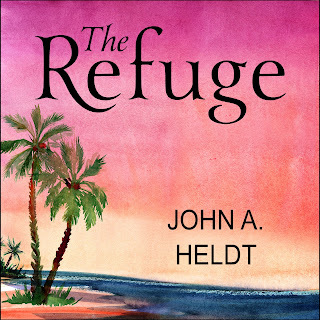
The Refuge , the fourth book in the Time Box series, joined that group last week. Released on February 29, it is now available through Amazon, Apple Books, and Audible.
Roberto Scarlato, who also narrated The Fair and Sea Spray , books two and three in the series, will narrate book five. The talented Michigan voice artist will begin work on Crown City sometime this spring.
As with previous audiobooks, I can distribute a limited number of Audible books in exchange for reviews. Please contact me if interested in a free code for The Refuge or selected other audiobooks.
Even so, I have not neglected other formats. Though print books and audiobooks are not as lucrative or easy to update, they are important. Many people will not read a book unless they can hold a paper copy in their hands. Others prefer not to read at all. They would rather listen.
 For that reason and others, I have done my best to convert all of my Kindle books to print and audio. All twenty-three of my novels are already in print. As of last month, nineteen are also available in audio.
The Refuge , the fourth book in the Time Box series, joined that group last week. Released on February 29, it is now available through Amazon, Apple Books, and Audible.
Roberto Scarlato, who also narrated The Fair and Sea Spray , books two and three in the series, will narrate book five. The talented Michigan voice artist will begin work on Crown City sometime this spring.
As with previous audiobooks, I can distribute a limited number of Audible books in exchange for reviews. Please contact me if interested in a free code for The Refuge or selected other audiobooks.
A wedding to remember
 I don't normally go barefoot while wearing a suit, but I did just that on Saturday when I married off my son, Matthew, on a beach. Along with my in-laws, Ken and Michelle Miller; daughter-in-law, Mikayla; wife, Cheryl (all pictured); and many guests, I helped turn Navarre Beach, Florida, into a wedding chapel. Many blessings to the newlyweds as they begin their new lives.
February 8, 2024
The impact of AI on art
I first learned about artificial intelligence (AI) in the seventh grade. While reading "EPICAC," a short story by Kurt Vonnegut, I learned all about EPICAC, the world's first electronic general-purpose computer, and two of its handlers. Like others in my English class, I learned about the possibilities and problems of using technology to produce art.
In Vonnegut's story, the unnamed narrator, a nerdy mathematician, asks EPICAC to write poems to win over Pat, a reluctant colleague. He succeeds when he passes off the computer's work as his own. Pat agrees to marry him, provided that he write her a poem every anniversary. All is well, in fact, until EPICAC falls in love with Pat and destroys itself trying to understand why it cannot marry a human.
Since that time, I have viewed the fusion of technology and art with a decidedly jaded eye. I believe literature, like other art, should be imperfect, messy, and most of all, authentic, something brimming with quirks and idiosyncrasies. It should be more man than machine.
Others take a different view. In recent years, they have flooded the market with movies, music, and images that were created with the help of computers. Some have used tools that are accessible online.
As an author, I have focused more on AI's impact on writing and publishing. So have others. The Columbia Journalism Review detailed AI's impact on journalism earlier this month. Other publications, such as Forbes and Publishers Weekly , have explained how technology is changing the way authors and publishers produce books.
Artificial intelligence has even seeped into the realm of audiobooks. A few weeks ago, Amazon began offering authors the option of having their works narrated with a virtual voice. Examples of the new technology, still in the beta stage, can be found here.
Being something of a Luddite, I have resisted the trend toward AI, but even I recognize the promise it holds and how it can be used within acceptable boundaries. For several weeks now, I have used Google Gemini, an AI chatbot and research assistant, as a tool in finding information about the United States in the 1770s. I intend to use it even more in the days to come as I finish my research for my next novel.
Even so, I will keep most new technologies at bay. I will produce books as I have done for twelve years now and will probably do for twelve more. I will use AI for research, but never for writing.
I will take that approach with other things as well, including those more personal. For 37 years, I have written my wife, Cheryl, a poem every anniversary. Most are cringey limericks, haikus, and sonnets I wouldn't share in a tavern, but all are original and authentic. Unlike the narrator in "ENICAC," I did my own work. That's how it should be.
In Vonnegut's story, the unnamed narrator, a nerdy mathematician, asks EPICAC to write poems to win over Pat, a reluctant colleague. He succeeds when he passes off the computer's work as his own. Pat agrees to marry him, provided that he write her a poem every anniversary. All is well, in fact, until EPICAC falls in love with Pat and destroys itself trying to understand why it cannot marry a human.
Since that time, I have viewed the fusion of technology and art with a decidedly jaded eye. I believe literature, like other art, should be imperfect, messy, and most of all, authentic, something brimming with quirks and idiosyncrasies. It should be more man than machine.
Others take a different view. In recent years, they have flooded the market with movies, music, and images that were created with the help of computers. Some have used tools that are accessible online.
As an author, I have focused more on AI's impact on writing and publishing. So have others. The Columbia Journalism Review detailed AI's impact on journalism earlier this month. Other publications, such as Forbes and Publishers Weekly , have explained how technology is changing the way authors and publishers produce books.
Artificial intelligence has even seeped into the realm of audiobooks. A few weeks ago, Amazon began offering authors the option of having their works narrated with a virtual voice. Examples of the new technology, still in the beta stage, can be found here.
Being something of a Luddite, I have resisted the trend toward AI, but even I recognize the promise it holds and how it can be used within acceptable boundaries. For several weeks now, I have used Google Gemini, an AI chatbot and research assistant, as a tool in finding information about the United States in the 1770s. I intend to use it even more in the days to come as I finish my research for my next novel.
Even so, I will keep most new technologies at bay. I will produce books as I have done for twelve years now and will probably do for twelve more. I will use AI for research, but never for writing.
I will take that approach with other things as well, including those more personal. For 37 years, I have written my wife, Cheryl, a poem every anniversary. Most are cringey limericks, haikus, and sonnets I wouldn't share in a tavern, but all are original and authentic. Unlike the narrator in "ENICAC," I did my own work. That's how it should be.
February 2, 2024
The City of Brotherly Love
I have never been to Philadelphia. Once, in 1984, while driving with a college friend from Connecticut to Washington, D.C., I entered the city's New Jersey suburbs on Interstate 295, but not the city itself.
Since then, I have not come even close to the place that gave us the Phillies, cheesesteaks, and most important, the Declaration of Independence. Like a lot of people, I have seen the city from afar and not given it a second thought. That changed last month, at least in a figurative sense, when I began researching the Philadelphia of the late 1770s, the primary setting of my next novel and time-travel trilogy.
 Since January 1, I have read books and articles, contacted experts, and watched movies and television series to get a better understanding of a setting that is as important to democracy as the declaration itself.
As I did, I learned that Philadelphia, the City of Brotherly Love, was a pretty big deal. With a population of forty thousand, it was the largest city in the Western Hemisphere in 1776 and the center of commerce and culture in British North America. It boasted America's first library, hospital, and university. (Harvard, alas, was a mere college.)
It also featured interesting people. Ben Franklin put his stamp on the city. So did George Washington, John Adams, Thomas Jefferson, William Howe, and the treasonous trio of Benedict Arnold, Peggy Shippen, and John André. All added color and intrigue to a town that never rested during America's eight-year war for independence. Some, like Franklin and Shippen, will mingle with my protagonists in the first book. Others, like Washington, will do so in the second and third.
The protagonists, two brothers from 2024, will also experience Philadelphia. They will visit the city's bustling waterfront, Independence Hall, High Street Market, City Tavern, and the countryside between Philadelphia and Upper Merion Township, where a mysterious stone shed will serve as a time portal in all three books. They will see their native Pennsylvania as it existed in the 1770s and other eras.
I hope to finish researching Philadelphia, the war, and the 1770s this month and begin writing the book itself in March or early April.
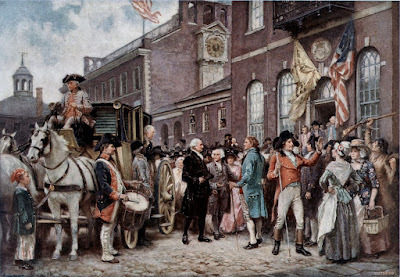
Image Credit: In "Washington's Inaugration at Philadelphia," an oil painting by Jean Leon Gerome Ferris (1863–1930), George Washington arrives at Congress Hall in Philadelphia on March 4, 1793. The public domain illustration is courtesy of Wikimedia Commons.
Since then, I have not come even close to the place that gave us the Phillies, cheesesteaks, and most important, the Declaration of Independence. Like a lot of people, I have seen the city from afar and not given it a second thought. That changed last month, at least in a figurative sense, when I began researching the Philadelphia of the late 1770s, the primary setting of my next novel and time-travel trilogy.
 Since January 1, I have read books and articles, contacted experts, and watched movies and television series to get a better understanding of a setting that is as important to democracy as the declaration itself.
As I did, I learned that Philadelphia, the City of Brotherly Love, was a pretty big deal. With a population of forty thousand, it was the largest city in the Western Hemisphere in 1776 and the center of commerce and culture in British North America. It boasted America's first library, hospital, and university. (Harvard, alas, was a mere college.)
It also featured interesting people. Ben Franklin put his stamp on the city. So did George Washington, John Adams, Thomas Jefferson, William Howe, and the treasonous trio of Benedict Arnold, Peggy Shippen, and John André. All added color and intrigue to a town that never rested during America's eight-year war for independence. Some, like Franklin and Shippen, will mingle with my protagonists in the first book. Others, like Washington, will do so in the second and third.
The protagonists, two brothers from 2024, will also experience Philadelphia. They will visit the city's bustling waterfront, Independence Hall, High Street Market, City Tavern, and the countryside between Philadelphia and Upper Merion Township, where a mysterious stone shed will serve as a time portal in all three books. They will see their native Pennsylvania as it existed in the 1770s and other eras.
I hope to finish researching Philadelphia, the war, and the 1770s this month and begin writing the book itself in March or early April.
Image Credit: In "Washington's Inaugration at Philadelphia," an oil painting by Jean Leon Gerome Ferris (1863–1930), George Washington arrives at Congress Hall in Philadelphia on March 4, 1793. The public domain illustration is courtesy of Wikimedia Commons.
January 4, 2024
New priorities for a new year
The road ahead looks different now. Three weeks into retirement, it looks more like Nevada's Route 50, the "loneliest road in America," than a busy thoroughfare dotted with attractions and billboards.
 Even so, it is not empty. It's more like path that offers new opportunities for an author who loves challenges and a change of pace. Fresh from an enjoyable nine-day vacation in Puerto Rico, I am already mapping out the possibilities for a productive 2024.
My first order of business, of course, is to start a new series. With the Carpenters and the Second Chance triology in my rear-view mirror, I am now focused on new characters and storylines. In fact, I have already begun outlining a time-travel series where two orphaned brothers, moved by their grandfather's deathbed confession, begin a life-changing journey to the 1770s and the Philadelphia of America's founders.
If that theme sounds familiar, it should. In my next project, I will borrow from The Fire , Class of '59 , The Lane Betrayal , Duties and Dreams , and other works in creating a trilogy that will blend old and new. In doing so, I will delve into the American Revolution for the first time.
I intend to research the period through the winter and begin writing in April. I hope to have the first book in the series out by the fall.
I also hope to convert at least two more books to audio in 2024, including The Refuge , which should be out sometime next month. With the release of that title, narrated by Roberto Scarlato, nineteen of my twenty-three novels will be available as audiobooks.
Though I will not be as driven to sell books as in past years, I will not neglect the business side of things either. I passed the 800,000 lifetime sales mark on Amazon in December 2023 and hope to hit the million mark before putting my MacBook Air out to pasture.
I should note, of course, that Amazon counts free and discounted books as "sales," which is why I am still writing and not building matching bungalows on Bora Bora, but the seven-figure-sale milestone is still important. It represents one of the few remaining objectives I want to reach in a career that began as a hobby a dozen years ago.
Beyond writing, I hope to do more traveling and reading in the coming year. Trips to Florida, the Pacific Northwest, and possibly the wine country of Northern California loom. So do more examinations of the framers. Walter Isaacson's Ben Franklin is my next read, followed by David McCullough's John Adams, a book I read years ago.
I am also going to keep an open mind toward getting a dog. Spending quality time with "Backup," my daughter Amy's lovable lab-pit mix, in Puerto Rico has prompted me to explore the notion again. In the meantime, I will find useful ways to use my newfound time.
I hope the holidays have been good to you and yours and wish you the best in whatever you take on in the coming year!
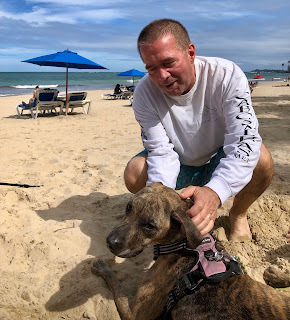
Photo: With "Backup," in Carolina, Puerto Rico, on New Year's Eve.
 Even so, it is not empty. It's more like path that offers new opportunities for an author who loves challenges and a change of pace. Fresh from an enjoyable nine-day vacation in Puerto Rico, I am already mapping out the possibilities for a productive 2024.
My first order of business, of course, is to start a new series. With the Carpenters and the Second Chance triology in my rear-view mirror, I am now focused on new characters and storylines. In fact, I have already begun outlining a time-travel series where two orphaned brothers, moved by their grandfather's deathbed confession, begin a life-changing journey to the 1770s and the Philadelphia of America's founders.
If that theme sounds familiar, it should. In my next project, I will borrow from The Fire , Class of '59 , The Lane Betrayal , Duties and Dreams , and other works in creating a trilogy that will blend old and new. In doing so, I will delve into the American Revolution for the first time.
I intend to research the period through the winter and begin writing in April. I hope to have the first book in the series out by the fall.
I also hope to convert at least two more books to audio in 2024, including The Refuge , which should be out sometime next month. With the release of that title, narrated by Roberto Scarlato, nineteen of my twenty-three novels will be available as audiobooks.
Though I will not be as driven to sell books as in past years, I will not neglect the business side of things either. I passed the 800,000 lifetime sales mark on Amazon in December 2023 and hope to hit the million mark before putting my MacBook Air out to pasture.
I should note, of course, that Amazon counts free and discounted books as "sales," which is why I am still writing and not building matching bungalows on Bora Bora, but the seven-figure-sale milestone is still important. It represents one of the few remaining objectives I want to reach in a career that began as a hobby a dozen years ago.
Beyond writing, I hope to do more traveling and reading in the coming year. Trips to Florida, the Pacific Northwest, and possibly the wine country of Northern California loom. So do more examinations of the framers. Walter Isaacson's Ben Franklin is my next read, followed by David McCullough's John Adams, a book I read years ago.
I am also going to keep an open mind toward getting a dog. Spending quality time with "Backup," my daughter Amy's lovable lab-pit mix, in Puerto Rico has prompted me to explore the notion again. In the meantime, I will find useful ways to use my newfound time.
I hope the holidays have been good to you and yours and wish you the best in whatever you take on in the coming year!
Photo: With "Backup," in Carolina, Puerto Rico, on New Year's Eve.
December 17, 2023
The road to retirement
I started as a paperboy. Sometime in 1974, at the ripe old age of 12, I began delivering the
Seattle Times
in a suburban subdivision that could have doubled as a set on
The Brady Bunch
. For three years, I overcame deadlines, dogs, and sometimes dreadful weather to get folded papers onto dry porches. I officially entered the workforce.
Since that time, I have held no fewer than thirty jobs. In high school and college, I washed dishes, bagged groceries, flipped French fries, sold appliances, shelved books, delivered office supplies, counted people for a census, mentored boys at a summer camp, wrote articles, and answered phone calls for a congressman.
In one summer job, at a vegetable packing plant, I stood inside a small refrigerated chamber and broke up clumps of frozen peas on a moving conveyer belt. With a long rake. For eight hours a day.
All of the grunt jobs prepared me well for the "real" world, where I made my mark as a sportswriter, an editor, a librarian, and finally as an author. Each experience taught me patience, humility, discipline, responsibility, and many other things I applied in life.
Though most of these jobs are decades in the past, I remembered all of them today as I punched a time card for the last time and officially retired. Leaving my position as a computer lab assistant at a Las Vegas library brought fifty years of labor into focus.
When people work a wide variety of jobs, they learn a lot about themselves. When they work with a wide variety of people, they learn a lot about society. They learn things that give them perspective and a better understanding of the world around them.
I know I did. I not only learned things but also put them to use. In several novels, I borrowed from work experiences, particularly those as a grocery clerk, a newspaper reporter, and a librarian. In Camp Lake I did even more. I constructed an entire story around my memorable tenure at a summer camp in Maine in 1983. I expect to incorporate even more work experiences in future books.
In the meantime, I will look back. I will remember the unexpected rewards and the special times from five decades of working for "the man" and for myself. I will recall the moments that mattered.
Perhaps the biggest came in 1994, when I walked into a newsroom to a standing ovation. My peers, fellow editors and reporters at a daily newspaper in Washington, had just learned of my award in a regional journalism competition, and let me know it. They took a moment from their busy schedules to acknowledge a job well done.
I will also remember the thank-yous, which always seemed to come at the right times. In 1983, a New York woman, the mother of an introverted boy, thanked me for teaching her son to ride a bike at camp. Eight years later, a girls basketball team sent me a card after I covered their heartbreaking run through a state tournament. In 2006, a Montana man thanked me for helping him reunite with a German woman he had met in the Army fifty years earlier. I was a reference librarian then, a person who loved to solve problems.
Now, I am a retiree, a soon-to-be Social Security recipient who can shop for senior discounts, take afternoon naps, and tell teenagers to get off my lawn. (Just kidding. I don't have a lawn.)
I don't plan to remain idle. I value time like most people value food and plan to put that time to good use. Sometime in January, after returning from a vacation in Puerto Rico, I will lay the groundwork for my next book, my next series, and my next course in life.
That's what I look forward to most. Retirement, for me, will not be an opportunity to rest. It will be a chance to do more. Much more.
Since that time, I have held no fewer than thirty jobs. In high school and college, I washed dishes, bagged groceries, flipped French fries, sold appliances, shelved books, delivered office supplies, counted people for a census, mentored boys at a summer camp, wrote articles, and answered phone calls for a congressman.
In one summer job, at a vegetable packing plant, I stood inside a small refrigerated chamber and broke up clumps of frozen peas on a moving conveyer belt. With a long rake. For eight hours a day.
All of the grunt jobs prepared me well for the "real" world, where I made my mark as a sportswriter, an editor, a librarian, and finally as an author. Each experience taught me patience, humility, discipline, responsibility, and many other things I applied in life.
Though most of these jobs are decades in the past, I remembered all of them today as I punched a time card for the last time and officially retired. Leaving my position as a computer lab assistant at a Las Vegas library brought fifty years of labor into focus.
When people work a wide variety of jobs, they learn a lot about themselves. When they work with a wide variety of people, they learn a lot about society. They learn things that give them perspective and a better understanding of the world around them.
I know I did. I not only learned things but also put them to use. In several novels, I borrowed from work experiences, particularly those as a grocery clerk, a newspaper reporter, and a librarian. In Camp Lake I did even more. I constructed an entire story around my memorable tenure at a summer camp in Maine in 1983. I expect to incorporate even more work experiences in future books.
In the meantime, I will look back. I will remember the unexpected rewards and the special times from five decades of working for "the man" and for myself. I will recall the moments that mattered.
Perhaps the biggest came in 1994, when I walked into a newsroom to a standing ovation. My peers, fellow editors and reporters at a daily newspaper in Washington, had just learned of my award in a regional journalism competition, and let me know it. They took a moment from their busy schedules to acknowledge a job well done.
I will also remember the thank-yous, which always seemed to come at the right times. In 1983, a New York woman, the mother of an introverted boy, thanked me for teaching her son to ride a bike at camp. Eight years later, a girls basketball team sent me a card after I covered their heartbreaking run through a state tournament. In 2006, a Montana man thanked me for helping him reunite with a German woman he had met in the Army fifty years earlier. I was a reference librarian then, a person who loved to solve problems.
Now, I am a retiree, a soon-to-be Social Security recipient who can shop for senior discounts, take afternoon naps, and tell teenagers to get off my lawn. (Just kidding. I don't have a lawn.)
I don't plan to remain idle. I value time like most people value food and plan to put that time to good use. Sometime in January, after returning from a vacation in Puerto Rico, I will lay the groundwork for my next book, my next series, and my next course in life.
That's what I look forward to most. Retirement, for me, will not be an opportunity to rest. It will be a chance to do more. Much more.
November 19, 2023
A last look at a series
The trilogy is now ten days old. The Duties and Dreams ebook came out November 9, the paperback yesterday. Even the Second Chance boxed set is in circulation. Yet the series, my fifth overall, is still fresh in my mind. It probably will be for weeks to come.
When you write a historical fiction series as detailed and exhaustive as Second Chance, you leave a little bit of yourself behind. I know I did. I am still getting used to a daily schedule that does not involve seven to eight hours of researching, writing, and editing. I plan to enjoy the hiatus between this project and the next. In the meantime, I intend to reflect a bit on my shortest — but arguably most important — series, one that will serve as a template for the next one.
The first thing you need to know about Second Chance is that it is a nod to Baby Boomers, the pampered, free-spirited, often-maligned mob I joined in 1961. If you were born between 1946 and 1964, you will immediately recognize the backgrounds of my protagonists, from their Leave it to Beaver beginnings to their personal and professional struggles in the 1960s, 1970s, and beyond. You will understand why the Carpenters did what they did when they wandered through 1906, 1912, and finally 1918.
I choose to write about old souls because I can relate to them. Like Bill, Paul, and Annie, I could relate to coming of age and growing old(er) in a world that was much different than today's. I could relate to at least some of their experiences, setbacks, and triumphs.
Annie was, by far, my favorite character — for many reasons. She brought energy and passion to the series and probably best personified its growth. She grew in ways her more set-in-their-ways older brothers could not or would not. She represented the best of her family and her generation. She acquitted herself well.
Cassie Lee, Charles Rusk, and Emilie Perot were my favorite secondary characters. All brought something to a trilogy that was as varied as the settings. Each helped the Carpenters grow.
If there was one thing I enjoyed most about producing this series, it was researching the events that shaped it. Though I knew a lot about the Titanic, I knew little about the San Francisco earthquake, the Triangle Shirtwaist Factory fire, the Mexican Revolution, and even World War I. I knew even less about Baja California, Brooklyn, and Alsace, a storied French region I want to visit someday.
I also enjoyed returning to my native Northwest — Portland, Tacoma, and Mount Rainier make appearances in two books — and bringing children back into my work. From the students of Oakland Prep and Gotham Prep to Mabel Moss to Chloe the flower girl to the offspring of Bill and Annie, kids put their stamp on mostly grown-up stories. Bea and Millie Carpenter and Patrick and Henry Lee brought both comic relief and perspective to the Second Chance trilogy.
I put a stamp on the series, as well. As some readers know, I often use meaningful dates, places, and devices in my stories. I have used August 2, my wedding anniversary, more times than I can count. I occasionally use birthdays too — and, in the case of my latest release, I used the birthday. When I had the opportunity to end both Duties and Dreams and the Second Chance series on December 30, 1961, by moving up the last chapter by one day, I took it. When you are a writer of fiction, you can do those things.
I did not intend to tie the book's title to its dedication, but it happened anyway. Shortly after titling Duties and Dreams , I noticed that the book's initials (DAD) lined up nicely with the subject of its dedication page. Even before writing a word, I had decided to dedicate the novel to James Heldt, my father, who is still going at age 92.
As coincidences go, that was hard to beat. It was a fitting touch to a series I will no doubt think about for a long time.
When you write a historical fiction series as detailed and exhaustive as Second Chance, you leave a little bit of yourself behind. I know I did. I am still getting used to a daily schedule that does not involve seven to eight hours of researching, writing, and editing. I plan to enjoy the hiatus between this project and the next. In the meantime, I intend to reflect a bit on my shortest — but arguably most important — series, one that will serve as a template for the next one.
The first thing you need to know about Second Chance is that it is a nod to Baby Boomers, the pampered, free-spirited, often-maligned mob I joined in 1961. If you were born between 1946 and 1964, you will immediately recognize the backgrounds of my protagonists, from their Leave it to Beaver beginnings to their personal and professional struggles in the 1960s, 1970s, and beyond. You will understand why the Carpenters did what they did when they wandered through 1906, 1912, and finally 1918.
I choose to write about old souls because I can relate to them. Like Bill, Paul, and Annie, I could relate to coming of age and growing old(er) in a world that was much different than today's. I could relate to at least some of their experiences, setbacks, and triumphs.
Annie was, by far, my favorite character — for many reasons. She brought energy and passion to the series and probably best personified its growth. She grew in ways her more set-in-their-ways older brothers could not or would not. She represented the best of her family and her generation. She acquitted herself well.
Cassie Lee, Charles Rusk, and Emilie Perot were my favorite secondary characters. All brought something to a trilogy that was as varied as the settings. Each helped the Carpenters grow.
If there was one thing I enjoyed most about producing this series, it was researching the events that shaped it. Though I knew a lot about the Titanic, I knew little about the San Francisco earthquake, the Triangle Shirtwaist Factory fire, the Mexican Revolution, and even World War I. I knew even less about Baja California, Brooklyn, and Alsace, a storied French region I want to visit someday.
I also enjoyed returning to my native Northwest — Portland, Tacoma, and Mount Rainier make appearances in two books — and bringing children back into my work. From the students of Oakland Prep and Gotham Prep to Mabel Moss to Chloe the flower girl to the offspring of Bill and Annie, kids put their stamp on mostly grown-up stories. Bea and Millie Carpenter and Patrick and Henry Lee brought both comic relief and perspective to the Second Chance trilogy.
I put a stamp on the series, as well. As some readers know, I often use meaningful dates, places, and devices in my stories. I have used August 2, my wedding anniversary, more times than I can count. I occasionally use birthdays too — and, in the case of my latest release, I used the birthday. When I had the opportunity to end both Duties and Dreams and the Second Chance series on December 30, 1961, by moving up the last chapter by one day, I took it. When you are a writer of fiction, you can do those things.
I did not intend to tie the book's title to its dedication, but it happened anyway. Shortly after titling Duties and Dreams , I noticed that the book's initials (DAD) lined up nicely with the subject of its dedication page. Even before writing a word, I had decided to dedicate the novel to James Heldt, my father, who is still going at age 92.
As coincidences go, that was hard to beat. It was a fitting touch to a series I will no doubt think about for a long time.
November 10, 2023
A duty to dream
Be careful what you wish for.
The warning, from The Old Man and Death, one of Aesop's Fables, is one of the oldest themes in literature. It is also, for all practical purposes, the central theme of the Second Chance series.
In The Fountain and Annie's Apple , the first two books in the trilogy, characters wish for one thing and get another. They find that the road to happiness is littered with potholes, rocks, and nails.
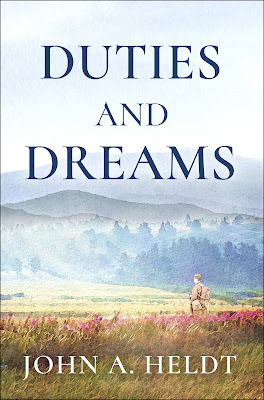 Then they find it again. In
Duties and Dreams
, several adults, linked by blood, marriage, and history, discover that even innocent wishes come with a price.
Then they find it again. In
Duties and Dreams
, several adults, linked by blood, marriage, and history, discover that even innocent wishes come with a price.
As World War I rages in Europe, the Carpenters and the Lees make a home in Southern California. Bill and Cassie add to their family. Andy and Annie start one of their own. Paul, a bachelor, enters the world of business. All find peace in a turbulent time. Then draft notices arrive, illness strikes a child, and life for two intertwined families takes a troubling turn. Thirty years later, Emilie Perot, a beautiful resistance fighter, and Steve and Shannon Taylor, an American couple with ties to Paul Carpenter, conspire to escape Nazi occupation. Each seeks freedom and a new life in France's Vosges Mountains, home of a legendary fountain of youth that can restore health and send visitors through time. As events unfold in the different eras, the participants march on. All are unaware of the forces that seem determined to throw them together.
Paul, 30, takes a star turn in this one. From the first chapter to the last, he is the focus of the story. Readers follow the quiet member of a secretive family as he returns to the U.S. Army, travels to wartime France, and battles one life challenge after another. They see a luckless-in-love soldier make a friend from the future.
Others also step up. Annie, 27, shines as a young wife and mother. Bill and Cassie, both 36, do the same as spouses and parents. Even Andy, the curmudgeon of book two, finds his place. Now 30, the lieutenant rolls with the punches of an unpredictable war.
Though Duties and Dreams is a plot-driven novel, complete with a nasty villain, action, and running clocks, it is a character-focused story, one that examines the impact of war, disease, and separation on ordinary human beings. Set in seven countries during the most difficult days of the twentieth century, it brings to a conclusion a sweeping family saga that began with a leap of faith.
Duties and Dreams is my twenty-third novel. It goes on sale today as a Kindle book at Amazon.com and its international web sites.
The warning, from The Old Man and Death, one of Aesop's Fables, is one of the oldest themes in literature. It is also, for all practical purposes, the central theme of the Second Chance series.
In The Fountain and Annie's Apple , the first two books in the trilogy, characters wish for one thing and get another. They find that the road to happiness is littered with potholes, rocks, and nails.
 Then they find it again. In
Duties and Dreams
, several adults, linked by blood, marriage, and history, discover that even innocent wishes come with a price.
Then they find it again. In
Duties and Dreams
, several adults, linked by blood, marriage, and history, discover that even innocent wishes come with a price.As World War I rages in Europe, the Carpenters and the Lees make a home in Southern California. Bill and Cassie add to their family. Andy and Annie start one of their own. Paul, a bachelor, enters the world of business. All find peace in a turbulent time. Then draft notices arrive, illness strikes a child, and life for two intertwined families takes a troubling turn. Thirty years later, Emilie Perot, a beautiful resistance fighter, and Steve and Shannon Taylor, an American couple with ties to Paul Carpenter, conspire to escape Nazi occupation. Each seeks freedom and a new life in France's Vosges Mountains, home of a legendary fountain of youth that can restore health and send visitors through time. As events unfold in the different eras, the participants march on. All are unaware of the forces that seem determined to throw them together.
Paul, 30, takes a star turn in this one. From the first chapter to the last, he is the focus of the story. Readers follow the quiet member of a secretive family as he returns to the U.S. Army, travels to wartime France, and battles one life challenge after another. They see a luckless-in-love soldier make a friend from the future.
Others also step up. Annie, 27, shines as a young wife and mother. Bill and Cassie, both 36, do the same as spouses and parents. Even Andy, the curmudgeon of book two, finds his place. Now 30, the lieutenant rolls with the punches of an unpredictable war.
Though Duties and Dreams is a plot-driven novel, complete with a nasty villain, action, and running clocks, it is a character-focused story, one that examines the impact of war, disease, and separation on ordinary human beings. Set in seven countries during the most difficult days of the twentieth century, it brings to a conclusion a sweeping family saga that began with a leap of faith.
Duties and Dreams is my twenty-third novel. It goes on sale today as a Kindle book at Amazon.com and its international web sites.
October 10, 2023
Review: Band of Brothers
For an obvious reason, I rarely watch a television series twice. A series, unlike a movie or even a book, represents a serious investment in time. This month, however, I made an exception. When I saw that
Band of Brothers
, a ten-episode miniseries, was making a tour of duty on Netflix, I jumped on it. I am so glad I did.
When you watch something a second (or third or fourth) time, you notice things you did not notice originally. You spot nuances and themes that hid in plain sight the first time you watched.
So it was with Band of Brothers , which follows "Easy" Company, an elite American airborne unit, from its training in the U.S. and England to D-Day to the end of World War II. In watching the production a second time, I was able to truly appreciate its brilliance.
Among other things, I was able to appreciate the war's toll on Easy's members, especially those who served for the duration of the conflict. I was able to see the fatigue, the frayed nerves, the frailties, and even the pettiness of ordinary men pushed to their limits.
Though Damian Lewis, playing Major Richard Winters, shines in the series, he is not the only star. More than twenty others, including New Kids on the Block's Donnie Wahlberg and Friends' David Schwimmer, provide strong performances. All add something to a series that many consider to be the finest every aired.
In addition to the story and the performances, I enjoyed the added content, such as the comments from the actual soldiers at the beginning of each episode. I thought the brief narratives from men in their seventies, men in a position to reflect on the war and their lives, was a treat that lent even more authenticity to the series.
Band of Brothers , which originally aired on HBO in 2001, is more than compelling television. It is history at its best. Despite its violence and mature content, I would recommend it to anyone. Rating: 5/5.
When you watch something a second (or third or fourth) time, you notice things you did not notice originally. You spot nuances and themes that hid in plain sight the first time you watched.
So it was with Band of Brothers , which follows "Easy" Company, an elite American airborne unit, from its training in the U.S. and England to D-Day to the end of World War II. In watching the production a second time, I was able to truly appreciate its brilliance.
Among other things, I was able to appreciate the war's toll on Easy's members, especially those who served for the duration of the conflict. I was able to see the fatigue, the frayed nerves, the frailties, and even the pettiness of ordinary men pushed to their limits.
Though Damian Lewis, playing Major Richard Winters, shines in the series, he is not the only star. More than twenty others, including New Kids on the Block's Donnie Wahlberg and Friends' David Schwimmer, provide strong performances. All add something to a series that many consider to be the finest every aired.
In addition to the story and the performances, I enjoyed the added content, such as the comments from the actual soldiers at the beginning of each episode. I thought the brief narratives from men in their seventies, men in a position to reflect on the war and their lives, was a treat that lent even more authenticity to the series.
Band of Brothers , which originally aired on HBO in 2001, is more than compelling television. It is history at its best. Despite its violence and mature content, I would recommend it to anyone. Rating: 5/5.