Steven P. MacGregor's Blog, page 4
April 8, 2020
Connecting in a disconnected world
As we continue to hunker down in our homes, the number one thing our locked-down world is learning is what makes us most human – each other. Interaction is so fundamental to the very state of being human that we take it for granted. That is, until we’re suddenly deprived of it almost overnight and thrust into an isolation experiment of global proportions.
COVID-19 is testing the body to its limits, but it is also testing the spirit. On an individual level the strain can feel great, and we’re all finding out just how much we miss family and friends. But human connections matter to our teams too. Team leaders everywhere are wrestling with how to create cohesiveness and foster culture remotely – tasks that are hard enough to accomplish when everyone is present and accounted for in the office.
So, for those team builders and home-workers out there, here are some suggestions of how you can stay connected and keep morale high.
Stay in the moment but look ahead too. Leaders will have to strike a balance between helping their team members stay in the ‘now’ so they don’t feel overwhelmed by the great uncertainties that are out there. But showing them that you believe in the future is vital to their belief that they can get through this. I’ve heard of one manager who is doing this by getting his team to re-imagine their offering. How do they want to better serve their customers? How do they want to re-design buildings, uniforms? He’s even got them planning celebrations for customers when the service opens up again, post-Corona. He’s inspiring them to believe in an even better future while they deal with this strange day-to-day.
Know your team, and yourself. Now’s the time for leaders to dig out their team’s personality inventory. Remind yourself about their introvert/extrovert preferences and other traits. Do your introverts need drawing out more, one-to-one with you, to find out how they are really coping? Do your extroverts need lots of team interaction? Of course, you have to ask them individually what they feel they need, but refreshing your understanding of their personality means you can be prepared to offer them the right help. Take some time also to check-in with yourself. How mindful are you of your own behaviour? And how is that behaviour impacting on others?
Share. It’s never been more important to build in a team habit of gratitude and sharing. Finish each day/week with everyone sharing what they are grateful for. Maybe do an exercise where the team share what they value about each other – ‘what I really value about Sally/Henry is…….’ And share some home life too – who doesn’t love a baby or cat held up to the camera? What goofy stuff are your kids up to that might make co-workers laugh? For those co-workers isolating alone, this feeling of family could be invaluable. Sharing builds empathy which will make your team stronger in the long-run.
Help others. It’s often said that the best way to help ourselves is to help others. Maybe now’s the time for the team to choose a charity or community project to help. Find out if your local hospital, care homes or foodbank need help you can give remotely. Getting the team involved can focus everyone on thinking of others – the best way to stop obsessing about ourselves. You will soon see that kindness and compassion is incredibly energizing for all.
Purpose, purpose, purpose. Above all your job as leader is to keep the purpose alive. Now’s the ideal time to re-connect with the ‘team soul’. What are you trying to accomplish in the world and what needs to change so you can serve your purpose better in the future? How can you go the extra mile for your customers now when they are hurting too? How can you surprise and delight them now and when you return to normality? At this moment, for all of us, purpose is king. It allows us to strip away all the non-essential ‘stuff’ that may have accumulated over time.
This time can be an unexpected gift for leaders – a reset button to enable us to work with our teams in a more meaningful way, emerging with a strengthened sense of connectedness and a culture that can thrive under any circumstances.


April 6, 2020
Leadership development in times of crisis
Episode 26 of the Chief Wellbeing Officer podcast.
In the third and final part of our look at Wellbeing in Professional Services we talk to Katherine Semler, Head of Leadership Development Iberia at Korn Ferry. The rapidly accelerating COVID-19 crisis provides the context for discussing leading through a crisis and the role that wellbeing is increasingly playing in leadership development.
March 25, 2020
Express yourself
We write to you in strange times indeed. Most (if not all) of us are reading this cut off from the routines of ordinary human life as we knew it.
It would be easy to assume we need a whole new way of working and thinking but at the same time we believe this crisis is an actual "corrector" and offers a precious opportunity to create and embed small habits into our daily lives. We have the profound believe that if every single one of us uses these days and weeks to energetically work on oneself, the world will be a stronger and more conscious/aware/centered place once we get out of it. The universal sequence we trust in starts with "leading one self" and only then leads to "leading others" all the way to "leading lasting change". And as a fact, "leading one self" starts with self awareness and small personal daily habits.
Some initial habits/nuggets we threw around ranged from how to start one's day, how to distill what actually matters, how to embed mindfulness and gratitude into one's day all the way to the power of nutrition and recovery. Many more habits will come over the weeks ahead and it is all about each of us finding (and activating) our own little formulas. These formulas represent our own personal pathways to a higher level of "leading one self".
But this short article is actually about a second thought that came up over the past days. We’ve been pondering and wondering how others living in isolation throughout history had managed these periods without any technology available. Turns out there are some great lessons to be learned from historical ‘home workers’. Let us share some which caught our attention:
Henry David Thoreau produced his great work Walden while living isolated in his Concord hut from 1845 to 1847. He also kept a journal - ‘my journal is that of me which would else spill over and run to waste……perhaps this is the main value of a habit of writing….that so we remember our best hours and stimulate ourselves.’
Journaling is so useful as a repository for our fears and frustrations and as a space to release our creativity. If we could urge you to do one thing it’s use this time, when we have all been forcibly ‘slowed’ and are not rushing out the door to take on a hundred things, to go inside, get reacquainted with yourself and your deepest hopes and dreams. Are you still on the right path?
Then there was Mother Julian. An English mystic and hermit of the Middle Ages. She used her alone time to give the world the first book written by a woman in English. Revelations of Divine Love with its now famous mantra ‘All shall be well, and all shall be well, and all manner of things shall be well’ has been an inspiration for centuries. How could you inspire and comfort others now?
And what about Nelson Mandela who spent his years in and out of solitary confinement, earning a law degree and tenaciously pursuing his fight for freedom for his people? He adopted a daily routine to get him through, including exercise. Have you worked out a new exercise routine?
Finally, perhaps the most famous home worker ever. From 1942 to 1944 Anne Frank lived with only her, often exasperating, family and friends in a tiny shared space. In these unpromising surroundings, suffused every day with fear, she started and stuck to her life’s great task - her diary - producing one of the most enduring accounts of human hope in the face of adversity. Enforced isolation gave her the chance to develop her gift and her journal kept her sane: ‘I can shake off everything as I write; my sorrows disappear, my courage is reborn.’
From her isolation, she also issued one of the most moving personal credos ever. Even as her people were subject to the deepest fears and difficulties imaginable, she could write:
‘I keep my ideals, because in spite of everything I still believe that people are really good at heart. How wonderful it is that nobody need wait a single moment before starting to improve the world.’
And so, while sticking to the practices reprised above and along with a sensible reliance on tech, is to write, write, write. Mine your inner creativity as a precious resource. There is some alchemy about capturing things on the white page or screen that makes them seem manageable, that helps you reconnect with yourself – and we’re all going to need to ‘find the friend within’ now.
Maybe even start a joint journal with family or friends during this shared time. Accounts of past pandemics by Samuel Pepys and Daniel Defoe are still read today. Anne Frank started her diary because the Dutch government asked its citizens to record the extraordinary times they were living through, so there may even be a call for personal accounts in future. What a valuable gift for generations to come.
We wish for you all that this rare human experience may paradoxically yield you, like Thoreau, some of your ‘best hours’. Stay strong and well.
March 15, 2020
Water as the source of life
In the last post – already some weeks back - we looked at how to distinguish urgency from importance which is easier said than done. This time around, the discussion is rather different, but it relates in one significant way. That is, when it comes to priorities, the topic in question is about as important as it gets. No, we’re not talking about boardroom decisions, refinancing debt or priority actions due to Corona, we’re talking about water: the source of life; that most precious of compounds that quenches our thirst and cleanses our bodies, both inside and out. Quite simply, it is the one commodity we can’t live without.
When you think about it, we don’t just need water, we are water – two-thirds of us at least. That’s right: around 60% of the human body is made up of H2O, and still our systems crave more in order to function. That makes it pretty much the most essential nutrient out there.
Of course, we all know that drinking enough water is important to our physical health – two liters a day should do it, says the science – but how often do we stop to think about the benefits of H2O to our mental wellbeing as well as to our daily productivity?
Our brains are about 80% water, so it should come as little surprise that drinking a steady supply throughout the day can make all the difference to the way we think and feel. With every sip, water improves our concentration and cognition, it heightens our memory function and increases the flow of oxygen and blood to our brains. Research shows it even helps to boost moods, balance emotions and reduce stress. What’s more, as Harvard Medical School points out, hydration does not have to come bottled; water-filled foods such as fruits, vegetables and soup can help boost energy too.
Now, ditching your morning espresso for 3 glasses of water might feel like a step too far, but upping our water intake is a realistic goal we can all strive to achieve – and one that can pay off, not just where health is concerned, but in the performance and productivity stakes too.
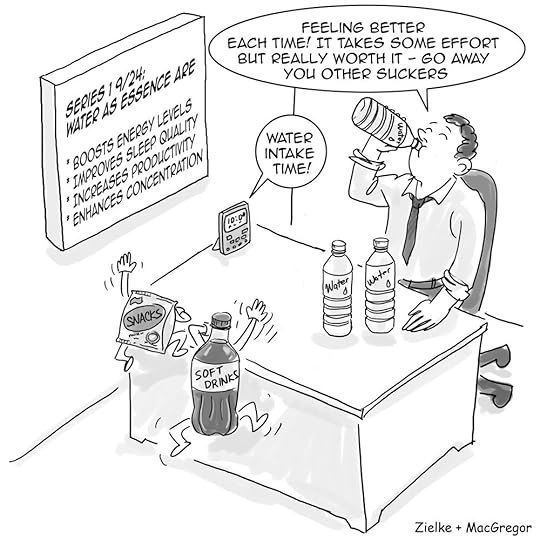
According to a study conducted by the Hydration, Nutrition and Cognition Research Unit at the University of East London, drinking water can increase productivity by 14%. Meanwhile, research published in the journal, Appetite, shows that once thirst strikes, mental performance including memory, attention and concentration, decreases by as much as 10%. Executive health and performance pioneers Juliette and Michael McGannon note that the ageing process is essentially a ‘drying out’ process, and advise a range of measures around keeping well hydrated which becomes ever more critical as we age in order to combat illness and disease.
If research studies aren’t your thing, then we can vouch for the power of water from our own personal experiences. Take both of us for example: when Mischa began consciously drinking more water some years back, he noticed a significant improvement not just in his energy levels, but in the quality of his sleep and related recovery each morning. He started to drink three liters per day starting with 500ml as soon as he wakes up in the morning, and the same again before he goes to sleep. That’s a third of his target daily intake in two instances only. To help him keep track, Mischa uses an app that tracks his water intake throughout the day (aqualert and mywaterreminder are just two of the available options). For Steven, more mindful water consumption has helped in several areas, from being able to stay the course on a daily 16 hours intermittent fasting regime, to improving recovery from hard training sessions. Appreciating a sparkling water with ice and lemon has also become a special recovery ritual and prevents excessive alcohol consumption during cocktail season!
The case for water is compelling, but then we know that, don’t we? The real challenge facing most of us is simply remembering to turn on the tap. Make water a part of your routine – set an alarm if you have to. Keep bottles strategically placed so that water is always within reach.
Away from drinking, water has other benefits too, though they are admittedly less tangible and harder to prove. According to Californian marine biologist and researcher, Dr. Wallace J. Nichols, simply being close to water – a lake, a river, an ocean – can improve performance, increase calm and decrease anxiety. His premise – a concept he calls the Blue Mind – may seem unorthodox, but it draws on neuroscience as well as individual accounts, and it is gaining traction around the world. In fact, it is a line of thinking that the University of Exeter is furthering with doctoral research into what it calls ‘virtual blue spaces.’ Specifically, the university is developing virtual reality aquatic settings such as beaches and coasts, and testing their ability to improve psychological wellbeing. And in real world architecture and building design water is a feature in the growing movement of biophilic design, which recognizes the presence of nature as being key to our health and wellbeing.
Ok, so water may not be the answer to everything, but it’s a great place to start. Happy, healthy and switched on? We’ll drink to that!
March 13, 2020
Scaling empathy
Episode 25 of the Chief Wellbeing Officer podcast.
In the second part of our look at wellbeing in professional services we talk to EY Seren CEO Michael Von der Geest on his mission to build an empathic corporate institution. We discuss the reasons behind wellbeing moving to the mainstream in professional services, what deploying empathy means and reflect on a post-like world where technology has the human being at the centre.
March 3, 2020
Coronavirus and Behaviour Change
1, 2, 3, 4, 5……
I’m in the next room, and a large smile spreads across my face.
13, 16, 14….and that smile turns into a chuckle.
My 5-year old son is practicing his counting. Speaking three languages each day and with most of his school instruction coming in Catalan, we thought it a good idea to try and re-enforce some of the basics at home. My wife came up with the counting idea while he washed his hands. And taking it to the next level, as he has done in the past few days, of counting beyond 10, through the tricky teens to 20, has important lessons for us all in the midst of the emerging global epidemic that is COVID-19.
I’m sure you know your numbers pretty well by now, but do you get to the recommended 20 (seconds) when washing your hands? 10? 5?? Your habits might just change over the next few weeks.
Thorough hand-washing has been a part of public health campaigns for over 100 years. From the CDC in the US to the NHS in the UK it remains a periodic focus for health officials who know the relevant research, such as a meta-level research study by the Canadian Medical Association Journal in January of 2014 which brought together more than 20 years of research into the common cold. How to catch it less often, and when you do, how do you spend less time with it. The big conclusion? Hand washing of course. If we take greater care on washing our hands, this has a much greater impact on the cold than any type of vitamin supplement or drug.
Hospitals know this only too well, with an acute appreciation of the danger of disease and germs spread between wards by well-travelled and overworked nurses in particular. Yet can you ask nurses to wash their hands 50, 100 times a day? Even the recommended washing time of 20 seconds can feel like an eternity. So instead of disrupting the daily operation of the hospital in such a significant way, not to mention fight on a cultural level with behavior change, they made it easy by simply placing hand sanitizers on the back of each door, with the desired habit to have a quick spray and clean when entering and leaving each ward.
The importance of clean hands has also been present in the private sector, especially in those companies with a mission of doing good and doing well. It’s been at the core of Unilever’s sustainability strategy and particularly its Sustainable Living Plan. Building on the traditions of a company in which millions of children took part in a Clean Hands Health campaign in 1920s America, hand-washing classes have been offered in rural India since 2002. Former CEO Paul Polman extended this across the developing world with more hand-washing work offered in the years 2011-2015 than in the previous 20. The 21-day course, using Unilever’s Lifebuoy soap, has been shown by independent studies to reduce diarrhea cases by 25% and increases school attendance because children are sick less often.
From health to performance, hand-washing was also part of the lauded Cumulative Effect of Marginal Gains strategy for Great British Olympic track cycling. Moving from a position of mediocrity, having won one Gold medal in 100 years, to unprecedented success for any country, winning 22 Golds in the last three Olympics, one of their ‘marginal gains’ was having a London-based surgeon teaching the Olympic cyclists how to wash their hands. Particular focus was placed on the back of the thumb, the area that many of us omit, and where different germs can cause sickness or even a minor decrease in the 70km/h average speeds where winning or losing comes down to the thickness of a bicycle tyre.
Ok, ok, so you get the picture. Clean hands! But will such heightened awareness lead to sustainable behaviour change? As commentary has been passed by the likes of the Financial Times and McKinsey on the effects and legacy of the Coronavirus in the past few days, this might be one of the big questions.
I write these reflections a day after finding out one of our March leadership development workshops with Salesforce is cancelled as the company places a temporary ban on all non-essential travel for their 50,000 employees. As Marc Benioff and co talk of new office protocols, and I see evidence of these at other clients such as my visit to Uber in Paris last week, I’m in the same position as many other business professionals in reflecting on the long-term effects of this crisis. As many experts, including Bill Gates predict that Coronavirus may be the first of similar outbreaks in the future we may all need to consider our own agility around learning and behaviour, just like a 5 year-old counting to 20.
February 21, 2020
How can wellbeing survive in professional services?
Kicking off our new thematic focus in the Chief Wellbeing Officer podcast we talk to Arti Kashyap-Aynsley, Wellbeing Leader at Deloitte Consulting UK, about the different perspectives on wellbeing, including senior leadership, young talent, and clients, and the operational changes taking place for a sector known for brutal hours and a lack of routine. The importance of role models is also discussed as we discuss Arti's personal wellbeing journey.
This is the first of 3 episodes in the “wellbeing in professional services” theme that forms the basis of Q1 2020.
January 23, 2020
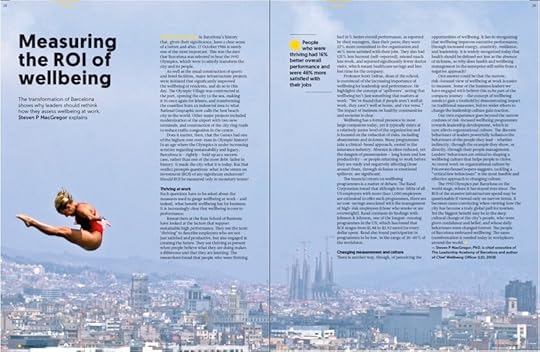
Measuring the ROI of Wellbeing
The original PDF file of my article originally published in Dialogue, the journal of Duke Corporate Education.
January 21, 2020
The Dopamine trap
Welcome to episode (8/24) in our series. After reflecting about the first 15 minutes of each of our days in the last episode, this week we look at how we might kick things off when we actually get to work.
The Harvard Business Review article we cited last time “How to spend the first 10 minutes of your day” applies here again – it is a worthwhile read. Being able to distinguish what is important from what is urgent is an impactful tool that allows valuable prioritization when you have a lot on your plate. Don’t be tempted to slip into reactive mode and attack the things that are top of your list, simply due to the fact they were received most recently, or by someone who is shouting the loudest.
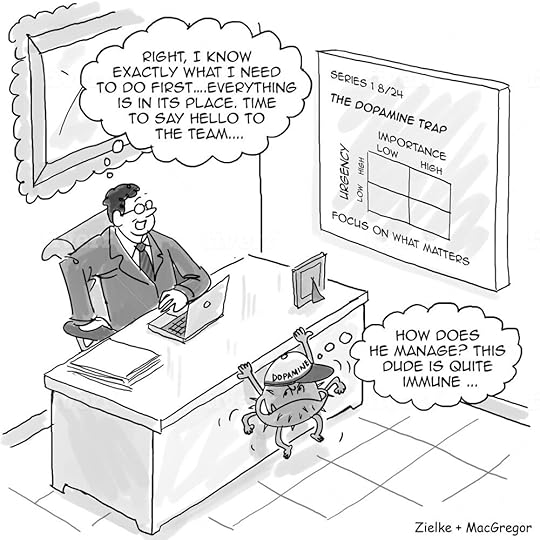
The challenge for all of us is that crossing out tasks or marking them as completed with a simple √ within a to-do list makes you feel great. And who is not striving to get this feeling early in the day. The reason is that whenever you recognize a task or project as completed, our brain releases a load of dopamine, a neurotransmitter that is responsible for generating feelings of accomplishment, satisfaction and happiness. This release of dopamine not only makes you feel good but also motivates you to continue completing tasks and extend that pleasant feeling.
A small nice “biological trap” in its purest form.
Sometimes termed the Eisenhower matrix, this 2x2 distinction guides you towards the things that might be done immediately (urgent and important), delegated (urgent but not important), planned for (not urgent but important) and eliminated (not urgent or important).
On a more general level, this first consideration of the day is about setting yourself up for success – what chefs may term ‘mise en place’ – getting everything ready for tackling the core, important work ahead.
This links to tackling the toughest problem you currently face (if it is important and urgent of course). Most of us will be at the peak of our powers during the morning, especially if you have a strong Lark chronotype (see episode 4). Psychological depletion, which predicts worsening willpower, decision-making and ethics as the day progresses, has still to kick in. So make the most of this golden window. Don’t be tempted to go for the low hanging fruit, such as ‘killing’ a bunch of emails. It may feel good since it is easy to measure, unlike the more vague deep thinking on a tough problem, but it won’t get you as far.
Our own pocket of time here has varied over the years as we have changed working locations, and been more or less externally focused. For Steven a key insight has been not to be afraid of space – the thinking and writing that is of far greater quality though perhaps less immediately gratifying than firing off a string of emails. For Mischa, the first 10 minutes at work are thinking about what needs to happen practically during the day to accomplish the three things that make this day a successful day. He sometimes shifts agendas, reprioritizes the plans for the day to ensure that by the end of the day these three small but critical elements have been accomplished (see his comments in the previous episode).
And a final reflection. The workplace is a community of people, and thriving workplaces have strong bonds between the people in that community. Don’t forget to connect with your colleagues when you get to work. We are whole human beings, more than what we do at work, and so connecting on a level separate from work and work tasks is just as important as the connection itself. As Peter Drucker said: “Good manners are the lubricating oil of an organization.”
January 13, 2020
Your first 15 minutes of the day
After our first 6 episodes during the last months of 2019 culminating with some thoughts “to get us moving” shortly before Christmas, we’re delighted to welcome you to our first episode of 2020 (7/24). Here we look at the small golden window as soon as you wake up – “your first 15 minutes of the day”.
When you wake up in the morning, how do you normally invest your first minutes of the day? Do you capture yourself taking a rapid glimpse at your phone? – some important messages might have flown in over night. Do you capture yourself watching the news? – something profoundly important might have happened once you were in your REM phase of Nirvana.
This is not uncommon and most of us deal with this “sensed need” to get connected. But is this the most effective way to start a day? Isn’t it better to first connect with yourself before connecting to the world? HBR published an article in 2014 titled “How to spend the first 10 minutes of your day.” In contrast to this episode this advice pertained more to the first 10 minutes at the office, not of consciousness, yet the key concept there also has important lessons for us. Instead of reacting to others, say through reading email, we proactively plan what is important for us to achieve that day. When we are less reactive to some external stimuli, we are able to distinguish what is truly important, not simply urgent.
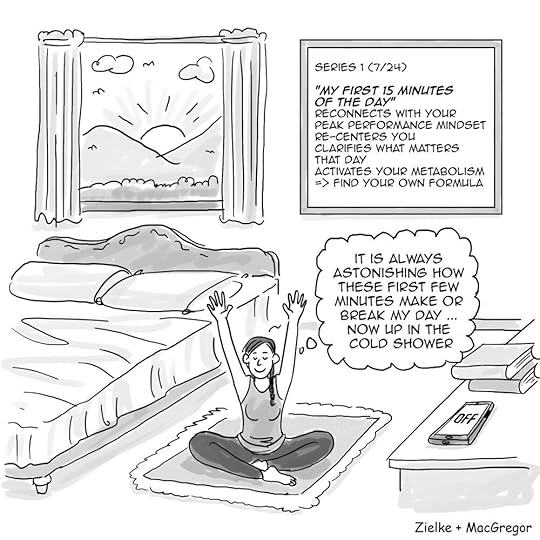
Our invitation this week is to think about YOUR morning ritual. The power of a morning ritual cannot be understated! It is something the world's most centered, happy and successful people hold as one of the reasons for their state of being. Studies also show that it impacts greatly on the remainder of the day.
Not sure where to start? Don’t worry, there are no right or wrong answers, just something that feels right for you. Let us give you some of our own actions.
For Mischa, after waking (normally between 5-6am), the first thing is sitting for 1 minute (only 60 seconds!) and reflecting about 1 single question: What are the 3 things that need to happen today to make this a wonderful day? Just 3 things, not a single one more. Straight after he starts his 7-minute yoga routine (the yoga mat being placed right next to the bed the previous night). This routine came from a teacher in Nepal who advised not to think about doing yoga 2-3 times a week for one hour but rather having a simple short exercise of 40 seconds (with 8 moves) and repeating 10 times. The simplicity and repetitive nature has a wonderful impact on both, body and mind. The final element is a cold shower (which was quite difficult having spent the last 4 years in Dubai where the lowest temperature is differently scaled!). Additional value comes from standing still for 30 seconds under the cold shower without moving –a simple mindfulness practice which works wonders.
For Steven, similar actions have come into play at different times over the years, including walking the dog, meditation and a morning Pilates routine. Like Mischa, a pre-dawn start is highly prized. Changes have come from a different apartment or different family circumstances – a screaming child can scupper the best-laid plans! In all, he tries to remember a simple piece of advice read a few years ago: “Look at a cloud before your smartphone each day.” Now whether you’re lucky enough not to actually find a cloud isn’t the point. It’s a reminder to start the day by first finding our feet in this marvellous world, and not be dragged along by someone elses crisis.
Now that we're in a new year, take a moment and think about YOUR morning ritual. Make the first 15 minutes of every day something count and seize the day!