The Dopamine trap
Welcome to episode (8/24) in our series. After reflecting about the first 15 minutes of each of our days in the last episode, this week we look at how we might kick things off when we actually get to work.
The Harvard Business Review article we cited last time “How to spend the first 10 minutes of your day” applies here again – it is a worthwhile read. Being able to distinguish what is important from what is urgent is an impactful tool that allows valuable prioritization when you have a lot on your plate. Don’t be tempted to slip into reactive mode and attack the things that are top of your list, simply due to the fact they were received most recently, or by someone who is shouting the loudest.
The challenge for all of us is that crossing out tasks or marking them as completed with a simple √ within a to-do list makes you feel great. And who is not striving to get this feeling early in the day. The reason is that whenever you recognize a task or project as completed, our brain releases a load of dopamine, a neurotransmitter that is responsible for generating feelings of accomplishment, satisfaction and happiness. This release of dopamine not only makes you feel good but also motivates you to continue completing tasks and extend that pleasant feeling.
A small nice “biological trap” in its purest form.
Sometimes termed the Eisenhower matrix, this 2x2 distinction guides you towards the things that might be done immediately (urgent and important), delegated (urgent but not important), planned for (not urgent but important) and eliminated (not urgent or important).
On a more general level, this first consideration of the day is about setting yourself up for success – what chefs may term ‘mise en place’ – getting everything ready for tackling the core, important work ahead.
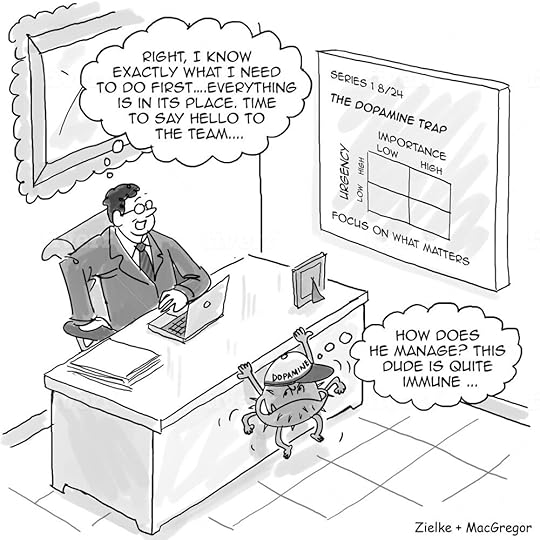
This links to tackling the toughest problem you currently face (if it is important and urgent of course). Most of us will be at the peak of our powers during the morning, especially if you have a strong Lark chronotype (see episode 4). Psychological depletion, which predicts worsening willpower, decision-making and ethics as the day progresses, has still to kick in. So make the most of this golden window. Don’t be tempted to go for the low hanging fruit, such as ‘killing’ a bunch of emails. It may feel good since it is easy to measure, unlike the more vague deep thinking on a tough problem, but it won’t get you as far.
Our own pocket of time here has varied over the years as we have changed working locations, and been more or less externally focused. For Steven a key insight has been not to be afraid of space – the thinking and writing that is of far greater quality though perhaps less immediately gratifying than firing off a string of emails. For Mischa, the first 10 minutes at work are thinking about what needs to happen practically during the day to accomplish the three things that make this day a successful day. He sometimes shifts agendas, reprioritizes the plans for the day to ensure that by the end of the day these three small but critical elements have been accomplished (see his comments in the previous episode).
And a final reflection. The workplace is a community of people, and thriving workplaces have strong bonds between the people in that community. Don’t forget to connect with your colleagues when you get to work. We are whole human beings, more than what we do at work, and so connecting on a level separate from work and work tasks is just as important as the connection itself. As Peter Drucker said: “Good manners are the lubricating oil of an organization.”