Carolee Dean's Blog, page 10
August 1, 2022
Exploring Science Through Fairy Tales
A few weeks ago, Kristen Wilkinson wrote a post about Science Experiments for the Kitchen. On that same theme of discovering science in unexpected places, this week I'm reviewing Fairy Tale Science: Explore 25 Classic Tales Through Hands-On Experiments written by Sarah Albee and illustrated by Bill Robinson.

We've been talking a lot this summer about connecting books to summer fun, mostly by exploring hands-on activities like cooking, gardening, creating inventions, and visiting animal habitats and national parks, but it's also a time to rest, relax, watch movies and revisit Disney videos like Mulan and Tangled (aka: Rapunzel). These movies help kids internalize the structure of stories, but they do much more than that.
One of my favorite quotes is from the epigraph of Neil Gaiman's book, Coraline. He paraphrased it from G.K. Chesterton. "Fairy tales are more than true: not because they tell us that dragons exist, but because they tell us that dragons can be beaten."

I have this quote hanging in my house. Fairy tales teach us that although there are many things in this world to fear, we can overcome them with courage, bravery, and truth. Stories like Mulan can even give us a slice of history. The story comes from a poem from the sixth century about a girl who takes her father's place to join the Khan's army. Though no one knows for sure if Hua Mulan was a real person, it is well-documented that there were warrior women in China, Central Asia, and Greece around the time that the story takes place.
In Fairy Tale Science, author, Sarah Albee, provides a brief summary and background information about each fairy tale and then makes a scientific connection. For Mulan, Albee discusses archery and provides a simple method to determine if it is more effective to close one eye or keep both eyes open when aiming at a target. Relax, you don't have to purchase an actual bow and arrow for this experiment. Two pencils, a paper cup, and some coins are all you need to teach your child about depth perception and stereopsis. By the way, the book is full of practical ways to learn academic vocabulary as well as science concepts and there is a fantastic glossary of terms at the back.
Can hair actually support a handsome young man's body weight? Watch Tangled or read Rapunzel and then find out how the protein chains in hair create tensile strength that is even more durable than the same amount of cast iron. Learn about parallel load-bearing and why braiding increases the strength of the strands. You won't actually be lifting a handsome prince in this experiment, just some pennies or marbles, but the concept is the same.
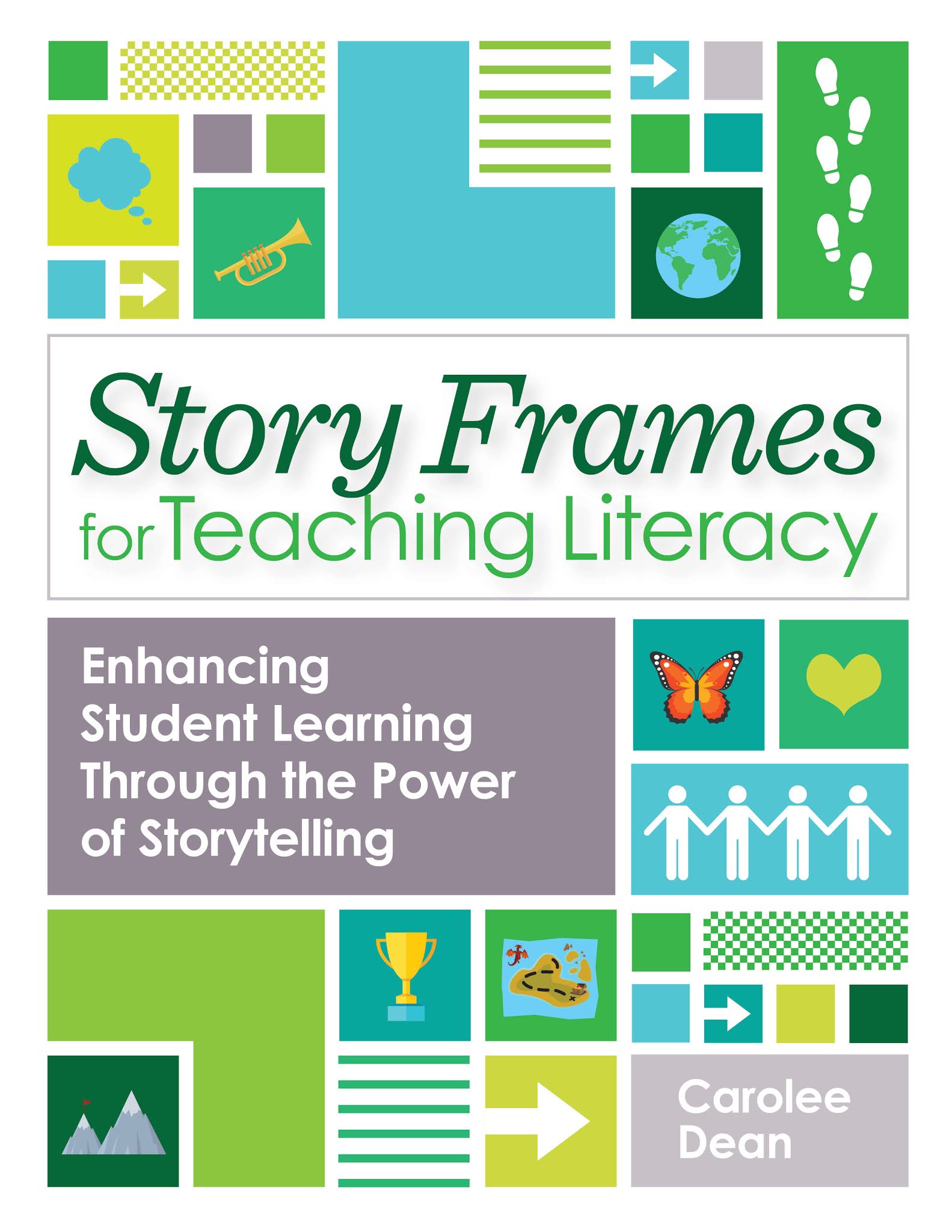
After watching Cinderella, you may want to experiment with whether or not a pumpkin is more aerodynamic than a zucchini or a cucumber. Then you can broaden your perspective even more by comparing the movie to one of the many versions of the story from another culture such as Adelita: A Mexican Cinderella Story by Tomie dePaola or The Rough-Face Girl written by Rafe Martin and illustrated by David Shannon. That final suggestion comes from my book, Story Frames for Teaching Literacy: Enhancing Student Learning Through the Power of Storytelling.
The point is that Fairy Tales are a fun way to expand your world knowledge. Even spending a day binge-watching movies can lead to meaningful learning experiences.


July 17, 2022
A Visit to the Poe Museum in Words and Pictures
We've been talking a lot this summer about authentic reading experiences and linking books to summer fun. See my PDF on that topic. You may have spent the last few weeks exploring the zoo or visiting a national park or creating science experiments out of fun recipes. You've likely been taking photos of family, friends, exotic places, and kitchen creations.
But what are you going to do with all of those photos besides posting them on social media?
Pictures tell a story, the story of our lives. So, why not spend some downtime with your kids this summer reliving those wonderful memories and creating a photo album before summer rolls into fall, this year rolls into next year, and those pictures are forgotten.
Creating captions for photos provides a meaningful and authentic writing opportunity for kids. You can do this the old-school way by taping photos into an album with captions underneath, or you can create a photo album online through Shutterfly, Walgreens, or even Costco. Start a file on one of those sites and add to it little by little. By the end of the year, you will have a wonderful project that can be shared with friends and family.
I will use my recent trip to the Poe Museum as an example. I recently took a trip to Richmond with my husband and daughter where I had a chance to visit the Edgar Allen Poe Museum there.
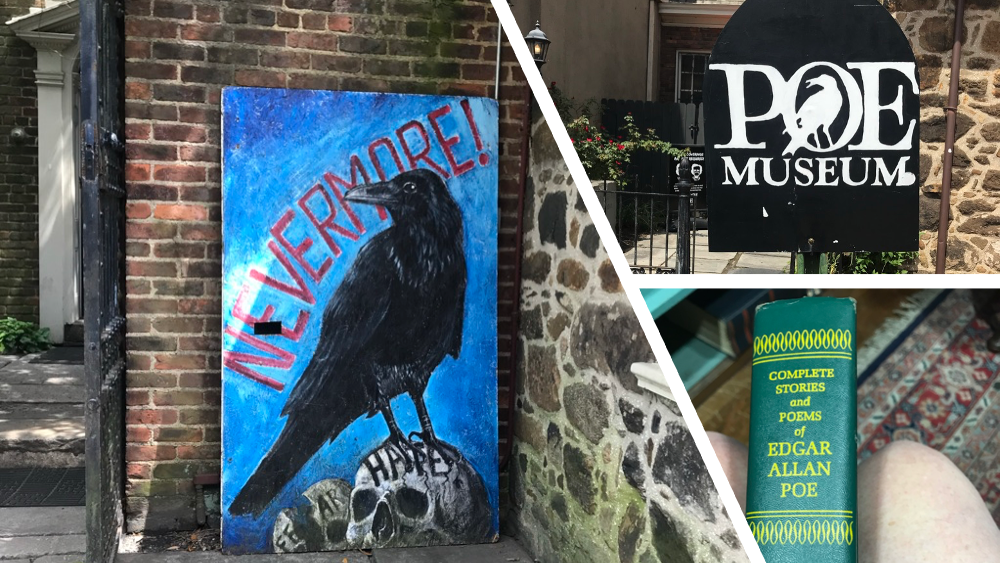
There are many ways to create captions for photos. The most basic approach is to simply use the location and date to create a noun phrase. Next, try taking the same information and adding a preposition to create a prepositional phrase or a verb to create a gerund phrase. Then add a subject to create an independent clause/simple sentence. Add another clause to create a compound sentence. If you want to get fancy, add a dependent clause for a compound-complex sentence.
This activity provides an authentic writing experience with real-world rewards. It also creates teachable moments to talk with kids about the difference between a phrase, a clause, a sentence, and even a paragraph. See my examples below:
Noun Phrase: The Poe Museum, Richmond, VA, Summer 2022
Prepositional Phrase : At the Poe Museum in Richmond.
Gerund Phrase: Visiting the Poe Museum in Richmond.
Simple Sentence: Carolee visited the Poe Museum in Richmond.
Compound Sentence: Carolee visited the Poe Museum in Richmond and she bought two books and an Edgar Allen Doll.
Compound-Complex Sentence: Carolee visited the Poe Museum in Richmond and she bought two books and an Edgar Allen Doll when she was finished with her tour.

I could go on to write paragraphs and more about the Poe Museum, but that might be too much for the family photo album. It could make an interesting FaceBook post or blog article though.
I was intrigued by all of the memorabilia and information about Poe's life. One of the most interesting displays was about his death. Edgar Allen Poe died under very mysterious circumstances at the age of 40. It was voting day, and he was found delirious in a gutter, wearing another man's clothes. He was taken to the hospital where he spent the next four days making incoherent references to someone named Reynolds. He died without being able to tell anyone what had happened to him. Poe may have been a victim of "cooping," where victims were beaten, dressed in disguise, and forced to vote for a certain candidate repeatedly by using different names. And some worry about voter fraud now! But that was only one of the theories. A display at the museum listed a total of 26 possible death theories including Rabies and Meningitis.

In addition to horror and poetry, Poe wrote science fiction and invented the first detective stories - The Murders in the Rue Morgue, The Mystery of Marie Roget, and The Purloined Letter. He introduced ideas like the least likely suspect and false clues and inspired writers like Stephen King, Neil Gaiman, and Arthur Conan Doyle, the creator of Sherlock Holmes, as well as movie director, Alfred Hitchcock.
There it is, a recap of my visit to the Poe Museum in words and pictures. It won't all make it into the family photo album, but it's a good example of how a visit to a museum and a few photos can inspire everything from a few words to paragraphs and even books.
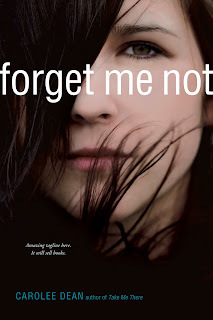
Poe has definitely inspired my writing. I did a spoof on his poem, "The Raven," for my verse novel, Forget Me Not . The poem is called, "The Dead Rapper Rap" and it features Tupac as a substitute teacher. Ravens figure prominently in the book and the cover designer even made the girl's hair on the front of the book look a bit like raven wings. Did I mention that my middle name is Lenore? My mother was a big fan of "The Raven."
Thanks for stopping by my blog. Sign up for my newsletter HERE to keep up with news and free offers and you will receive the free writing template for Travel Trouble sent directly to your email address.

June 23, 2022
Science Experiments For the Kitchen - Cook and Learn by Kristen Wilkinson

Did you start a garden this summer or visit your local farmer’s market? If so, keep the learning about plants going with Science Experiments You Can Eat, written by Vicki Cobb and illustrated by Tad Carpenter. Now that you’ve grown all those lovely vegetables in your garden, you can bring them into the kitchen for some science experiments. You can run an experiment to explore how plants take in water and how water moves up the stem of a plant. You can even investigate the chemical reactions that happen with chlorophyll and cellulose when you cook plants.
Make a delicious lemon fizz and watch the reaction as gas is formed. Use the red cabbage indicator from an earlier experiment to determine if the lemon fizz is an acid or a base. Learn about stabilized emulsions by making your own mayonnaise. Keep your fresh baked cookies crisp by determining which type of sweetener (granulated sugar versus honey) is more hydroscopic than the other. Hydroscopic means “wet cooking” by the way. This book is great for cooks of all ages (with supervision) and adults will even learn a thing or two.
The experiments in this book are easy to follow and accompanied by helpful background information on the concept you are investigating. And, as the title promises, you can eat each experiment after you are finished learning!
I have learned through my work at the Environmental Learning Center that kids are natural scientists; they are curious and love to learn about the world around them. You can encourage this curiosity at home through science experiments like these. Maybe the next time your child has one of their unending “why” questions, you’ll be able to help them design an experiment to find the answer on their own!

Kristen Wilkinson is the Program Director for the Colorado State University Environmental Learning Center, an environmental education outreach center in Northern Colorado for children and adults.Download the FREE PDF on Tips for Connecting Books to Summer Fun. Watch for more book titles and tips coming weekly through the summer. Sign up for the newsletter HERE to keep up with articles and you will receive the free writing template for Travel Trouble.
June 17, 2022
Authentic Reading and Writing Opportunities for Summer to Build Background Knowledge

Summer is a time to put aside the constraints of the classroom, let loose, and have some fun, but that doesn't mean kids stop learning. In fact, summer is a great time to build background knowledge by exploring kids' special interests and activities through books.
START WITH A BOOK
Reading Rockets has put together a wonderful, free resource called Start With a Book. It includes three parts:
1. Choose a Topic to Explore - Reading Rockets provides a list of 24 different topics including Birds and Animals, Inventions and Inventors, Cooking and Food, Geography and Travel, and Nature: Our Green World. Many of these topics are also related to my Free PDF on Tips for Connecting Books with Summer Fun.
2. Find Great Kids Books - Under each topic, Reading Rockets provides links to several children's book titles, but that's not all. They also make suggestions for writing activities like Keeping a Nature Journal, Let's Write a Recipe, Building Stories where kids design a house, and Robots and Work where kids brainstorm an invention of a robot and write about it.
3. Keep the Adventure Going - Reading Rockets provides websites, podcasts, and more connected with each topic so kids can continue to build background knowledge.
READWORKS
Would you prefer short non-fiction articles for older students on a greater variety of subjects? Does your child have difficulty reading on their own? If so, you may want to check out ReadWorks. It is a free resource for educators and parents that provides short reading passages along with vocabulary activities and comprehension questions, on a variety of topics including STEM, social studies, poetry, and literary fiction. They include a recording of each reading passage to support struggling readers. To sign up for ReadWorks and learn more about what they offer, go to their website at https://www.readworks.org/. Articles are listed by grade level and length.

Through ReadWorks, kids can learn about geysers before visiting Yellowstone, read about a farmer's market in New York City before spending a day at their local venue, or investigate an animal that stirs their interest after a trip to the local zoo. These are all ways to build authentic reading experiences and background knowledge while capitalizing on a child's natural curiosity.

So have fun with those summer activities, but make those activities even more interesting by connecting them with something fun to read!
Watch for more book titles and tips by following this blog. Sign up for my newsletter HERE to receive the free writing template for Travel Trouble
June 5, 2022
My Pandemic Garden and the Wisdom of Thinking Small

Does anybody else have a pandemic garden that looks like this... empty... nothing growing in it because now we are all out traveling and having grand adventures? I got so deeply into gardening during the pandemic that we tore out all the grass that was previously growing here. I even invested in a composter. See it in the corner in the picture below? I think the same gunk is in it from a year ago. I'm a little afraid to open it, to be honest. Thank goodness my husband knows me well enough to have suggested (rather strongly) that I start my agricultural project on the side of the house that no one can see. Right now it's just empty space. In a few weeks, there will be weeds to deal with. That's what happens when you take out the grass and leave nothing but dirt and bark mulch.

Gardening is one of the topics in my summer series on Tips for Connecting Books with Summer Fun. Getting kids involved in gardening is a good way to expand their background knowledge in science. Even my grown kids got involved in this garden. My son helped me tear out the grass and my daughter watered and weeded. Now they are both off to new adventures in graduate school, which is part of the reason my garden looks so empty.
Recently, I came across Grow All You Can Eat in 3 Square Feet: Inventive Ideas for Growing Food in a Small Space by DK Publishing. Many people live in apartments or may rent a house and don't have permission to dig up the grass to plant vegetables. Even if you have a large yard, there can be good reasons for starting a garden in a small space. During the pandemic, many people in my neighborhood started planting gardens. I wasn't the only one, but now many of their gardens look like mine. I forgot about the wisdom of thinking small and starting with something not only manageable in the short term but sustainable for the long term. I wish I had come across this book then.

Grow All You Can Eat provides colorful photographs and step-by-step directions for things you would expect like container gardens and window boxes, but there are also tips on planting vegetables in a reusable shopping bag and building a fence trellis out of old bicycle wheels. There are many tips that are useful even if you have more space such as how to extend the growing season, making use of the space between plants with intercropping, and planting slow crops with fast-growing crops.
If you would rather try a community garden, check out the post earlier in May about Books on Community Gardening and Pollination.
To be honest, I will most likely spend this summer enjoying the fruits of other gardeners' labor at my local farmer's market.
Download the FREE PDF on Tips for Connecting Books to Summer Fun. Watch for more book titles and tips coming weekly through the summer. Sign up for the newsletter HERE to keep up with articles and you will receive the free writing template for Travel Trouble.
May 29, 2022
Children's Books for Better Speech and Hearing Month
Sharing books about main characters with disabilities promotes awareness and acceptance. The three books I will be discussing today also happen to have connections to my summer series on Tips for Connecting Books to Summer Fun. They are all fiction titles, but one is about gardening (albeit in dystopian Australia). One is about wild birds, and another ends with a concert in the park.
A good place to find some of the best books featuring characters with disabilities is on the American Library Association (ALA) website page for the Schneider Family Book Award. The purpose of the award is to honor an author or illustrator for a book that, "...embodies an artistic expression of the disability experience for child and adolescent audiences." Every January, the ALA announces winners in the age categories of 0-8, 9-13, and 14-18. Some of the highlights for the recent 2022 awards are below.

The winner in the young children's category was My City Speaks. Photographer Darren Lebeuf and paper artist Ashley Barron have created a visually engaging tale of a girl with a visual impairment and her father as they travel to familiar spots in their city (including a community garden) and finally arrive at a concert stage in the park where she plays the violin.

The winner in the middle-grade category was A Bird Will Soar, by Alison Green Meyers. It is written from the perspective of Axel, a boy on the autism spectrum who loves birds but often finds family confusing. He makes sense of the people around him by comparing them to birds. The insight into Axel's inner thoughts and feelings is part of what makes this book so remarkable. When a storm destroys an eagle's nest, Axel must help a struggling eaglet to heal. The story is filled with poems and lots of interesting bird facts.
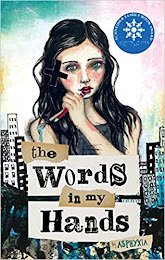
The winner in the teen category was Words in my Hands, written and illustrated by Asphyxia and published by Annick Press. It is an illustrated novel told in a combination of text, paint, collage, and sketch about a girl who is deaf and is living in a slightly futuristic world in Australia filled with food insecurity, political upheaval, and environmental turmoil. It is dystopian but at the same time frighteningly realistic. Ultimately it is a story of resilience and hope as Piper, the main character, strives to create a sustainable garden and find her "voice." Asphyxia, the author/illustrator, is deaf and has included a "Dear Reader" note at the end of the book that shares ideas for how the hearing can be more sensitive and inclusive of people with hearing challenges.
For books about gardening for younger readers, see the books in last week's blog post about Books on Community Gardening and Pollination.
Since May is Better Speech and Hearing Month, you may want to check out the book list I created last November about Children's Books Featuring Main Characters with Speech, Language, Learning, and Hearing Challenges. Because many kids with speech and language challenges also struggle with reading, you may also want to share stories from my list of Children's Books Featuring Main Characters with Dyslexia. Don't forget the list I shared in April for Autism Awareness Month.
Watch for more book titles and tips including activities for Real-World Writing by following this blog. Sign up for my newsletter HERE to receive the free writing template for Travel Trouble.
May 22, 2022
Books on Community Gardening and Pollination to Inspire Young Readers by Kristen Wilkinson

Miguel’s Community Garden, written by JaNay Brown-Wood and illustrated by Samara Hardy, is a beautiful, interactive story. The author guides readers to help Miguel find his sunflowers by comparing plant characteristics, such as leaf shape and petal color, which are illustrated in plenty of detail to allow readers to investigate the garden. The diverse cast of characters shows that everyone is welcome at the community garden. The colorful, detailed illustrations will keep kids’ attention while the story guides parents to discuss the different plants they see from spinach to mushrooms. You don’t need to be a plant expert to help Miguel find his sunflowers in time for the garden party!

The Reason for a Flower: A Book About Flowers, Pollen, and Seeds, written and illustrated by Ruth Heller, explains the process of pollination in fanciful verse. Read these two books together with your 6-9 year old child to show how pollination produces many of the foods present in Miguel’s Community Garden. Explore your own kitchen to find foods that are the result of pollination such as tomatoes, apples or rice. If you have a garden or can visit one, go looking for pollinators like bees and butterflies, and see if you can watch them at work. Make note of which flowers they visit. Then come back in a few weeks to see if a fruit is growing from the pollinated flowers. Exploring the natural world with your child can be as simple as looking for insects outside your front door. At the Environmental Learning Center, we emphasize that any time spent outdoors is valuable. Kids don’t need a grand adventure to the wilderness; they just need to explore in their neighborhood with a caring adult.

Kristen Wilkinson is the Program Director for the Colorado State University Environmental Learning Center, an environmental education outreach center in Northern Colorado for children and adults.Download the FREE PDF on Tips for Connecting Books to Summer Fun. Watch for more book titles and tips coming weekly through the summer. Sign up for the newsletter HERE to keep up with articles and you will receive the free writing template for Travel Trouble.
May 14, 2022
5 Tips for Connecting Books with Summer Fun
It’s summer and it is tempting to set aside books for more hands-on activities, but why not explore those activities more deeply by connecting books with summer adventures like planting a garden, exploring science in the kitchen, becoming an inventor, going to a national park, or visiting a zoo?
Discover book titles to go with each of these activities here on my blog in the summer series I am creating with Kristen Wilkinson, guest blogger and Program Director for the Colorado State University Environmental Learning Center, an environmental education outreach center in Northern Colorado for children and adults. She will be joining us throughout the summer with tips and book reviews.
Kristen and I started by creating the 5 Tips which we will expand on throughout the summer. They may be downloaded in a FREE PDF on my website at wordtravelliteracy.com where more free PDFs may be found on my page for Parent Resources. If you are an educator, consider sending the PDF or the link home with students to promote summer reading and be sure to check out my page for Teacher Resources.
5 TIPS FOR CONNECTING BOOKS WITH SUMMER FUN
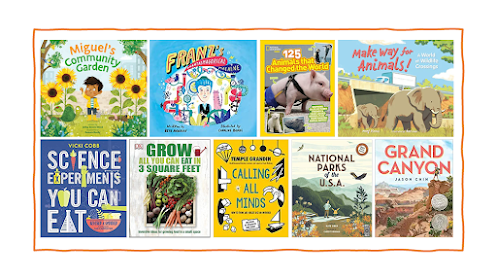
1. Plant a Garden– Plant zucchini in a reusable shopping bag on an apartment balcony or build a fence trellis with old bicycle wheels for climbing cucumbers. Explore these ideas and more with step-by-step directions and photographs in Grow All You Can Eat in 3 Square Feet: Inventive Ideas for Growing Food in a Small Space by DK Publishing. You may want to participate in a group garden like the main character in Miguel’s Community Garden written by JaNay Brown-Wood and illustrated by Samara Hardy. It’s ideal for ages 3-7. Maybe you’d just like to visit a community garden or attend a local Grower’s Market. For further exploration, SciShow Kids has YouTube episodes on How Does a Seed Become a Plant? and Grow Your Own Plants!
2. Explore Science in the Kitchen – Use those healthy foods you grew in your garden or bought at the Grower’s Market and have fun cooking. Take your culinary adventure one step further by learning the chemical properties of food. Make a science experiment out of the process with Science Experiments You Can Eat (Revised and Updated) written by Vicki Cobb and illustrated by Tad Carpenter. It is perfect for ages 8 and up. SciShow Kids also has a whole series on cooking with science: Baking a Cake with Science, How to Build a Solar Oven, and Why Does Cooking Eggs Make Them Hard?
3. Become an Inventor – Read about real-life inventors in books like Franz’s Phantasmagorical Machine written by Beth Anderson and illustrated by Caroline Hamel. Many items around the house can be used with the suggestions outlined by Temple Grandin in Calling All Minds: How to Think and Create Like an Inventor. If your kids have ideas for inventions that are a little too complicated or dangerous to try at home, send their designs to Kids Invent Stuff https://kidsinventstuff.com/. The website links to the YouTube channel where you can watch the engineer hosts, Ruth and Shawn, build the inventions of kids ages 4-11. They even offer prizes. Even if your kid’s invention idea is not selected, that’s okay. Submitting a written description along with a video or drawing is a great way to promote summer writing and creative thinking.
4. Visit a National Park – If you aren’t able to take a big trip, go on a nature walk, visit a local natural area, or take a virtual trip through nature by watching America’s National Parks by National Geographic (Disney+) or Born in the Rockies by Nature (PBS) Either way, start your journey by reading books like National Parks of the U.S.A. written by Kate Siber and illustrated by Chris Turnham or Grand Canyon written and illustrated by Jason Chin. These books can be read aloud to young children or explored on their own by kids ages 7 and up. They are also great resources for adults.
5. Visit a Zoo or Wild Animal Park – If you don’t have one nearby, watch shows like Animals with Cameras by Nature (PBS). Read about the fascinating world of wild animals in books like Make Way for Animals!: A World of Wildlife Crossings written by Meeg Pincus and illustrated by Bao Luu and discover real-life animal heroes in 125 Animals That Changed the World by Brenna Maloney. Read more about wildlife crossings at https://www.wildways.us/.
Don’t forget to visit your local library or bookstore to find more fun books and ask about their summer reading programs while you are there.
Watch for more book titles and tips including activities for Real-World Writing by following this blog. Sign up for my newsletter HERE to receive the free writing template for Travel Trouble.

April 13, 2022
Autism Awareness Month
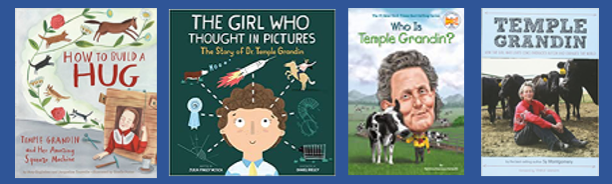
 I'm very excited to share the news that just out in April, 2022, is a new book about Temple Grandin. She Persisted: Temple Grandin is a chapter book from the She Persisted series written by Lyn Miller Lachmann.
 I interviewed the author, Lyn, in April of 2021 about her challenges with Asperger's Syndrome and her fiction title, Rogue. It's about a young girl on the spectrum who views herself like the X-Men character, Rogue. It contains biographical connections to Lyn Miller-Lachmann's personal experience with Asperger's. Find that interview HERE.

There have been several books for children written about (and by) Temple Grandin for a wide range of age groups. Last April, I wrote a post exploring several titles. Find that post HERE.

For additional resources, check out the following websites:
March 12, 2022
Activities for Using WATERCRESS with Older Students with Links to the Common Core
When I worked in the public schools, SLPs and special education teachers were often required to link goals and objectives to the Common Core State Standards (CCSS). With that in mind, I thought it might be interesting to look at how one picture book could be used across grade levels to address specific standards. I hope this information will be especially useful for professionals who want to use the same book with students of a variety of ages and ability levels.
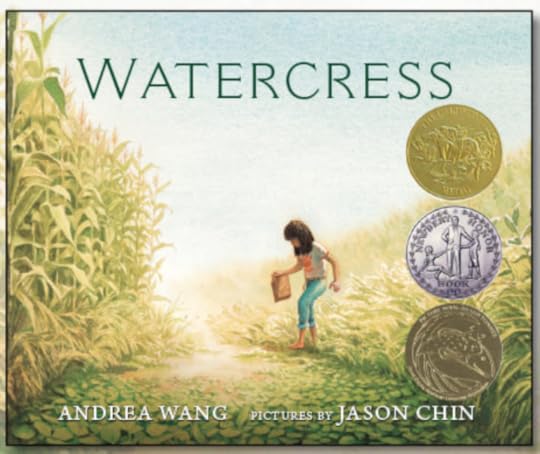
The picture book I chose was Watercress, written by Andrea Wang and illustrated by Jason Chin. Earlier this year, Watercress, a picture book based on a childhood memory of the author, won both the 2022 Caldecott Medal as well as a Newbery Honor. Since Newbery titles are typically for older students, this book is a perfect example of a story that is appropriate for students of all ages. Watercress also won the Asian/Pacific American Award for Literature in the picture book category, making it an excellent book to connect to the social studies curriculum. Find details about Watercress at Neal Porter Books, Holiday House for Young Readers.
For a discussion about the difference between memoir, autobiography, and autobiographical, see my post titled Memoir Vs. Autobiography.
For printable downloads of the educator guides in this blog post along with additional educator guides and freebies, visit the Teacher Resources page on my website at wordtravelliteracy.com.
I realize that not every state uses the Common Core. I have also created a version of this blog post that specifically incorporates the Texas Essential Knowledge and Skills (TEKS). Whether you are a proponent of CCSS or not, it is intriguing to see how picture books can meet learning objectives for older students. In the activities below, I first describe a specific literacy reading standard and then share an activity that supports that standard.
A NOTE ON WRITING STANDARDS
In fourth grade, the reading standards begin to have a more direct correlation with the anchor writing standard CCSS.ELA-Literacy.CCRA.W.9. In fourth grade and up, a student is expected to apply the grade-level reading standards to draw evidence from a text to support a written analysis. Therefore, the activities for fourth grade and up for reading may also be used for writing.
Grade 3 Standard: CCSS.ELA-LITERACY.RL.3.9 Students compare stories written by the same author, and/or stories on a similar subject written by different authors.
Activity: Compare and Contrast Watercress with Magic Ramen: The Story of Momofuku Ando, also written by Andrea Wang (illustrated by Kana Urbanowicz). Watercress centers on a personal experience of the author while Magic Ramen explores Momofuku Ando and his efforts to combat hunger in Japan after World War II. Discuss as a class how both books deal with hunger in very different ways. Have students write about a personal experience with hunger.
Grade 4 Standard: CCSS.ELA-LITERACY.RL.4.6 requires students to compare and contrast first and third-person narration.
Activity: Read Watercress as well as Thank You, Mr. Falker written and illustrated by Patricia Polacco. Both stories are about the personal experiences of the author, but Watercress is written in the first person while Polacco’s book is written in the third person. Discuss the two books and then write about how the different use of Point of View (POV) affects the narration.
For further exploration, share the picture book, The Hundred Year Barn, written by Patricia MacLachlan and illustrated by Kenard Pak. Although it is written in the first person and sounds like a personal story, it is NOT autobiographical nor is it a memoir. Discuss with students how they can determine if a story is autobiographical by looking at the author’s notes and online interviews. Write a compare and contrast essay including point of view. Have students write an account of a personal experience in the first person. Then write the same account in the third person. Ask them to explain which version they prefer and explain why.
Grade 5 Standard: CCSS.ELA-LITERACY.RL.5.9 By the end of fifth grade, students should be able to compare stories in the same genre specifically in regard to looking at how different authors handle similar subjects.
Activity: As in the fourth-grade activity, Watercress could be compared to the picture book, Thank You, Mr. Falker by Patricia Polacco. Both are picture books, and both are autobiographical, but Watercress focuses on one day in the life of the author, while Polacco’s book covers several years. Expand the conversation of point of view and discuss why each author may have decided to write the story in the time frame they chose. Have students write an account of a personal experience that takes place in the course of one day. Then write about a series of related experiences that take place over several days, weeks, or even years.
Grade 6 Standard: CCSS.ELA-LITERACY.RL.6.9 By the end of sixth grade, students should be able to compare similar subjects explored across different genres.
Activity: Compare Watercress to Brown Girl Dreaming, told in verse, by Jacqueline Woodson. Her book won the National Book Award and was also a Newbery Honor selection in 2015. It is written as a series of poems starting with her birth, highlighting her young years moving from Greeneville, SC to New York City, and ending with her resolve to become a writer with the encouragement of her fifth-grade teacher. It is recommended for grades 5-6.
For further exploration, compare both books to the chapter book, 26 Fairmont Avenue written and illustrated by Tomie DePaola. It is a 2000 Newbery Honor Book for grades 2-5. Discuss how a picture book, a chapter book, and an autobiography told in verse all written about personal author experiences all became Newbery Honors. Write an essay comparing the similarities and differences between the three books.
Grade 7 Standard: CCSS.ELA-LITERACY.RL.7.5 Students analyze how a story’s form affects its meaning.
Activity: Andrea Wang, the author of Watercress first wrote the story as a personal essay. She later rewrote the same story as a picture book. Building on the sixth-grade activity described above, discuss whether or not Watercress could have also been written as a poem, a song, a film, a graphic novel, or a chapter in a longer memoir? Would additional information be required? How would the various forms have affected the story’s impact? For a writing activity, have students use Watercress as inspiration and write about a day in their life. Then rewrite what they have written as a picture book, a poem, a page from a graphic novel, a scene from a play, or a short chapter. Discuss why they chose the form they ultimately picked.
Grade 8 Standard: CCSS.ELA-LITERACY.RL.8.5 By the end of eighth grade, students should be able to analyze multiple texts, discuss the different structures of each one, compare and contrast the texts, and discuss how the different structures affect the meaning and/or style.
Activity: All books listed below are about the personal experiences of popular children’s authors that were written by the author.
Option A: Choose two or three books from the selections previously mentioned or the additional listings below and write a compare/contrast essay focusing on the structure of each book.
Option B: Choose one of the books from the list below and then choose a work of fiction by the same author. Write an essay discussing how the author’s personal experiences may have affected their fiction. Also, discuss how the structure of their personal story differed from the structure of the fictional title selected.
TITLES
Watercress written by Andrea Wang and illustrated by Jason Chin
Thank You, Mr. Falker written and illustrated by Patricia Polacco
Brown Girl Dreaming by Jacqueline Woodson.
26 Fairmont Avenue written and illustrated by Tomie DePaola.
You may also want to add these additional titles:
Boy: Tales of Childhood by Roald Dahl
My Own Two Feet: A Memoir by Beverly Cleary
The Tarantula in My Purse and 172 Wild Pets: True-Life Stories to Read Aloud by Jean Craighead George
Woodsong by Gary Paulsen
But I’ll be Back Again by Cynthia Rylant
For teens consider adding:
Hole in My Life by Jack Gantos
Ordinary Hazards: A Memoir by Nikki Grimes
Stop Pretending: What Happened When My Big Sister Went Crazy by Sonya Sones
Reference: National Governors Association Center for Best Practices, Council of Chief State School Officers. (2010). Common Core State Standards (English-Language Arts). Washington DC: Author retrieved from http://www.corestandards.org/
Also, see the Lerner Books post about How to Use Picture Books with Teens and Tweens: Q&A with Literacy Experts.
For more information about teaching students how to write personal narratives, see my book Story Frames for Teaching Literacy: Enhancing Student Learning Through the Power of Storytelling.
Subscribe to my monthly newsletter HERE and receive a FREE fill-in-the-blank story template PDF called Travel Trouble. Each month you will get updates, activities, and tips about writing and working with students along with book news.