David Berger's Blog, page 18
March 18, 2012
Gay Characters and Task Force: Gaea
When I started writing this novel years ago, I had an internal conversation about whether or not I was ready to commit to having gay characters play a prominent role. It wasn't because I was ashamed of being gay myself, but rather more of a concern that my book wouldn't be well received because of the content. After all, would an 18 year old straight guy want to read a novel if the main character were gay? Or, if gay characters showed up throughout? It was something I actually spent considerable time thinking about.
I was a late bloomer and "came out" at 27. Being the eldest of three children, and the only son, I felt this weight on me to live up to other people's expectations. And, for as much as I love her dearly, I have a Jewish mother who expected me to marry and give her grandchildren. No pressure, right? I eventually grew comfortable with my decision to be myself, and now I'm an "out and proud" teacher in my school, sponsoring the Gay/Straight Alliance, but this isn't what I wanted to talk about here. I'm mentioning this because it took me some time to feel comfortable telling people who I was. As a gay writer, I never wanted to write strictly gay stories. Rather, I wanted to write about people, and if some of them were gay, then that's the way society is.
Token characters for the sake of including them never felt right to me, whether in my own work or other's work, so I had to think how I wanted to approach this in Task Force: Gaea. In two distinct places in the novel, two male characters identify as gay, although without saying as much openly. One has an experience where he encounters a man who has feelings for him, and the other is dating a man. No fanfare. No "out-n-proud" moment. To say more about them would probably be too much and ruin things in the story. In the sequel, though, the latter's relationship plays a little more prominently, but insofar as I explore the relationships of the main characters. I think, nowadays, books (or movies or TV shows) with gay characters don't raise the eyebrows they used to, unless there's blatant sexual behavior. In fantasy fiction, where boundaries of reality tend to be hazy, having characters of all types becomes the norm: werewolves, witches, vampires, gods, etc. But, men and women can still be who they are—gay, lesbian, straight, bisexual, or transgendered—without any problem at all. Why should there be?
If someone chooses not to read my book, or any one else's book, with gay characters, then that isn't a fan I want to have anyway. We live in a colorful world, and people of all shapes, sizes, ethnicities, and orientations exist. Even as I have been writing this post, I am wondering if I shouldn't pursue gay fantasy fiction avenues for promoting Task Force: Gaea. I honestly hadn't thought about it, since the gay characters don't figure as prominently right now. But, how much "gayness" does a book have to have before people in the GLBT community would read it? Perhaps, this is enough to broaden the spectrum a bit.
I'm curious to know what you think, reader, but bear in mind that comments are moderated here. Be appropriate, please. Do you care if your books have gay characters? Does it matter which genre?
I was a late bloomer and "came out" at 27. Being the eldest of three children, and the only son, I felt this weight on me to live up to other people's expectations. And, for as much as I love her dearly, I have a Jewish mother who expected me to marry and give her grandchildren. No pressure, right? I eventually grew comfortable with my decision to be myself, and now I'm an "out and proud" teacher in my school, sponsoring the Gay/Straight Alliance, but this isn't what I wanted to talk about here. I'm mentioning this because it took me some time to feel comfortable telling people who I was. As a gay writer, I never wanted to write strictly gay stories. Rather, I wanted to write about people, and if some of them were gay, then that's the way society is.
Token characters for the sake of including them never felt right to me, whether in my own work or other's work, so I had to think how I wanted to approach this in Task Force: Gaea. In two distinct places in the novel, two male characters identify as gay, although without saying as much openly. One has an experience where he encounters a man who has feelings for him, and the other is dating a man. No fanfare. No "out-n-proud" moment. To say more about them would probably be too much and ruin things in the story. In the sequel, though, the latter's relationship plays a little more prominently, but insofar as I explore the relationships of the main characters. I think, nowadays, books (or movies or TV shows) with gay characters don't raise the eyebrows they used to, unless there's blatant sexual behavior. In fantasy fiction, where boundaries of reality tend to be hazy, having characters of all types becomes the norm: werewolves, witches, vampires, gods, etc. But, men and women can still be who they are—gay, lesbian, straight, bisexual, or transgendered—without any problem at all. Why should there be?
If someone chooses not to read my book, or any one else's book, with gay characters, then that isn't a fan I want to have anyway. We live in a colorful world, and people of all shapes, sizes, ethnicities, and orientations exist. Even as I have been writing this post, I am wondering if I shouldn't pursue gay fantasy fiction avenues for promoting Task Force: Gaea. I honestly hadn't thought about it, since the gay characters don't figure as prominently right now. But, how much "gayness" does a book have to have before people in the GLBT community would read it? Perhaps, this is enough to broaden the spectrum a bit.
I'm curious to know what you think, reader, but bear in mind that comments are moderated here. Be appropriate, please. Do you care if your books have gay characters? Does it matter which genre?


March 16, 2012
Romance in Fantasy
Recently, I've been pondering something that afriend mentioned to me while reading Task Force: Gaea: why is there noromance in the novel? A worthy question, to be sure, and it started me thinkingabout the nature of "romance" in literature. Now, I'm not sure why shecommented about it—unless she truly wished to see characters engage in aromantic relationship. Within this story (about the birth of the team of heroeswho were charged with saving their own world at the risk of losing their ownexistence), I came to two conclusions:
Romance is definitely inthe novel.It's not the romance onemight expect.
[1] In medieval romances, chivalry permeates the story, the knightsof old acting in accordance with their tenets of proper behavior. Also apparentwould be the knight's love for a lady. The setting would be illusory andambiguous, a place beyond the scope of time, perhaps. Layered on top of thiswould be the supernatural—elements that coax the imagination and ignite theinternal fires. A disguised individual makes his presence known, too, and thenumber "three" repeats throughout the tale.
In Task Force: Gaea, the god Apollo becomesthe first knight of this tale, and his adventure builds, ultimately meeting upwith his lady. The heights of Olympos or the depths of Tartaros spread outbefore the protagonist, and these places just beyond the scope of the humanmind tickle the imagination. Greek gods and primordial beings pepperedthroughout tie in the supernatural as well. Additionally, a man whose identityremains hidden from others (but not the reader) traverses the landscapes of thenovel in search of his quest. Ultimately, the three Fates appear to entangleothers in their yarn of time. So, by this account, the novel is a medieval romance ,of a sort.
The main hero/knight of this tale—Danelos, hisorigin a mystery, furthers the plot in ways beyond imagining. Anothercharacteristic of this hero/knight is being reared away from home, his trueparents being ignorant of him. In Task Force: Gaea, I'll leave that tothe reader. This character's identity remains unknown for a time, until hispath crosses others from whom he needs help, and he ultimately finds out moreabout his past. How the triumph benefits anyone? Well, I think finishing thenovel would tell the reader that.
[2] As far as the other kind of romance, the one when hearts combine intoone, and lovers seduce, suitors charm, and people take enormous personal risksjust to claim that one, true love—well… it's not really a part of thisstory. Not yet. Relationships emerge, but these couplings have higher purposesbeyond the interweaving of souls and building foundations to last forever.Having read and thoroughly enjoyed Terry Goodkind's Sword of Truth series, I found Richard Cypher and Kahlan Amnell's relationship compelling,especially since their relationship spans the entire series of novels. But,here, I think Richard and Kahlan's relationship is integral to the entirestory, and its growth, obstacles, and ultimate maturation have as much to dowith the plot as do other characters.
Apollo's relationship in Task Force: Gaea,while certainly important to the plot, isn't the binding thread to the story,as the reader learns. This coupling has a more divine purpose—literally. Ajourney as compelling as any a god could navigate, Apollo's story ultimatelybrings the reader to the next logical step in the narrative, one that has muchmore prominence to the novel. It's a building block: necessary for support, butnot so for subsequent structure.
Romance has its place and, in the sequel, itcertainly will be much more visible and pertinent. The next installment delvesmuch deeper into characters and their motivations, so be patient, stay tuned,and more information will come your way.

March 15, 2012
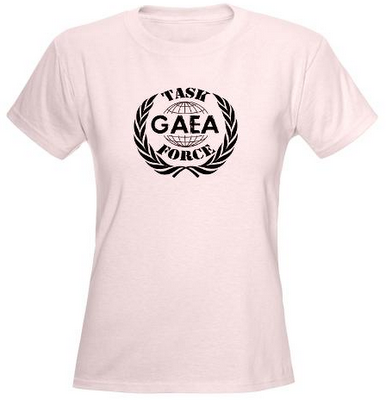
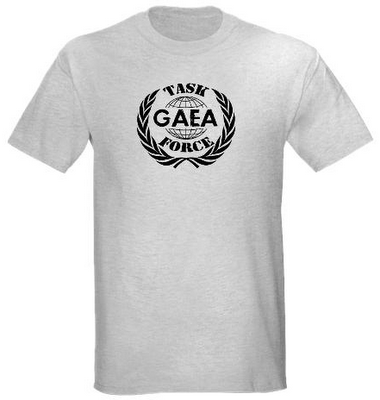
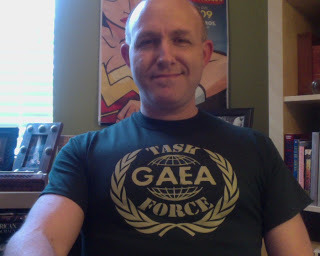
New Shirts!
Forest green/pale gold, insignia of Task Force: Gaea


March 12, 2012
My Muses #3—Former Students
#3: Task Force: Gaea has been in the works since 1985 (if you count "The Olympus Corps.," the original short story, as the beginning), so it has predated my teaching career. I didn't really start promoting my writing in the classroom until 2002, when I started teaching high school English. From the onset, my students seemed intrigued about the idea of their English teacher writing a novel, and they would ask questions about it. This meant I had to know my book well. I had been working on the manuscript more at that time, although I wasn't committed to some of the plot points that later made it into the novel, but I had enough knowledge to share to pique their interest, or hoped to do that.
 Cover ImageA poster entitled, "A Work in Progress" hung in my room, with a plot summary and the artwork I had acquired of my four main characters. Back then, I hadn't solidified some of the key events, so student interest prodded me into committing to some of the ideas I would later cement to the text. In essence, my students were putting a level of pressure on me to keep up with the writing, and that helped me move past the writer's block I occasionally fought with over the first few years at the high school. Trying to manage a full time teaching job, one which I thoroughly enjoyed, with writing, proved quite difficult, and I had trouble "finding balance," as it were, with all aspects of my life.
When I began teaching in the International Baccalaureate program a year later, students again expressed their interest in fantasy fiction or even in the fact that their teacher was writing a book. One student in particular, Jason Pioli, wanted to know more about the book and when "his people" and "my people" would be on the same page, so to speak. He kept asking for a sample of the work, and his interest fanned the flames under me; I became even more eager to finish. After some stops and starts, I was able to give Jason a taste of the novel, and—because of his ongoing support—I named him in my Acknowledgments. Our "people" were finally aligned. So, thank you, Jason.
Flash forward to August 2011. My current students, also eager to know more about the novel, were in for a treat. I had finished the manuscript, had it read by a few people, and had started the process to publish. I had already been in touch with Michael Hamlett, the artist who had created the inspirational pieces for me a decade ago, and had finished the cover image. Over the winter break, I had a poster made of the cover (see above), and it was hanging on the wall in my classroom when we reconvened in January. As soon as they saw it (and it hangs next to posters of Superman, Wonder Woman, and Batman reading), their interest seemed to explode. Their excitement became fuel for me yet again, and I pressed on with publishing even more enthusiastically.
I had placed a copy of the cover image in front of the class (an 8.5" x 11" piece of photo paper with the entire cover image, front, spine, and back) for a while, so when I replaced it one morning with a proof copy of the book, I saw their excitement build even more.
The first copy that I signed was for a student of mine, and I was unnerved. What do I say? Do I just sign my name? I wanted to personalize the message. It was historic moment for me.
My students have been a part of my life for 20 years, and they deserve credit for having been the inspiration at various points in my writing. Thank you, everyone. You've made this a worthwhile journey.
 Cover ImageA poster entitled, "A Work in Progress" hung in my room, with a plot summary and the artwork I had acquired of my four main characters. Back then, I hadn't solidified some of the key events, so student interest prodded me into committing to some of the ideas I would later cement to the text. In essence, my students were putting a level of pressure on me to keep up with the writing, and that helped me move past the writer's block I occasionally fought with over the first few years at the high school. Trying to manage a full time teaching job, one which I thoroughly enjoyed, with writing, proved quite difficult, and I had trouble "finding balance," as it were, with all aspects of my life.
When I began teaching in the International Baccalaureate program a year later, students again expressed their interest in fantasy fiction or even in the fact that their teacher was writing a book. One student in particular, Jason Pioli, wanted to know more about the book and when "his people" and "my people" would be on the same page, so to speak. He kept asking for a sample of the work, and his interest fanned the flames under me; I became even more eager to finish. After some stops and starts, I was able to give Jason a taste of the novel, and—because of his ongoing support—I named him in my Acknowledgments. Our "people" were finally aligned. So, thank you, Jason.
Flash forward to August 2011. My current students, also eager to know more about the novel, were in for a treat. I had finished the manuscript, had it read by a few people, and had started the process to publish. I had already been in touch with Michael Hamlett, the artist who had created the inspirational pieces for me a decade ago, and had finished the cover image. Over the winter break, I had a poster made of the cover (see above), and it was hanging on the wall in my classroom when we reconvened in January. As soon as they saw it (and it hangs next to posters of Superman, Wonder Woman, and Batman reading), their interest seemed to explode. Their excitement became fuel for me yet again, and I pressed on with publishing even more enthusiastically.
I had placed a copy of the cover image in front of the class (an 8.5" x 11" piece of photo paper with the entire cover image, front, spine, and back) for a while, so when I replaced it one morning with a proof copy of the book, I saw their excitement build even more.
The first copy that I signed was for a student of mine, and I was unnerved. What do I say? Do I just sign my name? I wanted to personalize the message. It was historic moment for me.
My students have been a part of my life for 20 years, and they deserve credit for having been the inspiration at various points in my writing. Thank you, everyone. You've made this a worthwhile journey.
March 11, 2012
My Muses: #2—High School English Teachers
#2: I guess it does seem a little cliché to say that your English teachers were your role models and muses, but it's quite true. I was a geek in high school, as much as one could be with Atari, 8-tracks, and Saturday morning cartoons, and I remember reading... a lot. My most favorite memories of being at Commack High School South were in the classrooms of Al Kindelmann, Jim Mahoney, Al Candia, and Jack McGrath.
These teachers inspired me, guided me, challenged me to levels of insight I didn't know I could reach. All of these teachers, and Mr. Ferrotti as well (who taught me Latin and Spanish), pushed me. They saw something in me that perhaps I couldn't see in myself.
 Mr. McGrathWhen I was graduating, I (of course) had my teachers sign my yearbook, and one teacher—Mr. McGrath—wrote something that has forever changed who I am. It was the kindling spark to help me write the novel, Task Force: Gaea. Over the years, all 27 of them, I would reflect back on this quotation he wrote and it would re-energize me.
"On a blue Aegean night, when all the gods and nymphs have said adieu, your muse will find new life."
 Mr. CandiaThis quote resonates with me, and that is why I dedicated my novel to Mr. McGrath. He, like Mr. Kindelmann, Mr. Mahoney, Mr. Candia, and Mr. Ferrotti, left an indelible mark on me, and I wouldn't wash it off if I could. Mr. Kindelmann taught 9th grade honors English, I believe, and he was the kind of teacher you couldn't help but listen to when he talked about literature. His humorous personality helped forge my own in the classroom, and sometimes I ask myself, "How would Mr. Kindelmann handle this?"
Mr. Candia also had the energetic personality and teaching style that I try to emulate now. His attention to detail in my work forced me to become much more scrutinizing. When we worked on the yearbook, I designed the art for it, and he supported my decisions and guided me to making more informed ones as well.
By the way, these photos of my teachers aren't how I remember him (it was from a yearbook years before I had them as teachers); but, it doesn't matter what they looked like—these were people who had a profound impact on me as a person and an educator.
My muse has indeed found new life, Mr. McGrath, and I thank you for it.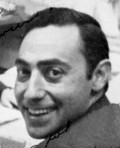 Mr. FerrottiMr. Ferrotti taught me Spanish and Latin, and that language spark also kept me going over the years. My interest in Classical literature (Cato, Catullus, Virgil) all came from him. In fact, I still have a copy of the Odyssey that belonged to Mr. Ferrotti, and whenever I look through it, I remember his deep voice talking about conjugations and declensions. He also tried to tutor me in Italian, but I think my 17 year old brain could only handle so much at once, so I stuck with Spanish and Latin. I still regret not going on that trip to Italy and Greece. Someday, Sr. Ferrotti, some day!
 Mr. MahoneyI took a college course in high school—I guess it would be considered dual enrollment now—through C. W. Post University on Long Island, and Mr. Mahoney was the instructor. He, too, brought out my love of literature and writing. I've recently been in touch with Mr. Mahoney, and he gave me Mr. Grath's contact information, so I could finally tell him how much of an impact he has had on me.
The debt I owe these teachers can't be repaid since I wouldn't know what I could ever do to show them my gratitude.
Next: #3—Former students
These teachers inspired me, guided me, challenged me to levels of insight I didn't know I could reach. All of these teachers, and Mr. Ferrotti as well (who taught me Latin and Spanish), pushed me. They saw something in me that perhaps I couldn't see in myself.
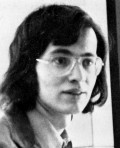 Mr. McGrathWhen I was graduating, I (of course) had my teachers sign my yearbook, and one teacher—Mr. McGrath—wrote something that has forever changed who I am. It was the kindling spark to help me write the novel, Task Force: Gaea. Over the years, all 27 of them, I would reflect back on this quotation he wrote and it would re-energize me.
"On a blue Aegean night, when all the gods and nymphs have said adieu, your muse will find new life."
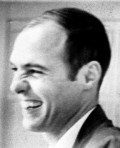 Mr. CandiaThis quote resonates with me, and that is why I dedicated my novel to Mr. McGrath. He, like Mr. Kindelmann, Mr. Mahoney, Mr. Candia, and Mr. Ferrotti, left an indelible mark on me, and I wouldn't wash it off if I could. Mr. Kindelmann taught 9th grade honors English, I believe, and he was the kind of teacher you couldn't help but listen to when he talked about literature. His humorous personality helped forge my own in the classroom, and sometimes I ask myself, "How would Mr. Kindelmann handle this?"
 Mr. Candia also had the energetic personality and teaching style that I try to emulate now. His attention to detail in my work forced me to become much more scrutinizing. When we worked on the yearbook, I designed the art for it, and he supported my decisions and guided me to making more informed ones as well.
By the way, these photos of my teachers aren't how I remember him (it was from a yearbook years before I had them as teachers); but, it doesn't matter what they looked like—these were people who had a profound impact on me as a person and an educator.
My muse has indeed found new life, Mr. McGrath, and I thank you for it.
 Mr. FerrottiMr. Ferrotti taught me Spanish and Latin, and that language spark also kept me going over the years. My interest in Classical literature (Cato, Catullus, Virgil) all came from him. In fact, I still have a copy of the Odyssey that belonged to Mr. Ferrotti, and whenever I look through it, I remember his deep voice talking about conjugations and declensions. He also tried to tutor me in Italian, but I think my 17 year old brain could only handle so much at once, so I stuck with Spanish and Latin. I still regret not going on that trip to Italy and Greece. Someday, Sr. Ferrotti, some day!
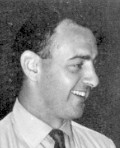 Mr. MahoneyI took a college course in high school—I guess it would be considered dual enrollment now—through C. W. Post University on Long Island, and Mr. Mahoney was the instructor. He, too, brought out my love of literature and writing. I've recently been in touch with Mr. Mahoney, and he gave me Mr. Grath's contact information, so I could finally tell him how much of an impact he has had on me.
 The debt I owe these teachers can't be repaid since I wouldn't know what I could ever do to show them my gratitude.
Next: #3—Former students
My Muses: #1—Wonder Woman
#1: This video has just about all the elements of the character who helped spur me on to write and finish Task Force: Gaea. Who says comics can't be role models? Here you have it: Wonder Woman.
You want to see more? Try this: http://dc.wikia.com/wiki/Wonder_Woman.
That's not even the tip of the iceberg, either. Not by a long shot.
Next: #2—Jack McGrath
You want to see more? Try this: http://dc.wikia.com/wiki/Wonder_Woman.
That's not even the tip of the iceberg, either. Not by a long shot.
Next: #2—Jack McGrath
March 10, 2012
Gaea: the Protogenos, Earth Mother, and TFG
E. B. White once said,
"I would feel more optimistic about a bright future for man if he spent less time proving that he can outwit Nature and more time tasting her sweetness and respecting her seniority."
 Think how many times we reference "Mother Nature" or "Mother Earth" when we talk about how Humanity is destroying the environment. Many speak of her reverently as euphemism, a separate part of G-d or perhaps the female side of G-d, romanticizing the idea of nature being female because of her nurturing qualities. I don't want to get into the religious side of all of G-d's facets, because Judaism certainly discusses this and especially because I don't want this to turn into a Torah study blog, but I do want to focus some attention on the primordial entity known as Gaea, Terra by the Romans, or as we have come to know her:
Mother Earth.
White's quote speaks to the very nature (no pun intended) of the problem we have: we use the Earth as a possession, leaving it in whatever condition we like, hoping that someone else will come along and clean up after us. Well, sorry fellow humans, Mother Earth ain't that kind of mother. We are supposed to take care of HER. Now, while it's true that this planet will probably outlast us (i.e. the human race), unless we find some way to blow ourselves up, we definitely, most assuredly need to ensure Earth's survival. For as much as people might like to think that our Earth has the ability to preserve herself, she simply can't do anything with Styrofoam or plastic. Those trinkets of human existence don't decompose (although some plastics are designed to do just that, but not enough).
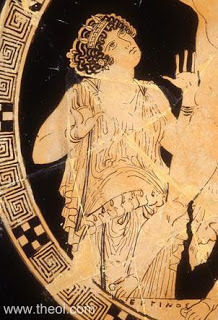 GaeaIn Greek mythology, Gaea was a Protogenos (primordial one), a daughter of the infinite void of Khaos, and she parthenogenically (without male assistance) gave birth to many entities, including Eros (love, not to be confused with Aphrodite's son), Pontus (the seas), Ourea (the mountains), and Uranus (the heavens). With Uranus, she had the Titans, the Hecatoncheires (hundred-handed ones), and the Cyclopes.
Gaea didn't play a major role in mythology; in fact, she stayed in the background much of the time. One of the times she did intervene was when she gave Kronos, her son and king of the Titans, a scythe of flint to kill his father, Uranus (who had been imprisoning his less aesthetically pleasing children—the one-eyed Cyclopes and the Hecatoncheires—in Tarterus. Aside from that, Mother Earth didn't get involved in the world of Humanity.
In Task Force: Gaea , the role of Mother Earth is more than just to exist. She sees a need to get involved in issues that involve her very survival and acts upon it. In fact, she gets quite involved in the creation of an entire race of people, but there's more about that in the novel. Gaea's role as a part of a larger family becomes one of the core elements of the novel, hence why the U.N. task force bears her name. Those involved with this organization see her protection as paramount. I have great respect for the Earth, and by making Gaea a stronger, more involved primordial entity, I have given her a say in what happens to her. Maybe in our world the Earth can't actually take an active stance on survival, but the world where the U.N.-sanctioned group Task Force: Gaea exists, 'ain't nobody gonna mess with Momma'.
When we see Gaea again in the sequel, her role continues to be vital, but for different reasons, reasons that I can't explain yet. And, no matter what happens with Dan, Aleta, Sarah, and Brandon, they will give their very lives if necessary to protect Gaea... Μητηρ Παντων (Matêr Pantôn)... Mother of All.
And Gaea knows this.
For more about Gaea, visit Theoi, Pantheon, and Wikipedia.
 Think how many times we reference "Mother Nature" or "Mother Earth" when we talk about how Humanity is destroying the environment. Many speak of her reverently as euphemism, a separate part of G-d or perhaps the female side of G-d, romanticizing the idea of nature being female because of her nurturing qualities. I don't want to get into the religious side of all of G-d's facets, because Judaism certainly discusses this and especially because I don't want this to turn into a Torah study blog, but I do want to focus some attention on the primordial entity known as Gaea, Terra by the Romans, or as we have come to know her:
Mother Earth.
White's quote speaks to the very nature (no pun intended) of the problem we have: we use the Earth as a possession, leaving it in whatever condition we like, hoping that someone else will come along and clean up after us. Well, sorry fellow humans, Mother Earth ain't that kind of mother. We are supposed to take care of HER. Now, while it's true that this planet will probably outlast us (i.e. the human race), unless we find some way to blow ourselves up, we definitely, most assuredly need to ensure Earth's survival. For as much as people might like to think that our Earth has the ability to preserve herself, she simply can't do anything with Styrofoam or plastic. Those trinkets of human existence don't decompose (although some plastics are designed to do just that, but not enough).
 GaeaIn Greek mythology, Gaea was a Protogenos (primordial one), a daughter of the infinite void of Khaos, and she parthenogenically (without male assistance) gave birth to many entities, including Eros (love, not to be confused with Aphrodite's son), Pontus (the seas), Ourea (the mountains), and Uranus (the heavens). With Uranus, she had the Titans, the Hecatoncheires (hundred-handed ones), and the Cyclopes.
Gaea didn't play a major role in mythology; in fact, she stayed in the background much of the time. One of the times she did intervene was when she gave Kronos, her son and king of the Titans, a scythe of flint to kill his father, Uranus (who had been imprisoning his less aesthetically pleasing children—the one-eyed Cyclopes and the Hecatoncheires—in Tarterus. Aside from that, Mother Earth didn't get involved in the world of Humanity.
In Task Force: Gaea , the role of Mother Earth is more than just to exist. She sees a need to get involved in issues that involve her very survival and acts upon it. In fact, she gets quite involved in the creation of an entire race of people, but there's more about that in the novel. Gaea's role as a part of a larger family becomes one of the core elements of the novel, hence why the U.N. task force bears her name. Those involved with this organization see her protection as paramount. I have great respect for the Earth, and by making Gaea a stronger, more involved primordial entity, I have given her a say in what happens to her. Maybe in our world the Earth can't actually take an active stance on survival, but the world where the U.N.-sanctioned group Task Force: Gaea exists, 'ain't nobody gonna mess with Momma'.
When we see Gaea again in the sequel, her role continues to be vital, but for different reasons, reasons that I can't explain yet. And, no matter what happens with Dan, Aleta, Sarah, and Brandon, they will give their very lives if necessary to protect Gaea... Μητηρ Παντων (Matêr Pantôn)... Mother of All.
And Gaea knows this.
For more about Gaea, visit Theoi, Pantheon, and Wikipedia.
March 9, 2012
Latest reads: The Hunger Games/Catching Fire
I teach high school, and many of my AP and IB students are avid readers of fiction, so when a few of my IB students all but accosted me with, "Mr. Berger! You have to read Hunger Games! I'll even lend you my copy!", I knew I had to comply or risk dismemberment or disemboweling, neither of which would please me.
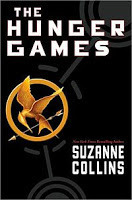 So, during our school's celebration of reading, Read-A-Latte, I nestled myself into a chair in the library while my students read their own guilty pleasure and read
The Hunger Games
, by Suzanne Collins. The last time students "told" me I had to read something, it was
Twilight
, but I am just not into vampires and werewolves, so I respectfully begged off. After reading a chapter or two, I found it wasn't for me. But, I am ecstatic that Stephanie Meyer's works have gotten a bevy of adolescents (and adults) to read about Edward and Bella.
So, during our school's celebration of reading, Read-A-Latte, I nestled myself into a chair in the library while my students read their own guilty pleasure and read
The Hunger Games
, by Suzanne Collins. The last time students "told" me I had to read something, it was
Twilight
, but I am just not into vampires and werewolves, so I respectfully begged off. After reading a chapter or two, I found it wasn't for me. But, I am ecstatic that Stephanie Meyer's works have gotten a bevy of adolescents (and adults) to read about Edward and Bella.
As I got to know Katniss, Gale, and Peeta from District 12, as well as Haymitch, Cinna, and Effie, as well as the other tributes and Capitol folk, I found that I could relate to them easily, as if I had known them for a long time. That familiarity brought me a level of comfort, even when situations in the arena did not—but that was the intention.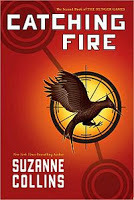 Now, I could easily type out a review of the novel, with spoilers and such, but that's not my intention. Suzanne Collins' work has elicited hundreds, perhaps thousands, of bloggers, writers, and reviewers to share their thoughts, for better or worse. I simply wanted to share that I had indeed read the works, and enjoyed them. One of my students, Jessica C., had read my novel and mentioned that "your book was better." While it pleases me to know that my work surpassed that of a published, well known author for someone, after reading both books, I can honestly say Collins' books were simply different in their portrayals.
Task Force: Gaea
is a Greek myth-based fantasy epic, while
The Hunger Games
and
Catching Fire
are more sci-fi. Plus, while my book uses first person narration in the first half where a god whom Zeus punishes shares his experiences, the reader sees third person narration in the second half; Collins' novel uses the first person point of view of Katniss throughout. The reader truly becomes intimately familiar with all of her thoughts and feelings more.
Now, I could easily type out a review of the novel, with spoilers and such, but that's not my intention. Suzanne Collins' work has elicited hundreds, perhaps thousands, of bloggers, writers, and reviewers to share their thoughts, for better or worse. I simply wanted to share that I had indeed read the works, and enjoyed them. One of my students, Jessica C., had read my novel and mentioned that "your book was better." While it pleases me to know that my work surpassed that of a published, well known author for someone, after reading both books, I can honestly say Collins' books were simply different in their portrayals.
Task Force: Gaea
is a Greek myth-based fantasy epic, while
The Hunger Games
and
Catching Fire
are more sci-fi. Plus, while my book uses first person narration in the first half where a god whom Zeus punishes shares his experiences, the reader sees third person narration in the second half; Collins' novel uses the first person point of view of Katniss throughout. The reader truly becomes intimately familiar with all of her thoughts and feelings more.
The adversity plaguing Apollo (in TFG) affects him in ways that evoke different emotions from the reader than those events that affect the reader via Katniss' saga. I am currently reading Mockingjay, the last of Collins' books in this trilogy, and I am enjoying it so far, but I am only (as of this post) about 30 pages into it.
Perhaps, when I am done with all three, I will post some sort of review, but right now, I'm simply enjoying the stories.
 So, during our school's celebration of reading, Read-A-Latte, I nestled myself into a chair in the library while my students read their own guilty pleasure and read
The Hunger Games
, by Suzanne Collins. The last time students "told" me I had to read something, it was
Twilight
, but I am just not into vampires and werewolves, so I respectfully begged off. After reading a chapter or two, I found it wasn't for me. But, I am ecstatic that Stephanie Meyer's works have gotten a bevy of adolescents (and adults) to read about Edward and Bella.
So, during our school's celebration of reading, Read-A-Latte, I nestled myself into a chair in the library while my students read their own guilty pleasure and read
The Hunger Games
, by Suzanne Collins. The last time students "told" me I had to read something, it was
Twilight
, but I am just not into vampires and werewolves, so I respectfully begged off. After reading a chapter or two, I found it wasn't for me. But, I am ecstatic that Stephanie Meyer's works have gotten a bevy of adolescents (and adults) to read about Edward and Bella.As I got to know Katniss, Gale, and Peeta from District 12, as well as Haymitch, Cinna, and Effie, as well as the other tributes and Capitol folk, I found that I could relate to them easily, as if I had known them for a long time. That familiarity brought me a level of comfort, even when situations in the arena did not—but that was the intention.
 Now, I could easily type out a review of the novel, with spoilers and such, but that's not my intention. Suzanne Collins' work has elicited hundreds, perhaps thousands, of bloggers, writers, and reviewers to share their thoughts, for better or worse. I simply wanted to share that I had indeed read the works, and enjoyed them. One of my students, Jessica C., had read my novel and mentioned that "your book was better." While it pleases me to know that my work surpassed that of a published, well known author for someone, after reading both books, I can honestly say Collins' books were simply different in their portrayals.
Task Force: Gaea
is a Greek myth-based fantasy epic, while
The Hunger Games
and
Catching Fire
are more sci-fi. Plus, while my book uses first person narration in the first half where a god whom Zeus punishes shares his experiences, the reader sees third person narration in the second half; Collins' novel uses the first person point of view of Katniss throughout. The reader truly becomes intimately familiar with all of her thoughts and feelings more.
Now, I could easily type out a review of the novel, with spoilers and such, but that's not my intention. Suzanne Collins' work has elicited hundreds, perhaps thousands, of bloggers, writers, and reviewers to share their thoughts, for better or worse. I simply wanted to share that I had indeed read the works, and enjoyed them. One of my students, Jessica C., had read my novel and mentioned that "your book was better." While it pleases me to know that my work surpassed that of a published, well known author for someone, after reading both books, I can honestly say Collins' books were simply different in their portrayals.
Task Force: Gaea
is a Greek myth-based fantasy epic, while
The Hunger Games
and
Catching Fire
are more sci-fi. Plus, while my book uses first person narration in the first half where a god whom Zeus punishes shares his experiences, the reader sees third person narration in the second half; Collins' novel uses the first person point of view of Katniss throughout. The reader truly becomes intimately familiar with all of her thoughts and feelings more.The adversity plaguing Apollo (in TFG) affects him in ways that evoke different emotions from the reader than those events that affect the reader via Katniss' saga. I am currently reading Mockingjay, the last of Collins' books in this trilogy, and I am enjoying it so far, but I am only (as of this post) about 30 pages into it.
Perhaps, when I am done with all three, I will post some sort of review, but right now, I'm simply enjoying the stories.
March 8, 2012
Read!
Read more books. Just do it. Find a genre or more than one that you like, and just read.
:)
SBTW6Y9Z63YJ
:)
SBTW6Y9Z63YJ
Sneak Peak—Be a Member of Task Force: Gaea
Here's what's you'll see soon... with more to come. Soon, you too can join Aegis, Aetos, Aether, and Zodiak.