Beth Alvarez's Blog, page 25
November 5, 2019
First week of NaNoWriMo
Not a whole week, but this is the first Tuesday. Four days into NaNoWriMo, and my project is 31% complete.
Okay, so being completely honest and fair, the first day was a wild cheat. The first day, I reread and revised what I’d written for To Steal the Crown over the past few months. I added a few words, but honestly, I didn’t track how many. To keep everything clean and organized for this month’s unofficial participation in NaNo, I then scrapped the Pacemaker tracking I had established for this book and put all my already-written words down as work logged on the first day. Not factual, but convenient, so I went in with a big chunk on day one.

Since this project is going to be so short, it won’t take much daily work. That’s kind of a good thing, because I need time to get back into the swing of writing. I’ve been editing like crazy, but editing and writing are really different things. Even though I’ve been writing tons of new material for the books in the Snakesblood Saga, I still count that as editing, because it’s just smoothing out things that were already there.
Monday was a bit of a catch-up day, since I couldn’t meet my goal on Sunday. I did okay Saturday, but Sunday, I was just wiped out. I think I may revise my strategy and plan to do a little less on weekends. Or maybe I’ll leave the project alone—right now, the project on Pacemaker is set up to adapt my schedule to evenly space what still needs to be done across the days that remain. If I miss one day, or don’t quite hit my goal, it’s easier to make up a few words at a time than to try to catch up the next day alone.
But catching up is part of why I want to keep my workloads small. Right now, my goal averages 700 words a day for the month of November to see this novella completed. On a good day, that’s an hour or less. On bad days, like today, it takes a few hours in broken-up writing sessions. And on the worst days, even that seems insurmountable.
I suppose that’s one of my chief complaints about NaNoWriMo in an official capacity. 1,667 isn’t a huge number of words, and I can do that many most days that I’m able to sit down and write. I did 1,117 Monday and finished before 3, so I could have tried to squeeze in more after my daughter went to bed. But if I didn’t make it to that 1,667 goal, NaNo would mean I’d have to struggle to make up those extra 550 words the next day, or else I’d begin the slow backwards slide of falling behind.
Writing should be fun, not pressure-filled, and not stressful. As an indie, I set my own schedule and don’t have to worry about deadlines set in contractual stone. I can afford to set my workload smaller, and I should—even if I write 500 words a day, which is something I can hammer out in two 10-minute sprints if I have time to think between them, that’s still going to give me three average-sized books a year. Or two very large books, which is what I trend toward writing. But two books a year? That’s nothing to sneeze at, even if it’s below what I have the capacity to create at this point in time.
So, starting off small. If I feel so inspired, I’ll write bigger, longer chunks later on, but right now, I’m happy to clock out after 700. I’m still trying to produce one video a week, and that takes a lot of time. I want to have fun sometimes, too. I’ve been playing Skyrim again, and it’s refreshing to sit down in the evening and not have to work. Hopefully, I can keep this momentum going through the whole month.
Wish me the best—I’ll report back on that next week.


October 29, 2019
Here comes November
I’m not writing today. I finished book 5 of my Snakesblood Saga on Sunday, and this week is all about prep for next month.
I haven’t officially participated in NaNoWriMo since I was 16 or so, with a book I’ll someday get around to writing now that I really know where it’s going. This year isn’t really changing that–I’m not officially joining in, but that’s partly because the project I’m going to be writing (unofficially) for NaNoWriMo is shorter than 50,000 words… and it’s already been started, which would be considered cheating.
I’m using the month of November to write To Steal the Crown, the second book in my Westkings Heist novella series. TSC is slated for publication in February, which means this will be my fastest turnaround between writing, editing, getting beta readers, and publishing a story. Fortunately, it’s pretty short: Like To Steal the World, I expect TSC will be around 25,000 words, give or take a bit. That’s under 1,000 words of writing a day, which should be pretty easy for me to conquer, even with Thanksgiving break thrown in.
The cover for the book is ready, and I plan to share it toward the end of the month, whenever the book is finished. I’ll also be checking in each week of November to report on my progress getting through TSC. After working my way through Snakesblood 5, it’ll be refreshing to work on something else, and I’m excited to see where it goes.
I have news for the Snakesblood Saga, too, but I’m not sure when I should share that. Beginning of November? End? I guess we’ll see how the first few days of writing TSC go before I decide.
October 22, 2019
More author organization
As I creep closer to the release date for To Steal the World and the release timeframe for Serpent’s Mark, I’ve felt increasingly overwhelmed by the number of things I need to do to have these books ready. I’m still crawling through Snakesblood book 5, but since I’m doing everything myself, I have a lot of other things to handle.
I’ve made to-do lists leading up to release, but se eing pages and pages of stuff left undone was daunting. To make the job a little more palatable, I decided to put up a Kanban board next to my desk. I had a corkboard from Ikea I hadn’t hung yet, so I popped it up on the wall above the (currently malfunctioning) printer and filled it with color-coded post-it notes. The idea behind the board is to have each note represent one task–one small step in the bigger process of publishing. The left-hand side is filled with things I need to do, the middle area is for things in progress, and the right-hand side is for tasks that are complete.
Whenever I have a few minutes to work on something, I can grab a post-it off the To Do section and move it to the center, then focus on that task. Right now, I’ve got three things sitting in the middle, but they’re things I hope to complete within the month. The big one is cover art for Serpent’s Mark. Every time I get close to having it done, I second-guess myself and my abilities and back away from the project. But I’ve got to finish it by the end of the month, so I can’t keep backing down forever. I got some great feedback on the piece and am reworking some large portions of it, so hopefully we get there soon. I have 5 more covers to make after that one, after all.
The other tasks are larger and smaller: One is finishing the first draft of the second Westkings Heist novella, while the other is completing a series of small icon-like illustrations I’d like to use at chapter headers in the Snakesblood books. I may back off that as we progress, since I may not use them in the ebook versions, but we’ll see. Hopefully those illustrations and the cover will be done by the end of the week.
While my photos don’t reflect it, since I took them as soon as I had the board done and up on the wall, I’ve gotten a handful of things moved over to the finished side. A lot of the final work for TSW has been done–just ISBN registration and copyright pending, and those have to wait until January–and I’ve done a couple things for Snakesblood, too. One bit one was re-drawing the map of Elenhiise again, because I had redone it in Clip Studio Paint to create the vector image, only to discover CSP couldn’t actually export as a vector–rendering all my work useless. But I recreated the map for a third time using Illustrator, and now all is well.
Most of the board is dominated by work for Serpent’s Mark, but the row of hot pink tabs are business related and I’ll be addressing those a bit at a time, too–but instead of going onto the right side of the board, those might just go into the trash. 
October 15, 2019
Project planning… well ahead of time
I’ve shared a bit about Spectrum Blade, one of my work-in-progress books that’s currently on hold while I finish my Snakesblood Saga. I’m reworking the fifth Snakesblood book, which means Spectrum will be back on the table in the second half of next year. I’m doing what I can to prepare ahead of time without having to devote any time to actually writing. One thing I’m going to do is set up a planner for tracking work on the series.
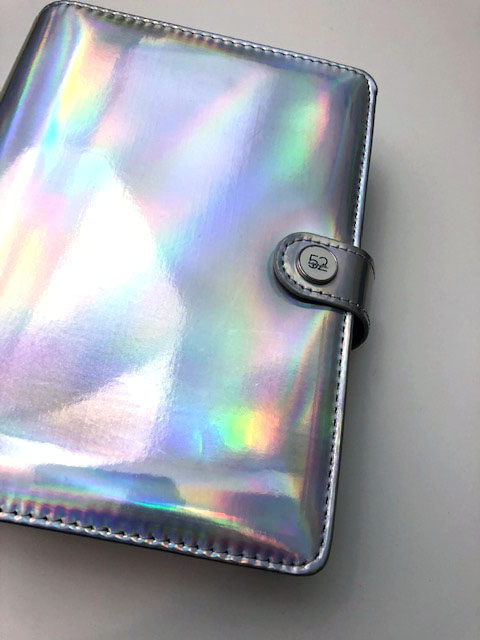
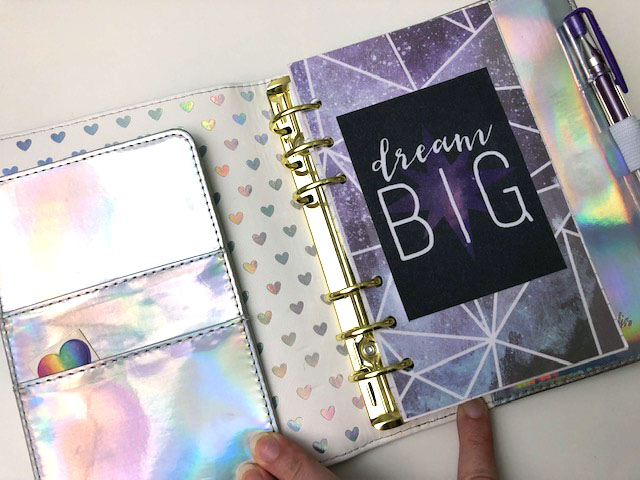
I saw this planner last year–maybe year before last, actually–and wanted it. I didn’t have a NEED for it, or a reason to buy it, but I bought it anyway because planners. Fortunately, with the whole colors thing going on with Spectrum Blade, I feel like this will be a perfect planner to use for the project.
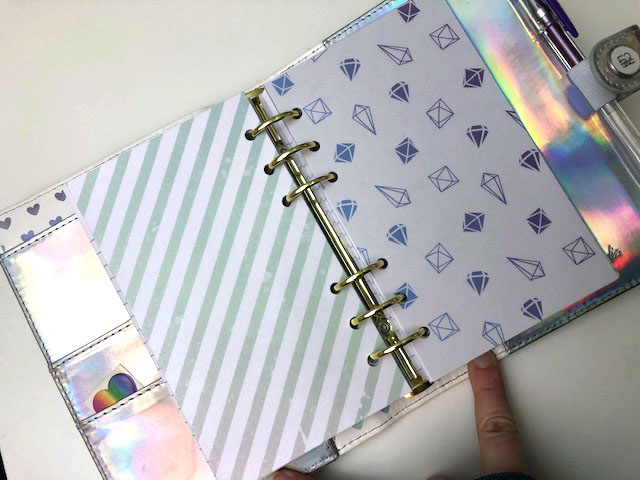 I set up some dividers inside using scrapbooking paper my parents gave me for Christmas that I wanted to use, but didn’t know how to utilize. The prismatic color schemes and designs work perfectly with the shimmering holographic cover. I’ve got some pretty washi tape set aside to add color pops, and I’ll be designing some series-specific stickers for a little extra fun, but right now, I’m focusing on how to use this to help my writing.
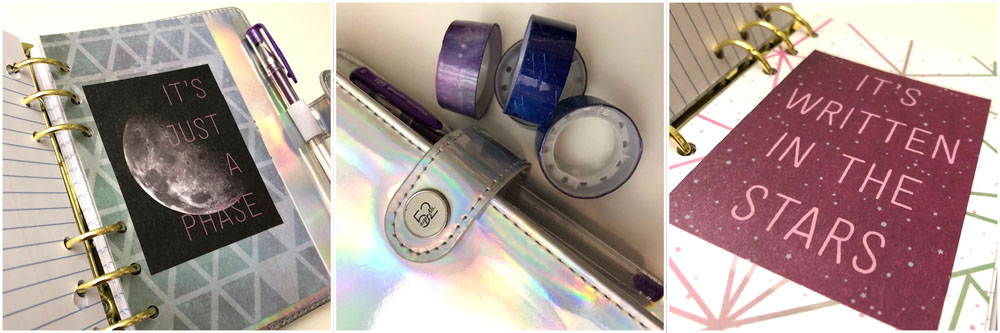
I used a planner while writing Her Midnight Cowboy, and I felt it was a great assistance, though I didn’t use it as much as I hope to use this one while writing Spectrum. It was invaluable as a reference manual, though, so that’s going to be a good portion of my focus. For sake of simplicity, I’ll just list out the things I plan to put in this one to help me with Spectrum Blade.
A typed copy of the outline for quick reference
In-depth bios for major characters
Lists of minor characters with info on their role and physical descriptions
Maps of the setting
Information about the major cities and regions
Character artwork (just for fun!)
A writing calendar to track my progress
A plot calendar to keep the timeline straight
An appendix of magical items and their purposes
A bestiary of created animals/monsters
In essence, the planner will become a “series encyclopedia” of sorts, tracking all the minutiae that might fall by the wayside as I move through the story. Since I expect the series to be five books, having everything lined out and easy to reference should make my life a lot easier. Whether or not that actually happens, I guess we’ll see, but once I start setting up the pages, I’ll surely share photos (and possibly downloadable sheets to print your own pages) so everyone can see.
In the meantime, I’ve got to get back to Snakesblood #5. I’ve lost a character in the midst of these dangling plot threads, and I have no idea where she is.
October 8, 2019
Examining book formatting: The Sword of Midras
Before I started writing my own books, I honestly didn’t really notice how books were formatted. There were little things I noticed, like pretty graphics, but I didn’t really pay much attention. I didn’t sit and examine them or anything like that–I just wanted to get back to the story. Once I started digging into what goes into book production, I became a lot more appreciative of the aesthetics and thought maybe I should consider looking deeper into what’s done in modern books.
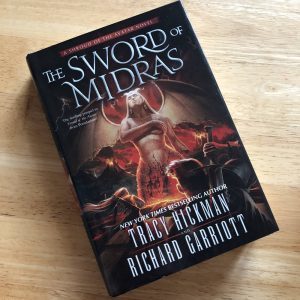 When I came across The Sword of Midras by Tracy Hickman and Richard Garriott in a dollar store, I figured there were worse ways to spend a dollar than checking out a fairly recent book. I’m fond of Tracy Hickman’s work, too, so I figured I’d actually read it, too. You know, for research.
So at a glance in the dollar store, I picked up on a couple things:
The trim size is 8.5 x 5.5 inches, which is a fairly standard size for both hardcover and trade paperback books now. The book claims 332 pages, so I estimated the word count at 83,000–a little slim for an epic fantasy, so that was an interesting tidbit. It’s published by Tor, the fantasy and science fiction branch of Macmillan.
It also appeared to be a tie-in for a franchise, Shroud of the Avatar, which I later learned was Richard Garriott’s new MMO and the spiritual successor to his previous game, Ultima. Near as I can figure, the book was penned as a combination backstory/marketing effort, reaching markets that might be interested in Shroud of the Avatar. Since a lot of gamers I know are avid fantasy readers, it seems like a reasonable decision.
The cover art follows current trends of slightly more impressionist digital painting. Only the focal point–the statue–is really rendered, while most of the rest is just sort of hinted at with broad brush sweeps and scribbled highlights. This style is especially popular in video game concept art, so again, makes sense given the market.
From that cursory inspection, I felt I had a firm idea where this book belonged in the shelves and who they were trying to nab, so I paid my dollar and tax and took it home for a deeper look.
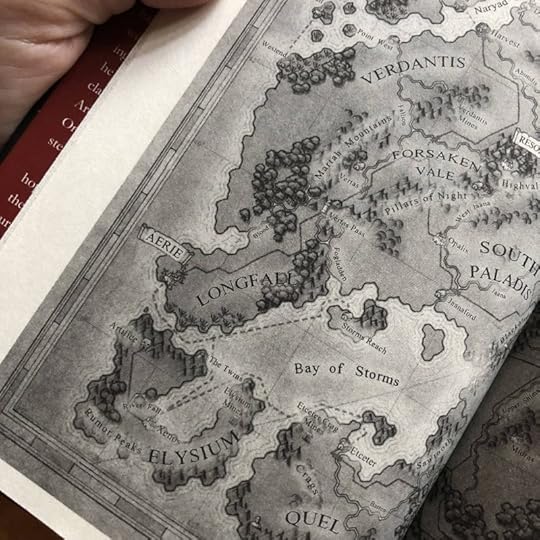
Like all proper fantasy books, the first few pages include a map. This particular map sort of intrigued me, as it was clearly generated using a hexagonal grid. There are a lot of software options that give results like this, so I’m curious how the map was made. Some elements are hand-drawn, and the coastlines have been manually varied a little bit to help reduce the very mechanical appearance of the hex grid, but it’s still noticeable and extremely prevalent in the rivers and roadways. An unusual choice, but one I think will become more common as publishers look for ways to trim costs… and independent authors hunt for ways to do things themselves.
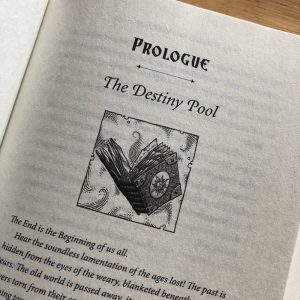 The book’s chapters are titled, which is less common outside of fantasy, but hey, I like chapter titles. You can look forward to titled chapters in some of my upcoming series. The book is also divided into sections, which I see less often these days, but each section reads like an episodic installment. The prologue is, curiously enough, formatted differently than the rest of the book. The prologue features the chapter number (in this case, just the word ‘prologue’) as a large header, a simple but attractive divider, the chapter title in italics, and then a header image.
I actually really like that layout–it’s similar to what I have in mind for my own fantasy books. The image used is definitely the sort of artwork you’d see used on item or skill icons in a video game, so that should appeal to their target market. But after the prologue, we have the first section break.
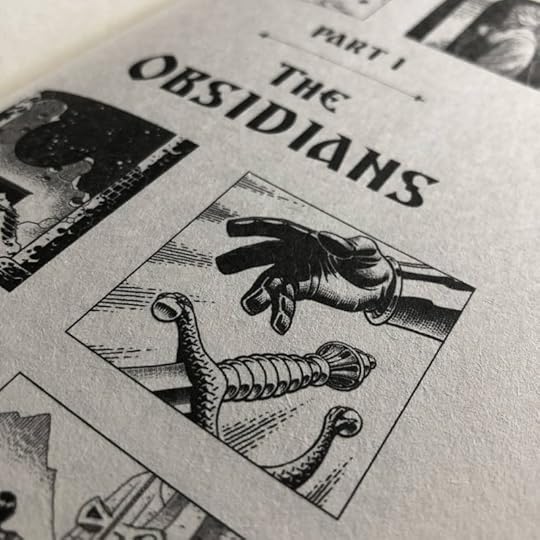
The section breaks are titled as well–lots of titles, jeez–and the break pages are nicely formatted, with lots of images. At a glance, they appear to tell a bit of the story, themselves. Once I spent some time reading, I found that assessment was correct. However, the chapters within the sections break are formatted with a different heading style, and while it’s attractive enough in its own right, I was a little disappointed since I found the prologue formatting much nicer. I also would have liked to see the section images paired with the chapters they belonged to, as I felt that would have been a nice touch. Things to consider for my own books in the future, I suppose!
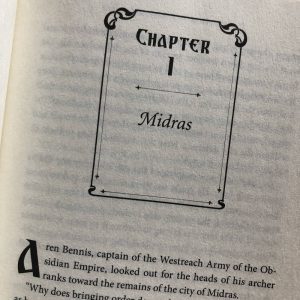 Otherwise, there isn’t much to note. The chapter header graphic remains the same through the rest of the book, with artwork only inserted at the beginning of each section. The chapters introduce drop caps, which is fine, but I was a little peeved that they didn’t take the time to set quotation marks into the margins when chapters began with dialogue. The Chicago Manual of Style says dropping the opening quotation mark is acceptable ahead of drop caps, but it’s strange to devote so much effort to the rest of the styling and then not take a few seconds to insert the quote-in-margin–especially since there are only 2 or 3 chapters that start with dialogue. Regardless, I prefer Oxford over Chicago, so fight me.
That’s all for this book, though. What did you think? Anything you liked/disliked? And more importantly, would you like to see more books assessed this way? I have a whole shelf full that I’d be happy to devote to the cause. 
October 1, 2019
October’s reading list
One thing I’ve wanted to do for a while is boost the number of books I’m reading. I set a goal to read 3 books this month, so I can start working through my modest TBR pile. I don’t really have time to review books anymore, but I thought I’d start keeping a list of what I’m reading. I tend to lose things in my Goodreads shelves, so instead, I thought I’d log my reading habits on my blog, starting each month with a look at what I’m working on.
For this month:
As a Sword In My Bones by Jessica Joiner
[image error]
I picked this one up for my eReader a while back after it came recommended in a reader group. I started it last week. It’s a little slow to get going in the first chapter or two, but then hints of political intrigue start building and the reader’s collection of puzzle pieces kicks off. A bit more along the lines of historical fantasy than what I’m used to, but I’m still curious to see where it goes.
Song of the Dragon by Tracy Hickman
[image error]
Tracy Hickman is a favorite of mine, so when I saw this in a 25 cent bin at a thrift shop up where my parents live, I was a little surprised to see it in a super rural farming community… but also eager to snap it up. I’ve actually already cracked this one open, too–I usually have one paperback and one ebook going at the same time and I read them in different situations. Right now I’m 4 chapters in and it’s been nothing but a great big battle. Ironically, now that the battle is close to winding down, things are finally starting to get interesting!
Dragon’s Code by Gigi McCaffrey

Once upon a time, I lived and breathed Pern books. I was less enthusiastic about Todd’s installments because the man couldn’t keep his canon straight. Dragons and whers changing color between books, characters mixed up… oh, it was dreadful. I hadn’t heard anything about a new Pern installment, but this one is about Piemur (!!!) so I’m willing to give Gigi a chance to impress me.
Haha… unintentional Pern pun…
What are you reading this month?
September 24, 2019
My vision board
I learned about vision boards earlier this year. I think I’d probably heard of them before that, but never really paid attention. It wasn’t until I had a nice big cork board I wasn’t using for anything that it crossed my mind—and then only because I came across a video on YouTube where an author was talking about a vision board for her career. It sounded interesting. And I had a board, so maybe it was worth looking into.
I have to admit I didn’t think much of many things I read. Long articles about the law of attraction didn’t do anything for me—while I surely believe we reap what we sow, I’ve never felt particularly moved by the notion that deciding I would have something would make it gravitate to me. Lots of things in life are conscious decisions. But the best predictor of success is work.
But that doesn’t mean I can’t envision the things I want, so that was what I decided to make the focus of my board. A combination of things that are important to me, things that inspire me, things I want to achieve, and things I treasure. A board of dreams and aspirations, with an extra emphasis on what I already have that makes my life amazing. I selected some photos of my family, things I hope to achieve, things I hope to create, and sprinkled in snapshots of things that are beautiful to me or helpful to me as a creative, such as some positive comments left by editors.
I put my mockup cover for a book I want to publish more than anything in the middle of one side, and put covers of other titles I’ve published or am working on around the edges. I pinned it all against some pretty colored paper to make it a little cheerier, then put the board on my desk.
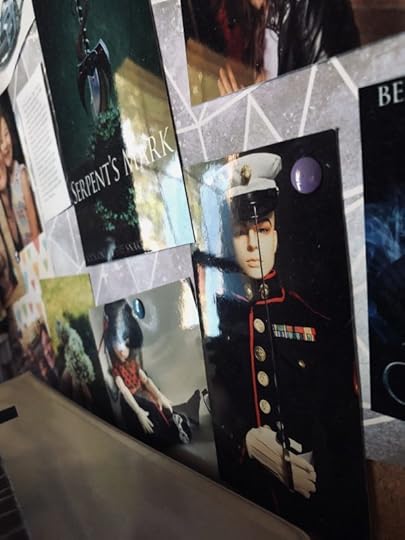
It’s a pretty picture of what I want. Simple things that bring be happiness, time with the people I love, and a few lofty ambitions, too (that Shelby GT500 Mustang isn’t buying itself…) just to keep me motivated to move forward.
Most importantly, though, everything I put on the board was realistic. Things I can make happen, things I can achieve, nothing that makes me feel discouraged or less than or like I’m lagging behind. It strikes a balance between what I have and what I dream of, and helps keep me focused on joy. With pictures of my daughter’s smiling face on the board, how could it do anything else?
I don’t think it’ll make me any more likely to get those things. I don’t think pinning them on a board makes them any more real or more likely to happen. But they’re happy reminders, and for me, that’s what counts.
September 17, 2019
Using dice for writing books
Through the month of August, I shared some photos of my modest dice collection on social media. I never had an opportunity to gather dice like my friends; living where I did, there was absolutely nowhere to get them, and I’m a tactile person, so I like to see and hold them as a part of picking out what I like. Plus, photos rarely do them justice. Many dice don’t photograph well. Either they look way better in person, or the colors captured can be way off. That said, my ultimate dice wish list would include a set of gemstone dice. Labradorite, to be precise. I probably won’t ever find those in person, so that’s a someday purchase where I’ll take the leap and buy online.

Either way, my dice don’t really get used. I haven’t played anything D&D in… I don’t even know. Not since well before I got married, and that was a good while back. Most of the time, when I use my dice, I use them for writing.
I mentioned as much when I shared photos of my story dice, which I use for creating prompts. I occasionally use those for getting stories un-stuck, too. But most of the time, I use my regular D&D dice sets for my writing. A friend asked how I made that work, so I figured I’d summarize what I told him here, just because others might find it interesting.

It’s pretty simple: I use my dice to determine things that aren’t plot-fixed and set in stone. Chances of success at menial things, or blows exchanged in battle. It helps make things a little more believable if the heroes get banged around sometimes, and having the dice to determine when those bumps and bruises should happen makes things easier for me.

Of course, everything I do is super simplified—no stats, just dice rolls. Depending on what I’m doing, I may also handicap characters in battle by mismatching dice. Instead of D20 vs D20, a more skilled character might get a D20 while their less skilled opponent gets a D12. Or, for my characters who might be sparring and fight at the same level, I narrow the gap: D6 vs. D6, where the blows will be less devastating. Or, to give one a slight advantage, maybe pitting a D8 against a D10.
Really simple, but it’s a great time saver, so I always try to keep my dice handy when I’m working through a scene.
That’s it!

September 10, 2019
Am I really a bookworm?
This is potentially unsurprising, but as someone who writes a lot and reads a lot, I interact with a lot of other bookish people online. I’m in groups for readers of particular genres, have made friends with people who enjoy the same tropes I do, connect with fellow writers, and talk books with the same nerdy friends I’ve had for years.
Sometimes, though, I’m not really sure I belong.
I blame the internet. There’s a weird aspect of internet culture that is all about hyperbole. Everything anyone says ends up being wildly exaggerated. Sometimes for sake of humor, sometimes to spark outrage. And one side effect of this phenomenon is that, when I sit down to read in my groups, all the ridiculous memes everyone shares make me feel like I can’t relate.

It’s weird how little of what other readers think is “relatable bookish content” doesn’t apply to me at all. I don’t have problems with a massive backlog of books in my to-be-read pile, as I typically only buy books when I am ready to read them. Right now my backlog is the largest it’s ever been: four books, one of which I’m currently reading, and three I’ll read before the end of the year. The only reason I even bought four books at once was because I found them while traveling and I didn’t know if I’d be able to pick them up locally. I don’t lose sleep over exciting books–though I have grouchily stayed awake until the next scene break or the end of the chapter, just so I’m stopping in a good place. And I don’t have issues with putting my reading habits aside to take care of other things.

I don’t have problems hoarding books–my bookshelves mostly hold things that haven’t yet found a place to live in our new home, because I don’t keep that many books. And I don’t keep that many books because the only things that earn a place on my shelves are things I intend to reread, or books that have sentimental value. Nothing more.

Maybe it’s weird that the hyperbole that surrounds bookish culture makes me uncomfortable, but I surely can’t be the only person who nervously chuckles and can’t relate. I’m stereotypically bookwormish in other ways: I like snuggling in warm blankets and cuddling my cat while I read. I have an opinion on the Oxford comma. I prefer tea to coffee. I love the smell of books. And I have glasses I’m supposed to be wearing, but they’re not that comfortable, so I really only use them when I drive or am playing a video game with particularly small UI text.
I’m just not like those bookworms, so when it comes to my reader groups, I sometimes find it hard to connect.
Like I don’t really understand what it’s like to be a book person.
Like I’m not nerdy enough.
Like when it comes to the stories I’ve always loved to get lost in, maybe I’m a little too down-to-earth.
I don’t know.
Just me?
September 3, 2019
Free printable Animal Crossing planner stickers
I’m kind of on a sticker/planner kick right now. No apologies. I’ve really enjoyed working on freshening up my planner spreads. I’m also finally getting around to customizing one of my smaller planners, which I don’t currently use for anything. That’s something I’d like to get around to–using different planners to keep track of different things. It seems like a good idea, but I never know how to divide/track stuff and it all ends up in my main planner instead.
No big deal.
Anyway, it’s not a secret that I love Animal Crossing. My mom and all my sisters play, and my daughter plays, too. It’s got such simple, pleasant visuals. I wanted to use some of those visuals as stickers in my planner, but I couldn’t find anything to use for it and the graphics from the games themselves were too low-resolution to use.
Clearly, the best solution was to re-draw the icons and textures from scratch, by myself.

Click the image for the full-sized, 300 DPI image file.
Depending on the margins your printer allows, you might be able to get 4 of these sheets on a page. If you want to use a cutting machine like a Silhouette Cameo or some such, you’ll have to arrange them a little more carefully to fit within the cutting guidelines. So far, I’ve just cut out mine by hand. Couldn’t begin to tell you why, but there you go.
Anyway, being that Animal Crossing belongs to Nintendo, these stickers must be for personal use only. You’re free to print them and use them, but they can’t be used for anything commercial and should not be redistributed elsewhere.
Happy planning!