
Debra Landwehr Engle's Blog, page 4
October 7, 2014
Universal Voices video
From the beginning, The Only Little Prayer You Need has been guided by a power far beyond me. So when I got the idea of creating a video about the prayer a few weeks ago, I was pretty sure I couldn’t take credit for the idea.
People responded to the call for video clips, an amazing video editor named Rodger Routh put them together, and composer Bob Thomas wrote the perfect music for the video without even seeing it. Here’s the incredible result. Hope you’ll watch, enjoy, comment and share this video as another tool to help spread a message of love and healing around the planet.


September 29, 2014
It’s time for the launch—let’s do this together
This week, The Only Little Prayer You Need: The Shortest Route to a Life of Joy, Abundance and Peace of Mind will be officially released to the world. Like a lot of authors, I feel like I’ve given birth. And like many parents, I feel this creation has a little to do with me, and a whole lot to do with a power I can’t exactly explain.
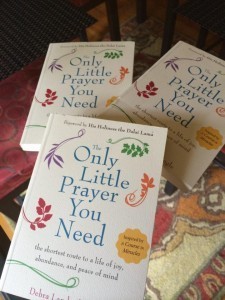
A friend texted me a photo of her pre-ordered books when they arrived. Aren’t they beautiful?
In other words…I’m extremely proud of this book—and also extremely grateful that I got to be the one who gave it life.
From the beginning, The Only Little Prayer You Need has been a work of divine inspiration. It started, as the first two chapters explain, on a day when I was overwhelmed by mundane life events that added up to a mud pit of frustration, and what I can only call stuckness.
Now, a little more than a year and a half later, it’s being released into the world with a foreword by the Dalai Lama, an endorsement by Archbishop Emeritus Desmond Tutu, great reviews and a lot of anticipation.
It just goes to show you what a bad day can do.
That’s why I can’t take full credit for it. If it had been up to me, I probably would have stewed in that mud pit for a lot longer than I did. But when the prayer showed up, things began to change.
Something/someone much wiser and more powerful than me wanted the message of this book to get out to the world, and I just happened to say yes to the assignment. At every stage, the process has slowed down when I’ve gotten in the way. And it has sailed like a boat in the wind when I’ve stepped aside and simply said “Yes.”
That’s why I SO believe in the core message of the book: The only thing standing in the way of peace in our lives—and in our world—is fear. And we’ve been thinking we can fix that fear when, honestly, we need a lot of help.
It sounds simple, and it is. Yet it’s also complex because we believe we’re complex beings. And that’s what this book, in its very straightforward way, sorts out.
If you’d like to help turn this book from a message into a movement, you can help in many ways:
Tell your friends about The Only Little Prayer You Need.
Post a review on amazon.com. They’ll accept reviews starting October 1, the official release date. Posting a review takes just a few minutes and can make a huge difference in the number of people who read the book.
Check with your local bookseller to see that they’re stocking it.
Study it in your book club or church circle or other organization.
Contact me to set up a book club visit in person or via Skype, or to speak to a group in your community.
Spreading the message of this book is a little like a political campaign, except without any attack, defensiveness or backstabbing.
Okay, so it’s nothing like a political campaign.
It’s more like sharing a cup of tea or a deep conversation or your favorite piece of music—something that comes straight from your heart to the heart of another, intended to do nothing but heal, soothe and comfort.
If there’s one thing we all need in our lives—and in the world—it’s less fear and more love. I believe this book can help not just in a little way, but in a big, magnificent, unbelievable way. I hope you’ll feel the Spirit of this book and help me carry it as far as it will go, which I’m pretty sure is a lot farther than any of us can imagine.
Thank you for reading, for sharing your stories, and for being part of the message!
August 29, 2014
What We Know
My husband and I were watching PBS the other night and, thankfully, happened to see part of the series on Freedom Riders. This episode focused on the collaboration of strangers from across the U.S. who came together to be trained in nonviolent resistance.
From different races, levels of education and geographic regions, they boarded buses together, bound for the deep South and a higher purpose: to end segregation.
Put this together with a TED talk I listened to on my walk this morning. The topic was cheating, and it was presented by behavioral economist Dan Ariely. He gave two examples of experiments in which people declined to cheat, even though participants in other experiments had done so routinely.
Those who didn’t either had been instructed to think about the 10 Commandments or the MIT honor code (never mind that it doesn’t exist). In both cases, people didn’t cheat, implying that if there’s a mention of morality, it gives people pause.
The combination of these two programs brought up a question for me: Why don’t we use what we know?
We know that nonviolent movements can create lasting change. And we know that introducing some level of conversation about honesty, character, kindness, and decency into our daily lives also creates change.
The thing we don’t know is, why don’t we put these tools to work every single day?
Let me just mention that I’m not talking about adhering to a strict moral code. Moral codes are invented by humans who end up fighting each other about what morality means.
I’m talking about drawing on the better part of ourselves to change the conversation. Instead of complaining, it means talking about possibilities. Instead of focusing on weaknesses, strengths. Instead of anticipating attack or fighting back, it means planting our feet and standing firmly for a peaceful resolution.
There are people who say they don’t know what the answer is to the world’s problems. This, I believe, is an abdication of will. We know what the answer is. It’s just that there’s a part of ourselves that doesn’t want to act on it. That’s the part of our mind that feels alone and separate and ready to defend itself even when there’s nothing to defend against. It’s the part of us that feels guilty and thinks it can only get relief by making everyone else feel guilty, too.
This is not the way.
We know the way. It’s not one religion or one honor code or one definition of morality. It’s the way of drawing on our better nature to expect more of ourselves. It’s the way of forgiveness. It’s the way of asking a higher power for help. It’s the way of the Freedom Riders, of valuing peace above all else and then standing for it.
We may think there has to be a big moment, a big war, a big injustice to precipitate change. But the change we need is not just in ending wars or injustices on a large scale. We need the kind of change that will end the cycle of blame and attack that we’ve all engaged in for countless centuries. We need a paradigm shift in what it means to co-exist on the planet, whether it’s in our families, our communities, or our nations.
There have been plenty of way-showers in every culture, religion and neighborhood. Let’s emulate them. Let’s speak in calmer voices and listen to one another’s concerns. Let’s realize that every war—whether it’s between countries or between neighbors—is a civil war. And let’s do something truly different.
Let’s give up the fight. Use what we know. And let’s get on board, bound for a higher ideal.
August 16, 2014
My Message at the Loving Kindness Tour
I had the honor last night of speaking at the opening ceremony for the Maitreya Loving Kindness Tour in Des Moines, Iowa. Here’s the text of my talk:
What a remarkable night. We’ve been to Tibet, to India, to Africa, and to places in between. And now I want to come full circle and bring you back to Iowa.
My husband Bob and I live on an acreage about 7 miles north of Winterset, just southwest of Des Moines in Madison County. For those of you who remember the book and movie, The Bridges of Madison County, this is THAT Madison County. The covered bridge where the characters Francesca and Robert fell in love is just a few miles from our house, and you can still sit on the same barstool at the North Side Café in Winterset where Clint Eastwood sat in the movie.
On this acreage a couple of years ago, a feral cat showed up in our yard—a small gray striped cat who hung around but would run whenever we stepped outside to leave food on the front porch. Before long, we realized this cat was pregnant, and we started calling her Mama Cat. And before too much longer, she had her kittens in our neighbor’s barn. Over time, we started to win Mama Cat over. I’d be out gardening, and she’d come a little closer each day. I could tell she wanted attention, but she just didn’t trust us yet… until one day when she walked right up to me, turned around, stuck her tail up in the air and invited me to scratch her rear end. We’ve been acquaintances every since.
Mama Cat started bringing her kittens to our house to eat. But while she has become somewhat domesticated, her kittens have not. They run if they even see us looking at them out the window. Bob built them a shelter that sits on the front porch during the winter, and he rigged up a wiffle golf ball tied to a long string that hangs from a hook on the front porch, where the kittens can play feline tetherball.
But the kittens continued to run.
One cold day, I felt especially frustrated as I opened the front door to feed them. They were huddled on the porch, but they scattered into the bushes as soon as they heard the door. Their insistence on running every time we reached out to them, their lack of trust that we had their best interest at heart, kept us apart and made their lives harder than they needed to be. So I stood on the front porch in the cold and spoke to them in the bushes, “If you would just stand still, we could help you.”
“If you would just stand still, we could help you.”
I thought I was talking to the kittens. But you know how sometimes your words come back to you and smack you in the face? As soon as I said those words, I imagined being surrounded by angels and spirit guides who were pointing at ME and saying, “If YOU would just stand still, we could help you.”
I realized in that moment how much I—like the rest of the human race—am running in circles, trying to find shelter and safety, when the help we need is right there—all around us and in us. We run and hide from help rather than accepting it. We run away from what we need rather than toward it.
Why? Why would we do such a crazy thing? In one word: fear.
For the past 30 years, I’ve studied something called A Course in Miracles, which is based on this premise: In this world, there are two things: love and fear. And of those two, only love is real. Now fear feels real. It keeps us stuck. It keeps us from believing we have value. It keeps us from following our dreams or finding a life partner. It holds a grudge. It speaks to us, often right after something wonderful happens, and warns us just to wait, because the other shoe is about to drop. It keeps us running into the bushes, limiting our ability to receive what’s right in front of us.
It’s not that loving kindness isn’t available. It’s just that fear stands in the way. If our part is to ask for our fear-based thoughts to be healed, then Spirit’s part is to encourage us to do so, to complete the healing we can’t do for ourselves. “If you would just stand still, we could help you.” But our fear keeps us running in so many directions.
We run toward the mall to buy things so we can measure our worth in a shopping bag. We run into relationships because we don’t feel complete. We run out of relationships because we don’t feel loved. We run toward violence because we feel helpless. And, as we were reminded earlier this week, we run to alcohol and drugs and sometimes ultimately to suicide so as not to feel at all.
But we can stop running and, for me, that’s what this experience, the experience of the Buddha Relics, is here to teach us. It’s about standing still so we can receive what we’re running around, trying to find.
I’ve learned that standing still isn’t about quieting your body. It’s about quieting your mind. Taking just a few moments to stop the parade of thoughts that goes marching through your mind every moment of the day. Think of it as an intermission. An intercession. A pause. An opening of the door. Or, as you will experience when you view the relics, a moment to receive the blessing.
Some of you here tonight experienced the relics two years ago when they were in Des Moines. Some of you may have had a reaction similar to that of my sister-in-law who, after viewing the relics, said, “I don’t know what that was, but it was amazing!”
Others of you may be here out of curiosity. What are these relics? What makes the experience so amazing? And why are they in Iowa of all places?
Personally, I believe they’re in Iowa because this is where we plant things. This is where we put seeds in the ground, where those seeds put down deep roots and grow and produce nourishment that spreads around the world and feeds the human race. And…this is where, as any RAGBRAI rider who has been invited to stay in a stranger’s home will tell you, loving kindness is embedded in our way of life.
So how do you describe the experience of the Buddha Relics? How do you describe the indescribable? My words will fall short, but I’ll do the best I can by telling you this story:
I’ve had two spiritually profound dreams in my life. They happened years apart…one when I was about 7 years old, and the other when I was in my early 30s. Now, when other people tell me their dreams, or when I tell them mine, it’s a little like describing your trip to the State Fair…nonsensical unless you experience it for yourself. “All the food is served on a stick! There’s a bull that weighs more than two bulls put together! They fry candy bars in fat…and eat them! And people crowd around to watch a man with a headset teach them how to use a mop!” I love the fair, but it does sound a little like falling down a rabbit hole. And that’s how other people’s dreams can sound, too. So I’m going to put you IN these dreams.
This is the one I had when I was seven. You might want to close your eyes. Imagine that you’re in an old DeSoto….one of those big old cars from the early 1960s. You’re with your family, and your dad is driving up the side of a mountain. The road is nothing but switchbacks, and you’re above the tree line, so it’s desolate…nothing but rocks and debris. At the top of the mountain, the car breaks down. So you all get out and, by yourself, you step over the very peak of the mountain. On the other side, there is nothing but blue sky and green grass. Not any ordinary green, but a green that’s like taking an Iowa cornfield or soybean field and ramping up the green 1,000 times. The most intense and vibrant and alive green you could ever imagine. You sit down on that green, green grass. Everything else fades away. And you feel the most sublime and complete peace come over you…a peace you’ve never felt before.
That’s the first dream. In the other one, you’re in a rocket. God is sending you into space for 20 minutes because he’s going to stop the world and send it on a new path. He’s concerned about the direction it’s going, so he’s going to reboot it, if you will. In the rocket, you look out a small window and see the stars glimmering. But you can feel the moment everything stops. You’re aware that there’s no wind blowing. That the oceans are still. And that even the stars have ceased to shimmer. And for those 20 minutes, you once again feel that deep peace, that indescribable peace, the peace that passeth all understanding. It feels good, doesn’t it?
When I woke up from both those dreams, even the one when I was seven, I asked myself and God whether it even was possible to feel such deep and total peace in this world because it always seemed like something was in the way. I couldn’t name that feeling of peace until more recent years, studying A Course in Miracles. The Course helped me name the feeling I’d experienced in my dreams. I realized that it was not extreme love. It was the total absence of fear. The total absence of fear.
As I mentioned, A Course in Miracles says there are only two things: love and fear, and of those two, only love is real. In other words, all those fears we hold within us, that keep us scattering into the bushes, are not the truth of who we are or the world we live in. In those dreams, I was experiencing divine energy without the walls we erect in this world, without the ego trappings of fear we carry. Those dreams were a return home, a remembrance of the divine love within each and every one of us.
In this world, it’s rare to encounter that kind of purity—that complete and total light—because, like the barn cats, we have so much fear…much of which we don’t even recognize. But this evening and in the coming days, you will have an opportunity to encounter that divine love by being in the presence of the relics. They are the embodiment of love without fear. That’s why they attract people from all cultures, all religious traditions, all faiths, all belief systems. That’s why we did two opening prayers tonight….the Buddhist mantra and what would be considered a more Christian prayer. Because the relics are a bridge…the symbol not just for Buddhists, but for all humanity, a reminder of the love we are at our core. The love we came from and will return to. The awesomeness not just of love, but of the absence of fear.
Some people say that, in the presence of the Buddha relics, they are changed. I would say it a little differently. We are not changed, because the love within us is changeless. But in the presence of the relics, we are renewed. We remember our Selves. Our souls light up. We have a feeling, even if just for a moment, of coming home, of comfort and the deep emotion that comes from indescribable peace….the hallelujah of love without fear.
We have the opportunity to help God reboot this world. We have, in every moment, the choice to open our hearts to loving kindness or be constrained by fear. And that choice doesn’t just affect us. It ripples out like the light flowing from Hoyt Sherman tonight. It literally changes the world.
The Dalai Lama wrote this as part of the foreword to my book The Only Little Prayer You Need: A calm mind and self-confidence are the basis for happy and peaceful relations with each other. We need to encourage an understanding that inner peace comes from relying on human values like love, compassion, tolerance and honesty, and that peace in the world relies on individuals finding inner peace.
In my mind, that’s what the Buddha Relics are doing here. They are teaching us. They are encouraging us. They are planting seeds in this rich Iowa soil. The Buddha Relics remind us that we can receive help and blessings beyond our imagination, beyond all the limitations of fear. All it takes is a moment to remember the message from the heavens, and from the masters:
Just stand still, and we will help you.
August 5, 2014
Enter to win five free books!
It’s hard to believe, but The Only Little Prayer You Need will be launched before you know it, on October 1. It’s exciting to see the effects of this prayer in people’s lives on a daily basis….and the book isn’t even out yet!
So, to help spread the word to as many people as possible, my publisher has generously offered to donate a prize for a pre-publication drawing. Here’s how it works:
Do any or all of the three options listed below, and you’ll be entered in a drawing to win five free books. Not just any books, but books by some of the wisest and most inspiring thought leaders writing today: Eckhart Tolle, Byron Katie, Mark Nepo, B.J. Gallagher, Dawna Markova, and The Dalai Lama.
It’s simple: Just check out the options, below, and get one, two, or three entries in the giveaway. (While pre-ordering The Only Little Prayer You Need is one option, no purchase is required to be eligible to win.)
We’ll draw the winner’s name the first of September. Good luck! I’m wishing you all sorts of great reading and inspiration in your future!
July 23, 2014
Creating a Peaceful World
At last night’s A Course in Miracles class, we talked about how overwhelming it can be to see the violence around the world and not know how to respond. The same conflicts rage on, and nothing ever seems to change.
Whether we’re looking at a conflict in our own lives, or one on a battlefield half a world away, the dynamics are the same. Our egos are afraid, and so they cling to blame, defense and attack. They perpetuate conflict out of fear.
This is why we need divine intervention. Not because we’re innately bad, but because our egos drown out the path to peace…the path of forgiveness.
It may not seem like enough to ask for divine help, but in fact it’s everything. Changing fear-based patterns that have gone on for so long takes a new thought, a new energy, and something radical.
So be radical. Ask for fear to be replaced with love for yourself and everyone else on the planet. Focus on the possibility of change, no matter how daunting the challenge.
And remember that we don’t have to go out and create a peaceful world. We simply need to remember the peace of divine love that exists within us, and extend it to everyone we meet.
June 11, 2014
3 Universal Laws of Success
Ever noticed that many of our beliefs are 180 degrees opposite of spiritual truths? Here are three truths that can help you find more happiness and success, starting today.
If you want something, give it away. We think that if we give something away, we no longer have it. But the act of giving reinforces in our mind who we are as spiritual beings, meaning that we’re giving a gift to ourselves as well.
If you want peace, give it. If you want kindness, offer it to others. If you want respect, see it in everyone you meet. You’ll be amazed at how quickly this can shift your experience of yourself and the world.
If you defend yourself, you are attacked. Ever watched someone practice Tai Chi? The movements are slow, fluid, and graceful…not what you’d expect for a martial art. With other martial arts, you defend and attack. With Tai Chi, you let energy move through and around you so there is no attack, no opposing force.
Now think about your mind that way. Are you unconsciously braced for battle, expecting criticism or negativity at home or work? If you set up a stance of defense in your mind, you will draw attack. Instead, imagine your mind like those fluid Tai Chi movements—neutral, calm, and flowing rather than engaging in battle.
Fulfilling your purpose is an inside job. We often look to a job or career path—something outside ourselves—as our purpose. But when it comes right down to it, we all share the same purpose: to extend love into the world. That can happen in all its forms, including kindness, compassion, joy, creativity, and peace. To find the form of that purpose that’s right for you means asking yourself…
What brings me joy?
What draws on my unique creativity?
What feels like kindness and compassion to me?
How can I create peace in my corner of the world?
To help you find the answers, try this: Stand tall, quiet your mind, and put your hands out as though you’re about to receive a gift. Then close your eyes, focus inward, and say, “I am ___________________.” Listen to the answer. You may have to keep repeating the statement until you get to the quiet mind, the connection with Spirit that’s eager to help you remember the highest expression of who you are.
May 13, 2014
Writing and Spirituality: Brenda Ueland’s “Be Reckless!”
Whenever I teach a writing class, I let the students know up front that we’re really talking about life. It may SEEM like we’re discussing specific details and the structure of scene, but that’s only a disguise. Writing is life, and vice versa.
So here’s a tip for all budding writers that applies to all seekers as well:
Read the book If You Want to Write by Brenda Ueland. Read it if for no other reason than she includes the most delightful chapter titles, such as “Why Women Who Do Too Much Housework Should Neglect It for Their Writing.”
I like this book for all sorts of reasons. One, it originally was published in 1938 and, like any classic, is relevant and contemporary 75+ years later. But it also reinforces a message that applies equally to writing and life.
Be reckless! Ueland says. Be a lion…or a pirate. Don’t worry about impressing others.
Too many people, she says, have been taught “that writing is something special and not just talking on paper.”
That’s it. Just talking on paper. Not second-guessing yourself. Not letting your critical ego run the show. Not editing yourself to be acceptable.
When you talk, you don’t cast out a sentence, then reel it back in. You don’t rewind and mull it over, dissect it like it’s a frog, move words around, discard it, judge it and finally put it under your potted plant to catch drips. You just say it. And depending on the energy and intention with which you say the words, they either soar with vitality or land on the floor with a thud. They either fling open the window and flood the room with light or slam the door shut in darkness.
If you second-guess your writing—if you try to make it perfect rather than real—you’ll strip all the energy from it. It will be like talking in a monotone.
And if you second-guess your life? If you go for perfection rather than authenticity? If you worry about what others think? You will get stuck. You’ll be a slave to your fears. Your life will become a monotone.
Writing recklessly doesn’t mean writing without regard for others. It means writing with the highest regard for who you came here to be. Living recklessly means the same thing.
Be a lion or a pirate, Ueland says. Write—and live—from the voice that is real, imperfect and undeniably you.
January 27, 2014
A grassroots approach to feeding the hungry
In the next few months, I’m going to be interviewing people who are finding creative ways to address hunger in their communities. Their stories will be part of a documentary and book that we’ll launch at the next Hope for the Hungry conference November 8 in Des Moines.
This project starts with an important question: Here in the heartland of the U.S., the richest agricultural area on the planet, how can hunger exist?
But, truthfully, the bigger question is: Why does hunger exist anywhere?
In central Iowa, one of the people asking that question is Diana Sickles, a retired Lutheran pastor who decided a few years ago that it was time to stop talking about hunger and start taking action. She joined the U.N. initiative to alleviate childhood hunger by 2015, and she launched the Hope for the Hungry conferences in Des Moines to bring people together to focus on solutions.
Her passion for feeding hungry kids launched this book and video project.
While we’ll be talking mainly to Iowans, our goal is to document the many solutions that communities can replicate anywhere. We’ll feature organizations like…
Table to Table, whose team of volunteers rescues unused food from grocery stores and restaurants and delivers it to local agencies, food pantries and shelters. In 2013, they rescued more than 1.1 million pounds of bread, bakery items, produce, dairy and prepared foods.
The Food Corps program, which puts service members (often enthusiastic young people) in schools, where they help kids establish a school garden. They also bring the fresh produce into the school cafeterias and classrooms, cooking with the kids to whip up things like harvest stew and kale chocolate chip cookies (they were a hit!).
Community and church gardens like the Faith and Grace garden in West Des Moines, where founder Mark Marshall spends almost every waking hour beyond his full-time job digging in the dirt and helping manage the hundreds of volunteers who now work in the one-acre garden. Mark tells me that, in a town of 10,000 people, a couple of churches and a team of volunteers could raise enough produce to address the hunger issues in their community.
There are lots of issues in this world that need less fear and more love, and hunger is one of the most basic and widespread. If you know of innovative programs or individuals who have an important story to share, please let me know. While this book and video project will focus on the heartland, we want to hear about projects in your part of the country and the world as well.
January 16, 2014
A new day
One of the first lessons in A Course in Miracles says that we see everything in our life through the lens of past interactions and beliefs. So, for instance, if I meet someone with red hair, my perception of that person is immediately skewed according to other red-headed people I’ve known, and by what I’ve been told about them. If I stop and think about it, I remember passages from children’s books about girls with red hair and freckles being adventuresome and having gumption (there’s a word you don’t hear much anymore!). Unknowingly, I bring those expectations into the present.
The Course reminds us that we do this with everything—every person, every landscape, every conversation, every item we interact with throughout the day. So our day, without us even being aware of it, may go something like this: “Here’s my favorite chair, there’s the tree that sheds so much when the wind blows, here’s the person who owes me $20.”
The point, the Course says, is that our past perceptions color our present interactions and experiences. This can be especially significant in relationships, where we hold on to past slights and old grudges and carry them around with us every day. No wonder relationships go sour when we can’t see a person as they truly are, but instead as what they owe us.
Today, take a few moments just to see things and people in the present. Change your vision, as the Course says, by seeing through the lens of love rather than fear. And if you find that fear is standing in your way, ask for those fear-based thoughts to be healed so you can see this new day in its true light.


