
Mark Horrell's Blog, page 36
June 15, 2016
Why The Economist thinks Mount Everest is so dangerous
Last week The Economist published an article with the headline Why Mount Everest is so dangerous.
Now you may be wondering what a magazine about economics has to bring to the table on the subject of mountaineering. You’d be right to ask.
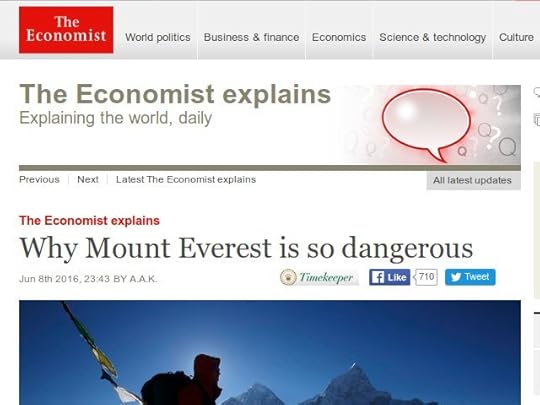 The Economist explains: Explaining bollocks, daily
 There are many reasons Mount Everest is dangerous, even on its standard routes.
Climbers on the south side have to pass through the Khumbu Icefall, with its giant crevasses spanned by ladders tied together wi...


June 8, 2016
Kilimanjaro: To the Roof of Africa
While surfing YouTube the other day, feeling nostalgic for the mountains of Africa, I stumbled across David Breashears’ 2002 IMAX documentary Kilimanjaro: To the Roof of Africa.
I hadn’t seen it before. While it’s not quite the same experience watching it on a modest tablet screen rather than in giganto-vision inside an IMAX theatre surrounded by hoofer-woofer speakers (or whatever they’re called) that didn’t matter to me. I’ve always been one for content over special effects.
The film is nar...
June 1, 2016
A long overdue, heroic story of rescue high on Everest
For the first 29 years of Everest’s climbing history the death rate was 100%. That’s to say that the only two people to climb it, George Mallory and Sandy Irvine, (if indeed they climbed it) didn’t come back alive.
Then Tenzing Norgay and Edmund Hillary climbed it in 1953 and came back down again. Suddenly the death rate was down to 50%, and it’s been going down ever since. Today the overall rate is closer to 4%, with close to 300 deaths in total and 7500 successful summits.
This year 563 peo...
May 25, 2016
Did Everest’s Hillary Step collapse in the Nepal earthquake?
We were now fast approaching the most formidable obstacle on the ridge – a great rock step. This step had always been visible in aerial photographs, and in 1951 on the Everest Reconnaissance we had seen it quite clearly with glasses from Thyangboche. We had always thought of it as the obstacle on the ridge which could well spell defeat … Search as I could, I was unable to see an easy route up to the step or, in fact, any route at all. Edmund Hillary, High Adventure
After two years of tragedy...
May 18, 2016
Book review: Summit 8000 by Andrew Lock
I couldn’t bring much of my mountaineering library with me when I moved to Rome, but luckily Edita had a book on her shelf that I was very interested in reading: Summit 8000 by Andrew Lock.
In 2009 Andrew Lock became the first Australian to reach the summit of all fourteen 8000m peaks. Summit 8000 is his autobiography, and covers all of those ascents and more. I wasn’t counting, but he must have made around thirty expeditions to the 8000m peaks for those fourteen successes (and one extra asce...
May 11, 2016
The first ascent of the South Face of Aconcagua
A day’s drive up the Trans-Andean Highway from Mendoza, in one of Argentina’s prime wine-growing regions, is the ranger station at the entrance to Aconcagua Provincial Park. Here climbers on Aconcagua’s Normal Route will stare up the Horcones Valley and get their first good sight of the mountain they have come to climb.
At 6,959m, Aconcagua is one of the Seven Summits. It is the highest mountain in South America, the Southern Hemisphere, and the Western Hemisphere (whatever the *$! that means...
May 4, 2016
Are western operators right to complain about cheap Nepali operators on Everest?
Last week the Himalayan Times reported how the rise of cheap Nepali operators who employ inexperienced Sherpas are increasing their market share of commercial Everest expeditions and making the mountain more dangerous.
This is not a new story, but it has passed unnoticed on the radar of western media, who prefer to focus on western operators and inexperienced western climbers, rather than Nepali operators and inexperienced Sherpas.
It was good to see the issue raised in the Himalayan Times, a...
April 27, 2016
When climbing documentaries were as popular as cookery shows
The most popular programme on British TV last year was the Great British Bake Off, a televised baking competition. I’ve never seen it, as I’m pretty sure watching people bake cakes would bore me to death, but I’m in a minority. A quarter of the UK population – 15.1 million people – tuned in to watch the final.
I can’t imagine why anyone would want to sit in front of the telly watching somebody bake a cake, but cookery programmes are extremely popular, presumably because so many people cook. M...
April 20, 2016
Feeling at home in the Apennines
Any search for books about the Apennines which aren’t travel guides, leads inexorably to one book: Eric Newby’s Love and War in the Apennines.
Newby is one of Britain’s best-loved travel writers, and Love and War in the Apennines is regarded by many as his best book. It’s more a biography than a travel book. It covers the time he spent as a prisoner during the Second World War after being captured during a raid on Sicily and sent to the town of Fontanellato in the Northern Apennines. When Ita...
April 13, 2016
Sherpa: They Live, We Come Back
Judging by the number of words I’ve expended on the subject, you can be forgiven for believing I enjoy wading into the debate and defending the right of ordinary people like myself to pay Sherpas to help us achieve the dream of climbing Everest (and therefore, the right of Sherpas to earn an income from doing so).
The truth is, I don’t really. The argument gets a bit boring as it gets more vitriolic. The vitriol nearly always originates from people who are badly informed. Haters will hate, an...


