
Cynthia Sally Haggard's Blog: Cynthia Sally's Blog, page 66
January 29, 2020
She walked away. But she wasn’t weak. (PARIS WIFE)
[image error]PARIS WIFE by Paula McLain is a fictionalized account of Ernest Hemingway’s first marriage to Hadley Richardson, and the time they spent together in Paris during the 1920s. Hadley Richardson was not glamorous; indeed in the eyes of Hemingway’s increasingly sophisticated circle of friends she was probably seen as a liability. And she couldn’t compete with the alluring determined, shrewd woman, who beguiled her way into the Hemingway’s marriage by presenting herself as Hadley’s friend, and succeeded in becoming the second Mrs. Ernest Hemingway.
So it was an interesting choice to tell the story of the marriage using Hadley’s voice, especially as Hadley fails to keep her marriage. Or rather, she makes a choice not to fight for it. Which makes her an interesting protagonist, the protagonist who walks away from a fight.
But I don’t think most people will walk away from this novel thinking that Hadley was weak, or made the wrong decision, because what comes across so well in this book is how difficult Hemingway himself was. A great writer, yes. A great person to live with? Not so much.
If you enjoy reading about the twenties, then I highly recommend this book. Five stars.
The post She walked away. But she wasn’t weak. (PARIS WIFE) appeared first on Spun Stories.


January 27, 2020
Ronan Farrow’s CATCH & KILL: Lies, Spies and a Conspiracy to Protect Predators
“Catch and Kill” refers to a tactic used by news organizations to get rid of stories they don’t like. They spend a (HUGE) sum of money to buy the rights to the story, which they then NEVER publish, broadcast or share in any way. Instead the inconvenient truth is completely buried.
I was not sure what I was getting into with this audiobook, as I usually read sordid tales of greed and hypocrisy that happened in the past, not at NBC news and not in the present. To say that Farrow’s tale was shocking is an understatement. His narrative begins with his attempts to report on the story about Harvey Weinstein, when some heroically brave women finally decided to speak up in 2017, despite their fear of retaliation and character assassination. However, the higher-ups at NBC had a problem with this reporting. It wasn’t the quality of the reporting. It wasn’t the facts. It wasn’t the sources. Or the ethics. It was…well they had a very hard time actually saying what it was.
[image error]One of Farrow’s sources tipped him off by saying that there were more Harvey Weinstein’s at NBC. And so Farrow’s narrative stopped being an account of the Harvey Weinstein story, and instead became an account of Matt Lauer’s abuse of subordinate women, in particular one woman (whose name I will not mention) whom he savagely raped, hurting her so much that she couldn’t walk properly for a time.
I guess it was this story about Matt Lauer that shocked me the most, and made me furious that a group of people (women who depended on Lauer for their career prospects) should be forced to work at their “dream job” in an environment that was positively hazardous to inhabit.
I have written one novel about the Middle Ages, and so am familiar with macho, male-dominated cultures, where women are afraid to speak up, are routinely brutalized, and are seen (mostly) as rented wombs for the getting of male children. I watched “Game of Thrones” and didn’t flinch. But Lauer’s unprovoked savagery against this young woman made me sick.
Five stars.
The post Ronan Farrow’s CATCH & KILL: Lies, Spies and a Conspiracy to Protect Predators appeared first on Spun Stories.
Interview Questions 24: Answered by Cynthia Sally Haggard
What was the first historical novel you read?
I’m not sure, but I remember enjoying Jean Plaidy’s Isabella & Ferdinand trilogy (Castile for Isabella, Spain for the Sovereigns, and Daughters of Spain) when I was about ten.
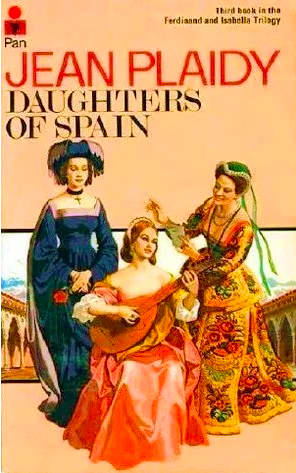
This is what my copy of Daughters of Spain looked like when I was ten.
What is the last historical novel you read?
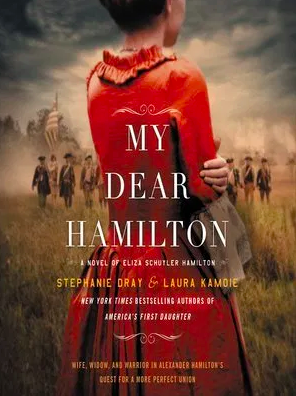
My Dear Hamilton by Stephanie Dray & Laura Kamoie. I loved the voice, the blend of love & exasperation in Eliza’s voice as she talked about her husband.
The post Interview Questions 24: Answered by Cynthia Sally Haggard appeared first on Spun Stories.
January 25, 2020
Reading Sundays: SHADES OF UNREALITY (Part 3) a short story by Cynthia Sally Haggard
[image error]But the bears I’d seen were black or brown, and were large, muscly, fearsome creatures. This thing was not only the wrong color, it was—stuffed. Like that strange cat, no muscle nor sinew rippled below its skin. It appeared padded with something, mayhap down feathers, and its stuffing made it strangely docile, even sweet-natured.
Then it came to me. These must be Pouppées, the toys of a Royal child. Soon he would come toddling into the room. Perhaps my scribe wanted me to meet him, for I have a large experience of children, being the mother of thirteen.
The toy bear continued to speak.
“Why would it be a problem if Roomba and Scooba bestir themselves to present their case? You say they’ll become too uppish, but you don’t have to contend with them, our companion does.”
He must be talking about the children that own these toys. What were their names? I always pride myself on my ability to remember the little one’s names, they get so upset if one forgets them. But Roomba and Scooba? What strange names to bestow on children. Poor little things.
But the bear hadn’t finished. What a talkative toy he was…[Continued next week.]
The post Reading Sundays: SHADES OF UNREALITY (Part 3) a short story by Cynthia Sally Haggard appeared first on Spun Stories.
Setting, Farewell My Life by Cynthia Sally Haggard: GEORGETOWN, WASHINGTON DC
FAREWELL MY LIFE is three parts. The first part, THE LOST MOTHER opens in Georgetown in September 1921.
At that time Georgetown was NOT the busy commercial hub that it now is, but rather a quiet charming village. Traditionally a tobacco port, :Wisconsin Avenue (High Street) and M Street (Bridge Street) were much quieter.
The fashionable part of Georgetown was west of Wisconsin, where people built large mansions such as Dumbarton Oaks and Tudor Place. This is where Zia Paulina had lived when her husband was alive, and where she brought up her 3 nieces – Josephina, Louisa and Angelina – when they arrived on her doorstep in 1898.
[image error]
Grand House in Georgetown, Washington DC
The less fashionable part of Georgetown was East of Wisconsin in an African-American neighborhood called “Herring Hill.”
[image error]
Modest House in Georgetown Washington DC
This is where the novel opens, in a modest house on O Street (Beall Street) opposite the AME Church.
One of the perks of being a novelist is that you get to set your novels in your favorite places. I love Georgetown and enjoyed my walks around there as it’s only a 30 minute walk from my apartment in DC…
[image error]
A photo I took on one of my many jaunts to Georgetown…
The post Setting, Farewell My Life by Cynthia Sally Haggard: GEORGETOWN, WASHINGTON DC appeared first on Spun Stories.
January 22, 2020
THE DAUGHTERS OF PALATINE HILL by Phyllis T. Smith, narrated by Cristina Panfilio, Joyce Bean & Amy McFadden
THE DAUGHTERS OF PALATINE HILL is the sequel to I AM LIVIA. Whereas the first novel dealt with the life of Livia Drusilla and her relationship with the Emperor Augustus, DAUGHTERS deals with Augustus’ daughter Julia as well as Livia’s adopted daughter Selene, the product of the affair between Cleopatra and Mark Antony.
Selene’s parents are both dead, but their memory remains, which is why this poised 14-year-old has to be extremely careful how she behaves as she goes about forging a relationship with the intimidating (and dangerous) Livia Drusilla.
By contrast, Julia,[image error] daughter of the Emperor Augustus and step-daughter of Livia Drusilla is comfortable in her life of privilege and ease. After her first husband dies, she is married off to army general Agrippa, who is considerably older than she is. Of course, Julia had no say in this marriage, and with the passing of time and her husband’s many absences abroad she acquired at least one lover.
After Agrippa’s death, Julia was married off to another husband, also not of her liking, Tiberius, who also happened to be Livia Drusilla’s eldest son. With this marriage, things became more fraught. Livia Drusilla had a mother’s natural ambition for her son, and her step-daughter (and now daughter-in-laws) behavior was a problem.
I won’t tell you here what happens to Julia, but I will say that this is a gripping novel with three strong women at its center. Five stars.
The post THE DAUGHTERS OF PALATINE HILL by Phyllis T. Smith, narrated by Cristina Panfilio, Joyce Bean & Amy McFadden appeared first on Spun Stories.
January 20, 2020
I AM LIVIA by Phyllis T. Smith, narrated by Joyce Bean
I AM LIVIA opens in an arresting way, when 15-year-old Livia Drusilla[image error] overhears her father and his friends plotting to murder Julius Caesar. Most novels would be a disappointment after that opening. This one is not. It portrays the life and times of Livia Drusilla who eventually became the consort of the Emperor Augustus.
Like most people, I don’t know much about the Emperor Augustus, and what I do know is based upon the stone statues of him as an awe-inspiring divinity. Like most good novelists, Phyllis T. Smith brings him to life, humanizes him, and makes us see him as the brilliant and charismatic young man he was, before the difficulties of life and the corruption of power spoiled him.
Highly recommended! Five stars.
The post I AM LIVIA by Phyllis T. Smith, narrated by Joyce Bean appeared first on Spun Stories.
Interview Questions 23: Answered by Cynthia Sally Haggard
What does your writing routine look like?
The truth is that I don’t have a writing routine. When I write, I work every day in the morning because that is my best time of day. But as I have to promote my books myself there are times when I can’t write. For example, right now (at the time of this interview) I’m editing audio files so that I have Audible versions of both of my novels.
[image error]
A plan for writing…which I DON’T have!
What research did you undertake when writing Farewell My Life?
I read LOTS of books, about fashion, manners, history…anything that gave me a vivid picture of life in the 1920s and 1930s. Of course, I also went online too, but that was just to fill out the research I’d gleaned from books.
The post Interview Questions 23: Answered by Cynthia Sally Haggard appeared first on Spun Stories.
January 18, 2020
Reading Sundays: SHADES OF UNREALITY (Part 2), a short story by Cynthia Sally Haggard
[image error]The animal resembled a cat with deep sea-green eyes and orange fur. But something wasn’t quite right, because it was bigger than most cats I know, and it seemed—softer somehow. I studied it carefully. Underneath its fur were not muscles and skin, but—padding. It didn’t look quite real.
“Look!” it exclaimed.
I jumped back, startled. Had that cat spoken?
It held up a large sheaf of something, some very large sheets paper, so finely made that the light shone through. I had never seen paper with such evenly made fineness in my life. It reminded me of a bolt of silk. As I scrutinized it, I realized it was covered all over with extremely small writing. Or rather, marks formed by moveable type, of the sort used by Master Caxton.
“British Government Contemplates Robot Rights,” declared the cat, flourishing those papers.
“Why would that be a problem?” asked a deep voice. The contrast in pitch made me realize that the strange cat must be female. I looked around. Another shape materialized, but this time it was off-white. Large and roundish, it possessed a bear-shaped face. But what drew my attention was its bow-tie, which was pink and covered in blue flowers.
I have seen bears before. During my girlhood, I inhabited a castle in a rather wild part of the country on the Scotch Marches, and there were plenty of wild animals there, howling wolves, snuffling boar, and cantankerous bear. But the bears I’d seen were black or brown, and were large, muscly, fearsome creatures. This thing was not only the wrong color, it was—stuffed. Like that strange cat, no muscle nor sinew rippled below its skin. It appeared padded with something, mayhap down feathers, and its stuffing made it strangely docile, even sweet-natured…[Continued next week.]
The post Reading Sundays: SHADES OF UNREALITY (Part 2), a short story by Cynthia Sally Haggard appeared first on Spun Stories.
Fashions in the 1920s & 1930s 4: from Farewell My Life by Cynthia Sally Haggard
It is 1938, when the novel closes.
Here is Coco Chanel in 1938, working with a model.
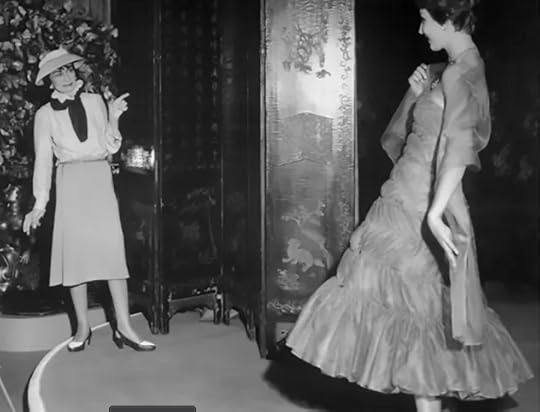
I remember my female teachers in my girls school wearing a similar outfit. Although their skirts were made out of tweed and the tailoring wasn’t so elegant…nor did they wear such smart hats…
Coco Chanel is wearing a 2-piece outfit because she is a working woman. These outfits first became popular around 1910 as more & more young women poured into the workplace and wanted something more practical than a dress to cope with the inevitable mishaps of daily life. Having a blouse to wash was much more practical…
The post Fashions in the 1920s & 1930s 4: from Farewell My Life by Cynthia Sally Haggard appeared first on Spun Stories.
Cynthia Sally's Blog

- Cynthia Sally Haggard's profile
- 129 followers

