
Cynthia Sally Haggard's Blog: Cynthia Sally's Blog, page 33
August 12, 2021
ECSTASY by Mary Sharratt
What a difference a medium makes! I tried to listen to the audio version of this, and couldn’t get into it, which was a great surprise to me as I love Mary Sharratt’s novels.
What happened when I decided to read it on my iPad mini? I LOVED it.
ECSTASY is the story of Alma Schindler’s first marriage to Gustav Mahler (1860-1911), the celebrated composer. If you have read Alma’s Memories & Letters, much of this material will be familiar to you. However, in Mary Sharratt’s hands, the story comes alive.
Gustav and Alma married 9 March 1902, partly because Alma was already pregnant with their first child.
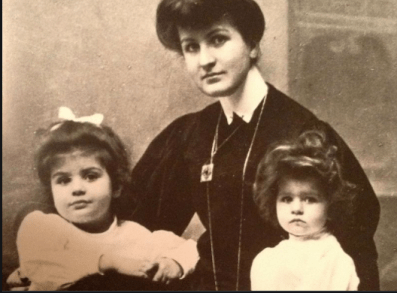
Alma Mahler (1879-1964), with her daughters Maria (1902-1907) at left and Anna (1904-1988) at right.
Much has been discussed about the problems that Alma (a rather spoiled 21-year-old) had with Gustav (a controlling man, 19 years her senior.) But I didn’t realize until I read ECSTASY that their problems erupted pretty much on the first day of their marriage, when instead of spending time on a delightful honeymoon with his new (and very young) wife, Gustav dragged Alma off to Crefeld, a no-nothing town in Germany’s industrial belt, to conduct one of his symphonies.
Thus Alma spent her twenties in a relationship that made her lonely (Gustav was often absent) and emotionally starved (he was too much of a workaholic to notice his wife). Most damaging of all, Gustav believed that having two composers living together was ridiculous. So who had to give up their dreams? You guessed it. The damage done by suppressing her identity as a talented composer in her own right and becoming Gustav’s handmaid by serving his career (she copied out many of his scores) haunted her for the rest of her life.
Only when she began an affair with Walther Gropius, did Gustav finally wake up, and realize what a treasure he had in his wife. Of course, they were only granted a year of happiness, before Gustav succumbed to heart disease, dying on 18 May 1911.
If you love reading about turn-of-the-century Vienna, Gustav Mahler, the members of the Secession Movement, or Alma, you are in for a treat. Five stars.


August 10, 2021
HOME AGAIN by Kristin Hannah
The cover to most editions of this novel shows a man and a woman from the waist down, standing barefoot on the sand. The man holds a rough branch for a stick. The woman wears light summer pants and from the position of their legs and feet it appears that she is reaching out to him for a hug.
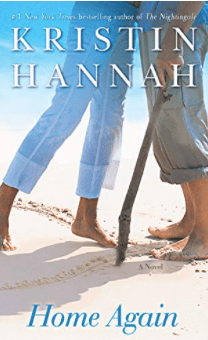
Misleading cover suggesting frothy beach read.
Charming, except that it has NOTHING to do with the novel at hand, where none of the scenes take place on a beach. It is not even a beach read, because it is replete with the hurt feelings and toxic anger that inevitably emerge when people are abandoned, locked up, and denied their basic human rights.
Why the PUBLISHER attempted to make this book into a piece of INSIPID FROTH, I have no idea. It does this novel, and Kristin Hannah a GREAT DISSERVICE.
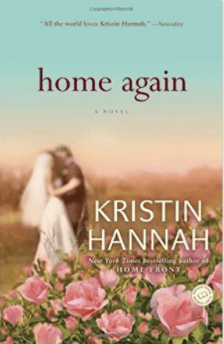
Overly sentimentalized cover that nevertheless does capture the novel’s content.
Having got that out of the way, I will say that I appreciated this novel very much. I am just getting to know novelist Kristin Hannah, having enjoyed “The Nightingale” and “The Four Winds.” So I am dipping into her oeuvre, starting with some earlier novels and moving forward.
What makes this novel so great is that the author takes the time to let the emotions spill onto the pages. We can feel Angel’s rage, Lina’s hurt feelings, Father Francis’ compassion and Madelaine’s sense of bewilderment as she tries to navigate around these powerful emotions that emanate from the people she loves.
If you want to read some of Kristin Hannah’s earlier work, you should definitely read this. Five stars.
August 5, 2021
Kristin Hannah’s THE FOUR WINDS
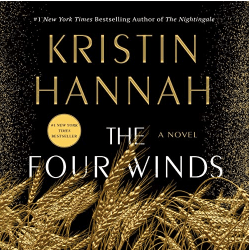 What an interesting book this was, so moving, so gritty (pun intended) so grim.
It is 1920s America in the Texas Panhandle. Protagonist Elsa lives with abusive parents who demean everything she does. One day, she goes for a walk (late at night) and meets a young man…
Of course, her life changes forever. Elsa finds a home in a kind family of Italian-Americans. She brings her children up on a farm, learning to make delicious Italian food. Everything goes well for 14 years, until the dust storms arise.
In compelling prose, Ms. Hannah delineates the shame and humiliation of being dirt poor, so poor that it is indeed very difficult to get clean, especially in the midst of a storm when all the topsoil from the middle west gusts into your back yard.
If you have not yet read this novel, you are in for a treat. Five stars.
August 3, 2021
THE MISSING SISTER (SEVEN SISTERS #7) by Lucinda Riley
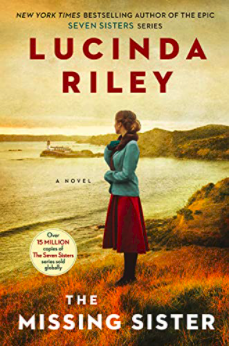 Oh dear, I really feel for author Lucinda Riley. It must be so difficult to be writing under the kind of pressure she is under as she brings her SEVEN SISTERS series to a close. Naturally (like everyone else) I expected volume seven, THE MISSING SISTER to END the series, and was extremely disappointed when it did not.
As much as I have enjoyed reading this series, what really held my attention was the secret story about Pa Salt. What a concept to have a mysterious gentleman adopt six daughters for no apparent reason, die mysteriously and then leave clues in the form of an armillary sphere that suddenly appears in the garden of their house on Lake Geneva. How I longed to know more, and author Lucinda Riley did a wonderful job in teasing us readers with bits and bobs about his life and mysterious appearances after his supposed death.
This time, alas, it didn’t work. While I understand that Lucinda Riley (who is Irish) is very proud of her heritage, I really think that THE MISSING SISTER could have benefitted from some structural editing. There was no need to have TWO stories about Irish women – Nuala and Merry. There was no need to have the red herring about Mary Kay (which quickly evaporated.) Indeed I think that ALL THREE of those stories should have been cut to make room for the tale about Pa Salt. Instead we are left with a book that has NO ENDING (NOT popular with readers) leaving us up in the air (quite literally) with a cliffhanger.
One good thing to come out of this, is that fans of the SEVEN SISTERS series will gobble up the eighth (and last?) book, so this new volume (appearing in 2022) is likely to hit the bestseller list. The bad part is that we are left with a book that doesn’t work. It wouldn’t surprised me if future readers skipped Volume 7 to get onto Volume 8. Which is a pity. Three stars.
July 29, 2021
THE WORDS I NEVER WROTE by Jane Thynne
I love Jane Thynne’s novels, especially the Clara Vine series set in the Second World War, as this novel is. So it was with a great deal of anticipation that I began to read.
Unfortunately, I was disappointed. 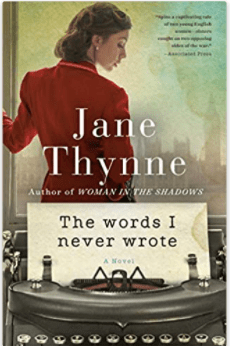 THE WORDS I NEVER WROTE is a braided narrative with part set in the present day, and part set in the past. Although I loved the concept of modern-day Juno Lambert discovering a 1931 Underwood typewriter that once belonged to celebrated journalist Cordelia Capel, I agree with other readers that this part of the story was not strong and should have been cut.
The real meat of the story (as so often in these braided narratives) is what happened in the past. That part of the novel begins in 1936, when Cordelia Capel’s sister Irene marries a German businessman and goes to live in Berlin. As most everyone knows, marrying a German in the 1930s was NOT a good move, and so tension naturally arises as to what is going to happen to Irene and her new German family when the Second World War engulfs Europe in the Fall of 1939.
But I really think that Jane Thynne should NOT have relied on that historical tension alone. What this book needed, IMHO, was its OWN tension, a narrative arc that gives a novel a spine until the tension is so great, you cannot put the novel down.
Instead what we have is a braided narrative going with the sisters (another reason why we didn’t need the present day to intrude), with Cordelia reporting on the war from Paris, and Irene going to mind-numbingly boring functions in Berlin, with a husband who increasingly turns into a stereotype of a Nazi monster. Meanwhile, the Jews are being systematically hounded, and although those scenes were powerfully narrated, still the novel lacked direction. Three stars.
July 27, 2021
SUN & MOON, ICE & SNOW by Jessica Day George, read by Jessica Roland
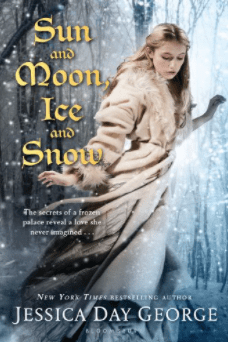 Those of you who are familiar with the Norwegian Fairy Tale EAST OF THE SUN, WEST OF THE MOON will recognize many elements of that story, since this novel is essentially a retelling of it. But what a wonderful job Jessica Day George does in bringing this story to life!
Not much is said about the nameless young woman who loses her prince to the Troll Princess in the original tale. But Ms. George spends a great deal of time at the beginning of the novel telling us about her and her life as a woodcutter’s daughter, at a time when everyone is near starvation due to the near-constant winter they have to endure.
And so we meet Lass as a baby and young child, and we understand her neglect by her mother and the weak father who stands by and lets it happen. When she is nine years old, her eldest brother finally returns home, prematurely sad and grey. And so we wonder why. Then Lass meets an enchanted animal, gains an unusual skill, her fame spreads, and one day a Polar Bear knocks at the door…
Beautifully told in limpid prose, Jessica Day George’s retelling of this Norwegian tale is a must-read. Five stars.
July 22, 2021
THE KILLING FOG (THE GRAVE KINGDOM #1) by Jeff Wheeler
 I heard somewhere that author Jeff Wheeler was disappointed that this trio of novels titled THE GRAVE KINGDOM had not sold well. How could that be? Isn’t THE GRAVE KINGDOM about a young woman pitting herself against the forces of evil? Isn’t this story being told by a magnificent writer?
Jeff Wheeler is a magnificent writer, but I can see why many would find these books less-than-exciting, and would perhaps not buy the other volumes after reading THE KILLING FOG.
To begin with, for a novel that has so much fighting – including Kung-Fu moves on the part of the protagonist Bingmei – this is a quiet piece. It is quiet because the characters are quiet, because they get on so well together, because there are no arguments that escalate into feuds or worse. In short, we can (mostly) depend upon our dependable characters to be pleasant, helpful, and behave in a civilized fashion towards one another.
As everyone knows, well-behaved people, however well they fight, do not make for very interesting reading.
Another problem is that the novel lacks a sense of direction. It is a typical adventure novel (sometimes called a “picaresque” novel) in which a bunch of quirky characters go on one adventure after another. I know that many authors don’t like to start with a framing device, but I do think that the reader should be given some clue as to where we’re going in the first few pages.
A third problem – related to the first two – is that this novel lacks a spine. It lacks a spine because there is no escalating tension in this novel, no conflicts to push it forward, nothing to give it that sense of direction that would make it unputdownable.
Lastly, there is very little emotion expressed in the novel. Instead, emotions are mostly hidden, simmering away. But whether we are talking about love, anger, resentment or contempt, what gives a novel color is the unspooling of those emotions on the page.
This is not to say that there weren’t many enjoyable moments in the novel. I loved the descriptions of the ice caves that hid the palace of Fusang. I loved the descriptions of Quoin’s knots, and the sailing back & forth between Wangfujing and other places. I loved seeing Bingmei practice her moves. But without conflict, direction, or escalating tension, this novel fell short for me. Which is a great pity. Three stars.
July 20, 2021
Graham Hancock’s AMERICA BEFORE: The Key to Earth’s Lost Civilization, read by the author
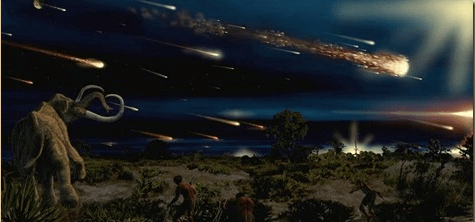 Personally, I am not a great fan of conspiracy theories, and I tend to disagree in general with Graham Hancock, particularly with his claim that there had to be one Lost Civilization (why not more than one?) and his general tendency to dismiss the role of chance or randomness in our lives and culture. However, that has not prevented me from enjoying many of his volumes: Fingerprints of the Gods, The Message of the Sphinx, Heaven’s Mirror.
This book, however, sounded completely different. In America Before, Mr. Hancock spends a great deal of time (some might say an inordinate amount of time) establishing his bona fides by painstakingly detailing the massive amount of research that has happened over the past 20 years on the archaeology of various sites in North America, some of which are now thought to be from 130,000 years ago. In other words, truly ancient.
Before this volume, Mr. Hancock would cheerfully lay out his various theories about what might have happened in the ancient past (his favorite date is 11,600 years ago when the last Ice Age came to an end), weaving together speculation and facts in his usual entertaining style. Now, in more sober vein, he refers to himself as a “pseudoscientist” (half tongue-in-cheek) and is much more careful to qualify what he says and to make very clear when he is speculating and when he is not.
The fact that Mr. Hancock is a very talented writer is particularly evident in this volume as the reader is obliged to trudge through some very dry stuff while waiting for the punch line. But when the punch line eventually blows in, it is truly magnificent. Even better, it is based upon that mountain of research that he forced you through in this 640-page volume. Four stars.
July 15, 2021
THE LIONS OF FIFTH AVENUE by Fiona Davis
This is the first novel that I’ve read by author Fiona Davis, so I wasn’t sure what to expect. 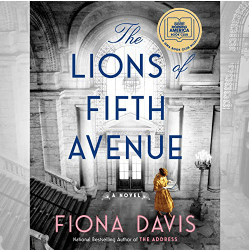 THE LIONS OF FIFTH AVENUE is one of Ms. Davis’ novels about famous buildings, and all the details about the New York Public Library are fascinating. The structure of the novel is a braided narrative, with part of it happening in 1913, when Laura Lyons lives with her family in an apartment INSIDE the New York Public Library (because her husband is the superintendent of the library.) The other part of the narrative takes place 80 years later, in 1993, when Laura’s granddaughter Sadie is promoted to be curator of the same library.
To Ms. Davis’ credit, both parts are equally strong, but ultimately I found the novel unsatisfying. By writing a braided narrative the author is taking the risk of losing the reader because now they have to double their effort to keep two casts of characters straight. And I did have a hard time, trying to remember who everyone was.
The other problem is that the author did not pace the unfolding of her characters, which meant that there was not enough setup, enough sprinkling of information in the story to explain why various characters acted as they did. For example, I never understood Laura’s son Harry’s abrupt shift from inhabiting the family home to his refusal to go home with his mother. Similarly, I found Laura’s husband’s too-sudden death hard to understand.
In both cases, Ms. Davis simply didn’t spend enough time with her characters, enough time to let their emotions play out on the pages. So what happened to them seemed rushed and contrived. This is especially true of Robin Larkin, who fell into the pages of the 1993 story from nowhere and turned out to be an important character. Three stars.
July 13, 2021
Elly Griffiths’ THE LANTERN MEN (RUTH GALLOWAY #12), narrated by Jane McDowell
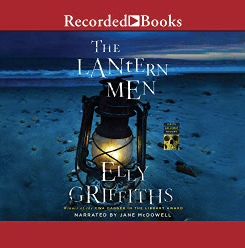 Old tales hold power in this latest volume about forensic archaeologist Ruth Galloway and her friends Cathbad (a Druid), DCI Nelson (a police officer) and Frank Barker (her partner.)
What is so great about Elly Griffiths’ stories is that they depict life in 21st-century England so well. People no longer feel forced to marry even when they have children, and this is shown up in the complex relationships of the main characters. Cathbad & Judy (also a police officer, and Nelson’s right-hand person) are not married, but have two children and seem very happy together. Nelson and Michelle are married, with two adult daughters and a toddler son. They, however, merely seem to tolerate each other for the sake of their children. Then there is Ruth, an unmarried mother, whose daughter Kate is also Nelson’s child.
Ruth & Nelson do an admirable job of being restrained most of the time. But when Ruth is badly hurt, passions flare, and feelings seem to grow more and more intense between herself and Nelson. One wonders how much strain the Nelson marriage can stand.
And I haven’t even started on the story, which you should read for yourself. Five stars. #ellygriffiths #thelanternmen
Cynthia Sally's Blog

- Cynthia Sally Haggard's profile
- 129 followers

