
Cynthia Sally Haggard's Blog: Cynthia Sally's Blog, page 32
September 10, 2021
K IS FOR KILLER by Sue Grafton read by Mary Peiffer
 Lorna Kepler, a stunning loner, dies suddenly. Her body is so badly decomposed when someone eventually finds it in the lonely hut she called home, the cops think she may have died of natural causes. But she was only 24 years old and in perfect health.
Her mother hires Kinsey Milhone to investigate. And what a tangled mess it is!
Lorna led a complex life. By day a receptionist and college student, by night she connected with powerful men, wiling to pay a fortune for her “services.”
This volume leads us into the dark side of life in southern California. As usual, Ms. Grafton’s writing is impeccable, and her plot twists so deft that even I couldn’t figure out what was going on until the very end. Five stars.


September 8, 2021
THE LOST APOTHECARY by Sarah Penner
I am puzzled as to why so many authors have recently taken to writing braided narratives as they are very hard to do. (Especially for debut authors.) Inevitably the part set in the present day is a lot less interesting than the part set in the past, and the exasperated reader is left wishing the author had ditched the former for the latter.

Such is the case with debut author Sarah Penner’s THE LOST APOTHECARY. Like many readers I really could have done without the frayed 21st marriage of Caroline & her husband (whose name I forget, as he was really so forgettable.) Instead, I really wish Ms Penner had put her energies into getting the past right. It was jarring to have everything in meters in England in the 18th century, when meters were only just coming into being, in France, after the French Revolution. And I haven’t even mentioned all the problems with language that many readers noted, which ruined the atmosphere of a novel set in London in the late 18th century.
This was all the more disappointing because THE LOST APOTHECARY is such a brilliant concept. Who wouldn’t love to read about feisty women from the past who get their revenge on all the men who treat them so contemptuously and with such lack of respect? Poisoning with clever techniques for hiding the evidence is the ultimate crime.
Unfortunately, the way it was handled didn’t bring out all the juicy possibilities. For one thing, Nella (we never know her last name) the apothecary is too guilty. I understand how she feels, but her never-ending guilt makes her too one-dimensional and as her character never changes, over time this begins to pall.
And then there is Liza, her 12-year-old would-be assistant. I loved Liza, she is entirely charming. But again, there is no character development.
How I wish that instead of the story Ms. Penner chose to tell, we could have had a tale in which we were privy to a string of men’s bad deeds to women in the late 18th century, and how the women plotted their revenge and got away with it…until they didn’t. That would have provided a magnificent story arc with bags of tension. Instead we got a tired, dying apothecary and a too-young girl who tried to help…and didn’t
Which was a great pity. Three stars.
September 6, 2021
THE NIGHT HAWKS (RUTH GALLOWAY #13) by Elly Griffiths read by Jane McDowell
 For those of you who may not know, Norfolk is in a remote part of the UK, so it is no wonder that old tales about enormous dark dogs whose bark is a harbinger of death are still around in the 21st century.
Ruth is now Head of Archeology at the University of North Norfolk, back in her too-lonely cottage (which she loves) with daughter Kate who is now about 10 years old. Between teaching and doing mounds of paperwork, Ruth finds herself caught up in a sinister murder investigation, involving a murder-suicide and dead bodies, one of which appears to be a Bronze Age Murderer.
Now she has to worry about this newly-discovered Bronze-Age site as the local metal detectorists (people prowling around at night with metal detectors, something that has become a craze in Britain recently) might disturb it. These locals call themselves the Night Hawks, and as far as Ruth is concerned, they are a pain in the neck. But when they begin to die off one by one, an annoying hobby becomes worrisome.
Enter DCI Nelson and his team. But that lonely farmhouse is no place to go, especially when we find our well-loved friends imprisoned there by a slightly mad man with a large dog. Five stars,
September 3, 2021
J IS FOR JUDGMENT by Sue Grafton, narrated by Mary Peiffer
 Wendell Jaffe disappeared five years ago, gone overboard somewhere near Baja where his ketch was found. But his body never surfaced. His death was hard on his family, his sons aged 12 and 17, and his widow Dana Jaffe who was forced to wait out the statutory five years before California Fidelity would pay up the $500,000 life insurance.
Shortly thereafter, an insurance agent spots him in a bar in Mexico, a dusty resort aptly named dark winds, and Kinsey Milhone is sent to investigate.
What follows is by turns scary and hilarious. My favorite episodes are the ones where Kinsey plays hooker to escape from an awkward situation, and another where she parrots a telemarketer in order to get valuable information on Wendell Jaffe’s death out of an unsuspecting person.
Another entertaining read. Five Stars!
September 1, 2021
LADY CLEMENTINE by Marie Benedict
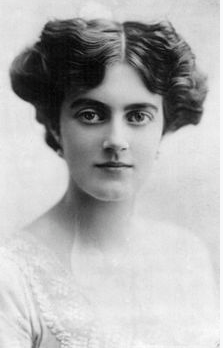
Clementine Churchill in 1915 when she was 30 years old.
As author Marie Benedict notes, if you look at those famous war photos of husband Winston Churchill (1873-1965) he is ALWAYS alone. It is fascinating to think that his wife Clementine may have actually been there, lurking just outside that camera shot.
So I want to congratulate Ms Benedict for bringing to light an interesting woman who did so much for her country. However, that doesn’t mean to say there weren’t any problems with this novel.
To begin with, it not well-paced, especially in the beginning. As one reader has noted, it does seem as it Clementine is always smoothing her skirt before something interesting happens, or touching her wedding dress, or describing the lace decorating her blouse. Details such as this are NOT meant to interrupt the narrative flow, but to enhance the drama. Unfortunately they INTERRUPT IT, which has the effect of exasperating the reader.
Like other readers, I also had a problem with the credibility of this account. I’m a dyed-in-the-wool feminist, the daughter of another dyed-in-the-wool feminist, so I am all for women getting the credit for their ideas. But even I had trouble believing this narrative, told from the point of view of Clementine, who takes credit for EVERYTHING Winston did. That just doesn’t seem plausible.
Then there is Clementine’s mother-guilt over her three eldest children: Diana (who died of suicide), Randolph (difficult from the word “go” with his tantrums) and Sarah (who had a tendency to get arrested). Clementine’s relationship with these three children does NOT show her in a good light and I think this novel would have been so much richer if only it had started in her childhood. From what little I was able to glean, Clementine had a chaotic childhood herself. Her mother was famous for her numerous lovers, and Clementine herself must have realized quite young that she was NOT Sir Henry Hozier’s daughter, but illegitimate, a daughter of an unknown father. Then she experienced the trauma of losing a beloved elder sister when she was just 15 years old.
All this emotional upheaval helps to explain not only her temper (she was an angry person) but also her dismal relationship with Diana, Randolph and Sarah. It took the death of her fourth child Marigold in 1921 (at the age of two) to shock her out of her self-absorption, so that when her youngest, Mary, came along in 1922, she at least had the good sense to employ a nanny who was a distant relative, and would prove a reliable parent for Mary, rather than the procession of nurses, nannies & governesses that her elder children had to endure. What a pity Ms. Benedict did not explore Clementine’s emotional history more thoroughly.
Lastly, this book relies far too much on the external tension of the historical facts, rather than having its own internal arc of tension. The book only really gathers momentum when the Second World War begins. Before that, it has a start-stop quality of snapshots of “important” scenes, such as Winston’s Proposal, the Wedding Day, the Birth of Each Child, the Move to the Admiralty (when Winston became First Lord in 1911.) Ms Benedict dutifully ploughs through each event whether it is inherently interesting or not, and there is no dramatic tension to knit these events together.
So even though I am grateful for learning about such a fascinating woman, I am going to take two stars off for the various problems enumerated above. Three stars.
August 30, 2021
THE WOMEN OF CHATEAU LAFAYETTE by Stephanie Dray, narrated by Emma Bering (Adrienne)Tavia Gilbert (Beatrice) & Rachel Jacobs (Marthe)
 What a book! I am astounded at how author Stephanie Dray took THREE narratives, braided them together, made each of them interesting and made the whole novel comprehensible. Quite a feat of technical mastery over the material.
I experienced this volume as a narration so was able to enjoy the quiet voice of Adrienne de La Fayette (Lafayette’s long-suffering never-complaining wife of the French Revolution via the voice of Emma Bering), the energetic, overbearing voice of Beatrice Chanler (the New York socialite who rescued the chateau during the First World War via the voice of Tavia Gilbert) and the dry voice of Marthe Simone (a fictional character depicting a teacher turned resistance fighter during the Second World War.)
I am not going to say more so as not to spoil it for those of you who have not yet had the pleasure of experiencing this novel. All I can say is that I was enthralled from beginning to end. Five stars.
August 26, 2021
I IS FOR INNOCENT by Sue Grafton, narrated by Mary Peiffer
 Is David Barney innocent?
Six years ago a jury absolved him of the murder of his wife Isabelle, letting him saunter off into the sunset and avail himself of Isabelle’s millions.
But first husband, Kenneth Voight, convinced that Barney is responsible, has recently launched a civil suit.
The stakes are high, not only because of the moola, but because the statute of limitations runs out in a few weeks. Prosecuting attorney Lonnie Kingman finds himself wrong-footed by the sudden death of his PI, Morley Shine, who was amassing evidence against Barney.
Enter Kinsey Milhone, who believes that a little light dusting will get the case ready for Kingman, only to find that Shine’s files are in disarray or missing, and that Barney’s alibi checks out.
Part of the pleasure in reading one of Sue Grafton’s alphabet novels is in watching Kinsey’s clever mind tick along. Here she is, wading into a mess of a case, believing at first that Morley Shine was derelict in his duties. Only gradually does she realize he was getting too close to the truth.
If David Barney didn’t murder Isabelle, then who did? And did Morley Shine really drop dead of a heart attack?? Five stars.
August 24, 2021
H IS FOR HOMICIDE by Kinsey Milhone…sorry Sue Grafton, narrated by Mary Peiffer
No-one is more surprised than myself that I am such a fan of the Kinsey Milhone series. After all, I live in the past, preferring long skirts when spending a day at home, enjoying 19th-century classical music. And I’m English!
So what could I possibly have in common with a wise-cracking 30-something PI who has no problem using words like “bullshit”?? But I find myself nodding along and laughing at Kinsey’s antics as I knit thread into cloth, shaping shawls and sweaters. Beats me.
 In any event, here we have Kinsey strong-armed into going undercover as part of an informal plea deal after she coshed an officer-of-the-law on the nose. Kinsey protests. She’s never gone undercover before, and she’s not trained. But her male superiors override her, claiming she will wear a wire and they will always be nearby keeping watch on her.
Naturally, none of this comes to pass. Kinsey goes from prison to prisoner of an unsavory gang capo named Raymond Maldonado, getting in good with him to learn more about the huge insurance scam he runs. She is obliged to do this sans wire, officer backup or even a payphone.
Kinsey, of course, comes out on top (literally) pinning the capo to the ground in the last shootout, capturing him on behalf of the Santa Teresa Police Department and the LAPD, for which she will probably get no credit. (At the end of this volume she’s still awaiting her payment.)
This is a quick, easy read (or listen) written by an extremely talented author and narrated by someone who gets Kinsey. Five stars.
August 19, 2021
ON MYSTIC LAKE by Kristin Hannah
I had never heard of Kristin Hannah before I read her 2016 masterpiece THE NIGHTINGALE (which won the 2016 Audie for Fiction.)
That book was special, as it combines an historical fictional account of what happens to a French family when the German Army comes to town in 1940, together with Ms. Hannah’s spacious style of writing which allows emotions to unspool on the page.
After reading that volume and THE FOUR WINDS, I decided to go back and delve into her other books.
 ON MYSTIC LAKE gave me mixed feelings. On the one hand I can see why so many readers complain about how repetitious it was. Because it WAS repetitious, and definitely needed some judicious cutting.
OTOH, it was a beautifully compassionate description of the emotional devastation wrought by sudden loss, and how that can lead to disassociation, substance abuse, affectlessness, voicelessness and eerie feelings that one is disappearing.
I give this book 3 stars for the general plot and characters, and 5 stars for the wonderful descriptions of 6-year-old silent Izzy, who believes her hand is disappearing.
August 17, 2021
ACROSS A BROKEN SHORE by Amy Trueblood
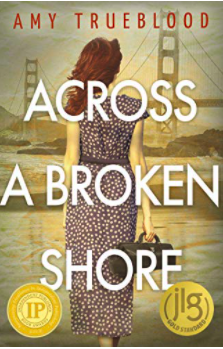 I loved reading this novel, even though a problem emerged towards the end of it (which I’ll get to later.) Who wouldn’t love a story about a young girl (Willa is 18 years old) who discovers a love for medicine and her life’s calling after meeting another woman doctor who believes in her?
Poor Willa MacCarthy inhabits a devout Catholic household in which she has to contend with four older brothers and two parents bent on sending her to Convent Prison (in which she will have to remain silent for ten hours a day).
Why does a brilliant, feisty young woman even consider this form of death? Because she holds a terrible secret that gnaws at her every day of her life. Going to convent would make reparations. Or at least, so she thinks.
And so author Amy Trueblood sweeps us up into a large Irish Catholic family, living in San Francisco in 1936 (just when the Golden Gate Bridge was being constructed) with their love, their warmth, their secrets. Her characters jump off the page, and she situates you in that era of San Francisco’s history with her telling details.
So what is the problem?
It occurs towards the end of the novel. By this time it is blindingly clear what is going to happen. But Ms. Trueblood is not confident enough in her audience to appreciate this. The consequence is that the material becomes unnecessarily repetitive, which spoils an otherwise wonderful novel. Four Stars.
Cynthia Sally's Blog

- Cynthia Sally Haggard's profile
- 129 followers

