
Cynthia Sally Haggard's Blog: Cynthia Sally's Blog, page 27
December 22, 2021
A brilliantly wicked piece set in the movie world of Berlin in the early 1930s (LAUGHTER IN THE DARK)
“Once upon a time there lived in Berlin, Germany, a man called Albinus. He was rich, respectable, happy; one day he abandoned his wife for the sake of a youthful mistress; he loved; was not loved; and his life ended in disaster. This is the whole of the story and we might have left it at that had there not been profit and pleasure in the telling; and although there is plenty of space on a gravestone to contain, bound in moss, the abridged version of a man’s life, detail is always welcome.”
~ Vladimir Nabokov
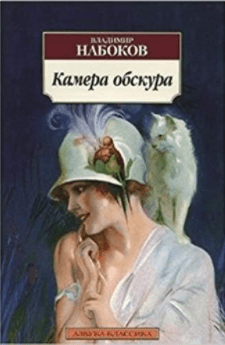 KAMERA OBSCURA by Vladimir Nabokov, book title in the original Russian (Nabokov refused to write in German even though he spent more than 10 years in Berlin.)
So begins LAUGHTER IN THE DARK (aka Kamera Obscura in the original Russian), Vladimir Nabokov’s sixth novel published in Berlin in 1933. The brilliance of it is that Nabokov tells you what is going to happen in such a way that he still makes you want to read about it. The only other person who carried off the same trick with similar panache is Gabriel Garcia Marquez in his Chronicle of a History Foretold.
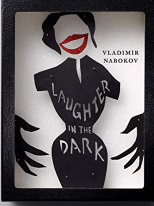 I love this cover of LAUGHTER IN THE DARK as it conveys the sardonic nature of the novel.
LAUGHTER IN THE DARK is a brilliantly wicked piece set in the movie world of Berlin during the early 1930s. I won’t reveal the plot, but suffice it to say that if you’ve enjoyed Lolita, you should enjoy this novel, which has some interesting parallels. Five stars.


December 21, 2021
How to render emotion on the page (THE LOVER)
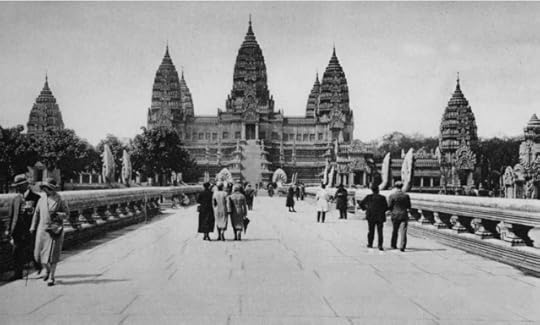 The French Colony of Indochine (today’s Vietnam, Laos & Cambodia) as seen in the 1920s, the setting for Marguerite Duras’ THE LOVER
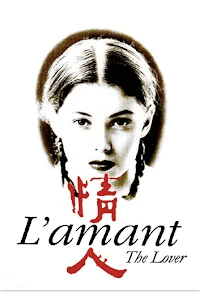
Marguerite Duras’ THE LOVER (“L’Amant in the original French) is a semi-autobiographical story of forbidden love between a 15-year-old French girl and her 27-year-old Chinese lover, the son of a millionaire.
The nameless young woman, the narrator of this story, comes from an abusive family, and this causes her to be emotionally shut down. Thus Duras has the difficult task of rendering emotion on the page via a character who doesn’t have easy access to her emotions. Throughout this story, Duras deploys silence as a way of expressing emotion:
Never a hello, a good evening, a happy New Year. Never a thank you. Never any talk. Never any need to talk. Everything always silent, distant. It’s a family of stone, petrified so deeply it’s impenetrable. Every day we try to kill one another, to kill. (54)
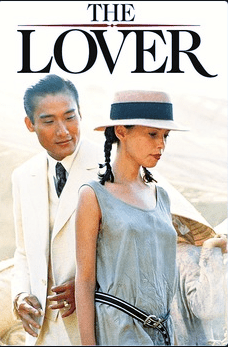 Tony Leung ka-fai playing The Lover, Jane Marsh playing The Young Girl.
The emotional information is given via the narrator’s internal monologue. The sentences are carefully put together to build an arc of tension. In the first and second sentences, Duras lists common greetings that have become so familiar they are clichés. Thus the emotional energy is low. Then the tension is raised in the third sentence when we learn that these people never talk, and in the fourth sentence that they don’t need to talk. Sentence five builds on this thought, while sentence six provides a description of this family by using a metaphor that likens it to stone: “It’s a family of stone, petrified so deeply it’s impenetrable.” (54) This metaphor brings other images to mind. Stone is cold, hard, unyielding, inflexible. It explains this family brilliantly. If that were not enough, the next sentence raises the stakes even more: “Every day we try to kill one another, to kill.” (54) The violence of this sentence enacts the emotions powerfully on this page, pulling the reader in. It tells us that silence is habitually used by this family as a weapon to kill. Notice how effectively Duras uses repetition to make her point more powerful.
I highly recommend this novel. Five stars.
December 20, 2021
Imagine if one of the Princes in the Tower lived to see his sister become Queen…(THE WHITE PRINCESS)
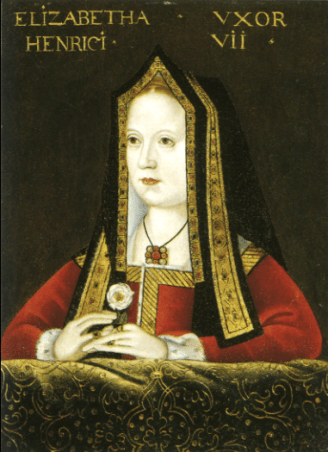 Queen Elizabeth of York (1466-1503), daughter of Edward IV (1441-1483) and Elizabeth Woodville (1437-1492), wife of Henry VII (1457-1509) and mother of Henry VIII (1491-1547) the Bluebeard of the Tudor Dynasty.
THE WHITE PRINCESS by Philippa Gregory is the story of Elizabeth of York, daughter of THE WHITE QUEEN (Elisabeth Woodville) and granddaughter of THE LADY OF THE RIVERS (Jacquetta de St Pol). It spans the years 1485, when Elizabeth was 19 years old, to 1499, when she was 33, and it mostly concerns the conspiracy to topple Henry VII from the throne of England, and replace him with someone who was either Elizabeth’s brother Richard Duke of York, or a convincing impostor whose name may have been Perkin Warbeck. Unfortunately for Elizabeth, Henry VII happened to be her husband, and thus she is torn between husband and (possible) brother.
Some readers have criticized Philippa Gregory for writing a novel that is full of lies. Though her take on this period of history is certainly controversial, I believe that it is backed up by research, by the latest thinking on this subject. If is fascinating to think that one of the princes in the Tower, Richard Duke of York, may have actually survived and lived to see his eldest sister on the throne of England. Even more fascinating are the scenes in which they both appear together, for they could never acknowledge each other with Henry’s spies watching.
Ms. Gregory has been criticized for employing a prose style in this novel that “will either drive points home for readers or drive them batty,” to quote one reviewer. And it is true, the prose style is repetitive:
“You have defeated him, he is down in the mud.”
She turns her head away from me. “He could be diminished, he could be dirty, he could be starved, and yet he would still shine,” she says…”They said he looked like Jesus…They said he looked like a saint. They said he looked like a broken prince, a damaged lamb, a dimmed light. Of course, he can’t be freed. He can never be freed.”
Elizabeth of York in THE WHITE PRINCESS describing her possible brother “Perkin Warbeck” who could actually be Richard, Duke of York (1473-1499)
Which is surprising for a writer who can write such beautifully lyrical prose as:
“With this contradictory parentage of mine: solid English earth and French water goddess, one could expect anything from me: an enchantress or an ordinary girl. There are those who will say I am both. But today, as I comb my hair with particular care and arrange it under my tallest headdress, take the hands of my two fatherless boys and lead the way to the road that goes to Northampton, I would give all that I am to be, just this once, simply irresistible…”
Elizabeth Woodville describing herself in THE WHITE QUEEN

There must be a reason for the repetition. And I think that reason is that is conveys the suffocating paranoia of Henry VII’s court. If I am right, then Ms. Gregory has taken a risk in not writing the beautiful prose we know her to be capable of. Five stars. #philippagregory #thewhiteprincess
December 19, 2021
Anne Neville has a quiet, yet powerful voice (THE KINGMAKER’S DAUGHTER)
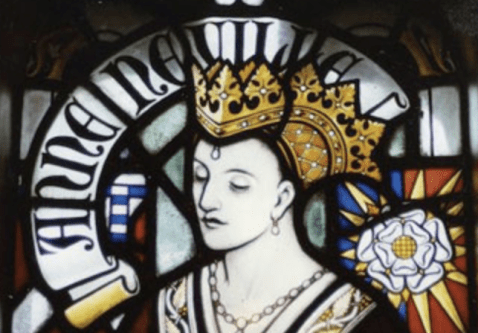 Queen Anne Neville (1456-1485) from a stained glass memorial in Cardiff Castle. I love this image of Anne, because you can see that behind that surface quietude is a vivid and lively personality.
Anne Neville (1456-1485) is not well-known as a personality in her own right. She is most famous for being the wronged wife of Richard III (1452-1485). At the time of her death, many whispered that she’d been poisoned by her husband to make way for his marriage to his niece Elizabeth of York (1466-1503). That marriage never happened, because Richard was obliged to deny before parliament that he’d had a relationship with Elizabeth. Shortly thereafter, on August 22, Richard was killed at the Battle of Bosworth Field.
Anne is also known as the daughter of Richard Neville, Earl of Warwick (1429-1471), aka “Warwick the Kingmaker” for his making and unmaking of England’s kings during the Wars of the Roses. And lastly, she is known for being the wife of Edward, Prince of Wales (1453-1471), the son and heir of Henry VI and Marguerite d’Anjou. They married in 1470, when Anne was only 14. Edward was killed at the Battle of Tewkesbury in 1471, leaving Anne a widow at the age of 15.
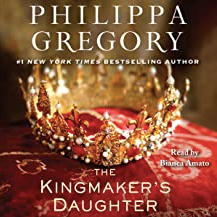
So it was a pleasure to read Philippa Gregory’s account of her in THE KINGMAKER’S DAUGHTER, in which Anne is the protagonist. In Ms. Gregory’s account, Anne emerges as an endearing and intelligent heroine, caught up in the snares of her father’s politics during as he swings from one side to another. Originally promised to Richard of Gloucester, a younger brother of the Yorkist King Edward IV, Anne is married off to Edward, Prince of Wales of the House of Lancaster. When Edward regains his throne and the House of Lancaster is crushed, Anne (according to Ms. Gregory) chooses to marry Richard of Gloucester as her second husband. Thus her marriage to the man who later becomes King Richard III, starts out as a love match.
Ms. Gregory keeps very close to her characters in her stories, and I think this is what makes them so popular. In this novel, you feel as if you are actually with Anne as the events of her life unfold. The author has also done a superlative job with Anne’s voice. Anne is not a charismatic person like Elizabeth Woodville or Jacquetta de St. Pol. Her voice does not have the bite of a Margaret Beaufort. Nevertheless, her quiet determination shines in this novel. Five stars. #philippagregory #anneneville #thekingmakersdaughter
December 18, 2021
Philippa Gregory’s THE RED QUEEN
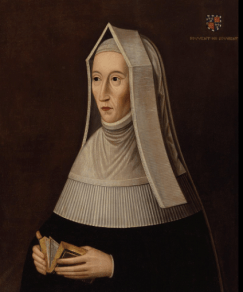 Lady Margaret Beaufort (1443-1509) painted by an unknown artist in the second half of the 16th century. Lady Margaret was the mother of Henry VII of England (1457-1509) and grandmother of the famous King Henry VIII (1491-1547), the Bluebeard of the Tudor Dynasty.
The novel begins in 1453, when Lady Margaret Beaufort is about to go to court for the first time to formally dissent from her pre-contracted marriage to the son of a disgraced nobleman, so that she becomes available to make a better match.
The hour is late, but nine-year-old Lady Margaret is on her knees at prayer, having visions of herself as her heroine Joan of Arc…when everything is spoiled by her mother’s maid coming in and insisting that she go to bed, for they have to rise early on the morrow.
It cannot be right that the York princess is a favorite at the court, the darling of her uncle, the sweetheart of her people, and I thrown down. God cannot really want these women to lead peaceful, happy lives, while my son is in exile.
-Lady Margaret Beaufort talking about her future daughter-in-law Elizabeth of York
Philippa Gregory is has surpassed herself in this novel, for the voice of Lady Margaret is truly remarkable: determined, shrewd, strong, certain and unconsciously funny!
The whole novel is infused with that voice, and it makes fascinating reading. If you have not read this novel and you love the period of the Wars of the Roses, then you are in for a treat. Five stars. #theredqueen #philippagregory
December 17, 2021
Philippa Gregory’s THE WHITE QUEEN
THE WHITE QUEEN is the story of Elizabeth Woodville (1437-1492), Queen of Edward IV, mother of the Little Princes in the Tower, and also of Elizabeth of York, who married Henry Tudor after he defeated Richard III at Bosworth, and founded the Tudor dynasty.
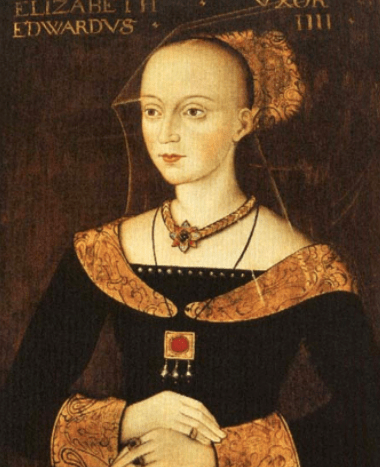 Queen Elizabeth Woodville (1437-1492),painted by an unknown artist circa 1471, when she would have been about 34 years old. She is shown in the high fashion of the day with a plucked forehead, plucked eyebrows and a partial, translucent veil.
The novel starts in 1464, when Elizabeth is sent by her family to beg the new King Edward Vfor his favor. There has been a war. Her family was on the losing side. She has nothing to give her two sons because their dead father’s estates have been confiscated. She is chosen to go before the King, because she is a beauty and the young monarch is known to appreciate pretty women.
The rest, as they say, is history. Edward IV secretly weds Elizabeth on May 1, 1464. Even more remarkably, he keeps his promises to her by publicly declaring their union in September of that year, horrifying his counselors, his friends, his family, and most of all, his mother Cecylee, Duchess of York, who does all that she can to disturb the marriage.
Philippa Gregory is such a talented writer and this novel is an easy and enjoyable read. Like others, I did not feel that the extended references to Melusina helped the story. A few details here and there, slipped into the text, would have suited me better.
But the real problem with this novel is the ending. It ends in April 1485, before Elizabeth’s nemesis and brother-in-law Richard III is defeated at Bosworth, before her eldest daughter marries the victor and becomes Queen of England, and before Elizabeth’s own disgrace and exile in 1487, and her subsequent death at Bermondsey Abbey in 1492. Philippa Gregory has created such a compelling character, I was sorry to see her abandon the novel so early, depriving us all of the pleasure of hearing what Elizabeth would have said about these events.
December 16, 2021
WINTER GARDEN by Kristin Hannah narrated by Susan Ericksen
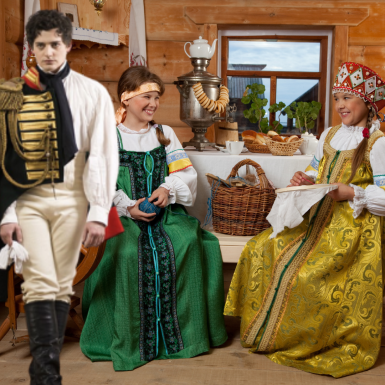 A collage put together by me showing the main characters in Anyas’ tale: love interest Sasha in his guise as The Prince, sister Olga in green (left) and protagonist Vera wearing gold (right). The sisters are garbed in traditional Russian costume. The prince is wearing clothes that officers of the Russian army wore during the Napoleonic wars.
 Having just finished Katherine Arden’s WINTERLIGHT trilogy of Russian folktales set in 1300s Rus, it was absolutely fascinating to read about the Siege of Leningrad presented as the Russian folktale THE PEASANT GIRL AND THE PRINCE.
WINTER GARDEN is not the easiest book to read. Many readers will be put off by the beginning which features the maddeningly frigid Snow Maiden mother Anya Whitson, who seems to hate her daughters, her much more likable husband Evan, who is a loving father, and those two damaged daughters Meredith, who bears the brunt of her mother’s icicle nature, and Nina who escapes her family to become a famous photojournalist in Africa.
Much of the first third of the book is taken up with this family dysfunction, which grows more and more irritating as you realize just how stuck these people are.
Things do not start to warm up until the death of beloved father Evan. Not surprisingly I expected the family to blow apart, and not be on speakers. But Evan exerts power beyond the grave, having extracted a promise from younger daughter Nina to persuade their mother to tell them THE PEASANT GIRL AND THE PRINCE tale to the end.
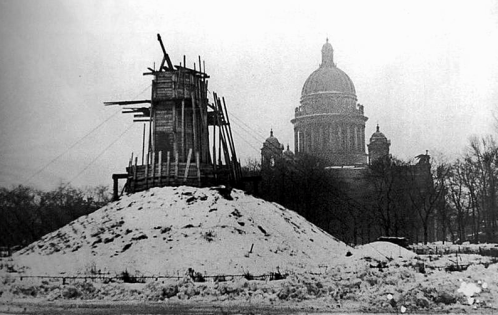 The famous Bronze Horseman statue camouflaged from German aircraft during the Siege of Leningrad (now called St Petersburg) from 22 June 1941 to 27 January 1945. About 1 million died mostly from starvation and cold due to freezing winters with no heating. But the city never surrendered to the German army.
Meredith, hurt and impatient, sees no good in forcing their icy mother to tell a fairy tale. But this is no ordinary story. Instead, it is Anya’s autobiography, from seeing her father dragged away by Stalin’s minions just after she’s met the love of her life at age 15, to having her first child at 17 and her second at 18, from the Second World War beginning when she is just 22 years old, the havoc and tragedy of a great city (Leningrad aka St. Petersburg) under siege from German airplanes, the hunger, the starvation, the deaths of 700,000 people from starvation including the elderly and the very young. (Anya loses her grandmother to fire, her mother and son to starvation, her husband and daughter to explosion.)
It becomes clear by the end of this excruciating tale that Anya has been suffering from PTSD for most of her life, turning her into a traumatized woman who has no emotional energy left for her two younger daughters born in America.
Everyone in this family suffers from the fallout of Anya’s emotional devastation. But, as in other novels, author Kristin Hannah delivers a Happy Ending.
Five stars for a truly tremendous tale, which foreshadows THE NIGHTINGALE.
 The cover shows St. Isaac’s cathedral, which is also featured in the photo showing the Siege of Leningrad.
December 15, 2021
THE WINTER OF THE WITCH (WINTERNIGHT #3) by Katherine Arden narrated by Kathleen Gati
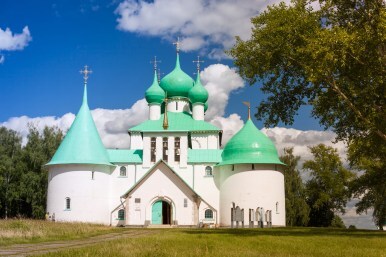 The Battle of Kulikovo where the Russian Nation was born. Memorial Church of St Sergius on Kulikovo Field. Photo 58249856 / Battle Kulikovo © Sergei Lemtal | Dreamstime.com
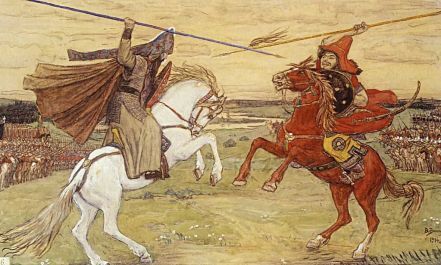 Single combat between Alexander Peresvyet (a Russian Orthodox monk) and Chelubey, the Tatar Champion. Both men killed each other just before the Battle of Kulikovo. Painted by Viktor Vasnetsov (1848-1926).
This novel has an extremely interesting structure, perhaps because it is the third novel in a trilogy. Unlike most novels which begin at a low energy point and gradually build to a climax. this novel starts with a a deluge of overwhelming disasters that leave you reeling, only to cool down to a lyrical piece about horses, hunger and sorcery before blazing back to life, just before its end, with an account of the Battle of Kulikovo, which occurred on 8 September 1380 between the Golden Horde (descendants of Genghis Khan) and various Russian principalities under the united command of Prince Dmitry of Moscow.
This novel is a blend of fiction and fact, of fantasy and historical fiction. Thus Dmitry is a major character in THE WINTER OF THE WITCH, alongside his best friend Alexander Peresvyet, who really was a Russian Orthodox monk who fought as the Russian Champion before battle began. But did Alexander have a sister called Vasya, who had The Gift of Sight? Did her Magical Powers increase as she grew older so that she could control fire, golden bridles and glowing mares? Was she responsible for the Russian victory? And lastly, is she the basis of the Russian legend about Snegurochka, the Ice Maiden who was the consort of the Winter Demon?
It is a testament to Ms. Arden’s talents as an author that she kept me riveted to this book through the long back and forths through starry skies, the deep forests, and across the empty Russian countryside that made up most of this volume. One would expect to be bored after all the drama of the beginning. Yet, I somehow found myself caught in Vasya’s world, where her friends consisted of a terrifying bear, a frosty consort and a charming mushroom. (And that list doesn’t even include all the horses that she befriended.)
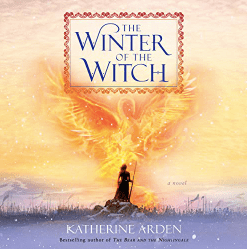
Fortunately, we didn’t have a Happy Ending, as that would not have been right for a novel set in the gory Middle Ages. But the ending we did get was ultimately satisfying.
December 14, 2021
THE GIRL IN THE TOWER (WINTERNIGHT #2) by Katherine Arden narrated by Kathleen Gati
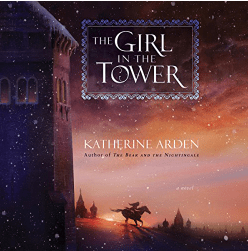
Like many readers, I thought THE GIRL IN THE TOWER much better than the THE BEAR AND THE NIGHTINGALE
As you can see from my review of THE BEAR AND THE NIGHTINGALE, I was exceedingly puzzled by that book, especially by the ending. How can Vasya, who is supposed to be so important that her mother died bringing her into the world, do anything if she is hidden away in a dark & remote forest?
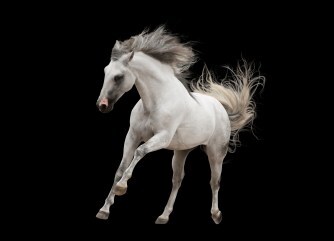 A white stallion, perhaps Vasya’s Solovey. (iStock image.)
This volume answers that question. Because Vasya only spends one night in the forest with Winter Demon Morozko before setting off on her wonderful stallion Solovey “to see the world.” Naturally events intervene. As a character, Vasya is wonderfully exasperating, being a well-meaning, kind soul who nevertheless attracts trouble as honey entices a bee. Poor Vasya is now 16 years old, a perfect age for marriage in Medieval Russia, and so she has to dodge the advances of more than one male personage who tries to trap her into marriage. (We know that this volume takes place in 1381, because that is when the Tatars burned Moscow.) Due to the mores of the time, Vasya would be in total thrall to her husband. To avoid this fate and guard her freedom, she is obliged to pose as a boy by the name of Vasyli Petrovich (rather than Vasilisa Petrovna.)
Oh dear, what a lot of trouble she gets into as a result of this very understandable lie. When people find out that she is no boy but a young woman of 16, they are thunderstruck, and not in a good way. How could a girl possibly ride a stallion? How could she possibly fight like a man? And how could she be so immodest as to dress as a boy?
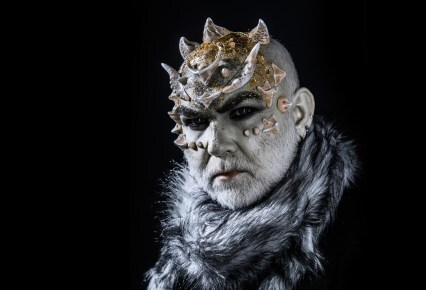 A rare image of “Father Frost” or “Winter Demon” or “Morozko” which does NOT make him look like Santa Claus! Photo 130198165 © Volodymyr Tverdokhlib | Dreamstime.com
Vasya’s head would be on the chopping block, were it not for the attentions of Winter Demon Morozko. As I said above, she spent one night with him in the forest, and to twenty-first-century ears that has a very suggestive ring. However, author Katherine Arden gives us the strong impression that “nothing happened” partly because Vasya is so young & vibrant (whereas Morozko is an ancient wisp of a man) and partly because Morozko always does what she wants, even if it makes him unhappy and anxious.
 An image of Snegurochka (or the “Snow Maiden,”) the role played by Vasya in GIRL IN THE TOWER. Photo 235197621 / Ded Moroz Snegurochka © Olga Kuzmina | Dreamstime.com
Of course, Morozko can never stay away from her for long. He is mesmerized by her vibrancy, her bravery, and her authenticity. One reason why we love Vasya is because she is always herself. So it is no surprise to discover that Morozko loves her and desires her, while she tends to give him short shrift. But there is another, darker, reason why he needs to stay close. Eventually, Vasya realizes what that reason is, and because she prizes freedom (whereas he wants to tie her to him forever) she explodes, thus breaking his hold over her.
There are many reasons why this novel sings. It is extremely well-paced, there are no unnecessary details cluttering up the narrative flow, the dialogue is marvelous, the descriptions stunning, and like all really good novelists, Ms. Arden knows how to let emotions spill onto the page. The end of the novel provides us with a happy ending of sorts (thank heaven) but more awaits in Volume 3 of this trilogy. Five Stars.
December 13, 2021
THE BEAR & THE NIGHTINGALE (WINTERNIGHT #1) by Katherine Arden narrated by Kathleen Gati
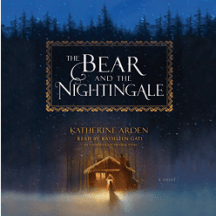
I admit that I was very puzzled by THE BEAR AND THE NIGHTINGALE. At the beginning, it sounded like a set of linked short stories. Oh well, I said to myself, the author clearly loves Russian folklore, so I suppose she is going to tell us her favorite stories.
Slowly, the book coalesced into a narrative centered on Vasya Petrovna, a young girl with The Sight. Of the five children born to her mother and father, she is the most like her mother, who was similarly gifted. There is also talk of a grandmother (her mother’s mother?) who also had this Gift.
Unfortunately, Vasya’s mother dies shortly after her birth, and in a household made up mostly of men, Vasya has no-one who is able to trammel her wildness. Consequently, she behaves like a boy. Not only does Vasya have The Sight, she is unusually good with horses. Of course, this tiny 14-year-old is able to ride savage stallions that would make grown men pale with fear.
 Sculpture of Ovinnik (“Threshing Barn Spirit”) by Belarussian Sculptor Anton Shipitsa. (See Wikipedia.)
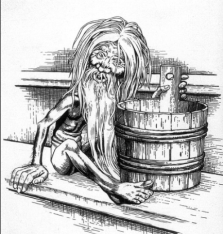 Illustration of Bannik (“Bath Spirit”) by Ivan Bilibin. (See Wikipedia.)
However, Vasya is a kind-hearted soul and does her best to help her family. Her attempts are thwarted by her Wicked Stepmother Anna Ivanovna, who can also “see” things. Unfortunately for Anna, instead of seeing these creatures as friendly (as Vasya with her Pagan beliefs does) her Christian Religion constrains her to see them as Demons. (Note: In Russian these beings are called Domovoy, and have been compared to the Household Deities (Di Penates) of the Romans.)
Consequently, she lives in a state of successive panic attacks. It doesn’t help when handsome Father Konstantin appears, as his religious zeal causes everyone in the village (except Vasya) to live their lives in a succession of panic attacks, sure that they are destined for an Eternity in the Flames of Hell due to their Wicked Ways (i.e. their Pagan beliefs.)
Despite her kindness, most people are put off by Vasya. They don’t appreciate having a teenaged girl in their midst with her wide “feral” eyes, her hoydenish ways, her outlandish abilities to ride stallions. They whisper that she is a witch.
Poor Vasya is given a “choice” that was given to all teenaged girls in 14th-century Europe: Marry, or immure yourself in a Convent.
 Wooden Hut in Snowy Forest, Carpathians, Ukraine, Europe. (iStock Image.)
Instead, Vasya disappears into the Forest with Winter Demon Morozko, so as not to cause her family embarrassment, and more importantly, difficulties in managing their lands. (Her father is a Boyar, and her mother and stepmother are related to the Royal Family.) Had she remained home, there is a good chance she would have been burned at stake for being a witch.
The ending was as puzzling as the beginning. Vasya rides into the forest on her favorite stallion, discovers Morozko’s abode, and goes inside. THE END. But what about Father Konstantin? Does he obey Vasya’s repeated exhortations to leave the village so that everyone can calm down & experience some joy in this world? Or does he stay so that he can eventually entice Vasya into his bed? And what of Vasya? She disappears into the Forest. But is she not condemning herself (at the age of 14) to a life of Cold & Darkness with an Icy Demon? And didn’t her mother say that it was important to have this last child, this daughter, even it if might kill her? But how can Vasya do anything if she is in a Dark & Remote Forest?
So I went back to Amazon, only to discover that THE BEAR & THE NIGHTINGALE is the first in a series of three. Stay Tuned. Five Stars.
Cynthia Sally's Blog

- Cynthia Sally Haggard's profile
- 129 followers

