
Cynthia Sally Haggard's Blog: Cynthia Sally's Blog, page 26
January 3, 2022
J. K. Rowling’s A CASUAL VACANCY
 The quaint fairy tale village of Castle Combe at the border between the Cotswolds and Wiltshire with its characteristic bridge. This is what Pagford looks like. Photo 33816322 / Cotswolds © Pljvv | Dreamstime.com
A CASUAL VACANCY by J. K. Rowling is the story of a bitter class struggle between the smug, wealthy inhabitants of Pagford, and their much poorer neighbors who inhabit the council flats called “The Fields”.
 Park Hill estate in Sheffield, Yorkshire UK completed in 1961, and now half-abandoned. This gives you an idea of what “The Fields” council flats look like. Photo by Paolo Margari from independent.co.uk.
When kindly counsel member Barry Fairbrother dies suddenly, someone has to be found to fill that vacant seat. The good people of pretty Pagford would rather not have to deal with all the problems created by poverty and would love to redraw the boundaries so that the inhabitants of “The Fields” now live in nearby (and poorer) Yarvil. And so the plot of the novel turns on whether the people of Pagford will be able to fill that seat with someone who will do their bidding, or not.
This book is not particularly easy to read. It is written in omniscient third with 18 point-of-view characters. Personally, I thought that Rowling did a wonderful job in telling this story, and I was not bored or confused as some readers were. But potential readers should be warned that most of the characters in this book are just plain mean and there is plenty of betrayal, infighting and heartbreak. However, if you stick with this story, you will find a rewarding, thought-provoking read. Four stars.


January 2, 2022
Mr. Locke is an apt name for her “guardian”…(THE TEN THOUSAND DOORS OF JANUARY by Alix E. Harrow, narrated by January LaVoy)
 This is the sort of clothing 7-year-old January might have worn in 1901. Notice the tight boots, black stockings, drawn-in waists and high collars of these “summer” dresses. The girl at right has longer skirts to denote that she is older.
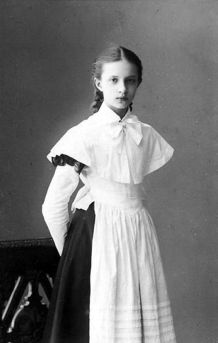 This is the sort of clothing 17-year-old January might have worn in 1911. Notice the long skirts. My grandmothers (born in 1892 and 1894) turned seventeen in 1909 and 1911. They both told me that once you turned sixteen, you were obliged to lower your skirts.
 How wonderful to read something so imaginative! I loved the voice of naughty (temerarious) January Scaller, who at 7 had precociously worked out how to annoy everyone. Her mischievous side really drew me in.
But what was also wonderful is how a 7-year-old motherless girl is so very vulnerable to the blandishments of her “guardian” with the apt name of Mr. Locke, so that when he admonishes her that she must learn to “stay in her place,” she does just that, learning to suffocate her true nature, just as young ladies of her era (the novel is set in the years 1901 and 1911) learn to curb their growing curves by jamming them into corsets.
I LISTENED to this novel, and the voice of January LaVoy really helped the get a flavor of this story. I really LOVED the way she captured the accents of 7-year-old January, her father Julian, her mother Adelaide. Highly recommended. Five Stars.

January 1, 2022
Happy 2022 Everyone!

Here’s to the New Year…hope all of you are keeping healthy, happy & safe!
Today, I thought I would share one of the most fascinating novels I have ever read: THE KING’S CURSE by British Historical Novelist Philippa Gregory. As you will see, some of Ms. Gregory’s instincts about her characters have been borne out by recent research. Something for you to enjoy this New Year’s Day!
Philippa Gregory’s THE KING’S CURSE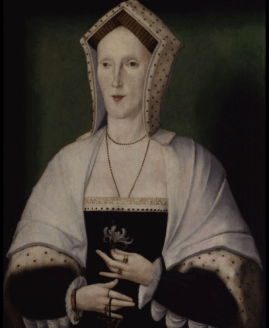 Portrait of an unknown woman, possibly Margaret Pole, Countess of Salisbury painted in 1535, when Margaret would have been about 62 years old.
Philippa Gregory has done it again, found a compelling, forgotten woman, in the shape of Margaret, Countess of Salisbury, and woven a whole tale around this character.
Margaret of Salisbury (1473-1541) had an impeccable pedigree. She was the elder child of George, Duke of Clarence, brother to both Edward IV and Richard III. Her mother was Isabel Neville, daughter and co-heiress with her sister Anne, of Warwick the Kingmaker. Margaret was comfortable at court and knew most of its players. She was a cousin to Queen Elizabeth of York (wife to Henry VII and mother of Henry VIII.) She became close friends with Henry VIII’s first wife Katherine of Aragon. So she is an excellent choice for the ending of Gregory’s series on the Cousin’s War (aka The Wars of the Roses).
Philippa Gregory is known for her unorthodox takes on history, and this novel is no exception. Many people have wondered why Henry VIII and his first and second wives (Katherine of Aragon and Anne Boleyn) were plagued by so many stillbirths and miscarriages. Between them, these two women produced only two children who were born alive and survived more than a few days: Princess Mary, later Mary I (1516-1558) and Princess Elizabeth, later Elizabeth I (1533-1603).
Ms. Gregory’s research led her to the work of some scientists who believe that Henry VIII may have suffered from the rare Kell positive blood type, which can cause miscarriages, stillbirths, and infant deaths:
There has been much work on the loss of Henry VIII’s babies. Current…research from Catrina Banks Whitley and Kyra Kramer suggests that Henry may have had the rare Kell positive blood type, which can cause miscarriages, stillbirths, and infant deaths when the mother has the more common Kell negative blood type.
~ Philippa Gregory, Author Note
If true, this disease may explain why Henry plunged England into a bloodbath beginning in 1535 when he executed Sir Thomas More for failing to support his marriage to Anne Boleyn. The following year, he not only executed Anne herself, but many of her male companions including her brother Sir George Boleyn. The charge was treason, but many historians believe this was a trumped-up charge that had much more to do with Henry’s desire to get rid of her. For having given birth to the future Elizabeth I and suffered three additional miscarriages, it seemed clear she was not going to provide Henry with the male heir he craved. (No sooner had Anne been murdered on 19 May 1536, Henry married Jane Seymour who subsequently provided him with that male heir the following year, a son Edward, who became Edward VI (1537-1553). Sadly, Jane Seymour, died shortly after Edward’s birth.) Whitley and Kramer’s research sheds light onto Henry’s horrific behavior towards Anne Boleyn:
Whitley and Kramer also suggest that Henry’s later symptoms of paranoia and anger may have been caused by McLeod syndrome—a disease found only in Kell positive individuals. McLeod syndrome usually develops when sufferers are aged around forty and causes physical degeneration and personality changes resulting in paranoia, depression and irrational behavior.
~ Philippa Gregory, Author Note
 Portuguese Cover
As Henry was born in 1491, he would have reached the age of forty in 1531, around the time he married Anne Boleyn, which perhaps explains why he turned from a seemingly jovial young man, content to let others govern the country for him, to a terrifying ogre in the 1530s.
What makes THE KING’S CURSE so fascinating is that author Philippa Gregory found an eerie corollary between the actions of some of the characters in her previous novels (LADY OF THE RIVERS and THE WHITE QUEEN ) and modern-day science. Reading this gave me the shiver
Whitley and Kramer trace Kell syndrome back to Jacquetta, Duchess of Bedford, the suspected witch and mother of Elizabeth Woodville.
Sometimes, uncannily, fiction creates a metaphor for an historical truth: in a fictional scene in the novel, Elizabeth, together with her daughter Elizabeth of York, curse the murderer of her sons, swearing that they shall lose their son and their grandsons, while in real life her genes—unknown and undetectable at the time—entered the Tudor line through her daughter and may have caused the deaths of four Tudor babies to Katherine of Aragon and three to Anne Boleyn.
~Philippa Gregory, Author Note
Five stars for a tremendous novel.
December 31, 2021
Maggie Gyllenhal’s movie based upon Elena Ferrante’s THE LOST DAUGHTER drops today on Netflix!
THE LOST DAUGHTER by Elena Ferrante is a meditation on motherhood.
When 40-something Leda decides to rent a beach house near Naples for the summer, her unaccustomed solitude leads her to meditate on her life and her daughters. Now that her daughters (both in their twenties) have grown and moved far away to Toronto, Canada, Leda wonders why she doesn’t feel devastated by their absence.
 A child’s lost doll sparks a chain of alarming events for vacationing professor Leda (played by Olivia Coleman) in “The Lost Daughter.”
Instead, she feels the opposite. How can that be?
As Leda moves around between beach house and beach, strolling through a pretty resort with its cafes and restaurants, tentatively making friends with the Napolitano families taking vacations, she continues to probe and to meditate.
What emerges is a brutally honest take on motherhood.

I won’t spoil this by saying any more, but Leda does something that turns the title on its head.
Four stars.
Over the years, many people have wondered who Elena Ferrante actually is. A report published in the New York Times 2 October 2016 reveals her to be Italian translator Anita Raja, daughter of a Polish woman who fled the Nazis, and a Neopolitan father. To read more, click on this link.
 The translator Anita Raja in a still from a YouTube video of a talk at N.Y.U. Florence in 2015.
December 29, 2021
Emile Zola’s NANA
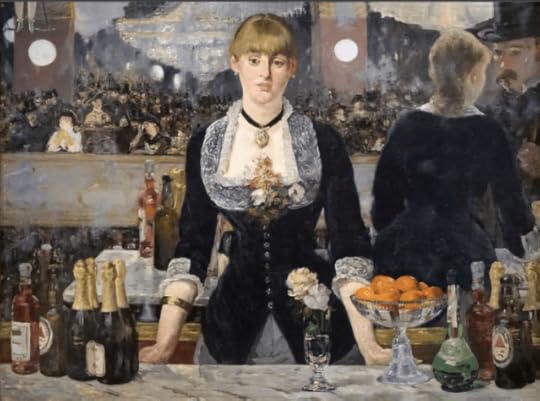 “A bar at the Folies-Bergère” painted by Édouard Manet in 1882, shows a slice of life in the sex-obsessed Paris of the 19th-century, where a young barmaid is actually shown to be transacting “business” with a “gentleman” in a top hat. The oranges placed in front of her are apparently meant to let her audience know she is a prostitute.
 NANA, published in 1880 by Emile Zola, is an interesting take on sex-obsessed Paris of the nineteenth century, the Paris that has now become a stereotype for sexual behavior in our own times.
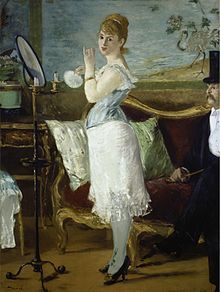 Édouard Manet who was much taken with the description of the “precociously immoral” Nana in Zola’s L’Assommoir gave the title “Nana” to his portrait of Henriette Hauser, which he painted in 1877 before Nana was published.
 The word “nana” has become, in contemporary French, “a mildly rude French term for woman, comparable to broad”.
The heroine, Nana, is both available and unavailable. She gains notoriety when she bares all and appears on the stage in the nude as Venus. She is not shy at sharing her bed with several men. Yet when these men try to claim her, to possess her as their own, she turns away, preferring to be by herself.
This is a wonderful novel until the end.
Nana’s horrific death from smallpox is described in a style of male chauvinist, moralizing, sexist claptrap, totally offensive and “uncool” (in the jargon of today’s young people.)
Which is a shame, as it spoils an otherwise great novel. Five stars for the interesting take, 1 star for the male priggery.
December 27, 2021
THE SWEETNESS OF FORGETTING by Kristin Harmon narrated by Kim McKean
 Typical street in the Le Marais (the Marsh) neighborhood in Paris, where Grandmother Rose lived before her family was torn apart in 1942 by the Nazis.
Here is yet another novel about the harrowing events of World War Two, with the Fairy Tales a beloved French grandmother told to her grand-daughter used to find two missing men.
What a fabulous concept! What a pity it was not as well executed as it might have been.
First, I would like to talk about all the wonderful things in this novel. Author Kristin Harmon got most everything right. Her characters (with one exception) were compelling: the male characters interesting and multi-dimensional, the whiny teenager growing into a young woman, and the grandmother (although largely absent) a compelling presence. And who couldn’t love a novel located in a French Bakery in Cape Cod with a trip to Paris fitted in?
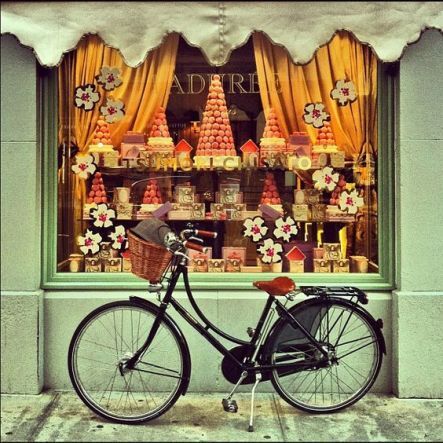 A typical French Bakery complete with bicycle outside (to bike off all those delectable calories proffered by smiling cakes oozing cream…)
But there were some problems that ruined the experience. As most of you know, audiobooks can be very unforgiving of narrative style. Which means that if you, as the author, have some irritating tics, they are going to be magnified by the audio experience, especially when the narrator speaks in a mind-numbing monotone.
Where Ms. Harmon really fell down was with her dialogue tags. As other readers have noted it was extremely irritating to have the characters “muttering” or “mumbling’ or “saying things in a small voice.” You can get away with this sort of thing ONCE, but NOT multiple times. Instead, you have to pick words that are either invisible (like “said”) or provide insight or interest into what is going on. The experience of listening to these boringly repetitive dialogue tags was NOT edifying. Instead, it was like listening to chalk grating on chalkboard.
Secondly, the protagonist Hope became more and more of a problem as the novel unfolded. I get that she is emotionally dysfunctional and has a lot of stresses in her life (failing bakery, obnoxious teenaged daughter, caddish ex-husband and dying grandmother) but still, she was SUCH A WET BLANKET! No wonder daughter Annie was so rude to her! Every time Annie suggested something her mother was so lukewarm, because (as she explained to herself and Annie) she wanted her 12-year-old daughter to “learn to manage her expectations.” It was maddening. What she really meant (of course) was that SHE didn’t want to do anything that took her out of her comfort zone.
It didn’t help that she got more and more dithery as the novel went on. Near the end she was so cold to love interest Gavin that I was surprised he showed up, when she changed her mind about him for the THIRD TIME. Despite the author’s wishes, I really DON’T predict a Happy Ending for them. So I give this novel 5 stars for a wonderful concept and 3 stars for its execution. (Four Stars.)
December 26, 2021
FIVE DAYS GONE: The Memory of My Mother’s Disappearance as a child by Laura Cumming narrated by Kate Reading.
 Laura’s mother disappeared in 1929, from Chapel Sands Lincolnshire, when she was only 3 years old.
I don’t usually read memoir, as I normally don’t find it very interesting. And this quiet narrative of family strife would normally cause me not to continue due to boredom. But there was something about FIVE DAYS GONE that kept me going and enjoying this narrative until the very end. For one thing, it is very well told. The author chooses to cast the early part of the memoir through her mother’s eyes, the innocent protagonist around whom all these events swirl, who is kept in the dark about their significance. Gradually she shifts to her own point of view, as the concerned daughter of Grace Blanchard/Betty Elstead/Elizabeth Cumming.
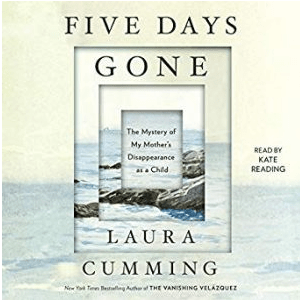 What a beautiful cover for this lovely novel!
I loved Kate Reading’s melodious voice, but at this point I wish she had done something to distinguish mother from daughter. Of course, we expect Laura to sound like her mother Elizabeth, but even so, the narrator could have accentuated the differences. For example, I sound very much like my sister. But I speak faster than she does. The unfortunate effect of this lack of distinctiveness between the voices of mother and daughter was that I kept being pulled up short, not sure who I was listening to.
I loved the ending of this memoir, even though it raised more questions than answers. The man at the center of the love-triangle, George, is telling the absent mother Hilda that he loves her. So I could not help wondering if that meant that he was punishing himself by staying with Vida, the woman he was married to. Four stars.
December 25, 2021
Merry Christmas Everyone!
 A Russian Troika preparing to head out on a snowy day. Photo 137429427 © Adandr | Dreamstime.com
I thought you might enjoy this photo of a troika of horses for this Christmas! Today, I thought I would share some thoughts with you about another of my favorite novels of all time: THE HUNTRESS by American Historical Novelist Kate Quinn. Here is a book review I wrote a while ago, which I decided to recycle for your enjoyment today.
Have a safe, healthy & happy day with your family, friends & loved ones!
 Kate Quinn’s THE HUNTRESS narrated by Saskia Maarleveld
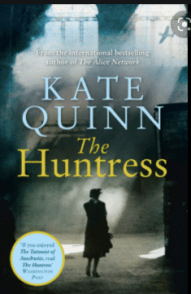
How I loved THE HUNTRESS, Kate Quinn’s study in evil! We are in Boston, Massachusetts. It is the spring of 1946. The Second World War has just ended, when Jordan McBride is introduced to her stepmother-to-be Annaliese Weber, a pretty woman with a chic taste in clothes, a warm smile and a charming 4-year-old named Ruth. But 17-year-old Jordan is suspicious. A young photographer, she is used to looking very carefully at the people around her, and one day she surprises Annaliese in a photo with a wolfish expression at odds with her usual warm smile. Who is she?
Ian Graham, a 40-something British War Correspondent who has witnessed the horrors of Omaha Beach, lost the brother he loved to Die Jägerin, the huntress, a woman notorious for murdering people (including 6 children.) Ian is on a mission to find this woman, and so he hunts the huntress to bring her to justice, with multilingual sidekick and professional flirt Anthony Ratmonovsky.
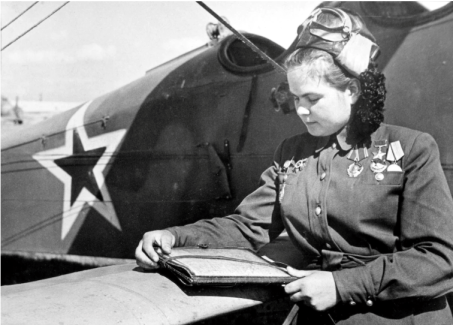 A female Soviet pilot, decorated with medals, stands next to a plane in 1942. (Agentur Voller Ernst/picture-alliance/dpa/AP Images)
Nina Borisovna Markova grew up trapping animals and surviving the brutal cold of Lake Baikal, Siberia. At 19, she sees a plane for the first time and falls in love. By the time the war is nearly over, she has become a Soviet pilot with 600 bombing raids under her belt. Despite her stellar service, despite all of her awards, she is denounced, because her out-of-control (and mad) father says unflattering things about Comrade Stalin. Facing arrest, Nina takes her beloved plane Rusalka and flies west, eventually running out of fuel over Poland. There, she burns the plane to cover her trail and sets off into the woods, where she meets escaped prisoner Sebastian Graham, who has injured his leg.
Kate Quinn braids these three narratives together into a complex and wonderful novel. Her characters literally jump off the page. How I loved Nina, who is so wild, so primal, and who, under her glowers and prickles, suffers from a broken heart. Then there is very proper Ian Graham, who possesses, under his starched collars and ties, a wild heart. Lastly, there is Jordan, who is far too observant and candid for anyone’s comfort. Jordan, who destroys Thanksgiving with her trenchant observations, and nearly destroys her father’s marriage.
Highly recommended for its stellar research and complex characters. Five stars.
#katequinn #thehuntress
December 24, 2021
Happy Christmas Eve Everyone!
 Christmas Eve Midnight Mass (image taken from the Roman Catholic Diocese of Norwich, Connecticut.)
 Today, I thought I would share some thoughts with you about one of my favorite novels of all time: TIGANA by Canadian fantasy writer Guy Gavriel Kay. Here is a book review I wrote a while ago, which I decided to recycle for your enjoyment today. Have a Safe & Happy evening (and don’t forget to travel safely!)
 The story of a disappeared state (TIGANA by Guy Gavriel Kay)
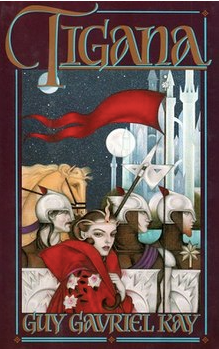 First Edition Cover
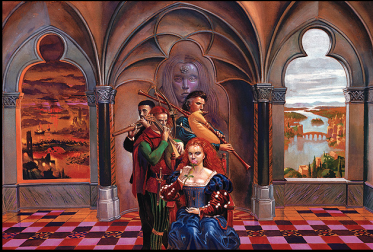 Croatian Cover
I am a fan of Guy Gavriel Kay’s writing, and TIGANA is one of my favorite novels. It begins with a provocative prologue, which segues into a day in the life of a talented 19-year-old singer, who’d just been ripped apart (verbally) by the newest member of the troupe, an attractive red-maned young woman.
Naturally, things are not what they seem, and I loved meeting this cast of quirky characters, some of whom have unexpected nobility attached to them.
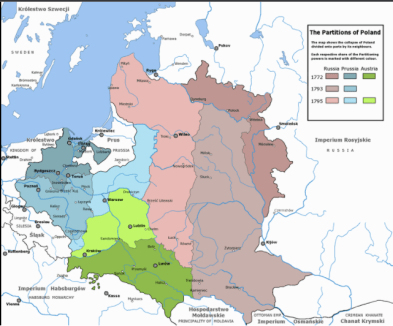 The partitions of Poland carried out by the Kingdom of Prussia (blue), the Russian Empire (brown) and the Hapsburg Monarchy (green) in 1772, 1793 and 1795. (See Wikipedia.)
 Finnish Cover
In his Author’s Note, Guy Gavriel Kay says that this novel is about memory, its importance and misuse. But what struck me was that Tigana is an exploration of a disappeared state, a place that is wiped off the map so completely that even when its old name is uttered, no-one can hear it. It reminded me of 19th-century Poland, which didn’t exist between 1795 and 1918. As the author notes, most insurrections are inspired by a loss of language and culture (think of the Irish, the Welsh, the Scots, the Basques and Yugoslavia.) Losing a name is a tragedy. It is not the mere loss of a proper noun, but a psychological assault on a person’s identity and culture, the probing knife that curdles ones self-respect. The emotional fallout can be vast, resulting in grief, rage, and everlasting bitterness.
And this is what this novel so beautifully delineates. Five stars. #guygavrielkay #tigana
December 23, 2021
THE LEOPARD “Il Gattopardo” by Giuseppe di Lampedusa
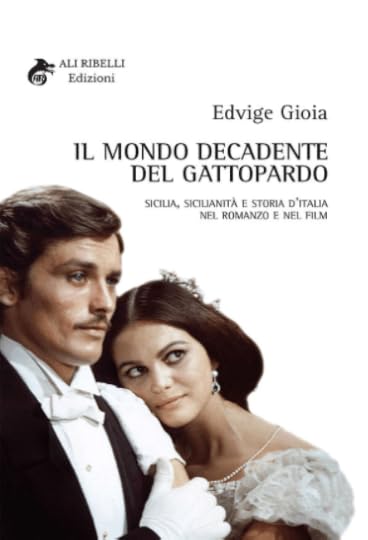 A critical examination of the decadent world of IL GATTOPARDO, Giuseppe di Lampedusa’s novel about his grandfather Prince Fabrizio, set in 1860s Sicily during the Risorgimento.
 Giuseppe di Lampedusa’s THE LEOPARD (Il Gattopardo in the original Italian), about Sicily on the brink of the Risorgimento in 1860, is based on the life of the author’s maternal grandfather, Prince Fabrizio di Salina.
What is really wonderful about the novel is the luminous prose that comes through in the sensitive English translation of Archibald Colquhuon, and the amazing details that make it come alive. I loved the way in which we follow Prince Fabrizio through his dark palaces, glimpsing his daughters’ dresses billowing as they curtseyed to him. Or as we followed him on an erotic jaunt to Palermo, when he insists on being accompanied by his chaplain! (That was one of my favorite episodes of the novel).
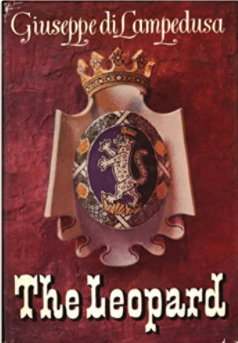 The English-language version of IL GATTOPARDO.
And it is interesting that di Lampedusa chose to deal with such an earthquake of a movement as the Risorgimento at such a remove. There are no scenes where the redshirts storm the palace, or Fabrizio has a loud argument with his nephew or his new low-born relative does anything exceptionally vulgar. Everything is muted, and veiled by civility. But then, that is exactly what life was like in 1860s Europe.
And I think that is why E.M. Forster called it “a novel which happens to take place in history,” as opposed to “an historical novel.” Five stars.
Cynthia Sally's Blog

- Cynthia Sally Haggard's profile
- 129 followers

