Scott Overton's Blog, page 15
February 28, 2015
HACKING THE HUMAN BODY
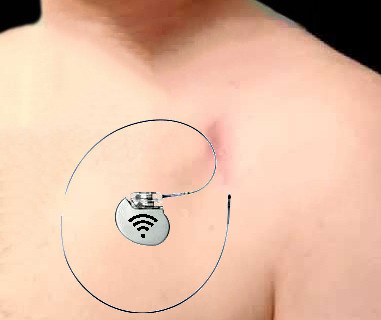 A radio program this past week was both an eye opener for me, and confirmation that a novel-in-manuscript of mine is not far-fetched at all.
On a show called “The Current” from the Canadian Broadcasting Corporation a guest named Mark Goodman spoke about the frightening prospect of computer hackers gaining access to high-tech medical devices implanted into human bodies. This wasn’t science fiction. He’s a futurist who’s worked with the FBI. Such hacking is possible right now, because so many of such devices use WiFi or Bluetooth signals and may be connected to the internet. Pacemakers are WiFi-enabled to allow a doctor to remotely trigger a strong jolt of current and save your life if you have a cardiac episode. A great idea, unless a hacker gains access to your pacemaker. Then your life is in their hands, whether for ransom or some kind of sick sport. The insulin pumps of diabetics could be triggered to deliver a fatal dose. Or imagine the horror of feeling your bionic arm or leg controlled by someone else. Hearing obscene or threatening messages in your cochlear implant.
All of these things are possible now, or soon will be.
Cochlear implants are directly connected to the brain. Experimental eye replacements will be, too, and some prosthetic limbs will have direct neural control. My manuscript (working title: Augment Nation) postulates a time coming soon when brain computer interfaces will take over from smartphones as the must-have accessory. If such devices are left vulnerable by inadequate software, the implications are horrific (worthy of a science fiction novel!) We’ve seen far too many examples of how our laws and law enforcement methods have not kept up with cybercrime, and the cost is huge. We don’t dare let security measures for high-tech medical devices fall behind in the same way.
Potential victims are numerous: powerful politicians, bank managers, corporate CEO’s, aircraft pilots (military and civilian), missile silo operators, security staff for bio-tech labs…it takes no effort to imagine dozens of scenarios in which hackers could use deadly leverage to achieve almost any goal. Terrorism? Let’s not even go there. And that’s not mentioning the threat from people who are simply twisted, or psychopathic.
Feel the urge to unplug your house and curl up under a blanket?
Our society already has many regulatory structures in place to ensure that new medical treatments do no harm. For instance, drugs have to go through numerous levels of testing before being approved for the general population. Harmful side effects or interactions with other medications prevent approval. It’s not a perfect system, but it certainly helps. Why not require security safeguards for medical technologies: refuse to approve their use unless they meet a certain standard of cyber-security? There may be no such thing as an “un-hackable” device, but encryption and well-scrutinized code can go a long way.
For once, let’s not wait to play “catch-up” with the criminals. Let’s get ahead of them and make sure that the benefits of brilliant new technology aren’t undermined by vulnerabilities.
It’s the right prescription.


February 17, 2015
SPACE SUBMARINE OR QUIXOTIC COLONY?
The space news that catches your interest this week will probably depend on whether you think space exploration requires direct human involvement or not. If you feel that it just isn’t the real deal unless humans in space suits are landing a rocket ship on another planet, then you’ll probably be most interested in the latest from the Dutch non-profit organization known as Mars One.
In case you’ve forgotten, Mars One is the groups that plans to start sending astronauts to colonize the planet Mars, four at a time, beginning in 2024. The catch is, it’s a one-way trip; the would-be colonists will never be coming back to Earth. If things go according to plan, they’ll get new companions (and supplies) every two years, but no return flight. The selection process for the astronaut colonists has involved applications from around the world—more than 200,000 of them to begin with, which was whittled down to 1,000, then 660. And now the final 100 have been chosen. So here’s where the real circus—I mean, science—begins, as the finalists try to survive in a mock Mars habitat while the cameras roll to produce a reality-TV show (one of the methods of financing the project, don’t you know). You can watch a promo here. Oh, did I mention that one of the finalists is a 38-year-old from Poland who calls himself “M1-K0” and claims to already be a Martian?
A very different space story involves NASA’s release of a video featuring a concept submarine proposed for the exploration of the hydrocarbon oceans of Saturn’s giant moon Titan. Titan is a strange place, with a largely nitrogen atmosphere, a landscape of dunes, frozen methane snow (and a little water ice) plus large lakes or small oceans of a hydrocarbon mixture. Even so, many scientists feel Titan may be a good candidate to find forms of life, probably in those oceans. So it would be most helpful to have a space probe that could explore beneath the surface. Hence this submarine proposal. But before you go picturing a space-suited Captain Nemo piloting the sub through undersea canyons and past bizarre creatures, the truth is the probe will be robotically controlled. It’ll surface from time to time to send data back to Earth, but no astronaut submariners will be involved. And the mission is still a good number of years away, with some pretty big hoops to jump through first.
I’ve said before that I think the Mars One project is doomed to fail, hopefully before any volunteers commit elaborate suicide by rocketing off toward the red planet. If I were a betting man, my money would be on the Titan submarine mission as the one more likely to succeed. BUT, speaking as a fiction writer, there’s only so much drama I can create around a robot probe in a sea of frozen BBQ fuel, whereas dozens of novels could be written about the Mars One venture.
So let’s keep our fingers crossed for the success of the cautious, well-reasoned-and-researched approaches to the exploration of space, and leave the dramatic failures to the world of fiction.
February 3, 2015
WHO SHOULD MAKE THE RULES FOR OUTER SPACE?
 Remember old cartoons and movies that featured an astronaut proudly planting a flag to claim a new planet for his native land? Have you ever dreamed of staking a claim on your very own asteroid for a family mining operation and homestead, gliding along under the Milky Way?
Reuters news agency announced this morning that the U.S. Federal Aviation Administration (FAA) is going to extend its current licensing authority over commercial space launches in the United States to the licensing of companies for projects on the Moon. Bigelow Aerospace plans to spend billions of dollars to put inflatable space habitats on the Moon, and the FAA is saying the company can expect to have exclusive rights to the territory they choose and related areas.
Holy Swiss cheese! The FAA is offering them the Moon?
Well, technically the FAA is just saying that if they license Bigelow to plant its habitats, they won’t license anybody else to drop in and exploit the same patch of moonscape. They don’t really dare to say more than that because the FAA doesn’t have the authority to award property rights, mineral rights, or any other rights on the Moon or any other planet.
The old cigar-with-fins spaceship landing on the Moon and an astronaut jumping out to plant the Stars and Stripes became out-of-date in 1967 when the United Nations Outer Space Treaty went into effect (a couple of years before an astronaut actually did jump out of a spacecraft and plant the Stars and Stripes on the Moon. Hmmmm.) Anyway, the treaty says that nobody can claim ownership of anything in outer space because it’s for all humankind to share.
That’s an issue for companies like Bigelow that want to land on the moon, and it’s likely to become a more pressing issue as companies and organizations attempt to win the Google Lunar X-Prize of $20 million (plus subsidiary prizes), because any of them that do succeed in reaching the Moon will surely want to be able to make it worth their while afterward, too. There are also a number of companies proceeding with serious plans to mine asteroids.
So who should decide property and other rights in outer space? The United Nations or a special subsidiary of it? Some new international body (a United Federation of Planets anyone?)
I think the key question is whether we want to repeat what’s been done on Earth. Do we want the wealthiest nations to have their way on whatever territory they can reach because they have the means to get there? Do we want rich people to have the ability to buy up all the available land they can afford and then sell pieces of it to the rest of us for the highest price they can get? Do we want big corporations to have favoured status when it comes to exploiting mineral or other resources, leaving the “little guy” scrabbling for the dregs? That’s the way it is here and now, on Earth, and has been for a long time. Or do we want the exploration of space to be a break from the past—a chance to do things differently?
If so, the UN Outer Space Treaty isn’t going to be adequate for the challenges (legal and otherwise) of the coming century. It needs an upgrade, and we average folk need to make our desires known. Before big American companies get settled in on the Moon. By then it might be too late.
January 27, 2015
WHERE IS EVERYBODY?
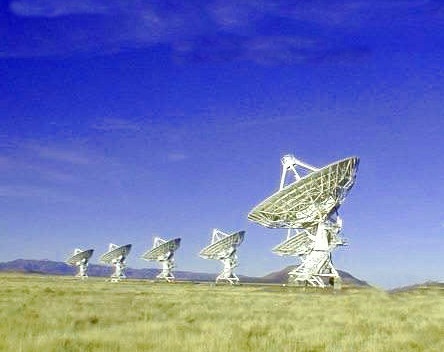 It’s called the Fermi Paradox: if the universe is so big that intelligent life must have evolved somewhere other than Earth, where is everybody? Why haven’t we seen any signs of them, or at least their TV commercials—those are unavoidable, no matter who you are, right?
Well, first of all, why are we so confident that there must be intelligent life elsewhere? Mainly because the universe is so big: our own galaxy is thought to contain 300 billion stars, and the universe we can see appears to have more than a hundred billion galaxies, so what are the odds this is the one and only planet that produced intelligent life? And that argument was made long before we actually knew that other stars had planets. Scientists working with the Kepler Space Telescope have now found thousands of possible planets orbiting other stars, and feel confident enough to consider more than one thousand of them “confirmed planets” (as of this month). A star system designated Kepler-444 has five rocky-type planets (like Earth) and was formed over eleven billion years ago. By comparison, our own solar system is only five billion years old. So if planets have been around at least that long, mustn’t some have produced life, and probably intelligent life, long before now? After all, here on Earth we’ve found that life can arise under even the most extreme conditions.
But The Great Silence is a fact. The Search for Extraterrestrial Intelligence (SETI) has been going on since the 1960’s, first searching for radio signals, and then many other signs of the by-products or artefacts of civilization. At one point SETI was scanning a billion frequencies of electromagnetic radiation, looking for some kind of signals. Granted, our own planet’s electromagnetic noise has only been spreading outward through space like an expanding bubble since the dawn of radio a hundred years ago, and signals from other galaxies would take millions of years to get here. But why is there such deafening silence within our own galaxy?
Here are some speculations (of my own and others):
- God took one shot at it and was satisfied with the result. (Yes, I’m being facetious, but somebody would’ve said it.)
- Truly intelligent beings recognized television for what it is and banned it forever.
- A lot of species stuck with the landline telephone rather than let cell phone companies gouge them. Or (more seriously) they went straight to line-of-sight communication using light, rather than spraying EM radiation in every direction.
- There are lots of hyper-intelligent races but they recognize that exposure to superior technologies kills a species’ initiative, so they’ve agreed to leave us alone (except for a few slip-ups, but then look how many times Star Trek captains blew the Prime Directive).
- There were lots of intelligent species, but they couldn’t get along and killed each other off.
- Other life forms are so completely different from the kind we know that they also communicate in ways we can’t recognize.
- Maybe the odds of life springing from a soup of organic chemicals and then evolving into a self-aware intelligence really are so low that, out of our whole galaxy we’re the only lottery winners.
There are many, many more serious explanations for The Great Silence. Maybe advanced species build Dyson spheres around their whole suns and have plenty to keep them busy without going anywhere else. Or maybe cosmic ray bursts sterilize huge chunks of galactic real estate on a regular basis. You can read a couple of great articles on the subject by George Dvosrky at io9 here and here.
But we can’t ignore the possibility that aliens have seen our TV shows and decided we’re just not worth talking to. The Kardashians and the House of Commons channel could keep us isolated for years to come.
January 21, 2015
CAN NOVEL RESEARCH AFFECT YOUR DIET?
 Writers don’t just make up everything we write out of thin air. Even most fantasy writers do research, I’m sure. Whether it’s historical facts, geographical details, social context, fashion, scientific principles, or the average velocity of a sneeze…we like to get stuff right when we include it in a story.
The internet is an absolute godsend when it comes to doing research, but it can take you to weird places. And I’m not talking about the category of sites that start with P and end with –orn. I just mean that, well, research can end up affecting your life.
A case in point: a lot of the novel I’m currently writing is set in New York City. I don’t live there, and have never yet been there, but thanks to Google Maps and Streetview I can go virtually anywhere in the city, describe the trees, the buildings, the view in the distance. I can watch videos of people who’ve gone skydiving on Long Island and have my characters do that. And when the people in the book feel the need to grab a bite, I can find a good restaurant for them and check out the menu to see what they’d like (I don’t even have to leave a tip!) The characters in this novel are vegetarian, so that poses an extra challenge but certainly not a difficult one.
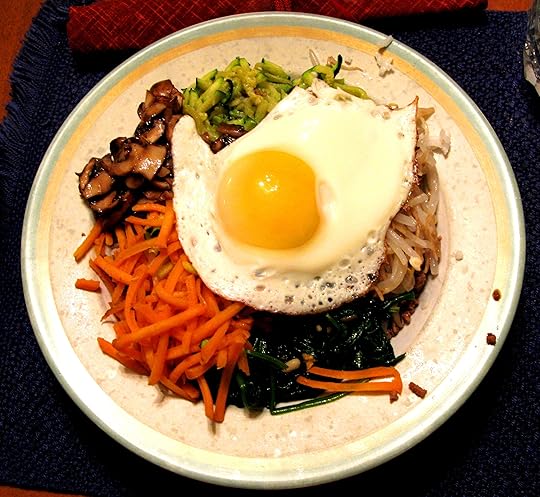
The other day I had the need to place a dinner scene. The characters were on the east side of Midtown Manhattan. Walking, not driving. Vegetarian. One was also Asian. After scrutiny of a few menus of real restaurants (by me, not them) they wound up at a Korean place. It happens that I like Korean food. One ordered Bibimbap. My mouth started to water. The next thing I knew I was looking up recipes and phoning my wife to bring home the ingredients we didn’t have on hand. Bibimbap was not only on the menu in my story but also in my kitchen that night. The picture above is our actual result. What’s more, it lived up to my expectations. I can’t always say that about my literary output for the day.
I hope I never have to eat my words. But if I occasionally get a dinner idea from one of my characters, I say bring it on.
Now if I can just resist looking up flights to New York.
January 13, 2015
WILL WRITERS SOON BE OUT OF A JOB?
 I’ve felt the cold breath of obsolescence down my neck this week as I read some articles about the advancement of computerized content generation. Sure, automation has been taking jobs away from human workers for decades, but we don’t usually think of software being able to replace the human mind when it comes to the “arts”, including literature.
Perhaps the term literature is a bit of stretch when describing the output of computer programs to this point, but not by much, and mainly because the early focus has been on non-fiction content. If you’re the proud author of more than a handful of books listed on Amazon, you might want to sit down, because more than one hundred thousand Amazon listings are credited to a Marketing professor named Philip M. Parker and seven hundred thousand to his company Icon Group International, Inc. Of course, Parker himself didn’t actually write more than three of them. The rest were written by software he has created. The company specializes in producing books on niche topics, often economics or medicine-themed, written using software algorithms according to specified formulae, and directed to avoid plagiarism. Once the desired parameters of the book are entered, they take anywhere from minutes to days to produce, and cost pennies. That means terrific profit percentages, even for a book with a very small market. You can read about Parker’s work and watch a video here, or check out his YouTube channel, but if you’re an author, take a Valium first. He’s also making inroads into the production of videos and computer games.
Novelists can’t breathe easy either. A novel completely written by computer was produced and released by a team of IT and language experts in Russia back in 2008, based on the styles and plots of seventeen famous books, especially Tolstoy’s Anna Karenina. I don’t know how much progress has been made since.
Before we sneer too much, let’s remember that an awful lot of the fiction being sold these days is terribly formulaic, which makes it ideal for a computer takeover. Certain publishing imprints of romance novels and soft erotica are the most obvious examples, but in science fiction just take a look at the reams of Star Wars, Star Trek and other franchise stuff that clogs up the bookshelves. Some bestselling mystery and thriller authors have become franchises unto themselves, putting their names on books written by (supposedly in partnership with) other writers who usually aren’t called ghostwriters but might as well be. If their styles are that easily imitated, they’d be perfect candidates for computer ghostwriting instead. Imagine how the publishers of James Patterson, Tom Clancy, and Clive Cussler must be salivating at that thought.
It’s not a question of if this will happen, but when, so I guess we authors need to hope that readers will be discriminating enough to prefer stories created by real live humans, and word of mouth will become far more important than name recognition. The top-selling books of any given year are often ones that carve fresh ground. The top-selling authors, not so much.
January 6, 2015
THE COLD GAVE ME A COLD
[image error]It’s not unusual for me to start a new year with a cold. My kids and their kids visit over the Christmas holidays from another part of the country and bring germs that I haven’t been exposed to yet. It’s a price I’m willing to pay for all of the grandkid cuddle time. Except it turns out that maybe it wasn’t the cuddling (and coughing and sneezing and baby drool) that did me in. Maybe it was building the snowman.
When I think of all of the years I snootily insisted from my scientifically-educated pedestal that catching a cold had nothing to do with being cold, I'll have to apologize to Mom for all those scarves I refused to wear. Now comes a Yale University study that builds on earlier research to proclaim that, Yes, after all, cold weather is to blame for us getting sick (along with the germs, of course).
You see, although there are a couple of hundred viruses that give us colds, about forty percent of the colds we get are from germs called rhinoviruses, and rhinoviruses like cooler temperatures. They can do their nasty work in a normal human body core temperature of 37C, but they multiply much more quickly at 33C. So when we go outside in the winter and breathe in air that drops the temperature of our inner nose and sinuses we’re making those rhino-bugs very happy campers.
But wait, there’s more. The new Yale study claims that, while that colder 33C is giving a boost to rhino-reproduction it’s also putting handcuffs on the very forces we’re counting on to defend us: immune-system proteins like interferon and others, which attack virus DNA to keep them from spreading, and kill body cells that have gone over to the other side. At 33C and colder, the genes that produce those proteins are depressed (just like us when we look at the thermometer) and don’t work nearly as well.
So what’s the bottom line when you factor all these things together? Breathing wintry air can make it as much as one hundred times more likely that the cold germ invasion will succeed!
I live in Canada (minus 25C early this morning), and I rarely let cold weather keep me from exercising outdoors, all in the name of good health. Boy, do I feel like a chump.
In my newest novel manuscript I predict that in coming years we’ll use a nano-shield spray treatment applied daily like sunscreen to protect us from germs. It can’t come soon enough. And it better work well in the cold.
December 24, 2014
BOXING WEEK AT KOBO INCLUDES ME
 The gift of good reading is one of the best things to give all year long and perfect for Christmas presents (or as a reward to yourself for making it through the holiday season!)
Kobo is one of the top ebook sellers in the world and from December 24th 2014 through January 5th 2015 their big Boxing Week sale is on. I mention it because there’s a special 35% off promotion on a select list of titles including my three-short-story collection called Disastrous! Follow this link and you choose as many of the selected titles as you want, as many copies as you want, and get 35% off the regular price by using the promotion code December35 when you check out.
If you use the link above, you’ll need to scroll to the bottom of the page and click “Show more results” before you get to see my book, so….
Here’s the link directly to my anthology Disastrous!: Three Stories of the End of the World which offers about 16,000 words of apocalyptic fiction.
For instructions on how to use a Kobo promo code click here.
Remember the code is December35.
Stock up on good reading for the coming year and have a terrific holiday!
December 17, 2014
INVASION OF THE CHIMERA CELLS
 Perfect title for a cheesy horror movie, right? But I’ve recently seen several articles based on scientific studies which confirmed that many people’s bodies contain cells that come from other people. (Scientific American offered a good overview of an especially interesting 2012 study.) That’s a little creepy, but fascinating.
The studies I’ve read about involved women, and particularly mothers, whose bodies were found to have measurable numbers of cells that must have come from their own male babies. How do we know? Because these foreign cells have both X and Y chromosomes—women only have two X chromosomes in their native cells. That’s also why the studies have focused on women—the male XY cells are relatively easy to find. And these foreign cells have been discovered in many different organs and other tissue, including the brain. (A friend of mine tweeted: “Brings the meaning of ‘mommy brain’ to a whole new level!”)
The phenomenon is known as microchimerism (from the mythical chimera which had body parts from many different creatures). The most common reason this happens is that the placenta is part of both mother and child, and fetal cells can migrate across it and remain in the mother’s body for many years. The migration can also go the other direction, which opens up the possibility that cells from an older sibling that made themselves at home in Mom’s body could then migrate into a new fetus. There are other ways to end up with cells from someone else: cells can pass between twins in the womb, organ transplants and even blood transfusions are an obvious route, but breastfeeding might also do it, and even sex.
What I’ve found most interesting is that these immigrant cells apparently don’t just sit idle. Some scientists are investigating whether there could be a link to autoimmune conditions like rheumatoid arthritis and multiple sclerosis, because the body may detect foreign cells and respond by going on the attack. But there is also strong statistical evidence involving humans, and study findings involving mice, that suggest such cells provide health benefits. It looks like they could reduce the risk of breast cancer and Alzheimer’s Disease, plus help to repair damaged muscle and organ tissue, including the heart (wouldn’t that be fitting: a child healing a mom’s heart?)
Only a lot more research will reveal if these apparent connections are solid, but if it is true that cells from the body of another human being provide us with health benefits, that’s fodder for a whole lot of deep thought.
How would this strange chain of biological inter-dependency come about? I’m a believer in natural selection, but there are times I can’t help but wonder if it had a little help.
December 10, 2014
TIME AND TIME AGAIN
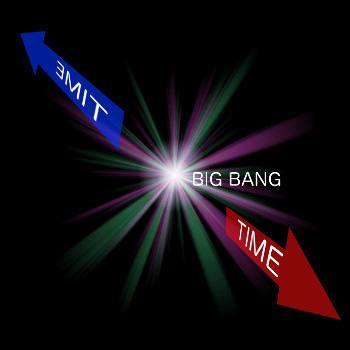 Science fiction writers love to find a fresh scientific basis upon which to imagine stories. A new theory that was just published in October might fit the bill. It’s a (mostly) new way of looking at Time.
We think of Time as having a direction: from the past into the future. “Time’s arrow” is the metaphor we picture. More scientifically, it’s the second law of thermodynamics—systems always progress from a state of order into greater and greater disorder. Like Humpty Dumpty—you can’t put him back together again. Or a Mojito cocktail that can’t be un-mixed. Or the universe, spreading from one single point to a huge amount of stuff scattered across a nearly infinite space, thanks to the Big Bang. The laws of physics work in either direction, though, so there’s no explanation for why Time travels in the direction it does nor how the matter of the universe got into such a perfect state of order before the Big Bang.
Physicists Julian Barbour, Tim Koslowski, and Flavio Mercati created a computer model of particles influenced by simple gravity (Scientific American has a good, though dense explanation here, or read another assessment here.) They showed that gravity will always bring such systems into occasional states of equilibrium/order, but from that ordered state Time will proceed in both directions, forward and back. That implies that there is a universe evolving as we know it and an alternate universe before the Big Bang that is going in the other direction, expanding farther and farther into what we would see as the past. The state of the universe in the moment before the Big Bang is just middle ground in a larger process.
Granted that Barbour, Koslowski, and Mercati’s idea hasn’t yet been reconciled with the theory of General Relativity or a few other possible objections, but it’s an interesting discovery.
There have been lots of stories about time travel and many more about alternate universes based on Hugh Everett’s Many-Worlds Theory, but what about a time travel story that involves going back to the Big Bang and beyond into a universe where Time itself moves backward, according to our perceptions?
Don’t expect me to write it—the paradoxes of time travel give me a headache at the best of times.
Time for a good, stiff Mojito.