Mari Mann's Blog, page 5
February 18, 2009
A Proust Sighting and an Anniversary
Today, February 18th, is the 2nd year anniversary of this blog. In honor, I have a sighting to report (brief flashback: a Proust sighting is what I call it when I see someone mention Proust in a book, a magazine, or etc…) I recently checked a book out of the library called Between Meals: An Appetite for Paris by A.J. Liebling. Here's a quick glimpse of Liebling from the back cover of the book:
"No writer has written more extensively about food than A.J. Liebling. Between Meals (1962), the great New Yorker writer's last book, is a wholly appealing account of his "education sentimentale" in French cooking during 1926 and 1927, when American expatriates like Ernest Hemingway and Gertrude Stein made cafe life the stuff of legend. A native New Yorker who had gone abroad to study, Liebling shunned his coursework and applied himself to the fine art of eating- or "feeding", as he called it."
Liebling was apparently a man who decided, early on, that he wanted to do two things: write, and eat. More specifically, to write about eating. And in order to do that well, one must necessarily eat as much and as well as one possibly can. What better place to do this than Paris?
So when, as a young man, he was temporarily adrift in life, as young men are wont to do, his father suggested a trip to France, Liebling seized the opportunity, sealing the deal with his father with a little fictional narrative that was a little taste of his later literary abilities. (To read about this and more about Liebling, click here.)
Like Proust, Liebling spent most of his time in Paris, but also like Marcel, he occasionally made forays into the countryside. Between Meals is the result. And the first sentence of this book contains our Proust sighting. I love it when I pick up a book, whose contents are unknown to me, and discover Marcel in the pages. It's like seeing a friend in a place where you hadn't exected to see them, and only adds to your enjoyment of that place.
So, the sighting:
"The Proust madeleine phenomenon is now as firmly established in folklore as Newton's apple or Watt's steam kettle. The man ate a tea biscuit, the taste evoked memories, he wrote a book. This is capable of expression by the formula TMB, for Taste~Memory~Book. Some time ago, when I began to read a book called The Food of France, by Waverley Root, I had an inverse experience: BMT, for Book~Memory~Taste. Happily, the tastes that The Food of France re-created for me- small birds, stewed rabbit, stuffed tripe, Cote Rotie, and Tavel- were more robust than that of the madeleine, which Larousse defines as "a light cake made with sugar, flour, lemon juice, brandy and eggs". (The quantity of brandy in a madeleine would not furnish a gnat with an alcohol rub.) In the light of what Proust wrote with so mild a stimulus, it is the world's loss that he did not have a heartier appetite. On a dozen Gardiners Island oysters, a bowl of clam chowder, a peck of steamers, some bay scallops, three sauteed soft-shelled crabs, a few ears of fresh-picked corn, a thin swordfish steak of generous area, a pair of lobsters, and a Long Island duck, he might have written a masterpiece."
Of course, there are many who believe, on just such a mild stimulus, Proust did write a masterpiece. A meal like the one described by Liebling, and after reading the entire book, that is just one meal A.J. is describing, would probably have hastened Proust's already early demise. Or at least caused him intense distress. One imagines him thoroughly berating Celeste for bringing him such a gastronomic nightmare (or gourmet's dream, from Liebling's point of view).
As an extra added bonus, this sighting is also a madeleine reference. Besides my own madeleine moments, shared here, I have experimented with making them myself, which you can read about and see recipes for here. What caught my attention in Liebling's description of madeleines, which he attributes to Larousse, is the addition of brandy. No recipe I had ever seen for madeleines included spirits of any kind. I have apparently missed out. So a little googling finally turns up this recipe (from this article):
PLAIN 18TH-CENTURY MADELEINES
Adapted from '"The New Making of a Cook" by Madeleine Kamman (William Morrow, 1997)
Time: 1 hour, plus at least two hours' chilling
1 cup unsalted butter, more at room temperature for buttering pan
2 medium eggs
3 large eggs
Grated zest of 1 lemon
2 tablespoons dark rum
1 cup granulated sugar
1/4 teaspoon salt
1 teaspoon lemon juice
1 1/2 cups sifted unbleached all-purpose flour, more for flouring pan
2/3 cup sifted cake flour.
1. In a mixer fitted with a whisk, cream butter until white. Add 1 whole medium egg and 1 medium egg yolk. Place egg white in a bowl, and set aside. Continue mixing until blended. Turn to low speed, and add 3 large egg yolks (adding whites to the one in the bowl), beating after each addition. Add lemon zest and rum, and continue mixing for another minute.
2. Increase speed to medium. Add 2/3 cup sugar and the salt, and beat until all traces of sugar crystals disappear. Add remaining sugar, and whip another minute. Transfer batter to a large bowl. Wash and dry mixer bowl and whisk, then add egg whites. Beat until foamy, then add lemon juice and continue beating until very smooth and white.
3. Mix flours, and sift two-thirds of the flour over batter. Fold together until just blended. Fold in one-quarter of the egg whites. Slide remaining egg whites on top of batter, and sift remaining flour over. Fold all layers together until batter is perfectly homogenized. It should be soft and fluffy. Spoon batter into a pastry bag fitted with a small (about 1/4-inch) round tip. Refrigerate for at least 2 hours, or overnight.
4. Preheat oven to 375 degrees. Generously butter a madeleine pan (small or large molds). Pipe batter into molds, so they are three-quarters full. Bake until they form humps and are nut brown around edges, 6 to 8 minutes, longer if using large molds. Remove from oven, and bang pan on a countertop to release madeleines from molds. Carefully lift off any that stick. Place in a folded napkin to keep warm. Repeat with remaining batter.
Yield: about 60 small madeleines.
As you can see, this recipe calls for rum, not brandy, but I can use the amount given as a basis for how much brandy to add. Have I made these madeleines yet? Non. Will I make them? I bought the brandy yesterday.
Bon appetit.
[image error] [image error]



 [image error]


November 18, 2008
Come into my Boudoir
Vivian: "So you do get up. I was beginning to think you worked in bed, like Marcel Proust."
Phillip Marlowe: "Who's he?"
Vivian: "You wouldn't know him, a French writer."
Marlowe: "Come into my boudoir…"
From The Big Sleep, a 1946 film noir starring Humphrey Bogart as Phillip Marlowe and Lauren Bacall as Vivian, for Marcel Proust on the anniversary of his death, November 18, 1922
Bonne nuit, Marcel





July 10, 2008
The Creative Habit
July 10th is the anniversary of Marcel's birth in 1871, and 137 years later, he is still going strong. My latest Proust sighting occured in this book, "The Creative Habit: Learn it and Use it for Life" by Twyla Tharp:
"When Marcel Proust dipped his petites madeleines into his tea, the taste and aroma set off a flood of memories and emotions from which modern literature still has not recovered."
The above quote and the ones that follow are from a chapter called Muscle Memory in which Tharp discusses the form of memory retained by our bodies by a repeated physical act, in an unconscious form similar to the Proustian madeleine moment. You know the saying that one never forgets how to ride a bike? That's what she means.
"Muscle memory has its uses in the creative process, perhaps more for acquiring skill than for developing inspiration. But it's useful nevertheless."
So what's the connection between muscle memory and Proust? Well obviously, he had to learn the skill of bending his elbow to bring the madeleine to his mouth without spilling the tea in the spoon- not really.
"…the exercise is less about muscles and more about perceiving structures and harmonies anew- from the vantage point of the author rather than the reader."
The exercise Tharp is speaking of is, in whatever field of endeavor you aspire to, you should choose an example or a mentor that inspires you or challenges you and emulate them, to the best of your ability. This is where Proust comes in:
"Raymond Chandler and Proust went through a similar process when honing their very different crafts. Chandler believed Hemingway to be the greatest American novelist of his time, and he wrote imitations of Hemingway's style to absorb what he loved about it. Proust went further, spending twelve years translating and annotating the writing of the English art historian John Ruskin. He also wrote a series of articles for Le Figaro imitating the styles of such 19th century literary figures as Balzac and Flaubert."
I think there is much value in this advice, and I think Marcel would agree with me and with Twyla.
I have not tried to write in the style of Proust, but I have tried to paint in the style of my favorite painter, Vincent van Gogh. Here's an attempt, in acrylic:
[image error]
And here's an attempt in oil, in the style of Marc Chagall, on a subject and a place nearer to Proust's world:
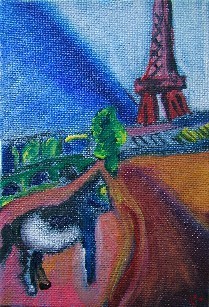
The Eiffel Tower was completed in 1889, 18 years after Marcel's birth, which brings us back to the day, 137 years ago, that we look back to today; Joyeux Anniversaire, Marcel.