
Mari Mann's Blog, page 3
November 17, 2011
On Writing and Death
From Time Regained, by Marcel Proust, who died on November 18th, 1922.
"The idea of Time was of value to me for yet another reason: it was a spur, it told me that it was time to begin if I wished to attain to what I had sometimes perceived in the course of my life, in brief lightning-flashes, on the Guermantes way and in my drives in the carriage of Mme. de Villeparisis, at those moments of perception which had made me think that life was worth living. How much more worth living did it appear to me now, now that I seemed to see that this life that we live in half-darkness can be illumined, this life that at every moment we distort can be restored to its true pristine shape, that a life, in short, can be realised within the confines of a book! How happy would he be, I thought, the man who had the power to write such a book! What a task awaited him! To give some idea of this task one would have to borrow comparisons from the loftiest and the most varied arts; for this writer- who, moreover, to indicate the mass, the solidity of each one of his characters must find means to display that character's most opposite facets- would have to prepare his book with meticulous care, perpetually regrouping his forces like a general conducting an offensive, and he would have also to endure his book like a form of fatigue, to accept it like a discipline, build it up like a church, follow it like a medical regime, vanquish it like an obstacle, win it like a friendship, cosset it like a little child, create it like a new world without neglecting those mysteries whose explanation is to be found probably only within worlds other than our own and the presentiment of which is the thing that moves us most deeply in life and in art. In long books of this kind there are parts which there has been time only to sketch, parts which, because of the very amplitude of the architect's plan, will no doubt never be completed. How many great cathedrals remain unfinished! The writer feeds his book, he strengthens the parts of it which are weak, he protects it, but afterwards it is the book that grows, that designates its author's tomb and defends it against the world's clamour and for awhile against oblivion."
From the French Pleiade edition translated by C.K. Scott Moncrieff and Terence Kilmartin, First Vintage Books Edition, September 1982





October 31, 2011
Merci, a bientot!
Thank you to everyone who came out to Knotts Island for the Artisan Festival, and especially to everyone who came to my book signing table there. A big merci to all who purchased Parisian by Heart; after you read it, please let me know what you think of it, and if you feel so inclined, write a review on Amazon and/or Goodreads- that would be greatly appreciated as well. Merci beaucoup, a la prochaine!





October 23, 2011
Artisan Festival Book Signing
On October 30th, 2011, I will be at an Artisan Festival here on Knotts Island at Willowgait Farm. It's an annual event, free to everyone including the vendors, who will be selling all kinds of handmade arts and crafts. Here's some pictures I took in previous years…
[image error]
Artisan Festival at Willowgait Farm


My table in 2010 with artwork in baskets
This year I'll have copies of my book, Parisian by Heart, for sale and will be signing them as well. If you've already purchased a copy, please bring it with you and I'll sign it for you. Here's a link to info on the Festival. Let me know if you're coming so we can speak a howdy.
[image error]




September 11, 2011
Parisian by Heart
Marcel Proust's famous notebooks, in which he wrote In Search of Lost Time, were a crazy quilt pastiche of numerous revisions, written on any other pieces of paper available and with lines and circles drawn in to show where the inserts were to go, and in what order. He (or actually his companion-housekeeper, Celeste Albaret) literally cut and pasted these paperoles, as he called them, into the notebooks, in the days before word processors and computers. One sees Proust, propped up in bed, with his sweaters and pillows behind and around him, carefully cutting around his words and Celeste standing nearby, perhaps holding a little pot of glue, listening while Marcel explains exactly where each snippet is to be placed. On the bed and the little tables around him are the notebooks, more pieces of paper, perhaps envelopes from letters he's received, perhaps bills from merchants, on which he's written character descriptions, remembered conversations, forgotten details of the places in the books that have been recalled to his memory, somehow…
Would he have embraced a computer, with its word-processing capabilities, its immediate and seamless ability to not-literally but visually cut and paste to one's heart's desire? Or would he have preferred the sight and touch of being surrounded by his words, the tactile and sensual cutting and pasting, the clean slice of the scissors and the smell of the glue? Visualize Proust again, propped up in the bed, with a laptop on his knees? Or the even smaller computer called, fortuitously, a notebook?
Mais, non. Let us leave Monsieur to his writing and explain the title of this post. My love of Marcel Proust and The Novel lead me to writing my first novel around Proust and Paris and it's title is Parisian by Heart. The following, which I have magically copied and pasted here using my notebook, is an excerpt from my book.
"As I followed Francoise back into this room, we discovered Marcel had ensconced himself in the bed and was struggling to arrange the pillows and what looked to be several sweaters around and behind himself. He had moved a small upholstered bench next to the bed and had placed his hat, which he had been holding in his gloved hands earlier, on it, along with those gloves which were of a lavender color and matched his vest. I could see his vest now because he had removed his coat and hung it on the back of the closet door.
He was still fussing with the pillows and sweaters and as soon as he saw Francoise, he fell back onto the pillows and said, "Oh, my dear Celeste, you have taken so long! Put down those things and help me please. Madame, have you any more pillows?" This last request had been directed at me. I ran into the living room and got some pillows off the window seat and returned with them. Francoise took them from me and as she did, she looked at me in such a way, her chin tucked down and her eyes looking up into mine, that I knew she was warning me not to bring up the Celeste/ Francoise problem.
She now had Marcel propped up in the bed, with pillows and sweaters piled up behind him, and on either side of him, so that he could prop his elbows on them as he ate his croissant and drank his coffee, with the tray on a pillow on his lap. Francoise stood at the foot of the bed, watching as Marcel finished his croissant and then going to fetch another as he requested. While she was gone, he lay back on the pillows and closed his eyes. At that moment, he looked so much like the photograph taken by Man Ray after Proust had died, of him lying on his death bed with his sunken eyes closed and his nose sharp with skin stretched tight over it, that I was frozen in time, staring at the face I'd never seen in reality and yet- here it was. He opened his eyes and caught me staring at him. He smiled.
"Do not worry, Madame, I will be restored soon. And then I will begin the story". Francoise returned with the second croissant for Marcel, and a tray with more croissants and coffee that she handed to me.
"Bon appetit, Madame", she said, and went back to stand at the foot of the bed. Marcel finished his croissant, then gently dabbed at his face with one of the linen napkins. He sighed, lay back on the pillows, and closed his eyes.
"As you can see, Madame, I am not well. Since I was eight or nine, I have been so close to death at times that my family feared they were going to lose me. The first two years of my life, I was the only child, and I was my mother's heart's delight. Then, when I was two, my brother was born, and my mother was no longer mine alone. And even worse, my brother was healthy and athletic and fulfilled my father's every expectation of him. I, on the other hand, could not seem to please him in any way, although God knows I tried. My brother and I remained my parent's only children." He stopped here to look at me. "Same as you and your sister, non?"
"Yes", I said, "I mean, oui." He nodded.
"I loved my brother, but could not forgive him for having to share my mother with him. So I wrote him out of my life. I centered my life around my mother and dealing with my illnesses. It was all I had the strength for anyhow; that, and my writing.
"Our family was large and we had many other family members living around us. Grandparents, aunts and uncles, cousins…we were all very close and spent summers together in our small village outside of Paris and the rest of the time in Paris itself. My father had his work as a doctor there, my brother and I were in school, the years went by…My brother became a doctor, like our father. For myself, when I felt well enough, I just wanted to pursue my pleasures. I adored going to the Theater, or to the Opera, or to museums…I would go to the Louvre and stand enthralled in front of Veronese's The Wedding at Cana for hours. I did my one year of military service, and while I enjoyed the company of the other men…"
He glanced quickly at Francoise and coughed a little cough. "Well, that was not going to be for me. I got a job, just to try to please my father, at the Bibliotheque Mazarin, thinking that at least I would be immersed in literature but I just could not resign myself to being an "unpaid assistant" so I never actually went to work there. I toyed with being a museum curator, I got degrees in the law and in philosophy, but all I really wanted to do was write.
"Then, one by one, family members began to die. I lost aunts, uncles, my beloved grandmother, and then the greatest blow of all, from which I will never recover…" He covered his eyes with his hands and was silent. Francoise stood with her head bowed. After a minute or two, he spoke again. His voice was low and without emotion, as if to give any voice to his feelings would unleash a torrent that he would rather keep within. "My mother died, quite horribly, and I could do nothing but watch. My father and my brother, both doctors, could do nothing. I did not know why, or even begin to comprehend, how I could go on living myself, unless it was to somehow give testimony, through my own life and my life's work, to her having been my mother and to have been loved and so loving to me, by me…"
He lay back again, and his breathing became shallow and labored. "I must finish quickly now. My mother, along with all the other things she gave me in life, gave me the key, albeit unwittingly, that I am about to give to you. One day, as I came home tired, dispirited and cold, for reasons that are not important now, she offered me a cup of tea and a petite madeleine to dip into it. I did not usually take tea, preferring coffee, but that day I accepted the tea and the madeleine. I dipped the madeleine in the tea. Little bits of it broke off and floated in the amber liquid. I spooned them into my mouth and was instantly transported back in time to when I was a child and would have a cup of tea and madeleines with my Aunt Leonie. There I was, sitting on the side of her bed, smelling the lime blossoms she used to make her tea and feeling the warm spring air of Combray on my face from her open window." He looked at me out of his deep-set, dark eyes that contained an intensity within like that of a hypnotist. "Do you understand what I am saying, Madame?"
"Yes, I think so", I said. "You experienced an "involuntary memory", the first of several you would have, that opened up to you the realization that memories and experiences are contained within physical objects, or certain sensory events…"
"Non!" His hands flew up before his face as if he wished to shut out all sight and sound, then he slowly lowered them back onto the tray before him. "You do not understand. I physically went back in time. I became a time-traveler, not just in my mind or thoughts or memories but in my body as well." He leaned closer to me. "Do you understand now?"
His eyes held mine for what seemed like an hour but could only have been seconds. Something flickered within me, as if a long-buried memory was trying to come to the surface, but I could not grasp it. I shook my head. Proust lay back among the pillows and remained quiet for so long, his breathing growing deeper and deeper, that I became sure he was asleep. I looked at Francoise. She shook her head at me, warning me not to speak and to be patient.
She had not moved from the foot of the bed, and I would come to know that she would remain that way for hours, so that when Marcel did wake up, she would be there and he would not have to call for her. I motioned towards a chair, she shook her head again, and pointed towards the tray she had brought for me. I had forgotten about it. The coffee was still hot and had milk in it, the croissant was warm and buttery and flaky, melting in my mouth like nothing I had ever eaten before. Francoise smiled, and motioned for me to take another. I obeyed.
After some time had passed, Francoise moved quietly to the side of the bed and began to arrange some bottles and a small box of some kind of powder on the table there. I don't know where these things came from, somehow they were just in her hands. She came around to the other side of the bed and on the dresser there, began to lay out some notebooks that had cardboard covers and were very worn and frayed at the edges. Could these be the notebooks, the cahiers that I had read about, that Marcel had written In Search of Lost Time in? I looked closer. They were, and I had the disorienting and dizzy feeling that suddenly I was in a cathedral or temple, standing in front of an altar on which lay the Holy Grail. My vision contracted inward, so that everything else in the room disappeared and all I could see were the notebooks. I felt faint. Francoise, or was it Celeste, was at my elbow and she whispered in my ear, "You see, Madame, Monsieur is a Magus".
The next thing I was conscious of was that I was lying on the floor looking up at the ceiling. I was alone."

Parisian by Heart
Parisian by Heart is available at Amazon, Barnes and Noble and other book retailers. It was chosen as a quarter-finalist in Amazon's Breakthrough Novel Award.





 [image error]
August 25, 2011
Parisian by Heart
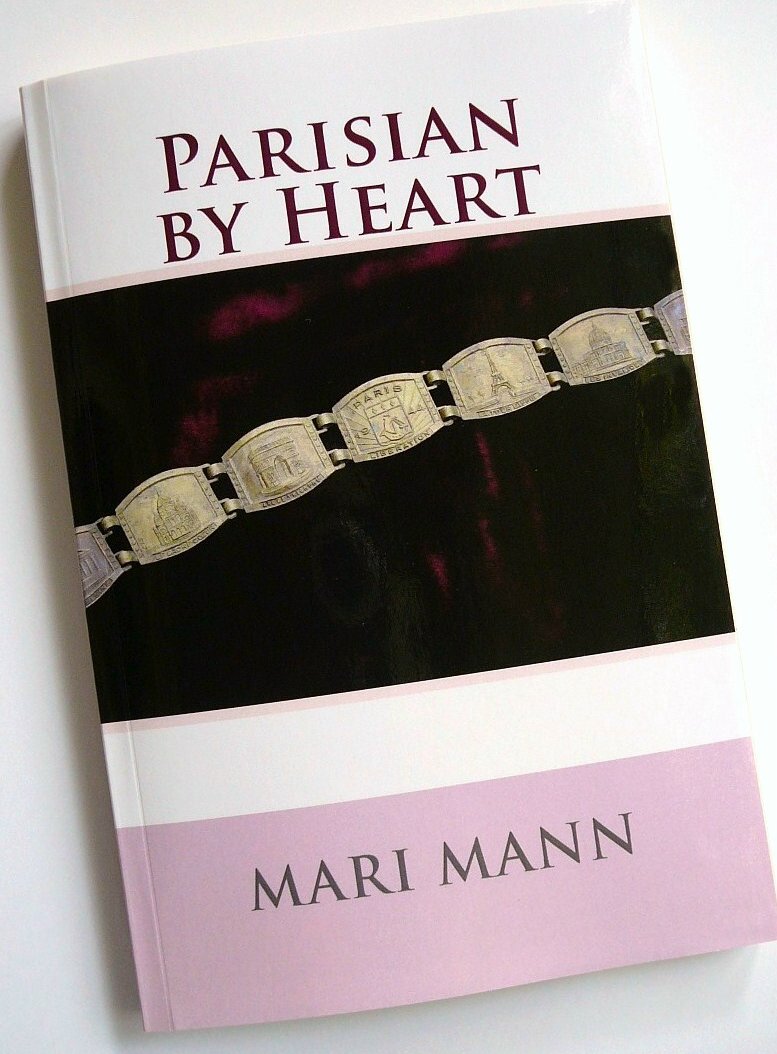
Parisian by Heart
"I do not know how to distinguish between our waking life and a dream. Are we not always living the life that we imagine we are?"
Henry David Thoreau
"From her home on an island in North Carolina, a mysterious longing for Paris, France, leads a budding writer into the world of her dreams and imagination – or so she believes. Her guides and companions on this trip include two writers and an artist who drew so vividly from their lives and imaginations that the world cannot forget their visions. They share stories and memories of times together, and the discovery that their lives are intertwined in unexpected ways. The writers are Marcel Proust and Charles Dickens, and the artist is the tortured and driven Vincent van Gogh.
The story begins in our traveler's home, within her familiar surroundings, but as the tale unfolds the line between the real world and the realm of dreams ultimately disappears. She finds herself in very different places across the ocean with very different people. She converses with Marcel Proust at his favorite meeting place, the Hotel Ritz inParis. She shares a meal with Vincent van Gogh and watches while he paints in the Arlesian sun.
And she meets with a writer by the name of Charles Dickens who gives her a manuscript in which a woman finds herself humbly serving the needs of a group of well-positioned elderly ladies who have gotten together at a remote guest house to play bridge when they know the night will bring a full moon rising over the water. Before they are finished they have a very unexpected visitor with the strange name of Samael. He knows things about them and offers to make a bargain.
Our lives are marked by our memories, written or unwritten, but which lives and what memories? PARISIAN BY HEART tells the story of one personal journey of discovery and revelation."
The above (except for the Thoreau quote) is the "pitch" I wrote for my book as its entry into the Amazon Breakthrough Novel Award. The book made it into the quarter-final round, but sadly, no further. If the above pitch piques your interest, and you'd like to read more, it is available on Amazon: http://www.amazon.com/Parisian-Heart-Mari-Mann/dp/1453679553/ref=sr_1_1?s=books&ie=UTF8&qid=1314284764&sr=1-1 and you can ask for it at bookstores as well. Merci, mon amis, et merci beaucoup, Marcel.





June 9, 2011
Knotts Island Peach Festival 2011

Doesn't that look delicious?

You know you want this t-shirt...

Look! An old tractor!

Where can I get a quilt and a coot?
At the Knotts Island Peach Festival, of course. You can eat peaches, see antique farm equipment, play games, listen to music, browse among craft and food vendors, eat peach pies and ice cream, watch (or participate in) a pie-eating contest, bid on a quilt, a coot, some photographs and other items in a Silent Auction….June 25th and 26th, 2011 at the Ruritan Park on the island. More on Facebook.





March 16, 2011
Spring Chickens and St. Paddy's Day
My house is currently full of potential life
In a stockpot in the kitchen, resting on a heating pad, are fifteen Bantam eggs due to hatch tomorrow, St. Patrick's Day. If any do hatch, I plan to baptize all the babies with Irish names, like Fiona or Fergus.
In the bathroom, in a real incubator (as opposed to a stockpot), are 18 eggs from our hens, due to hatch at the end of the month. If any of these babies hatch, I'll call them April Fools.
In trays in the kitchen, the living room and the greenhouse (now there's a novel idea), are seeds in potting soil, waiting to turn into seedlings and then make the transition to the outside, when they are old enough and it is warm enough. I plan to name them Lunch and Dinner. Maybe Breakfast.
And tomorrow I have named Spring Chicken and St. Paddy's Day Art Gathering, which I invite you to attend, details here.





January 31, 2011
Meatless Monday
The Meatless Monday movement is growing and while I have issues with it (see below), everybody's gotta start somewhere and so here's a recipe for today:
Rutabaga Ramen Stir-fry
2 pkgs Ramen noodles
Ginger, chopped
Onion, chopped
Garlic, chopped
Grated rutabaga
Greens
Tofu, cubed (optional)
Soy sauce
Stock
Peanut oil
Garlic pepper
Sesame oil
Grate rutabaga. Marinate cubed tofu in soy sauce. Brown ginger in peanut oil, then add rutabaga, onions and garlic. Add stock, steam until tender. Steam greens. When done, set aside and cook noodles in the hot water from the greens. When noodles are done, add greens, tofu, and rutabaga mix, season with flavor packets, garlic pepper, sesame oil, and soy sauce to taste.
I made this recipe up because I was given two huge rutabagas and two equally huge turnips awhile back and was searching for ways to use them. I've made this recipe 3-4 times now using either grated rutabaga or grated turnip, with and without the tofu (get organic tofu that's been made from non-GMO soybeans), and using different greens (collards, spinach, kale, etc).
Now here's my problem with Meatless Mondays: have we really become so spoiled that we have to have meat every day, at every meal, so much so that there has to be a movement just to get us to consider not eating meat for one day a week? Yes, spoiled, because previous generations of Americans didn't have meat every day, because they couldn't afford it, for one thing, and because it wasn't so easily available as it is today. A family might consider themselves lucky to have a meal with meat once a week. A President was even elected partly because he promised everyone "a chicken in every pot". That sounded good to a lot of Americans in 1928.
But it's not 1928 anymore and not only do we have chickens in every pot, we have chickens and cows and pigs and fish on every street corner and every other place in between. They've been raised for us (in mostly horrible conditions) and killed for us (oh excuse me, I mean "harvested") and either packaged for us to take home and cook for ourselves or prepared for us and handed out the window at the drive-thru. Cheap, easy, and quick.
And unsustainable, unhealthy, and all too often cruel. These reasons and others are why we, my husband and I, eat meatless most days of the week. Once or twice a week we eat small, sustainable fishies, like sardines. But like I said, everyone's gotta start somewhere, so if you're a Meatatarian and just want to dip your toe into going a little meatless, try the recipe above. Not only is it cheap, easy and quick, it's sustainable, healthy and cruelty-free. Oh, and it tastes good too.





November 30, 2010






October 25, 2010
Where do ideas come from?
Stephen King, Master of the Macabre and author par excellence, when asked where he gets his ideas, used to say something like, "I subscribe to an idea clearing house. For a low fee they send me one idea a month." On his website he says:
'I get my ideas from everywhere. But what all of my ideas boil down to is seeing maybe one thing, but in a lot of cases it's seeing two things and having them come together in some new and interesting way, and then adding the question 'What if?' 'What if' is always the key question.'
Marcel Proust, Master of the Life of the Mind and writer par excellence, says:
"The real voyage of discovery consists not in seeking new landscapes, but in having new eyes."
Marcel and Stephen are, I think, saying the same thing in these quotes. Ideas come when we see or experience something that may be something we see or experience (or hear, or taste…) frequently and instead of thinking "here I am, falling asleep on an airplane again", you think, "here I am falling asleep on an airplane again…what if I wake up and almost everyone else has disappeared?" (Stephen King's The Langoliers)
Good idea. Or instead of thinking, "here I am, driving to my job again", you think, "here I am, driving to my job again…what if I quit and started writing that novel that I always wanted to write?"
Possibly a bad idea, unless you are Marcel Proust and independently wealthy (and who actually never drove and never had a job, but stay with me here).
Look over to the right at the last column on this blog. You'll see two badges there, one that says Nanowrimo 2009 and one for Nanowrimo 2010. I should have a badge over there that reads "Nanowrimo 2009 winner" but I thought the badge design was goofy (yes, even goofier than the two that are there) and so didn't post it. Nanowrimo stands for National Novel Writing Month and the idea is that you challenge yourself, in the month of November, to write a 50,000 word novel. If you achieve this goal, you "win". And you get a goofy badge.
I don't know whose idea Nanowrimo is, but I thought "What if…" and although I didn't quit my job, I did write over 50,000 words and learned that I could write the novel I had in my head for so long. And another thing I learned was that, when the Idea Clearing House sends you that monthly idea, if you don't write it down immediately, the idea is withdrawn from your mind and sent on to someone else.
So since last year's experience, I have been capturing as many of the "what if" ideas that have come my way and am now ready to start the next 50.000 words. Nanowrimo begins on November 1st. Look at life with new eyes, and if you decide to ask yourself, "what if I sign up for this?" and you end up 30 days later with your first novel, remember where you got this idea and dedicate the book to me. And Marcel Proust. And Stephen King. It's a really good idea.








![[image error]](http://marimann.files.wordpress.com/2011/10/pa250008.jpg)