Len Joy's Blog, page 4
April 23, 2021
Countdown to Tuscaloosa: 36 Days

Thursday is my heaviest workout day. Normally, I have an hour plus tempo ride at 6 a.m., a swim lesson at 8 a.m., and a tempo or hill run in the late afternoon. But as we get closer to race date, Coach Heather Collins likes to schedule a couple of brick workouts. A brick is workout that encompasses two of the segments of a triathlon, usually the run and bike segments.
I am planning to compete in two races in Tuscaloosa. The Standard Duathlon (10k run, 40k bike, 5k run) on Saturday and the Sprint Duathlon (5k run, 20k bike, 2.5k run) on Sunday.
It’s still cold here in the morning (32 degrees yesterday) so the ride segment was on the trainer. In order to simulate race effort, Heather had me do an FTP test for the bike portion. FTP is short for Functional Threshold Power. It is a power test used when training inside so that each rider can establish his or her own relative power level measured in watts.
It’s nobody’s favorite workout. An exercise in torture. After a thirty-minute warmup, the objective is to ride as hard as you can at a level you can sustain for twenty minutes. Meaning you’re not supposed to start at 200 watts and end at 150 watts.
As soon as I finished the test, I dismounted, put on my running shoes, and ran out of the house. The run segment was 2.5k and my goal pace was 8 to 8:30 per mile. The fatigue from the FTP test is a good proxy for the fatigue I would feel coming off the bike in the race.
When I did this workout two weeks ago, I took too long to get up to speed and my average pace was 8:40. A learning point for my race preparation.
This time I was really focused on getting up to speed immediately.
Maybe a little too focused. I ran what I thought was the 2.5k distance at a pace of 7:59. I was pleased until I checked the distance on my Garmin and realized I had only run 2.3k. Another learning point.
The coach has added “Know the course” to my list of pre-race instructions.


April 22, 2021
Countdown to Tuscaloosa: 37 Days
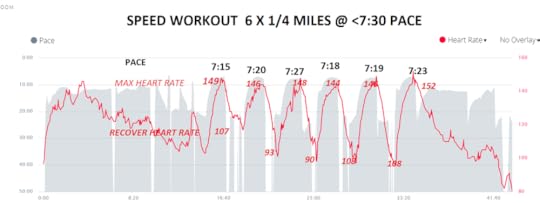
Tuesday afternoon after the morning intensity ride, I had a speed workout. Last year I did all my speed workouts at the high school track, but when they closed the track my coach Heather Collins of Heather Collins Training moved the workouts to the frontage road along the Evanston lakefront. There is no pedestrian traffic there, and very few cars when we are running so it was a good option and more equivalent to road conditions during a race.
Tuesday’s workout was to run 6 quarter miles with 1 to 2 minutes recovery between them at a pace of less than 7min 30secs per mile.
I was able to run six quarters under the 7:30 goal – my average pace was 7:20.
We compared this workout with the same workout last May, which was run on a track. I was just slightly slower this time, which could be a function of the track, which is a faster surface. The more interesting statistic was that my maximum heart rate was about 4% higher this time and my recovery heart rate was about 10% higher – meaning my heart rate was not able to recover as much as a year ago.
That could be because we haven’t done as much cardio training this year as we had at this time last year. Or it could be a sign of aging – that’s always a possibility.
I’m hopeful that as I start doing more cardio work that recovery statistic will improve.
April 21, 2021
Countdown to Tuscaloosa: 38 Days
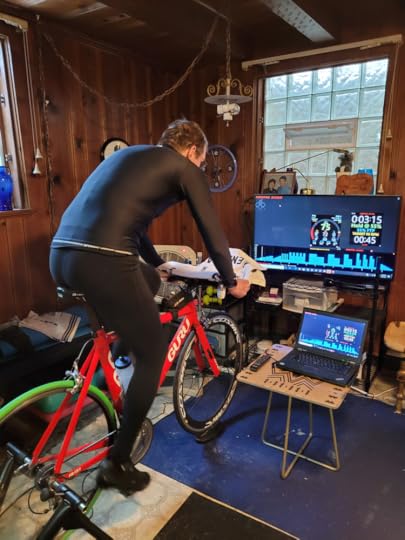
In past years, around November I would move my bike training to Craig Strong’s ,Precision Multisport Studio. Every Tuesday at 5:30 a.m. Craig and about a dozen of his clients would complete a 75 minute intensity ride. It was well-named – the rides were always challenging.
This year there was no studio, but Craig and his Precision team adapted. They set up a schedule of riding and exercise classes that are conducted via Zoom. I wanted to participate in the Tuesday and Thursday rides so I bought a smart trainer and the Perf Pro Training Software. Every Monday, Craig emails his clients the schedule of rides and classes for the week and the workout file for each of the rides.
You can do the rides on your own, but I find it more fun to join the Zoom ride which starts at 5:45 a.m. on Tuesday. When we rode in the studio, it always helped during the really challenging stretches to see that other riders are also challenged. It’s a misery loves company phenomenon.
So yesterday I went to my basement and completed my first ride of the week. I connect to the group via Zoom on my phone, click on the Perf Pro app on my laptop, and upload the workout which I project to the widescreen. Craig preps us for the ride, offers encouragement (he's also riding), and provides us with a curated playlist of songs, most of which I've never heard of. No Country.
I don’t see too much of the other athletes while I’m riding, but I know they are there and somehow that helps.
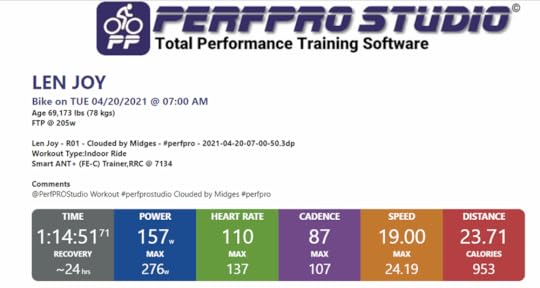
After the ride, Perf Pro emails me a record of the results. On yesterday's ride I burned 953 calories, the equivalent of six beers.
April 20, 2021
Countdown to Tuscaloosa: 39 Days
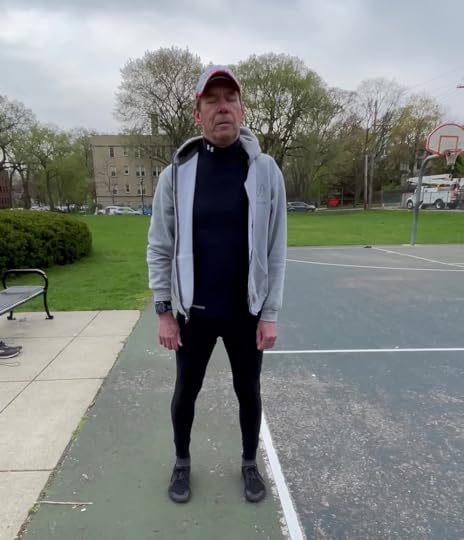
Ever since the facility where we trained was closed down in May because of the pandemic, I have had mobility and strength training Monday, Wednesday and Friday mornings at a park in Evanston with my coach, Heather Collins of Heather Collins Training.
We only missed one workout because of bad weather and that was because I cancelled expecting a major snowstorm that didn’t materialize. A few of the mornings part of the workout was shoveling a space on the basketball court so we could work out. The coach is, of course, really good at all the workout routines, but when it comes to shoveling, not so good for someone who grew up in Vermont.
It doesn’t look like I’m doing much in this photo (except frowning) but I’m actually concentrating really hard on the coach’s instructions.
Yesterday we were focused on footwork and balance. If I can become a more efficient runner, by keeping my feet, knees, hips aligned properly, I can mitigate the decline in speed that comes with aging and avoid injury.
In the afternoon I had a swim workout at the McGaw YMCA and I have some cool underwater video, but I will save that for another day.
April 19, 2021
Countdown to Tuscaloosa: 40 days
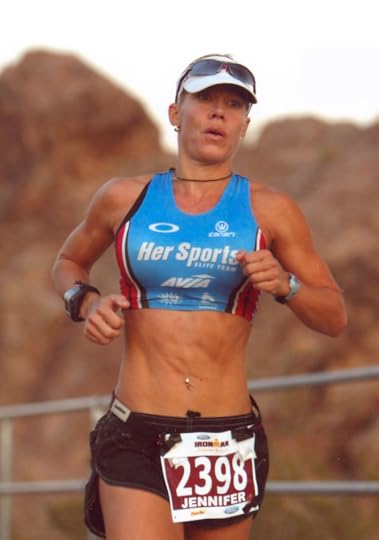
I posted this picture on my old blog, "Do Not Go Gentle..." on August 20, 2009. I was in Tuscaloosa that week preparing to compete in my first USAT National Championship.
The woman in the photo is Jennifer Hutchinson a sports dietician, a USAT Certified Level 3 Elite Coach, and a ten time Ironman competitor. That morning I attended her clinic on "Nutrition Tips to Race Well in the Heat." From my blog:
The first thing she told us was that those who don’t live year round in a high temp / high humidity climate should ideally arrive about two weeks before the race to become fully acclimated to the high temperature and humidity. But since that is not a practical option for most, she offered many practical suggestions for what to eat and drink on the day before the race and on race day.
Despite all her good advice, I didn't finish the race. I have competed in 80 triathlons and duathlons and that has been my only DNF. Now, after a year with no racing, I will be competing in my first event since November 2019 - the USAT Duathlon National Championship in Tuscaloosa
A chance for redemption.
My goal is to finish. And to be competitive in my new 70 to 74 age group. There are fewer of us competing now, but those that are still in the game are very good.
It will be a fun challenge and I'm planning to use this blog to chronicle my training over the next forty days.
February 5, 2021
Peace Time
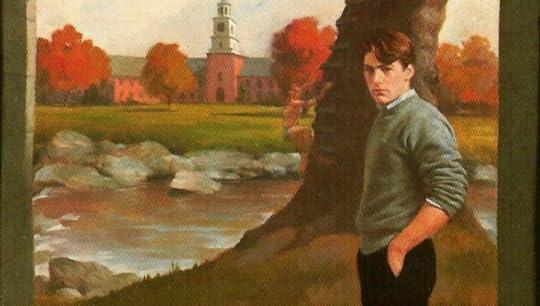
I've submitted my next novel "Dry Heat,"to my publisher and have started work on my 5th novel (tentatively titled "Freedom's Just Another Word..."). I was doing research and I came across this short story that I wrote back in 2015. I really liked it (I usually do, of course) but I never submitted it for publication. As I recall, some of the folks I shared it with didn't like the ending, but I get that a lot.
I thought I would share it here and I would love to hear from readers who want to suggest a different ending, or a longer story. My original concept was for a novel, but I went another direction with my novels. Hope you enjoy it.
Peace Time
I taught freshman English at Henry Adams High School in Lincolnwood, Illinois for thirty years. When I announced last month that I was taking the retirement package the school board had ginned up to get rid of the old farts like me, I’m quite sure it was not met with a lot of long faces among my colleagues or my students.
No one would ever assert that I was beloved. James Bradford would never be mistaken for Mr. Chips. Nor was I one of those irresistibly irascible old curmudgeons with a bark worse than his bite. Truth be told, I was not even a very good teacher.
Be that as it may, a discovery I made while cleaning out my desk has led me to believe that in one respect I am not unlike like my favorite movie actor, the late, great Paul Newman. Obviously not in appearance – my physique could most kindly be described as paunchy. Moreover, I’m very bald and I wear thick black-framed glasses for my acute short-sightedness.
In Newman’s later years he was dismissive of his accomplishments. He seemed to think being an actor was a trivial pursuit. Of course, that is certainly not how we are similar as I have no significant accomplishments to dismiss. My connection to Newman relates to his memory. Or perhaps I should say his amnesia.
A few years back I was watching Mike Wallace chat with Newman on Sixty Minutes. Wallace replayed an interview they’d had sometime in the early ‘50s. Young Newman, handsome as all get out, with that magic smile and crinkly eyes, was a studio actor on the rise who hadn’t hit the bigtime yet. Wallace was working for the ‘50s equivalent of Entertainment Tonight. His questions were every bit as lame as anything John Tesch ever offered up to the starlet of the week, but young Newman answered every one of Wallace’s creampuffs with unironic sincerity. He was literally bouncing in his chair with enthusiasm. It was deliciously, nauseatingly, fascinating.
Wallace stared sardonically as Newman studied the grainy black and white image of that effervescent younger version of himself. When the clip had run its course, Wallace (who, truth be told, except for the wrinkles and the grey hair, didn’t seem to have changed one iota) just said, “Comments?” And then he arched his eyebrow and smiled in that assholy way that
Wallace perfected over the decades.
Newman could only shake his head in disbelief. “I don’t know that young man. God bless him, he seems like a likable guy, but I don’t know him.” And then he offered a distracted, wistful smile and said, “I hope it all works out for him.”
As I sorted through my file drawers and desk, I found few items, other than my reference books and my dogeared copy of “A Separate Peace,” worthy of accompanying me into the retirement afterlife. I had kept John Knowles’ classic coming-of-age novel on my desk for the last twenty years as a silent protest over the English department’s asinine decision to replace it on the freshmen curriculum with “A Catcher in the Rye.”
I dumped all my old lecture notes. When I was a young zealot, I used to prepare detailed summaries for the class, but I abandoned such nonsense years ago. The students never read them. I gleefully jettisoned the tedious department memorandums and with a tad of bemusement, I tossed all the class essays I had accumulated. I just couldn’t imagine myself sitting down with a nice chilled Sancerre and reading, “The Importance of Symbols in the Scarlet Letter,” (David Parker – Class of ’95.)
It was when I extracted my middle desk drawer to dispose of all the dusty old paper clips, inter-office envelopes and half-used post-it notepads, that I had my Paul Newman epiphany. Pushed way to the back was the commemorative plate I had been awarded by the Class of 1989 when they anointed me their “Teacher of the Year.” I winced, remembering how I’d sprinted to the stage (back then I could still sprint) to accept their tribute. I have a vague recollection of my speech, which was full of self-effacing earnest goodwill. Discovering that long forgotten plate was a painful reminder, but not especially troubling. However, tucked underneath the plate was something much more unsettling – a composition notebook with a label written in a surgically precise cursive that identified the notebook as the “Writing Journal of Robert Carlisle.” Paper-clipped to the notebook was my progress report to Mr. Carlisle on his first four months in my creative writing class:
December 15, 1989
Robert,
Fantastic job! You’ve made great progress this semester. Your essays are first-rate, your book reviews are spot-on and your poetry is lyrical. I think you have the true soul of a poet! Keep up the good work and I look forward to your return in January!
Mr. B
My god. Three exclamation marks? And did I really write “spot-on,” like some effete transplant from the United Kingdom? I had founded the creative writing course at Henry Adams in the late eighties, convinced I was going to nurture and inspire a budding John Cheever or perhaps a midwest version of Flannery O’Connor.
Of course, that never happened. It wasn’t the fault of the students. That enthusiastic young teacher didn’t know how to inspire students, and he never learned. I’m not being falsely modest. The numbers don’t lie. That first year my creative writing class had a waiting list. By the fifth year there were more empty chairs than students. When the school board finally, mercifully cut the funding, I felt as though a huge weight had been lifted from my shoulders. It is one thing to fail and be done with it. But my Sisyphean walk to that remote third floor classroom to face those empty seats day after day after day had become pure torture.
The fact that this young man’s journal had been tucked away in my desk drawer suggested he had never returned after the Christmas break. For me to have been so effusive in my praise – I’m sure that three exclamation marks was not my norm – he must have been a very special student. It seems I should have remembered Robert Carlisle. But truth be told, I had no more recollection of him than I had of that enthusiastic young teacher who had written those encouraging words.
I tossed the notebook and the award plate into the trashcan and was about to close up my file boxes when something inspired me to pluck the journal from the rubbish.
Now I am not a sentimental man. I still drive a 1992 Buick LeSabre, not because it was a gift from my mother (her final gift as it turned out), but because it has been perfectly adequate transportation for my three-mile drive between the bungalow on Kostner where I have lived my entire life, and the high school where I work. Keeping that car has been prudent, not sentimental.
A sentimental man wouldn’t have gutted his parents’ old bungalow after they passed away and transformed their cramped immigrant castle into a modern, spacious bachelor pad, equipped with a state-of-the-art open kitchen, Bose-sound system and gleaming oak floors.
Certainly, a sentimental man would be bringing home more than two cardboard fileboxes after thirty years. I daresay an inmate paroled to live out his final days would have more personal effects. And without question, a sentimentalist would not have jettisoned that cheesy plate from the long-forgotten Class of 1989.
It must have been old-fashioned curiosity, not sentiment, that compelled me to pluck Robert’s notebook from the trash. I was about to open the journal, perhaps hoping to be inspired one final time, when my dear friend and colleague, Maggie Wainright, appeared like a vision, at my classroom door.
“Knock, knock, James. Can I come in?” Maggie marched into my classroom, not waiting for me to reply. She wore a summery cotton dress, the color of butter, with a cinched waist that accentuated her fine figure. I couldn’t help but notice her open-toed sandals and her bright red toenails. Maggie was ready for summer vacation.
“Hello, Maggie,” I said, standing up and grinning like an idiot. Something about that woman just made me smile. When I was a younger man, I envied Cyrus Wainright. He and Maggie raised four children. They’re all grown up and moved away and Cyrus has been dead five years now. Heart attack. “Please, sit down.” I made an expansive gesture toward the student-help chair next to my desk.
“You weren’t planning to sneak off without saying good-bye were you?” Maggie stood in front of my desk, her eyes darting from file box to trashcan as though I were one of her less trustworthy students.
“Of course not. You know I would never leave without your permission.”
Maggie had been at Henry Adams longer than I had. She was nearly sixty, but had a lithe trim figure and distractingly mesmerizing light brown eyes. When I first met her in the teacher’s lounge back in the fall of ‘77 she reminded me of Patricia Neal playing hard-luck Alma Brown in the movie Hud with my soul-mate Paul Newman. She was a strong woman full of sass and attitude.
She looked at the two cardboard boxes on the desk. “That’s all you’re taking?” She crinkled her eyebrows, which accentuated the character lines around her eyes.
“Memories, Maggie. I have so many lovely memories.”
She gave me the fish-eye. “Why didn’t you let Grimes give you that going away lunch? Now I’m going to have to hear her bitch about you until I retire.”
I held up my palms in a gesture of helplessness. “So, no change. She’s been complaining about me for the last five years.”
“Yeah but now I’ll have to actually defend you.” She sighed dramatically and gave her head a little shake. Then she reached into the wastebasket next to the desk and retrieved the plate.
“What the fuck, James? You can’t throw this away.” She held the plate out at arms length squinting to read the inscription.
“Why don’t you take it?” I said. “Although you probably already have enough for a full dinner party.”
No lie. Maggie had been Teacher of the Year at least a dozen times. She’d have won it more, but the teacher’s union had come up with a rule that you couldn’t win two years in a row. Sort of a term-limits for excellent teachers. Wouldn’t want the mediocre teachers like me feeling left out.
She set the plate on the edge of my desk and gave me her disappointed teacher look. “You should keep it James. It will remind you that at one time you were a teacher. A very good teacher.” She pushed her lips together and held up her hand like a stop sign. “Don’t. I don’t want to hear it.”
True. I was going to lapse into my cynical, self-flagellation mode, but I quickly changed gears. “What? I just wanted to ask if you knew this boy.” I handed her my progress report on Robert Carlisle.
She read it and smiled, no doubt at my giddy prose.
“Do you remember him?” I asked.
Maggie laughed. “James, that was twenty years ago. I can’t even recall what I had for breakfast.” She flipped through the journal and an envelope slipped from the pages of the notebook. Maggie picked it up from the desk and looked at the address, written in the same precise cursive. “This is for you…Mister B.” She arched her eyebrows as she handed it to me.
The envelope was sealed and marked “Personal and Confidential for Mr. B.”
“Hmm. I wonder what happened to young Robert?” I thought about dropping the envelope in the trashcan just to get a rise out of Maggie, but instead I just set it on the desk.
“The same thing that happens to all those kids. He grew up.” Maggie frowned at me.
“Aren’t you going to open it?”
“Not right now. I need to finish my packing.”
“You’re no fun,” Maggie said, jutting her lip out in sort of a faux pout. “A bunch of us are going over to Gulliver’s. Why don’t you join us?”
“Pizza and beer are not on my diet,” I said. Gulliver made a great deep-dish pizza and they had a more than passable selection of draft beers. I used to go there with my colleagues all the time. But for some reason, I stopped.
Maggie put her hands on her hips. “Stop being such a dick, James. Finish packing and join us for a beer. You can have a light beer. I’ll buy.”
I did not like to disappoint Maggie. She looked especially lovely when she was angry. Or pretending to be angry. I held up my hand in a gesture of surrender. “Okay. I’ll try. Let me finish up here and I’ll do my best to stop in for that free beer. But don’t wait for me.” I gave her my most winning smile, but I doubt that Newman would have been impressed.
Maggie wheeled around and started for the door. “I’m not saying good-bye, James. I expect to see you later.”
And then she was gone and my classroom felt exceptionally empty and a little sad. I opened Robert’s letter.
December 17, 1989
Dear Mr. B:
You were wrong about Gene.
Sincerely,
Robert Carlisle
Gene, of course, is the narrator / protagonist of “A Separate Peace.” His best friend Phineas is the proverbial golden youth – handsome, athletic and popular. Gene believes he has achieved some level of parity with his good friend by virtue of his academic excellence. But there is no rivalry. Phineas marvels at Gene’s unattainably good grades but does not covet them. When Gene discovers that the rivalry is a figment of his imagination, he becomes distraught and in a moment of insanity destroys the noble Phineas.
When I taught the book, I was, justifiably, hard on Gene. Phineas was noble and pure and I felt a personal loss at his death. The story is Gene’s confession, his return to the scene of the crime. Perhaps I had been too zealous in my brief against young Gene. Most of the creative writing acolytes were not the athletes and popular kids in the school. Robert had probably expected that I, of all people, would be more understanding of Gene. More compassionate. Well, that was probably a good life lesson for him.
Sorry, Robert. I hope it all worked out for you.
I picked up the plate and Robert’s note and thought again about just dropping them in the trash, but in the end, I stowed them in the box on top of my copy of A Separate Peace.
It only took two trips to load my car. As I drove east on Touhy Avenue headed home for the last time, I stopped at the light on Lincoln. Gulliver’s Pizzeria was waiting there for me on my right. I spotted Maggie’s faded blue BMW in the corner of the lot and there was an open space next to her car. I thought about joining her, but then the light turned green. It wouldn’t take me long to unpack the car. Maggie would be there for a while. I could join her later.
<>
I
January 16, 2021
Two Poems about my Father
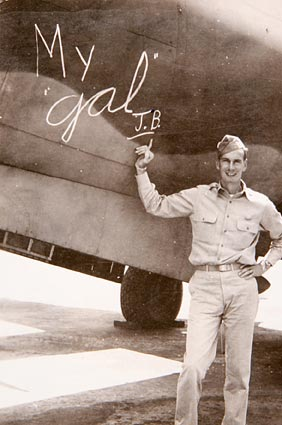
I’ve had two poems “published.” Not by being included in real poetry magazines, but published in the sense that one was the main feature of an article on summer vacations in the Chicago Tribune’s Tempo section, and one was part of a collection comprised of poems by actual poets, which I stumbled into somewhat by accident.
Both poems are about my father and both were written from a prompt. The first was composed as part of a poetry class exercise. We were asked to take a line from one of the poems we were studying and use that line to start our poem. Then we were supposed to remove it, so what remained were only our words. I followed the directions perfectly except for the part about removing the borrowed line, which was, “I think about my father.” It was too good to take out. Here’s the poem:
THE DRIVER
I think about my father. It is 1960. I am 9 and we are on the vacation we have talked about my whole life.
We have a mint-green Chevy wagon pulling a canvas tent trailer. No radio, no seat belts, no AC. We add an air-cooler in Albuquerque. They say we'll need it for the run across the desert. Six of us in that wagon. Mom and my three sisters and Me and Dad . . . The Driver. I always sit up front because I am The Boy.
From Canandaigua to Chicago, then south. Missouri . . . Kansas . . . Oklahoma. . . We miss the twisters at Roman Nose, but catch the rain in the Panhandle.
On to Gallup where Mom and Dad fight. Up to Angel Lake in the Rockies. The car overheats. The road is narrow and winding. I am scared.
We drive through Vegas at midnight. So many lights. We don't stop. I sleep through the Desert. I wake up at the Flamingo Motel in Pasadena.
Disneyland is cool. Knott's Berry Farm is boring. I like playing shuffleboard at the motel pool.
My Uncle takes us to the Beach. The ocean's too cold. It knocks me down. I can't get out. I like the motel pool. Then we turn around. Wall Drug, the Corn Palace, Mount Rushmore (where I get lost). Back through Chicago and all the way home. Four weeks to California and back. Seven thousand five hundred and forty-nine miles. Dad drives Mom keeps track. We come home and I grow up. Dad goes to every lousy basketball game (home and away) Even when we lose 18 in a row. Last summer my father turned 85. I ask him to give up driving his car. My sisters choose me because I was The Boy. He says he can drive better than most of those Yahoos on the road today. I agree. But . . . I can't say what I need to say. That he's in the final chapter of a great life. Why risk it all? What if you fall asleep or pass out or just lose control? What if you kill someone?
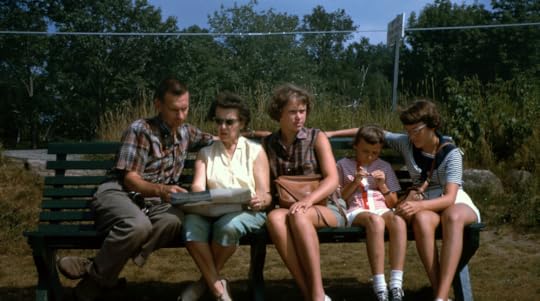
I took that class in the spring of 2004, six months after I had started on my quest to become a writer. Ten years later I was invited by my friend, Anja Koenig, who is a poet / scientist/venture capitalist, to participate in a writing project where each poet is given a title for their poem from an old journal. With some editing help from Anja, I ended up with a poem that was included in a collection of poems by Anja and many other real-life poets. It was quite an honor. I was lucky to be given the perfect title for what I was feeling at the time.
THE ROADS ARE INDIFFERENT
I drove my father to the VA
for a swallow test. He failed.
He used to be stronger than me.
Taller, better all around.
I took a towel and wiped
his face. His big farmboy hands,
knobby and translucent,
shook as he clung to his walker
for the long march down
the fluorescent-lighted gauntlet
to the parking lot.
At the funeral
his friends
said I looked just like him.
January 13, 2021
Writer, Writer, Pants on Fire Podcast

Len Joy, author of Everyone Dies Famous, talks about delaying the publishing journey until arriving in his 60s, after being dissuaded in his teens. Also covered: parallels between endurance athleticism and novel writing.
Listen to the Episode NowNovember 11, 2020
Remembering Two Veterans
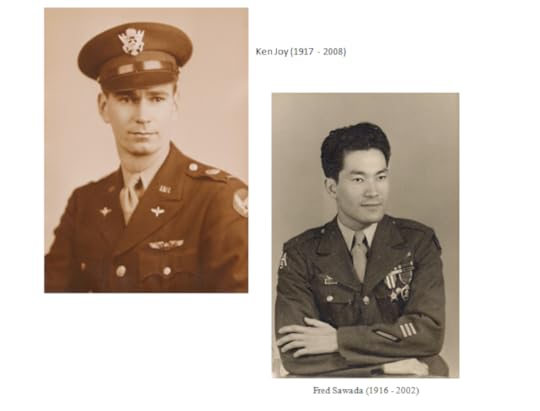
Back in the late 1990s while my wife and I were helping my father-in-law, Fred Sawada, move to an assisted living facility, we re-discovered among his papers, a letter his older brother George had written to their father and the original copy of Fred’s Silver Star citation.
Fred’s father, Shinsaku Sawada, came to America in 1918 and settled in Seattle with his wife and three children. In 1928 he lost his wife to tuberculosis. His eldest son George, writing to his father in 1943:
…you told us she’d gone away. That we mustn’t cry. You smiled at us, but not from the heart. How sad you looked when you thought we were safely tucked in bed, and your pretenses dropped like a heavy load.
Shinsaku built his tailoring business and saved for his children’s education. Again from George’s letter:
Then came the depression and overnight we were poor. Your business and the college fund were lost. I wanted to leave school and go to work...
“No,” you said with quiet doggedness. “You shall continue your education.”
George had graduated from the University of Washington and his younger brother, Fred, my father-in-law, was a private in the U.S. Army, when the Japanese attacked Pearl Harbor.
We were sent to relocation centers. I could not understand why you attempted to restore my faith in the government which had denied you the right of citizenship... I did not realize the love you bore for this country, made more dear because here it was that mother had been laid to rest: “Where your treasure is there will your heart be also.”
Wisely you said, “This is your sacrifice, accept it and you will no longer be bitter.”
On the 5th of July, 1943 Sergeant George Katsuya Sawada was killed by a sniper while serving as a Medic in the 442 Regiment in Italy.
Fred Sawada idolized his older brother. George was studious while Fred was hardheaded, impetuous and fearless. Wounded on five separate occasions, the following is from his citation for the Silver Star:
“For gallantry in action on 2 August 1944, in the vicinity of ****, Private First Class Sawada volunteered to act as lead scout for a four-man patrol assigned the mission of reconnoitering the Southern *** River bank. The night was dark and very quiet. While moving through a sparse vineyard he suddenly motioned his comrades to stop. He then advanced ten yards with his patrol leader. At this point they heard an enemy patrol advancing toward them. He held his fire until his patrol was observed by the enemy. Then, as the enemy patrol prepared to take up positions, he opened fire. In the resulting skirmish, the entire enemy patrol of seven men was either killed or wounded. Soon, six or seven machine guns, attracted by the fire fight swept the field with grazing fire. When the patrol was ordered to withdraw, Private First Class Sawada remained behind to cover their movement with his fire. He silenced one automatic weapon on his right flank, then engaged another. Only after the patrol had reached a covered position did he join his comrades. The determined aggressiveness, courage, and initiative displayed by Private First Class Sawada, enabled his patrol to withdraw without suffering a single casualty."
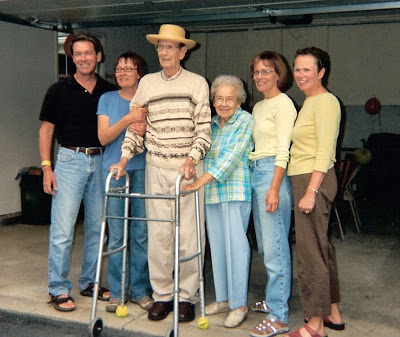
A few years before my dad died my three sisters and I helped him to write “Born on the Hill,” which is his memoir of growing up on a hard-scrabble farm in upstate New York, going on to Ag School at Cornell and then becoming a pilot in the Army Air Corps. Here he recalls his three most memorable flights:
In a fifteen-month period we had followed the invasion of Kawajalien, Saipan, Guam, Iwo Jima, Okinawa, Philippines, and Japan. During the same period, we made supply flights to Australia, Fiji Island, New Caledonia, with fueling stops at Tarawa, Canton and Christmas Island. My last trip was to Japan after the war was over. There are many stories that could be told but I would like to relate the tale of three flights.
The Most Satisfying
We all know about the attack of the Japanese on Pearl Harbor on December 7, 1941 but much less has been written about the simultaneous attacks on Hong Kong, Malaya and the Philippines. On January 2, 1942, Manila fell and American and Philippine troops were retreating to the Bataan Peninsula and finally to the Island of Corregidor. Among the thousands of American prisoners there were sixty nurses who survived the ordeal. They were all commissioned officers who had been through Hell.
We had the privilege of flying one group on the leg into Hickam Field in Oahu. After nearly three years as prisoners of war they were a sight to behold - all with smiles, some with tears, all unbelievably skinny, with long straggly hair. On our way we had to make a stop at Johnston Island. The Naval Commander was ready with a feast for breakfast. The Navy always had the best food and that morning at the head of the line was a huge bowl of fresh oranges. Those nurses grabbed those oranges and tore them apart and ate them like a dog would go after a fresh meat bone. It was the first fresh fruit they had had in months. I can tell you I stood there and watched with tears in my eyes. We flew them on to Hickam where they stayed for about a week before returning to the states.
When they arrived in California you would not believe they were the same women who had flown with us. They all had newly fitted uniforms and had been given a beauty treatment that made them all look great. We were all proud to be a part of their return celebration.
The Near Disaster
We had laid over in Kawajalien and were heading home with a full load of wounded, crew and fuel. My co-pilot on this trip was 2nd Lt. Jason Shurtleff, a big Swede who I was training to become a first pilot. As we rolled out to the runway I turned the controls over to him and told him it was all his for takeoff. It was a night with an overcast sky so we could not see the horizon once we were over the ocean. We did the usual run up and check list. The tower gave us our clearance to roll. The takeoff was normal and we started our climb.
At one thousand feet I pulled the flaps to see how he would react with the sudden sinking you get when the flats are pulled. His reaction was immediate as was mine when I felt the plane start to roll sharply to the right. I grabbed the controls and shouted for him to hold on. We had a problem.
The left flap was up and the right one was down and with both of us on the controls there was still no way we could stop it from turning right and if either one of us let go she would roll over and we would be in the ocean in seconds.
The next thing I knew, my engineer, Harry Hilinski hit the flight deck and reached for a hydraulic valve down under the throttle guardant. When he opened the valve the right flap came up and we were saved. The whole nightmare probably did not last more than 30 seconds, but our clean dry uniforms were now soaking wet. This valve is closed sometimes when the plane is on the ground to prevent someone from accidentally pulling up the gear. Harry was a good engineer, but we had some how missed it on our final check. The C-54 was later modified with a cable connection so this could not happen.
We had forty-four soldiers on board who had been wounded and were now heading home and we were within seconds of sending them all to the bottom of the ocean. I could not think about it for months without breaking into a cold sweat.
The Happiest Day
In August, 1945 I had been promoted to Check Pilot status and was doing regular check flights on Pacific flights and some regular crew check flights at Fairfield Suisun. On August 15, I had just started to roll down the runway when the news came over the radio that the war was over. It was a time to celebrate knowing that there would be no more wounded to bring home. It was bittersweet when we realized that we had dropped the first atom bomb on Hiroshima and Nagasaki killing thousands. At the time we did not even know what an atom bomb was.
As much as I enjoyed flying I had made up my mind that a military career was not for me. With that decision I knew this would be the last time I would ever fly a military aircraft and I would truly miss it.
When the war was over I had sufficient service numbers to be released immediately. I ask for release as soon as possible. On October 15, 1945 orders were cut for me to transfer to the AAF Separation Center at Westover Field, Chicopee Falls, Massachusetts - that being the closest base to my home in Norton Hill. I had leave time due me, so I was not discharged until December 15, 1945.
I had wanted to fly since I was a ten-year old farmboy. But in my wildest dreams I never imagined that not only would I learn to fly, but that I would fly all over the world and be paid for it.
Being a pilot in the Ferry Division gave me a unique opportunity to fly many different types of military aircraft. During my four years in the service I flew 17 different types of aircraft from trainers to single engine fighters, twin engine bombers, four engine bombers and transport planes.
My delivery of aircraft took me to every theater of operation in South America, Africa, India and Europe. When I was transferred to the AAF Transport Division and the Pacific Theater my flights took me to over twenty islands plus Australia and my final trip to Japan. Even though I was out of the country much of the time my home base was always in the U.S. I was never in a combat unit and never had to drop a bomb or fire a weapon.
The Army Air Corps played a critical role in all theatres of the war. I was proud of the role that I played delivering planes and supplies and returning with our wounded soldiers.
And what of those lifelong friends that I made way back in Basic Training? Bob Hurst flew planes over “the Hump” to India. We stayed in touch with him and his family for many years. Bob died in 1968. Walter “Rosie” Kent’s plane crashed in Alaska as he was delivering planes to the Russians. The plane was discovered decades later in a remote part of the Yukon. And Ed Kruer, who was short enough to fly pursuit planes, was lost over the Atlantic escorting
B-17s.
November 6, 2020
My Matthew McConaughey Mini-Film Festival
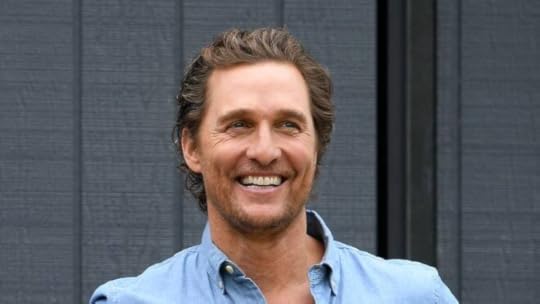
Suzanne and I often watch television in the evening when we’re home – which is all the time this year. We’ve been mostly watching series – lately Queen’s Gambit, Schitt’s Creek and Call My Agent (or Dix Pour Cent, if you prefer it without subtitles.) Last week Suzanne was busy with one of her other projects so I needed to find something else to watch. I didn’t want to get started on another series so I figured I would watch a few films. The problem is that there are so many movies available that I find myself paralyzed with indecision.
So, to avoid spending a half hour sorting through the options on Netflix, Amazon, Showtime, HBO, etc. I decided to create my own mini-film festival featuring Matthew McConaughey. Probably because we look so similar. That’s a joke. I’m actually a good half inch taller than Matt, according to his bio. Although I find it interesting that he is listed as 5’11 ½” – I think most men, and especially actors, would stretch the truth to six foot. So maybe he’s only 5’11”. Anyway, he seems like an interesting guy, so he got the call.
McConaughey made a film that garnered a Rotten Tomato score of 93% (Dallas Buyer’s Club) and another (Surfer Dudes) that was given a score of 0%. That show’s great range. Or really bad judgement on film selection. I had four days, so I picked four films. My only criteria were that they had to be free (to me). I pay enough to Xfinity and so I wasn’t renting any movies.
The first day, I picked a film that I had seen before – The Lincoln Lawyer.
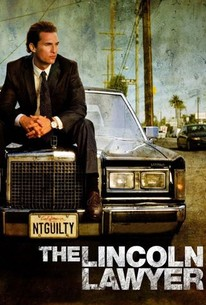
I had forgotten most of it, so I was able to enjoy it all over again. It’s adapted from a story by Michael Connelly (he wrote the Bosch series, among other crime dramas) and it has Marisa Tomei as Matt’s ex-wife. The premise is that McConaughey is a lawyer who operates out of his Lincoln Towne Car, defending drug dealing bikers and other underclass characters. Snappy dialogue and skillfully plotted. A solid cast with Ryan Philippe, Francis Fisher and Trace Adkins as a very believable Hells Angel type. Rotten Tomatoes score was 83%.
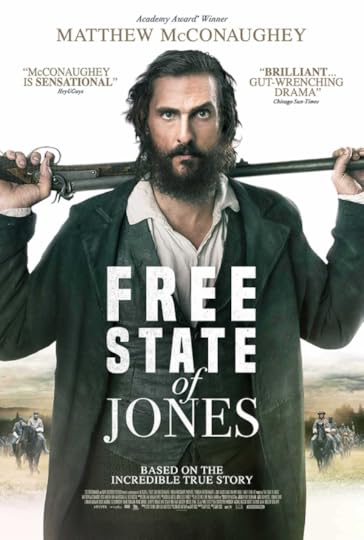
On day two, I watched The Free State of Jones. Newton Knight (McConaughey) is a small, non-slave-owning Mississippi farmer who deserts the Confederate Army in disgust after his 14 year-old cousin is killed while soldiers whose families owned at least twenty slaves are allowed to return to their home. He pledges loyalty to the Union and ends up leading a rebellion against the Confederacy. Based on my Wikipedia research the film is a fairly accurate account of a fascinating story. It only got a Rotten Tomato rating of 47%, probably because the story doesn’t have a great arc. There’s no climactic victory or defeat. Worth watching.
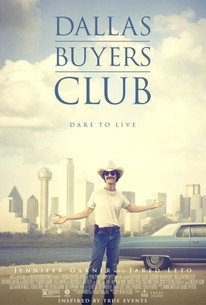
I saved Dallas Buyers Club for day three because I thought Suzanne might be available to watch it but she wasn’t. McConaughey won an Academy Award for his portrayal of Ron Woodruff, an AIDS activist. Jared Leto, who plays a transgender woman, won the Best Supporting Actor. Woodruff, a blue collar, redneck Dallas electrician is diagnosed with AIDS and establishes a club to provide drugs that don’t meet FDA approval, but offer dying patients symptomatic relief and life extension. It’s a powerful story of courage and resilience. The transformation of McConaughey’s appearance for this role Is amazing – he must have lost thirty pounds. His performance was totally believable. Rotten Tomato score of 93%.
So yesterday was the grand finale. I picked Killer Joe because it had a high rating and was based on a play by Tracy Letts. Looked like a sure thing. I didn’t realize it had an NC-17
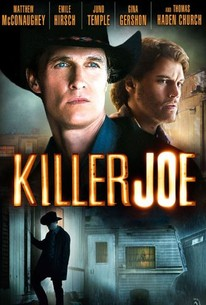
rating when it was released because of the sexual situations and violence. I watched it on TubiTv, which is not something I had ever used before. It has commercials, but it was not obtrusive.
The story is about a young man who hires Killer Joe (McConaughey) to kill his mother so he can collect her insurance to pay off the thugs to whom he owes money. He’s a hapless loser with an attractive, innocent sister (Juno Temple) who draws Joe’s attention.
I think I would have enjoyed the story more as a play because that would have tempered some of the more violent scenes. Perhaps it was just too much to watch this week, but after Joe graphically punches Gina Gershon in the face, I gave up. The film is described as darkly comic, but it was lot more dark than comic for me. It has an excellent cast and McConaughey’s performance is stellar. I just didn’t want to watch him, so I turned it off. Not the best ending to my film festival. Maybe I should watched Surfer Dudes. It might have been interesting to see what 0% looks like.
Rotten Tomatoes gave Killer Joe a 79% rating so maybe it just's me.