Jeff Goins's Blog, page 44
February 12, 2016
How I Used Medium.com to Get My First 20,000 Subscribers in 6 Months
I started blogging seriously in May of 2015. However, I didn’t want to solely publish at my own blog, since literally no one except my wife knew it existed. So every time I published an article on my blog, I copy and pasted it into Medium.com and published it there as well.

Medium is a popular and innovative platform based in Silicon Valley. The readers (and writers) at Medium are interested in entrepreneurship, self-improvement, cool ideas, good research, interesting stories, and lots more.
At Medium, content really is king. You may have a huge platform or be “well-connected,” but those things only get you so far at Medium. Only the best content consistently gets pushed to the top, regardless of your current following. This is an enormous advantage as what you write is completely in your control.
So, if you’re willing to write content “so good it cannot be ignored”—hopefully every writer’s goal—you can use Medium to launch your writing career and build your platform.
The remainder of this post will detail my story and strategies—how in six months:
I went from zero to 20,000 subscribers
Had articles published on outlets like Huffington Post, the Observer, and am now in works with TIME.
Had influencers endorse my work
My Story: From May 2015 to January of 2016
Last May, I really started researching the publishing industry. I had written an eBook and was anxious to know how to traditionally publish it.
I decided literary agents would be my best resource. After all, they know the publishing industry back-and-forth. After talking to 5–10 different agents about their coaching programs, it became apparent my questions would need to be answered elsewhere.
As one agent shared, in order to even be considered by agents and publishers, writers need to already have a substantial readership (i.e., a platform). I told her my goal was to have 5,000 blog subscribers by the end of 2015. She responded, “That would not be possible from where you currently are. These things take time. You will not be able to get a top publisher for 3–5 years. That’s just the reality.”
“Reality to who?” I thought as I hung up the phone.
I started looking at people’s blogs who I perceived to be successful. One dominant theme was that many of these bloggers referenced places their work was featured (e.g., Forbes). I made Huffington Post by December 2015 my goal. I started by pitching articles to self-improvement blogs like Addicted2Success.com and Purposefairy.com.
I also wrote a few articles on my own blog and republished them at Medium. The image below shows my May and June performance. Note, before May, I had never published anything on Medium. Before May, I had written five or so articles on my own blog and a non-published eBook.
A few notes: the far left column is the title of the article. The next column is the amount of views (i.e., clicks) each article received, followed by the number of actual reads, the percentage of reads compared to views, and lastly, the amount of times that article was “Recommended” (similar to “Liked” on Facebook).
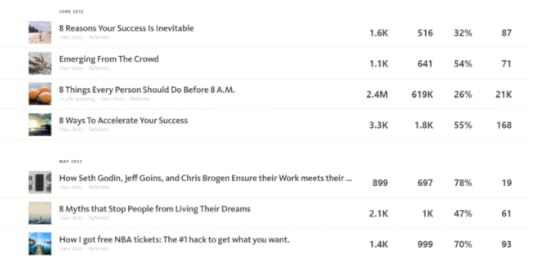
As can be seen in the image, one of my articles in June went viral. Honestly, I wasn’t at all prepared for the traffic my website got when this happened. My website was extremely crappy (like, the worst). More importantly, my website OPT-IN (where you collect email addresses) was not center stage, but small and on the right hand column.
While my viral article was getting the initial wave of traffic (approximately 200,000 clicks per day on Medium), I only received 40 subscribers to my blog. Surely I should be getting thousands of subscribers with this kind of traffic?
It dawned on me that I should be inviting readers to subscribe to my blog directly. Indeed, very few people would take the time to click on my Medium profile or look up my website on their own volition. So I edited the article in Medium and added the following at the end:
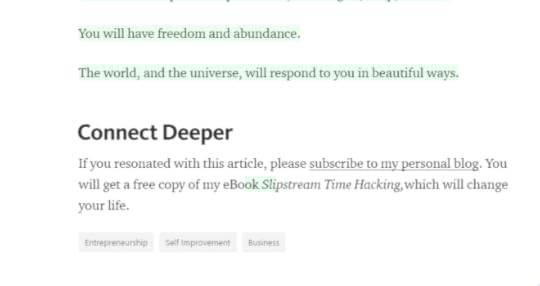
After adding this simple “call to action” (i.e., Connect Deeper), I jumped to 3,500 subscribers in just a few days. Unfortunately for me, this edit was done after most of the traffic had come and gone. So, I missed a huge opportunity, but learned an important lesson.
And that’s where my subscriber-base would sit for the next four months. The day my article went viral, I was contacted by Business Insider, Huffington Post, and the Observer, all asking if they could republish the article. My goal of two weeks prior was abruptly achieved.
I was given my own Huffington Post blog and the Observer said they’d like to pay me to write exclusively for them. I didn’t know what I was doing, and it sounded awesome, so I agreed. For the next four months (from the end of June to the end of October), I published almost all of my work exclusively at the Observer.
Unfortunately, I wasn’t getting very much traffic at the Observer, and my number of subscribers didn’t budge. Please note, I wasn’t putting the “call to action” at the end of my articles at the Observer.
In late October, I transitioned back to having Medium as my main platform for driving traffic to my website and building my reader-base. I immediately started to see a substantial growth in readership.
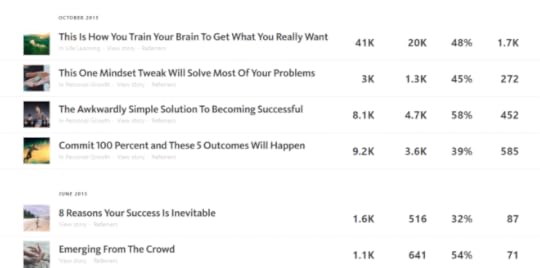
Since returning to Medium in late October, I have increased from 3,500 to 20,000 email subscribers. And in December, I revamped my website, making it far more professional.
Progressively, my followers on Medium increased and I got momentum. Although virility seems like a fluky thing—from my experience, you can come to control and predict what will do well. Here are my Medium stats from December:
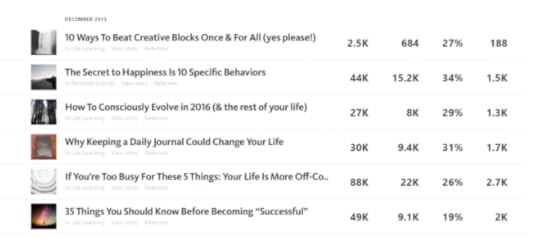
And January 19, 2016:

As you can see, there are spikes and drops. However, on Medium, when you have one article that’s getting a lot of traffic, it’s good to publish others. The traffic from one ripples into the traffic of other freshly published articles—they can assist one another.
Furthermore, the traffic from my newly published articles also brought attention back to my article published in June, which rippled back into the newer articles—generating more traffic and more subscribers. For example, the image below shows three of my articles hitting the Top 5 Trending on Medium, two published in January, one from the previous June.
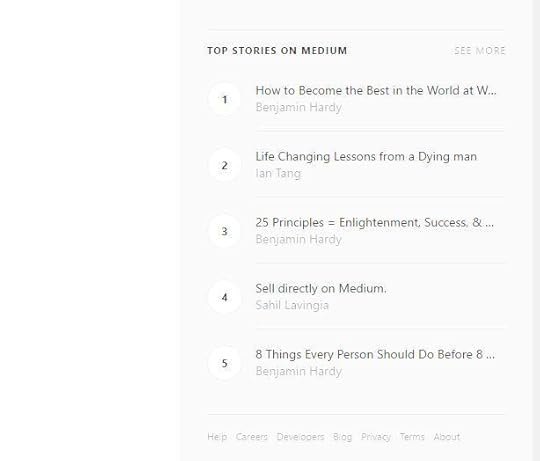
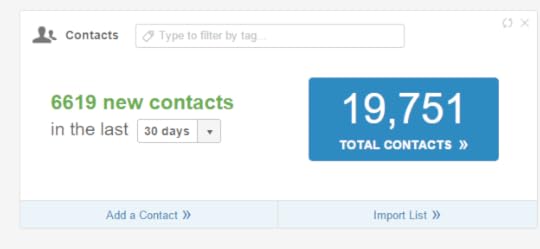
In truth, most of my subscribers have come in the months of December and January. In the past two months, I’ve increased by 13,000 subscribers.
The image below shows my current subscriber base as found in my Infusionsoft management account. Note that 33% were from the last 30 days.
From here on out, I’ll dig into my writing process and some of my strategies for writing valuable material.
Strategy #1: I’m Just Trying To Have As Much Fun As I Can
Our culture has become obsessed with working hard and being busy while simultaneously trivializing the importance of play. Indeed, “The only kind [of play] we honor is competitive play,” says Bowen F. White, MD, a medical doctor and author of Why Normal Isn’t Healthy.
Despite the increasing disinterest in play among American adults, Stuart Brown, founder of the National Institute for Play, has studied the “Play Histories” of over six thousand people and concludes playing can radically improve everything — from personal well-being, to relationships, to learning, and to an organization’s potential to innovate. As Greg McKeown explains, “Very successful people see play as essential for creativity.”
In his TED talk, Brown said, “Play leads to brain plasticity, adaptability, and creativity… Nothing fires up the brain like play.” There is a burgeoning body of literature highlighting the extensive cognitive and social benefits of play, including:
Cognitive
Enhanced memory and focus
Improved language learning skills
Creative problem solving
Improved mathematics skills
Increased ability to self-regulate, an essential component of motivation and goal achievement
Social
Cooperation
Team work
Conflict resolutionLeadership skill development
Control of impulses and aggressive behavior
My approach to writing is to have as much fun as possible. That’s what guides my writing process and my writing progress. For me, it’s like snowboarding—if I’m too serious about it, I’ve missed the point. So I’m just trying new tricks on my snowboard and pushing my creative boundaries because it’s fun. When it stops being fun, I take a step back and question my motivations.
Strategy #2: Experiment
Tim Ferriss doesn’t do what he thinks will make him happy. He does what excites him. Although his overarching vision remains consistent, Ferriss doesn’t have long-term plans.
Instead, he does short-term (e.g., a few months) “experiments,” which he puts all of his energy into. He has no clue what doors may open as a result of these experiments, so why make long-term plans? He’d rather respond to the brilliant and best opportunities that arise, taking him in now unforeseen directions.
I’ve recently adopted Ferriss’ concept of doing short-term experiments. This has changed my approach to work. For example, a few months ago I stumbled upon a personal development article that had over 1,000,000 social shares. I decided to perform an experiment to attempt creating an article that would also get 1,000,000 shares. The result was this article.
Although the article hasn’t been shared a million times yet, the results were profound and unexpected. It drew the attention of an editor at TIME who asked if they could syndicate it at the end of February. Additionally, the article attracted several thousand new readers (including some of my favorite authors & researchers) and subscribers to my blog. Lastly, it connected me with a better web-developer and new coaching clients. All from one short experiment that took a week to perform.
Experiments are a fun way to pursue goals because they allow you to get innovative and bold. Experiments are short-term — and thus relatively low risk. They are your “moon shots.” Why play small? What’s the worst that could happen, you waste a few weeks or months and learn a lot while doing it?
Trying to get several articles into the “Top Stories On Medium” simultaneously was another experiment I tried in December. Even this very article, the one you’re currently reading, is an experiment. Who knows what the results will be?
Strategy #3: Frame My Goals As Quests
I believe most people fail at achieving their goals and resolutions because they perceive their goals to be drudgery. Instead of traditional goal-setting—which is too serious and lacks the whimsy of an epic adventure—I’ve framed my goals as a bucket list. Each item on my bucket list bucket list becomes an epic quest to achieve.
According to Chris Guillebeau, in his book, The Happiness of Pursuit, a quest has a defined beginning and an end. It has various stages and levels, like a video game. It can’t be easy. Challenge is the essence of adventure, and thus, the essence of a quest. A quest must be attainable. For example, Guillebeau didn’t set out to visit every planet in the solar system, but to visit every country in the world (which he completed). Lastly, it must be something pulling deeply at you. If you didn’t do this thing, you’d regret it. Hence, the bucket list informs the quests you undertake.
As an example, rather than trying to publish three articles per week, I’m questing to get published on my favorite platforms. Instead of running four times per week, I’m training for an ultramarathon.
This approach to goal-setting—and living in general—is proactively designing your life around your highest ideals, which is the opposite of what most people do. Most people try to squeeze their dreams and highest ideals into the “margins” of their busy lives. As Stephen Covey explained, “If the ladder is not leaning against the right wall, every step we take just gets us to the wrong place faster.” Thus, pursuing your highest ideals as your top priority keeps you honest to yourself, and allows you to not get caught up in other people’s agendas.
It also makes life a lot of fun!
Strategy #4: Create Content That Is So Good It Can’t Be Ignored
Every article is an opportunity. Don’t publish articles just to hit publish. One blog post could change the entire trajectory of your career.
I believe I’ve had success on Medium because my articles are jam-packed. They aren’t fluffy. They’re dense—and often need to be read and re-read several times. People regularly tell me they’ve printed-out one of my articles and stuck it to their fridge so they can read it daily.
When I write an article, I’m not concerned about how long it will be. Instead, I focus on how good I can make it. I want my art to leave people better than it found them, including you.
Strategy #5: Quantity Facilitates Creativity And Sometimes, Even Masterpieces
In the book Originals, Adam Grant explains that “originals” (i.e., people who create innovative work) are not reliable. In other words, not everything they produce is extraordinary. And the same is true for you. In order to produce your magnum opus, you’ll need to create a high volume of work. You have to kiss a lot of frogs to find your prince.
For example, among the 50 greatest pieces of music ever created, six belong to Mozart, five are Beethoven’s, and three Bach’s. But in order to create those, Mozart wrote over 600 songs, Beethoven 650, and Bach over 1,000.
Similarly, Picasso created thousands of pieces of art, and few are considered to be his “great works.” Edison had 1,900 patents, and only a handful we would recognize. Albert Einstein published 248 scientific articles, only a few of which are what got him on the map for his theory of relativity.
I once asked Seth Godin and Jeff Goins how they each produce high quality work. Here were their responses:
Seth Godin via email: “Plant a lot, harvest a few.”
Jeff Goins via Twitter: “I keep shipping. I find that when I stop producing, the quality goes down. A deadline makes me do my best work.”
Quantity is the most likely path to quality. The more you produce, the more ideas you will have—some of which will be innovative and original. And you never know which ones will click. You just keep creating.
“Quantity is the most likely path to quality.”Benjamin HardyTweet thisTweet
So I ask: Are you creating a large volume of work?
Are you inputting or outputting?
If you like building, build more stuff. If you like writing, write more stuff. If you like connecting, connect more. If you like running, run more. Do stuff. Output. Do it more.
You give your ideas value by acting on them. A good idea, not acted upon, only brings pain and fear. Conversely, action brings confidence. Action is fun. Inaction slowly kills you inside.
Don’t wait to be moved by the spirit. Move the spirit yourself through action. There is no inspiration without action. Action is inspiration. That’s how it works.
Faith is action, and thus also power. Faith and fear cannot co-exist in the same person at the same time. Thus, action (i.e., faith) and inaction (i.e., fear) are opposites. Do what you love. Do it more. Output all the time.
Strategy #6: “Listicles” With Style
A comment on one of my articles:
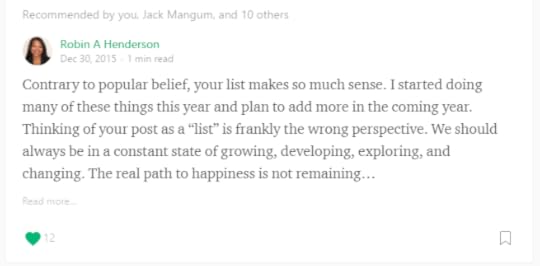
I get messages all the time from people who say stuff like, “Your articles aren’t like the normal listicle type articles. Yours have more substance.”
Not every article should be in list format. But why neglect what works? People love articles written as lists. Consequently, I frame a large portion of my articles as lists. And to be honest, those are the ones that consistently do the best.
The numbers don’t lie.
Within the flexible framework of a list, you have loads of room for creativity. My “list” articles are packed with information and sometimes very long. There are no rules. Just strategies that work or don’t work. Lists—if done well—work.
Strategy #7: Boost Your Opinion With Research And Powerful Quotes
The following image comes from an article I published last week about why I believe we should embrace, rather than avoid, imposter syndrome.
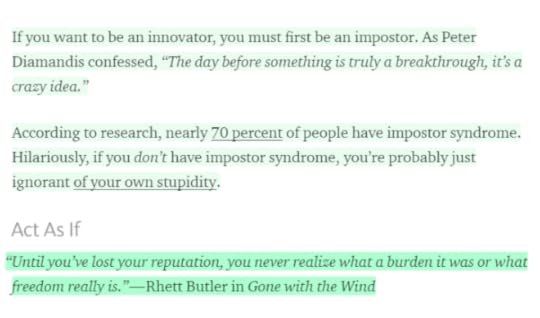
Having great quotes and using research gives you credibility. It also makes your writing more well-rounded and powerful.
Strategy #8: Surprise People
My two most viral articles included elements of surprise. For example, my morning routine article told people they should take cold showers in the morning. Although the rest of the article was good (in my opinion), that one surprising element was the tipping-point.
Similarly, another successful article started with, “Stop Consuming Caffeine.” Although that turned many people off, it also startled and surprised a lot of people.
Add some shock-factor to your writing. Give people something that is either counter-cultural or something they haven’t thought of before but which is relevant and important.
Strategy #9: Syndication
Your biggest problem is obscurity—other people don’t know you and aren’t thinking about you.
—Grant Cardone, The 10X Rule
Personally, I don’t care where my stuff is published. As long as the reader is directed back to my website, anyone who asks if they can republish my work can have it (including you). My only stipulation is that they keep my Connect Deeper section with links back to my website at the end of every article they republish.
This may not be good for SEO purposes. And I may change my strategy in the future. But for now, my goal is to “become omnipresent” as Grant Cardone calls it. I want to increase my odds of getting my writing in front of the right readers and potential collaborators.
Only on rare occasion (like this), will I write an exclusive article.
Conclusion
So there you have it. I did it. I’m doing it. And you can too.
Connect Deeper
If you resonated with this article, please subscribe to my personal blog. You will get a free copy of my eBook Slipstream Time Hacking, which will change your life.
Have you published anything on Medium? Which of Benjamin’s tactics do you want to try first? Share in the comments.


February 10, 2016
093: Stop Chasing Your Dream (the Wrong Way) [Podcast]
Everybody who leaves a day job to pursue their craft is blindsided by an abundance of something they never anticipated: time. No one sees it coming and no one ever warns you about it.

The same thing happens to high school graduates who go onto college. One day their lives are regimented from dawn to dusk with school, sports, homework, and chores. The next day they have a few classes and untold hours of free time that no one taught them how to manage.
When you’re pining for the day you’ll walk out the office door and go pro, you don’t think about how to use all the free time you used to spend working at your desk. “Work” takes on a new definition and the sudden volume of time available overwhelms many.
This week on The Portfolio Life, Andy and I talk about what I did wrong when starting a full-time writing career, and what you should do instead.
Listen in as we discuss the wrong way to build a blog, establish a platform, and refine your voice.
Listen to the podcast
To listen to the show, click the player below (If you are reading this via email or RSS, please click here).
No more Mr. Nice Guy
I know this guy who always went after the wrong girl. He was a nice guy, a sappy romantic really, and he’d fall head over heals for these girls who just weren’t that interested in him. No matter how many times he held the door open, or bought them flowers, he couldn’t win their hearts.
He tried too hard to tell a girl what he thought she wanted to hear, and live up to this stereotypical persona of the perfect guy portrayed in romantic comedies. It never worked.
One day, in a fit desperation, he gave up trying to play the “game”. He was still a good guy, but he stopped trying to fake it, and instead held a healthy confidence in who he was and what he had to offer. Two weeks later, he met his future wife and they celebrate their 10th wedding anniversary this year.
I’m not saying you’ll magically bump into your soulmate or get a book contract dropped on your doorstep, but when you stop trying to succeed at the wrong thing, or even the right thing in the wrong way, you can’t imagine what the future holds.
Show highlights
In this episode, we discuss:
What not to pursue on your journey to writing full-time
The eight times I tried blogging before getting it right
Why chasing what you think people want to hear leads to failure
Resisting the temptation to chase a quick buck
Connecting your skills and passion with what your tribe needs
Avoiding extremes when it comes to building a business
The fastest way to (almost) guarantee you succeed
Redefining what work looks like when you quit a day job
One thing most entrepreneurs are unprepared for
Takeaways
The worst kind of failure is succeeding at the wrong thing.
Fear obscures the bigger picture and distracts our focus from the goal.
Succeeding at something we don’t really want to do is a trap.
What makes an audience meaningful is they care about what you have to say.
Passion and money aren’t bad. They have to work together in order for you to feel good about the work you do.
It’s always easier to do the wrong thing than it is to do the right thing. Which is what makes the right thing so hard.
Resources
Evil Plans by Hugh MacLeod
Listening to Your Life by Frederick Buechner
You Are a Writer
What are you doing to pursue your unique voice instead of trendy topics? What are you doing to avoid the traps I fell into when I started my writing career? Share in the comments

February 8, 2016
How to Influence People: The Most Overlooked Secret
Anyone can be a leader. Sounds easy, right? It’s not. True leadership is rare, because most people aren’t willing to do the one thing they need to grow their influence.

Photo credit: Flickr (Creative Commons)
What do the world’s best leaders know that the rest of us don’t? How do you become an influencer without feeling like a sleazy salesman? How do you connect with important people and get your reputation to spread?
People sometimes ask me how I’ve been able to do interviews with in-demand “celebrities” like Steven Pressfield and Chris Brogan. They wonder how to get guest posts published on Copyblogger or Zen Habits, some of the most popular blogs on the web.
These people are the same ones who ask about getting a NY Times best-selling author to endorse your book or want to know what it takes to interview the CEO of a major company. They want to know the answer to a simple question that confounds most of us. And for years, I didn’t understand it myself. It’s this: Why can’t I get more influence?
The answer may surprise you.
The secret to gaining influence
Some people don’t want you to know this. It’s a secret long held by the social elite, what builds dynasties and topples kingdoms. It’s the explanation for how even the humblest of beginnings can lead to the strongest successes.
This is important for you to hear, and it could be the answer to getting your book published or launching a successful business. It might even mean landing that connection that changes everything.
The secret to how to connect with influential people is simple: Ask them. Why do so many people neglect this practice? Why overlook something so obvious?
First, let’s set the record straight: I’m nobody special. I’m not a charismatic leader or persuasive speaker. I do not possess any innate gifts for winning people over.
A chubby misfit in high school, I learned to play guitar and to avoid getting beat up (sometimes). In other words, I’m no Dale Carnegie. Far from an “outlier,” I’m often unsure of myself and struggle with confidence issues.
Why share this? Because if I can do it, you can do it. And if you believe me and you’re ready for some practical tips on how to do it, click here for two bonus videos and a downloadable eBook where I lay it out step-by-step for you.
The new leadership
Bill Gates used to publish his email address. An important leader and CEO, he still made himself available to his followers. When I heard about this, I decided to email an author I had always admired and see what might happen. I asked his advice, and a day later, he responded. I was in awe.
A year later, that same author, a guy named Seth Godin, emailed me, offering to do an interview for my blog about his next book. When the book launched, he linked to me and sent more traffic than my little blog had ever seen.
After this experience, I had a thought that changed everything: If uber-blogger Seth Godin is this accessible, who else is? If someone so influential and unreachable (in my mind) was just an email away, what would stop me from contacting anyone I wanted to meet?
That’s just what I did.
What followed was a chain of events that included one audacious pursuit after another. I discovered there were others like Seth who were making themselves available to “average Joes” like me.
This is the new leadership: accessibility. There are people out there, waiting to connect with those bold enough to ask.
You are your own worst enemy
Not too long ago, I saw a friend get a guest post published on a popular blogging site, a popular blog about making money online. I was amazed, even a little jealous.
Although I had gotten into the habit of making big asks, this was one platform that was still “off limits” to me. Maybe some day, I thought. So I sent my friend a message, asking him how he got his piece published.
Do you know what his secret was? You guessed it. He asked.
He sent an email with an idea, they approved it, and then they published it. In fact, this was the second time he had done this. So I did the same — and it worked like a charm.
“We humans have a bad habit of talking ourselves out of greatness.Tweet thisTweet
We doubt ourselves, thinking we don’t have what it takes. We give in to fear and sabotage ourselves before we even begin. We are our own worst enemy.
Recently, I encouraged a friend to email a leader he admired. He wouldn’t do it. He had already made up his mind. This person was just too busy to respond. After I all but forced my friend to do it, the person emailed him back immediately.
My friend couldn’t believe it, because he had already said “no” for him. Turns out, most people are this accessible. We just have to believe they want to hear from us.
How to win a friend
“Winning friends” was a phrase popularized by Dale Carnegie, and it’s one that bothers me. It sounds self-serving. Friendships aren’t won; they’re made, organically and honestly.
But it wasn’t until I started reading Carnegie’s secrets in How to Win Friends and Influence People that I finally let my guard down. Here are a few of his methods:
Show genuine interest in someone else.
Remember people’s names.
Listen.
Sincerely make someone feel important.
Smile.
Honesty and sincerity?! Man, what a jerk… 
February 6, 2016
THIS is How to Get Big Time Influencers to Promote Your Book
We can talk about blogging, Twitter, podcasts, Facebook, Goodreads, and everything else you can do to launch a successful book, but there is one thing that works the best AND is the hardest to do.

How do you get big name authors, bloggers, and influencers to promote your book?
I’ll admit it. This is the hardest part for me too.
Fortunately, my friend Tim Grahl has been doing this for years and is an expert and finding simple ways any author can promote their book.
If you remember, Tim is the guy who has launched dozens of bestselling books as high as #1 on the New York Times bestseller list AND had five clients on the list at the same time.
Needless to say, he knows his stuff.
Several years ago he landed on something that is easy to do and works every time.
In fact, it was what took him from a behind-the-scenes nobody with a small self-published book, to a recognized expert in his field who was selling hundreds of copies a week.
For the first time ever, he’s going to share this strategy publicly.
This isn’t a theoretical framework that might work for you.
It’s step-by-step how to find the right influencer, exactly what copy to use in your email, and how to get a “yes”.
You don’t have to be a big time author or an extroverted salesy author.
Tim is teaching “How to Get Influencers to Promote Your Book” in a live, free training this coming Monday, February 8th.
Click here to grab your spot at the training.
Also, you’ll want to make sure to grab your spot (there’s only 1000) and show up live, because Tim will be doing a giveaway and special offer that’s only available during the live presentation.
I’m excited to share this and help you with the hardest part of a book launch.
Make sure you grab your spot at this training to learn how you can get big time influencers to help promote your book. The training is this coming Monday and you can grab your spot here.
Who is one person you’d like to promote your book? Share in the comments.

February 5, 2016
Break Free From Busyness and Do the Work You Were Meant For
I remember the day I decided to finally write a book. I got out my antiquated laptop and Googled, “How to Write a Book”. One of the results said to write a blog and build a following. So I Googled, “How to Write a Blog”. I’m not even kidding.

I sometimes laugh at how much I didn’t know. But you know what? That didn’t stop me. I knew what I wanted to do, and even though it took ten years to get there, my first book, Breaking Busy: How to Find Peace and Purpose in a World of Crazy just released last month.
Please don’t think that setting a goal and reaching it is a walk in the park. My life is crazy all the time, and crazy busy a lot of the time. With a full-time job and five sons (yes, you read that right, five sons), ages 7–17, my house is in a constant state of motion and mess (if I’m being real).
If you are at all like I was, you’re thinking, “I’m too busy to add one more thing to my plate, so how in the world am I going to (fill in your goal here)?” I get it.
The good news is whether it’s writing a book, or bringing your passion to life, the circumstances in your life don’t have to line up perfectly to accomplish what you were meant to do in this world.
The goal of publishing Breaking Busy changed how I spent my time while actively writing. I couldn’t just take eight months off of work (and life) to write the book. I wrote on Saturdays, edited on Sunday afternoons, and spent little pockets of time scribbling notes of inspiration during the week.
This process really put what I was preaching to practice. I had the good, necessary, and sometimes uncomfortable experience of telling lots of people “no” in those eight months.
“Thank you for inviting me, but I can’t make it.”
“I would love to be able to help, but my weekends are full.”
So how do you break busy and carve out space for your goals?
Make a stop doing list
This is one of my favorite strategies. Often, when we find ourselves feeling busy and overwhelmed, we want to develop a plan to do more things to fix it. What we really need to do is just stop doing things.
Our lives have gotten all cluttered up with things we think we “should” do; so much so that we can’t figure out what the things are that we were meant to do.
Are you doing what you should do or what you were meant to do? And how do you go about subtracting from the clutter in your life to get to the things you were meant to do in the first place?
Deciding what to subtract from your life is one of the key components of Breaking Busy. Distractions are everywhere, waiting to lead us down the wrong path, and keep us from our calling.
“Distractions are everywhere, waiting to lead us down the wrong path, and keep us from our calling.Alli WorthingtonTweet thisTweet
The best way to discover what you want/need to stop doing is by asking yourself these questions:
What is sucking the life right out of me right now?
Does this activity get me any closer to achieving my goals?
My experience is that most people have an immediate answer to these questions. And that answer, once it’s “out there”, gets people moving in the right direction.
Discover what “future you” will think
When evaluating a choice, it is important to think about the future you.
What is the goal? What do you hope to accomplish?
I like to ask myself what “Future Alli” will think about decisions I make.
Many times during the months of Saturdays I spent locked in our master bedroom writing Breaking Busy, I felt huge amounts of guilt. I missed having family time on the weekends, and I struggled with wondering if I was hurting our family by taking all the time away to write.
It would’ve been easy to let worry about being selfish or not being a good mom make me give up and be miserable the whole time I was working. It helped to think about what “Future Alli” would think in ten weeks, ten months, or ten years.
Would I regret giving up?
Of course.
Would my kids be scarred for life because I took a few months of Saturdays to write?
Nah.
Any decision you have to make, any dream you are building, any goal you have—the best way to keep going and not get sidetracked by fear, doubt and unnecessary busyness is to ask yourself what this will mean to the future you.
Time management is not the problem
While researching busyness, I read approximately a gazillion books on time management and realized one thing—if time management was the real issue, we wouldn’t all still be so busy.
Busyness, at the root, is a result of living in a world that says you have to be more, do more, and achieve more to be enough.
Busyness keeps us distracted from the life we were meant to live. We focus on the tyranny of the urgent, instead of focusing on the things that help us live out our calling in that season of life.
Yes, we have to learn to manage our time differently, but more importantly, we must learn to spend our precious time doing the things we were created for.
I know you can break busy and find your own peace and purpose in this world of crazy busy. I know you can do it, because I did. Breaking Busy won’t be easy, and it won’t be perfect, but it will be worth it.
What is distracting you from what you were meant to do? How does the idea of “future you” change your perspective? Share in the comments

February 3, 2016
092: Pat Flynn: Validate Your Idea Before You Leap [Podcast]
When a new idea strikes, many of us are tempted to withdraw for months to work on it in solitude. But creating anything in a vacuum is the best way to ensure no one notices it.

Creatives have no shortage of ideas. We get them in the shower, during a workout, washing dishes, or driving. But not every idea is a good idea. People have wasted years on an idea that sounded good at the time but ultimately flopped.
Where do good ideas come from? How does innovation happen? When do you decide what new project to start and how? I asked Pat Flynn these questions, and he shared his whole idea validation process with me. It was fascinating.
The way great ideas come in to the world is not the way we would expect.
This week on The Portfolio Life, Pat and I talk about practical thought experiments that help frame the actions you’ll take to carry your idea forward. Listen in as we discuss the origin story of Pat’s astronomical success, and why getting laid off was the best thing that ever happened to his career.
Listen to the podcast
To listen to the show, click the player below (If you are reading this via email or RSS, please click here).
Look before you launch
Creating anything, whether it’s a blog post, a book, or a WordPress plugin, isn’t just about the quality of the thing itself. It’s also about who it’s for. You have to serve your audience before you serve yourself.
Nobody knows how to serve an audience better than my friend Pat Flynn. Pat has built a very profitable online business and huge personal brand in just a few years. And how has he done it? Where does he get his incredible ideas from? Simple: from the people he serves.
Pat is one of the nicest guys I know who defies the idea that nice guys finish last. His entire seven-figure business is based on one idea: helping people. Turns out, that old adage — what goes around, comes around — is true.
Show highlights
In this episode, Pat and I discuss:
What entrepreneurs can learn from toddlers and paper airplanes
Determining if a new idea is worth your time and energy
Why a measure of indifference helps you survive failure
One question that disarms the dark clouds of fear
How desperate times can serve as a competitive advantage
What to do if an idea doesn’t compliment your strengths
The dangers of ignoring how a business fits into your life
A foundational flaw in the traditional 5-year plan
Why you can’t afford to ignore your history when planning your future
The iterative process of idea validation for writers
Exercises to micro-test an idea with your audience
Quotes and takeaways
“Once you understand the why behind what you do, what you should do becomes more clear.” —Pat Flynn
”Failure can be playful.” —Pat Flynn
“The only way to see if something works is to try it. Real failure is when you give up.” —Pat Flynn
“If no one cares, you’ve got more work to do before you can move forward.” —Pat Flynn
If you’re afraid it means you’re about to do something good. It means there’s something of value at stake.
Success isn’t when everything goes your way.
Resources
Will It Fly? by Pat Flynn
Let Go by Pat Flynn
How Pat Flynn Made His First $3 Million In Passive Income (Forbes)
Green Exam Academy
SPI 079: Time Travel and Book Marketing
Why Making A Career Leap Might Be A Bad Strategy (Fast Company)
Who are you talking to about your big idea? What are you going to do differently to help it fly instead of flop? Share in the comments

February 1, 2016
What Nobody Tells You About Being a Best-selling Author
“What does your daddy do?” the teacher asked.
“He makes books,” my son Aiden replied.
Well, not exactly. But that’s the best my wife could coach our three-year-old at the time. And it works, kind of. I wonder if in a few years when he finds out I don’t actually make books, but in fact write them, that he’ll be disappointed. I know there are days when I am.

Last week, an author friend emailed me, asking if I could promote her book because her publisher said she had a shot at “hitting the list.” What list? “Oh, I dunno,” she texted. I sighed and gave her a call.
Book launches do weird things to you. They can cloud your judgment, even make you a little selfish. As the author of four books, I’m speaking from experience. So I chatted with my friend a bit and convinced her that in the long run, it would be better for her to try to sell and help a lot of people with her book than to chase some best seller list.
The next day, I had a chat with another author who was about to launch his first book. Same kind of deal. Lots of pressure on the book launch. Lots of stress about becoming a “best seller.”
Redefining the best seller
Here’s the truth, though: being a best seller doesn’t mean what you think it does. What do I mean? Well, here. Let’s take a look at three hard truths about bestsellers:
Most “bestsellers” hit the New York Times, USA Today, or Wall Street Journal best sellers list once and never sell more than a few books after that.
The title “best-selling author” does NOT necessarily mean higher speaking fees, more consulting gigs, or more publicity around your brand. I have spoken with many best-selling authors about this, and they all seem to agree that this is a false assumption.
There is no magic number of sales it takes to become a best seller. One author I know became a New York Times best-selling author by selling 3000 books. Another I know sold 20,000 in the first week and didn’t make that same list.
So does this mean we just shouldn’t care about becoming a “best seller”?
Not at all. Rather, we should redefine the term, or instead recapture it for what it should mean: a book that sells better than most books.
And what that means for you and me is that instead of trying to chase arbitrary titles like “New York Times best seller” we should instead seek better ways of reaching and serving an audience and getting a book (or whatever it is you have to offer) in their hands. And if the New York Times notices, fine. If not, all the better.
The point is, stop chasing things that aren’t real measurements of success. Focus on what you can control (like how many books you sell or how many people you reach). And do the best work you can when the world isn’t watching.
“Do the best work you can when the world isn’t watching.Tweet thisTweet
In the end, it’ll feel a lot better than spending $100,000 to hit a list and never be heard from again. Trust me.
For more on this, check out Tim Grahl’s free video series on what it really means to be a best seller. Click here to check it out.
Have you ever chased the wrong measurement of success? What does a best-selling book mean to you? Share in the comments.

January 27, 2016
091: Steve Kamb on Why Nerds Should Rule the World [Podcast]
In high school, nerds were the kids everyone secretly envied and feared. Perhaps because we knew that one day they’d sign our paychecks, and invent cool stuff like the iPhone and Twitter. One nerd in particular is flipping the multi-billion dollar fitness industry on its head.

Steve Kamb is the most physically fit nerd I know. In fact, he’s the most physically fit person I know, period. He is ripped. And he thinks Zelda is the best video game ever made. Cool, right?
As the founder and rebel leader of Nerd Fitness, Steve is dedicated to “helping desk jockeys, nerds, and average Joes level up their lives.” His unique program applies video game principles and behavioral psychology to physical fitness, and has transformed the lives of over 5,000 rebels.
This week on The Portfolio Life, Steve and I talk about how he started building a community of 280,000 subscribers (and counting) while working on cruise ships with rock stars.
Listen in as we discuss sacrificing comfort and security to commit to your community, and why prioritizing happiness is the key to unlocking your potential in life and work.
Listen to the podcast
To listen to the show, click the player below (If you are reading this via email or RSS, please click here).
Play your way to progress
These days people seem obsessed with productivity. A new app is released every other week and folks scramble to move their task lists again. They buy Moleskines by the stack, and jump on trendy methodology bandwagons in the hopes of feeling fulfilled every time they check something off.
But this sense of accomplishment is fleeting and is often dwarfed by the ever growing mountain of to-dos in their inbox.
What if we’ve been approaching goal-setting all wrong? What if the key to achieving our dreams lies hidden in the code of our favorite video games?
One of the things I found most interesting about Steve Kamb’s gamification of physical fitness is that it actually creates the freedom to reach your goals on your own terms. Not only is it fun, it works!
By defining our goals in the context of a game, and breaking down milestones into levels to complete, we set ourselves up for success and happiness.
Leveling up your life goes beyond working out and eating right. Steve has witnessed thousands of people use gamification to change their lives and work to accomplish adventures they never dreamed of.
“Leveling up your life goes beyond working out and eating right.Tweet thisTweet
Show highlights
In this episode, Steve and I discuss:
How to find a tribe of rebels for your cause
The hidden principle behind video game addiction
Developing an alter ego of your day job
Writing as a means of serving your tribe
The underestimated power of strategic guest posting
Gaining influence with influencers
Why 1,000 subscribers is a significant milestone
How to give your audience a voice of their own
The value of involving your tribe in the creative process
Quotes and takeaways
When we are making progress, we tend to be happier.
Prioritize your life and work for happiness.
Life can be a game. You can play throughout life and work.
You learn a lot from your community.
Resources
Level Up Your Life by Steve Kamb
Nerd Fitness
3 Steps to Become the Superhero You Were Meant to Be
The 4-Hour Workweek by Tim Ferriss
279 Days to Overnight Success by Chris Guillebeau
8 Reasons You Need to Rediscover Your Passion for Exercise
Which video game do you want your life to be like? How can you apply the progress principle to your work? Share in the comments

January 25, 2016
The Gift of Criticism: Why Writers Should Read Reviews
The other day I was trolling Amazon, looking for an excuse to quit writing and become a janitor. In other words, I was reading my reviews. Yes, it’s a terrible habit. But bear with me for a moment, because I discovered something surprising.

First of all, anytime you start reading reviews of any product on Amazon, you inevitably will find the typical trolls, critics, and people who are mad at you because the USPS never delivered their book to the remote island on which they live — and somehow that’s your fault.
But buried in those pieces of feedback are occasionally some gems worth digesting.
Like I said, I wasn’t looking to be encouraged. I was hoping for an excuse to beat myself up, because I’m a writer and that’s what we do. We’re a pretty masochistic bunch. Of course, I don’t read the positive reviews. I blaze right through the 4- and 5-stars and go straight for the jugular: the much-dreaded one-star review. Which was actually, to my surprise, a place of great inspiration.
Leaning into critique
If you click “critical reviews” on Amazon, they will take you to a series of reviews that range from 1- to 3- stars, and on that page I found something I didn’t expect to see — encouragement. Here’s what one reader, Erin, had to say about my latest book, The Art of Work:
There’s a lot to grab hold of in Goins’ book about discovering “the reason you were born.” (No pressure.) Seven themes anchor his ideas — Awareness, Apprenticeship, Practice, Discovery, Profession, Mastery, and Legacy — and each theme is illustrated with anecdotes from the lives of ordinary people, including Goins himself.
In the chapter on Awareness, a story illustrates how noticing what makes us different from other people can be a source of both pain and purpose. In the chapter on Practice, we see an example of how our love for something, like painting, might be honed into a skill set, like web design, without making us feel like a sell-out. “Your vocation can evolve,” Goins writes in the chapter on Profession, and I breathe a sigh of relief.
Much of Goins’ writing seems best suited to our independent selves, the selves that get to manifest their own destiny with the support but not permission of loved ones. His advice to “do what’s required of us,” “push ourselves to the point of exhaustion,” and “keep moving,” does not resonate in my own life where I work part-time in order to pursue the delight of being human with my husband, my friends, my church, and a whole ecosystem of people on whom my choices bear. A book on how two, independent adults discern vocational rhythm together? Now that I’d be clawing to read.
Well, that’s not what I was expecting to read in a three-star reviuew. And then I came across another review that was both encouraging and, well, challenging:
I was dubious about this book. A work about writing by a writer who seems to only write about writing. I didn’t think his angle was legitimate. True, Goins found a niche, and it worked for him, but what about his own writing? I mean, it’s easy to write about writing in the way we can talk about writing: but what have you really produced? Aside from the writing about writing schtick, in other words, where was HIS great novel, masterpiece, his magnum opus?
Other dubious points: like others, I started to listen to his podcasts, follow his blog, receive his emails, etc. I found his relentless marketing tactics to be irksome at times.
But in the end, I’d have to say that Goins deserves a lot of credit. A lot. His book is, in fact, well-written and surprisingly more thoughtful and far-reaching than I thought. He’d quote and cite a number of my favorite and trusted writers (you tend to trust a person who trusts and cites people you trust). And under each of his illustrations and stories, there was an acknowledgement, a practicality, and honesty of suffering and the at times harshness of reality that I felt didn’t whitewash or cover over the sometimes painful process.
One last point: I really underestimated Goins. There are a lot of accompanying videos and resources associated with the book and you’ll probably see his video guides. His boyish voice cracks sometimes; he has a dippity-do haircut and looks like he’s still in high school.
But underneath that is a supremely confident and genuinely likable author who just happens to have found his calling: giving advice, helping others find out what to do. I realized that this was his kind of magnum opus, his Great American Novel, every bit as legitimate as Mark Twain or James Joyce. And he’s quite gifted at it.
Much deeper, more profound than I gave him credit for and I’m glad to say that this is a very, very nice book. And he always gives you the option to opt out of his emails! After reading this book, I decided to stick with his emails!
And lastly, there was this two-star review:
The Art of Work is heavily skewed towards creative fields, extremely self-focused, and lacks coverage of important life and career skills. Though Goins would say that any dream is worth pursuing, and while his examples are somewhat varied, the process outlined in the book would work best for someone like himself: a writer, or an artist, or some other creative. There’s less here about years of education and preparation, and more about forsaking preparation to jump off into the blue and pursue a dream.
A nation of wimps?
Hara Marano, an editor-at-large for Psychology Today and author of the book A Nation of Wimps, points out that we as a culture have taught ourselves to avoid uncomfortable situations, especially ones where our core beliefs may be test.
Core beliefs like, “I’m a good writer”? You bet.
These days, it’s easy to cast aside anyone who critiques your work as a “hater.” But is this always true? I don’t know about you, but I’m interested in mastery, and you don’t master a craft by avoiding criticism. You don’t get good without asking the question, “Is this any good?” And occasionally, as hard as it is, we need to listen to the voices that say “no.”
This isn’t license to turn yourself into a doormat. The more I do this kind of work, the kind in which you bear your soul to the world and wait for people to reject you, the thicker skin I get. And the more I realize that if I’m going to do important work, it can’t be for everyone. Nothing great is ever for everyone.
“Nothing great is ever for everyone.Tweet thisTweet
Lessons learned from thoughtful criticism
So let’s return to those reviews. Here are a few lessons worth noting:
The readers gave honest reviews. None of the above were five stars. The lesson? You don’t have to always tell people what they want to hear. This is the essence of an honest review, in my opinion, which is the whole point of the review system in the first place: not to tickle the author’s ears but to help other customers make an informed buying decision.
The feedback is valuable. You don’t have to be mean to say someone could have done better or that it just wasn’t for you. I really appreciate this, both as an author and reader. This is the kind of review I would want to read if I were trying to decide if the book was for me. It also helps me do better with the next book.
I almost missed these, because I was afraid. Of what? Well, being criticized, I guess. But these have to be some of the best reviews I’ve ever received. Why? Because they affirmed the areas in which I want to grow. Each reader shared what didn’t resonate and how I could improve on the next book.
Here’s the takeaway: We need to not insulate ourselves from criticism. If you’re a writer like me, you need to appreciate the fact that you can’t write a book for everyone and that hopefully with each book, you can get a little better.
I’ve been reading my reviews from The Art of Work to see how I can improve on the next book before I start writing it. I’m also learning how to write for a specific audience, so as not to confuse people when I try to do too many things, and that it’s okay to have a “dippity-doo” haircut. 
January 21, 2016
Launch a Bestseller with This Free Book
A few months before The Art of Work was about to launch, I called a handful of people asking for advice. One of those people was book marketing expert Tim Grahl. The advice he gave me resulted in a best-selling book.

If you don’t know him, Tim is the guy behind multiple best-selling titles including books by Dan Pink, The Heath Brothers, Barbara Corcoran, Charles Duhigg, and many others. On one occasion, he had five different authors who were all on the New York Times best sellers list at the same time!
It’s safe to say Tim knows book launches better than practically anyone else, certainly better than me. That’s why I called him.
Learn from a real expert
There are plenty of people on the Internet who get lucky once and try to brand themselves as an expert. Tim is not one of those people. He’s the real deal.
One of the things that I love about this guy is that he doesn’t just theorize about this stuff. He practices it, too. You see, not only is Tim a smart marketer; he’s also an author himself.
After eight years of helping authors launch their books, Tim decided to try it for himself. And his first book, Your First 1000 Copies, sold over 1000 copies in the first two weeks of its launch. And that was with an email list of less than 1000 people! That self-published book went on to sell 10,000 copies in the first year, which is more than many traditionally published authors ever sell.
Not only has Tim worked with big-name authors like I mentioned above, but he’s also helped many indie authors launch their books, including sci-fi author Hugh Howey who went on to great success, selling over a million copies of his book. And as I said, he helped me launch my first best-selling book. So Tim knows his stuff.
That’s why I’m thrilled he’s offering a free digital copy of his brand-new book, no strings attached.
Get Book Launch Blueprint for free
Here’s how it works:
You can go to Amazon and buy the book for $10 right now, or…
For a limited time, you can click this link below to get the book for free.
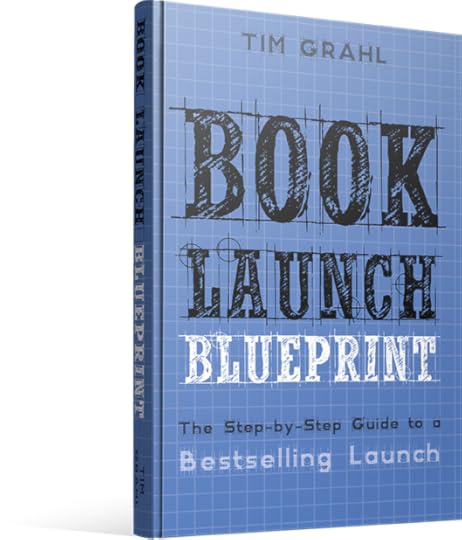
Click Here to Get Book Launch Blueprint by Tim Grahl for Free
This is a special offer Tim is extending to his audience and to the audiences of a handful of friends and partners. So I’m excited to share it with you. Just make sure you grab it today, because this free book offer goes away on Friday, January 22 at 11:59 p.m.
This book will walk you through, step-by-step, how to launch a best-selling book, forever removing all the mystery from the process. As an added bonus, you’ll get a free video series from on how to launch a best-seller the right way (his process will blow your mind).
In the spirit of full transparency, you’ll also get an opportunity to join Tim’s course, Launch a Bestseller, which I’m an affiliate for and get compensated if you sign up. But I only ever endorse people and products I use and love.
When you get this free book, there’s no pressure to buy anything, and you can opt out of his email list at any time. Tim is one of the most respectful marketers I know, doesn’t spam his readers, and offers a ton of value. You won’t regret getting his stuff.
Go grab the free book here before it expires.
What would launching a best-selling book mean for you? Share in the comments.